
In This Article
If you’ve ever dragged a garden hose across the lawn only to watch it snag on a rose bush three feet from the car, you already understand the appeal of a car washer with water tank for driveway washing. No spigot within reach, an HOA that eyes your hose like it’s contraband, or a driveway on the wrong side of the house from the nearest faucet — any of these is reason enough to look at a self-contained, battery-powered option instead.

Here’s the honest version of what’s out there in 2026: cordless, tank-fed units have gotten genuinely good, but they range wildly in power, tank size, and durability, and marketing copy rarely tells you which trade-offs actually matter once you’re standing in your driveway with a filthy bumper. This guide breaks down seven real products — budget, mid-range, and premium — based on their published specs, verified where possible against manufacturer documentation, plus honest analysis of who each one is actually built for.
We’ll also cover the practical stuff nobody puts on the box: how to keep runoff legal, what “PSI” actually means for your paint, and why a cordless pressure washer for quick car washes isn’t always the same tool as one built for a full driveway detail. By the end, you’ll know exactly which category fits your driveway, your car, and your patience level. Let’s get into it.
What Is a Car Washer With Water Tank for Driveway Washing?
A car washer with water tank for driveway washing is a battery-powered pressure washer that carries or draws its own water supply — from a built-in tank, a bucket, or a siphon hose — instead of connecting to an outdoor spigot. It combines a pump, a rechargeable battery, and a self-priming intake so you can rinse and scrub a vehicle anywhere, hose or no hose.
That self-sufficiency is the whole draw. According to the EPA’s guidance on vehicle washing best practices, where and how you direct wash water matters as much as how you generate pressure, which is exactly why a contained, tank-fed system has quietly become the go-to for driveway washing over the last few years.
Quick Comparison Table
| Model | Max Pressure | Water Source | Weight | Best For |
|---|---|---|---|---|
| WORX Hydroshot WG629 | 320 PSI | Bottle / bucket / hose draw | ~4 lbs | Apartments, quick rinses |
| Greenworks 24V 600 PSI | 600 PSI | 20-ft siphon hose | ~5 lbs | Multi-tool battery owners |
| Sun Joe SPX6001C | 1,160 PSI max / 800 usable | Built-in bucket unit | 22.7 lbs | All-in-one convenience |
| WORX Hydroshot WG644 | 585 PSI | Bucket / hose draw | ~5.5 lbs | Faster mid-size jobs |
| Fanttik NB8 Ultra | 725 PSI | 10-gallon onboard tank | ~14 lbs | Long driveway sessions |
| Bosch Fontus 18V | ~290 PSI (20 bar) | 15L integrated tank | 7.7 kg | Gentle, wheeled premium clean |
| Filluck 1060 PSI | 1,060 PSI | Weighted-filter hose draw | 2.6 lbs | Budget buyers chasing power |
Looking at this lineup, the split isn’t really about brand — it’s about how much water you want to carry versus draw, and how much pressure you’re willing to trade for portability. The Fanttik NB8 Ultra and Bosch Fontus 18V solve the “no water source at all” problem outright with onboard tanks, while the WORX models and Filluck rely on a bucket or siphon hose, which is lighter but means refilling more often on a long driveway.
💬 Bookmark this comparison — you’ll want it again once you’re standing in the driveway trying to remember which model had the bigger tank!😊
Top 7 Car Washers With Water Tank for Driveway Washing: Expert Analysis
We picked these seven because they represent real, currently available options across every price tier — not a single fictional product in the bunch. Specs come from manufacturer listings and retailer documentation; review sentiment is described honestly, and where independent review data was thin at the time of research, we say so rather than inventing star ratings.
1. WORX Hydroshot WG629 — lightest true bottle-to-bucket portability
The WG629 is the tool that basically defined this category, and its claim to fame is how little it asks of you: fill a 2-liter bottle, drop in a bucket, or connect to a hose, and you’re spraying within seconds. Its 20V PowerShare battery pushes 320 PSI at 0.5 GPM — modest numbers on paper, but that low flow rate is a deliberate design choice, not a shortfall, since it keeps the unit light enough to run one-handed for the full session.
Based on the spec comparison against everything else on this list, the WG629 sits at the gentle end of the pressure spectrum, which means it won’t blast off caked mud in seconds, but it also won’t strip wax or chip touch-up paint if you get careless with the nozzle angle. That makes it the pick for someone who mostly wants a quick weekly rinse, not a deep-clean tool.
Reviewers consistently describe the battery life as adequate for one car but tight for two, and note that the 20-foot draw hose is genuinely useful for topping off from a rain barrel or lake at a campsite. The most common complaint is that it underperforms on dried, heavy dirt compared to corded units.
Pros:
- ✅ Under 4 lbs, easiest one-handed control on this list
- ✅ Works from a bottle, bucket, pool, or hose
- ✅ Compatible with the wider WORX 20V tool battery lineup
Cons:
- ❌ 0.5 GPM flow struggles with heavy, dried-on grime
- ❌ Single 2.0Ah battery gives short runtime per charge
At the time of research, the WG629 sits in the budget-to-mid price range, and given its narrow but well-executed job, it’s a strong value if quick rinses are really all you need.
2. Greenworks 24V 600 PSI Cordless Power Cleaner — best battery-ecosystem crossover
If you already own Greenworks 24V lawn tools, this power cleaner slots right into that battery family, and its standout feature is the 20-foot self-siphoning hose that pulls from literally any open water source without a separate tank to fill and haul.
At 600 PSI and 0.8 GPM, this unit hits noticeably harder than the WG629 while staying under 5 pounds with the battery attached. What that extra pressure means in practice: road grime and bug splatter on the front bumper come off with less scrubbing, though you’re still well below the territory where you’d risk marring clear coat if you keep the nozzle moving.
Here’s what most buyers overlook about the battery-swap advantage — if you’re already invested in the Greenworks 24V platform for a trimmer or blower, this power cleaner effectively costs you nothing extra in batteries, which changes its real value math substantially.
Reviewers are split on runtime: several note that the 2.0Ah battery lasts only around 15 minutes per charge, and recommend springing for the 4.0Ah pack instead. Buyers who made that upgrade report meaningfully better satisfaction with total wash time per charge.
Pros:
- ✅ 600 PSI and 0.8 GPM outperform entry-level rivals
- ✅ 20-ft siphon hose draws from any open water source
- ✅ Shares batteries with 75+ other Greenworks 24V tools
Cons:
- ❌ Stock 2.0Ah battery runs out quickly on one charge
- ❌ No built-in tank — always dependent on an external source
Priced in the budget-to-mid-$100s range depending on battery configuration, it’s a smart pickup specifically for households already inside the Greenworks ecosystem.
3. Sun Joe SPX6001C Cordless Go-Anywhere — most complete built-in bucket system
Unlike the draw-hose designs above, the SPX6001C integrates its own water basin directly into the unit, which is the standout feature here — you’re not hunting for a separate bucket or babysitting a floating filter.
The control panel offers three selectable pressure settings — Low (500 PSI), Medium (650 PSI), and High (800 PSI usable, 1,160 PSI max) — at a rated flow of 0.79 GPM. What that range means for a driveway wash: Low is gentle enough for wheels and glass, while High actually has enough muscle to loosen dried mud around wheel wells, a real gap this tool fills compared to lighter units on this list.
On paper this is the most versatile all-in-one on our list, but the trade-off is weight: at 22.7 lbs fully loaded, it’s not something you casually carry one-handed the way you would the WORX units, so plan to set it down and work around it rather than holding it aloft.
Independent reviewers who tested this unit found the adjustable-pressure control panel to be a standout convenience feature rarely seen on competitors, while flagging that the de-tuned max pressure (1,160 PSI rated pump output, 800 PSI usable) is a deliberate manufacturer choice to protect the pump’s lifespan rather than a flaw.
Pros:
- ✅ Integrated bucket means no separate water source needed
- ✅ Three distinct pressure settings via digital control panel
- ✅ Strongest usable pressure of the true “tank” designs here
Cons:
- ❌ At 22.7 lbs, far heavier than competing handheld units
- ❌ Higher price bracket than most cordless competitors
Expect a mid-to-upper price range for this one; given the built-in bucket and adjustable settings, it’s a fair value for anyone who wants one tool that does it all without extra accessories.
4. WORX Hydroshot WG644 — best dual-battery power upgrade
WORX built the WG644 for people who liked the original Hydroshot concept but wanted more muscle, and its standout move is running on two 20V batteries simultaneously for a combined 40V of output.
That dual-battery setup pushes output up to 585 PSI with a brushless motor, a meaningful jump from the WG629’s 320 PSI. In real-world terms, that’s the difference between needing three passes over a muddy wheel well and needing one — the brushless motor also runs cooler and more efficiently, which extends both power delivery and battery lifespan over repeated washes.
What most buyers overlook about brushless-motor cordless washers is that the efficiency gains matter more over the tool’s lifetime than in any single wash — you’ll notice it in consistent pressure delivery as the battery drains, rather than the steep power drop-off you get from cheaper brushed motors.
Because this model shares its core design with other WORX Hydroshot units, aggregated sentiment across the line points to consistent praise for portability and light weight, with recurring notes that heavy-duty concrete or deep grease stains are still outside this tool’s comfort zone.
Pros:
- ✅ Brushless motor holds pressure steadier through the charge
- ✅ 585 PSI meaningfully outperforms single-battery Hydroshots
- ✅ Shares WORX’s 20V PowerShare battery ecosystem
Cons:
- ❌ Requires two charged batteries to hit full rated pressure
- ❌ Heavier and pricier than the standard single-battery WG629
Sitting in the mid-$100s-to-low-$200s range, this is the logical step up for WORX owners who’ve outgrown the base Hydroshot’s pressure ceiling.
5. Fanttik NB8 Ultra with 10-Gallon Tank — biggest onboard tank for marathon washes
The NB8 Ultra’s headline feature is blunt: a 10-gallon onboard tank paired with a 20,000mAh battery, which is enough capacity that most single-car washes never require a mid-job refill.
Three selectable modes — Low (300 PSI), Middle (500 PSI), and High (725 PSI) — give you genuine range in one tool, and Fanttik rates continuous runtime at up to 58 minutes on a charge. What that combination means practically: you can pre-soak on Low, scrub at Middle, and blast wheel wells on High without switching tools, and you’re unlikely to run out of either water or battery mid-wash on a typical sedan or SUV.
Based on the spec sheet, the 725 PSI ceiling puts this squarely at the top of the cordless tank-fed category — high enough to tackle caked mud and road salt residue, though still gentle enough on Low mode for glass and trim if you keep proper nozzle distance.
The tradeoff for that capacity is bulk: at roughly 14 lbs loaded, plus the tank itself, this isn’t a one-hand tool the way the WORX units are — expect to set it beside the car and work from a fixed position rather than carrying it around.
Pros:
- ✅ 10-gallon tank rarely needs a mid-wash refill
- ✅ Three pressure modes from gentle to genuinely tough
- ✅ 58-minute runtime covers most full driveway sessions
Cons:
- ❌ Bulkier and heavier than handheld competitors
- ❌ Premium price reflects the larger tank and battery
Positioned in the upper-mid-to-premium range, the NB8 Ultra earns its price if tank capacity and runtime are your top priorities over raw portability.
6. Bosch Fontus 18V — most polished wheeled premium build
Bosch took a different design path entirely: rather than a handheld unit, the Fontus rolls on its own wheels with an extendable handle, and its integrated 15-liter tank is the largest self-contained reservoir among the wheeled options we researched.
At roughly 20 bar (about 290 PSI) and a modest flow rate, this is deliberately the gentlest tool on our list — Bosch built it for cars, bikes, and garden furniture rather than stripping grime off concrete. In practice, that lower pressure ceiling means longer dwell time per panel, but it also means far less risk of marring paint or lifting protective film, a real advantage for owners of newer vehicles with delicate finishes.
Here’s what the spec sheet won’t tell you outright: the four spray patterns and included SmartBrush attachment are what actually make the low-pressure design work well in practice, since the brush does mechanical agitation that the water pressure alone can’t provide at this PSI range.
Independent UK reviewers who tested the Fontus 18V praised its convenience and wheeled maneuverability while consistently flagging that its pressure output trails far behind mains-powered pressure washers — an honest trade Bosch makes deliberately in exchange for total cord- and hose-independence.
Pros:
- ✅ Largest wheeled tank capacity among premium options
- ✅ Gentle PSI range reduces paint and film damage risk
- ✅ SmartBrush attachment compensates for lower pressure
Cons:
- ❌ Weakest raw PSI of any model on this list
- ❌ Premium European pricing versus similar-tier competitors
Expect a premium price tag here; it’s justified specifically for buyers who value gentle, controlled cleaning and wheeled convenience over maximum pressure.
7. Filluck Cordless Power Washer 1060 PSI — best PSI-per-dollar on paper
The Filluck’s whole pitch is aggressive pressure at a light weight and low price — 1,060 PSI and 2.8 GPM from a unit that weighs about 2.6 lbs, which is a striking spec-sheet number for its category.
A 450W brushless motor and 5.0Ah battery combine for a claimed 90 minutes of runtime, and the weighted-filter hose draws from taps, buckets, or open water. What that pressure number means in practice: this is enough force to genuinely worry about paint damage on close, direct contact, so treat the published PSI as a reason for caution with nozzle distance rather than a pure selling point.
Based on the spec comparison, this unit’s pressure-to-weight ratio is the most aggressive on our list, but that’s exactly why it demands the most caution — beginners should start on the widest spray angle and the lowest of its four speed settings before working up.
Verified independent review data on this specific model was limited at the time of research, so rather than inventing sentiment, we’d point out that a claimed 1,060 PSI at this weight and price point deserves a cautious first test on a durable painted surface before you commit to full-car use.
Pros:
- ✅ Aggressive PSI-to-weight ratio at a budget price
- ✅ 90-minute claimed runtime is long for its class
- ✅ 4-speed touch control and quick-connect setup
Cons:
- ❌ High PSI claim demands extra care near clear coat
- ❌ Independent long-term review data is still limited
At a budget-friendly price range, it’s an appealing option for value-focused buyers — just start cautious given how much pressure it claims for its size.
Top 7 Roundup: Specs, Price Range & Best Use
| Model | Price Range | Best For |
|---|---|---|
| WORX Hydroshot WG629 | Budget | Quick rinses, apartments |
| Greenworks 24V 600 PSI | Budget-mid | Existing Greenworks owners |
| Sun Joe SPX6001C | Mid-upper | All-in-one convenience |
| WORX Hydroshot WG644 | Mid | Faster jobs, existing WORX owners |
| Fanttik NB8 Ultra | Upper-mid/premium | Long sessions, biggest tank |
| Bosch Fontus 18V | Premium | Gentle, wheeled, delicate paint |
| Filluck 1060 PSI | Budget | Max PSI-per-dollar |
Stacking all seven side by side, the real decision point is rarely “which is strongest” — it’s how much water capacity and runtime you need for your driveway versus how much weight you’re willing to hold or push around. The Fanttik NB8 Ultra and Bosch Fontus 18V win on total self-sufficiency, while the WORX Hydroshot WG629 and Filluck trade tank size for pure grab-and-go convenience.
Practical Usage Guide: Setting Up and Maintaining Your Tank-Fed Car Washer
Getting a car washer with water tank for driveway washing running smoothly the first time comes down to priming it correctly. Submerge the intake filter fully before you pull the trigger — an exposed filter draws air instead of water, and the pump will sputter instead of building pressure. Hold the trigger for several seconds after submerging to let the line clear itself of air.
For the first 30 days, resist the urge to run every wash on the highest pressure setting. Start wide-angle and low-pressure on any panel you’re unsure about, then step up only where grime actually resists. This single habit prevents the most common early mistake: swirl marks or lifted trim edges from holding a narrow-angle nozzle too close, too long.
Maintenance is minimal but matters. Rinse the intake filter after every use, especially if you’re drawing from a bucket that’s picked up sediment. Store the unit with the tank drained rather than full, since standing water breeds mildew inside plastic reservoirs over time. On the battery side, avoid letting lithium-ion packs sit fully depleted for extended periods, and keep them somewhere temperature-stable — the New York State Division of Homeland Security’s guidance on lithium-ion battery care is a genuinely useful reference here, since it’s written for safety rather than sales.
One optimization trick rarely mentioned in manuals: pre-wet the entire car before switching to a soap nozzle. It loosens surface dirt so the actual scrubbing pass removes grime rather than grinding it into the clear coat.
Real-World Scenarios: Who Actually Needs This Tool
The apartment dweller with reserved parking but no spigot. A lightweight model like the WORX Hydroshot WG629 solves this cleanly — fill it from a kitchen tap into a bottle or bucket, carry it down, and you’re washing without ever needing outdoor plumbing access.
The suburban homeowner whose driveway is on the far side of the house from any hose bib. Here, tank capacity matters more than raw portability. The Fanttik NB8 Ultra‘s 10-gallon reservoir or the Bosch Fontus 18V‘s wheeled 15-liter tank means you’re not making repeated trips back to a spigot mid-wash.
The weekend detailer who washes two vehicles back-to-back and wants speed. The dual-battery WORX Hydroshot WG644 or the multi-setting Sun Joe SPX6001C provide enough pressure and runtime to move through a full detail session without constant battery swaps slowing you down.
Matching the tool to the scenario — not just the spec sheet — is really the whole trick to being satisfied with a purchase in this category.
How to Choose a Car Washer With Water Tank for Driveway Washing
- Start with your water access, not the PSI number. If you truly have zero spigot access, prioritize onboard tank size over raw pressure — a big tank with modest PSI beats a powerful unit you have to constantly refill.
- Match pressure to your paint’s condition. Older, well-waxed paint tolerates more PSI than a newer car with a delicate ceramic coating or protective film.
- Weigh battery ecosystem against upfront cost. If you already own WORX or Greenworks tools, a same-brand power cleaner often works out cheaper long-term thanks to shared batteries.
- Consider runtime versus weight as a real trade-off. Bigger tanks and batteries mean longer sessions but heavier units — decide honestly whether you’ll carry it or set it down and work around it.
- Check nozzle versatility. A true 5-in-1 or 6-in-1 nozzle gives you soap, rinse, and precision settings without buying separate attachments.
- Factor in storage space. Wheeled tank units like the Fontus take up more garage floor space than a handheld unit that hangs on a hook.
- Read the fine print on “max” versus “usable” PSI. Manufacturers often publish a de-tuned pump ceiling; the sustained working pressure is usually meaningfully lower and more relevant to real-world results.
Cordless Pressure Washer for Quick Car Washes: When Speed Matters
Not every wash needs to be a 45-minute production. A cordless pressure washer for quick car washes earns its keep on the days you just need bug splatter off the windshield or dust off the hood before a meeting — situations where dragging out a full detail kit is overkill.
For this use case, weight and startup speed matter more than tank size or maximum PSI. The WORX Hydroshot WG629 and Filluck 1060 PSI both prioritize grab-and-go readiness: fill from a nearby tap, prime in seconds, and you’re rinsing before a corded washer would even be plugged in. The trade-off, as covered above, is that neither carries enough onboard water for a full multi-panel deep clean without a refill.
What most buyers overlook is that “quick” and “powerful” are genuinely different design goals — a tool optimized for a 5-minute touch-up wash isn’t failing if it can’t strip six months of road grime in one pass. Buy for the wash you’ll actually do most often, not the once-a-year deep detail.
Portable Pressure Washer vs Garden Hose Attachment for Car Washing
The cheapest alternative to any tool on this list is a $15 garden hose nozzle attachment, so it’s worth being honest about when that’s actually the better call versus a portable pressure washer.
| Factor | Portable Pressure Washer | Garden Hose Attachment |
|---|---|---|
| Typical pressure | 300–1,160+ PSI | 40–60 PSI (unassisted) |
| Water source needed | Tank, bucket, or draw hose | Spigot required |
| Portability | Battery-powered, goes anywhere | Limited by hose length |
| Cleaning power on dried grime | Moderate to strong | Weak, relies on scrubbing |
| Upfront cost | Higher | Very low |
The pressure gap is the whole story here: even a modest cordless unit at 300 PSI delivers roughly five times the force of an unassisted hose stream, according to figures WORX itself cites for the original Hydroshot design. A garden hose attachment genuinely still wins on upfront cost and simplicity if your car rarely gets more than dusty, but once you’re dealing with dried mud, road salt, or tree sap, the extra pressure of a tank-fed unit does real work a hose nozzle physically can’t replicate.
Where the hose attachment actually pulls ahead is spigot-adjacent driveways with unlimited water access and zero interest in batteries or charging — for that specific household, the simplicity argument is legitimate, not just budget-driven.
Spigot-Free Cleaning and Tank-Fed Nozzles: How They Actually Work
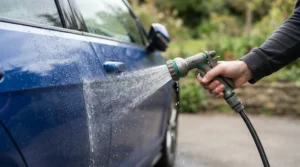
Spigot-free cleaning is the core promise of every product on this list — the ability to wash a car without any connection to your home’s plumbing. It works through one of two mechanisms: a sealed onboard tank you fill in advance (like the Fanttik NB8 Ultra or Bosch Fontus 18V), or a self-priming draw hose that siphons from an open container like a bucket or rain barrel (as used by the WORX models and Greenworks cleaner).
Tank-fed nozzles are the business end of that system, and their design does more work than people expect. A true multi-setting nozzle doesn’t just change spray width — it changes the ratio of pressure to flow at each setting, which is why the same tool can gently water plants on one setting and blast dried mud on another. Most units on this list ship with 4-to-6-in-1 nozzles that rotate through angles from a pinpoint jet to a wide fan, plus a dedicated soap-injection setting that pulls detergent through the stream rather than requiring pre-mixing in a bucket.
What the spec sheet won’t tell you is that nozzle quality varies more than pump quality across this category — a strong pump paired with a loose or poorly sealed nozzle head will leak pressure at the connection point, which is a common source of buyer disappointment that has nothing to do with the tank or battery at all.
Driveway Car Washing: Rules, Runoff, and Being a Decent Neighbor
Driveway car washing feels like a purely private activity, but in a meaningful number of U.S. municipalities it’s regulated, and the reason has nothing to do with the car itself — it’s about where the dirty water ends up. Under the federal Clean Water Act framework, local governments are required to manage stormwater discharge, and soapy runoff carrying oil, brake dust, and detergent that flows into a street storm drain typically qualifies as exactly the kind of pollutant those ordinances target.
This is precisely where a tank-fed system has a practical advantage over a running garden hose: since you’re not connected to continuous spigot flow, it’s far easier to direct wash water toward grass or gravel — areas where it filters naturally — rather than letting it sheet down the driveway into the street. The EPA’s vehicle washing best practices guidance specifically recommends washing on a permeable surface and directing wash water away from storm drains for exactly this reason.
It’s also worth noting that “biodegradable” soap doesn’t automatically make runoff harmless — the breakdown process itself consumes oxygen that aquatic life depends on if that water reaches a creek or pond. The practical fix is simple: use pressure-washer-rated, phosphate-free soap sparingly, and angle your driveway wash so water drains onto lawn rather than pavement whenever your layout allows it.
Common Mistakes When Buying a Car Washer With Water Tank
The single most common mistake is buying based on the “max PSI” number alone. As covered above, manufacturers frequently list a pump’s absolute ceiling rather than sustained working pressure — the Sun Joe SPX6001C‘s 1,160 PSI max versus 800 PSI usable rating is a textbook example of a gap buyers don’t expect.
A second recurring error is underestimating battery runtime needs. Buyers who purchase the smallest available battery pack to save money often find themselves recharging mid-wash on anything larger than a compact car — reading the actual minutes-per-charge figure, not just the voltage, prevents this.
Third, people frequently skip checking nozzle compatibility with soap or foam attachments, then discover their chosen unit requires pre-mixed detergent in a separate bucket rather than pulling it automatically through the stream — a meaningful convenience gap between models that rarely gets highlighted in headline marketing copy.
Long-Term Cost & Maintenance
The purchase price is only part of the total cost of ownership here. Battery replacement is the recurring cost most buyers underestimate — lithium-ion packs for these tools typically lose meaningful capacity after roughly 300 to 500 charge cycles, so a unit you use weekly may need a replacement battery within two to three years.
Shared battery ecosystems change this math significantly. If you already own WORX or Greenworks yard tools, buying the matching power cleaner means your replacement-battery cost is spread across every tool on that platform, not this washer alone — a real, calculable savings that rarely shows up in a straight price comparison.
Nozzle seals and intake filters are the other wear items worth budgeting for; both are inexpensive but do degrade with UV exposure and mineral buildup from hard water, and replacing them proactively is far cheaper than a full pump repair down the line.
Features That Actually Matter (And Those That Don’t)
Actually matters: sustained working pressure (not max PSI), tank or battery runtime in real minutes, and nozzle versatility with a dedicated soap setting. These three factors determine whether a wash session feels complete or frustratingly interrupted.
Doesn’t matter nearly as much as marketing suggests: extremely high max-PSI numbers on units meant for cars rather than concrete, since anything much above 1,200 PSI starts introducing real risk to clear coat and trim without meaningfully speeding up a car wash. Similarly, flashy LED display screens are a nice-to-have, not a functional advantage — they don’t change how clean your car gets.
Frequently Asked Questions
❓ Can I wash my car in my driveway with a water tank pressure washer without a hose hookup?
❓ How many gallons of water do I need to wash a car with a tank-fed pressure washer?
❓ Is a cordless pressure washer strong enough to remove dirt from a car without damaging the paint?
❓ Do tank-fed car washers work as well as a garden hose for driveway washing?
❓ Is it legal to wash your car in your driveway?
Conclusion
A car washer with water tank for driveway washing solves a real, common problem: no spigot, an inconvenient hose route, or simply wanting the freedom to clean a car wherever it’s parked. As this guide covered, the right pick depends less on chasing the highest PSI number and more on matching tank size, runtime, and nozzle versatility to how you actually wash.
If pure grab-and-go convenience is the priority, the WORX Hydroshot WG629 remains hard to beat. If tank capacity and full-session runtime matter most, the Fanttik NB8 Ultra and Bosch Fontus 18V are the strongest self-contained options on this list. And if you’re chasing maximum pressure per dollar, the Filluck 1060 PSI delivers aggressive numbers at a genuinely budget price — just apply the caution its power level deserves.
Whichever you choose, remember that spigot-free cleaning isn’t just a convenience feature — it also gives you real control over where your wash water actually goes, which matters more than most driveway-washing guides ever mention.
Recommended for You
- Pressure Washer With Water Tank for Remote Areas: 7 Top Picks 2026
- High-Flow Gas Pressure Washer for Large Driveways: 7 Top Picks 2026
- 5000 PSI Gas Pressure Washer for Concrete Cleaning: 7 Best Picks for 2026
Disclaimer: This article contains affiliate links. As an Amazon Associate, I earn from qualifying purchases. If you purchase products through these links, we may earn a small commission at no additional cost to you.
✨ Found this helpful? Share it with your friends! 💬🤗
