
In This Article
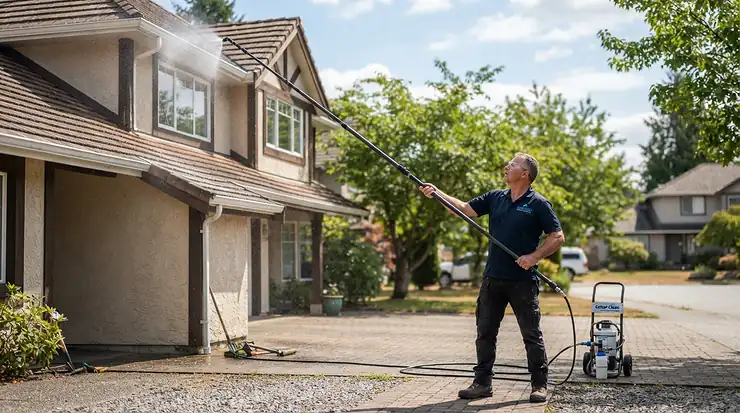
Here’s a confession: most people don’t think about their gutters until water is sheeting off the roof in the wrong place, or a green streak has crept halfway down the siding like it’s staking a claim. An extension wand for pressure washer for second-story cleaning is exactly what it sounds like — a telescoping pole that lets your pressure washer’s nozzle reach up two stories while your feet stay planted on solid ground. No ladder, no wobbling on a rung with a hose looped around your arm, no calling a neighbor to “just hold this for a second.”

I’ve spent the last few weeks buried in spec sheets, retailer listings, and aggregated buyer feedback for these tools, and one thing became obvious fast: not all telescoping wands are built the same, and the difference between a good one and a frustrating one usually comes down to three things — length, lock stability, and how well it plays with the PSI and GPM your washer is already putting out. This guide breaks down seven real products across budget, mid-range, and professional tiers, explains what the specs actually mean once you’re thirty feet up (metaphorically — you’ll be on the ground), and gives you a decision framework so you’re not left guessing.
Cleaning gutters, siding, soffits, and second-story windows without a ladder isn’t a gimmick. It’s a documented safety upgrade — falls from ladders send more than 500,000 Americans to the emergency room every year, according to CDC/NIOSH data on ladder-related falls. Keep that number in your back pocket; we’ll come back to it.
Quick Comparison Table
| Product | Max Reach | Pressure Rating | Best For |
|---|---|---|---|
| VEVOR Pressure Washer Telescoping Wand | 21 ft | Up to 4000 PSI | Budget all-rounder with the most accessories |
| Tool Daily / PWACCS 24 FT Telescoping Wand | 24 ft | Up to 4000 PSI | Longest reach on a budget |
| CRAFTSMAN CMZPWTW18 | 18 ft | Up to 3000 PSI | Homeowners who want a trusted, simple name |
| BE Power Equipment 85.206.018L | 18 ft | Up to 5000 PSI | Professionals needing serious pressure headroom |
| MI-T-M AW-7018-1800 | 18 ft | Gas-powered compatible | Contractors running commercial gas units |
Looking at this snapshot, the split is pretty clean: the VEVOR Pressure Washer Telescoping Wand and Tool Daily / PWACCS 24 FT Telescoping Wand compete on reach-per-dollar, while BE Power Equipment 85.206.018L and MI-T-M AW-7018-1800 are built for people who are on a ladder — sorry, wand — every week and need components that won’t quit after one season. The CRAFTSMAN CMZPWTW18 sits in the middle as the “I just want something reliable with a name I recognize” pick. Notice that reach and pressure rating don’t always move together — a 24-foot pole doesn’t automatically mean stronger water pressure, which is a mistake we’ll unpack later in this guide.
💬 Found a favorite already? Bookmark this page so you can compare prices before you buy!😊
Top 7 Extension Wands for Pressure Washer Second-Story Cleaning: Expert Analysis
1. VEVOR Pressure Washer Telescoping Wand — most accessories for the price
The standout here isn’t just the 21-foot reach, it’s what comes in the box alongside it. The VEVOR Pressure Washer Telescoping Wand ships with a brush head, three extension wands (including a curved gutter attachment), seven spray nozzle tips, and a pivoting coupler, which is an unusually generous kit for an entry-level product.
Rated up to 4000 PSI with a 3/8-inch quick-connect inlet and two adapters, it’s built to match most gas and electric residential washers without a trip to the hardware store for fittings. What that 4000 PSI ceiling means in practice: you’re not going to overwhelm this wand with a typical consumer-grade washer, so the bottleneck will almost always be your machine, not the wand. Based on the spec comparison against similarly priced wands, the padded shoulder and chest strap setup is a meaningful upgrade — holding even a lightweight aluminum pole at full extension for twenty minutes straight will tire your shoulders, and a real harness (not just a strap) redistributes that load.
Aggregated feedback on major retail listings tends to focus on the accessory count and ease of switching nozzles mid-job, though some buyers note the four telescopic locks take a bit of practice to seat firmly on the first try.
Pros:
- ✅ Seven nozzle tips plus a curved gutter attachment included
- ✅ Padded shoulder and chest harness reduces arm fatigue
- ✅ Works with most gas and electric washers via included adapters
Cons:
- ❌ Four-section locks need a firm, deliberate click to seat
- ❌ 21 feet may fall short on taller two-story homes with peaked rooflines
Priced in the mid-$80s to low-$100s range at the time of research, this is a strong value pick for homeowners who want one purchase to cover windows, siding, and gutters without buying separate attachments later.
2. Tool Daily / PWACCS 24 FT Telescoping Wand — longest stock reach in this lineup
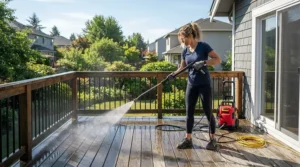
If length is your priority, the Tool Daily / PWACCS 24 FT Telescoping Wand wins the tape measure contest outright, stretching a full 24 feet — enough for most second-story roof edges and even some taller gable peaks.
It’s rated for gas or electric washers up to 4000 PSI, with a 3/8-inch quick connect that adapts to M22 14mm or 15mm fittings, so compatibility across washer brands is genuinely broad. What most buyers overlook about a 24-foot wand specifically is weight distribution: the longer the pole, the more leverage gravity has on your wrists, so the clip-and-grip handle design here — which lets you use two hands to steady the trigger — actually matters more than it sounds like on paper.
Reviewer sentiment on this one is mixed but informative: praise clusters around raw reach and the lifetime support line the brand offers, while a recurring complaint is that the pole feels less rigid than shorter alternatives once you’re past 20 feet extended, which can translate to a wobblier spray pattern on windy days.
Pros:
- ✅ 24-foot reach covers the tallest typical two-story gables
- ✅ Two-hand trigger clip improves control at full extension
- ✅ Universal M22 adapter included for broad washer compatibility
Cons:
- ❌ Noticeably more flex at full 24-foot extension than shorter wands
- ❌ Seller reviews on some marketplaces are limited and mixed
Expect to pay somewhere in the low-to-mid $100s range, which is reasonable for the added six feet of reach over most competitors — just plan on using it in calmer weather.
3. CRAFTSMAN CMZPWTW18 — trusted brand with a built-in harness
There’s a reason people default to familiar brand names for tools they’ll use twice a year and then store in the garage: they want something that still works the way it did the first time. The CRAFTSMAN CMZPWTW18 leans into that with an 18-foot extension rated for washers up to 3,000 PSI and 1.7 GPM.
The lower pressure ceiling compared to some rivals isn’t necessarily a downside — most residential electric pressure washers top out well under 3,000 PSI anyway, so this wand matches the exact tier of machine most homeowners already own rather than over-engineering for commercial-grade output. Here’s what to weigh: the included T-shaped brush head is genuinely useful for siding and screens where you want gentle agitation instead of a pure water blast, and the angled attachments make gutter runs easier to trace without repositioning your feet every few seconds.
Reviewer sentiment around Craftsman’s accessory line consistently praises the three-year limited warranty and the general “it just works” reliability that comes with an established hardware brand, with occasional notes that 18 feet feels tight on homes with unusually tall rooflines.
Pros:
- ✅ Backed by a three-year limited warranty
- ✅ T-shaped brush head handles gentle surface agitation well
- ✅ Rated appropriately for common residential PSI/GPM output
Cons:
- ❌ 18-foot max reach may not clear steep or tall gable peaks
- ❌ Lower 3,000 PSI ceiling limits use with higher-output gas washers
Typically priced in the $150-$220 range, this is the safe, brand-name choice for buyers who value warranty coverage over raw specs.
4. DeWalt DWZPWTW18 — straightforward, no-frills reliability
Some tools earn their keep by doing exactly one job without extra complexity, and the DeWalt DWZPWTW18 is that tool. It extends to 18 feet with locking levers you can adjust mid-job, paired with a T-shape brush for general surface cleaning.
DeWalt doesn’t pad the spec sheet with a dozen nozzle variants here, and that’s arguably the point — what most buyers overlook about a simpler accessory lineup is that fewer parts mean fewer things to lose track of in a garage bin. Based on the spec comparison with bundle-heavy competitors, this wand trades accessory variety for straightforward, repeatable function: extend, lock, spray, done. For homeowners who already own a full set of pressure washer nozzles and just need the reach, that’s a reasonable trade.
Aggregated buyer commentary around DeWalt’s accessory ecosystem tends to trust the brand’s reputation for durable power-tool components, though the wand itself has a smaller review footprint than some of the higher-volume budget options on this list, so treat any single data point with appropriate caution.
Pros:
- ✅ Adjustable locking levers for quick on-the-fly length changes
- ✅ DeWalt brand reliability carried over from its power tool line
- ✅ Simple design with fewer failure points
Cons:
- ❌ Fewer included accessories than bundle-focused competitors
- ❌ Smaller public review sample makes long-term durability harder to verify
Pricing generally sits in the $180-$250 range, positioning it as a mid-tier pick for brand loyalists who don’t need extra attachments.
5. YS 5-Section Telescoping Pressure Washer Wand — highest flow rate in this lineup
Here’s a spec most shoppers skip past: GPM, or gallons per minute. The YS 5-Section Telescoping Pressure Washer Wand is rated for up to 9 GPM alongside its 4,000 PSI ceiling, and that flow rate matters more than people realize once you’re rinsing soap off a wide expanse of siding.
Built from lightweight aluminum alloy paired with 430 stainless steel components, it extends across five sections from 5 to 20 feet — that extra section (compared to four-stage competitors) generally means smoother incremental length adjustments, since each segment covers a shorter span. What the spec sheet won’t tell you, but the design implies, is that five shorter sections typically lock more securely at partial extensions than four longer ones, because there’s less unsupported pole length between locking points. It includes a 15-degree extension wand specifically angled for gutter and roof-corner access, plus five nozzle tips covering 0 through 60 degrees for soap application.
Feedback on comparable high-flow wands in this category tends to highlight faster rinse-down of large soap-covered areas as the main selling point, since higher GPM clears suds before they dry into streaks.
Pros:
- ✅ 9 GPM flow rate speeds up rinsing large soaped areas
- ✅ Five-section design locks more securely at partial lengths
- ✅ Stainless steel components resist corrosion over time
Cons:
- ❌ Requires separately purchased M22 adapters in some regions
- ❌ 20-foot max reach is shorter than the category-leading options here
Expect a price point in the $220-$260 range — a fair ask given the flow-rate advantage for anyone regularly doing full-house soap-and-rinse jobs.
6. BE Power Equipment 85.206.018L — highest pressure ceiling for professionals
When a wand needs to survive daily commercial use rather than a twice-a-year homeowner chore, the spec sheet changes entirely. The BE Power Equipment 85.206.018L is rated for a genuinely industrial 5,000 PSI and 8 GPM, adjustable from 7.5 to 18 feet, built from aluminum and weighing in around 14 pounds.
That 5,000 PSI rating isn’t overkill marketing — it’s headroom for hot-water pressure washers and commercial gas units that residential-grade wands simply can’t handle without risking a blown seal. Based on the spec comparison against the budget and mid-tier options above, this is the wand you buy when a wand failure mid-job costs you money, not just a wasted Saturday. The temperature tolerance up to 200°F also opens the door to hot-water washing, which cuts through grease and grime that cold water alone won’t touch — relevant for anyone tackling commercial kitchen exteriors or heavily soiled siding.
Reviewer sentiment among contractor-facing buyers consistently credits BE Power Equipment’s reputation for durable, repair-friendly components, with the main honest caveat being that this tool is genuinely overbuilt — and priced accordingly — for someone who power washes their own house once a year.
Pros:
- ✅ 5,000 PSI and 8 GPM rating suits commercial-grade washers
- ✅ Rated up to 200°F for hot-water pressure washing
- ✅ Aluminum build designed for daily professional use
Cons:
- ❌ Maximum 18-foot reach is shorter than several budget competitors
- ❌ Price and pressure rating are overkill for occasional homeowner use
Pricing generally lands in the $200-$280 range, which is genuinely reasonable for a commercial-spec tool, though homeowners doing a single annual cleaning will likely overpay for capability they won’t use.
7. MI-T-M AW-7018-1800 — built for gas-powered commercial units
Rounding out the premium tier, the MI-T-M AW-7018-1800 is explicitly rated for gas-powered pressure washer units, extending from 6 to 18 feet. MI-T-M has spent decades building commercial and industrial pressure washing equipment, and this wand reflects that lineage rather than a general consumer accessory line.
The gas-powered compatibility distinction matters more than it first appears: gas units typically produce higher sustained PSI and GPM than electric models, and a wand not rated for that combination can develop leaks or seal failures under sustained commercial use. Here’s what to weigh if you’re a landscaping or exterior cleaning business owner — buying a wand explicitly rated for gas units up front avoids a mid-season replacement when a consumer-grade wand can’t keep up with your washer’s actual output.
Because MI-T-M sells primarily through industrial and catalog distribution channels rather than high-volume consumer marketplaces, publicly aggregated review data is thinner here than for the Amazon-heavy competitors on this list — worth noting honestly rather than papering over with invented testimonials.
Pros:
- ✅ Explicitly rated for gas-powered pressure washer units
- ✅ Backed by MI-T-M’s decades of commercial equipment manufacturing
- ✅ Sturdy build suited to repeated commercial-grade use
Cons:
- ❌ Limited publicly available consumer review data
- ❌ Distribution through industrial catalogs can mean slower shipping than marketplace competitors
Pricing sits around $215-$230 at the time of research, positioning it as a specialist choice for gas-washer owners rather than a general homeowner recommendation.
Full Spec Comparison: All 7 Wands Side by Side
| Product | Reach | Pressure/Flow | Price Range | Best For |
|---|---|---|---|---|
| VEVOR Pressure Washer Telescoping Wand | 21 ft | 4000 PSI | $85-$110 | Accessory-rich budget pick |
| Tool Daily / PWACCS 24 FT Telescoping Wand | 24 ft | 4000 PSI | $110-$135 | Maximum reach on a budget |
| CRAFTSMAN CMZPWTW18 | 18 ft | 3000 PSI / 1.7 GPM | $150-$220 | Warranty-backed reliability |
| DeWalt DWZPWTW18 | 18 ft | Not disclosed | $180-$250 | Simple, brand-trusted design |
| YS 5-Section Telescoping Pressure Washer Wand | 20 ft | 4000 PSI / 9 GPM | $220-$260 | Fastest rinse-down on soaped siding |
| BE Power Equipment 85.206.018L | 18 ft | 5000 PSI / 8 GPM | $200-$280 | Commercial and hot-water use |
| MI-T-M AW-7018-1800 | 18 ft | Gas-compatible | $215-$230 | Gas-powered commercial washers |
Scanning this table side by side, the pattern is clear: reach and pressure trade off more often than they stack. The Tool Daily / PWACCS 24 FT Telescoping Wand wins on length, but the BE Power Equipment 85.206.018L and YS 5-Section Telescoping Pressure Washer Wand win on raw water power, and neither pairing happens to land in the same product. If your home genuinely needs 24 feet of reach, you’re likely sacrificing some pressure ceiling to get there, which is worth planning around rather than discovering mid-job.
✨ Don’t Miss These Exclusive Deals!
🔍 Take your gutter and second-story cleaning routine to the next level with these carefully selected wands. Click on any highlighted product to check current pricing and availability — these tools will help you tackle exterior cleaning safely, without ever touching a ladder!

Practical Usage Guide: Setting Up Your Wand for Safe Second-Story Work
Getting a telescoping wand out of the box and immediately blasting your gutters is how people end up chasing a nozzle across the lawn or soaking their own shoes. Start with the wand fully collapsed, attach it to your pressure washer’s hose per the manufacturer’s fitting (most use a 3/8-inch quick connect, occasionally needing an M22 adapter), and test at minimum extension before you fully deploy it. This lets you catch any leaks or loose couplings while the pole is still short enough to manage with one hand.
Once you confirm a solid connection, extend one section at a time, listening and feeling for each lock to click firmly into place — a section that isn’t fully seated is the number one cause of mid-job wand collapse, and it’s completely preventable with a five-second check. Put on the support harness before you start spraying, not after your arms are already tired; the whole point of the strap system is to prevent fatigue, not fix it retroactively.
For the first 30 days of ownership, inspect the O-rings and quick-connect fittings after every third or fourth use — these are the components most likely to wear from repeated attach-detach cycles, and a five-dollar replacement O-ring beats discovering a leak mid-spray. Store the wand fully or mostly collapsed in a dry space; leaving aluminum sections extended in a damp garage invites corrosion at the joints over a season or two, which is the most common reason a telescoping wand stops locking smoothly.
Real-World Scenarios: Matching the Right Wand to Your Home
Picture three different households. First, there’s Maya, who owns a modest two-story colonial with a straightforward gable roof and cleans her gutters twice a year. She doesn’t need commercial-grade pressure or 24 feet of reach — the VEVOR Pressure Washer Telescoping Wand covers her situation with room to spare, and the included gutter attachment handles the twice-yearly leaf clearing without a second purchase.
Then there’s Derek, whose home has a steep, high-peaked roofline that pushes well past standard two-story height at the gable ends. For him, the extra six feet on the Tool Daily / PWACCS 24 FT Telescoping Wand isn’t a luxury, it’s the difference between reaching the peak and not — even if that means accepting slightly less rigidity at full extension.
Finally, consider Priya, who runs a small exterior cleaning side business out of her garage on weekends. She’s using a commercial-grade gas washer several times a week, not twice a year, which makes the BE Power Equipment 85.206.018L or MI-T-M AW-7018-1800 the sensible investment — the higher upfront price amortizes quickly against the cost of replacing a consumer-grade wand that wasn’t built for that duty cycle.
Problem → Solution: Fixing the Most Common Extension Wand Headaches
Even the right wand runs into predictable snags. Here’s how to handle the ones that come up most often.
Problem: Water pressure feels weak at full extension. This is almost always a nozzle mismatch or a kinked hose rather than a wand defect — check that you’re using the correct-angle nozzle tip for the surface, and walk the hose line to clear any twists before troubleshooting the wand itself.
Problem: Wand feels wobbly at full length. Longer wands (20+ feet) naturally flex more than shorter ones; using the support harness properly, and bracing your dominant hand closer to the base rather than gripping only the trigger end, meaningfully cuts perceived wobble.
Problem: Gutter debris isn’t dislodging. Swap to a curved gutter attachment or a 15-degree angled nozzle rather than a straight tip — direct pressure often just compacts debris rather than clearing it, while an angled spray works underneath the clog.
Problem: Quick-connect fitting won’t seat. Nine times out of ten this is a metric-versus-standard mismatch between your washer’s outlet and the wand’s inlet; keep an M22 14mm-to-15mm adapter on hand, since washer brands aren’t standardized here.
Problem: Locks slip under pressure. This is typically a sign of wear on the internal O-ring or a section that wasn’t fully extended before locking — inspect and replace worn seals rather than forcing the lock, which accelerates the wear.
Buyer’s Decision Framework: Choosing Fast Without Guesswork
If you want a shortcut instead of reading every product section twice, use this: if your home is a standard two-story with a simple roofline and you clean twice a year, choose a budget wand in the 18-21 foot range because you don’t need commercial pressure specs for occasional use. If your roofline has tall gables or dormers, choose the longest available wand — even at the cost of some rigidity — because reach beats stiffness when the alternative is not reaching at all. If you run a gas-powered commercial washer or clean exteriors professionally, choose a wand explicitly rated for gas units and higher PSI, because a mismatch here causes premature failure. If soap-and-rinse speed matters more than reach, prioritize GPM over max length, since a higher flow rate clears large soaped surfaces faster regardless of how tall your house is.
| Price Tier | Typical Range | What You’re Getting |
|---|---|---|
| Budget | Under $135 | 21-24 ft reach, generous accessory kits, consumer-grade locks |
| Mid-range | $150-$260 | Trusted brand names, better lock stability, moderate pressure ratings |
| Premium/Professional | $200-$280 | Commercial PSI/GPM ratings, gas-washer compatibility, hot-water tolerance |
Looking at this breakdown, the honest takeaway is that price scales more with duty cycle and pressure rating than with reach — a $90 wand and a $260 wand can both extend to roughly 20 feet, so don’t assume length alone justifies the higher price tag.
How to Choose an Extension Wand for Pressure Washer for Second-Story Cleaning
Picking the right wand comes down to a handful of decision points, in this order of importance:
- Measure your actual roofline height, including gable peaks, not just the standard “two-story” assumption — a tape measure or a smartphone height app beats guessing.
- Check your pressure washer’s PSI and GPM output before shopping, since a wand rated well below your washer’s output risks seal failure over time.
- Confirm the connector type, typically 3/8-inch quick connect, and whether you’ll need an M22 adapter for your specific washer brand.
- Decide how often you’ll realistically use it — twice-a-year homeowners rarely need commercial-spec pressure ratings.
- Factor in accessory needs, particularly a curved gutter attachment if gutter cleaning is a primary use case.
- Consider your own physical comfort at full extension — a support harness isn’t optional gear for anyone using a wand regularly.
- Read the warranty terms, since telescoping locks are a wear component and coverage varies meaningfully between brands.

Telescoping Pole Length: Finding the Right Reach for Two-Story Homes
Extension wand length for two-story homes is one of the most misunderstood specs on the entire shopping page, mostly because “two-story” isn’t a fixed height. A standard two-story home with 8-foot ceilings and a simple roofline typically sits around 20-25 feet from ground to roof edge, which is why most telescoping pole length options in this category cluster between 18 and 24 feet — that’s not a coincidence, it’s manufacturers targeting the actual measurement homeowners need.
Where this gets tricky is gable peaks and dormers, which can add another 5-10 feet beyond the standard roofline. If your home has any steep or peaked sections, round up rather than down when choosing telescoping pole length — an 18-foot wand that falls two feet short at the peak means you’re back on a ladder for exactly the spot you were trying to avoid climbing to. As a rule of thumb, measure your tallest point, add a few feet of buffer for standing distance from the house, and choose the shortest wand that still clears that number, since shorter poles at full extension tend to hold steadier than longer ones pushed to their max.
Telescoping Wand for Gutter Cleaning With a Pressure Washer
Using a telescoping wand for gutter cleaning with a pressure washer is different from general siding or window work, and the attachment you use matters more than the wand itself. Straight nozzles tend to compact leaf debris deeper into the gutter channel rather than clearing it, which is why most of the products in this guide include a curved or angled gutter-specific attachment — typically bent at 15 to 90 degrees to spray upward and underneath accumulated debris rather than straight down onto it.
Gutter cleaning frequency matters here too: most home-maintenance guidance recommends cleaning gutters at least twice a year, in late spring and early fall, with more frequent cleaning needed for homes surrounded by mature trees. A telescoping wand genuinely shines in this exact task, since gutters are simultaneously hard to reach and prone to reaccumulating debris quickly — meaning you’ll be doing this chore repeatedly, and a wand you can deploy in minutes without hauling out a ladder each time pays for itself in convenience alone, not just safety.
Ladder-Free Exterior Cleaning vs Traditional Ladder Work
Ladder-free exterior cleaning isn’t just a marketing phrase — it’s a genuine category shift in how homeowners approach elevated maintenance, and the comparison against traditional ladder work is worth laying out plainly.
| Factor | Telescoping Wand (Ground-Based) | Traditional Ladder |
|---|---|---|
| Fall risk | Feet remain on ground level | Elevated, balance-dependent |
| Setup time | Minutes, no repositioning needed | Requires repositioning per section |
| Physical strain | Arm/shoulder fatigue at extension | Full-body balance and climbing strain |
| Best For | Gutters, upper siding, second-story windows | Close-up detail work, low-height tasks |
The safety case here isn’t abstract. Ladder-related falls account for a documented, persistent share of home injury statistics, and OSHA’s official guidance on portable ladder safety exists precisely because balance failures at height are so common and so preventable. A telescoping wand doesn’t eliminate every risk — you’re still managing water pressure and a heavy pole — but it removes the single biggest variable, which is your own footing thirty feet above the ground. That said, ladders still win for detail work requiring close visual inspection, so this isn’t an either/or replacement in every scenario, just for the specific job of rinsing and clearing elevated surfaces.
Common Mistakes When Buying an Extension Wand
The single most common mistake is buying based on maximum reach alone without checking pressure compatibility, which leads to a wand that either underperforms with a powerful gas washer or, less commonly, gets overwhelmed connecting to a higher-output unit than it’s rated for. A close second is skipping the connector check — assuming every pressure washer uses the same fitting, then discovering mid-unboxing that an M22 adapter is required and not included.
Buyers also frequently underestimate physical fatigue, skipping the support harness because it looks optional, then abandoning a job halfway through because their arms gave out at full extension. Another recurring misstep is choosing the cheapest available option without checking whether it includes a gutter-specific attachment, then having to buy one separately anyway. Finally, some buyers assume a telescoping wand replaces every use case for a ladder — it doesn’t; close-up inspection and detail work still benefit from a stable, stationary vantage point.
Safety, Regulations & Compliance for Elevated Cleaning
While telescoping wands themselves aren’t subject to specific federal regulation the way workplace ladders are, the broader safety context is worth understanding. Fall-related injuries remain a persistent public health concern — the CDC’s ongoing ladder safety research has repeatedly found that a substantial share of fatal falls nationwide involve a ladder, which is a large part of why ground-based tools like telescoping wands have grown in popularity for routine home maintenance.
Basic safe-use practices still apply regardless of which wand you choose: never point a pressurized nozzle toward yourself or bystanders, keep the wand and hose clear of overhead power lines, and always test water flow at minimum pressure before extending fully so you’re not caught off guard by unexpected kickback. If your home’s gutters or siding require any structural repair rather than simple cleaning, that’s a job for a professional, not a pressure washer attachment — a wand cleans surfaces, it doesn’t fix damage.
FAQ
❓ What length extension wand do I need for a two-story house?
❓ Can any pressure washer use a telescoping wand for gutter cleaning?
❓ How much does a good extension wand for pressure washer for second-story cleaning cost?
❓ Is a telescoping wand safe for cleaning windows on a second story?
❓ Do telescoping wands work with electric pressure washers?
Conclusion
Cleaning the parts of your house that live above ladder-comfortable height doesn’t have to mean risking a fall every spring and fall. Whether you land on the accessory-loaded VEVOR Pressure Washer Telescoping Wand, the extra-long Tool Daily / PWACCS 24 FT Telescoping Wand, or a commercial-grade pick like the BE Power Equipment 85.206.018L, the right extension wand for pressure washer for second-story cleaning comes down to matching reach and pressure rating to your actual home and actual pressure washer — not just picking whichever one has the longest number on the box.
Measure your roofline first, check your washer’s specs second, and let those two numbers narrow the field before price does. Gutter buildup and second-story grime aren’t going anywhere on their own, but with the right tool, you also don’t have to go up there to deal with them.
Recommended for You
- Pressure Washer Nozzle Set For Multiple Surfaces: 7 Top Picks (2026)
- Mini Power Washer For Small Cleaning Jobs: 7 Top Picks (2026)
- 7 Best Portable Pressure Washer For Camping Picks (2026 Guide)
Disclaimer: This article contains affiliate links. As an Amazon Associate, I earn from qualifying purchases. If you purchase products through these links, we may earn a small commission at no additional cost to you.
✨ Found this helpful? Share it with your friends! 💬🤗
