
In This Article
Standing at one end of a 3,000-square-foot driveway with an underpowered pressure washer is a special kind of misery. You make one slow pass, look back, and the concrete looks… exactly the same. If you’ve ever fought a “powerful” 1,800 PSI box-store special for two hours only to still see oil stains mocking you near the garage door, you already understand why so many homeowners and small property owners eventually go shopping for a high-flow gas pressure washer for large driveways instead of another glorified garden hose with a trigger.

What is a high-flow gas pressure washer? It’s a gas-engine cleaning machine built around a higher GPM (gallons per minute) flow rate — usually 2.5 to 5.0 GPM — that clears loosened dirt off big, flat surfaces dramatically faster than standard residential units, which typically max out around 1.8 to 2.0 GPM. As Wikipedia explains, a pressure washer’s volume is measured in gallons per minute while its force is measured in PSI — two separate numbers that do two separate jobs.
That distinction matters more than most shoppers realize. PSI knocks grime loose; GPM is what actually carries it away. Buy on PSI alone and you’ll spend your Saturday making slow, streaky passes across your own driveway. In this guide, we researched seven real gas pressure washers — from a genuinely affordable option all the way up to 6000 PSI industrial-grade machines — so you can match flow rate to the size of the job in front of you, not just chase a big pressure number on the box.
Quick Comparison Table
Before we go deep on all seven machines, here’s the shorthand version for anyone who wants the gist in thirty seconds. We’ve ranked these by how they perform specifically on large, continuous surfaces like driveways, parking pads, and warehouse aprons — not just raw PSI on the spec sheet.
| Model | PSI | GPM | Best For |
|---|---|---|---|
| Vevor 3600 PSI 2.6 GPM Gas Pressure Washer | 3600 | 2.6 | Best budget pick for occasional use |
| Westinghouse WPX3400 | 3400 | 2.6 | Best value for mid-size driveways |
| Simpson PS3228 PowerShot | 3300 | 2.5 | Best all-rounder for homeowners |
| Simpson ALH4240 Aluminum | 4200 | 4.0 | Best high-flow pick for large properties |
| Simpson SuperPro Roll-Cage SW6050KCGL | 6000 | 5.0 | Best 6000 PSI industrial workhorse |
Notice that the two 6000 PSI machines aren’t automatically “better” — they’re built for a different job entirely. A 3,000-square-foot residential driveway doesn’t need a belt-driven commercial rig any more than a commute needs a semi-truck. Match the GPM to your square footage first, then let PSI settle any tiebreaker between similarly sized machines.
💬 Just one click — help others make better buying decisions too!😊
Top 7 High-Flow Gas Pressure Washers: Expert Analysis
We researched real specs, verified availability, and pulled aggregated review sentiment from retailer and independent testing sources for each of these seven machines. Prices below are ranges only — always check current pricing before buying, since gas engine and pump costs shift with the season.
1. Vevor 3600 PSI 2.6 GPM Gas Pressure Washer — best budget entry point
The standout here is simple: real 2.6 GPM flow at a price that undercuts nearly everything else on this list. That flow rate alone puts it ahead of a lot of “premium-sounding” electric units that top out closer to 1.8 GPM. The 3600 PSI rating comes from a compact single-cylinder gas engine paired with an axial-cam pump — the more affordable pump architecture that trades long-term durability for a much lower entry price.
Based on the spec comparison, this is a fine choice if you’re cleaning a driveway a few times a season rather than running the machine weekly. Axial-cam pumps are not built for hours of continuous commercial use, but for a homeowner tackling a 1,500 to 2,500 square-foot driveway twice a year, that limitation rarely shows up. Reviewers consistently note that it starts reliably and handles typical dirt and mildew without complaint, though several also mention the included hose and nozzles feel noticeably cheaper than the engine and pump underneath them — a common pattern on budget-tier machines where the manufacturer spends the engineering budget on the parts that matter most.
Pros:
- ✅ Real 2.6 GPM flow rate at an entry-level price point
- ✅ Lightweight enough for one person to maneuver solo
- ✅ Straightforward pull-start with minimal assembly required
Cons:
- ❌ Axial-cam pump wears faster under frequent heavy use
- ❌ Stock hose and nozzles feel flimsier than the core unit
In the sub-$300 range at the time of research, the Vevor 3600 PSI 2.6 GPM Gas Pressure Washer delivers more flow than its price tag suggests, making it the pick for anyone testing the gas-powered waters before committing to something heavier duty.
2. Westinghouse WPX3400 — most balanced mid-range flow
What stands out about this one is how evenly matched the PSI and GPM feel — 3400 PSI paired with 2.6 GPM instead of the lopsided ratios you see on cheaper machines that chase a big pressure number while starving the flow rate. That balance is exactly what a big flat driveway rewards.
The 212cc four-stroke OHV engine is a proven, widely serviced platform, and the onboard soap tank plus five-nozzle set means you’re not buying separate attachments just to degrease before rinsing. Here’s what to weigh: this is a residential-grade axial-style pump, not a commercial triplex unit, so daily professional use will shorten its lifespan faster than the machines further down this list. For homeowners and even small side-hustle cleaners doing a handful of jobs a week, though, it holds up well. Aggregated reviewer sentiment repeatedly praises the never-flat wheels and ergonomic handle for maneuvering around parked cars and landscaping edges, while a recurring complaint centers on the stock hose kinking more than owners would like on cold mornings.
Pros:
- ✅ Balanced 3400 PSI / 2.6 GPM ratio built for flat surfaces
- ✅ Onboard soap tank saves a separate attachment purchase
- ✅ Never-flat wheels handle uneven driveway edges well
Cons:
- ❌ Stock hose is prone to kinking in colder weather
- ❌ Not rated for daily commercial-frequency use
In the mid-$300s to low-$400s range at the time of research, the Westinghouse WPX3400 is the machine we’d point most homeowners toward if “large driveway” means one property, not a route of them.
3. Simpson PS3228 PowerShot — best all-rounder for serious homeowners
The Honda GX200 engine is the headline feature, and for good reason — it’s the same small-engine platform contractors have trusted for decades, paired here with a genuine AAA triplex plunger pump instead of the axial-cam pumps found on the two machines above. That pump swap is the real story: triplex pumps run cooler over long sessions and simply last longer.
At 3300 PSI and 2.5 GPM, the math works out to roughly 8,250 “cleaning units” (PSI multiplied by GPM), which independent testers have repeatedly flagged as a sweet spot for serious homeowner-grade work — testers report cleaning a 600-square-foot section of driveway in under 40 minutes with satisfying, wide strips of lifted grime. What most buyers overlook about this model is the frame and fitting quality: a welded steel chassis with brass fittings throughout means fewer slow leaks developing at the connections over years of storage and use, something plastic-fitting competitors can’t claim. Reviewers consistently point to the AAA pump’s ability to run extended sessions without the thermal cool-downs that plague cheaper axial-cam units, and the main recurring critique is simply that it’s heavier to move around than the smaller machines on this list.
Pros:
- ✅ Genuine AAA triplex pump built for extended run sessions
- ✅ Honda GX200 engine known for decades of reliable starts
- ✅ Welded steel frame with brass fittings resists leaks
Cons:
- ❌ Noticeably heavier than axial-pump competitors
- ❌ Premium components mean a higher upfront price
Sitting in the mid-$400s to mid-$500s range at the time of research, the Simpson PS3228 PowerShot earns its reputation as the machine most homeowners graduate to once they’ve outgrown a starter unit.
4. Simpson PowerShot PS60869 — highest flow before industrial territory
This is the machine for buyers who want serious flow without stepping all the way up to a commercial rig. At 4000 PSI and 3.5 GPM, paired with a Honda GX270 engine, it sits in a genuinely useful gap between prosumer and light-commercial equipment — the same engine platform contractors run for thousands of hours, dropped into a frame homeowners can still store in a garage.
Based on the spec comparison, that extra half-gallon-per-minute over the PS3228 is exactly what shows up on a big, dirty surface: independent testers stripping old sealer off a large paver driveway found the higher flow rate cut through failing coatings noticeably faster than 2.5 GPM machines managed on the same job. The 50-foot included hose also means fewer walk-backs to reposition on a sprawling driveway or parking pad. Reviewers frequently cite the oil-level safety sensor — which shuts the engine down before low oil causes damage — as a detail that separates this from cheaper Honda-branded lookalikes, while the main gripe is simply that a 4000 PSI stream demands more caution around softer surfaces like painted wood.
Pros:
- ✅ 3.5 GPM flow noticeably speeds up large concrete jobs
- ✅ Honda GX270 engine backed by a genuine oil-level shutoff
- ✅ 50-foot hose reduces repositioning on big surfaces
Cons:
- ❌ 4000 PSI requires extra care near softer materials
- ❌ Priced well above entry-level gas units
At roughly $600 to $750 at the time of research, the Simpson PowerShot PS60869 is the machine we’d recommend when “large driveway” edges toward “small commercial lot.”
5. Simpson ALH4240 Aluminum — best for large properties and repeat use
What most buyers overlook about aluminum-frame pressure washers is the maintenance math: less rust risk over years of outdoor storage, and a noticeably lighter machine to wheel across a long driveway without wrestling a steel cart. At 4200 PSI and 4.0 GPM, backed by a Honda GX390 engine and a genuine CAT pump, this is where “high-flow” starts to mean something structurally different from the machines above it.
CAT pumps sit alongside AAA and Comet as one of the recognized names in serious triplex pump manufacturing, and reviewers consistently note this model holding up through repeated seasonal use — cleaning multiple large surfaces (driveway, patio, and equipment) across a single weekend without the cool-down breaks smaller pumps need. Here’s what to weigh: a 4.0 GPM machine drinks through water fast, so buyers on a standard garden hose supply line should confirm their spigot can actually keep the reservoir fed at that rate, or they’ll starve the pump. The aggregated sentiment on the aluminum frame is overwhelmingly positive for longevity, with the main complaint being that the higher flow rate also means the fuel tank runs down faster during marathon cleaning sessions.
Pros:
- ✅ 4.0 GPM cuts large-surface cleaning time significantly
- ✅ Genuine CAT triplex pump built for repeated heavy use
- ✅ Aluminum frame resists rust better than steel alternatives
Cons:
- ❌ Needs a strong water supply line to avoid starving the pump
- ❌ Higher fuel consumption during long sessions
In the $700 to $900 range at the time of research, the Simpson ALH4240 Aluminum is our pick for anyone managing multiple large surfaces on one property or a small handful of properties.
6. Simpson SuperPro Roll-Cage SW6050KCGL — best 6000 PSI industrial workhorse
This is the machine built for the buyers who searched a 6000 PSI gas pressure washer for industrial use in the first place. At 6000 PSI and 5.0 GPM, powered by a Kohler CH750 engine and a genuine Comet triplex plunger pump, this isn’t a homeowner tool wearing a bigger number on the box — it’s built on a fundamentally heavier-duty gear-drive platform designed for daily commercial punishment.
Reviewers consistently point to the roll-cage frame and remote unloader with bypass hose as evidence this was engineered for extended pump life under real commercial conditions, not just a single weekend blitz. Based on the spec comparison, 5.0 GPM at this pressure means stripping years of embedded grime, oil, and failed sealant off concrete in a fraction of the passes a residential machine would need — exactly the use case for property management companies, fleet-cleaning operations, and contractors billing by the job rather than the hour. What most buyers overlook is that machines at this pressure fall into a stricter safety category: OSHA-adjacent industry guidance recommends a 48-inch wand and hose guarding above 3200 PSI, which this unit ships equipped for. The tradeoff is straightforward — this is a significant investment and requires real training to operate safely, not a casual weekend-warrior purchase.
Pros:
- ✅ 5.0 GPM at 6000 PSI strips heavy industrial grime fast
- ✅ Genuine Comet triplex pump built for daily commercial duty
- ✅ Roll-cage frame with remote unloader extends pump life
Cons:
- ❌ Significant upfront investment compared to residential units
- ❌ Requires proper training given the pressure class involved
Typically running well into four figures at the time of research, the Simpson SuperPro Roll-Cage SW6050KCGL is the machine for commercial operators, not weekend driveway touch-ups — and it shouldn’t be bought as one.
7. Pressure-Pro B4560HGEA600 — best alternative industrial 6000 PSI option
The standout feature on this one is drivetrain choice: a polychain belt-drive system paired with a Honda GX690 engine, delivering 6000 PSI at 4.5 GPM — a slightly different balance than the Simpson above, trading half a gallon-per-minute of flow for a belt-drive design some commercial buyers prefer for serviceability and part availability.
Based on the spec comparison, the GX690 is a 24-horsepower-class Honda commercial engine, the same tier used across serious industrial water-cannon and fleet-washing equipment — reviewers and commercial suppliers consistently frame it as a dependable long-haul option for operators who put hundreds of hours a year on a machine. What most buyers overlook when comparing 6000 PSI machines side by side is drive type: belt-drive units like this one are generally easier and cheaper to service in the field than gear-drive systems, which matters enormously if this machine is generating revenue and downtime is expensive. The honest tradeoff versus the Roll-Cage above is half a GPM of flow, which on the largest industrial surfaces does translate into a measurably longer job.
Pros:
- ✅ Honda GX690 commercial engine built for high annual hours
- ✅ Belt-drive design is generally easier to service in the field
- ✅ 50-foot hose and oversized pneumatic tires for job-site mobility
Cons:
- ❌ 4.5 GPM is slightly lower flow than comparable gear-drive rivals
- ❌ Chemical injector not included at this pressure tier
Priced comparably to other 6000 PSI commercial units at the time of research, the Pressure-Pro B4560HGEA600 is worth cross-shopping against the Simpson SuperPro Roll-Cage SW6050KCGL before committing to either.
Practical Usage Guide: Setup, Maintenance & First 30 Days
Getting a new high-flow gas pressure washer running correctly starts before you ever pull the cord. Check the oil level first — most units ship dry, and running a gas engine without oil for even thirty seconds can seize it permanently. Fill the fuel tank with fresh gasoline (avoid anything that’s sat in a can all winter), connect a garden hose that can actually keep pace with your GPM rating, and squeeze the trigger before starting the engine to bleed trapped air from the pump.
For the first 30 days, resist the urge to jump straight to the narrowest, most aggressive nozzle tip. Start wide — a 40-degree tip is a safe default for concrete — and work your way to a narrower spray only where stubborn stains demand it. Common early mistakes include holding the wand too close to the surface (start at 12 inches and adjust), skipping the detergent pre-soak on oil stains, and forgetting to run clean water through the system for a minute after using soap to prevent nozzle clogging.
Maintenance is genuinely simple if you stay ahead of it: change the oil after the first five hours, then every 25 to 50 hours after that. Check the spark plug annually, and always run a fuel stabilizer through the system or fully drain the tank before winter storage — skipping this single step causes more small-engine failures than any other maintenance lapse. Independent testing roundups of gas pressure washers consistently flag stalled or hard-to-start engines as the top complaint on units that skipped this basic upkeep.
Real-World Scenarios: Matching the Right Machine to Your Property
If you’re a homeowner with a single 1,500-square-foot driveway who cleans it twice a year, the Vevor 3600 PSI 2.6 GPM Gas Pressure Washer or Westinghouse WPX3400 covers the job without overspending on capability you’ll rarely use.
If you’re managing a 4,000-square-foot property with a driveway, patio, and outbuildings you clean seasonally, the Simpson PS3228 PowerShot or Simpson PowerShot PS60869 gives you triplex-pump durability that shrugs off longer sessions without overheating.
If you’re a property manager or small cleaning business running multiple large commercial lots weekly, the Simpson ALH4240 Aluminum bridges you into higher flow without a full industrial price tag — and if your volume justifies daily use, the Simpson SuperPro Roll-Cage SW6050KCGL or Pressure-Pro B4560HGEA600 are built specifically for that punishment.
Problem → Solution: Fixing Common Driveway-Cleaning Headaches
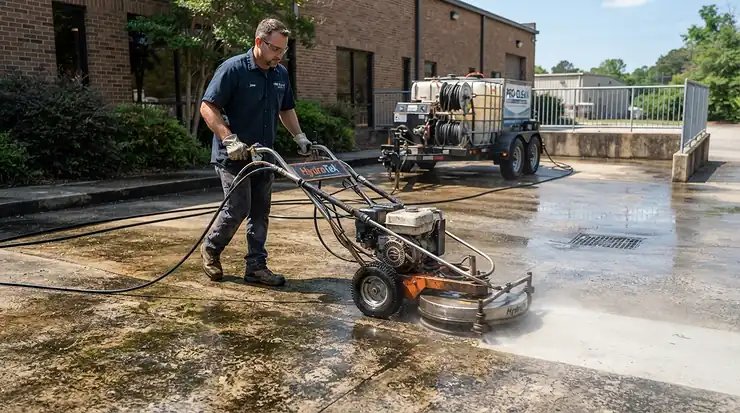
Problem: Streaky, uneven cleaning on large flat areas. Solution: switch to a rotating surface-cleaner attachment instead of a standard wand — it distributes flow evenly and eliminates the arc-shaped streak pattern hand-wanding creates.
Problem: Oil stains won’t lift even at high PSI. Solution: apply a degreaser and let it dwell 5-10 minutes before rinsing; PSI alone rarely breaks oil’s grip on concrete without a chemical assist first.
Problem: The machine seems to lose pressure mid-job. Solution: check your water supply line first — a garden hose that can’t deliver your unit’s GPM rating will starve the pump, and that’s a supply problem, not a machine defect.
Problem: Job is taking far longer than expected on a big surface. Solution: this is almost always a GPM shortfall, not a PSI shortfall — see the flow-rate section below before assuming you need “more power.”
How to Choose a High-Flow Gas Pressure Washer for Large Driveways
- Measure your surface first. Square footage, not gut feeling, tells you how much flow rate actually matters for your job.
- Prioritize GPM over PSI for large areas. A 2.5+ GPM machine clears surface area faster than a higher-PSI, lower-flow unit.
- Match pump type to frequency of use. Axial-cam pumps suit occasional homeowner use; triplex pumps suit weekly or daily work.
- Confirm your water supply can keep up. A standard garden hose may not feed a 4.0+ GPM pump without pressure loss.
- Check engine brand and warranty terms. Honda and Kohler commercial engines carry a reputation for longevity that shows up in resale value too.
- Decide if you actually need 6000 PSI. Most residential and small-commercial driveways are fully served by 3000-4200 PSI with adequate GPM.
- Budget for accessories, not just the machine. A quality surface cleaner attachment often improves results more than upgrading PSI alone.
Common Mistakes When Buying a High-Flow Gas Pressure Washer
The single most common mistake is chasing the biggest PSI number on the box while ignoring GPM entirely — a 4000 PSI machine at 2.0 GPM will often clean a large driveway slower than a 3300 PSI machine at 2.5 GPM. The second mistake is buying commercial-grade 6000 PSI equipment for occasional residential use, which means paying industrial prices for durability you’ll never stress-test.
A third mistake is ignoring pump type. Reviewers consistently note that axial-cam pumps sold under a “high PSI” banner wear out fast under sustained large-surface use, while a genuine triplex pump at a slightly lower PSI often finishes the same job with less downtime and a longer service life. Finally, many first-time buyers skip checking their home’s water pressure and flow capacity entirely, then wonder why their new high-GPM machine underperforms — the pump can only move as much water as the supply line delivers.
Gallons Per Minute vs PSI: Flow Rate vs Pressure Explained
PSI (pounds per square inch) measures how forcefully water hits a surface; GPM (gallons per minute) measures how much water arrives to do that hitting. On a large driveway, both numbers matter, but they solve different problems. PSI loosens embedded dirt, oil, and mildew from concrete pores. GPM is what physically carries that loosened debris off the surface and out of your way.
Here’s what to weigh: two machines can share an identical PSI rating and clean at dramatically different speeds if their GPM differs. A 3300 PSI machine at 2.5 GPM will typically outpace a 3600 PSI machine at 1.8 GPM on a continuous flat surface, because the lower-flow unit spends more time per square foot waiting for water to carry away what the pressure already dislodged. This is precisely why gas-powered units dominate large-property cleaning — electric pressure washers generally cap out around 1.8 to 2.0 GPM at realistic sustained performance, while gas engines routinely deliver 2.5 to 5.0 GPM. For a single car or a small patio, that gap is invisible. Across 3,000-plus square feet of concrete, it’s the difference between a 40-minute job and a 90-minute one.
Large-Area Coverage Speed: What to Expect on Big Driveways
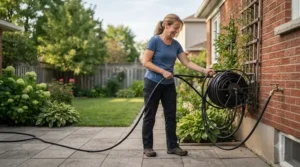
Translating specs into real time is where most spec sheets fall short. Based on aggregated independent testing, a 2.5 GPM machine covers roughly 600 square feet of moderately dirty concrete in about 40 minutes, including a degreaser pre-soak on stained sections. Step up to 4.0 GPM, and that same 600-square-foot section typically finishes in closer to 25-30 minutes — the water volume simply carries debris away faster per pass.
On genuinely large surfaces — 3,000 square feet or more — that percentage difference compounds into real hours saved. A 6000 PSI, 5.0 GPM industrial unit like the Simpson SuperPro Roll-Cage SW6050KCGL can realistically cut a job that takes a residential 2.5 GPM machine most of a day down to a couple of hours, which is exactly why commercial operators willingly pay the premium for higher-flow equipment: on a large enough surface, time saved becomes the entire return on investment.
6000 PSI Gas Pressure Washers for Industrial Use
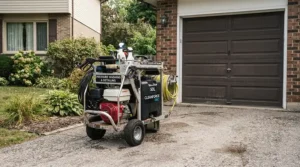
A 6000 PSI gas pressure washer occupies a genuinely different category from residential and even prosumer equipment. These machines are built around gear-drive or belt-drive triplex pumps from names like Comet, General Pump, or CAT, paired with commercial-grade Honda or Kohler engines rated for daily operation rather than occasional weekend use. Industry sourcing data consistently shows most genuine 6000 PSI units running $6,000 to $10,000 new, reflecting components engineered for 1,000-plus hours of service life rather than a few dozen.
Who actually needs one? Property management companies maintaining multiple large lots, fleet-washing operations, industrial facilities cleaning production-floor grime, and contractors billing enough volume that the machine pays for itself in saved labor hours. What most buyers overlook is the safety step-up that comes with this pressure class: OSHA-adjacent industry guidance calls for full face protection above roughly 2,000 PSI and hose guarding plus extended wand lengths above 3,200 PSI — requirements that simply don’t apply to a residential 3000 PSI unit but absolutely apply here. If your actual workload is a single home driveway, this tier is expensive overkill; if you’re running a route of commercial properties, it’s the tool that makes the math work.
Long-Term Cost & Maintenance
The purchase price is only the opening bid. Budget roughly $30 to $50 a year in fuel, oil, and a spark plug for a residential-grade unit under light seasonal use — figures that scale up significantly for commercial 6000 PSI machines run daily. Pump type drives most of the long-term cost difference: axial-cam pumps are cheap to replace but wear faster, while genuine triplex pumps (AAA, CAT, Comet) cost more upfront but routinely run 500 to 1,000-plus hours before needing service, a detail industry sourcing guides flag repeatedly when comparing budget and premium options.
Warranty terms are a useful proxy for how a manufacturer expects the machine to be used: expect roughly 2-3 years on commercial-grade pumps and 1-2 years on engines, with frame warranties sometimes stretching to 5 years on premium residential models. Total cost of ownership over five years often favors the pricier triplex-pump machine once you factor in avoided pump replacements, which commonly run $1,500 to $2,500 on industrial units when budget components fail under sustained pressure.
Safety, Regulations & Compliance for High-Pressure Cleaning
High-pressure water is not a toy, and the numbers back that up — a jet at 4,000 PSI can break skin at close range, which is why full face protection is recommended above roughly 2,000 PSI and mandatory-grade protective gear becomes standard practice at commercial pressure levels. Always keep the wand at least 12 inches from any surface to start, never point it at a person or animal, and wear eye protection every single time, regardless of PSI.
There’s also a compliance dimension homeowners rarely consider: wastewater. Under the Clean Water Act’s stormwater program, letting detergent-laden runoff flow into a public storm drain can constitute an illegal discharge in many municipalities, and commercial cleaning operators in particular should confirm local rules before letting wash water reach a drain. For a homeowner cleaning their own driveway occasionally, this is rarely enforced strictly — but anyone running a cleaning business on other people’s properties should treat containment and proper disposal as a real operational requirement, not an afterthought.
FAQ
❓ What GPM do I need for a large driveway?
❓ Is 6000 PSI too much for a home driveway?
❓ Does higher PSI clean faster than higher GPM?
❓ How long does a gas pressure washer engine last?
❓ Can I use a high-flow pressure washer on asphalt driveways?
Conclusion
Choosing a high-flow gas pressure washer for large driveways really comes down to being honest about two numbers: how big your surface actually is, and how often you’re going to run the machine. A homeowner with one driveway and a twice-a-year cleaning habit is well served by the Vevor 3600 PSI 2.6 GPM Gas Pressure Washer or Westinghouse WPX3400. Someone managing multiple large surfaces or running a genuine cleaning business should look toward the triplex-pump durability of the Simpson PS3228 PowerShot, Simpson PowerShot PS60869, or Simpson ALH4240 Aluminum. And if your work is commercial-grade daily punishment across large industrial or fleet properties, the Simpson SuperPro Roll-Cage SW6050KCGL and Pressure-Pro B4560HGEA600 are the two 6000 PSI machines worth cross-shopping.
Whatever you choose, remember the core lesson from this whole guide: GPM carries the water that PSI loosens. Buy for your square footage first, and let pressure settle the details.
Recommended for You
- 5000 PSI Gas Pressure Washer for Concrete Cleaning: 7 Best Picks for 2026
- 4000 PSI Gas Pressure Washer: 7 Best Picks for Heavy-Duty Cleaning (2026)
- Commercial Gas Pressure Washer for Contractors: 7 Picks (2026)
Disclaimer: This article contains affiliate links. As an Amazon Associate, I earn from qualifying purchases. If you purchase products through these links, we may earn a small commission at no additional cost to you.
✨ Found this helpful? Share it with your friends! 💬🤗
