
In This Article
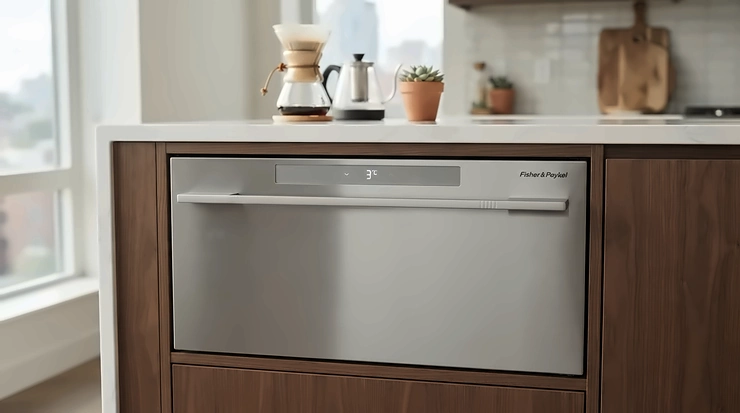
A single drawer dishwasher for small households and couples is a compact built-in unit that slides out like a kitchen drawer instead of dropping open like a door. It holds roughly seven place settings in one self-contained tub, runs half-loads without waste, and loads at waist height. For one or two people, that is often the whole job.

Here’s the dirty little secret of the standard dishwasher: for two people, it’s a storage cabinet with a grudge. You stack dishes for three days, run it half-empty, and bend at the waist like you’re bowing to a very demanding emperor. The drawer format flips that script. The concept was developed by New Zealand’s Fisher & Paykel, whose engineers sketched it in the late 1980s before the DishDrawer launched commercially in 1997. Nearly three decades later, retailers still describe drawer machines as made almost exclusively by that one company, which shapes this guide. Every model below is a Fisher & Paykel single DishDrawer, because that is where the real choices live.
So what are you actually choosing between? Mostly height (standard versus tall tub), finish (stainless versus panel-ready), noise, and extras like a built-in water softener or Wi-Fi. This guide covers all of it, plus the practical stuff the spec sheet skips: the counter-height install, cabinet width, and whether a drawer works on an island or in a bar area. Prices below are ranges only, since they move constantly. Check current pricing before you buy.
Quick Comparison: 7 Single DishDrawer Models at a Glance
| Model | Place Settings | Height | Style | Price Range | Best For |
|---|---|---|---|---|---|
| Fisher & Paykel DD24SAX9N | 7 | About 16 1/8 in | Stainless full console | $900–$1,100 | Budget-first couples |
| Fisher & Paykel DD24SCTX9N | 7 | About 17 7/8 in | Stainless, tall tub | $1,000–$1,200 | Bigger plates, same simple look |
| Fisher & Paykel DD24STI9N | 7 | About 17 7/8 in | Panel-ready, tall | $1,000–$1,200 | Cabinet-matched kitchens |
| Fisher & Paykel DD24SI9N | 7 | Standard (not tall) | Panel-ready | $1,050–$1,650 | Seamless look on a budget |
| Fisher & Paykel DD24SHTI9N | 7 | About 17 7/8 in | Panel-ready, tall, water softener | $1,150–$1,350 | Hard-water homes |
| Fisher & Paykel DD24ST4NX9 | 7 | About 17 7/8 in | Built-under, smart | $1,250–$1,700 | Quietest, app-connected |
| Fisher & Paykel DD24SDFTX9N | 7 | Tall | Semi-integrated | $1,400–$1,700 | Oversized plates up to 13 in |
Notice what doesn’t change: all seven hold about seven place settings, and all share a nominal 24-inch cabinet width. You’re not shopping for capacity here. You’re paying for height, finish, and polish. The DD24SAX9N is the value anchor, the DD24SHTI9N is the pick if hard water spots your glassware, and the DD24ST4NX9 buys the lowest listed sound level plus app control. Everything between is a trade of money for style and a few extra inches of tub.
💬 Just one click — help others make better buying decisions too!😊
Top 7 Single Drawer Dishwashers for Small Households and Couples: Expert Analysis
1. Fisher & Paykel DD24SAX9N — the lowest-cost way into drawer life
Every category has an entry ticket, and this one is it. Dimensions run about 16 1/8 inches tall, 23 9/16 wide and 22 9/16 deep (handle excluded), which is exactly why it disappears into a cabinet run.
The spec sheet lists seven place settings, plates up to 11 inches, 151 kWh per year and 1.81 gallons per cycle. In practice, an 11-inch plate limit means standard dinner plates fit, but oversized platters and chargers will not. Six programs (Rinse, Fast, Delicate, Normal Eco, Normal, Heavy) cover everything from crystal to crusted pans. Retailers list the sound level around 45 dBA.
Based on the spec comparison, this is the sensible default for a couple who cooks real meals but doesn’t host dinner parties. Reviewers of single DishDrawers on consumer sites split fairly cleanly: single-person households praise years of reliable service, while others report that large pots simply don’t fit. Per-model review pools are small, so treat that as direction, not gospel.
Pros:
- ✅ Lowest entry price in the single DishDrawer family
- ✅ Efficient: roughly 1.8 gallons per cycle
- ✅ Compact height suits low or crowded cabinet runs
Cons:
- ❌ Shallower tub limits large platters and tall pots
- ❌ Plain stainless front only, no panel-ready option
Price range: around $900–$1,100. For two people who run a load every day or two, it’s the best value here.

2. Fisher & Paykel DD24SCTX9N — same simplicity, extra headroom
The tall-tub version of the entry model, built for people who have been burned by a skillet that wouldn’t fit. At about 17 7/8 inches tall, it trades a little cabinet space for noticeably more vertical room.
Retailer listings highlight Quick, Sanitize and Extra Dry options on top of six wash programs, and a sound level near 44 dBA on the gentle cycle. The manufacturer says Sanitize kills 99.9% of bacteria in the final rinse, a nice-to-have if you wash baby bottles or cutting boards. Dealers also list it as ADA compliant for accessible-height installation.
Here’s what to weigh: that extra two inches of height does most of the work of a bigger dishwasher without adding any width. If you cook with a Dutch oven or a wide sauté pan, this is the smarter spend over the DD24SAX9N. Reviewer data specific to this model is thin, so lean on the shared DishDrawer platform reputation and verify against current listings.
Pros:
- ✅ Tall tub fits larger pots and stemware
- ✅ Quick, Sanitize and Extra Dry modifiers
- ✅ Quiet gentle-cycle rating near 44 dBA
Cons:
- ❌ Costs more than the standard-height sibling
- ❌ Needs slightly more cabinet height to install
Price range: around $1,000–$1,200. Good value if your cookware is bulky.
3. Fisher & Paykel DD24STI9N — integrated tall drawer with serious cycle depth
This is where the Series 9 upgrades start. It’s panel-ready, so you can hide it behind cabinet fronts, and the interior gets a tall top drawer that retailers say is available only on integrated models.
Listings credit it with 15 wash programs, Sanitize, an Eco option, key lock, child lock and a 44 dBA sound level. The party trick is “knock to pause”: rap on the front panel mid-cycle when you’ve forgotten a mug, and it stops. In a small kitchen where the drawer is a few steps from you all day, that little ritual becomes a daily convenience.
What most buyers overlook is the panel-ready premium. You’re paying to make an appliance vanish, which is gorgeous in an open-plan space and pointless in a utility kitchen. Retailer review pools for the Series 9 line are small, so verify current sentiment before you commit.
Pros:
- ✅ Panel-ready for a fully integrated look
- ✅ Knock-to-pause saves aborted cycles
- ✅ Extensive program menu for mixed loads
Cons:
- ❌ Costs more for looks than raw performance
- ❌ Custom panel or door accessory adds expense
Price range: around $1,000–$1,200. A fair price for integration.
4. Fisher & Paykel DD24SI9N — panel-ready, standard height
The non-tall integrated option, aimed at design-led kitchens where the dishwasher shouldn’t announce itself. Retailers describe it as a seamless slide-in that takes cabinet panels, with Quick, Sanitize and Extra Dry options.
One retailer page shows a 4.0-star average from five reviews, small but encouraging. The listing also notes the same knock-to-pause convenience as its Series 9 siblings. Pricing is the wild card: dealer listings range widely, so shopping around matters more here than on any other model in this guide.
The honest tradeoff is capacity-for-style. Standard height means the same limits as the DD24SAX9N, with prettier packaging. Choose it when the cabinet front matters more than the tub depth, and skip it if you actually cook large.
Pros:
- ✅ Panel-ready for a cabinet-matched front
- ✅ Knock-to-pause and Sanitize options
- ✅ Often discounted below the tall integrated models
Cons:
- ❌ Standard-height tub limits oversized dishes
- ❌ Wide dealer price spread requires shopping around
Price range: around $1,050–$1,650. Value depends entirely on the price you find.
5. Fisher & Paykel DD24SHTI9N — the built-in water softener model
Hard water is the silent killer of glassware, and this is the only single drawer here that fights it internally. The built-in softener reduces minerals in the water to improve wash performance, which is exactly what you want if your wine glasses come out chalky.
The spec sheet lists a 12.25-inch plate capacity, 152 kWh per year and 1.79 gallons per cycle, plus 15 wash programs and a sound level near 44 dBA on the gentle cycle. It’s panel-ready and tall, at about 17 7/8 inches high. The tall top drawer handles oversized platters and long-stemmed glasses.
Here’s the logic: if your home has hard water, the softener means fewer rinse-aid fixes and less spotting, which makes the premium a genuine functional upgrade rather than a styling tax. If your water is soft, skip it and buy the DD24STI9N instead. It has no Wi-Fi and no Sabbath mode, per one retailer listing.
Pros:
- ✅ Built-in water softener fights spotting
- ✅ 12.25-inch plates fit comfortably
- ✅ Efficient at roughly 1.8 gallons per cycle
Cons:
- ❌ Premium wasted in soft-water homes
- ❌ No Wi-Fi connectivity
Price range: around $1,150–$1,350. Excellent value for hard-water homes, overkill elsewhere.

6. Fisher & Paykel DD24ST4NX9 — quietest and the only app-connected one
This is the smart one. It’s a built-under single with a recessed pocket handle, top controls, and Wi-Fi via SmartHQ, so you can start or stop a cycle from your phone.
Listings put the sound level at 42 to 44 dBA, the lowest in this group, with six wash cycles, 7 place settings, Quick, Sanitize and Extra Dry modifiers, and fan-assisted drying. It measures 23 9/16 by 17 7/8 by 22 9/16 inches. One retailer shows a 4.0 rating from seven reviews, including a long-time DishDrawer owner who praised the cleaning and low noise and liked the extra storage space that a single drawer leaves behind.
In an open-plan apartment where the dishwasher sits near the sofa, those few decibels matter more than any feature on the spec sheet. The smart features, by contrast, are a bonus, not a reason to pay the premium. Retailer pricing is the highest in this group.
Pros:
- ✅ Lowest listed sound level in the lineup
- ✅ Wi-Fi app control via SmartHQ
- ✅ Recessed handle for a flush look
Cons:
- ❌ Priciest option for a seven-setting drawer
- ❌ Smart features add little to daily results
Price range: around $1,250–$1,700. Worth it for open-plan living, not for a utility kitchen.
7. Fisher & Paykel DD24SDFTX9N — semi-integrated for oversized plates
The biggest-plate option in the group. Retailers say its taller tub fits plates up to 13 inches, which matters if your dinnerware leans rustic and generous.
It carries 15 wash programs, an Eco option, knock-to-pause, key lock, child lock and a 44 dBA rating. Semi-integrated means the controls are visible while the front stays clean, a middle ground between full stainless and a fully hidden panel. One retailer shows a 4.0-star rating from a single review, which tells you almost nothing about long-term durability.
Think of it as the DD24SCTX9N with premium trim and more plate room. If a 13-inch plate sounds like an edge case, it probably is, and the savings elsewhere are better spent. If you entertain from a well-stocked cupboard of artisan ceramics, this is the only single drawer built for you.
Pros:
- ✅ Fits plates up to 13 inches
- ✅ Visible controls with a clean front
- ✅ Long program list with Eco and knock-to-pause
Cons:
- ❌ Among the most expensive single drawers
- ❌ Very limited review data to verify reliability
Price range: around $1,400–$1,700. Buy it only if your plates demand it.
Looking at the table and the profiles together, the DD24SAX9N gives the best value under about $1,100, while the DD24SHTI9N earns its extra cost only in hard-water homes. Budget buyers should note that the premium models (DD24ST4NX9 and DD24SDFTX9N) add polish and connectivity, not meaningfully more capacity. The wide spread in the DD24SI9N‘s listed prices means dealer shopping can save you more there than anywhere else.
✨ Don’t Miss These Exclusive Deals!
🔍 Take your small kitchen to the next level with these carefully selected drawers. Click on any highlighted item to check current pricing and availability. These tools will help you create a calmer, bend-free cleanup routine you’ll actually enjoy!
How to Choose a Single Drawer Dishwasher for Small Households and Couples
Choosing well comes down to six questions. Work through them in order and the shortlist writes itself.
- Measure your tallest dishes first. Standard-height drawers cap plates around 11 inches, while tall models reach about 12.25 and some semi-integrated ones 13. Check your dinner plates and biggest skillet before anything else.
- Decide how visible the dishwasher should be. Stainless full console is cheapest. Panel-ready models hide behind cabinet fronts, and the cost gap is real.
- Check your water. If glassware comes out cloudy, the DD24SHTI9N water softener solves a problem other models can’t.
- Weigh noise honestly. Listed levels range from about 42 to 45 dBA. In an open-plan room, the lowest numbers matter.
- Confirm the cabinet opening and counter height. Models are 16 to 18 inches tall and 24 inches wide, so a clean fit depends on your cutout.
- Budget for installation. Plumbing, electrical, and panels can add meaningfully to the sticker price.
Finally, resist feature creep. A seven-setting drawer will never behave like a family dishwasher, no matter how many cycles it lists.

Place-Setting Capacity: What Seven Really Means
Place-setting capacity sounds like a neutral number until you realize it’s a promise about how you load. A basic place setting is a dinner plate, side plate, glass, cutlery, and optionally a bowl and cup. Seven of those is a decent dinner for two with room for a pan, or a full day of dishes for one.
Seven also puts these machines in a particular regulatory category. Federal and ENERGY STAR rules treat dishwashers under eight place settings as compact, while standard units start at eight. That matters for efficiency claims: the ENERGY STAR Most Efficient criteria exclude compact dishwashers, so don’t expect a Most Efficient badge on a drawer even when its water use is low. The listed figures (about 1.8 gallons and 150 kWh per year) are impressive, but they come from a smaller load.
Real-world place-setting capacity depends on rack geometry. The folding tines and adjustable cup racks let you swap glasses for pots, and the cutlery basket is removable. Based on the spec comparison, treat the number as “dinner for two plus cookware,” not “seven guests.” Retail listings also describe the single drawer as suited to a couple or single person, which matches that reading. If you regularly produce more dishes than that, consider a double drawer or a conventional unit instead.
Counter-Height Install: Getting the Drawer to the Right Spot
The big promise of a drawer is minimal bending, and that only pays off if the install puts the rim where your hands are. A counter-height install means the drawer sits under the countertop with its pull-out edge near waist level, rather than dropped low in a toe-kick zone.
Dealers describe these units as positionable at “bench height” for easy loading. At roughly 16 to 18 inches tall, a drawer fits many cabinet configurations, and retailers list several models as ADA compliant for accessible installation. For context, the ADA Standards’ work-surface provisions cap accessible work surfaces at 34 inches above the floor. Standard dishwashers are about 34 inches tall, so a drawer is a practical way to create an accessible appliance zone. Local rules and a licensed installer decide what’s actually required in your home.
Here’s the practical angle: because the machine is short, installers can sometimes raise it within the cabinet so the top drawer opens closer to counter level. Whether that works depends on your plumbing, cabinet structure, and the manufacturer’s installation guide, so confirm before cutting anything. Dishwasher clear floor space also matters, since the open drawer shouldn’t block the sink or your path.
Single Drawer Cabinet Width: Measuring Before You Buy
Single drawer cabinet width is where buyers get tripped up, because the nominal 24 inches is also the size of a standard dishwasher. Every unit in this guide lists a 24-inch appliance fit width, with actual dimensions near 23 9/16 inches wide and about 22 inches deep. In other words, if you’re replacing a conventional dishwasher, the cutout is the right width already.
The difference is height. A drawer stands only 16 to 18 inches tall, which leaves a gap above or below it. That’s a feature, not a flaw. Owners and installers fill the extra space with a storage drawer or a filler panel, and one reviewer specifically liked the extra storage that a single drawer leaves behind. Plan this early, because your cabinetmaker needs to know what goes above or below.
What to measure: the opening width, the height from floor to underside of countertop, the depth including any plumbing, and the position of water and drain lines. Download the manufacturer’s installation guide for your model, since retailers link them on each product page. Depth varies slightly between listings (roughly 21.75 to 22.5 inches), so verify against the exact spec sheet instead of trusting a summary.
Drawer Dishwasher for Kitchen Islands: Smart or Risky?
A drawer dishwasher for kitchen islands is one of the nicest design ideas in the category, and one of the easiest to get wrong. The appeal is obvious: the island is your central prep zone, the dishes start there, and a drawer rim at waist height means plates go in without a trip across the room.
The risks are mostly plumbing. Islands often lack the wall behind them that a standard dishwasher drain relies on, so installers typically need a properly vented drain solution, and local code governs the exact method. The integrated models even list a separate venting kit installation guide, a hint that this scenario is anticipated. Hire a licensed plumber, and show them the manufacturer’s installation manual before the island is built, not after.
There’s also a living-with-it point. Because the drawer opens outward, you need clear floor space on the working side. The integrated, panel-ready models like the DD24STI9N and DD24SI9N blend into island cabinetry, while the stainless DD24SAX9N reads as an appliance. If your island faces the living room, the quieter DD24ST4NX9 is the considerate pick.
Drawer Dishwasher for Second Kitchen or Bar Area
A drawer dishwasher for second kitchen or bar area duty is arguably the single drawer’s most natural home. A wet bar, butler’s pantry, or secondary kitchen generates glassware, small plates, and barware, not heavy pots. That fits a seven-setting tub perfectly.
Retailer coverage frames the single drawer as ideal for small kitchens, studio apartments, or secondary units in a bar or butler’s pantry. The Delicate program on the DD24SAX9N handles thin glassware, and the Sanitize option on the tall models suits glassware that sees a lot of mouths. If your bar area has hard water, the DD24SHTI9N is the one that keeps glassware spot-free, which is a real quality-of-life issue when guests are holding the glass up to the light.
Placement is flexible because the drawer is short. It slides under a bar counter at accessible height, and a panel-ready model like the DD24STI9N can match custom bar cabinetry. One practical warning: a second kitchen still needs water, drain, and a dedicated power connection, so scope the utilities before you fall in love with the cabinetry.
🔥 Ready to Upgrade Your Bar or Second Kitchen?
✨ A drawer dishwasher can make the cleanup after every gathering effortless. Check current pricing and availability on the models above and find the one that fits your space!
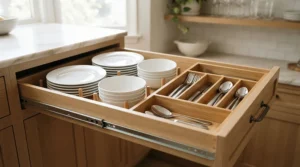
Single Drawer vs Standard Dishwasher: The Honest Comparison
| Factor | Single Drawer | Standard Dishwasher |
|---|---|---|
| Capacity | About 7 place settings | Typically 12–16 place settings |
| Loading | Waist height, minimal bending | Low door, deep bend |
| Footprint | 24 in wide, 16–18 in tall | 24 in wide, about 34 in tall |
| Water use | Around 1.8 gal/cycle (listed) | ENERGY STAR up to 3.2 gal/cycle |
| Flexibility | Run small loads often | Run full loads less often |
| Best For | Couples, singles, secondary kitchens | Families, big hosts |
Capacity is the whole story. A standard machine holds roughly double what a single drawer does, so the drawer is the right tool only if you generate fewer dishes. For a couple, the daily rhythm is the real difference: a drawer fills up in a day or two and runs, while a full-size unit sits half-loaded for days or runs wastefully. The ENERGY STAR Version 7 standard sets a ceiling of 3.2 gallons per cycle for standard units, so the drawer’s lower per-cycle water figure reflects a smaller load rather than a magic efficiency gain.
Based on the comparison above, the drawer wins on ergonomics and flexibility, and loses on raw capacity. If you cook for guests monthly, you can still wash in two batches. If you cook for six every weekend, buy a standard machine or a double drawer.
Practical Setup and Maintenance Guide
Getting the most from a drawer takes a few habits that the product pages never mention.
First-week setup:
- Level the unit and confirm the drawer glides without catching before you slide it into the cabinet.
- Run an empty Normal cycle to flush the lines and check for leaks at the connections.
- Learn the rack: fold the tines flat for pots, raise the cup racks for tall glasses.
Loading tricks:
- Load larger items at the back and keep the spray arm clear. One owner review warns that if anything slips below the rack, the arm won’t spin and dishes won’t get washed.
- Scrape rather than pre-rinse, since the machines are designed to handle food residue.
- Use the cutlery basket for small items, and don’t let utensils nest.
Monthly maintenance:
- Clean the filter and check the spray arm for blockage.
- Wipe the door seal and drawer rails.
- Run a cleaning cycle with a dishwasher cleaner if you notice odor.
Common first-30-day mistakes:
- Overloading the drawer, which blocks spray coverage.
- Using too much detergent in a small tub.
- Ignoring the cycle menu: Rinse, Fast, Delicate, and Heavy exist for a reason, and using Normal for everything wastes the format’s whole point.
Treat the first month as a learning period. Owners who describe a “learning curve” with drawer loading generally come around once they develop a rhythm.
Real-World Scenarios: Which Drawer Fits Which Household?
Three profiles show how the choices play out. These are illustrative reasoning cases, not testimonials.
The city couple in a 650-square-foot apartment. Budget about $1,000 to $1,200, cook most dinners, and own regular dinner plates. The DD24SCTX9N is the sweet spot: the tall tub handles a Dutch oven, and the stainless front needs no extras. The DD24SAX9N would also work if the budget is tight.
The design-conscious couple with an open-plan kitchen and an island. The dishwasher sits within earshot of the sofa, so quiet and looks both matter. The DD24ST4NX9 earns its premium here, with its lowest listed sound level and recessed handle. Budget for plumbing work, since island drainage needs planning.
The hard-water household with a home bar. Glassware is the priority, and mineral spotting is the enemy. The DD24SHTI9N, with its built-in softener and tall panel-ready tub, matches the bar cabinetry and protects the stemware. Budget in the $1,150 to $1,350 range.
A final profile worth noting: single occupants who rarely cook. For them, the DD24SAX9N is plenty, and spending more is wasted. The pattern across all four is that capacity stays constant, so the decision is about environment, noise, and finish.
Long-Term Cost and Maintenance
Sticker price is only the entry fee. Over a decade, energy, water, and repairs determine whether a drawer was a bargain.
On running costs, the listed figures (about 151 to 152 kWh per year and 1.8 gallons per cycle) are low. For comparison, the federal standard for standard-size dishwashers allows up to 307 kWh per year and 5.0 gallons per cycle, and ENERGY STAR Version 7 units use no more than 240 kWh and 3.2 gallons. The drawer’s numbers are measured on a smaller load, so the gap overstates the saving, but the direction is real: small households avoid running a mostly empty big machine.
On repairs, one repair-information site lists typical dishwasher repairs in the $85 to $450 range, and drawer owners report mixed long-term experiences. Some single-person households describe years without issues, while a few reviewers cite reliability complaints and warranty-service friction. Dealers also advertised a promotion in 2026 of up to a 15% rebate plus an extended warranty on qualifying Fisher & Paykel purchases, which can meaningfully improve ownership economics, but verify current terms before relying on it.
The ownership math: a single drawer costs more per place setting than a standard unit, and it earns that back through ergonomics, flexibility, and smart sizing, not through lower sticker price.
Common Mistakes When Buying a Single Drawer Dishwasher
Most regret comes from a handful of avoidable errors.
- Buying for the occasional big dinner. If one party a year drives the purchase, you’re optimizing for the wrong day.
- Skipping the plate measurement. Plate capacity ranges from about 11 to 13 inches, and a mismatch is annoying forever.
- Ignoring plumbing for islands and bars. Drain and venting needs are the usual budget blowout.
- Paying for panel-ready when you won’t use it. If the front shows anyway, the premium is wasted.
- Over-trusting thin reviews. Several of these models have only a handful of retailer reviews, so judge the platform, not one star rating.
- Forgetting the pot problem. Reviewers repeatedly note that large pots and pans are the weak spot, so a tall tub matters if you cook.
The cure is simple: measure first, decide how much dish volume you actually generate, and match the finish to how visible the dishwasher will be.

FAQ
❓ How many place settings does a single drawer dishwasher hold?
❓ Can a single drawer dishwasher replace a standard dishwasher?
❓ Is a single drawer dishwasher good for a kitchen island?
❓ Are drawer dishwashers ADA compliant?
❓ How loud is a single drawer dishwasher?
Conclusion
The drawer format makes a quiet argument: most households of one or two people have been buying more dishwasher than they use. A single drawer dishwasher for small households and couples gives you right-sized capacity, waist-high loading, and the freedom to run small loads without guilt. The tradeoff is honest and simple: about seven place settings, a plate-size ceiling, and a premium per setting.
Here is how the seven break down. The DD24SAX9N is the budget-smart default. The DD24SCTX9N adds the headroom cooks need. The DD24STI9N and DD24SI9N bring panel-ready integration, while the DD24SHTI9N answers hard water. The DD24ST4NX9 is the quiet, connected option, and the DD24SDFTX9N is the choice for oversized plates.
Before you buy, measure your plates, confirm your cabinet width and counter-height install, and check current prices, since they shift often. Match the finish to how visible the machine will be, and match the tub to how you actually cook. Do that, and a drawer will make cleanup the least dramatic part of your evening.
Recommended for You
- App-Controlled Dishwasher With Cycle Notifications: 7 Top Picks 2026
- Third Rack Dishwasher: 7 Best Picks Worth Buying In 2026
- WiFi Dishwasher With Remote Start: 7 Best Picks For 2026
Disclaimer: This article contains affiliate links. As an Amazon Associate, I earn from qualifying purchases. If you purchase products through these links, we may earn a small commission at no additional cost to you.
✨ Found this helpful? Share it with your friends! 💬🤗
