
In This Article
A drawer dishwasher for accessible ADA-compliant kitchens is a built-in dishwasher that pulls out like a cabinet drawer instead of swinging down like a door. Ideally, its controls sit inside the 15-to-48-inch reach band and its loading height cuts bending. Some models carry an ADA label. Others only promise convenience. Knowing the difference matters.
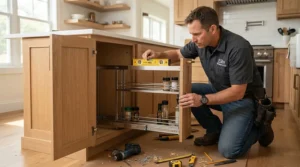
Picture the standard routine. The door drops open like a drawbridge. You crouch. You lift a plate over the lip of a bottom rack that sits near your shins. Repeat until your knees file a complaint. Now picture a seated user attempting the same routine, with a door that lands exactly where the wheelchair needs to go.
That’s the problem a drawer dishwasher for accessible ADA-compliant kitchens is meant to solve. The drawer travels straight toward you. The racks sit near counter height instead of ankle level. On the models that earn the label, the controls fall inside the unobstructed forward reach range of 15 to 48 inches that the Access Board’s operable-parts guide describes.
Here’s the part most roundups skip: the category is small. Fisher & Paykel pioneered the format and still supplies most of it. Café sells a double-drawer alternative. Remodelista noted years ago that KitchenAid, Maytag, and Kenmore had abandoned their drawer attempts. So this guide covers seven real models across those two brands, flags which ones carry an ADA label, and tells you where retailer listings disagree. Prices below are ranges gathered at the time of research, so check current price before you budget.
Quick Comparison: 7 Drawer Dishwashers for Accessible Kitchens at a Glance
| Model | Format | ADA Label (per listings) | Best For |
|---|---|---|---|
| Fisher & Paykel DD24DAX9N | Double | Yes | Households needing a labeled, high-capacity model |
| Fisher & Paykel DD24SAX9N | Single | Yes | Small households and raised-height installs |
| Fisher & Paykel DD24SCTX9N | Single, tall tub | Listings conflict | Full-size dinner plates in a single drawer |
| Fisher & Paykel DD24DCTX9N | Double, tall top drawer | No | Standing users with big platters |
| Fisher & Paykel DD24DI9N | Double, panel-ready | Yes (one listing) | Cabinet-matched accessible kitchens |
| Fisher & Paykel DD24DHTI9N | Double, tall, panel-ready | Verify before buying | Design-forward kitchens with hard water |
| Café CDD420P2TS1 | Double | No | Drawer ergonomics without an ADA requirement |
Reading across the table, only three models clearly carry an ADA label, and the DD24DAX9N is the one that pairs the label with full double-drawer capacity. The tall models trade the label for room (or leave the label unconfirmed), so they suit buyers who want less bending but don’t need a compliance claim. If a label matters to you, treat the “verify” and “conflict” rows as unanswered until the current spec sheet says otherwise.
💬 Just one click — help others make better buying decisions too!😊
Top 7 Drawer Dishwasher Options for Accessible Kitchens: Expert Analysis
Every entry below turns specs into daily-life meaning, and review notes are aggregated sentiment from real retailer and review pages, not hands-on testing.
1. Fisher & Paykel DD24DAX9N Double DishDrawer — ADA-labeled with two independent drawers
The standout is independence: each drawer runs its own program, so a seated user can wash a handful of mugs without launching a full load.
Now the numbers. Each drawer takes seven place settings and plates up to 11 inches, which adds up to 14 settings. Cabinet height adjusts from 32 5/16 to 34 5/8 inches, so an installer can tune the unit to your counter instead of bending your counter to the unit. Noise lands around 43–45 dBA depending on which retailer’s sheet you read, quiet enough for an open-plan room.
Based on the spec comparison, this is the safest starting point for most households that need a manufacturer-labeled ADA model. The top drawer is the star for loading comfort. The lower one is the compromise, since it still asks for a deeper reach. One major retailer’s page shows a 3.5-out-of-5 average, and the common thread is occasional bottom-drawer drainage complaints set against general praise for the two-drawer convenience.
Pros:
- ✅ Manufacturer ADA label on the spec sheet
- ✅ Two drawers run separate programs
- ✅ Adjustable height tunes the final fit
Cons:
- ❌ Lower drawer still needs a deeper reach
- ❌ Some buyers report bottom-drawer drainage issues
Expect roughly $1,650–$2,200 across retailers at the time of research (check current price). Value verdict: the best balance of capacity and labeling here.

2. Fisher & Paykel DD24SAX9N Single DishDrawer — smallest footprint, most placement freedom
At just 16 1/8 inches tall, this single drawer doesn’t have to live in the standard 34-inch slot, and that freedom is the whole point.
Specs, translated: seven place settings, 23 9/16 inches wide, 22 9/16 inches deep, and a 16 1/4-inch cutout height. It runs near 45 dBA with six wash programs and an ADA label. The manufacturer’s literature says it can be installed at an accessible height for loading and unloading, which opens options like an island or a raised cabinet. Confirm the exact cutout and support requirements in the installation guide before anyone picks up a saw.
Here’s the honest take: this is the cleanest route to bend-free loading height and the weakest on capacity. One or two people will be fine. A family that cooks daily will run it twice. I couldn’t find a large body of verifiable single-drawer owner reviews, and most retail pages repeat spec language, so treat performance claims as manufacturer claims for now.
Pros:
- ✅ Manufacturer ADA label
- ✅ Compact enough for raised or island installs
- ✅ True half-load washing without waste
Cons:
- ❌ Seven place settings fill up fast
- ❌ Little independent owner feedback available
Roughly $900–$1,050 at the time of research (check current price). Value verdict: the most affordable accessible drawer in this roundup.
3. Fisher & Paykel DD24SCTX9N Single DishDrawer, Tall — full-size dinner plates in one drawer
The tall tub is built for the chunkier dinnerware that squeezes awkwardly into standard single drawers.
Specs: seven place settings, 44 dBA, six wash programs with three modifiers (retailers count 15 cycle combinations), plus Sanitize, a delicate setting, a cutlery basket, and a child lock. The modifiers matter in practice because Quick, Sanitize, and Extra Dry let you match the wash to the load instead of defaulting to “normal” forever.
The catch is paperwork. One retailer lists this model as ADA compliant, another lists it without that label, and a third spec page includes it in its features. When listings disagree, I’d treat the label as unconfirmed and ask the manufacturer or dealer for the current spec sheet in writing. For households with bigger plates and no formal compliance requirement, the tall tub is a real quality-of-life upgrade over the shorter single.
Reviews are thin. Retail pages mostly echo manufacturer copy, so there’s little aggregated owner sentiment to summarize.
Pros:
- ✅ Tall tub fits full-size dinner plates
- ✅ Sanitize and Extra Dry modifiers
- ✅ Child lock for shared households
Cons:
- ❌ ADA label conflicts across retailer listings
- ❌ Still just seven place settings
Roughly $1,100–$1,450 at the time of research (check current price). Value verdict: a smart single if you confirm the label.
4. Fisher & Paykel DD24DCTX9N Double DishDrawer, Tall — extra-tall top drawer for platters
This one swallows the oversize stuff: Remodelista notes the tall top drawer fits 13-inch plates and serving platters without changing the unit’s exterior dimensions.
Specs: 14 place settings (seven per drawer), 44 dBA, six programs with three modifiers, Sanitize, and a child lock. A retailer lists it as not ADA compliant, and that’s the line to respect.
My analytical read: it’s a good fit for a standing user with back or hip pain who cooks big and wants less stooping, but it isn’t the pick for anyone who needs a labeled accessible install. The extra interior height doesn’t change where the controls or the drawer edge land. A repair-company page lists drainage faults as a frequent service call on this model family, though a repair vendor naturally emphasizes faults, so weigh it as a signal rather than a verdict.
Pros:
- ✅ Top drawer fits 13-inch plates and platters
- ✅ Full 14-setting capacity
- ✅ Quick, Sanitize, and Extra Dry options
Cons:
- ❌ Listed as not ADA compliant
- ❌ Repair shops cite drainage as a common call
Price varies by retailer, so check current price. Value verdict: pick it for capacity and cookware, not for compliance.
5. Fisher & Paykel DD24DI9N Integrated Double DishDrawer — panel-ready for matched cabinetry
If your remodel hides every appliance behind cabinet fronts, this is the model that can disappear into the run.
Specs: Series 9, panel-ready, designed to accept your own cabinet panel or a stainless door-panel accessory, with Professional-style handle kits sold separately. It also has a knock-to-pause feature, so you can tap the front to pause a cycle and add a forgotten fork. One retailer states the double drawer sits at an accessible height and carries the ADA label.
What the spec sheet won’t tell you is the planning cost: panel-ready models pull in a carpenter, a panel decision, and a handle decision. For a wheelchair-accessible kitchen layout where continuous cabinetry keeps sight lines calm, that’s a fair price. For a quick swap, it’s friction. I couldn’t verify a meaningful pool of owner reviews for this exact model, so confirm the label and cutout details on the current spec sheet.
Pros:
- ✅ Accepts custom cabinet panels
- ✅ Knock-to-pause for quick additions
- ✅ ADA label on one retailer listing
Cons:
- ❌ Panel and handle decisions add cost
- ❌ Limited verified owner feedback
Price not verified in my research, so check current price. Value verdict: worth it when cabinetry continuity matters.
6. Fisher & Paykel DD24DHTI9N Integrated Tall Double DishDrawer — built-in water softener, panel-ready
This is the design piece of the lineup, and the only one here with a built-in water softener.
Specs: a tall top drawer for plates up to 13 inches, knock-to-pause, panel-ready finish, and roughly 43 dBA per a dealer listing, in a footprint listed near 34 by 24 by 23 inches. Yale Appliance’s 2026 panel-ready roundup called it the most distinctive pick, buy-it-for-the-drawer-design rather than raw cleaning power. Yale also warned that installation asks more of your installer than a standard dishwasher, and reported a 16.6% service rate for the brand against an 8.8% category average.
Analytically, the water softener is a genuine value-add if you live with hard water, since scale is the quiet enemy of spray arms. But a retailer page leaves the ADA field blank, so verify the label before assuming it. Pair that with the installation warning and the premium price, and this model rewards buyers who plan the project end to end.
Pros:
- ✅ Built-in water softener for hard-water homes
- ✅ Top drawer fits 13-inch plates
- ✅ Panel-ready for seamless cabinetry
Cons:
- ❌ ADA status unclear on retailer pages
- ❌ Higher price and more demanding install
Roughly $2,000–$2,800 across retailers at the time of research (check current price). Value verdict: premium, and worth it only if you need the finish.
7. Café CDD420P2TS1 Double Drawer Dishwasher — standard-height double with a 13-inch top drawer
The standout is simply being the other option: a double drawer from a second brand, built for a standard 24-inch cutout.
Specs: 14 place settings, 34 inches tall, 23 9/16 inches wide, 21 3/4 inches deep, six cycles, three wash options, knock-to-pause, delay start, and a leak sensor. Noise is rated 46 dBA with one drawer running and 49 dBA with both, a few decibels louder than the Fisher & Paykel doubles above. The upper drawer takes 13-inch plates, the lower 11 1/2 inches. Retailers list it as not ADA compliant.
My take: choose it when you want drawer ergonomics but no compliance label is required, or when your dealer network favors Café. Yale reported that Café’s service rate also runs above 16%, so ask about local service before buying. One retailer’s Café drawer category also lists an ADA-labeled model (CDD220P2WS1); verify its format and specs separately, because I couldn’t confirm its details.
Pros:
- ✅ 13-inch top drawer for large plates
- ✅ Fits a standard 24-inch cutout
- ✅ Knock-to-pause and leak sensor
Cons:
- ❌ Listed as not ADA compliant
- ❌ Louder than the F&P doubles with both drawers running
Roughly $1,000–$1,550 across retailers at the time of research (check current price). Value verdict: a fair non-ADA double.
Spec Snapshot: Side-by-Side
| Model | Capacity | Height | Noise | Price Range | Best For |
|---|---|---|---|---|---|
| DD24DAX9N | 14 | 32 5/16–34 5/8 in | 43–45 dBA | $1,650–$2,200 | Labeled double |
| DD24SAX9N | 7 | 16 1/8 in | 45 dBA | $900–$1,050 | Raised installs |
| DD24SCTX9N | 7 | Not verified | 44 dBA | $1,100–$1,450 | Big plates, small home |
| DD24DCTX9N | 14 | Not verified | 44 dBA | Check current price | Platter cooks |
| DD24DI9N | 14 | Not verified | Not verified | Check current price | Panel-ready kitchens |
| DD24DHTI9N | 14 | About 34 in | About 43 dBA | $2,000–$2,800 | Hard-water remodels |
| CDD420P2TS1 | 14 | 34 in | 46/49 dBA | $1,000–$1,550 | Non-ADA double |
The pattern is clear: labeled models cluster at the low end of the height range or come as singles, while tall tubs buy capacity at the cost of the label. If the “not verified” cells bother you, good, because they should; ask your dealer for the current data sheet for any model you’re seriously considering.
ADA Reach Range Requirements: What the Numbers Mean for a Drawer Dishwasher
Start with scope. The 2010 ADA Standards govern covered facilities, so for a private single-family home they generally work as a design benchmark rather than a legal mandate. As a benchmark, they’re excellent.
The headline numbers: operable parts must sit between 15 and 48 inches above the floor for an unobstructed forward reach, and side reach uses the same 15-to-48-inch window. When a counter is in the way, the Access Board’s guide allows a maximum 48-inch reach height if the reach depth is 20 inches or less, dropping to 44 inches for depths up to 25 inches. A 30-by-48-inch clear floor space is the baseline footprint at each appliance. For dishwashers specifically, section 804.6 of the 2010 ADA Standards adds two rules: clear floor space sits adjacent to the dishwasher door, and the open door can’t obstruct the clear floor space for the dishwasher or the sink.
What does that mean for a drawer? The standard regulates controls, not racks. A drawer unit with top-front controls installed in a roughly 34-inch slot places those controls well within the 15-to-48-inch band. So ADA reach range requirements are the easy part for a drawer dishwasher. The harder part is the floor space, because a drawer travels into the same zone a hinged door would sweep. Ask your installer or local code official how they’ll treat that travel.

Bend-Free Loading Height: Why Drawers Change the Math
Here’s the thing the ADA doesn’t write down: there’s no number for how high your dishes should sit. Bend-free loading height is a design choice, and it’s where drawers shine.
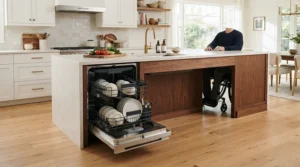
In a standard dishwasher, the lower rack sits low enough that loading means folding at the waist, over and over. In a double drawer, the top drawer sits just beneath the counter edge, so it’s the bend-free zone. The bottom drawer is the compromise. A single drawer changes the equation entirely. At about 16 inches tall, the DD24SAX9N can be positioned at an accessible height per manufacturer literature, so both a standing user and a seated user can load without stooping.
For seated users, depth matters as much as height. Drawer interiors run about 22 inches deep, and reaching over a counter lip to the back of a drawer pushes against the same reach-over-obstruction limits the Access Board describes. The practical fix is almost boring: load heavy plates and bowls toward the front, and save the back corners for light items like cups.
Single vs Double Drawer Dishwasher: Which Fits Your Kitchen
The short answer to “single vs double drawer dishwasher: which fits your kitchen” is household size and floor plan. A single drawer holds seven place settings. A double holds 14, split across two independently running drawers.
For one or two people, a single is often enough, and it’s cheaper (roughly $900–$1,450 in this research versus about $1,000–$2,800 for doubles). Its small height also lets you place it somewhere a double can’t go, like a raised island cabinet. For three or more people, or anyone who entertains, a double is the safer bet. It fills a standard 24-inch opening, and the independent drawers mean you can run a delicate load in one and a heavy load in the other.
Consider a third path: two stations. A single drawer at an island next to the prep zone, plus a standard unit elsewhere, gives a seated cook a bend-free spot without sacrificing family-size capacity. It costs more and needs more planning, but it’s a rare design where accessibility and capacity both win.
One caveat on water and energy: one design write-up notes that per-drawer consumption is lower than a regular dishwasher, but running a single repeatedly can erase that. Match the drawer to the load, not the other way around.
Drawer Dishwasher vs Standard Dishwasher: Cost, Capacity, and Installation Tradeoffs
Drawers sell ergonomics. Standard units sell capacity and a bigger service network. Here’s how the drawer dishwasher vs standard dishwasher: cost, capacity, and installation tradeoffs line up.
| Factor | Drawer (Double) | Standard Dishwasher | Best For |
|---|---|---|---|
| Upfront cost | About $1,000–$2,800 | Varies widely by model | Standard for tight budgets |
| Capacity | 14 place settings (7 per drawer) | Often 14–16 place settings | Standard for big households |
| Loading | Pull-out, top drawer near counter height | Door and deep racks, more bending | Drawer for bend-free loading |
| Installation | Reported as more demanding | Familiar to most installers | Standard for simple swaps |
| Service history | Yale reported 16.6% service rate for F&P vs 8.8% category average | Broad, mature network | Standard for lowest risk |
The analysis is simple: if your priority is the lowest-risk, highest-capacity appliance, a standard dishwasher usually wins. If your priority is a comfortable loading position and flexible half loads, a drawer wins, and you pay for it in upfront cost and installer scrutiny. Standard ADA-height options exist too. One retailer guide lists Cove’s 24-inch ADA-height dishwasher, which is worth comparing if you want a conventional door but a lower stance.
Wheelchair-Accessible Kitchen Layout: Where the Drawer Goes
A great appliance in the wrong spot is still a bad kitchen. Use this short guide to plan a wheelchair-accessible kitchen layout around your drawer.
- Anchor the clear floor space. Keep 30 by 48 inches at the dishwasher. The Standards permit clear floor spaces at appliances to overlap, so placing the dishwasher beside the sink lets one patch of floor serve both.
- Measure the drawer’s travel. The code language was written with hinged doors in mind. Pull-out depth isn’t something I could verify across these models, so read the installation guide and leave extra floor depth.
- Add a landing zone. Put counter space immediately beside the drawer to stage plates. A seated user shouldn’t have to carry dishes across the aisle.
- Mind the turning space. Accessibility guidance commonly cites a 60-inch turning circle or equivalent T-turn. Don’t tuck the dishwasher into a corner that eats it.
- Center the unit. Some codes also ask for appliance centerlines to align with the clear space, so ask your inspector.
Treat this as a planning aid, not code advice. Your local jurisdiction has the final word.
How to Choose a Drawer Dishwasher for Accessible ADA-Compliant Kitchens
The best choice depends on your reach, your household size, and whether you need a compliance label. Work through these steps in order:
- Decide whether you need the label or just the benefits. For a covered facility or a Type A unit, you need the label and documentation. For a private home, the benefits may be enough.
- Set your loading height. Measure the highest and lowest points you can comfortably reach. Aim to keep the drawer’s loading edge inside that range.
- Pick single or double by household size. Singles (seven settings) fit one to two people. Doubles (14) fit families.
- Verify the label yourself. Retailer pages disagree on models like the DD24SCTX9N and leave fields blank on the DD24DHTI9N. Ask for the current spec sheet.
- Plan floor space and drawer travel. Confirm 30 by 48 inches plus the drawer’s pull-out depth.
- Choose finish and panel needs. Panel-ready models like the DD24DI9N add carpentry and handle decisions.
- Price the service plan. Ask about local technicians and warranty terms before you commit.
Features matter less than fit. Sanitize, delay start, and knock-to-pause are pleasant, but none of them changes whether you can reach the controls.

Real-World Scenarios: Three Households, Three Picks
These are hypothetical profiles, built from the specs above.
Scenario 1: The compact-kitchen power-chair user. One person, an 8-foot galley kitchenette, a budget around $1,000–$1,500, and daily use. The DD24SAX9N at an accessible height fits the footprint and the budget, and seven place settings suit one person who runs a load every day or two. The trade-off is larger pots, which will need hand-washing.
Scenario 2: The family of four with one wheelchair user. Four people, cooking most nights, a $2,000-ish budget, and a labeled model required. The DD24DAX9N delivers 14 settings plus the ADA label, with the top drawer at the most comfortable height for the seated user and the lower drawer for the standing family members’ heavier loads.
Scenario 3: The design-led remodel in a hard-water area. A new kitchen with panel-ready cabinetry, a larger budget, and mineral buildup concerns. The DD24DHTI9N brings a built-in water softener and a seamless front, provided you verify the ADA status first and budget for a careful install. If you’d rather keep it simpler, the DD24DI9N is the labeled panel-ready alternative.
Setup, First 30 Days, and Maintenance Tips
Treat this as a habit guide, not an installation manual. The manufacturer’s installation guide always governs the actual install.
- Day 1: Have the installer level the unit, check the drain hose for kinks, and run a short cycle while you watch for leaks.
- Week 1: Watch drainage. Repair resources list a blocked filter plate, a kinked hose, or debris at the pump as the usual suspects when a DishDrawer-style unit won’t drain.
- Weeks 2–4: Make sure nothing blocks the spray arm. One owner review noted the drawer performs well as long as the spray arm moves freely.
- Monthly: Clean the filter, wipe the door seals, and run a hot cycle when the machine smells stale.
Check the user guide for detergent recommendations, since I couldn’t verify one rule across all models. One parts retailer suggests DishDrawer-style units commonly last about 10 to 15 years with basic maintenance, which gives you a reason to build the filter habit early.
Common Mistakes When Buying a Drawer Dishwasher
Mistake 1: Assuming a label equals a compliant kitchen. A labeled appliance is one piece. The kitchen still needs the clear floor space and a door-or-drawer path that doesn’t block it. A city of Gig Harbor memo on Type A kitchens spells out the same adjacent-clear-floor-space rule for dishwashers, and it also lists an adjustable work surface between 29 and 36 inches.
Mistake 2: Buying the tall model by accident. The DD24DCTX9N and DD24SCTX9N share names with labeled siblings but not labels. Check the model number letter by letter.
Mistake 3: Ignoring drawer travel. Aisles that clear a hinged door can pinch a drawer.
Mistake 4: Skipping the service conversation. With service rates above category average reported for both brands, local technician availability is part of the purchase.
Mistake 5: Overbuying capacity. A double for a one-person home often means half-empty drawers.
Long-Term Cost, Reliability, and Service
Count more than the sticker. Doubles ran roughly $1,000–$2,800 here, installation can cost more than a standard swap (Yale called the drawer more demanding to install), and service history is the wild card.
The evidence is mixed. Yale reported a 16.6% service rate for Fisher & Paykel versus an 8.8% category average, and said Café also runs above 16%. Consumer Reports’ older member survey (2007–2017, 74,880 buyers) rated Fisher & Paykel drawers poor for predicted reliability, though Remodelista later reported repair rates down and ratings up. Australian owner reviews of the 60 cm sibling models include complaints about control boards and drainage, which is regional but worth knowing. One Bay Area repair shop quotes $100–$250 for drain repairs, a vendor-sourced figure.
Do the math honestly. A $2,000 double that lasts 10 to 15 years costs about $135–$200 per year before repairs. Retailer pages in 2026 also describe a manufacturer rebate and extended-warranty program on qualifying purchases, so confirm terms before you buy.
FAQ: Drawer Dishwashers for Accessible Kitchens
❓ Which drawer dishwasher models carry an ADA label?
❓ How much does a drawer dishwasher cost in 2026?
❓ Will a double drawer fit my existing 24-inch cabinet opening?
❓ Can I run just one drawer to save water?
❓ Can a drawer dishwasher be panel-ready for custom cabinets?
Conclusion
A drawer dishwasher for accessible ADA-compliant kitchens won’t fix a badly planned kitchen, but in the right spot it removes one of the most repetitive bends in the home. Here’s the short version. Start with the DD24DAX9N if you want a manufacturer-labeled double. Choose the DD24SAX9N if you want the cleanest route to bend-free loading height in a small household. Move to the DD24DI9N or DD24DHTI9N when matched cabinetry is the goal, and verify their labels first. The DD24SCTX9N and DD24DCTX9N offer more room but not a confirmed label. And the Café CDD420P2TS1 is the alternative when no label is required.
The honest caveats: the category is narrow, reliability data is mixed, and retailer listings sometimes disagree with each other. So verify the label, measure the drawer’s travel, and ask about service before you buy.
🚀 Ready to make dish duty easier?
Check current pricing and availability on the models above, and choose the one that fits your reach, your layout, and your household. Your kitchen should work for everyone who uses it!
Recommended for You
- Single Drawer Dishwasher For Small Households And Couples: 7 Top 2026
- App-Controlled Dishwasher With Cycle Notifications: 7 Top Picks 2026
- Third Rack Dishwasher: 7 Best Picks Worth Buying In 2026
Disclaimer: This article contains affiliate links. As an Amazon Associate, I earn from qualifying purchases. If you purchase products through these links, we may earn a small commission at no additional cost to you.
✨ Found this helpful? Share it with your friends! 💬🤗
