

In This Article
What is a Bosch dishwasher for quiet kitchens? It is a built-in model from Bosch’s 100, 300, 500, 800 or Benchmark lines that runs at roughly 38 to 50 dBA. Insulation, tub design and sensor-driven wash cycles keep the noise down, so conversation, TV and sleep carry on while the dishes get clean.

Here’s the thing about open-plan living. The dishwasher stopped being a background appliance the day walls came down. It now sits eight feet from your sofa, and it has opinions. Run a loud one at 8 p.m. and you’re pausing the movie. Run it at midnight and you’re a bad neighbor to your own family.
For context, a soft whisper sits around 30 dBA and normal conversation lands near 60, according to this common noise level reference. Bosch’s lineup lives in the narrow band between those two, and that’s why the brand dominates the “quiet” conversation.
But “Bosch” isn’t one machine. It’s five tiers, a dozen handle and panel variations, and a spec sheet full of acronyms. A 38 dBA Benchmark and a 48 dBA 100 Series both wear the same logo, and they don’t feel the same at 2 a.m.
This guide sorts it out. You’ll get seven real models, honest spec interpretation, a plain-English look at Bosch noise levels in dBA, and a head-to-head on Miele vs Bosch dishwasher for long-term reliability. Everything here is built from published specs and aggregated owner reviews, not hype. Prices appear as ranges because they move constantly, so check current price before you buy.
Quick Comparison: 7 Bosch Models at a Glance
| Model | Noise (dBA) | Tub / Drying | Price Range | Best For |
|---|---|---|---|---|
| Bosch Benchmark SHP9PCM5N | 38 | Stainless steel tub / CrystalDry | Around $1,800-$2,000 | Silence-obsessed buyers |
| Bosch 800 Series SHP78CM5N | 42 | Stainless steel tub / CrystalDry | $1,400-$1,600 range | Best all-rounder |
| Bosch 800 Series SHV78CM3N | 42 | Stainless steel tub / CrystalDry | $1,400-$1,600 range | Panel-ready kitchens |
| Bosch 500 Series SHPM65Z55N | 44 | Stainless steel tub / AutoAir | Around $1,000-$1,200 | Sweet-spot value |
| Bosch 300 Series SHEM63W55N | 44 | Stainless steel tub / PureDry | Around $900-$1,000 | Budget-minded quiet |
| Bosch 100 Series SHE4AEM2N | 48 | Hybrid tub / PureDry | Around $700-$800 | Tightest budgets |
| Bosch 800 Series SPX68B55UC | 44 | Stainless steel tub / 3rd rack | Check current price | Compact, ADA-friendly spaces |
The pattern is clear if you read down the noise column. Every step up in price buys a few decibels of silence, and the biggest jump in drying tech comes at the 800 tier and above. If you want the quietest possible machine, the Bosch Benchmark SHP9PCM5N is the answer on paper. If you want the best balance of cleaning, drying and calm, the Bosch 800 Series SHP78CM5N is the one to beat.
Budget buyers should note that the Bosch 100 Series SHE4AEM2N gives up the most on noise and drying. The Bosch 300 Series SHEM63W55N is often the smarter place to stop spending.
💬 Just one click — help others make better buying decisions too!😊
Top 7 Bosch Dishwasher for Quiet Kitchens: Expert Analysis
1. Bosch 800 Series SHP78CM5N — best all-rounder for open-plan homes
Open-concept kitchens are where this model makes its case. It’s rated at 42 dBA, and it pairs that low rumble with a flexible third rack and 8 wash cycles. Capacity is 16 place settings.
The spec that matters most beyond noise is CrystalDry, Bosch’s zeolite-based drying. Zeolite pulls moisture out of the air and releases heat, which is why plastics, the usual dishwasher casualty, come out far drier than with condensation-only systems. The PrecisionWash sensor system with PowerControl adjusts the wash to the load, so you don’t have to guess at cycles.
On paper, this is the machine that spares you the “quiet but still wet” compromise. Reviewed named it its best overall dishwasher, rating it 4.7 and praising its stain removal and fast cycles. Owners consistently mention quiet operation and cleaning, though a minority report that the drying option has to be switched on deliberately.
Pros:
- ✅ 42 dBA is genuinely hard to hear
- ✅ CrystalDry handles plastics well
- ✅ Flexible third rack and Home Connect
Cons:
- ❌ Premium price over the 500 Series
- ❌ Some owners must enable extra drying manually
Expect roughly the $1,400-$1,600 range. Verdict: the best value among the top-tier options, provided you’ll use the third rack and drying.
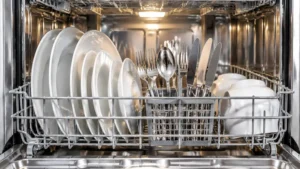
2. Bosch Benchmark SHP9PCM5N — quietest in the lineup at 38 dBA
Four decibels doesn’t sound like much. Yet 38 dBA sits at the very bottom of what Bosch sells, and it’s the number that earns this machine its place at the top of the hierarchy. Bosch’s own spec page lists it at 38 dB(A), with 16 place settings, 9 wash cycles and a sanitize option.
What does that mean in practice? The sound energy at 38 dBA is under half that of 42 dBA, though your ear perceives the gap as modest rather than dramatic. One owner mentioned a build weight above 120 lbs, which hints at the extra insulation behind the quiet. That’s an owner’s observation, so treat it as a hint rather than a spec.
You’re paying for the last few decibels, a sturdier feel and the Benchmark feature set. That’s a luxury purchase, and it should be framed as one. Owner sentiment skews strongly positive on noise (“extremely quiet” is a common phrase). A handful report drying disappointments or reliability troubles, so the premium doesn’t guarantee a flawless experience.
Pros:
- ✅ Lowest published noise rating in the Bosch lineup
- ✅ CrystalDry, third rack and sanitize option
- ✅ Premium build quality noted by owners
Cons:
- ❌ Costs far more per decibel gained
- ❌ A few owners report drying or reliability issues
Expect around $1,800-$2,000. Verdict: worth it only if silence is the top priority and the budget has room.
3. Bosch 800 Series SHV78CM3N — panel-ready for seamless cabinetry
Some kitchens hide their appliances, and this is Bosch’s answer for them. It’s the same core as the Bosch 800 Series SHP78CM5N: 42 dBA, 16 place settings, 8 wash cycles, a sanitize cycle and PrecisionWash. The difference is that it accepts a custom cabinet panel, so the dishwasher disappears into the cabinetry.
That design choice has a practical upside people overlook. Because the front blends into the cabinet run, you lose the visual clutter of a stainless door. And because the machine is so quiet, you also lose the audio clutter. The kitchen starts to feel finished rather than furnished with appliances.
There’s a caveat worth raising with your installer. The custom panel adds weight and changes how the door hangs. The published rating doesn’t isolate the effect of a heavy panel on noise, so ask how your cabinet maker plans to mount it.
Reviewer data is thinner for this exact SKU, so what follows reflects the broader 800 Series owner sentiment. Buyers consistently praise quiet performance and cleaning, with drying the occasional sore point.
Pros:
- ✅ 42 dBA with a fully hidden front
- ✅ Same CrystalDry and third rack as its siblings
- ✅ Home Connect support for remote control
Cons:
- ❌ Panel and installation add cost
- ❌ Thin SKU-specific review data
Expect the $1,400-$1,600 range before panel costs. Verdict: the right call for custom-cabinet kitchens, an unnecessary spend otherwise.
4. Bosch 500 Series SHPM65Z55N — sweet-spot value with a roomy third rack
The 500 Series has a loyal following because it avoids both extremes. It’s rated at 44 dBA, offers 16 place settings, and includes AutoAir drying, which cracks the door at cycle’s end to let steam escape. Reviewed describes it as whisper-quiet, with noise comparable to library ambience, and it praised the third rack’s unusually high clearance.
AutoAir is the spec to understand. Instead of zeolite, it relies on a door that opens a few inches at the finish. That works, but it’s less powerful on plastics than CrystalDry, which explains why a few owners complain about leftover moisture. Cycles include Heavy, Auto, Normal, Speed60 and Rinse, plus InfoLight, a beam that shows on the floor so you know it’s running.
That beam matters more than it sounds. When a dishwasher is this quiet, you can’t tell if it’s on. If you’ve ever opened one mid-cycle by accident, you’ll appreciate the visual cue.
Note that some retailers list this exact model as discontinued, with a newer 500 Series sibling (the SHP65CM5N, also 44 dBA) as its replacement. Verify what’s available before you commit.
Pros:
- ✅ Whisper-quiet 44 dBA
- ✅ Tall, flexible third rack
- ✅ InfoLight confirms it’s running
Cons:
- ❌ AutoAir drying is weaker on plastics
- ❌ May be phased out at some retailers
Expect around $1,000-$1,200. Verdict: the best “I want it quiet and I don’t want to overspend” choice.
5. Bosch 300 Series SHEM63W55N — proven quiet on a leaner budget
Here’s the unglamorous workhorse. The 300 Series offers 44 dBA, 5 wash cycles, 16 place settings, PureDry condensation drying, a stainless interior and a third rack. Bosch quieted the line to 44 dBA in 2017 from 46, a detail that shows how the brand keeps trickling its premium engineering downward.
What you give up is polish. The filter is manual-clean, the cycle list is shorter, and there’s no zeolite magic. But the sound isn’t compromised, and that’s the headline for anyone shopping specifically for a quiet machine.
Aggregated reviews are warm. Looria’s review aggregator gave it an A grade across 79 reviews, highlighting cleaning, reliability and “no repairs needed so far.” Best Buy summaries point to quiet operation, good cleaning and appreciation for the third rack.
One practical flag: some retailers now list this model as discontinued or replaced, so confirm the current successor before buying.
Pros:
- ✅ Same 44 dBA as the pricier 500 Series
- ✅ Strong aggregated owner sentiment
- ✅ Stainless interior and third rack
Cons:
- ❌ Fewer cycles and no zeolite drying
- ❌ Manual-clean filter requires upkeep
Expect around $900-$1,000. Verdict: arguably the smartest dollar-per-decibel purchase in the lineup.

6. Bosch 100 Series SHE4AEM2N — entry ticket to the Bosch family
This is where the noise story gets honest. The 100 Series Plus is rated at 48 dBA, and some 100 Series variants carry a 50 dBA rating. That’s noticeably louder than the 800 Series, though one budget roundup rightly notes that it’s still quieter than many competitors at the price.
Here’s the nuance. The 100 Series uses a hybrid tub, meaning part of the bottom is plastic rather than stainless steel. One reviewer specifically noted a little more noise than the 300 Series and up because of the plastic base and lighter insulation. You also get 14 place settings, two racks and PureDry drying, plus PrecisionWash sensors on this “Plus” model.
Owner sentiment is split in a predictable way. Many praise the quiet, cleaning and value, particularly for open-concept homes on a budget. Others report weak drying, and a few describe early failures or note it’s small for a large family.
Pros:
- ✅ Lowest entry price in the Bosch lineup
- ✅ Still quiet by competitive standards
- ✅ Includes PrecisionWash sensors
Cons:
- ❌ Hybrid tub is louder than stainless
- ❌ Drying draws frequent complaints
Expect around $700-$800. Verdict: fine for secondary kitchens, but a poor match if silence is your reason for buying.
7. Bosch 800 Series SPX68B55UC — compact 18-inch ADA-friendly option
Not every kitchen has 24 inches to spare. This 18-inch model carries the 800 Series badge, a third rack and a 44 dBA rating, and it’s marketed as ADA-compliant for accessible kitchens.
The trade-off is physics. A narrower tub holds fewer place settings than the 24-inch siblings, so it suits couples, apartments and accessible installations better than a family of five. In return you get the quiet and the sensor tech in a footprint that fits where standard units can’t.
I couldn’t verify deep review sentiment for this specific model, only a perfect rating on a single blog roundup, which isn’t enough to draw conclusions. Treat it as a spec-based pick and read recent owner reviews before buying.
Pros:
- ✅ Fits narrow and accessible spaces
- ✅ 44 dBA with third rack
- ✅ Stainless interior
Cons:
- ❌ Notably smaller capacity
- ❌ Limited verified owner feedback
Check current price, since compact models vary. Verdict: a niche solution that’s brilliant when you need it.
Bosch Noise Levels in dBA: What the Numbers Actually Sound Like
A decibel rating is the most quoted and most misunderstood number on a spec sheet. So let’s translate it.
First, dBA is A-weighted, meaning it emphasizes the frequencies human ears are most sensitive to. It’s the standard on appliance listings. Second, the scale is logarithmic. Every 3 dB roughly doubles the acoustic energy, while about 10 dB is what most people perceive as “twice as loud.”
Apply that to Bosch. The gap between the 38 dBA Benchmark and the 42 dBA 800 Series is four decibels. That’s a bigger physical difference than it sounds like, but a modest one to your ears. The leap from 42 to 50 dBA, from an 800 Series to some 100 Series variants, is far more noticeable. Reviewed’s quiet-dishwasher coverage makes a related point about balancing noise against cleaning performance, noting that the 800 Series isn’t the absolute quietest but is the best overall.
There’s also a counterintuitive truth worth repeating. Yale Appliance’s 2026 comparison argues that all three major premium brands sell models at or below 44 dB, so using decibels alone to choose between brands means optimizing the wrong variable. Within Bosch, though, decibels still separate tiers.
A practical translation:
- 38-42 dBA: effectively inaudible beyond the room’s ambient noise
- 44 dBA: a soft hum you notice only in a silent house
- 48-50 dBA: audible, like a quiet conversation across the room
Also remember that rugs, cabinet density, flooring and where your sofa sits all change what you perceive. A rating is measured in a lab, not in your kitchen. Read more in Reviewed’s quiet dishwasher guide, which compares real-world noise against cleaning.
The PrecisionWash Sensor System: Smarter Cleaning, Quieter Cycles
The PrecisionWash sensor system is Bosch’s marketing name for sensors plus powerful spray arms that evaluate each load and adjust the wash accordingly. Retailers describe the promise simply: start the dishwasher and walk away.
Why does that matter for a quiet-focused buyer? Because a smarter wash means fewer repeat cycles and fewer manual re-runs. The best noise reduction is the cycle you don’t have to start again.
Here’s what the sensors do in practice, based on Bosch’s published descriptions. They gauge how soiled the dishes are, then tune water usage and wash intensity to match. On the 800 Series, this is paired with PowerControl, which gives focused spray power on stubborn zones.
The honest limitation: Bosch doesn’t publish a public, itemized account of how every sensor decision is made. So the practical takeaway is behavioral, not technical. Load sensibly, trust the Auto cycle for most loads, and reserve Heavy for baked-on pans.
One more point. Because the PrecisionWash sensor system adjusts rather than blasts, an Auto cycle on a lightly soiled load typically runs gentler. Owners who describe “no more pre-rinsing” are describing exactly this payoff. That said, a few buyers report that sensor-driven cycles can run longer than expected, which is a trade-off worth planning around if you run the machine at bedtime.
Stainless Steel Tub: Why It Matters for Noise and Drying
The tub is the quiet hero of this whole story. A stainless steel tub does two things that plastic can’t match.
First, it absorbs and minimizes the sound of spraying water. Reviewed’s coverage of the 500 Series specifically credits the stainless steel tub for muffling spray noise. Second, it retains heat better, which aids drying and hygiene.
That’s why the tub material is a dividing line in the lineup. The 300, 500, 800 and Benchmark models use stainless steel tubs. The 100 Series uses a hybrid, with a plastic base and less insulation underneath, which one owner flagged as the reason it’s a little louder than the 300 and up.
Stainless also resists staining, odor absorption and warping from heat. Bosch’s warranty documentation, as listed by retailers, includes a limited warranty against rust-through on the inner tub liner, though terms vary, so read the exact coverage for your model.
The one trade-off: stainless is heavier and costlier. That’s partly why the Benchmark reportedly weighs more than the lighter units. For anyone building a Bosch dishwasher for quiet kitchens setup, the tub is the single most important material choice. Pay for it if you can.
Bosch 800 Series vs 500 Series Dishwasher: Which Is Worth Buying
This is the question that stalls more shoppers than any other, because the price gap is real and the noise gap is small. Here’s the head-to-head.
| Feature | Bosch 800 Series SHP78CM5N | Bosch 500 Series SHPM65Z55N |
|---|---|---|
| Noise rating | 42 dBA | 44 dBA |
| Drying | CrystalDry (zeolite) | AutoAir (door opens) |
| Sensors | PrecisionWash with PowerControl | PrecisionWash-class sensors |
| Third rack | Flexible | Flexible, tall clearance |
| Wi-Fi | Home Connect | Varies by model |
| Price range | $1,400-$1,600 | Around $1,000-$1,200 |
| Best For | Plastics and busy families | Value-focused quiet |
The Bosch 800 Series SHP78CM5N wins on drying, which is where the real-world gap lives. If your household uses lots of plastic containers, travel mugs and kids’ cups, CrystalDry is a daily-life upgrade. The two decibels of extra quiet are a bonus rather than the headline.
The Bosch 500 Series SHPM65Z55N is the pick when the budget is firm and your dishes are mostly glass, ceramic and metal. Reviewed itself said that if you don’t mind spending more, the 800 Series is its top-rated pick, which frames the choice nicely: the 500 is excellent, the 800 is better.
My take, framed as reasoning rather than testing: spend the extra for the 800 Series if drying matters to you, and save the cash with the 500 Series if it doesn’t. That answer is the whole story behind Bosch 800 Series vs 500 Series dishwasher: which is worth buying.
✨ Don’t Miss These Exclusive Deals!
🔍 Take your quiet kitchen to the next level with these carefully selected Bosch models. Click on any highlighted item to check current pricing and availability. These dishwashers will help you enjoy peaceful dinners and silent late-night cycles your whole family will love!
Miele vs Bosch Dishwasher for Long-Term Reliability
Reliability is where opinions harden, so let’s lay out what the evidence says, and where it disagrees with itself.
| Factor | Bosch | Miele |
|---|---|---|
| Typical price range | About $900-$2,000 | About $1,100-$4,000 |
| Commonly cited lifespan | Roughly 7-14 years | Often cited 14-20 years |
| Noise | Very quiet (38-50 dBA) | Extremely quiet |
| Service/repair costs | Generally lower | Generally higher, specialist parts |
| Best For | Value-minded families | Buyers staying 15+ years |
Start with the strongest claim for Miele. Several appliance resources cite lifespans of 15 to 20 years for Miele, versus 8 to 10 years for Bosch, and attribute that to Miele’s control over component manufacturing. Yale Appliance’s 2026 comparison reports a 5.6% service rate for Miele, the lowest it tracks, against 8.2% for Bosch overall, which it attributes largely to the M-Series.
Now the counterweight. Reviewed’s reliability ranking puts Bosch first for the lowest repair rates, with Miele a close second. One repair-industry comparison reported 5.9% of Bosch units and 6.2% of Miele units needing service in year one, a near tie. A survey of appliance repair companies in the same article found most naming Bosch as the most reliable. And Bosch is typically cheaper per repair, since parts and technicians are plentiful.
So how do you reconcile this? Lifespan claims are estimates, not guarantees, and different sources count differently. The fair reading is that Bosch wins on cost and availability of service, Miele wins on projected longevity, and both are strong. A repair-company source summed it up: the 800 Series delivers a large share of Miele’s performance at far lower cost, while Miele suits those planning 15+ years in one home.
If you want the full lens on Miele vs Bosch dishwasher for long-term reliability, read Reviewed’s reliability rankings alongside your own repair-cost tolerance.
How to Choose a Bosch Dishwasher for Quiet Kitchens
Here’s a seven-step shortcut. Each step carries the reasoning behind it.
- Set your noise ceiling first. If your kitchen is open to a living room or bedroom, target 42 dBA or lower. Under walls and doors, 44 dBA is plenty.
- Check the tub material. A stainless steel tub quiets spray noise and holds heat. Avoid hybrid tubs if silence is the goal.
- Match the drying to your dishes. Heavy plastic users should favor CrystalDry (800 Series and Benchmark). Glass and ceramic households can live with AutoAir or PureDry.
- Pick capacity honestly. Sixteen place settings suit families, while 14 or fewer suit couples. Compact 18-inch units hold even less.
- Decide on controls and handle. Top-control, pocket-handle models hide buttons. Front-control models show them. Panel-ready models vanish entirely.
- Weigh smart features. Home Connect lets you start and monitor cycles remotely, which is handy for scheduling a late-night run.
- Confirm availability and warranty. Some listed models are discontinued or replaced at certain retailers, and warranty terms list as one year, with longer parts coverage on some components.
If you remember nothing else, remember this: tub, drying and decibels, in that order.

Common Mistakes When Buying a Bosch Dishwasher
Most regret comes from a short list of avoidable errors.
Chasing the lowest number blindly. The difference between 38 and 42 dBA is real in physics and subtle in ears. Paying roughly $500 more for four decibels suits some buyers and is overkill for many.
Ignoring drying until it’s too late. Owner complaints cluster around drying more than noise. If your dishes come out wet, the machine will feel like a failure even if it’s silent. Match drying tech to your dishes.
Buying the model number without checking successors. Bosch rotates SKUs constantly. Check the exact model on the retailer’s page, and don’t assume a review of one letter-and-number combo applies to its sibling.
Skipping the install details. Water line, drain height and cabinet cutout all matter. Cabinet width is typically 24 inches for standard models, with specific cutout dimensions in the spec sheet.
Treating the dBA sticker as gospel. Lab ratings differ from living rooms. Rugs, hard floors and cabinet resonance change what you hear.
Assuming “quiet” means “gentle.” A quiet machine can still run long cycles. If bedtime schedules matter, check cycle durations too.
Practical Usage Guide: Setting Up and Keeping a Bosch Dishwasher Quiet
A quiet machine stays quiet only if you treat it right. Here’s a maintenance playbook that Amazon listings never provide.
First 30 days:
- Run the first cycle empty with a dishwasher cleaner to flush manufacturing residue.
- Level the unit. A tilted dishwasher rattles and defeats the engineering.
- Fill the rinse aid dispenser. It improves drying, especially on models without zeolite.
- Load heavy items on the lower rack, facing the spray arms, with nothing blocking rotation.
Weekly and monthly:
- Check the filter. Many models have a manually cleaned filter, and a clogged one lengthens cycles and increases noise.
- Wipe the door gasket to prevent odor and residue.
- Run a monthly hot cleaning cycle with a descaler, especially in hard-water areas.
Optimization tricks:
- Use Auto for typical loads, so the sensors can do their job.
- Enable extended drying when running plastics, since owners note some dishes stay damp otherwise.
- Crack the door after the cycle on non-zeolite models to speed drying.
- Use InfoLight, where available, to confirm the cycle is still running.
Common first-month mistakes:
- Overloading the third rack with items that block spray arms
- Using too much detergent, which causes cloudiness and residue
- Forgetting to refill rinse aid
- Running a cycle with a loose spray arm
Keep these habits and your Bosch dishwasher for quiet kitchens will stay quiet for years rather than quietly degrade.
Real-World Scenarios: Matching the Right Bosch to Your Kitchen
Specs are abstract. Profiles are useful. Here are three buyer scenarios, reasoned from the data.
Scenario 1: The open-plan family of five. Budget is flexible, the kitchen flows into the living room, and the household uses plastics daily. The Bosch 800 Series SHP78CM5N is the logical pick. CrystalDry handles the sippy cups, the 16 place settings handle the volume, and 42 dBA means movie night survives a wash cycle.
Scenario 2: The renovator with custom cabinetry. A designer kitchen, a hidden-appliance aesthetic and a willingness to pay for finish. The Bosch 800 Series SHV78CM3N disappears behind a panel, while the Bosch Benchmark SHP9PCM5N is the splurge if the owner also wants the lowest published noise. Confirm panel installation details with the cabinet maker.
Scenario 3: The first-home couple on a budget. A small kitchen, a modest budget and a desire for quiet. The Bosch 300 Series SHEM63W55N offers the same 44 dBA as pricier models, with a stainless interior and a third rack. If it’s discontinued at their retailer, they should check the current successor rather than defaulting to the louder Bosch 100 Series SHE4AEM2N.
Notice the pattern. Nobody needs the most expensive model; they need the right one.
Long-Term Cost & Maintenance: What You’ll Really Pay
Purchase price is only the entry fee. Total cost of ownership includes energy, water, detergent, repairs and time.
| Tier | Price Range | Drying | Noise | Best For |
|---|---|---|---|---|
| Bosch Benchmark SHP9PCM5N | Around $1,800-$2,000 | CrystalDry | 38 dBA | Maximum quiet |
| Bosch 800 Series SHP78CM5N | $1,400-$1,600 | CrystalDry | 42 dBA | Balanced value |
| Bosch 500 Series SHPM65Z55N | Around $1,000-$1,200 | AutoAir | 44 dBA | Mid-range savings |
| Bosch 300 Series SHEM63W55N | Around $900-$1,000 | PureDry | 44 dBA | Budget quiet |
| Bosch 100 Series SHE4AEM2N | Around $700-$800 | PureDry | 48 dBA | Lowest entry cost |
The price table shows a simple truth. The steepest cost per decibel is at the top, where roughly $400-$900 more buys 4-6 dBA. The best value density is the 300 to 500 range, where you get stainless tubs and 44 dBA for around $1,000.
Energy matters too. Retailer listings show the 500 Series SHPM65Z55N with an annual energy consumption of 269 kWh and Energy Star certification, a useful benchmark for running-cost estimates.
Service costs are where Bosch shines. Parts and technicians are plentiful, and Bosch is typically cheaper per repair than Miele. Yale Appliance’s published reliability reporting is worth reading in its Bosch vs KitchenAid vs Miele comparison if you want service-rate data. Repair-industry commentary also suggests proper maintenance can extend any dishwasher’s lifespan by 20 to 30 percent.
Do the math over ten years, and a $1,000 machine that lasts a decade costs about $100 a year. Spend more only if the extra noise reduction or drying performance changes your daily life.
FAQ
❓ Is a 42 dBA Bosch dishwasher quiet enough for an open-concept kitchen?
❓ Is the Bosch Benchmark worth it just for four extra decibels of quiet?
❓ Does the Bosch 100 Series have a stainless steel tub?
❓ How can I tell if my quiet Bosch is still running?
❓ Where should I verify a Bosch dishwasher's dBA rating before buying?
Conclusion
Choosing a Bosch dishwasher for quiet kitchens comes down to three honest trade-offs: decibels, drying and dollars.
If you want the quietest possible machine and have room in the budget, the Bosch Benchmark SHP9PCM5N at 38 dBA leads the lineup. If you want the best overall balance of silence, cleaning and CrystalDry performance, the Bosch 800 Series SHP78CM5N is the one I’d lead with. Panel-ready kitchens should look at the Bosch 800 Series SHV78CM3N, and compact spaces at the Bosch 800 Series SPX68B55UC.
On a tighter budget, the Bosch 500 Series SHPM65Z55N and Bosch 300 Series SHEM63W55N deliver the same 44 dBA calm for far less, with the 300 Series often the best dollar-per-decibel buy. The Bosch 100 Series SHE4AEM2N is a fair entry point, but its louder hybrid tub makes it a weaker match for anyone shopping specifically for quiet.
On the Miele question, the evidence says both brands are reliable, Bosch is cheaper to service and Miele is projected to last longer. Pick based on how long you’ll stay in your home.
Whatever you choose, verify the exact model number, confirm availability and check current price before you buy. Your future self, sitting in a peaceful kitchen at 11 p.m., will thank you.
Recommended for You
- Dishwasher Silverware Basket Replacement Universal Fit: 7 Best (2026)
- Dishwasher Rack Wheel Replacement For Bosch: 7 Proven Fixes (2026)
- Dishwasher Installation Kit With Braided Stainless Steel Supply Line: 7 Best Picks 2026
Disclaimer: This article contains affiliate links. As an Amazon Associate, I earn from qualifying purchases. If you purchase products through these links, we may earn a small commission at no additional cost to you.
✨ Found this helpful? Share it with your friends! 💬🤗
