

In This Article
A KitchenAid dishwasher for pots and pans is a 24-inch built-in model that moves small items to a third rack, leaving the lower rack open for large cookware, then uses soil sensing to adapt the wash to baked-on messes. Think of it as a dishwasher designed around the dishes that usually lose the fight.
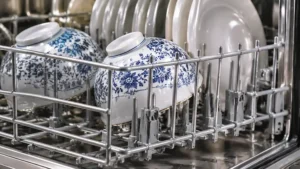
Here’s the problem. A dishwasher is only as good as its worst-loaded rack, and cookware is the great saboteur. A sheet pan blocks spray arms. A stockpot hogs the bottom rack. A lasagna dish arrives wearing a crust that has been baking at 375°F for an hour. Dishwashers have used soil sensors and variable wash times since the late 1990s, but the real change in the last few years is layout. Third racks and adjustable tines now decide whether your Dutch oven fits at all.
That’s why this guide goes beyond “which one is quiet.” You’ll get seven real KitchenAid models, a plain-English read on the ProWash cycle and the PrintShield finish, a decoder for KitchenAid dBA ratings, and a head-to-head look at KitchenAid vs Bosch dishwasher for busy families. Everything below comes from spec sheets and aggregated retailer review themes. I haven’t tested these machines, and I won’t pretend otherwise. Prices are ranges only, so check current price before you buy.
Quick Comparison Table: KitchenAid Dishwashers at a Glance
| Model | Noise | Third Rack | Finish | Best For |
|---|---|---|---|---|
| KitchenAid KDTM704KPS | 44 dBA | FreeFlex | PrintShield | Big cookware loads, all-round pick |
| KitchenAid KDTM604KBS | 44 dBA | FreeFlex | Black stainless | Dark-appliance kitchens |
| KitchenAid KDFM404KPS | 44 dBA | FreeFlex | PrintShield | Front-control fans |
| KitchenAid KDPM604KPS | 44 dBA | FreeFlex | PrintShield | Fully integrated look |
| KitchenAid KDTF924PPS | 39 dBA | FreeFlex Fit | PrintShield | ADA/flush-mount premium |
| KitchenAid KDTE204KPS | 39 dBA | Utensil rack | PrintShield | Quiet open-plan homes |
| KitchenAid KDFE104KPS | 47 dBA | None (two-rack) | PrintShield | Tight budgets |
Look at the pattern. The 44 dBA models with the FreeFlex third rack are the cookware specialists, because a deeper third rack hands the lower rack back to your pots. The KitchenAid KDTE204KPS wins on silence but trades away that deep rack. The KitchenAid KDFE104KPS is the entry ticket, though it skips the third rack entirely, so pans and everything else fight for two shelves.
💬 Just one click — help others make better buying decisions too!😊
Top 7 KitchenAid Dishwashers for Pots and Pans: Expert Analysis
1. KitchenAid KDTM704KPS — best all-rounder for heavy cookware
Start with the big one. The KitchenAid KDTM704KPS sits at the top of the cookware conversation because of its MaxTub interior, listed at roughly 7.25 cubic feet, plus a FreeFlex third rack that takes mugs, bowls and utensils off the lower level.
Specs, translated: 16 place settings and more than 50 wash jets mean spray coverage reaches the corners where casserole dishes love to hide. Adjustable tines fold down for roasting pans, colanders and Dutch ovens, which is exactly the flexibility cookware demands. True self-cleaning filtration also means you skip the manual filter chore.
Based on the spec comparison, this is the model for people who cook daily and hate hand-scrubbing. Reviewers of the earlier KDTM704ESS version repeatedly mention sparkling stainless pots and quiet operation, and current retailer pages show ratings in the high-4s. Some retailers list this exact model as discontinued or replaced, so verify availability.
Pros:
- ✅ Largest tub in the lineup for big loads
- ✅ Adjustable tines fit Dutch ovens and roasting pans
- ✅ LED interior light for easy loading
Cons:
- ❌ Some retailers list it as replaced or discontinued
- ❌ Top controls are hidden until the door opens
Price range: roughly $1,500-$1,700, so check current price. Verdict: the benchmark for serious cooks.

2. KitchenAid KDTM604KBS — black stainless that hides fingerprints
The KitchenAid KDTM604KBS is the style play. Black stainless is moody, modern and pairs well with matte-black hardware, and the PrintShield finish keeps it from looking like a crime scene after a family dinner.
Underneath, the numbers are strong. It carries 16 place settings, a stainless tub, five wash cycles including ProWash and Tough, and SatinGlide Max rails on the middle and third racks. Those rails matter more than they sound: a fully loaded rack of cookware weighs like a toddler, and gliding beats grinding.
What most buyers overlook is the third rack’s drying bar with moisture-wicking tabs, which helps glasses and mugs dry so you can park more small items up high and keep the bottom free for pots. The analysis here is simple: if your kitchen leans dark, this one earns its spot without a cookware compromise.
Reviewer themes on comparable 44 dBA KitchenAid models center on quiet running and strong cleaning, with cycle length as the main complaint. Retailer pricing for this finish varies, so treat the mid-$1,000s as a rough guide.
Pros:
- ✅ Black stainless with fingerprint resistance
- ✅ FreeFlex third rack frees the bottom
- ✅ Smooth SatinGlide Max rails
Cons:
- ❌ Pricing varies noticeably by retailer
- ❌ Cycles can run long on Tough
Value verdict: a style-forward cookware cleaner worth a price check.
3. KitchenAid KDFM404KPS — front controls and a deep third rack
Prefer buttons you can see? The KitchenAid KDFM404KPS swaps hidden top controls for a front panel, so you can tap a cycle without opening the door.
The third rack here is the largest KitchenAid offers per listing copy, with a deep, angled design that fits 6-inch glasses, mugs and bowls. That depth is the point. When mugs and spatulas live upstairs, the lower rack handles skillets, saucepans and mixing bowls without a Tetris session. The Express Wash cycle is listed as up to 35% faster than Normal for lightly soiled items.
The honest take: front controls mean the panel is part of the door’s face, which some people love and others find busy. Shopper tags on a related 44 dBA front-control KitchenAid at Best Buy lean heavily toward noise level, cleaning performance and the third rack, with cycle time as the leading gripe. Dimensions run about 23-7/8″ wide and 26-3/4″ deep, so measure the cabinet cavity before ordering.
Pros:
- ✅ Front controls are visible and easy to use
- ✅ Very deep third rack for bowls and mugs
- ✅ Express Wash for lightly soiled loads
Cons:
- ❌ Front panel looks busier than hidden controls
- ❌ No dedicated pots and pans cycle
Price range: around $1,200-$1,350. Value verdict: a smart mid-tier choice.
4. KitchenAid KDPM604KPS — fully integrated, pocket-handle polish
Some kitchens want the dishwasher to disappear. The KitchenAid KDPM604KPS is a fully integrated 24-inch model with a clean face, 16 place settings and a FreeFlex third rack.
The practical win here is the layout flexibility. Adjustable rows in the middle and lower racks let you reconfigure for pans one night and party glasses the next, and the two stemware holders keep wine glasses from tapping against your cast-iron adjacent chaos. Fan-enabled ProDry circulates heated air for a more thorough dry, which matters for plastic storage containers that otherwise stay damp.
Note the unvarnished fact from the spec sheets: this family lists no dedicated pots-and-pans cycle. That’s not a flaw, since ProWash and Tough cover the territory, but you’ll choose by soil level instead of pressing a label. The analysis: pick this when design cohesion matters as much as cookware capacity.
Pros:
- ✅ Integrated look blends into cabinetry
- ✅ Adjustable racks and stemware holders
- ✅ Fan-enabled ProDry for plastics
Cons:
- ❌ No labeled pots and pans cycle
- ❌ Priced above front-control cousins
Price range: about $1,300-$1,450. Value verdict: pays off for design-minded buyers.
5. KitchenAid KDTF924PPS — flush-mount ADA premium with Door-Open Dry
Premium territory starts here. The KitchenAid KDTF924PPS is an ADA-compliant, flush-mount model at 39 dBA with a FreeFlex Fit third rack.
The third rack is deep and angled, rated for 5-inch glasses, mugs and bowls, and KitchenAid says that, with the adjustable middle rack, you get 30% more capacity than its two-rack dishwashers. The catch is the 14-place-setting capacity, smaller than the 16-setting models above, which is a real tradeoff for pot-heavy households.
What it buys you instead is silence and efficiency. The Door-Open Dry system pops the door at the end of the cycle to vent hot air, which KitchenAid describes as its most energy-efficient dry system. Based on the spec comparison, this model suits accessible kitchens, flush designs and homes where the dishwasher sits near the sofa. It’s a quiet specialist, not a capacity king.
Pros:
- ✅ 39 dBA for near-silent running
- ✅ ADA-compliant flush-mount design
- ✅ Door-Open Dry vents steam automatically
Cons:
- ❌ Only 14 place settings
- ❌ Highest price in this lineup
Price range: roughly $1,850-$2,100. Value verdict: justified only if you need ADA or flush design.
6. KitchenAid KDTE204KPS — the quietest KitchenAid on this list
Silence sells. The KitchenAid KDTE204KPS runs at 39 dBA, which KitchenAid itself labels among its quietest, and it still delivers ProWash, Express Wash and heated dry.
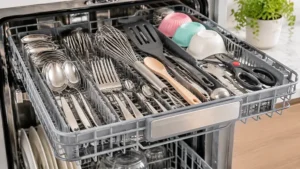
Spec reality: 13 place settings and a third-level utensil rack, not the deep FreeFlex version. That means the third rack handles cutlery and cooking tools, but bowls and mugs stay downstairs. For cookware, you’ll load pans on the lower rack and accept fewer large pieces per cycle. KitchenAid’s own quiet dishwasher buying guide notes that a stainless tub generally runs quieter than plastic and that food-trap filtration beats disposers for noise.
The analysis: this is a great second-tier option for apartments, studios and open-plan homes where noise is the dealbreaker. Pot-heavy cooks should look higher up the list.
Pros:
- ✅ Among the quietest KitchenAid models
- ✅ Typically cheaper than FreeFlex models
- ✅ ProWash and Express Wash included
Cons:
- ❌ Utensil rack, not a deep FreeFlex rack
- ❌ Only 13 place settings
Price range: about $750-$1,150 depending on promotions. Value verdict: great for quiet, modest for cookware.
7. KitchenAid KDFE104KPS — the budget entry with ProWash
The KitchenAid KDFE104KPS is the on-ramp. It’s a two-rack, 47 dBA model with ProWash, PrintShield and a heated dry option, and it keeps costs well below the third-rack tier.
Think of it as a capable machine with a real limitation. Without a third rack, everything shares two shelves, so a large skillet in the bottom rack means fewer plates around it. The adjustable upper rack helps, and a leak sensor adds protection, but cookware-heavy households will outgrow it faster. It’s also the loudest model here, though 47 dBA still sits well under the 50+ range typical of average dishwashers.
The honest verdict: good for renters, secondary kitchens and small households that mostly wash dishes, not roasting pans.
Pros:
- ✅ Lowest entry price of the seven
- ✅ ProWash soil sensing included
- ✅ PrintShield finish resists smudges
Cons:
- ❌ No third rack
- ❌ Loudest model on this list
Price range: around $750. Value verdict: a solid starter, but not a cookware champion.
How to Choose a KitchenAid Dishwasher for Pots and Pans
Skip the brochure poetry. Walk through these seven steps, and the right model usually reveals itself.
- Measure your cabinet first. Depth is the sneaky one, since some models run about 26-3/4 inches, and door-open clearance matters in galley kitchens.
- Count your largest cookware. If you own a 12-inch skillet and a Dutch oven, you want adjustable tines and a deep third rack, not a utensil tray.
- Choose your third rack type. FreeFlex handles bowls and mugs, and a utensil rack only handles cutlery.
- Check the dBA number. Anything at or below 44 dBA is considered quiet. Open-plan homes should aim lower.
- Decide on control placement. Top controls look cleaner, and front controls are easier to use.
- Match the finish. PrintShield on stainless or black stainless keeps smudges down.
- Confirm ENERGY STAR status and warranty, then check current price across retailers.

KitchenAid Dishwasher with FreeFlex Third Rack Review
Does the third rack actually matter for pots and pans? Yes, but indirectly, and that’s the whole trick. The rack doesn’t wash your pot. It evicts everything else from the room where your pot needs to live.
Listing descriptions say the FreeFlex third rack fits glasses, mugs, bowls, silverware and cooking tools, freeing the lower rack for pots, plates and mixing bowls. The top version is deep and angled to take 6-inch items. A second variant, FreeFlex Fit, is rated for 5-inch items and claims 30% more capacity than KitchenAid’s two-rack models.
Based on the spec comparison, three details separate good from great. First, rack depth decides whether mugs fit or tip. Second, the SatinGlide Max rails keep a loaded rack from jamming. Third, dedicated jets for the third rack mean upstairs items actually get washed instead of merely rinsed.
My honest caveat: shopper tags on related models show the third rack praised often, while cycle time shows up as the complaint. There’s no verified evidence this rack makes cookware cleaner. It makes cookware fit. For a KitchenAid dishwasher with FreeFlex third rack review that avoids hype, that’s the fair summary: capacity first, cleaning second.
ProWash Cycle: What It Does and When to Use It
The ProWash cycle uses sensors to measure soil levels during the wash and adapts time and water temperature accordingly. In plain English: it grades the mess, then picks the effort.
That’s useful for cookware because soil levels swing wildly. A lightly used saucepan and a burnt-on casserole dish can be in the same load. Soil sensing, which first appeared widely in dishwashers in the late 1990s, lets the machine run longer only when the water coming off the dishes stays dirty.
Here’s the practical rule. Use ProWash for mixed loads and everyday cookware. Switch to Tough when the pan is visibly baked-on. Add Hi-Temp Wash for greasy loads, and Sani Rinse for sanitizing. Use Express Wash only for lightly soiled items, since KitchenAid says it’s about 35% faster than Normal.
One honest limitation: the ProWash cycle isn’t a dedicated pots-and-pans cycle, and spec sheets list that cycle as absent. It’s a smart default, not a miracle. If a pan still has char after one pass, soaking and a rerun beats blaming the machine.
PrintShield Finish: Is the Smudge Resistance Worth It?
Everyone with a stainless dishwasher knows the dance: cook, load, spot a thumbprint, wipe, repeat. The PrintShield finish exists to end that dance.
KitchenAid describes it as a specialized coating that resists smudges and fingerprints and cleans with water and a soft cloth. It comes in stainless steel and black stainless options, and it appears on most models in this guide, including the KitchenAid KDTM704KPS, the KitchenAid KDFE104KPS and the KitchenAid KDTF924PPS.
Here’s what that means in practice. If your household includes kids, sticky hands and a front-facing dishwasher, the coating earns its keep. If your dishwasher is hidden behind a panel, it’s irrelevant. Just remember that fingerprint-resistant isn’t fingerprint-proof, and abrasive scrubbing can defeat a coating, so stick with soft cloths.
The bigger finish decision is stainless versus black stainless. Black stainless photographs well, but dark surfaces can show water spots, so compare both in person if you can. The verdict: PrintShield is a nice-to-have that rarely changes a purchase decision, but it’s worth having on a visible front panel.
KitchenAid dBA Ratings: What the Numbers Mean for Your Kitchen
Decibels aren’t linear. A common rule of thumb says every 10 dB roughly doubles perceived loudness, so a 47 dBA machine isn’t “a bit louder” than 39 dBA. It’s noticeably louder.
KitchenAid’s own guide explains that stainless tubs run quieter than plastic and that sound dampening around the tub helps, too. Industry commentary treats 44 dBA or lower as quiet and 50 dBA or higher as average, with older models reaching 60.
| KitchenAid dBA | Example Model | Real-World Feel | Best For |
|---|---|---|---|
| 39 dBA | KitchenAid KDTE204KPS, KitchenAid KDTF924PPS | Near silent | Open-plan homes, studios |
| 41 dBA | KDTE304RPS-type models | Very quiet | Living-room-adjacent kitchens |
| 44 dBA | KitchenAid KDTM704KPS, KitchenAid KDFM404KPS | Quiet | Most family kitchens |
| 47 dBA | KitchenAid KDFE104KPS | Audible but modest | Closed kitchens, budgets |
Looking at the numbers above, the jump from 44 to 39 dBA matters mainly if you can hear the dishwasher from your couch. If the kitchen is a separate room, 44 dBA is plenty. One more reality check from Yale Appliance’s comparison: all three brands they compare sell models at or below 44 dB, so noise alone rarely picks the winner.
KitchenAid vs Bosch Dishwasher for Busy Families
Here’s the fair fight. Both brands sell strong models in the roughly $700-$1,500 band, and both have shifted noticeably in the last few years.
According to Yale Appliance’s 2026 comparison, KitchenAid logged a 7.4% service-call rate against Bosch at 9.5% across more than 33,000 calls, though the gap is small and local service coverage matters more. Other published tables show service rates moving around year to year, so no single number settles it. Bosch leans toward drying and smart features, while KitchenAid commentary favors heated drying and cookware capacity. Fred’s Appliance notes that Bosch skips a bottom heating element and relies on condensation drying.
| Factor | KitchenAid | Bosch | Best For |
|---|---|---|---|
| Drying | Heated, fan-enabled ProDry | Condensation, AutoAir on 500 | Plastics: KitchenAid |
| Noise | 39-47 dBA range | As low as 38 dBA on 800 series | Silence: Bosch |
| Third rack | Deep FreeFlex on select models | Flexible third rack on 500 series | Cookware: KitchenAid |
| Reliability | 7.4% service rate (Yale data) | 9.5% service rate (Yale data) | Slight edge: KitchenAid |
The takeaway for busy families: KitchenAid fits big cookware and dries plastic containers better, while Bosch wins on whisper-quiet operation and smart features. If your kids’ lunchboxes and your skillets share every load, the KitchenAid KDTM704KPS or KitchenAid KDPM604KPS is the safer match. If the dishwasher runs while you’re on a video call, price out a Bosch 800 series too.

Practical Usage Guide: How to Load Pots and Pans in a KitchenAid Dishwasher
Loading is a skill, and nobody teaches it. This guide covers the setup, the first-use tips and the mistakes that cost you clean pans.
Start with the racks. Move bowls, mugs and spatulas to the third rack so the bottom stays open. Fold down the tines on the lower rack to create space for sheet pans and Dutch ovens. Stand pans at an angle, with the soiled surface facing the center spray, not the door.
Mind the spray arms. Before you close the door, spin the arms by hand. If a handle blocks one, rearrange. A pot handle hitting a spray arm is the most common cause of mysteriously dirty dishes.
Pick the cycle. Use ProWash for typical loads, Tough for baked-on cookware, and Top 2 Racks when the lower rack is empty and you only need to wash the top two levels.
Maintain it monthly. Wipe the door gasket, check the filtration area, and run a cleaner cycle quarterly. Common first-30-day mistakes include overloading, using too much detergent, and skipping rinse aid, which hurts drying.
One honest tip: check your cookware manufacturer’s care label first. Many makers recommend hand-washing nonstick and cast iron, no matter how good the machine is.
Problem → Solution Guide: Common Cookware Pain Points
Problem 1: Baked-on residue survives the wash. Solution: soak the pan 15 minutes, scrape big chunks, select Tough, and add Hi-Temp Wash. The KitchenAid KDTM704KPS and KitchenAid KDFM404KPS both offer these options.
Problem 2: Pots keep blocking the spray arm. Solution: move small items to the third rack and place large pots on the sides, not the center. A deeper third rack, as on the KitchenAid KDPM604KPS, makes this easier.
Problem 3: Plastic containers stay wet. Solution: use ProDry or Extended ProDry, and load plastics on the top rack. Fan-enabled drying on the KitchenAid KDTM604KBS helps here.
Problem 4: It’s too loud at night. Solution: use Delay Start for overnight runs, or choose the 39 dBA KitchenAid KDTE204KPS.
Problem 5: Fingerprints everywhere. Solution: choose the PrintShield finish, and wipe with a soft damp cloth, never an abrasive pad.
Buyer’s Decision Framework: If This, Then That
Short on time? Use this priority checklist instead of reading every spec.
- If you cook daily with large cookware, choose the KitchenAid KDTM704KPS, because the biggest tub and adjustable tines handle roasting pans.
- If you want a black-stainless kitchen, choose the KitchenAid KDTM604KBS for style without cookware compromise.
- If you prefer visible controls, choose the KitchenAid KDFM404KPS.
- If cabinetry cohesion matters most, choose the KitchenAid KDPM604KPS for the integrated look.
- If accessibility or flush design is required, choose the KitchenAid KDTF924PPS.
- If silence beats capacity, choose the KitchenAid KDTE204KPS.
- If budget rules, choose the KitchenAid KDFE104KPS and accept the two-rack limit.
Scenario example: a family of five with a sheet-pan habit and a 7 a.m. rush needs capacity and a hidden-control front, so the KitchenAid KDTM704KPS fits. A college student in a studio apartment needs quiet and low cost, so the KitchenAid KDFE104KPS or KitchenAid KDTE204KPS fits better.
✨ Don’t Miss These Exclusive Deals!
🔍 Take your cookware cleanup to the next level with these carefully selected dishwashers. Click on any highlighted model to check current pricing and availability. These machines will help you create spotless, stress-free kitchen routines your family will love!
Long-Term Cost & Maintenance: What You’ll Really Pay
Sticker price is only the opening bid. Total cost of ownership includes energy, water, detergent and repairs.
Efficiency first. The current ENERGY STAR criteria for standard dishwashers, effective July 19, 2023, cap energy at 240 kWh per year and water at 3.2 gallons per cycle. Several KitchenAid models in this guide carry ENERGY STAR certification per retailer listings, but verify the model you choose, since variants differ.
Then service. Published repair-rate data is mixed. Yale’s data shows KitchenAid at a modest 7.4% service-call rate, while another source’s year-by-year table shows rates bouncing between roughly 5% and 16% across the years. In plain terms, no brand is immune, and local technician availability can matter as much as the logo.
Maintenance habits protect your investment: clean the filter area, run a cleaner every few months, and use rinse aid. Based on the spec comparison, models with true self-cleaning filtration trim the chores. Spread over a typical lifespan, a mid-tier model like the KitchenAid KDFM404KPS often beats a cheaper two-rack unit on cost per year, simply because it fits more and you rewash less.

Frequently Asked Questions
❓ Does a KitchenAid dishwasher have a pots and pans cycle?
❓ Can nonstick or cast iron go in a KitchenAid dishwasher?
❓ Do I need to pre-rinse dishes before loading?
❓ How many place settings does a 24-inch KitchenAid hold?
❓ Are KitchenAid dishwashers ENERGY STAR certified?
Conclusion
Picking the right KitchenAid dishwasher for pots and pans comes down to three honest questions: how big is your cookware, how loud can the machine be, and how much are you willing to spend? Third rack plus adjustable tines is the winning formula for pots, and the ProWash cycle covers the unpredictable middle ground between a lightly used pan and a casserole disaster.
If you want my analysis in one line, the KitchenAid KDTM704KPS is the cookware champion, the KitchenAid KDFM404KPS is the value pick, the KitchenAid KDTE204KPS is the quiet choice, and the KitchenAid KDFE104KPS is the budget entry. The KitchenAid KDTF924PPS earns its premium only when ADA or flush design is on your checklist.
Take a measuring tape to your cabinet, make a list of your three largest pans, and then check current price on the models above. Prices and availability shift fast, and a few listings are being replaced, so verify before you commit.
Recommended for You
- Bosch Dishwasher For Quiet Kitchens: 7 Proven Picks (2026)
- Dishwasher Silverware Basket Replacement Universal Fit: 7 Best (2026)
- Dishwasher Rack Wheel Replacement For Bosch: 7 Proven Fixes (2026)
Disclaimer: This article contains affiliate links. As an Amazon Associate, I earn from qualifying purchases. If you purchase products through these links, we may earn a small commission at no additional cost to you.
✨ Found this helpful? Share it with your friends! 💬🤗
