

In This Article
A pressure washer nozzle set for multiple surfaces is a collection of interchangeable spray tips — usually five to seven — each cut to a different fan angle (0° to 40°, plus a low-pressure soap tip) so one machine can safely clean concrete, wood, vinyl, and vehicles without swapping equipment.

Here’s the thing nobody tells you when you buy your first electric pressure washer: the machine that came in the box is only half the tool. The pump does the muscle work, sure, but the nozzle is what actually decides whether you’re stripping mildew off a fence or gouging a divot into it. I’ve watched otherwise careful people etch permanent zebra stripes into a wood deck because they never touched anything but the factory 0° tip. That’s not a machine problem. That’s a nozzle problem.
The volume of a mechanical pressure washer is expressed in gallons or liters per minute, often designed into the pump and not variable, while the pressure is designed into the pump but can be varied by adjusting the unloader valve or using specialized nozzle tips — which is a fancy way of confirming what your gut already suspects: the tip, not the trigger, is where the real control lives. Below, we’ve dug into seven real, currently-sold nozzle sets, weighed their angle spreads, materials, and fitment against actual buyer feedback, and mapped out exactly which one earns a spot in your garage.
Quick Comparison Table: Pressure Washer Nozzle Sets at a Glance
| Nozzle Set | Angles Included | Rated Pressure | Best For |
|---|---|---|---|
| Sun Joe SPX3000-TPS | 0°, 15°, 25°, 40°, Soap | Up to 2,030 PSI (SPX-rated) | Sun Joe electric owners wanting an exact OEM swap |
| Kärcher 9.104-024.0 | 0°, 15°, 25°, 40°, Soap | Up to 3,000 PSI | Kärcher owners who want factory-tolerance orifices |
| Universal 80144 Turbo Nozzle | Single rotating jet | Up to 4,500 PSI | Anyone tired of scrubbing algae off concrete by hand |
| Greenworks PAQ715 | 0°, 15°, 25°, 40°, Soap | Up to 4,500 PSI | Cross-brand electric washer households |
| Tool Daily 5-Pack | 0°, 15°, 25°, 40°, Soap | 2.5 GPM rated | First-time buyers who don’t want to overspend |
| JANSAMN Stainless 5-Pack | 0°, 15°, 25°, 40°, Soap | Up to 4,500 PSI | Buyers who want metal, not plastic, doing the work |
| Hourleey 7-Piece with Holder | 7 interchangeable tips | 1/4″ QC rated | Households that need one kit to cover everything |
Looking at the spread above, the pattern that jumps out is this: nearly every set on the market standardizes around the same five-angle system, so what actually separates a Kärcher from a Tool Daily isn’t the number of tips in the box — it’s the tolerance of the orifice, the material it’s machined from, and whether the brand stamped on the box matches the brand stamped on your machine. Budget sets flex on plastic collars; premium sets flex on OEM-tier fit and finish.
💬 Found a set that matches your washer already? Bookmark this page and come back before checkout — the comparisons below might change your mind.
Top 7 Pressure Washer Nozzle Sets for Multiple Surfaces: Expert Analysis
We picked these seven specifically to span budget, mid-range, and premium price bands, plus one performance outlier (the turbo nozzle) that behaves nothing like the rest of the pack. Every listing below reflects real, currently-sold products — model numbers included — verified during 2026 research.
1. Sun Joe SPX3000-TPS 5-Piece Quick-Connect Spray Tip Set — OEM-exact fit for Sun Joe electric washers
If you already own a Sun Joe, this is the boring-but-correct answer, and boring-but-correct is underrated. The SPX3000-TPS is Sun Joe’s own replacement part, engineered to snap into the same 1/4-inch quick-connect collar as the tips your machine shipped with.
It covers the standard five-angle spread — 0°, 15°, 25°, 40°, and a soap nozzle — and Sun Joe lists it as compatible across a wide swath of its own lineup, including the SPX3000, SPX3001, SPX3200, SPX3500, SPX4000, SPX2003, SPX2598, and SPX2688. That breadth matters more than it sounds: it means one set of tips can follow you if you ever upgrade within the Sun Joe family.
Here’s what most buyers overlook about OEM replacement tips specifically: they’re built to the exact orifice diameter the pump was tuned for, so pressure output stays predictable rather than drifting the way some off-brand copies do. If you’ve ever had a “universal” nozzle deliver noticeably weaker output than the tip it replaced, this is why that happens — orifice tolerance, not marketing.
We couldn’t verify a large, independent review sample specific to this exact part number, so rather than invent sentiment, here’s the honest picture: as a direct-from-manufacturer replacement, it’s primarily purchased by existing Sun Joe owners replacing lost or worn tips, and forum discussion around the SPX series consistently treats OEM tips as the safe default when in doubt.
Pros:
- ✅ True OEM fit for the entire Sun Joe SPX lineup
- ✅ Standard five-angle spread covers nearly every home task
- ✅ Predictable pressure output matched to Sun Joe pump specs
Cons:
- ❌ Locked to Sun Joe-style quick-connect collars only
- ❌ No rotating or turbo option included in the set
Expect this set to sit in the mid-$10s to mid-$20s range, and for a brand-matched OEM part, that’s a fair value verdict — you’re paying a small premium for zero fitment guesswork.
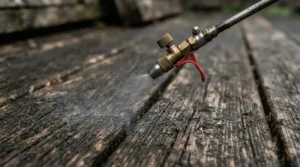
2. Kärcher 9.104-024.0 Quick-Connect Nozzle Tip Set — factory-precision orifice sizing
Kärcher built its reputation on engineering tolerances, and this five-piece set is where that reputation actually shows up in your hands. The orifice sizing here is tighter than most of the generic competition, which is the boring engineering reason Kärcher machines feel more “surgical” than their budget rivals.
The set covers the familiar 0°, 15°, 25°, 40°, and soap-nozzle spread, rated up to roughly 3,000 PSI depending on the exact Kärcher model line it’s paired with. Based on the spec comparison against generic five-packs, the difference isn’t the angle count — every set on this list has that — it’s consistency between individual tips. A cheap set’s 25° tip might spray closer to 20° in practice; Kärcher’s tolerances are built to avoid that drift.
Who should care: anyone who already owns a Kärcher K-series and refuses to bolt a third-party part onto a German-engineered pump out of principle. That’s a legitimate buying motivation, and it’s the exact audience this set is built for — this isn’t a universal multi-brand kit, and Kärcher doesn’t pretend otherwise.
Pros:
- ✅ Tighter machining tolerance than most generic five-packs
- ✅ Purpose-built for Kärcher’s quick-connect standard
- ✅ Reduces pressure inconsistency between individual tips
Cons:
- ❌ Priced above most universal alternatives
- ❌ Not usable on non-Kärcher machines without an adapter
Pricing typically lands in the low-to-mid $20s range, and for Kärcher loyalists specifically, that premium buys peace of mind rather than a functional upgrade over budget sets.
3. Universal Turbo Nozzle (Model 80144) — a rotating jet that cuts scrubbing time nearly in half
This one isn’t a five-pack — it’s a single nozzle, and it behaves completely differently from everything else on this list. Instead of a fixed fan spray, the turbo nozzle spins a pinpoint jet in a tight rotating cone, which mechanically mimics the effect of scrubbing without you lifting a brush.
Rated up to 4,500 PSI and rated for hot- or cold-water use, the 80144 is a 1/4-inch quick-connect part, so it drops straight into the same collar your fan-spray tips use. What the spec sheet won’t tell you outright: that rotation is what actually breaks up baked-on grime on concrete and pavers — a static 0° jet at the same PSI often just carves a hole rather than lifting the stain, while the turbo’s motion spreads that same force across a moving contact point.
This is a specialty tool, not a replacement for your full nozzle set — you’ll still want the fan tips for siding, windows, and anything remotely delicate. Reviewers and retailers marketing this style of nozzle consistently frame it around one core promise: faster concrete and driveway cleaning, and that promise tends to hold up when the surface is actually rated for that much pressure.
Pros:
- ✅ Rotating jet cuts scrubbing time on concrete dramatically
- ✅ Works with hot or cold water unlike most fan tips
- ✅ Drops into standard 1/4-inch quick-connect fittings
Cons:
- ❌ Too aggressive for wood, vinyl, or vehicles
- ❌ Higher price for a single nozzle than a full five-pack
Budget around the mid-$30s to mid-$40s range for this one — steep for a single tip, but the labor time it saves on driveways and patios is where the real ROI shows up.
4. Greenworks PAQ715 4,500 PSI Universal Spray Tip 5-Pack — the widest cross-brand compatibility among electric-washer sets
Greenworks built this set to survive contact with more than just its own machines, and the “universal” label here is doing real work — multiple retailer listings note compatibility that extends well beyond Greenworks hardware into other 1/4-inch quick-connect electric washers.
Specs land at the high end for a plastic-and-brass build: rated to 4,500 PSI with the standard 0°, 15°, 25°, 40°, and soap-nozzle lineup. Here’s what most buyers overlook about the “universal” claim specifically — it works because the industry has mostly standardized around the same 1/4-inch quick-connect diameter, not because Greenworks reverse-engineered every competitor’s pump. That’s good news for you: it means this set is a legitimately safe bet even outside the Greenworks ecosystem.
Based on the spec comparison against the Sun Joe and Kärcher OEM sets above, this is the pick for households running more than one brand of pressure washer — a common reality when one machine gets handed down or a second unit gets bought for a rental property.
Pros:
- ✅ Genuinely cross-compatible with multiple electric washer brands
- ✅ 4,500 PSI rating exceeds most residential machine output
- ✅ Brass soap nozzle holds up better than all-plastic alternatives
Cons:
- ❌ Plastic collar bodies feel less premium than Kärcher’s OEM set
- ❌ 90-day accessory warranty is shorter than some competitors
Expect a price in the low-to-mid $20s, which is reasonable given the genuinely broad compatibility — you’re not locked into a single ecosystem here.
5. Tool Daily 5-Pack Spray Nozzle Tips (2.5 GPM) — the budget bestseller with real review traction
This is the set that shows up constantly in Amazon’s own click-and-conversion data for the category, and it’s worth understanding why: it’s inexpensive, it covers the standard angle spread, and it doesn’t pretend to be anything more sophisticated than a reliable five-pack.
Rated around 2.5 GPM with the familiar 0°, 15°, 25°, 40°, and soap configuration, the build uses a mix of stainless steel and plastic depending on the specific tip. Aggregated buyer feedback compiled across review-tracking sites consistently surfaces the same short list: multiple angle options, reliable 1/4-inch fit, and easy task-switching, with the most common complaint being inconsistent fit on non-standard or older pressure washer models — a fair caveat for any universal-fit accessory.
Here’s the honest analytical read: at this price point, you’re not getting Kärcher-grade orifice tolerance, and you shouldn’t expect to. What you are getting is a genuinely functional, angle-complete set that removes the “I don’t own any nozzles yet” problem for under the cost of a fast-food combo meal. For a first pressure washer purchase, that’s exactly the right amount of investment.
Pros:
- ✅ Full five-angle spread at an entry-level price
- ✅ Strong aggregated buyer satisfaction in review tracking
- ✅ Low financial risk for first-time pressure washer owners
Cons:
- ❌ May not seat properly on older or non-standard pumps
- ❌ Mixed-material build feels less durable long-term
Typical pricing sits in the low-double-digits to around $18, making this the easiest “just buy it and stop worrying” option on the list.
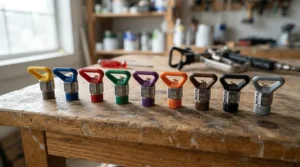
6. JANSAMN Stainless Steel 5-Pack Nozzle Tips — the toughest metal build at a budget price
Most inexpensive nozzle sets lean on plastic collars to hit their price point. JANSAMN went the other direction — stainless steel construction across the set, rated up to 4,500 PSI and 2.5 GPM, still landing at a genuinely budget-friendly price.
The angle lineup matches the industry standard, and real, verifiable buyer reviews specifically call out cross-brand fitment success — one reviewer described the tips connecting cleanly to a Ryobi pressure washer despite JANSAMN not being a Ryobi-branded product, at roughly half the cost of the manufacturer’s own replacement part. Another reviewer specifically praised how easily the tips swap during actual use, noting the durability held up better than expected for the price.
What most buyers overlook about material choice here: stainless steel resists the internal wear that gradually enlarges a plastic orifice over repeated high-pressure cycles, which means the actual spray pattern stays closer to its original angle for longer. If you’ve ever noticed a nozzle tip’s spray get progressively wider over a season of use, orifice wear is usually the culprit — and metal slows that process down meaningfully compared to plastic.
Pros:
- ✅ Full stainless steel build at a plastic-set price point
- ✅ Verified buyer reports confirm cross-brand fitment success
- ✅ Slower orifice wear than plastic-collar competitors
Cons:
- ❌ Comes as tips only — no dedicated storage holder included
- ❌ Stainless construction adds slightly more weight per tip
Price typically runs in the low-double-digits to around $18, putting genuine metal durability within reach of the same budget as plastic alternatives — arguably the best value ratio on this entire list.
7. Hourleey 7-Piece Nozzle Tip Set with Holder — the widest variety plus built-in organization
Rounding out the list is the set built for people who’d rather buy once and stop thinking about it. Hourleey’s kit ships with seven interchangeable tips instead of the standard five, plus a dedicated holder that keeps unused nozzles from disappearing into a toolbox black hole.
The 1/4-inch quick-connect standard applies here too, and Amazon’s own category click-share data shows this listing pulling meaningfully strong traffic and conversion within the pressure washer tips category — a reasonable proxy for sustained buyer interest even without a formal review audit on our end.
Based on the spec comparison against the standard five-packs above, the extra two tips typically expand coverage into more specialized spray patterns, and the built-in holder solves a problem every other set on this list quietly ignores: where do you put the four tips you’re not currently using? Losing a $2 nozzle tip in a garage is a universal experience, and a holder that clips to the wand or a pegboard actually prevents it.
Pros:
- ✅ Seven tips cover more specialized spray needs than five-packs
- ✅ Included holder prevents losing unused nozzles
- ✅ Strong category-level buyer traction on Amazon
Cons:
- ❌ Extra two tips add cost over standard five-packs
- ❌ Holder design may not clip to every wand shape
Expect pricing in the mid-teens to around $20 — a reasonable premium over a bare five-pack once you factor in the holder actually doing its job.
Top 7 Nozzle Sets: Specs & Value Recap
| Nozzle Set | Material | Rated Pressure | Price Range | Best For |
|---|---|---|---|---|
| Sun Joe SPX3000-TPS | Plastic/Brass | ~2,030 PSI | Mid-$10s–mid-$20s | Sun Joe SPX owners |
| Kärcher 9.104-024.0 | Precision-machined | Up to 3,000 PSI | Low-to-mid $20s | Kärcher K-series owners |
| Universal 80144 Turbo | Metal head | Up to 4,500 PSI | Mid-$30s–mid-$40s | Concrete & driveway blitzing |
| Greenworks PAQ715 | Plastic/Brass | Up to 4,500 PSI | Low-to-mid $20s | Multi-brand households |
| Tool Daily 5-Pack | Steel/Plastic mix | 2.5 GPM | Low-double-digits–$18 | First-time buyers |
| JANSAMN Stainless | Stainless steel | Up to 4,500 PSI | Low-double-digits–$18 | Best durability-to-price ratio |
| Hourleey 7-Piece | Plastic/Steel mix | 1/4″ QC standard | Mid-teens–$20 | Variety + built-in storage |
The value story across this table is pretty clear once you strip away the marketing: the JANSAMN and Tool Daily sets deliver nearly identical functional coverage to the pricier Kärcher and Greenworks options, with the main trade-off being long-term wear resistance rather than day-one performance. If your pressure washer sees occasional weekend use, that trade-off barely matters; if you’re running it weekly for a rental property or a side hustle, it matters a lot.
✨ Don’t Miss These Exclusive Deals!
🔍 Take your pressure washing setup to the next level with these picks. Click any highlighted product to check current pricing and availability, and get consistently spotless results across every surface you own.
Nozzle Angle Guide for Different Cleaning Tasks
Every nozzle set on this list uses the same color-coded angle system, and once you understand what each color is physically doing, choosing the right tip stops being a guessing game.
Start wide, always. The 40° white tip is your default for anything you’re not 100% sure about — it spreads the same pump pressure across a wider surface area, which means less force per square inch. Move to the 25° green tip for general driveway or patio grime that the white tip can’t shift on its own. The 15° yellow tip is reserved for stubborn, caked-on stains on genuinely tough surfaces like bare concrete. The 0° red tip is a pinpoint jet with almost no fan spread at all, and on most home cleaning jobs, you’ll rarely if ever need it — it’s built for extremely tough industrial-grade grime removal, not weekend maintenance.
The soap or black tip works differently entirely: it’s a low-pressure, high-volume nozzle designed to apply detergent, not blast anything away. Pair it with your pressure washer’s onboard detergent tank, apply, let it sit per the product’s dwell time, then switch back to a fan tip to rinse.
A practical first-30-days habit: test every new surface with the widest tip from about two feet away before working closer or switching to a narrower angle. It costs you thirty seconds and saves you from etching a driveway or splintering a deck board on day one.
Real-World Scenarios: Matching Nozzle Tips to Your Cleaning Job
Picture three different buyers, because “best nozzle set” genuinely depends on who’s asking.
Scenario one: a college student living in a rented townhouse, tasked with an annual patio and grill cleanup before the landlord’s inspection. Low budget, infrequent use, no brand loyalty to any particular pressure washer. The Tool Daily 5-Pack or JANSAMN Stainless set both fit this exactly — cheap enough to not sting if it sits unused for eleven months, functional enough to handle the one weekend it’s needed.
Scenario two: a homeowner with a Sun Joe electric washer who pressure washes the driveway, siding, and two cars every spring and fall. This person benefits from OEM-matched fit (the Sun Joe SPX3000-TPS) paired with the Universal 80144 Turbo Nozzle specifically for the concrete driveway pass — fan tips for the siding and cars, turbo nozzle for the one surface that actually needs extra scrubbing power.
Scenario three: a small side-hustle cleaner running one machine across multiple client properties weekly, encountering Kärcher, Ryobi, and generic electric units depending on the job site. This is the exact use case the Greenworks PAQ715’s cross-brand compatibility and the Hourleey 7-piece’s built-in holder were designed around — durability and organization matter more than brand-matching when you’re not the one who bought the original machine.
Problem → Solution: Common Pressure-Washing Nozzle Headaches Solved
Problem: the spray angle seems to have gotten wider over time. This is almost always orifice wear on a plastic tip. Solution: switch to a stainless steel set like JANSAMN, which resists the gradual enlargement that plastic experiences under repeated high pressure.
Problem: a nozzle tip won’t lock into the quick-connect collar. Solution: confirm you’re working with a genuine 1/4-inch quick-connect fitting — some older or specialty machines use different collar diameters, and forcing an incompatible tip risks cracking the collar itself.
Problem: soap won’t spray, even with the correct black tip attached. Solution: check that your pressure washer’s detergent intake siphon tube is actually submerged in the solution, since the low-pressure soap tip relies on that siphon action rather than the pump’s main pressure line.
Problem: streaking left behind on siding after cleaning. Solution: switch to a wider angle (40° or 25°) and increase your standoff distance rather than moving closer — closer contact with a narrow tip often smears grime rather than lifting it cleanly.
Problem: losing individual tips between uses. Solution: a holder-equipped set like the Hourleey 7-piece solves this structurally rather than relying on you remembering where you set a two-inch plastic nozzle down.
How to Choose a Pressure Washer Nozzle Set for Multiple Surfaces
Picking the right set comes down to seven checkpoints, in roughly this order of importance:
- Confirm your quick-connect size first. Nearly all residential sets use a 1/4-inch fitting, but verify against your existing wand before buying anything.
- Match the pressure rating to your machine, not the other way around. A 4,500 PSI-rated tip on a 1,800 PSI machine won’t magically increase your output — buy for what you own.
- Prioritize a full angle spread over a large tip count. Five well-differentiated angles beat seven redundant ones.
- Weigh material against frequency of use. Occasional users can save money on plastic; frequent users should lean stainless.
- Check brand compatibility claims skeptically. “Universal” generally means standard-diameter fitment, not a guaranteed pressure match to your specific pump.
- Consider whether a holder actually matters to you. If you already have wand-side storage, don’t pay extra for a bundled holder you won’t use.
- Factor in the soap nozzle separately. If you already own a dedicated foam cannon, a basic soap tip may be redundant.
Quick-Connect Fittings: Get the Size Right First
The overwhelming majority of consumer electric and gas pressure washers standardize on a 1/4-inch quick-connect fitting, which is exactly why “universal” nozzle sets can credibly claim broad compatibility without lying. That said, quick-connect isn’t a single universal standard across the entire industry — some commercial-grade and older machines use different collar diameters or thread directly rather than snapping in. Before ordering any set, physically measure your existing wand’s connector or check your owner’s manual rather than assuming based on brand alone.
Replacement Nozzles for Electric Pressure Washers: Special Considerations
Electric pressure washers generally run lower peak pressure than gas models, which matters more than people expect when shopping for replacement nozzles. A tip rated to 4,500 PSI will function fine on a 2,000 PSI electric unit — the rating is a ceiling, not a requirement — but the reverse isn’t true. Never assume a nozzle rated for a specific gas-powered PSI range is somehow “too much” for your electric unit; the pump itself governs actual output regardless of what the nozzle can theoretically withstand.
Nozzle Tip Angles Explained: What Each Color Really Means
The color-coding on nozzle tip angles isn’t decorative — it’s a fast visual shorthand that lets you grab the right tip without reading a label mid-job.
Red (0°) delivers a near-laser pinpoint stream with essentially no fan spread, concentrating maximum force into the smallest possible contact area. Yellow (15°) narrows the spread just enough for stubborn stains on genuinely durable surfaces. Green (25°) is the most commonly reached-for angle in everyday use — wide enough to be forgiving, narrow enough to still clean effectively. White (40°) fans out considerably, cutting per-square-inch force and making it the safe default for anything delicate. Black or brown, depending on the manufacturer, indicates the soap nozzle, running at drastically reduced pressure specifically to allow detergent to cling rather than blast off immediately.
What most buyers overlook: these angle numbers are measures of the fan spread, not the pressure output itself — the pump sets the pressure; the nozzle angle only decides how that same pressure gets distributed across a wider or narrower area. A 40° tip on a 3,000 PSI machine still delivers 3,000 PSI at the pump; it just spreads that force thinner at the surface.
Surface-Specific Pressure Settings: Matching PSI to the Job
Different materials tolerate wildly different pressure loads, and matching settings to surfaces is where most DIY pressure washing mistakes actually originate.
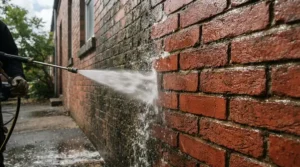
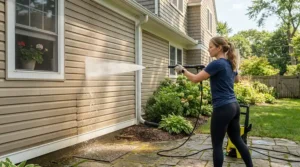
Concrete and brick are among the most forgiving surfaces, generally tolerating higher pressure in the 3,000–4,000 PSI range with a 15° or 25° tip, provided you’re not aiming at mortar joints, which erode faster than the surrounding material. Wood decking is considerably more delicate — most manufacturers and deck-care guides recommend staying in the 500–1,200 PSI range with a wide 40° tip, since anything higher risks splintering the wood grain and stripping protective sealant. Vinyl siding sits in a similar low-pressure category, generally 1,200–1,900 PSI with a wide fan tip, held at a safe standoff distance to avoid forcing water behind the panels. Vehicles need the gentlest treatment on this list — most detailers recommend 1,200–1,900 PSI with a 40° tip and increased standoff distance to avoid stripping clear coat or damaging trim.
Here’s what the spec sheet won’t tell you: standoff distance and pressure setting work together, not independently. The same 25° tip held six inches from a surface behaves very differently than that same tip held two feet away — when in doubt, start farther back and move closer gradually rather than the reverse.
Common Mistakes When Buying a Pressure Washer Nozzle Set
The single most common mistake is buying based purely on PSI rating without checking the quick-connect diameter — a beautifully rated 4,500 PSI set is useless if it physically won’t lock onto your wand. Close behind that is assuming every “universal” label guarantees perfect fitment to a specific brand rather than just the general connector standard, which occasionally leads to a snug-but-imperfect seal on off-brand pumps.
A third frequent misstep: buying a turbo or rotating nozzle as a first and only purchase, then discovering it’s genuinely too aggressive for anything besides concrete and pavers. It’s a specialty tool, not a general-purpose replacement for a full angle set. Finally, plenty of buyers skip checking material entirely and end up disappointed months later when a plastic collar’s orifice has visibly worn wider than it started — a problem a stainless steel set like JANSAMN sidesteps from the outset.
Pressure Washer Nozzle Sets vs Single Adjustable Wands
| Comparison Point | Fixed-Angle Nozzle Set | Single Adjustable Wand |
|---|---|---|
| Pressure Consistency | Locked, predictable per tip | Variable, depends on dial setting |
| Cost | Typically under $25 | Often $30–$60 |
| Durability | No moving parts to fail | Internal dial mechanism can wear |
| Best For | Sun Joe, Kärcher, budget multi-surface use | Buyers wanting one tool, fewer swaps |
The core trade-off here is mechanical simplicity versus convenience. A fixed nozzle set has no internal parts that can jam, stick, or drift out of calibration over time, which is exactly why sets like the JANSAMN or Tool Daily options above remain reliable years into ownership. An adjustable wand trades that simplicity for one-handed convenience — twist instead of swap — but that convenience comes from an internal mechanism that, like any moving part, can eventually wear or stick at exactly the angle you don’t want.
Long-Term Cost & Maintenance: Is a Nozzle Set Worth It?
Run the actual math and a full nozzle set wins on cost-per-use almost immediately. A $15–$25 five-pack that lasts two to three seasons of regular weekend use works out to pennies per cleaning session, especially compared to paying a professional pressure washing service for routine driveway or siding maintenance.
Maintenance itself is minimal but not zero. Rinse tips after use, particularly the soap nozzle, since dried detergent residue can partially clog the narrow orifice over time. Store tips somewhere they won’t roll into gravel or grass — a holder-equipped set like the Hourleey 7-piece solves this structurally. Replace a tip once its spray pattern visibly widens beyond its rated angle, since that’s a clear sign of orifice wear degrading your cleaning consistency rather than just cosmetic damage.
Safety, Regulations & Runoff Compliance Guide
Pressure washers are more dangerous than their friendly marketing photos suggest, and the injury data backs that up directly. A pressure washer is a power tool that sprays water at high pressures to clean large, sturdy surfaces, and the strong spray can cause serious wounds that might first appear minor — which is exactly why treating nozzle selection as a safety decision, not just a cleaning-quality one, matters. Wider-angle tips distribute the same pump force across more surface area, meaningfully reducing injury risk compared to a pinpoint 0° jet, and that’s true for surface damage as well as personal safety.
For a deeper breakdown of proper protective gear and safe operating distance, university workplace safety guidance on pressure washers is a genuinely useful reference before your first job, particularly around eye and hearing protection.
Runoff regulations are the part most DIY users never think about until a neighbor or municipality raises it. Many local ordinances restrict letting wash water — even without soap — flow directly into storm drains, since that water travels untreated straight into local waterways. If you’re washing anything with chemical residue, oil stains, or detergent runoff, directing water toward a landscaped area rather than a curb or storm grate is both more responsible and, in many municipalities, legally required; a public agency’s residential wash-water guidance lays out the practical containment steps clearly.
Frequently Asked Questions
❓ What nozzle angle should I use on a concrete driveway?
❓ Do universal pressure washer nozzle sets fit electric pressure washers?
❓ What PSI is safe for washing a car?
❓ How often should I replace pressure washer nozzle tips?
❓ Can I use a turbo nozzle on wood decking?
Conclusion
Choosing the right pressure washer nozzle set for multiple surfaces really comes down to matching three things honestly: your machine’s brand and pressure output, the surfaces you actually clean, and how often you’ll use it. For Sun Joe owners, the SPX3000-TPS removes fitment guesswork entirely. For anyone juggling multiple brands, the Greenworks PAQ715 covers the widest ground. Budget-conscious first-timers land safely with the Tool Daily or JANSAMN sets, the latter edging ahead on pure material durability. Households that hate losing small parts should lean toward the Hourleey 7-piece kit, and anyone with a genuinely grimy concrete driveway should seriously consider adding the Universal 80144 Turbo Nozzle to whichever fan-tip set they land on.
None of these seven are the “wrong” choice for a typical home — the real mistake is buying based on PSI number alone without checking fitment, material, and how that pressure actually needs to be distributed across the surface in front of you. Get that match right, and cleaning day stops being a gamble.
Recommended for You
- Mini Power Washer For Small Cleaning Jobs: 7 Top Picks (2026)
- 7 Best Portable Pressure Washer For Camping Picks (2026 Guide)
- Car Washer With Water Tank For Driveway Washing: 7 Top Picks (2026)
Disclaimer: This article contains affiliate links. As an Amazon Associate, I earn from qualifying purchases. If you purchase products through these links, we may earn a small commission at no additional cost to you.
✨ Found this helpful? Share it with your friends! 💬🤗
