
In This Article
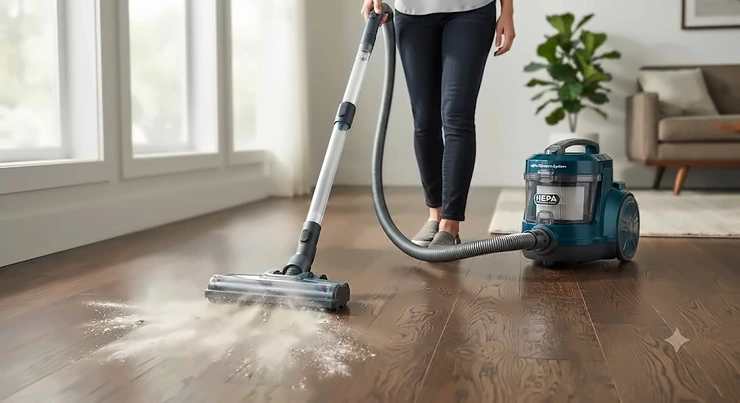
Here’s a dirty little secret about vacuuming: for decades, the machine that was supposed to clean your air was often the thing polluting it. Older vacuums would suck up dust, dander, and pollen, then blast a good chunk of it right back out through the exhaust — you were basically running a leaf blower for allergens. A properly built vacuum with hepa filter fixes that problem, but only if two things are true at once: the filter itself meets the real HEPA standard, and the machine around it is actually sealed so air can’t sneak past the filter media. Miss either piece and you’ve bought an expensive dust redistributor.
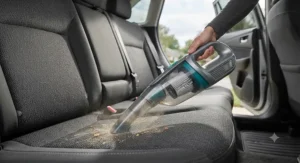
So what is a vacuum with hepa filter, in plain terms? It’s a vacuum cleaner built around a high-efficiency particulate air filter certified to capture at least 99.97% of particles down to 0.3 microns — the size range that includes dust mite waste, mold spores, and pet dander — combined with a housing designed so all exhaust air is forced through that filter rather than leaking around it, according to the U.S. EPA.
This guide skips the marketing fluff. We researched seven real, currently sold models spanning budget uprights to premium canisters, we’re upfront about which claims are independently verifiable and which are manufacturer-reported, and we’ll walk through exactly how to tell a genuinely sealed system from a filter that’s just along for the ride.
Quick Comparison Table
| Vacuum | Type | Filtration Claim | Best For |
|---|---|---|---|
| Bissell Pet Hair Eraser Allergen Lift-Off (39883) | Bagless upright | HEPA Sealed Allergen System, 99.97% | Best value pick for pet hair and dust |
| Simplicity S20EZM | Bagged upright | Certified HEPA (SAH-6 media) | Most budget-friendly certified HEPA upright |
| Shark Vertex Pro Cordless (IZ682H) | Cordless stick/handheld | HEPA + Anti-Allergen Complete Seal, 99.9% | Best cordless convertible for allergy sufferers |
| Kenmore Elite 81714 | Bagged canister | HEPA media filter, 99.97% | Best canister for plush carpet and pet dander |
| Riccar Clean Air Series | Bagged upright | Sealed HEPA filtration | Lightest sealed-HEPA upright for daily use |
| Dyson Ball Animal 3 | Bagless upright | Whole-machine HEPA, 99.97% | Strongest suction for heavy pet shedding |
| Miele Complete C3 Marin | Bagged canister | HEPA AirClean filter, sealed system | Most refined build for whole-home allergy control |
A quick look at that table tells you most of what matters before you spend a dime. Notice that “HEPA” alone doesn’t separate these seven — nearly every one claims the 99.97% figure — so the real differentiators are format (bagged vacuums generally seal better than bagless, since there’s no dust cup gasket to fail over time), and whether the brand backs the claim with a named filtration system rather than just a sticker. The Bissell Pet Hair Eraser Allergen Lift-Off (39883) and Simplicity S20EZM anchor the budget end, while the Miele Complete C3 Marin sits at the top for buyers who want German engineering and a near-silent motor to go with the filtration.
💬 Already leaning toward one? Jump to its full breakdown below — or keep reading for the comparison that’ll save you a return shipment.
Top 7 Vacuums With HEPA Filter: Expert Analysis
1. Bissell Pet Hair Eraser Allergen Lift-Off (39883) — best value pick for pet hair and dust
At around $150, this upright shouldn’t perform as well as it does, but Bissell built its reputation on exactly this kind of overachieving budget machine. The HEPA Sealed Allergen System is rated to trap 99.97% of dust and allergens, and independent lab measurements from Vacuum Wars clocked 88 inches of water lift at the hose on max power — ahead of two Shark Navigator competitors tested in the same batch. That number matters in practice: higher sealed suction means the vacuum pulls debris up through the nozzle instead of just skating over it, which is the difference between a carpet that looks clean and one that actually is.
Based on the spec comparison, this is the vacuum for renters and first-time HEPA buyers who want real allergen control without a $400 commitment. The detachable Lift-Off pod adds real versatility for stairs and upholstery, something budget uprights often skip entirely. Reviewers on Home Depot’s site consistently mention the tangle-free brush roll as the standout feature for multi-pet households, with fewer complaints about hair wrapping than older Bissell models.
Pros:
- ✅ Strong sealed suction for its price bracket
- ✅ Detachable pod handles stairs and furniture easily
- ✅ Tangle-free brush roll cuts pet-hair maintenance time
Cons:
- ❌ Bagless dust cup needs frequent emptying with heavy pet hair
- ❌ Plastic build feels less durable long-term than metal-frame rivals
At around $150, this is one of the strongest dollar-for-dollar entries into true sealed HEPA filtration — check current price before buying, since Bissell rotates promotions often.
2. Simplicity S20EZM — most budget-friendly certified HEPA upright
Simplicity built its name on no-frills machines that vacuum repair shops actually recommend, and the S20EZM keeps that tradition alive with dual HEPA media filtration and a bagged design that seals dust inside a disposable compartment the moment you toss it. What most buyers overlook about bagged models like this one is that the bag itself acts as a first-stage filter, so by the time air reaches the HEPA media it’s already been through two layers of capture — a meaningfully different airflow path than a bagless cyclone dumping straight into an exposed bin.
This is the machine for anyone who wants certified filtration without touring the premium aisle: reinforced lift points and six rubber wheels suggest Simplicity expects this thing to survive a decade of daily use, not just a warranty period. Aggregated retailer reviews describe it as basic but dependable, with several buyers specifically noting they switched from bagless models after struggling with dust clouds during emptying.
Pros:
- ✅ Dual HEPA media filtration in a sealed bag compartment
- ✅ Reinforced build designed for long-term daily use
- ✅ Foot pedal controls simplify one-handed operation
Cons:
- ❌ Requires ongoing bag purchases, adding to running costs
- ❌ Fewer attachments included than pricier bundles
In the roughly $300-$400 range depending on retailer, the S20EZM delivers legitimate certified filtration at a price point where many competitors cut corners on the seal instead of the features.
3. Shark Vertex Pro Cordless (IZ682H) — best cordless convertible for allergy sufferers
Cordless HEPA vacuums used to be a contradiction in terms — batteries meant compromises on suction and filtration alike — but the Vertex Pro Cordless narrows that gap considerably. Shark’s Anti-Allergen Complete Seal Technology pairs with the HEPA filter to trap 99.9% of dust and allergens, and independent testing from Vacuum Wars found no visible fog during their filtration check, which is their shorthand for a system that isn’t leaking particles back into the room.
Here’s what the spec sheet won’t tell you, but reviewer patterns suggest: the real advantage of this machine isn’t raw suction, it’s that people who own it actually use it more often, because detaching the handheld for above-floor cleaning takes seconds instead of dragging out a full canister. For apartment dwellers and anyone managing a cat’s litter-tracking or dander shedding on furniture, that convenience factor translates into more frequent cleaning, which matters more for allergy control than any single suction number.
Pros:
- ✅ True HEPA filtration with a documented sealed system
- ✅ Converts to handheld in seconds for furniture and stairs
- ✅ IQ Display shows real-time runtime and suction mode
Cons:
- ❌ Runtime drops noticeably in Boost mode
- ❌ Battery packs are an added cost for whole-home coverage
Priced in the $300-$450 range depending on battery configuration, this is the pick for buyers who value flexibility as much as filtration.
4. Kenmore Elite 81714 Pet Friendly Ultra Plush — best canister for plush carpet and pet dander
Kenmore doesn’t get the same buzz as Dyson or Shark, but the Elite 81714 quietly does something those two don’t: it’s built specifically around ultra-plush and high-pile carpet, where lesser nozzles either bury themselves or skate across the top without ever reaching the base fibers. The HEPA media filter captures 99.97% of dust particles including pollen, pet dander, mold, and bacteria, and the double-wall design is meant to keep airflow steady even as the bag fills.
Reviewers consistently note the suction is genuinely strong for pet hair on rugs and stairs, though a meaningful minority report the canister feels heavy and awkward when carrying it up and down stairs — a real tradeoff of the two-motor system that powers the nozzle. Based on the spec comparison, this is the right call for households with thick carpet and shedding pets who are willing to trade some portability for deep-pile performance.
Pros:
- ✅ 99.97% HEPA media filtration verified against dust and dander
- ✅ Ultra Plush nozzle purpose-built for high-pile carpet
- ✅ Pet PowerMate attachment lifts embedded hair from upholstery
Cons:
- ❌ 25-pound canister is heavy for stairs and multi-level homes
- ❌ Some owners report reduced performance after roughly a year
Typically priced in the mid-$200s to low-$300s, it’s a strong value for plush-carpet households specifically, less so for anyone prioritizing lightweight portability.
5. Riccar Clean Air Series — lightest sealed-HEPA upright for daily use
Riccar built its Clean Air Series specifically around the sealed-HEPA-for-allergies use case rather than bolting filtration onto a general-purpose machine, and it shows in the details: single-motor construction reduces both weight and the number of joints where air could leak, while genuine HEPA media bags (not “HEPA-type” paper) form the first line of defense. The metal components throughout are a deliberate departure from the mostly-plastic budget category.
What most shoppers overlook about vacuum brands like Riccar is that they’re sold primarily through independent sewing and vacuum specialty stores rather than big-box retailers, which usually means better parts availability and a repair technician who can actually service the machine years down the line — a genuine advantage for a household planning to keep a vacuum for a decade. Aggregated reviews from specialty retailers describe it as noticeably lighter to maneuver than comparable uprights, particularly appreciated by users managing joint pain or mobility limitations.
Pros:
- ✅ Genuine sealed HEPA bag filtration, not HEPA-type media
- ✅ Lightweight single-motor design eases daily use
- ✅ Metal build components support long-term repairability
Cons:
- ❌ Sold mainly through specialty dealers, less convenient than big-box shopping
- ❌ Fewer automated features than mainstream competitors
Expect to pay in the $400-$500 range — a premium over big-box uprights, but one that buys genuine sealed construction and long-term serviceability.
6. Dyson Ball Animal 3 — strongest suction for heavy pet shedding
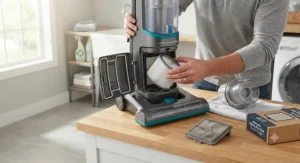
Dyson doesn’t build a “HEPA vacuum” as a separate product line — the Ball Animal 3’s whole-machine filtration, rated to trap 99.97% of particles at 0.3 microns, is just how every Dyson upright works by default. The 290 air-watt Radial Root Cyclone system is the headline number, and the newer de-tangling Motorbar head actively clears wrapped hair as it runs instead of waiting for you to cut it out with scissors, according to product testing from Vacuum Wars.
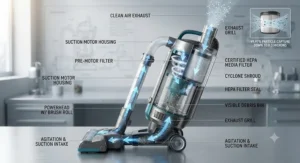
On paper this means the sealed system runs full airflow through a post-motor filter positioned after the cyclone separator has already pulled out the bulk of larger debris — a two-stage approach that’s part of why Dyson’s filtration holds up even as the bin fills. The EPA’s guidance on indoor biological contaminants identifies pet allergen reduction as a priority for allergy-sensitive households, and reviewers consistently cite this machine’s ability to keep pulling hair without clogging as its single biggest advantage over cheaper bagless competitors.
Pros:
- ✅ Whole-machine HEPA filtration standard on every unit
- ✅ De-tangling head actively clears pet hair mid-clean
- ✅ 50-foot combined reach from cord and hose
Cons:
- ❌ Premium price compared to similarly specced uprights
- ❌ Heavier than cordless alternatives for whole-home use
At roughly $450-$600 depending on bundle, it’s a genuine investment, but the combination of suction and self-clearing hair pickup justifies it for multi-pet homes.
7. Miele Complete C3 Marin — most refined build for whole-home allergy control
If the Ball Animal 3 is about raw power, the Complete C3 Marin is about refinement — Miele’s AirClean Sealed System pairs a HEPA AirClean filter with a skeleton-construction body that’s genuinely two pounds lighter than the outgoing S5 series, without sacrificing the stainless-steel wand or the whisper-quiet motor Miele is known for. The bundled SEB236 Electro Premium Powerhead includes an LED light and automatic suction adjustment across carpet and hard floor transitions.
Here’s what the spec sheet won’t emphasize: Miele’s HEPA AirClean filter and its bagged design mean you’re rarely exposed to dust during disposal at all, since the self-sealing HyClean bag closes automatically when removed. Genuine filter replacements carry an official Miele part number and typically run around $60-$65 each, a real ongoing cost worth budgeting for. Reviewers frequently mention the foot-pedal suction control and near-silent operation as standout features that separate it from every other canister in this guide, with the primary complaint being the corded design and the higher upfront price.
Pros:
- ✅ Sealed AirClean System with genuine HEPA AirClean filter
- ✅ Whisper-quiet motor and automatic suction adjustment
- ✅ Self-sealing bag minimizes dust exposure at disposal
Cons:
- ❌ Highest price point in this lineup
- ❌ Corded design limits reach compared to cordless models
Typically priced from around $900 to $1,100 depending on bundle, this is the choice for buyers treating a vacuum as a long-term health investment rather than a disposable appliance.
Practical Usage Guide: Setup, Maintenance & Optimization
Getting a sealed HEPA vacuum system right starts before you even turn it on. Check that the filter is seated flush against its gasket — a filter that’s even slightly askew defeats the entire purpose of a sealed design, since air will simply route around the path of least resistance. Most manufacturers recommend running the vacuum on its highest verified suction setting for the first few passes over problem areas like pet beds or under-furniture zones, since this is where compacted allergen buildup tends to hide.
A common mistake in the first 30 days is delaying the first filter check because “it still looks clean.” HEPA filters lose efficiency well before they look visibly dirty, and airflow resistance builds gradually enough that most people don’t notice their suction dropping. Set a reminder to inspect washable HEPA filters monthly and replace non-washable media filters every 6-12 months, or sooner in high-shedding pet households. For bagged systems like the Miele or Simplicity models above, swap the bag at roughly two-thirds full rather than waiting for it to be packed solid — an overfull bag restricts airflow and can push more particles toward the exhaust filter than it’s rated to catch in a single pass.
One optimization trick rarely mentioned in manuals: vacuum in overlapping passes rather than a single sweep, and go slower than feels natural. Sealed systems need enough dwell time over each section of carpet for suction to actually pull embedded particles up through the pile, not just across the surface.
Real-World Scenarios: Which HEPA Vacuum Fits Your Household
Consider a young couple in a 700-square-foot apartment with one indoor cat and hardwood throughout. Corded canisters are overkill for that footprint, and a full-size upright is genuinely annoying to store in a small closet. The Shark Vertex Pro Cordless or a compact bagless option makes more sense here — quick weekly touch-ups on hard floors and furniture matter more than deep-carpet suction they’ll never use.
Now picture a family of four with two dogs, a finished basement, and wall-to-wall mid-pile carpet upstairs. This is exactly the household the Dyson Ball Animal 3 or Kenmore Elite 81714 was built for — heavy daily shedding, real carpet depth to fight through, and enough square footage that cordless runtime becomes a genuine limitation rather than a minor inconvenience.
Finally, consider someone managing diagnosed asthma who’s been told by their allergist to reduce airborne triggers at home. For that person, the calculus changes entirely: a bagged, genuinely sealed system like the Miele Complete C3 Marin or Riccar Clean Air Series minimizes dust exposure during disposal itself, not just during operation — often the more medically relevant factor for someone with reactive airways.
Problem → Solution: Fixing Common HEPA Vacuum Complaints
Problem: Suction feels weaker after a few months. Solution: check the pre-motor filter and brush roll for hair wrap first — a clogged intake mimics filter failure far more often than the HEPA media itself is actually the culprit.
Problem: Sneezing or dust smell during emptying. Solution: switch to a bagged model if you’re currently using bagless, or empty the bin outdoors and away from your face; even sealed bagless systems release a puff of trapped dust the moment the bin door opens.
Problem: The vacuum smells musty over time. Solution: this is almost always trapped moisture or organic debris in the filter media rather than the HEPA filter failing — dry any washable filter completely (24-48 hours, out of direct sun) before reinstalling.
Problem: Uncertainty about whether a filter is genuinely “True HEPA.” Solution: look for an explicit 99.97% at 0.3 microns claim tied to a named testing standard like ASTM F1977, not just the word “HEPA” printed on the box.
How to Choose a Vacuum With HEPA Filter
- Confirm it’s a sealed system, not just a HEPA-labeled filter. A HEPA filter in an unsealed housing still leaks air around the edges.
- Check the certification language for a number and a standard, like 99.97% at 0.3 microns tested to ASTM F1977, rather than vague “HEPA-type” wording.
- Match the format to your flooring. Bagged models generally seal better long-term; bagless models offer easier visual feedback on when to empty.
- Weigh corded versus cordless honestly against your home’s square footage, not just convenience appeal.
- Factor in replacement filter and bag costs over a 3-5 year ownership window, not just the sticker price.
- Look for independent lab or reviewer verification of the sealed-system claim, since manufacturer marketing alone isn’t independently audited.
- Consider third-party certification, such as AAFA’s asthma & allergy friendly mark, for households managing diagnosed respiratory conditions.
Sealed HEPA Vacuum System vs Standard “HEPA-Type” Filtration
This distinction is the single most important thing to understand before buying any vacuum with hepa filter, and it’s also the one marketing departments most reliably blur. A genuine sealed hepa vacuum system routes 100% of exhaust air through the HEPA media, using gaskets and precision-molded housings to eliminate bypass paths. A “HEPA-type” or “HEPA-like” filter, by contrast, may use similar-looking pleated media without the certified 99.97% capture rate, and — more importantly — is frequently installed in a housing that was never engineered to force all airflow through it in the first place.
The American Lung Association notes that vacuums lacking a proper sealed filtration system can actually redistribute allergens back into a room even when a HEPA-branded filter is technically present, because unfiltered air simply finds an easier path around the filter media. In practice, this means two vacuums can both say “HEPA” on the box while performing completely differently — one meaningfully improves your air, the other is functionally decorative. The seven models in this guide were selected specifically because each documents an actual sealed-system claim rather than a bare filter mention.
Certified HEPA Standard: What NAFA and AAFA Certification Really Means
Not all “certified HEPA standard” claims come from the same place, and knowing the difference protects you from paying a premium for a label that isn’t independently verified. The National Air Filtration Association (NAFA) certifies filtration efficiency directly — a NAFA-certified HEPA filter must sustain 99.97% efficiency at 0.3 microns even as it accumulates debris, not just when brand new.
Separately, the Asthma and Allergy Foundation of America’s certification program, run jointly with Allergy Standards Limited, tests entire vacuum systems — not just the filter — against independent lab standards before awarding its mark. That’s a meaningfully different (and arguably more useful) certification for allergy sufferers, because it evaluates the sealed-system performance as a whole rather than isolating the filter component. When a listing claims a “certified hepa standard,” it’s worth asking which body actually did the certifying, since the term itself carries no legal weight without a named standards organization behind it.
99.97% Particle Capture and Medical-Grade Filtration Claims, Explained
What 99.97% Particle Capture Actually Means
The 99.97% particle capture figure that shows up on nearly every product page in this guide refers specifically to particles at 0.3 microns — deliberately the hardest particle size to trap, known as the most penetrating particle size. Particles larger or smaller than 0.3 microns are actually captured at even higher efficiency, so the number represents something closer to a worst-case guarantee than an average. What most listings don’t clarify is that this figure describes the filter media in isolation; it says nothing about whether the surrounding housing is sealed, which is why the certification and seal discussions above matter just as much as this one number.
Is “Medical-Grade Filtration” a Real Standard?
“Medical-grade filtration” is where honesty matters most, because there’s no single, universally regulated medical-grade vacuum filter standard the way there is for HEPA itself. The phrase is often used loosely to imply hospital-level cleanliness, and in some cases it does reference genuine hospital-grade S-Class filtration used in commercial equipment, but consumers should treat “medical-grade” as a marketing shorthand rather than a certified benchmark, and instead look for the specific 99.97% at 0.3-micron figure tied to a named testing method.
HEPA Filtration Vacuum Benefits for Allergy and Asthma Households
The practical hepa filtration vacuum benefits go beyond the abstract “cleaner air” pitch. For households with diagnosed dust mite or pet dander allergies, a properly sealed system reduces the re-circulation of the exact particle sizes most likely to trigger a reaction during and immediately after vacuuming — often the window when symptoms are worst, since disturbed dust takes time to resettle. For households managing asthma specifically, reducing airborne trigger exposure at the source is one of the few environmental controls a person can act on directly, rather than relying solely on medication.
There’s also a secondary, less-discussed benefit: households that switch to a genuinely sealed vacuum often report vacuuming more frequently, simply because the process no longer triggers immediate sneezing or eye irritation during use. More frequent cleaning compounds the direct filtration benefit, since allergen levels in carpet and upholstery build up between sessions regardless of how good any single pass is.
Common Mistakes When Buying a Vacuum With HEPA Filter
The most frequent mistake is assuming any product with “HEPA” in the title is automatically a true hepa vacuum cleaner with a genuinely sealed system — as covered above, that’s often not the case. A second common error is ignoring ongoing filter and bag costs entirely, then being surprised when a $150 upright needs a $25 replacement filter every few months. Third, many buyers skip checking whether their model is bagged or bagless without understanding the tradeoff: bagless models are often cheaper upfront and give clear visual feedback, but they expose you to a small burst of dust during every emptying, which matters more for allergy-sensitive households than casual users.
A fourth mistake is buying based on suction wattage alone. Air watts measure motor power, not sealed suction at the hose — two vacuums with identical motor specs can perform very differently once housing design and filter resistance are factored in, which is exactly why independent lab measurements like those from Vacuum Wars matter more than spec-sheet marketing numbers.
Features That Actually Matter (And Those That Don’t)
Genuinely useful: sealed-system verification, replacement filter cost and availability, and brush-roll design suited to your actual flooring. These directly affect both air quality and long-term ownership cost. Largely marketing noise: app connectivity for a corded upright, exotic color options, and vague “advanced” or “smart” filtration language without a specific efficiency number attached.
Worth a second look but often overlooked: cord length and hose reach for corded models (a shorter cord means more outlet-hopping across a large home), and dust cup or bag capacity, since a smaller capacity means more frequent, dust-releasing emptying cycles for heavy-shedding households.
Long-Term Cost & Maintenance: Filters, Bags, and Total Ownership Cost
A $150 bagless upright and a $1,000 bagged canister aren’t actually as far apart in five-year cost as the sticker prices suggest. Genuine Miele HEPA AirClean replacement filters run roughly $60-$65 and typically need replacing once a year with normal use, while Miele’s bags run in bulk packs that add a modest but real ongoing cost. Cheaper bagless uprights often skip a per-unit filter cost but instead see faster suction degradation, occasionally requiring a full replacement machine sooner than a well-maintained premium canister would need.
The practical takeaway: factor in roughly $50-$120 per year in filters and bags across any of these seven models, and weigh that against how many years you realistically expect to keep the machine. A household planning to own a vacuum for eight-plus years often comes out ahead with a durable, serviceable model like the Riccar or Miele, even with the higher upfront cost — while a renter moving every year or two is usually better served by a lower-commitment budget pick.
✨ Don’t Miss These Exclusive Deals
🔍 Take your home’s air quality to the next level with these carefully selected vacuums. Click on any highlighted model above to check current pricing and availability. The right pick will help you create a cleaner, allergen-lighter home your whole family — pets included — will actually notice.
Frequently Asked Questions
❓ What is the difference between HEPA and True HEPA?
❓ Do vacuum with hepa filter models need special bags?
❓ How often should I replace a HEPA filter?
❓ Can a HEPA vacuum help with asthma symptoms?
❓ Are bagged or bagless HEPA vacuums better for allergies?
Conclusion
Picking a vacuum with hepa filter really comes down to answering one honest question: are you buying a genuinely sealed system, or a filter that’s mostly there for the label? Every model in this guide passed that first test, which is exactly why they made the cut over the dozens of “HEPA-type” machines crowding the same shelves. From the budget-friendly Bissell Pet Hair Eraser Allergen Lift-Off to the refined Miele Complete C3 Marin, the right choice depends less on brand recognition and more on your flooring, your household’s shedding load, and how seriously anyone in your home needs allergen control to be more than a nice-to-have.
If you take one thing from this guide, let it be this: check for the sealed-system claim and the specific 99.97% at 0.3-micron figure before you check the price tag. Everything else — cord length, color, smart features — is genuinely secondary to whether the air coming out the back is actually cleaner than the air that went in.
Recommended for You
- Wet Dry vs Regular Vacuum: 7 Top Picks That Settle the 2026 Debate
- Commercial vs Residential Vacuum: 7 Real Differences (2026)
- Hepa Vs Non Hepa Vacuum: 7 Picks That Settle the Debate (2026)
Disclaimer: This article contains affiliate links. As an Amazon Associate, I earn from qualifying purchases. If you purchase products through these links, we may earn a small commission at no additional cost to you.
✨ Found this helpful? Share it with your friends! 💬🤗
