
In This Article
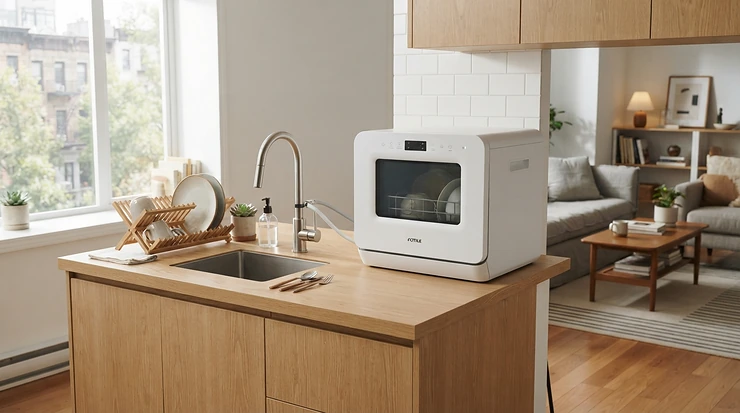
A countertop dishwasher for small apartments is a compact, plug-in dishwasher, typically 15 to 22 inches wide, that sits on a counter and holds roughly two to six place settings. It connects to your faucet or fills from a built-in tank, so no cabinet cutting, plumbing work, or landlord drama is required.
Now, the alternative. Hand-washing in a galley kitchen means a drying rack colonizing half your counter, soggy sleeves, and a sink that’s permanently “in progress.” Meanwhile, the apartment you actually rent has about as much room for a built-in dishwasher as it has for a pony. That gap is exactly why countertop units have gone from novelty to default answer. Capacity for these machines is measured in “place settings,” a convention Wikipedia’s dishwasher overview explains if you want the background.
Here’s the catch: the category is a swamp of near-identical listings, recycled spec sheets, and capacity claims that don’t always agree with each other. So this guide does the unglamorous work. It reconciles published specs, 2026 ENERGY STAR database entries, and aggregated review patterns across seven real models. Where sources disagree (and they do, often), you’ll see it flagged rather than smoothed over.
To be clear about method: nothing here comes from hands-on testing. It’s analysis built on real specs and real review data, with prices shown as ranges only. We’ll cover footprint, capacity for one or two people, water use, dorm and office use, and the portable vs countertop dishwasher for renters question. Let’s get to the shortlist.
Quick Comparison: 7 Countertop Dishwashers at a Glance
| Product | Place Settings | Water Hookup | Approx. Price Range | Best For |
|---|---|---|---|---|
| COMFEE’ CDC22P | 6 | Faucet | $280-$350 | All-round value with documented efficiency |
| BLACK+DECKER BCD6W | 6 | Faucet (quick connect) | $280-$410 | Brand-name buyers who want a delay-start timer |
| Midea MDC22P2ASS | 6 | Faucet | $300-$340 | Hard-water kitchens and a set-and-forget Auto cycle |
| Danby DDW621WDB | 6 | Faucet (quick connect) | $400-$450 | Stainless-tub fans with a tight cabinet gap |
| EdgeStar DWP62SV | 6 | Faucet (quick connect) | $320-$370 | Long-haul use with built-in water filtration |
| AIRMSEN 5L Tank Model | 4-5 (varies by variant) | Tank or faucet | $230-$290 | Renters with unfriendly faucets |
| Farberware FDW05ASBWHA | 2 | Tank or faucet | $310-$350 | Singles with the tiniest counters |
Prices are ranges observed across retailers at the time of research, so check current price before buying. The big divide in this table isn’t brand, it’s hookup. Five of the seven need a compatible faucet, while the AIRMSEN 5L Tank Model and Farberware FDW05ASBWHA can run from a tank you fill by hand. For place-setting capacity for one to two people, the six-place group has headroom, whereas the Farberware FDW05ASBWHA is honest about being a one-person machine. If budget is your tiebreaker, the COMFEE’ CDC22P and the AIRMSEN 5L Tank Model sit at the friendlier end of the range.
💬 Just one click — help others make better buying decisions too!😊
Top 7 Picks for a Countertop Dishwasher for Small Apartments: Expert Analysis
1. COMFEE’ CDC22P Countertop Dishwasher — best documented efficiency on a budget
Most budget dishwashers ask you to trust the box. The COMFEE’ CDC22P hands you a receipt instead: the ENERGY STAR database lists this series as a certified compact model using 2.0 gallons per cycle and 155 kWh per year, about 43% and 30% better than the federal standards it’s measured against.
Physically, it runs roughly 21.7 inches wide, 19.7 deep, and 17.2 tall. The listing promises six place settings and up to 70 pieces of tableware, with plates up to 10 inches. In plain English, that’s a couple’s full day of dishes, minus the roasting pan. Eight programs sounds generous, but most people will live on Normal, Eco, and Speed. The listing claims 49 dB, which, if accurate, is background-hum territory in a studio.
Based on the spec comparison, this is the default answer for a one- or two-person household with a standard threaded faucet. Review data I could verify was thin: one third-party roundup cites a rating around 4.2 stars across thousands of reviews, but I couldn’t confirm that on a primary retailer page. Treat it as directional and skim recent buyer comments.
Pros:
- ✅ Documented 2.0-gallon, 155 kWh ENERGY STAR figures
- ✅ Six place settings in a roughly 22-inch footprint
- ✅ Eight programs including Eco and Speed
Cons:
- ❌ Needs a compatible threaded faucet
- ❌ No built-in tank for hookup-free use
Typically in the $280-$350 range. Value verdict: the strongest paper-to-price ratio on this list.
2. BLACK+DECKER BCD6W Compact Countertop Dishwasher — delay start up to 24 hours
The BLACK+DECKER BCD6W is the name-brand option, and its standout trick is a delay-start timer that stretches to 24 hours. That means you can load after dinner and let the cycle run when the electric rate (or your sleep schedule) prefers it.
The ENERGY STAR record shows 2.0 gallons per cycle and 155 kWh per year, the same efficiency tier as the COMFEE’ CDC22P, in a 21.7 by 19.7 inch footprint. Seven programs (Intensive, Normal, Eco, Glass, 90 Minutes, Rapid, Soak), a child lock, and touch controls round it out. Retail copy touts a stainless interior, but the ENERGY STAR record lists a hybrid plastic-and-steel tub. Listings also disagree wildly on weight, from the low teens to the mid-40s in pounds, so confirm before you carry it up three flights.
Aggregated review sentiment is mixed. One review aggregator scores it around 6.8 out of 10, noting that buyers praise cleaning performance (about 19% of reviews) and ease of use (about 14%). The recurring complaints are damage on arrival (about 23%), weak drying (about 14%), and customer-service frustration. In other words, the machine seems fine when it shows up intact.
Pros:
- ✅ Delay start up to 24 hours
- ✅ Seven programs including a 90-minute cycle
- ✅ Child lock and quick-connect faucet assembly
Cons:
- ❌ Reviewers frequently report shipping damage
- ❌ Drying performance draws repeated complaints
Roughly $280-$410, depending on seller. Value verdict: fair at the low end, harder to justify near the top.
3. Midea MDC22P2ASS Countertop Dishwasher — Auto cycle plus adjustable water softener
If your tap water leaves white film on glasses, the Midea MDC22P2ASS deserves a look. A review-data aggregator lists an adjustable water softener, overflow protection, and a touch screen, a more thoughtful feature set than the price implies.
The cycle list reads Auto, Heavy, Normal, Delicate, ECO, Quick, and Rinse, plus extra-dry and power-wash options. The “6+2” marketing is just a way of counting those add-ons. Dimensions come in around 22 inches wide, 20 deep, and 17.25 tall, a hair larger than its rivals, so check tight spots. The ENERGY STAR record for the MDC22P2A series matches the COMFEE’ CDC22P at 2.0 gallons per cycle and 155 kWh per year. A sister model (MDC22P1AWW) lists 49 dBA, but I couldn’t confirm that figure for this exact model.
On sentiment, the aggregator’s user score of roughly 8.9 beats about 79% of its category. That’s a single source, so weigh it accordingly, but it’s encouraging. The same site notes there’s no load sensor, which is normal at this size. What matters in practice is that the Auto cycle lets you stop second-guessing programs.
Pros:
- ✅ Adjustable water softener for hard-water kitchens
- ✅ Documented 2.0-gallon ENERGY STAR water use
- ✅ Touch controls with an Auto program
Cons:
- ❌ Slightly deeper footprint than most rivals
- ❌ No load sensor, so manual cycle choices
Typically $300-$340. Value verdict: a smart pick for hard-water apartments.
4. Danby DDW621WDB Countertop Dishwasher — stainless tub and flexible delay start
The Danby DDW621WDB is the premium-feeling option. The manufacturer lists a stainless-steel interior, an automatic detergent and rinse-agent dispenser, and delay start in 2, 4, 6, or 8 hour steps, all in a body about 21.65 inches wide, 19.69 deep, and 17.24 tall.
Now the nuance. Danby’s page lists 3.1 gallons for a normal cycle. That’s modest against the federal ceiling for compacts, but it’s roughly 50% more than the 2.0 gallons documented for the COMFEE’ CDC22P, BLACK+DECKER BCD6W, and Midea MDC22P2ASS. Danby also advertises ENERGY STAR certification, and current criteria for certified compacts are tighter than 3.1 gallons. Verify the exact model in the ENERGY STAR Product Finder before you rely on the claim. Noise is stated at 52 dB, and the warranty is 12 months on parts and labor.
Verifiable review volume was limited, so I won’t invent a sentiment summary. Judge this one on build and brand preference. Practically, the stainless tub is nice if you run hot, greasy loads, and a dispenser means fewer pods rolling around your counter.
Pros:
- ✅ Stainless-steel interior
- ✅ Built-in detergent and rinse-aid dispenser
- ✅ Delay start in 2, 4, 6, or 8 hours
Cons:
- ❌ Highest listed water use here at 3.1 gallons
- ❌ Priciest six-place option on this list
Around $400-$450 at list. Value verdict: pay for the tub and the badge, not the efficiency.
5. EdgeStar DWP62SV Countertop Dishwasher — built-in water filtration
The EdgeStar DWP62SV wins fans for durability-minded features. Retail specs list water filtration, a built-in rinse-agent dispenser, an internal heater that lifts water to about 149°F, and a five-foot hose with a quick-connect faucet adapter.
It handles six place settings across seven cycles (heavy, normal, light, glass, baby care, speed, rinse) in a 21.7 by 19.7 by roughly 17.3 inch frame. Noise is listed at 52 dB, and a related EdgeStar listing shows 44 pounds. It uses a single spray arm, which suggests you’ll want to load strategically. Water-per-cycle figures weren’t published in the sources I found, and listings disagree on ENERGY STAR status. One retailer says compliant, another says no, so confirm in the Product Finder.
Here’s a manual warning that matters: EdgeStar cautions against hand dish soap, pods, and tabs, which can cause overflow. Buy loose powder or liquid dishwasher detergent. Reviews are a small sample. An eBay listing shows five 5-star ratings, a Lowe’s reviewer reports about two years of satisfied use, and another reviewer mentions a dented top on arrival.
Pros:
- ✅ Built-in water filtration and rinse-aid dispenser
- ✅ Heats water to roughly 149°F for sanitizing
- ✅ Seven cycles with child lock and delay start
Cons:
- ❌ Single spray arm limits loading flexibility
- ❌ No pods or tabs allowed
Generally $320-$370. Value verdict: solid if filtration matters and you’ll read the detergent rules.
6. AIRMSEN 5L Tank Countertop Dishwasher — no faucet hookup required
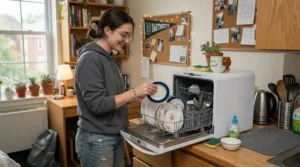
For renters whose faucets refuse to cooperate, the AIRMSEN 5L Tank Countertop Dishwasher solves the problem by avoiding it. You fill a built-in five-liter tank (about 1.3 gallons) by hand, or connect to a faucet if yours cooperates.
Several near-identical variants circulate, so specs shift. Place settings are listed as four or five, widths run roughly 14.6 to 16.9 inches, heights about 17.8 to 18 inches, and claimed noise ranges from 45 to 50 dB. One variant lists heating up to 167°F, 24-hour delay start, and compatibility with pods, liquid, or powder detergent. Narrow is the selling point: it can tuck beside a stove where a 22-inch unit can’t. The trade-off is a smaller basket, so plan on daily runs for two people.
Sentiment is hard to pin down because of the variant sprawl. Walmart listings show review counts in the hundreds per variant, and one roundup cites about 4.6 stars across roughly 1,600 reviews, which I couldn’t independently verify. Read the exact model’s reviews before ordering.
Pros:
- ✅ Runs without a faucet hookup
- ✅ Narrow footprint beside a stove or sink
- ✅ Claimed 45-50 dB operation
Cons:
- ❌ Only four to five place settings
- ❌ Many near-identical variants invite ordering mistakes
Roughly $230-$290. Value verdict: best flexibility per dollar for renters.
7. Farberware FDW05ASBWHA Countertop Dishwasher — two-place capacity for the tiniest kitchens
The Farberware FDW05ASBWHA is the specialist. Lowe’s lists two place settings, a 5-liter tank, five programs (Normal, Rapid, Fruit Wash, Baby Care, Glass), and plates up to 12 inches when angled. Width is around 16.5 to 17 inches and height about 17.3.
That two-place capacity is the whole story. For one person, it’s roughly a day’s dishes. For a couple, it’s a mid-day top-up. The loudest unit here at 62 dB, it’s a machine you’ll notice in a studio, so schedule it for when you’re out. Some retail listings muddy the capacity water, and one eBay buyer returned a unit after realizing it only held two place settings. Read the spec line twice.
Sentiment is small but positive. An eBay page shows 4.6 stars from 11 ratings, with buyers calling it quiet (a relative statement given the 62 dB spec), well designed, and good value. A Lowe’s reviewer says it works for a kitchen too small for even an 18-inch install.
Pros:
- ✅ Smallest footprint of the seven
- ✅ Tank or faucet water supply
- ✅ Fruit basket and baby-care cycle included
Cons:
- ❌ Only two place settings
- ❌ Loudest listed noise level at 62 dB
Typically $310-$350. Value verdict: pricey per place setting, but unbeatable if inches matter more than capacity.
Setup and 30-Day Maintenance Guide
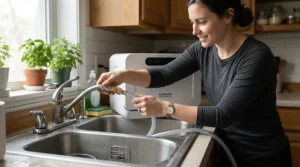
Day one sets the tone for the next five years, so don’t wing it. Start by checking your faucet: unscrew the aerator at the tip (pliers help), then fit the adapter that came in the box. Some retailers note that a little water inside a new unit is normal, because factory testing leaves a splash behind.
Before the first real load, run an empty cycle with dishwasher detergent and watch the connection for drips. A leak at the adapter is the most common first-week gremlin, and it’s usually just a washer that needs reseating. Skip hand soap entirely. EdgeStar’s own materials warn it can cause overflow.
Then adopt ENERGY STAR’s advice: scrape plates, don’t rinse them. Rinsing wastes water and the machine’s detergent is designed to work on food residue. If a pan sits overnight, use the Rinse program instead of running the tap.
In weeks two through four, build a tiny routine. Wipe the door gasket weekly, pull and rinse the filter, and leave the door cracked after cycles so moisture escapes. Check hose clamps monthly, because vibration loosens things. Finally, disconnect the faucet adapter when you’re not running a load. That keeps pressure off the fittings and gives you your sink back for filling pots.
Real-World Scenarios: Which Dishwasher Fits Which Life?
Scenario one: the studio renter. One person, a $300 budget, cooking five nights a week, standard threaded faucet. Place-setting capacity for one to two people is not the constraint here, so the COMFEE’ CDC22P or the Midea MDC22P2ASS make sense. Run it every second day and you’ll land near the ENERGY STAR usage assumption of around 215 cycles a year.
Scenario two: the couple with a pull-down faucet. Two people, a one-bedroom, a modern sink sprayer. Hooking a dishwasher to a pull-down faucet can restrict flow or stress the hose, according to repair-advice sources. A tank model like the AIRMSEN 5L Tank Model avoids the issue. Expect daily runs, since four to five place settings fills fast.
Scenario three: the cramped single with a micro-kitchen. One person, takeout half the week, almost no counter. The Farberware FDW05ASBWHA fits where nothing else does. You’ll run it every day or two, usually at night. Its 62 dB rating makes sleeping in the same room a bad idea.
Scenario four: the hard-water household. Cloudy glasses, constant spots. The Midea MDC22P2ASS, with its adjustable water softener, targets that problem specifically. Pair it with a rinse aid for best results.
Problem → Solution Guide: Fixing the Usual Headaches
Problem: the faucet adapter won’t fit. Many faucets have non-standard threads or built-in sprayers. Solution: buy a universal faucet-to-dishwasher adapter kit, measure your thread size first, or switch to a tank model like the Farberware FDW05ASBWHA.
Problem: dishes come out wet. Drying is the most common complaint on the BLACK+DECKER BCD6W. Solution: add rinse aid, open the door right after the final rinse, and use the extra-dry option where available. Plastic items dry worst.
Problem: the machine overflows with suds. Usually a detergent mistake. Solution: use only dishwasher detergent, and with the EdgeStar DWP62SV, avoid pods and tabs entirely.
Problem: it’s louder than expected. Listed noise ranges from the mid-40s to 62 dB. Solution: run it during the day, place a rubber mat underneath, and avoid contact with cabinets or walls that amplify vibration.
Problem: the counter feels overrun. Solution: store the hose and adapter in a bin beside the unit, and treat the machine as a stove-side appliance, not a centerpiece.
How to Choose a Countertop Dishwasher for Small Apartments
- Measure before anything else. Width, depth, and height all matter, plus the gap under your upper cabinets. Countertop footprint dimensions are the single most common reason people return these machines.
- Identify your faucet. A standard threaded spout works with faucet-fed units. A pull-down sprayer or touchless tap points you toward a tank model.
- Match capacity to your actual dishes. Six place settings suit two people who cook. A four- or two-place unit works for one person who eats out often.
- Verify efficiency in the ENERGY STAR Product Finder. Don’t take “energy efficient” at face value, because ENERGY STAR’s dishwasher page explains that certification is a distinct, verifiable thing.
- Check noise in context. Anything above about 55 dB will be audible in a studio. Under 50 is easy to live with.
- Read the warranty and the return window. Several units here carry just one year, and shipping damage shows up in reviews.
- Confirm the exact model. Near-identical listings often hide different capacities.
Countertop Footprint Dimensions: Will It Actually Fit?
Think of a countertop dishwasher as a microwave with plumbing. It needs counter depth, overhead clearance, and room for hoses, and the door drops forward when it opens, so you’ll want free space in front. Check the manual for exact door-swing and hose-clearance numbers.
| Product | Footprint (W × D × H, inches) | Water per Cycle | Noise (listed) | Best For |
|---|---|---|---|---|
| COMFEE’ CDC22P | 21.7 × 19.7 × 17.2 | 2.0 gal (ENERGY STAR record) | 49 dB | Standard counters with a threaded faucet |
| BLACK+DECKER BCD6W | 21.7 × 19.7 × ~17.2 | 2.0 gal (ENERGY STAR record) | 54-55 dBA | Delay-start fans |
| Midea MDC22P2ASS | ~22 × 20 × 17.25 | 2.0 gal (ENERGY STAR record) | 49 dBA (sister model) | Hard-water kitchens |
| Danby DDW621WDB | 21.65 × 19.69 × 17.24 | 3.1 gal (maker’s page) | 52 dB | Stainless-tub buyers |
| EdgeStar DWP62SV | 21.7 × 19.7 × ~17.3 | Not published in sources found | 52 dB | Filtration and longevity |
| AIRMSEN 5L Tank Model | ~14.6-16.9 W × 16.8-20.1 D × 17.8-18 H | 5 L tank (~1.3 gal) per fill | 45-50 dB (claimed) | Stove-side nooks |
| Farberware FDW05ASBWHA | ~16.5-17 W × depth not confirmed × 17.3 | 5 L tank (~1.3 gal) per fill | 62 dB | One-person micro-kitchens |
The six-place group clusters tightly at about 22 inches wide, so no dramatic footprint winner exists there. The AIRMSEN 5L Tank Model and Farberware FDW05ASBWHA save around five or six inches of width, which is the difference between “fits” and “doesn’t” in many galley kitchens. Remember that height matters as much as width, since all of these sit around 17 to 18 inches tall and need overhead room to load.
Place-Setting Capacity for One to Two People: How Much Is Enough?
A standard place setting means one person’s plate, bowl, glass, and cutlery for a meal. Pots, pans, and baking sheets don’t count toward the number, which trips up many first-time buyers. Under the federal definition, a compact dishwasher holds fewer than eight place settings plus six serving pieces.
So what does “six” mean in real life? For a single person eating three meals at home, six place settings is about two days of dishes. For two people eating dinner together plus breakfast and lunch, it’s daily. The COMFEE’ CDC22P and Midea MDC22P2ASS both advertise up to 70 pieces of tableware with plates to 10 inches, and that figure is realistic for a normal two-person day.
A tank model with four or five places, like the AIRMSEN 5L Tank Model, suits one person comfortably or a couple who eat out often. The Farberware FDW05ASBWHA at two places works only if you’re willing to run it nightly. Bigger isn’t automatically better. A half-empty dishwasher wastes water relative to dishes cleaned, and dishes sitting dirty in a closed box for two days is no one’s idea of hygiene.
Water Usage Per Cycle: What the Numbers Really Say
Here’s where the marketing gets fuzzy, so use the primary sources. According to published criteria, certified compact models must stay at or under 2.0 gallons per cycle and 155 kWh per year, while certified standard models may use up to 3.2 gallons. The federal ceiling for compacts is 3.5 gallons, and the ENERGY STAR records for the COMFEE’ CDC22P, BLACK+DECKER BCD6W, and Midea MDC22P2ASS show 2.0 gallons.
Retail copy muddies this. One COMFEE’ listing says water use is “as low as 2.77 gallons,” while the ENERGY STAR record says 2.0. The Danby DDW621WDB lists 3.1 gallons. Same category, wildly different numbers. Tank models use roughly 1.3 gallons per fill, though their multi-rinse cycles mean actual use per load isn’t directly comparable.
Why care? Run 215 cycles a year, the figure ENERGY STAR commonly assumes. At 2.0 gallons that’s about 430 gallons; at 3.1 it’s roughly 670. Hand-washing estimates run up to 27 gallons for a large load, which is a worst-case figure, but even half that dwarfs these numbers. ENERGY STAR also notes that dishwashers use about the same water regardless of how many dishes are inside, so fill the racks before you run. Compact models, the same page cautions, may use more energy than standard ones over time.
Countertop Dishwasher for Dorm Rooms and Office Kitchens
A countertop dishwasher for dorm rooms and office kitchens has different priorities than one for an apartment. Rules come first. Many residence halls limit appliances, and offices often require facilities approval. Ask before you buy, because a banned appliance is a very expensive paperweight.
Hookup is the second hurdle. Communal and office faucets are frequently touchless, sprayer-style, or otherwise non-threaded, which is exactly where a tank-fed model earns its keep. The Farberware FDW05ASBWHA suits an office desk-adjacent counter that handles mugs, a lunch container, and cutlery. The AIRMSEN 5L Tank Model adds a little more capacity for a shared pantry.
Noise matters in both places. A 45-50 dB claim on the AIRMSEN 5L Tank Model is friendlier than 62 dB on the Farberware FDW05ASBWHA if you share a wall with sleeping roommates. Sanitizing temperatures help in communal settings too: the EdgeStar DWP62SV reaches about 149°F per its specs, and the AIRMSEN 5L Tank Model lists up to 167°F on some variants. For a roommate-heavy dorm, six places and a quick-connect hose make the COMFEE’ CDC22P the practical middle ground, provided the sink cooperates.
Portable vs Countertop Dishwasher for Renters
Retailers use “portable” and “countertop” interchangeably for these small units. A classic portable dishwasher, by contrast, is a full-size machine on casters that rolls to the sink. For a small apartment, that distinction matters because the rolling kind needs floor space most studios don’t have.
| Option | Footprint | Install | Water per Cycle | Best For |
|---|---|---|---|---|
| Countertop, faucet-fed (like COMFEE’ CDC22P) | ~22 in. wide, counter | Faucet adapter | ~2.0 gal (ENERGY STAR) | Renters with threaded faucets |
| Countertop, tank-fed (like AIRMSEN 5L Tank Model) | ~15-17 in. wide, counter | Hand-fill, no hookup | ~1.3 gal per fill | Renters with sprayer faucets |
| Rolling full-size portable (typical category) | Floor space, about a standard width | Faucet adapter and drain | Up to ENERGY STAR’s 3.2-gal standard-size cap | Larger households with floor room |
| Hand washing | Sink and drying rack | None | Up to ~27 gal for a big load (estimate) | Nothing; it’s the baseline |
For most renters, the countertop options win on footprint and flexibility, with the tank-fed type solving the faucet problem. The rolling category buys capacity at the cost of floor space and storage. Hand washing is the baseline you’re trying to beat, and the water figures show why it loses.
Renter-specific logistics matter too. Check your lease for appliance rules, confirm your faucet type, and weigh the machine, since the units in this guide run from the mid-20s to the mid-40s in pounds when listings agree. Keep the box, because the return window (and moving day) will thank you. A portable vs countertop dishwasher for renters decision is really a faucet decision wearing a costume.
Features That Actually Matter (And Those That Don’t)
Matter: hookup method, place-setting capacity, footprint, documented water and energy use, and a return window. These decide whether the machine works in your kitchen.
Matter somewhat: delay start (nice for off-peak electric rates), a rinse-aid dispenser, and drying options, since drying complaints are a recurring review theme.
Don’t matter much: program count. Nine cycles sounds impressive, but most people live on Normal, Eco, and Speed. Baby care and fruit-wash modes are novelty extras, though a sanitizing temperature has real value for bottles.
Also overrated: tiny noise differences. The gap between 49 and 52 dB is hard to notice, but the jump to 62 dB is not. And “energy efficient” in marketing copy doesn’t equal certified. The FTC’s EnergyGuide label guidance explains how to read yellow labels and compare running costs, which is a better filter than adjectives.
Long-Term Cost and Maintenance: The Real Math
Take a $300 machine, a five-year lifespan, and the ENERGY STAR assumption of 215 cycles a year. That’s about 1,075 loads, so the purchase works out to roughly 28 cents per load. Add electricity: 155 kWh over 215 cycles is about 0.72 kWh per load, which at an assumed 16 cents per kilowatt-hour is around 11 or 12 cents. Water at 2.0 gallons adds pennies. All in, you’re looking at roughly 40 cents per load, though your local rates will differ.
Durability is the wildcard. One roundup suggests well-maintained units last 7 to 10 years, but review patterns tell a more cautious story: shipping damage and long-term durability worries appear in BLACK+DECKER BCD6W feedback, and warranties run about a year across the lineup. Budget for a replacement sooner than you’d budget for a built-in.
Maintenance costs are minimal: detergent, rinse aid, a filter rinse, and a replacement hose or washer eventually. For water-conscious buyers, EPA’s WaterSense program offers more ways to trim use around the house. Overall, a countertop dishwasher beats hand-washing on water and, for many households, on time, since ENERGY STAR’s own figures for standard units suggest hours saved each year.
FAQ
❓ How much does a countertop dishwasher cost for a small apartment?
❓ Will a countertop dishwasher work with a pull-down kitchen faucet?
❓ Can I use dishwasher pods in a countertop dishwasher?
❓ How long does a countertop dishwasher cycle take?
❓ Is a countertop dishwasher worth it for one person?
Conclusion
Here’s the short version. The best countertop dishwasher for small apartments depends less on brand than on three questions: Does your faucet cooperate? How many place settings do you really use? And does the footprint fit your counter?
If the faucet is standard and you want documented efficiency, the COMFEE’ CDC22P and Midea MDC22P2ASS are the safest bets. If you value a delay-start timer, the BLACK+DECKER BCD6W is worth a look, provided you’re comfortable with its shipping-damage reputation. The Danby DDW621WDB and EdgeStar DWP62SV cater to buyers who want stainless or filtration. And if your faucet is the problem, the AIRMSEN 5L Tank Model or Farberware FDW05ASBWHA let you skip it entirely.
For a countertop dishwasher for dorm rooms and office kitchens, tank models and quiet operation matter most, so lean that direction. Whatever you choose, verify the exact model number, check ENERGY STAR’s database, and confirm return terms. A dishwasher that fits your life beats a spec sheet that dazzles you.
✨ Ready to Win Back Your Evenings?
🔍 Take your small kitchen to the next level with the options above. Click any highlighted product name to check current pricing and availability, then pick the one that fits your counter, your faucet, and your routine!
Recommended for You
- Best Portable Dishwasher For Family Of Four: 7 Honest Picks (2026)
- 18-Inch Compact Built-In Dishwasher: 7 Best Picks, Ranked (2026)
- 24-inch Built-In Dishwasher: 7 Best Picks (Ultimate 2026 Guide)
Disclaimer: This article contains affiliate links. As an Amazon Associate, I earn from qualifying purchases. If you purchase products through these links, we may earn a small commission at no additional cost to you.
✨ Found this helpful? Share it with your friends! 💬🤗
