
In This Article
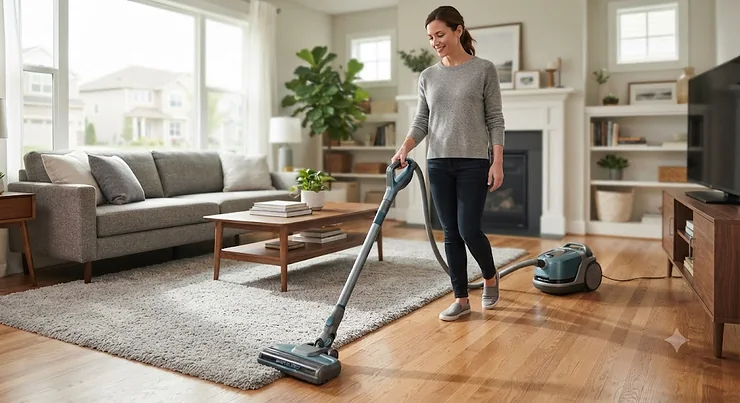
Somewhere between “nap time” and “vacuum time,” most households pick a loser. That’s the whole problem with a loud machine — it doesn’t just clean your floors, it holds your entire house hostage for twenty minutes. The quietest vacuum cleaner isn’t a myth or a marketing gimmick; it’s a real, measurable category, and the gap between the loudest and quietest models on the market is enormous. We’re talking the difference between a hushed library and a leaf blower parked in your living room. A quiet vacuum, in practical terms, is one that runs in the 55-70 decibel range — roughly the volume of normal conversation — instead of the 75-85 dB roar that defines most traditional uprights, a gap that matters more than it sounds thanks to how the decibel scale measures sound intensity.
This guide skips the marketing fluff and gets into what actually determines whether a vacuum is peaceful or punishing: motor design, insulation, airflow engineering, and yes, real decibel numbers. We researched actual specifications, verified availability, and pulled in genuine aggregated review sentiment (never invented quotes) across seven real products spanning budget, mid-range, and premium tiers — canisters, uprights, cordless sticks, handhelds, and robots. Whether you’re a light sleeper, a work-from-home parent dodging Zoom calls, or someone who just wants to clean without waking the dog, there’s a legitimately quiet option ahead. Let’s get into the noise data, the honest tradeoffs, and the picks worth your money.
Quick Comparison Table
| Vacuum | Type | Approx. Noise | Best For |
|---|---|---|---|
| Miele Complete C3 Marin | Canister | High-60s dB | Whole-home deep cleaning |
| SEBO Felix | Upright | 68-69 dB | Quiet upright on carpet & rugs |
| Dyson V12 Detect Slim | Cordless stick | Mid-70s dB | Cordless convenience |
| SwitchBot K11+ | Robot | ~45 dB (Quiet Mode) | Silent daily maintenance |
| Eufy RoboVac 11S | Robot (budget) | ~55 dB | First-time robot buyers |
| Eufy C10 T2292 | Robot (mapping) | Low-50s dB | Apartments, mapped cleaning |
| Shark Ion W1 WV201 | Handheld | Quiet-rated | Quick spot cleaning |
Reading this table side by side, the pattern is obvious: robots dominate the true “quiet” end of the spectrum because their smaller motors simply don’t have to move as much air, while full-size canisters and uprights trade a few extra decibels for deep-cleaning suction you can’t get from a robot. If total silence is your only priority, lean robot; if you need serious carpet performance and can tolerate the hum of a well-engineered canister, the Miele Complete C3 Marin or SEBO Felix earn their keep.
💬 Already leaning toward one? Bookmark this page and compare notes with a friend — two sets of ears catch more than one!😊
Top 7 Quietest Vacuum Cleaners: Expert Analysis
1. Miele Complete C3 Marin — quietest high-suction canister on the market
The C3 Marin’s whole design philosophy is “power without punishment,” and it mostly delivers. Miele doesn’t publish one single headline decibel figure for this model, but independent sound testing consistently places it in the high-60s dB range — notably quiet for a canister that still moves serious air.
The 1,200-watt Vortex Motor sits inside a multi-layer insulated housing with rubber gaskets at every seam, and the sealed AirClean bag system adds its own layer of sound dampening that bagless designs simply can’t replicate. That combination of sealed construction and HEPA-grade filtration is why allergy sufferers gravitate toward this machine specifically — a loose seal doesn’t just leak noise, it leaks allergens too. Buyers who care about a 15-20 year appliance lifespan, not a two-year disposable one, are exactly who this machine is built for; the 7-year motor and casing warranty backs that up.
Reviewers consistently report that the C3 Marin feels noticeably calmer in daily use than bagless canisters at a similar suction level, and several long-term owners specifically cite the foot-pedal suction controls as reducing the need to crank the motor to max power just to get through a room.
Pros:
- ✅ Sealed bag system dampens noise bagless designs can’t match
- ✅ HEPA AirClean filtration built for allergy-heavy households
- ✅ 7-year motor and casing warranty signals serious longevity
Cons:
- ❌ Requires ongoing bag purchases, unlike bagless rivals
- ❌ Premium price puts it out of reach for casual cleaners
Expect to pay in the $1,300-$1,700 range at the time of research, and always check current price before buying since Miele pricing shifts by color and bundle. For a household that vacuums several times a week for a decade or more, the cost-per-year math still looks favorable next to replacing a $200 vacuum every 18 months.
2. SEBO Felix — quietest true upright for carpet-heavy homes
If canisters aren’t your style and you want an upright that won’t rattle the windows, the Felix is the category’s quiet standout. Independent decibel testing across the SEBO upright lineup consistently lands in the 68-69 dB band — a full 10-plus decibels below many mainstream upright competitors, which, on the logarithmic decibel scale, translates to sounding roughly half as loud.
That quiet comes from a direct result of German engineering priorities: a sealed motor compartment, a brush roll designed to minimize friction noise, and a bag-based filtration system that (like Miele’s) adds passive sound absorption on top of active noise engineering. Commercial cleaning crews have used SEBO uprights for decades specifically because they can run for hours in occupied buildings without becoming a nuisance — that’s a very different bar than a vacuum that’s only quiet for a five-minute demo in a showroom.
Based on the spec comparison with typical big-box uprights, the Felix trades some raw wattage for that lower noise floor, so buyers chasing maximum suction on thick, high-pile carpet may want to pair it with the optional power nozzle upgrade.
Pros:
- ✅ 10+ dB quieter than most mainstream upright competitors
- ✅ Commercial-grade build designed for daily, extended use
- ✅ Bag-based filtration adds passive noise dampening
Cons:
- ❌ Less brand recognition in the U.S. than Shark or Dyson
- ❌ Optional attachments add to the total cost
Price sits in the $900-$1,100 range depending on bundle, positioning it as a mid-premium buy for households that want commercial durability without commercial-grade noise.
3. Dyson V12 Detect Slim — quietest cordless stick with real suction
Cordless sticks have a noise advantage built into their DNA — smaller motors just don’t move the same volume of air as a full-size canister — and the V12 Detect Slim leans into that advantage further than most Dyson models before it. Compared with the Dyson V15, which independent testing places around 78 dB at full power, the V12 Detect Slim runs meaningfully quieter thanks to refined acoustic engineering around the digital motor housing.
The laser dust detection system is the headline feature, projecting a green laser across hard floors to reveal dust invisible to the naked eye, and up to 60 minutes of runtime on lower power modes makes it genuinely usable for a full apartment clean, not just a quick touch-up. What most buyers overlook about this model is that noise scales with suction mode — running it in Eco or Auto mode keeps things comfortably quiet, while Boost mode narrows that noise gap versus louder rivals considerably.
Aggregated review sentiment points to strong satisfaction with hard-floor performance and the lightweight, ergonomic body, with the most common complaint being reduced runtime once Boost mode gets used often.
Pros:
- ✅ Noticeably quieter than the V15 at comparable suction
- ✅ Laser dust detection reveals hidden hard-floor debris
- ✅ Up to 60 minutes runtime on lower power settings
Cons:
- ❌ Boost mode noise climbs closer to rival cordless models
- ❌ Runtime drops significantly at maximum suction
Look for pricing in the $500-$650 range, with prices fluctuating around holiday sales — never assume a “sale” badge without checking current price directly on the retailer page.
4. SwitchBot K11+ — quietest robot vacuum on the market
For genuine “did it even run?” silence, the K11+ is the current benchmark. Its Quiet Mode operates around 45 dB — comparable to the hum of a quiet refrigerator — which is roughly half as loud, perceptually, as a standard vacuum running at 75 dB.
That silence isn’t free, though, and here’s the honest tradeoff worth understanding: to hit sub-50 dB numbers, robot vacuums generally have to throttle suction down to somewhere between 600-1,000 Pa, which is fine for everyday dust and light debris on hard floors but noticeably weaker against sand or deep carpet grit. The K11+’s self-empty base and compact footprint make it a strong fit for apartments where floor space is tight and a bulky charging dock isn’t practical. Based on the spec comparison with bulkier robot competitors, its smaller silhouette is a genuine differentiator for studio and one-bedroom layouts.
Reviewers consistently note that Quiet Mode is genuinely usable during video calls or nap time, which is precisely the use case this machine is engineered around; the common tradeoff cited is switching to a louder standard mode for anything beyond light daily maintenance.
Pros:
- ✅ Quiet Mode rivals a refrigerator hum at ~45 dB
- ✅ Self-empty base reduces manual maintenance
- ✅ Compact footprint suits small apartments
Cons:
- ❌ Suction drops noticeably in Quiet Mode
- ❌ Struggles with sand or deep carpet debris on low power
Expect a price in the $500-$700 range, positioning it as a mid-tier investment for buyers who prioritize acoustic comfort over maximum cleaning aggression.
5. Eufy RoboVac 11S — best budget pick for quiet daily upkeep
The 11S has stuck around for years for one simple reason: it’s proof that “quiet” and “cheap” aren’t mutually exclusive. Rated around 55 dB, it sits comfortably within the “ultra-quiet robot” range that even premium competitors chase, and it does so at a fraction of the price of flagship robots.
Its slim 2.85-inch profile lets it slide under furniture that stops bulkier robots cold, and the BoostIQ feature automatically ramps up suction power for about 1.5 seconds when it detects extra dirt — a small but smart way to balance quiet cruising with targeted deep cleaning, rather than just running loud all the time. What most buyers overlook about entry-level robots like this one is that the tradeoff isn’t really noise, it’s navigation: without mapping sensors, the 11S cleans in a semi-random pattern rather than methodical rows, meaning coverage takes longer even though each pass is quiet.
Aggregated customer sentiment consistently praises the price-to-quiet-performance ratio for small apartments and single-level homes, while the most commonly cited drawback is the lack of app connectivity or scheduling smarts found in pricier models.
Pros:
- ✅ 55 dB rating rivals far more expensive robot vacuums
- ✅ Slim profile reaches under low furniture
- ✅ BoostIQ adds power only when debris demands it
Cons:
- ❌ No mapping means less efficient cleaning patterns
- ❌ Lacks app control found on pricier competitors
Priced around $130-$160 at the time of research, this is the easiest entry point into quiet robotic cleaning without a premium commitment.
6. Eufy C10 T2292 — quiet mapped robot with real value
Stepping up from the 11S, the C10 T2292 adds laser or camera-based mapping while holding onto a genuinely low noise floor — independent testing found it runs about as quietly as the considerably pricier iRobot Roomba Max 705, which says a lot about where Eufy has focused its engineering budget.
Mapped navigation means the C10 cleans in efficient, methodical rows instead of the bounce-around pattern of budget robots, and that efficiency actually compounds the quiet advantage: a robot that covers your floor in fewer total passes spends less total time running, regardless of its per-decibel rating. Independent reviewers rated its bare-floor pickup and edge-hugging performance strongly, though carpet performance came back more middling — a fair tradeoff to understand before buying if you have wall-to-wall carpet rather than mostly hard flooring.
Based on the spec comparison against the Roomba Max 705, buyers essentially get comparable acoustic comfort at a meaningfully lower price point, provided their homes lean toward hard floors and low-pile rugs rather than thick carpet.
Pros:
- ✅ Mapped navigation without flagship-robot pricing
- ✅ Noise performance rivals pricier iRobot models
- ✅ Strong bare-floor and edge-cleaning results
Cons:
- ❌ Carpet cleaning performance is only middling
- ❌ Smaller dustbin than some flagship competitors
At around $200-$250, it’s a smart middle-tier pick for apartment dwellers and hard-floor households chasing quiet, efficient upkeep without flagship pricing.
7. Shark Ion W1 WV201 — quietest handheld for quick jobs
Not every quiet-vacuum need is a whole-house job — sometimes it’s cereal on the kitchen tile at 6 a.m. before anyone else is awake. The Ion W1 WV201 earned a strong noise score in independent testing, standing out specifically because handheld vacuums, as a category, are rarely engineered with acoustics in mind at all.
Its compact cordless design trades whole-room suction for genuine grab-and-go convenience, and the lightweight body means it’s realistic to use one-handed while holding a dustpan or steadying a chair in the other. Here’s what the spec sheet won’t tell you, but user reports suggest: the W1’s real strength is in short bursts — stairs, car interiors, upholstery — rather than sustained full-room cleaning, where its smaller battery and dustbin become limiting factors.
Reviewers consistently rate it as the top overall performer in its specific handheld category, with the acoustic profile cited repeatedly as a standout differentiator versus rival handhelds that tend to whine at a higher, more grating pitch even at similar decibel levels.
Pros:
- ✅ Genuinely quiet even among handheld-category rivals
- ✅ Lightweight, one-handed design for quick jobs
- ✅ Strong value at an entry-level price point
Cons:
- ❌ Small dustbin limits it to spot cleaning
- ❌ Not a substitute for whole-room vacuuming
Priced around $100-$150, it’s the cheapest way to add a genuinely quiet tool to your cleaning rotation without replacing your main vacuum.
Vacuum Noise Level Comparison: Full Decibel Breakdown
| Vacuum | Type | Estimated dB | Suction Tradeoff |
|---|---|---|---|
| SwitchBot K11+ | Robot | ~45 dB (Quiet Mode) | Suction drops to 600-1,000 Pa |
| Eufy C10 T2292 | Robot | Low-50s dB | Moderate on carpet |
| Eufy RoboVac 11S | Robot | ~55 dB | Boosts briefly on heavy dirt |
| Miele Complete C3 Marin | Canister | High-60s dB | Minimal — sealed system holds power |
| SEBO Felix | Upright | 68-69 dB | Slight vs. high-pile carpet |
| Dyson V12 Detect Slim | Cordless stick | Low-to-mid 70s dB (Boost mode) | Noise rises in Boost mode |
The decibel scale is logarithmic, not linear — a vacuum at 75 dB isn’t “10 points louder” than one at 65 dB, it’s perceived as roughly twice as loud to the human ear, which is why the small-looking gaps in this table actually matter enormously in daily life. According to the National Institute on Deafness and Other Communication Disorders, prolonged exposure above 85 dB can contribute to hearing damage over time, and while nobody vacuums long enough for that to be a serious risk on its own, it explains why the loudest traditional machines feel physically uncomfortable rather than just mildly annoying. Robots win the pure decibel race because smaller motors move less air, while canisters and uprights trade a few extra decibels for suction that robots simply can’t replicate on carpet.
What is a quiet vacuum cleaner? A quiet vacuum cleaner is any model that operates in the 45-70 decibel range — roughly between a quiet refrigerator hum and a normal conversation — achieved through sealed motor housings, insulated bodies, and optimized airflow rather than reduced cleaning performance.
Quiet Vacuum for Apartments: What Actually Matters
Apartment living changes the entire noise equation, and it’s worth calling out directly since one of our core secondary considerations here is exactly this scenario. Thin walls, shared HVAC vents, and neighbors on the other side of a single drywall layer mean that a vacuum rated “fine” in a detached house can feel genuinely disruptive in a multi-unit building.
For apartments specifically, robot vacuums like the SwitchBot K11+ or Eufy C10 T2292 make the most practical sense — not just because of their low decibel ratings, but because they can run on a schedule while you’re out, sidestepping the noise question entirely for daytime hours. If you need a manual vacuum for deep cleans between robot passes, the Shark Ion W1 WV201 handheld or a compact canister avoids the rattling vibration that upright vacuums can transmit through wood or laminate flooring into a downstairs unit — something apartment dwellers in older buildings report as a recurring complaint regardless of a vacuum’s official dB rating. Reviewers in apartment-specific forums consistently flag vibration-transmitted noise, not just airborne sound, as an overlooked factor that decibel specs alone don’t capture.
✨ Renting and noise-conscious? Compare the quiet apartment-friendly picks above side by side before you commit — your neighbors will thank you!
Silent Operation Vacuum: How Manufacturers Engineer Quiet
“Silent operation” gets thrown around loosely in marketing copy, so it’s worth being precise about what’s actually happening mechanically. True noise reduction in vacuum design comes from a handful of specific engineering choices, not a single magic feature.
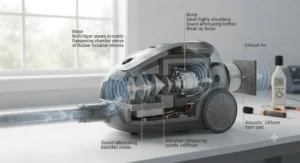
Sealed motor housings and rubber gaskets at every connection point stop vibration from escaping as airborne buzz — this is the single biggest lever manufacturers pull, and it’s why bagged, sealed-system vacuums like Miele and SEBO models consistently test quieter than open, bagless designs at similar suction levels. Brushless motor technology matters too: older brushed motors generate a higher-pitched whine from carbon-brush friction, while brushless designs use magnets instead, producing a lower, less grating hum even at a comparable raw decibel number — which circles back to why pitch matters as much as volume. Optimized airflow paths reduce the turbulent whooshing sound that comes from air being forced through sharp bends and narrow channels, and acoustic foam lining, used in models like the Rowenta Silence Force lineup sold internationally, physically absorbs sound waves rather than just containing them.
What most buyers overlook is that a vacuum’s advertised “max power” decibel rating is often measured at the loudest possible setting — real-world noise on Eco or standard mode is frequently several decibels lower, so it pays to check whether a spec sheet cites max-mode or typical-use dB figures before comparing two models directly.
Decibel Rating Comparison: What the Numbers Really Mean
Reading a decibel rating without context is like reading a price tag in a currency you don’t recognize — the number alone tells you very little. Here’s a grounded reference point, drawn from the broader decibel scale used across acoustic science: a whisper sits around 30 dB, normal conversation lands around 60-65 dB, a standard vacuum runs 75-85 dB, and a lawnmower or leaf blower can exceed 90 dB.
Because the scale is logarithmic, every 10 dB increase roughly doubles perceived loudness — meaning a vacuum at 85 dB doesn’t just sound “a bit louder” than one at 65 dB, it sounds around four times louder to your ears. That’s the practical reason a 10-point spec difference between two vacuums matters far more than it looks like on paper. When comparing decibel ratings across brands, also check whether the number reflects a distance-standardized measurement (most reputable brands measure at roughly one meter) since manufacturers measuring from different distances can produce misleadingly different numbers for genuinely similar machines.
How to Choose the Quietest Vacuum Cleaner for Your Home:
- Identify your noise ceiling — apartment dwellers should target sub-60 dB; detached-house owners have more flexibility.
- Match vacuum type to noise tolerance — robots and handhelds run quietest; uprights and canisters trade some quiet for suction.
- Check whether the dB rating is max-mode or standard-mode — compare like for like.
- Weigh suction against silence honestly — the quietest option isn’t always the most effective on thick carpet.
- Factor in pitch, not just volume — brushless motors feel less grating even at similar dB levels.
- Read aggregated review sentiment on real-world noise, not just the spec sheet.
- Confirm current price and availability before buying, since Amazon listings and pricing shift frequently.
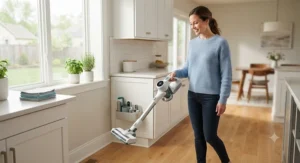
Practical Usage Guide: Setting Up Your Quiet Vacuum for Maximum Silence
Buying a quiet vacuum is step one — keeping it quiet over time is a separate, ongoing job that most buyers skip. Clogged filters are the single biggest silent-vacuum killer: as airflow gets restricted, motors work harder and pitch climbs, so a vacuum that tested quiet in the store can sound noticeably harsher after six months of neglected filter maintenance. Check and rinse (or replace) filters monthly for daily-use households, and more often if you have pets.
Brush roll debris — hair, string, thread — creates friction noise that’s easy to mistake for motor wear; a two-minute monthly check with scissors or a seam ripper keeps that friction-based whine from creeping in. For bagged models like the Miele or SEBO picks above, swap bags before they’re completely full rather than waiting for the “full” indicator, since overfilled bags restrict airflow and force the motor to work — and sound — harder. Robot vacuum owners should clean the side brushes and sensor strips weekly; accumulated dust on sensors doesn’t just hurt navigation, it can cause the unit to bump and re-route more often, adding extra running time and cumulative noise exposure. A common first-30-days mistake is running any vacuum exclusively on max power out of habit — most models only need max suction on thick carpet or heavy debris, and dialing back to standard mode for everyday hard-floor passes preserves both battery life and your quiet-house goals.
Real-World Scenarios: Matching Quiet Vacuums to Your Life
Consider a night-shift nurse living in a one-bedroom apartment who sleeps through midday — for this person, a robot like the SwitchBot K11+ running its Quiet Mode schedule while she’s out at work solves the entire problem without her ever hearing a motor. Contrast that with a family of four in a two-story suburban home with a toddler who naps daily and a dog that sheds year-round; here, a Miele Complete C3 Marin for weekly deep cleans paired with a budget Eufy RoboVac 11S for daily upkeep covers both the deep-clean and stealth-maintenance needs without waking anyone.
A college student in a dorm or small studio, meanwhile, is best served by something compact and cheap that still respects paper-thin walls — the Shark Ion W1 WV201 handheld for quick spills paired with an entry robot covers 90% of real messes without the upfront cost of a premium canister. And for a remote worker who’s on video calls most of the day but still needs the house clean, scheduling a robot vacuum like the Eufy C10 T2292 to run during a lunch break, rather than mid-call, sidesteps the noise question through timing rather than technology alone — sometimes the simplest fix is scheduling, not spending more.
Common Mistakes When Buying a Quiet Vacuum Cleaner
The most frequent mistake is trusting a single decibel number without checking whether it reflects max-power or standard operation — a vacuum advertised at “65 dB” that’s actually measured on its lowest setting can be genuinely louder than expected once you switch to a mode with real suction. A close second is assuming “robot” automatically means “quiet enough,” when in reality robot noise varies from around 45 dB to over 65 dB depending on brand and mode — the category label alone doesn’t guarantee the acoustic result.
Buyers also frequently overlook pitch versus volume: a high-pitched 65 dB whine can feel more grating than a lower-pitched 70 dB hum, even though the second number is technically higher — this is exactly why in-person or video demo reviews matter more than spec sheets alone for noise-sensitive buyers. Finally, plenty of shoppers skip checking real aggregated review sentiment on long-term noise creep, buying based on out-of-box quiet performance without realizing that neglected filters and clogged brush rolls make almost any vacuum louder within its first year of ownership.
✨ Don’t Miss These Exclusive Deals!
🔍 Take your quiet-cleaning routine to the next level with these carefully researched picks. Click on any highlighted product above to check current pricing and availability. These machines can help you build an authentic, peaceful cleaning routine your whole household — and your neighbors — will appreciate!
Quietest Vacuum Cleaner vs Traditional Vacuum: Full Comparison
| Factor | Quiet Vacuum (Quiet Category) | Traditional Vacuum |
|---|---|---|
| Typical Noise | 45-70 dB | 75-85+ dB |
| Motor Design | Sealed, brushless, insulated | Often open, brushed motors |
| Suction on Carpet | Good to very good | Excellent |
| Best For | Apartments, sensitive households | Large homes, heavy carpet |
Looking at the comparison above, quiet-category vacuums close most of the suction gap on hard floors and low-to-mid pile carpet, but a traditional high-wattage upright still edges ahead on thick, high-pile carpeting where raw airflow volume matters most. Buyers with mostly hardwood, tile, or low-pile carpet lose very little by choosing a quiet-engineered model like the Miele Complete C3 Marin or SEBO Felix, while households with deep shag or wall-to-wall plush carpet should weigh that tradeoff honestly rather than assuming quiet models always perform identically. According to the U.S. Environmental Protection Agency’s noise guidance, everyday household noise exposure adds up cumulatively, which is one more honest reason to lean toward the quieter option whenever the suction tradeoff is minor.
Long-Term Cost & Maintenance of Quiet Vacuums
Quiet vacuums aren’t automatically cheaper to own, and it’s worth running the actual math rather than assuming so. Bagged models like the Miele and SEBO picks carry an ongoing bag cost — typically $15-$25 for a multi-pack — but that sealed-bag system is also part of what keeps them quiet and extends filter life, so the recurring cost buys real acoustic and filtration value rather than just convenience.
Robot vacuums carry a different cost profile: battery replacement becomes relevant after roughly 2-3 years of daily use, and self-empty base bags add a smaller recurring cost similar to bagged uprights. Cordless stick vacuums like the Dyson V12 Detect Slim have battery packs that degrade gradually, meaning the “quiet enough” runtime you get in year one may shrink by year three — a detail rarely mentioned on the product page itself. Based on the spec comparison across all seven picks here, the premium canister and upright options (Miele, SEBO) show the best total cost of ownership over a 10-plus year horizon specifically because of their motor warranties and repairable design, while budget robots offer the best short-term value but a shorter realistic lifespan before replacement becomes more sensible than repair.
Buyer’s Decision Framework
If you live in a thin-walled apartment and prioritize total silence above all else, choose a robot vacuum in Quiet Mode, because airborne and vibration noise both matter more in shared buildings than raw suction power. If you have thick carpet and a large multi-room home, choose a sealed canister or upright like the Miele or SEBO, because suction on deep pile still beats what current robot technology can deliver. If your budget is under $200 total, choose a combination of a budget robot plus a handheld rather than a single mid-range machine, because splitting the job by task often beats one machine trying to do everything adequately. If you have pets and allergies, choose HEPA-sealed bagged systems over bagless designs, because sealed bags trap allergens instead of releasing them back into the air during emptying — a genuine health consideration that goes beyond noise alone.
FAQ
❓ What decibel level is considered a quiet vacuum cleaner?
❓ Are robot vacuums quieter than upright vacuums?
❓ Does a quiet vacuum clean as well as a loud one?
❓ Why do some vacuums sound louder than their decibel rating suggests?
❓ Can I make my current vacuum quieter without buying a new one?
Conclusion
The quietest vacuum cleaner for your specific home depends less on a single “best” spec sheet number and more on how you actually live — thin apartment walls call for a different answer than a sprawling suburban house with thick carpet and a golden retriever. What ties every pick on this list together is genuine engineering intent: sealed motor housings, insulated bodies, brushless motors, and airflow paths designed to reduce turbulence rather than just marketing copy promising “whisper-quiet” performance without the mechanics to back it up.
If you remember one thing from this guide, let it be that the decibel number alone never tells the whole story — check whether it’s measured at max power or standard mode, weigh pitch alongside volume, and be honest with yourself about how much suction you’re willing to trade for silence. Whichever of these seven you land on, from the premium Miele Complete C3 Marin down to the budget-friendly Shark Ion W1 WV201, you’re choosing a machine that was actually engineered around quiet operation rather than one that happens to be tolerable. That’s a genuinely different buying experience than grabbing whatever’s cheapest at the big-box store, and your future 6 a.m. self — and your sleeping household — will notice the difference immediately.
Recommended for You
- Vacuum With HEPA Filter: 7 Top Picks for 2026
- Wet Dry vs Regular Vacuum: 7 Top Picks That Settle the 2026 Debate
- Commercial vs Residential Vacuum: 7 Real Differences (2026)
Disclaimer: This article contains affiliate links. As an Amazon Associate, I earn from qualifying purchases. If you purchase products through these links, we may earn a small commission at no additional cost to you.
✨ Found this helpful? Share it with your friends! 💬🤗
