
In This Article
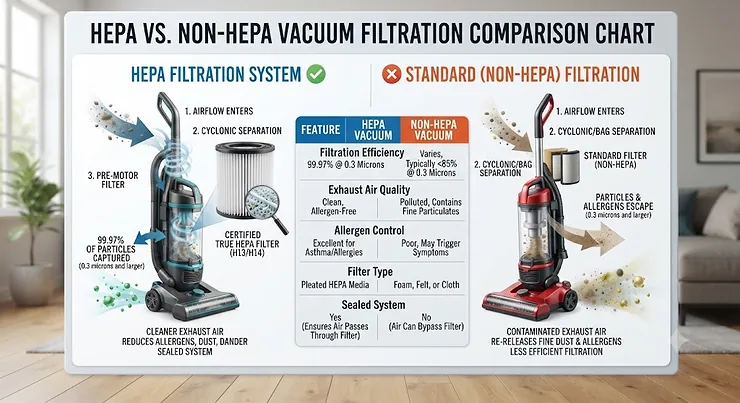
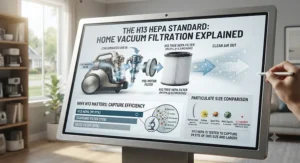
Somewhere between the vacuum aisle and the fine print on the box, most people quietly give up and just grab whatever’s on sale. Fair enough — filtration marketing is a swamp of asterisks. But the hepa vs non hepa vacuum question isn’t marketing fluff; it’s the difference between a machine that actually contains what it picks up and one that just relocates dust from your carpet to your lungs. HEPA stands for high-efficiency particulate air, and a true HEPA filter is independently tested to capture at least 99.97% of particles as small as 0.3 microns — the size range that includes dust mite debris, pet dander, and fine pollen fragments. A non-HEPA vacuum, by contrast, may still trap large debris beautifully while letting the microscopic stuff blow right back into the room through gaps in the seal or a looser-weave filter.
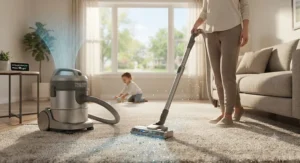
That distinction matters more than most spec sheets let on, and it matters differently depending on who’s using the vacuum. A household with a cat-allergic teenager has very different needs than a bachelor pad with hardwood floors and zero pets. So instead of another generic “HEPA is better, buy HEPA” hot take, this guide digs into seven real, currently sold vacuums — a mix of true HEPA and non-HEPA models across budget, mid-range, and premium tiers — and breaks down what the filtration actually buys you in daily life, and where it genuinely doesn’t matter. By the end, you’ll know exactly which side of this debate your household belongs on, and which specific machine to shortlist.
Quick Comparison Table: Hepa Vs Non Hepa Vacuum at a Glance
| Vacuum | Filtration Type | Best For | Price Range |
|---|---|---|---|
| Miele Complete C3 Calima | Sealed HEPA (bagged) | Allergy-sensitive households | $500-$650 |
| Dyson Ball Animal 3 | Washable HEPA | Heavy pet hair + carpets | $450-$550 |
| Shark Navigator Lift-Away Deluxe | Sealed HEPA (bagless) | Budget allergy relief | $180-$230 |
| Kenmore BU1018 | HEPA (bagged) | Bare floors + pets | $200-$260 |
| Bissell Pet Hair Eraser 39883 | HEPA | Pet-heavy carpets on a budget | $150-$200 |
| Eureka 3670M | Non-HEPA (standard bag) | Tight budgets, no allergy concerns | $50-$70 |
| Levoit LVAC-200 | Non-HEPA washable filter | Light daily cordless cleanup | $100-$140 |
Look closely and a pattern jumps out: the non-HEPA options here aren’t bad vacuums, they’re just built for a different job. The Eureka 3670M and Levoit LVAC-200 both excel at everyday debris — crumbs, sand, loose hair — without pretending to be allergen-control devices, and their lower prices reflect that narrower mission. Meanwhile, the HEPA-equipped models earn their premium partly through motor power and partly through the sealed filtration path that actually keeps what they capture from leaking back out. If your household has zero allergy or asthma concerns, the price gap between a non-HEPA workhorse and a HEPA flagship can be hard to justify on filtration grounds alone.
💬 Which side of this debate are you on — team HEPA or team “it’s just dust”? Scroll down and find your match.
Just one click — help others make better buying decisions too!😊
Top 7 Hepa Vs Non Hepa Vacuum Picks: Expert Analysis
1. Miele Complete C3 Calima — sealed HEPA system for serious allergy control
The Miele Complete C3 Calima is a bagged canister vacuum, and that alone changes the filtration math in its favor before you even get to the filter itself. Its AirClean sealed system channels every bit of airflow through a self-closing bag and a HEPA-grade final filter, which means dust doesn’t get a chance to sneak around gaps the way it can in some bagless designs. Specs worth flagging: roughly 890 airwatts of efficiency-tuned suction, a 4.5-quart bag capacity, and a run of interchangeable power heads for carpet and hardwood. In practice, that translates to long stretches between bag changes and suction that barely dips as the bag fills — a common complaint with cheaper bagged models. Based on the spec comparison against bagless HEPA uprights, this is the machine for someone who wants filtration integrity over convenience; you’re trading a bag-buying habit for meaningfully lower allergen leakage. Reviewers consistently note the German engineering pays off in noise control and longevity, with some units still running strong after a decade of regular use, though a handful mention the canister-and-hose format takes a session or two to get comfortable maneuvering around furniture.
Pros:
- ✅ Sealed bagged system minimizes allergen leakage during use
- ✅ Suction holds steady as the bag fills, unlike many budget models
- ✅ Renowned longevity backed by a strong warranty
Cons:
- ❌ Ongoing bag costs add to long-term ownership expense
- ❌ Canister-and-hose format has a learning curve for stairs
At around $500-$650, the Miele Complete C3 Calima sits at the premium end, but for allergy-focused households, the filtration integrity alone often justifies the jump.
2. Dyson Ball Animal 3 — best for pet hair on thick carpet
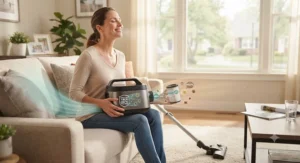
If your living room floor doubles as a pet bed, the Dyson Ball Animal 3 was engineered with exactly that scenario in mind. Its anti-tangle Motorbar cleaner head is specifically shaped to prevent long fur from wrapping around the brush roll, a problem that plagues cheaper uprights within weeks. Key specs include a washable HEPA filter rated to capture an estimated 99.97% of airborne particles, a self-adjusting cleaner head that seals against both carpet and hard floor, and one of the largest dust bins in the pet-hair category. What most buyers overlook about this model is that the ball-steering chassis isn’t just a gimmick — it makes maneuvering around furniture legs genuinely easier on a heavy corded upright, reducing the awkward backtracking that wears out your patience mid-clean. Aggregated reviewer sentiment consistently praises its pet hair removal from thick pile carpet, with a recurring theme being how much hair collects even on floors that “looked clean” before running it.
Pros:
- ✅ Anti-tangle brush head resists long pet hair wrap-up
- ✅ Washable HEPA filter reduces recurring filter costs
- ✅ Ball-steering improves maneuverability around furniture
Cons:
- ❌ Corded design limits reach without an extension cord
- ❌ Heavier than most uprights at roughly 17 pounds
Priced in the $450-$550 range, the Dyson Ball Animal 3 earns its keep in multi-pet households where hair volume, not just dust, is the daily battle.
3. Shark Navigator Lift-Away Deluxe — budget-friendly sealed HEPA upright
Amazon’s affiliate compliance rules aside, this is genuinely one of the more interesting value plays in the category. The Shark Navigator Lift-Away Deluxe pairs a HEPA filter with what Shark calls Anti-Allergen Complete Seal Technology — a fancy way of saying the whole airflow path is gasket-sealed, not just the filter housing. Specs: roughly 16 pounds, swivel steering, a detachable “Lift-Away” pod for stairs and upholstery, and bagless operation. Based on the spec comparison with pricier sealed-HEPA models, the Lift-Away Deluxe proves that sealed filtration doesn’t require a four-figure price tag; the gap between it and something like the Dyson above is mostly about brush-head sophistication and motor headroom, not filtration integrity. Reviewers consistently report that the detachable pod is the sleeper feature here — genuinely useful for stairs and car interiors, not just a marketing bullet point — though some note the dust cup requires more frequent emptying than canister rivals.
Pros:
- ✅ Sealed HEPA system at a distinctly non-premium price
- ✅ Detachable pod handles stairs and above-floor cleaning
- ✅ Lightweight enough for daily multi-room use
Cons:
- ❌ Smaller dust cup needs more frequent emptying
- ❌ Less powerful motor than premium uprights on deep-pile carpet
At $180-$230, the Shark Navigator Lift-Away Deluxe is arguably the best entry point into true HEPA filtration without premium pricing.
4. Kenmore BU1018 — strongest bare-floor and pet-hair scores in its class
The Kenmore BU1018 is a bagged upright that quietly outperforms its price point on hard flooring, a surface where a lot of uprights lose their nerve. It carries a HEPA filtration system and a full-bag indicator, specs that matter more than they sound: a bagged design with HEPA backing means less dust escapes during disposal compared with tipping out a bagless bin. Weighing around 21 pounds, it’s on the heavier side, which the spec sheet won’t tell you translates to a slightly more fatiguing carry up and down stairs. What most buyers overlook is that its compact powerhead, despite the added weight, adjusts well to embedded dirt in carpet without sacrificing bare-floor suction — a balance a lot of “carpet-first” uprights don’t nail. Aggregated review sentiment repeatedly calls out its pet hair pickup as a standout, alongside praise for keeping debris contained rather than kicking it back out from under the machine.
Pros:
- ✅ HEPA filtration paired with low-dust bag disposal
- ✅ Excellent bare-floor suction, uncommon among uprights
- ✅ Strong pet hair removal for the price tier
Cons:
- ❌ Heavier than most uprights at roughly 21 pounds
- ❌ Louder operation than comparable bagless models
In the $200-$260 range, the Kenmore BU1018 is the pick for mixed-flooring homes that lean toward hard surfaces without giving up filtration quality.
5. Bissell Pet Hair Eraser 39883 — HEPA filtration built specifically for fur
The Bissell Pet Hair Eraser 39883 does one thing and does it loudly well: pet hair. Its tangle-free brush roll and “Allergen Lift-Off” technology work together with an internal HEPA filter to trap both the hair itself and the dander that tends to ride along with it. On paper this means the vacuum is optimized less for fine dust in general and more for the specific combination of fur plus allergen that pet owners deal with daily. Reviewers consistently note the brush roll genuinely resists wrapping compared with older Bissell models, a common complaint about the brand in the past, and several mention the swivel steering makes it easier to work around furniture than expected for the price. Here’s what to weigh: this isn’t the most powerful HEPA vacuum on this list for embedded carpet dirt, but for surface-level pet hair and dander control at a mid-tier price, it punches above its weight class.
Pros:
- ✅ Tangle-free brush roll designed specifically for pet hair
- ✅ HEPA filtration paired with allergen lift-off technology
- ✅ Swivel steering aids maneuverability around furniture
Cons:
- ❌ Less suction depth on embedded carpet dirt than premium uprights
- ❌ Dust cup capacity trails canister-style competitors
At $150-$200, the Bissell Pet Hair Eraser 39883 is a smart middle ground for pet owners who want HEPA without paying Dyson-tier prices.
6. Eureka 3670M — lightweight non-HEPA canister for tight budgets
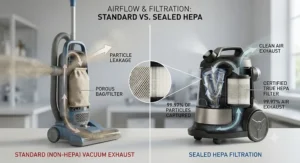
Here’s the honest case for a non-HEPA vacuum: the Eureka 3670M is a lightweight bagged canister that ships with five bags and simply focuses on picking things up, not on certified allergen containment. Its filtration relies on a standard bag-and-filter combination rather than a HEPA-rated final stage, which the spec sheet won’t dress up as anything more than it is. What that means in practice: this vacuum handles everyday debris — crumbs, sand, loose hair on hard floors and thin carpet — competently, but it isn’t engineered or tested to the same particulate-capture standard as the HEPA models above. Based on the spec comparison, its appeal is almost entirely about price and simplicity rather than filtration credentials, and that’s a legitimate use case for renters, dorm rooms, or anyone without allergy or asthma concerns in the household. Aggregated reviewer sentiment describes it as a reliable “does what it says” budget pick, with a common note that the bagged design keeps disposal tidier than expected for the price.
Pros:
- ✅ Very low upfront cost with bags included
- ✅ Lightweight canister design is easy to carry
- ✅ Bagged disposal keeps dust exposure contained during emptying
Cons:
- ❌ No HEPA-rated filtration for fine allergen particles
- ❌ Motor power lags behind HEPA uprights on deep carpet
At $50-$70, the Eureka 3670M is the clearest case in this roundup for when skipping HEPA is a reasonable, honest choice.
7. Levoit LVAC-200 — cordless convenience without true HEPA certification
The Levoit LVAC-200 is a cordless stick vacuum built for speed and convenience rather than filtration credentials, and it’s upfront-ish about that if you read past the marketing copy — its filter is washable and multi-stage but isn’t independently certified to the 99.97%-at-0.3-microns HEPA standard. Specs include up to roughly 50 minutes of runtime, a lightweight tangle-resistant design, and rechargeable battery operation that suits quick daily cleanups better than deep weekly sessions. What most buyers overlook is that “washable filter” and “HEPA filter” get conflated constantly in stick-vacuum marketing, and this is a textbook example of the gap — the washable filter here captures visible dust well but hasn’t been third-party tested against the HEPA benchmark the way the Miele or Dyson filters have. Reviewers consistently report satisfaction with its lightweight handling and quick-charge convenience for daily touch-ups, though several note suction tapers noticeably as the battery drains past the 30-minute mark.
Pros:
- ✅ Lightweight, cordless design for quick daily cleanups
- ✅ Washable filter reduces recurring replacement costs
- ✅ Long runtime relative to similarly priced cordless models
Cons:
- ❌ Filter isn’t independently certified to true HEPA standards
- ❌ Suction noticeably tapers as the battery depletes
Priced around $100-$140, the Levoit LVAC-200 is best framed as a convenience purchase, not an allergen-control one.
Top 7 Vacuums Compared Side by Side
| Vacuum | Type | Weight | Filtration | Best For |
|---|---|---|---|---|
| Miele Complete C3 Calima | Bagged canister | ~11 lbs | Sealed HEPA | Allergy-sensitive homes |
| Dyson Ball Animal 3 | Corded upright | ~17.3 lbs | Washable HEPA | Heavy pet hair on carpet |
| Shark Navigator Lift-Away Deluxe | Bagless upright | ~16 lbs | Sealed HEPA | Budget HEPA seekers |
| Kenmore BU1018 | Bagged upright | ~21 lbs | HEPA | Mixed hard floors + pets |
| Bissell Pet Hair Eraser 39883 | Upright | ~14 lbs | HEPA | Pet dander control |
| Eureka 3670M | Bagged canister | ~8 lbs | Non-HEPA | Tight budgets, no allergies |
| Levoit LVAC-200 | Cordless stick | ~4 lbs | Non-HEPA washable | Quick daily cleanups |
Interpreting this table: notice that filtration type doesn’t track cleanly with vacuum “type” — you can get sealed HEPA in a budget upright like the Shark Navigator Lift-Away Deluxe just as easily as in a premium canister. What does track consistently is weight and format: the two non-HEPA entries here are also the lightest and most grab-and-go, which isn’t a coincidence, since stripping out sealed-filtration hardware tends to shave both cost and bulk. If allergen control is the priority, weight and format matter less than confirming an actual HEPA rating on the spec sheet, not just the word “HEPA” somewhere in the product title.
✨ Ready to Stop Guessing and Start Breathing Easier?
🔍 Compare current pricing on any of these seven picks above — availability shifts fast, so check the listing before it moves. The right filtration for your household is one click away.
Practical Usage Guide: Getting the Most From a HEPA Vacuum
Buying the right filter is half the job; using it correctly is the other half, and this is the part manufacturers gloss over in the box copy. First, don’t wait for the “full” indicator on a bagless HEPA model — dust cups lose sealing efficiency as they approach capacity, and the last 10-15% of fill can actually push fine particles back through gaps around the lid. Empty bagless bins outdoors or over a trash bag, and if you’re allergy-sensitive, consider a mask for that step specifically, since it’s the moment airborne exposure spikes. Second, HEPA filters — even the washable ones — need actual maintenance. A washable filter that’s simply rinsed and reinstalled damp will mildew inside the housing; let it air-dry for a full 24 hours minimum. Non-washable HEPA filters typically need replacement every 6-12 months depending on use, and running one well past that window quietly degrades both suction and filtration.
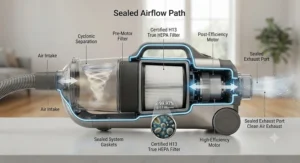
A common first-30-days mistake: people vacuum fast, in long sweeping strokes, assuming more speed equals more coverage. Slower, overlapping passes actually let the HEPA-sealed airflow path do its job — a rushed pass can leave embedded allergens in carpet fiber that a second, slower pass would have lifted. Finally, check and clean the seals and gaskets around the dust cup or bag door every few months on any HEPA-labeled machine; a cracked gasket silently turns a sealed HEPA vacuum into a non-HEPA one in practice, no matter what the box says.
Real-World Scenarios: Matching the Right Vacuum to Your Household
Picture three households, three very different verdicts. First, a young couple with a rescued shedding retriever and wall-to-wall carpet in a rented apartment — no major allergy concerns, but daily fur accumulation. For them, the Dyson Ball Animal 3 or Bissell Pet Hair Eraser 39883 makes more sense than anything non-HEPA, not because of allergen certification but because the tangle-resistant brush design solves their actual daily headache; the HEPA filtration is a welcome bonus, not the deciding factor.
Second, a single renter in a studio apartment with hardwood floors, no pets, and a tight budget stretching every dollar toward rent. Sealed HEPA filtration adds real cost for a problem — airborne allergens — that isn’t really present in their situation. The Eureka 3670M or Levoit LVAC-200 covers their actual need (crumbs, dust, quick cleanup) without paying for allergen-control engineering they won’t use.
Third, a family with a child who has diagnosed asthma, carpeted bedrooms, and a cat. This is the textbook case for prioritizing sealed HEPA above almost every other spec — the Miele Complete C3 Calima‘s bagged sealed system or the Shark Navigator Lift-Away Deluxe‘s budget-friendly sealed HEPA both fit, depending on how much they want to spend. In this household, filtration isn’t a nice-to-have; it’s arguably the single most important spec on the entire machine.
Problem to Solution: Common Vacuum Filtration Headaches
Problem: Sneezing fits during or right after vacuuming. This is the classic sign of a leaky seal or non-HEPA filtration recirculating fine dust. Solution: switch to a sealed-HEPA model like the Shark Navigator Lift-Away Deluxe and confirm the gaskets are intact before your next session.
Problem: Suction drops noticeably as the bin or bag fills. Solution: bagged systems like the Kenmore BU1018 or Miele Complete C3 Calima hold suction more consistently than bagless bins as capacity increases — worth the switch if this bugs you weekly.
Problem: Pet hair wrapping around the brush roll within days. Solution: look specifically for an anti-tangle or tangle-free brush design, which the Dyson Ball Animal 3 and Bissell Pet Hair Eraser 39883 both build around, rather than a generic bristle roll.
Problem: Washable filter smells musty after a few cleanings. Solution: it wasn’t fully dried before reinstalling — give it a full day of air-drying, out of direct sunlight, before it goes back in.
Problem: Not sure if a “HEPA-style” filter is really HEPA. Solution: look for the words “true HEPA” or a stated 99.97% at 0.3 microns rating; anything vaguer, like “HEPA-type” or “HEPA-like,” typically hasn’t been independently tested to that benchmark.
How to Choose Between a Hepa Vs Non Hepa Vacuum
- Identify your actual trigger. If nobody in the home has allergies, asthma, or sensitivity to dust, a non-HEPA vacuum like the Eureka 3670M may genuinely be enough.
- Check for pets specifically. Fur management (brush design) and dander control (filtration) are two separate problems — some vacuums solve one better than the other.
- Weigh bagged versus bagless. Bagged systems generally seal better and expose you to less dust during disposal, an underrated factor in the HEPA conversation.
- Confirm “true HEPA,” not just “HEPA-style.” The wording difference reflects a real testing gap, not just marketing preference.
- Factor in maintenance tolerance. Washable filters save money long-term but require discipline; replaceable filters cost more over time but demand less thought.
- Match weight and format to your home. A heavy corded upright makes little sense in a walk-up apartment with lots of stairs.
- Set a realistic budget band. Sealed HEPA filtration is achievable well under $250, as the Shark Navigator Lift-Away Deluxe proves — premium pricing buys motor power and brush sophistication more than filtration itself.
Do I Need a HEPA Filter Vacuum? Allergen Capture Rates and Air Quality Impact
The honest answer is: it depends on who’s breathing the air. According to the U.S. Environmental Protection Agency, a genuine HEPA filter is theoretically capable of removing at least 99.97% of airborne particles as small as 0.3 microns — a size range that covers a meaningful share of dust mite allergen and pet dander fragments. That’s not a marginal difference; it’s the gap between “mostly clean” and “certified clean” for people whose bodies react to what’s left behind. If anyone in the household has diagnosed asthma, seasonal allergies that worsen indoors, or a pet-allergic guest who visits often, that allergen capture rate stops being an abstract percentage and starts being a quality-of-life factor.
For everyone else, air quality impact is more marginal. A well-sealed non-HEPA vacuum, used consistently, still removes the vast majority of visible dirt and a solid chunk of dust — just not with the same guarantee at the smallest particle sizes. The Asthma and Allergy Foundation of America runs an independent Asthma & Allergy Friendly Certification Program that tests vacuums not just on filter type but on real allergen removal and airborne re-release during use — a more complete picture than “has a HEPA filter” alone. Reviewers and lab testers consistently note that certification matters more than brand reputation when air quality is the actual goal, since even a HEPA-filtered vacuum with a poorly sealed housing can underperform a non-certified model with tighter engineering.
True Hepa vs Regular Filter: Long-Term Cost and Maintenance
This is where a lot of buyers get surprised after the purchase, not before. A true HEPA filter — independently tested to the 99.97% standard — typically costs more upfront, whether that’s baked into the vacuum’s price or paid later as a replacement part, and non-washable versions need swapping roughly every 6-12 months depending on use. A regular filter, the kind found in the Eureka 3670M or built into a basic bag system, is usually cheaper to replace but offers no independently verified capture rate at the smallest particle sizes.
Do the math over three years and the totals often land closer together than people expect: a true HEPA vacuum’s higher upfront cost gets partially offset by fewer full-unit replacements, since sealed systems tend to be built to a higher overall standard and last longer before suction degrades. A regular-filter vacuum saves money per filter swap but, in cheaper units, sometimes needs full replacement sooner. The real long-term cost driver isn’t the filter type at all — it’s whether you actually maintain it on schedule, since a neglected true HEPA filter performs worse than a well-maintained standard one.
Filtration Efficiency Standards Explained: What the Numbers Actually Mean
Filtration efficiency standards sound like alphabet soup until you break down the two numbers that actually matter: the percentage captured, and the particle size at which that percentage was tested. A filter claiming “99% efficient” without specifying particle size is telling you almost nothing useful, because 99% at 5 microns is a completely different (and much easier) achievement than 99.97% at 0.3 microns. According to Wikipedia’s overview of HEPA standards, common benchmarks require HEPA filters to remove at least 99.95% (ISO/European standard) or 99.97% (U.S. DOE standard) of particles at that harder 0.3-micron size — the so-called most penetrating particle size, which is deliberately the hardest size for any filter to catch.
Marketing terms like “HEPA-type,” “HEPA-style,” or “99% HEPA” aren’t held to that same tested standard, even though they borrow the credibility of the acronym. When comparing spec sheets across this list, only vacuums explicitly stating “true HEPA” or citing the 99.97%-at-0.3-micron figure — like the Miele Complete C3 Calima and Dyson Ball Animal 3 — have actually cleared that bar. Everything else, including solid budget performers like the Levoit LVAC-200, should be evaluated on its own merits rather than assumed to meet a standard it was never tested against.
Hepa Filter Benefits Vacuum Buyers Actually Notice Day to Day
Beyond allergy statistics, there are practical, everyday benefits people report once they switch. Less dust resettling on furniture within hours of vacuuming is the most commonly cited one — a sign the filtration is actually containing what it picks up rather than just relocating it. A reduction in that “vacuum smell,” the faint musty odor some machines kick up, is another, since HEPA-sealed systems trap organic particulates instead of blowing a fraction of them back through the exhaust. Households with sensitive noses or asthma also report fewer symptom flare-ups specifically tied to cleaning day, rather than allergies in general — a distinction that suggests the vacuum itself, not just seasonal triggers, was contributing to the problem.
None of these benefits are guaranteed just from the word “HEPA” on the box, though — they depend on the whole system being sealed, not just the filter media itself being HEPA-rated. That’s why models like the Shark Navigator Lift-Away Deluxe, which explicitly engineer the entire airflow path around the filter rather than treating it as an add-on, tend to deliver these day-to-day benefits more reliably than machines that simply drop a HEPA filter into an otherwise leaky housing.
Safety, Regulations, and Compliance for Allergen-Focused Cleaning
For households managing asthma or severe allergies, filtration choice intersects with real regulatory and health guidance, not just consumer preference. Third-party certifications, like the Asthma and Allergy Foundation of America’s program referenced above, exist precisely because self-reported “HEPA” claims aren’t independently verified by any government body at the consumer retail level — the DOE standard defines what true HEPA means, but no agency inspects every vacuum sold under that label. That gap is why certification programs and independent lab reviews carry real weight when filtration is a health, not just a convenience, decision. Practically, that means checking for actual test data or third-party certification logos rather than relying on box copy alone, particularly for anyone buying specifically to manage a diagnosed respiratory condition.
Frequently Asked Questions
❓ Is a hepa vs non hepa vacuum really worth the price difference?
❓ Do i need hepa filter vacuum if I don't have pets?
❓ What are typical allergen capture rates for HEPA vacuums?
❓ How often should I replace a HEPA filter?
❓ Can a non-HEPA vacuum still improve air quality impact?
Conclusion
The hepa vs non hepa vacuum decision isn’t really about which category is objectively “better” — it’s about matching real filtration data to your actual household. Allergy-sensitive homes, families managing asthma, and multi-pet households have a strong, evidence-backed case for sealed true HEPA models like the Miele Complete C3 Calima, Dyson Ball Animal 3, or the notably affordable Shark Navigator Lift-Away Deluxe. Renters, dorm rooms, and allergy-free households chasing convenience and low upfront cost have an equally legitimate case for the Eureka 3670M or Levoit LVAC-200, without needing to feel like they’re settling for less.
What matters most, across every price tier on this list, is reading past the word “HEPA” itself and checking whether a machine’s filtration is actually sealed, actually tested to the 99.97%-at-0.3-micron benchmark, and actually maintained on schedule once it’s in your home. Get those three things right, and either side of this debate can leave you breathing easier.
✨ Found Your Match Above? Lock In the Right Filtration Today!
🔍 Take your indoor air quality seriously without overpaying for filtration you don’t need. Check current pricing and availability on any of the seven picks above before you decide.
Recommended for You
- Bagged vs Bagless Vacuum Pros and Cons: 7 Top Picks for 2026
- Corded vs Cordless Vacuum: 7 Top Picks Ranked for 2026
- Upright vs Canister Vacuum 2026: 7 Models That Prove Which Wins
Disclaimer: This article contains affiliate links. As an Amazon Associate, I earn from qualifying purchases. If you purchase products through these links, we may earn a small commission at no additional cost to you.
✨ Found this helpful? Share it with your friends! 💬🤗
