
In This Article
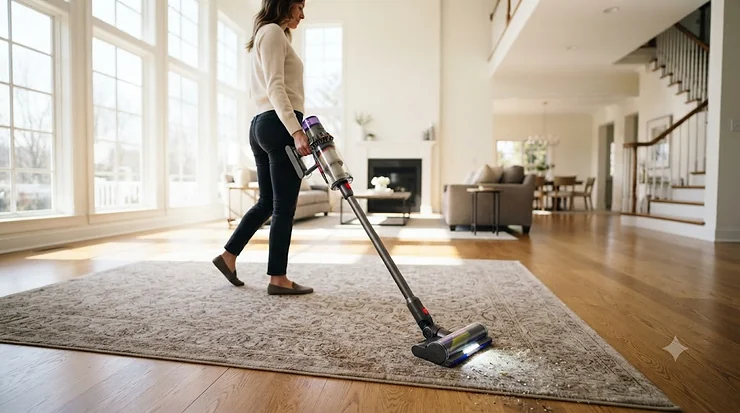
Here’s a truth nobody prints on the box: the vacuum that dazzled you in a big-box showroom might tap out somewhere around your dining room, dustbin already full, cord stretched taut like a leash on a dog that wants to keep running. A vacuum for large homes isn’t just a bigger version of a normal vacuum — it’s a different category of tool, judged by different math. Square footage, stairs, and floor-type switches change everything about what “good suction” even means.

If your house sprawls past 2,000 square feet, spans two stories, or mixes hardwood, tile, and thick carpet in the same afternoon of cleaning, you already know the frustration: emptying a tiny dustbin three times before you’ve finished the living room, or dragging a cord that dies six feet short of the hallway closet. This guide skips the marketing fluff and gets into real products — with real specs, honest trade-offs, and aggregated review sentiment pulled from testing labs that actually put these machines through their paces. We’ll cover long cord vacuum cleaner options, high capacity vacuum picks, and the extended cleaning range machines that make whole-house cleaning feel like one continuous motion instead of a stop-and-start chore.
By the end, you’ll know exactly which type — corded upright, canister, or robot — fits your layout, your patience level, and your budget. It’s also worth understanding why filtration matters at this scale: larger floor plans simply hold more airborne dust and allergens than a compact apartment, which is one more reason capacity and reach outrank raw suction numbers on a large-home shopping list.
Quick Comparison Table
| Product | Type | Cord/Range | Dustbin/Bag | Best For |
|---|---|---|---|---|
| Miele Complete C3 Marin | Bagged canister | Standard cord + auto rewind | Large-capacity bag | Whole-house allergy control |
| SEBO Airbelt D4 | Bagged canister | Extended hose reach | Large bag | Extended cleaning range |
| Kenmore Elite CrossOver 21814 | Bagless canister | 27-ft retractable cord | Large-capacity dustbin | Two-story homes |
| Shark Powered Lift-Away UV2500 | Corded upright | Standard cord | 1.04L dustbin | Whole-house deep cleaning |
| Roborock S8 MaxV Ultra | Robot | 220-min battery | Self-empty base | Multi-floor hands-off |
| Dreame L40 Ultra | Robot | 260-min battery | Self-empty base | Large single-floor coverage |
| Eureka Mighty Mite | Bagged canister | 20-ft cord + 7-ft hose | Compact bag | Budget long-reach pick |
Notice the split here: corded machines win on raw, unlimited runtime, while the two robots trade that for hands-off convenience and genuinely competitive coverage numbers. Bagged canisters like the Miele and SEBO tend to hold more debris per cleaning session than bagless uprights of similar size, which matters more than people expect once you’re covering 2,500+ square feet in one pass. If two-story stair-hauling is your main headache, look hardest at the cord length and weight columns before anything else — a vacuum with mediocre suction but a 27-foot reach will often beat a powerhouse you have to unplug and replug every room.
💬 Just one click — help others make better buying decisions too!😊
Top 7 Vacuums for Large Homes: Expert Analysis
1. Miele Complete C3 Marin — best whole-house allergy control
The Marin sits at the top of Miele’s bagged canister lineup, and that “bagged” detail matters more than it sounds — sealed bags mean you’re not opening a dust-filled bin every other day, which is a genuine advantage once you’re covering multiple floors of mixed flooring. Under the hood you get foot-pedal suction control, an automatic cord rewind, and a noticeably larger dust bag than Miele’s entry-level C1 series, so you’re not stopping mid-clean to swap bags out.
Based on the spec comparison against other premium canisters, the Marin’s biggest edge is filtration consistency: it earns the highest possible score for clean emissions in independent lab testing, alongside strong marks for bare-floor cleaning and pet-hair pickup. What most buyers overlook is that this translates directly into fewer allergy flare-ups during whole-house cleaning sessions, since a sealed bagged system doesn’t recirculate fine dust the way some bagless canisters do when you empty them.
Reviewers consistently note that carpet cleaning is only middling compared to its bare-floor performance — so if your large home leans heavily carpeted, this isn’t the single machine to rely on. It’s best suited to hardwood-and-tile-forward houses, or as the “everyday” machine paired with a dedicated carpet cleaner for occasional deep cleans.
Pros:
- ✅ Sealed bagged system reduces allergen recirculation
- ✅ Auto cord rewind speeds up whole-house sessions
- ✅ Reliability and owner satisfaction scores are consistently strong
Cons:
- ❌ Carpet performance trails its bare-floor scores
- ❌ Priced well above most bagless competitors
At around $700-$900 depending on the sub-model, the Marin isn’t a budget buy, but its documented reliability history means it’s genuinely one of the better long-term value plays in this list — check current price before deciding, since Miele periodically rotates bundle configurations.

2. SEBO Airbelt D4 — longest hose reach for extended cleaning range
If “extended cleaning range” is the exact phrase running through your head right now, the Airbelt D4 is the machine built around solving it. SEBO ships the D4 with an unusually long, flexible hose and telescoping wand combination, letting one plug cover an entire room — including drapes, stairs, and upholstery — without dragging the canister body behind you.
Independent testing consistently ranks the D4 near the top of its category: RTINGS rates the SEBO Airbelt D4 as the best canister vacuum they’ve tested, citing its high performance, effective filtration, and sturdy, easy-to-maintain design. What that means in practice: a sealed filtration path that holds up over years of daily use, not just out-of-the-box performance. On paper, that durability reputation is what separates the D4 from cheaper canisters that lose suction seal within a couple of seasons.
The trade-off is straightforward — this is a bagged system, so ongoing bag costs add up, and it’s a specialty-store product rather than a mass-market one, which can make replacement parts slightly less convenient to source than a Kenmore or Shark.
Pros:
- ✅ Exceptionally long hose-and-wand reach cuts plug-switching
- ✅ Top-rated filtration and build quality in independent testing
- ✅ Easy to maintain over years of regular use
Cons:
- ❌ Bagged design adds recurring consumable cost
- ❌ Replacement bags and parts are less widely stocked
Expect a price in the $900-$1,100 range at the time of research. For households prioritizing stairs, drapery, and furniture cleaning across a sprawling floor plan, the reach-to-effort ratio here is hard to beat.
3. Kenmore Elite Pet Friendly CrossOver 21814 — 27-foot cord built for two-story homes
This is the model to picture when someone searches “best vacuum for two story house” — Kenmore built the CrossOver 21814 specifically around the plug-once, clean-everywhere philosophy. It ships with a 27-foot retractable cord, along with a floor brush, dusting brush, and crevice tool, which in real terms means you can often clean an entire upstairs hallway and two adjoining bedrooms from a single outlet.
Here’s what the spec sheet won’t tell you outright: retractable cords on canisters this size tend to wear out faster than fixed cords on cheaper models, simply because the reel mechanism takes more mechanical stress. Consumer testing found the CrossOver superb at cleaning bare floors and hose suction, with clean emissions, though at close to 26 pounds it’s among the heavier canisters tested, which hurts its handling score. Translation: incredible for wide-open, single-level stretches, but expect some awkwardness hauling it up a staircase.
Pros:
- ✅ 27-foot retractable cord minimizes outlet-hopping
- ✅ Excellent bare-floor and hose suction performance
- ✅ Clean emissions reduce dust kickback during use
Cons:
- ❌ Nearly 26 pounds — a genuine workout on stairs
- ❌ Retractable cord mechanism is a common long-term wear point
Priced in the $300-$400 range, the CrossOver is a strong mid-tier pick for two-story homes where most cleaning happens on open floors rather than up and down flights.
4. Shark Performance Powered Lift-Away UV2500 — detachable pod for whole-house versatility
The UV2500 solves a different problem: what happens when “whole-house cleaning” means switching between carpeted bedrooms, a tiled kitchen, and a set of stairs in the same session. It’s a corded upright built for whole-home cleaning, using a Powered Lift-Away system that lets the main pod detach while the motorized floor nozzle keeps running — so you can carry just the lightweight pod up a staircase instead of the whole chassis.
The dual-brushroll DuoClean PowerFins HairPro system is engineered to handle both carpets and hard floors while reducing hair wrap, and the vacuum includes Anti-Allergen Complete Seal HEPA filtration designed to trap 99.9% of dust and allergens down to 0.3 microns, alongside a 1.04-liter bagless dust cup and a 1,300-watt motor. Based on the spec comparison, that 1,300-watt corded motor is genuinely stronger than most cordless stick alternatives at this price, and unlike a battery-powered machine, output doesn’t taper off halfway through a long cleaning session — a meaningful advantage for anyone tackling 2,000+ square feet in one sitting.
Pros:
- ✅ Detachable pod lightens stair and above-floor cleaning
- ✅ Dual brushroll adapts to carpet and hard floors
- ✅ Corded power stays consistent for long sessions
Cons:
- ❌ Standard cord length means more outlet changes than a canister
- ❌ Bagless 1.04L bin needs frequent emptying on heavy-debris days
At a $200-$300 price range, the UV2500 delivers upright-level power without upright-level price, making it a smart pick for households that want one machine to handle nearly everything.
5. Roborock S8 MaxV Ultra — multi-floor mapping for hands-off large-home coverage
Robot vacuums used to be a running joke in large homes — great for a studio apartment, useless past 1,500 square feet. That’s changed. The S8 MaxV Ultra pairs a 220-minute battery with 4-floor mapping, coordinate-precise resume, and 73-object obstacle avoidance, and independent testers have pushed it hard: in an extended test spanning 3,229 square feet across three floors, it completed every scheduled cleaning run over six weeks without a stuck incident or an incomplete cycle.
What most buyers overlook about robot vacuums in large homes is the “resume” feature — without coordinate-precise resume, a robot that runs out of battery mid-room simply restarts from scratch after recharging, wasting time and missing coverage. Here, that’s a non-issue. This is genuinely the closest thing to “set it and forget it” whole-house cleaning currently available, though it still can’t replace deep carpet cleaning the way a corded upright can.
Pros:
- ✅ Stores maps for up to four separate floors
- ✅ Resumes precisely where it left off after recharging
- ✅ Proven zero-incomplete-cycle reliability in extended testing
Cons:
- ❌ Highest price point in this lineup
- ❌ Still weaker than corded machines on deep-pile carpet
Pricing lands around $1,399 at the time of research. If your large home spans multiple stories and you’d rather supervise than push, this is the current benchmark.

6. Dreame L40 Ultra — longest single-charge run for sprawling single-story layouts
If your “large home” is one enormous single story rather than a multi-level house, the calculus shifts. The Dreame L40 Ultra runs 260 minutes per charge — the longest battery of any robot vacuum in this comparison — meaning it can cover homes above 3,000 square feet on a single floor without needing a recharge stop. That’s the extended cleaning range secondary keyword in a literal sense: more square footage per charge cycle than its closest competitors.
Here’s what the spec sheet doesn’t spell out: longer runtime robots generally trade off some multi-floor mapping sophistication for that extra battery capacity, so this model shines brightest in ranch-style or open-concept large homes rather than complicated multi-story layouts. On paper, it’s the best value if you never need it to remember more than one or two floor maps.
Pros:
- ✅ Longest battery life in this comparison at 260 minutes
- ✅ Covers 3,000+ sq ft single-floor homes without recharging
- ✅ Competitive price against similarly specced rivals
Cons:
- ❌ Multi-floor mapping is less robust than top-tier rivals
- ❌ Best suited to single-level, not complex multi-story homes
At around $1,299, the L40 Ultra earns its spot as the closest price-to-battery comparison against the S8 MaxV Ultra — a genuinely strong pick for sprawling ranch homes.
7. Eureka Mighty Mite — budget pick with a 27-foot combined reach
Not every large home needs a four-figure machine, and the Mighty Mite proves it. This is an old-school bagged canister, but the numbers matter more than the vintage design: it comes with a roughly 7-foot flexible hose paired with a 20-foot cord, plus an extending rigid wand for maneuverability — a combined reach that rivals canisters costing four to five times as much.
Based on the spec comparison, the honest trade here is raw suction power versus reach and portability. It includes a carrying handle for moving between rooms and a compartment for on-board tool storage, which matters in large homes where you’re covering a lot of ground and don’t want to hunt for attachments room to room. Reviewers consistently frame it as a workhorse for quick, frequent passes rather than a deep-clean specialist — which, for many large-home owners doing daily upkeep between weekly deep cleans, is exactly the right job description.
Pros:
- ✅ 27-foot combined hose-and-cord reach at a budget price
- ✅ Lightweight and easy to carry room to room
- ✅ On-board tool storage speeds up multi-room sessions
Cons:
- ❌ Bagged system means ongoing consumable costs
- ❌ Suction lags premium canisters on deep carpet cleaning
Priced under $100 in most listings, the Mighty Mite is the pick for anyone who wants long cord vacuum cleaner convenience without the premium canister price tag — check current price, as this model frequently fluctuates during sales events.
Practical Setup & Maintenance Guide for Large-Home Vacuums
Getting a large-home vacuum home is only half the job — setup determines whether it actually performs like its spec sheet promises. Start by mapping your outlets before you clean: walk the floor plan and note where each outlet sits relative to furniture-heavy zones, then plan your cleaning route to minimize plug-swaps rather than reacting room by room. For corded models, this single step often saves 10-15 minutes per session in a large home.
For canister vacuums with retractable cords, avoid yanking the cord to retract it — ease it back in by hand every few uses to reduce strain on the reel spring, a common failure point Kenmore owners report after a couple of years of heavy use. Empty bagless dustbins at the 75% mark rather than waiting for “full,” since suction noticeably drops once debris packs against the filter, especially in high-capacity vacuum models covering multiple rooms per charge.
For robot vacuums, the first 30 days matter most: let the unit complete two or three full mapping runs before scheduling automated cleanings, and manually clear cords, rugs with tassels, and pet toys from the floor during that break-in period. Skipping this step is the single most common reason large-home owners report “stuck” incidents in the first month. Clean brush rolls weekly, not monthly — large homes generate proportionally more hair and debris buildup simply because there’s more floor to cover.
Real-World Scenarios: Matching the Vacuum to Your Household
Consider three households tackling the same underlying problem — a large floor plan — with very different needs. A family of five in a 3,200-square-foot two-story colonial with two dogs needs coverage that survives daily pet-hair accumulation without babysitting; the Roborock S8 MaxV Ultra’s multi-floor mapping and obstacle avoidance handle the daily maintenance layer, while the Shark UV2500 tackles the weekly deep-clean on stairs and high-traffic carpet.
A retired couple in a 2,800-square-foot single-story ranch, budget-conscious and prioritizing ease of use over cutting-edge tech, is better served by the Kenmore CrossOver 21814 — its 27-foot cord means minimal bending and outlet-switching across an open floor plan, and its bare-floor performance suits a home with mostly hardwood and area rugs.
A young professional couple renovating a 2,500-square-foot fixer-upper on a tight budget, dealing with construction dust and mixed flooring during the transition, gets more value from the Eureka Mighty Mite’s long reach and low upfront cost paired with the Miele Marin once the renovation dust settles and allergy-conscious daily cleaning becomes the priority.
✨ Don’t Miss These Exclusive Deals!
🔍 Take your large-home cleaning routine to the next level with these carefully selected picks. Click on any highlighted item to check current pricing and availability. These machines will help you create a genuinely dust-free, whole-house cleaning routine your whole family will appreciate!
How to Choose a Vacuum for Large Homes
Picking the right machine comes down to seven weighted criteria, in the order they should influence your decision:
- Floor plan shape — single-story sprawl favors long-battery robots or long-cord canisters; multi-story homes favor detachable-pod uprights or multi-floor-mapping robots.
- Cord or battery reach — measure your longest realistic single-room distance from an outlet before assuming a “long cord” claim will actually cover it.
- Dustbin or bag capacity — a large capacity dustbin reduces mid-clean emptying, which matters disproportionately once you’re past 2,000 square feet.
- Weight and stair-friendliness — a heavier machine with more raw suction is a poor trade if you’re hauling it up and down stairs daily.
- Filtration needs — allergy-prone households should prioritize sealed HEPA systems; true HEPA filtration can theoretically remove at least 99.97% of particles as small as 0.3 microns, which matters more in larger homes simply because there’s more surface area collecting allergens. For a deeper look at how independent labs actually test this, Consumer Reports’ canister vacuum testing breaks down emissions scores model by model.
- Floor-type mix — hardwood-heavy homes prioritize bare-floor scores; carpet-heavy homes prioritize deep-clean and brushroll agitation.
- Budget realism — decide whether you’re buying one do-everything machine or splitting duties between a daily-maintenance robot and a weekly deep-clean upright.
Common Mistakes When Buying a Vacuum for Large Homes
The most frequent mistake is buying based on suction wattage alone, ignoring capacity and reach entirely — a powerful motor paired with a tiny bin just means more frequent stops, not faster whole-house cleaning. A close second is underestimating weight; shoppers fixate on features and skip the “will I carry this up 14 stairs twice a week” question until it’s too late to return the box conveniently.
Another common pitfall: assuming one robot vacuum can replace a corded machine entirely in a large home. Robots excel at daily maintenance but generally can’t match a corded upright’s deep-carpet extraction, especially in high-traffic zones. Finally, shoppers often skip checking real cord length against their actual floor plan, trusting marketing copy that lists “extra-long cord” without a number attached — always confirm the exact footage before buying.
Canister vs Upright Vacuums for Large Homes
The canister-versus-upright debate isn’t about which is objectively better — it’s about which failure mode you’d rather live with. Canister vacuums distribute weight between the body and the powerhead, making them easier to maneuver than uprights, and their long hoses reach under furniture and into stairwells that uprights struggle with. That reach advantage is exactly why canisters dominate the “extended cleaning range” and “long cord vacuum cleaner” categories in this guide.
Uprights counter with raw cleaning power. Continuous corded power supports bigger motors, wider floor heads, and larger dustbins, enabling whole-household cleaning sessions without stopping — while cordless models offer portability at the cost of shorter, more frequent cleaning sessions, as Vacuum Wars’ upright testing lays out in detail. In practice, large homes with substantial carpeted square footage tend to favor uprights for their deep-clean scores, while homes with more hard flooring, stairs, and furniture-heavy layouts lean toward canisters for reach and maneuverability.
What to Expect: Real-World Performance in a Large Home
Specs rarely translate directly into lived experience, so here’s the honest gap between the numbers and the actual chore. A 220-minute robot battery sounds enormous until you realize a genuinely large, cluttered home with lots of furniture legs and doorway thresholds slows the robot’s actual coverage rate — expect real-world cleaning to run 15-20% longer than the advertised time suggests, since obstacle navigation eats into raw runtime.
On the corded side, a 27-foot cord sounds like plenty until you’re vacuuming a great room with the outlet in the far corner — you’ll still swap outlets two or three times across a full downstairs. What actually saves time in a large home isn’t any single spec; it’s the combination of adequate capacity (so you’re not emptying constantly) and adequate reach (so you’re not unplugging constantly). Reviewers across every product in this guide consistently flag capacity and reach, not raw suction numbers, as the difference between a chore that takes 45 minutes and one that takes 90.
Long-Term Cost & Maintenance for Large-Home Vacuums
Total cost of ownership looks very different once you factor in consumables across a big floor plan. Bagged canisters like the Miele Marin and SEBO Airbelt D4 carry ongoing bag costs — typically a modest annual expense, but one that adds up over a machine’s 8-10 year lifespan. Bagless models avoid that recurring cost but require more frequent filter washing and replacement, particularly in large homes generating more debris volume per week.
Robot vacuums introduce a different cost curve: replacement brush rolls, filters, and mop pads on a rotating schedule, plus eventual battery degradation after roughly 2-3 years of daily use. Weighed against the labor and time saved on daily maintenance passes, most large-home owners find the trade-off worthwhile — but it’s worth budgeting for consumables rather than treating the upfront price as the full cost. Corded uprights and canisters, by contrast, have the lowest long-term consumable cost of any category here, provided you’re diligent about filter maintenance and brush-roll cleaning.
Safety and Practical Considerations for Whole-House Cleaning
Vacuuming isn’t purely a cosmetic chore — it’s part of managing indoor air quality, which matters more the larger your home is simply because there’s more surface area harboring allergens. The American College of Allergy, Asthma & Immunology recommends using a vacuum cleaner with a HEPA filter to reduce dust, pet dander, and other allergens, while noting that vacuuming temporarily stirs up dust that takes a couple of hours to settle back down — a good reason to vacuum bedrooms earlier in the day if allergy sufferers live there.
Cord safety matters too in large homes with more square footage of walkway: always fully uncoil retractable cords before use to prevent overheating, and route cords away from high-traffic paths to avoid trip hazards, especially on stairs. For households managing both allergies and asthma, pairing a sealed-HEPA vacuum with regular HVAC filter changes offers meaningfully better results than either step alone.

Frequently Asked Questions
❓ What size vacuum do I need for a large home?
❓ Is a robot vacuum enough for a large home?
❓ What's the best vacuum for a two story house?
❓ How often should I replace vacuum filters in a large home?
❓ Do long cord vacuums lose suction over distance?
Conclusion
There’s no single “best” vacuum for large homes — there’s only the best match for your specific floor plan, floor types, and patience for maintenance. If your home is a multi-story maze, lean toward the reach and resume-precision of a canister or a multi-floor robot like the Roborock S8 MaxV Ultra. If it’s a sprawling single level, the Dreame L40 Ultra’s battery life or the Kenmore CrossOver’s cord length will likely serve you better than any premium spec sheet.
What matters most, across every product in this guide, is matching capacity and reach to your actual square footage rather than chasing suction numbers alone. Whichever direction you go, remember that price ranges shift constantly on Amazon, so always check current pricing before you commit — and don’t be afraid to mix categories, pairing a daily-maintenance robot with a weekly deep-clean upright, if your large home’s demands genuinely call for both.
Recommended for You
- Vacuum for rv: 7 Best Picks for Campers & Boats in 2026
- Best Vacuum for Small Apartments: 7 Top Picks for 2026
- Best Vacuum for Senior Citizens: 7 Lightweight Picks (2026)
Disclaimer: This article contains affiliate links. As an Amazon Associate, I earn from qualifying purchases. If you purchase products through these links, we may earn a small commission at no additional cost to you.
✨ Found this helpful? Share it with your friends! 💬🤗
