
In This Article
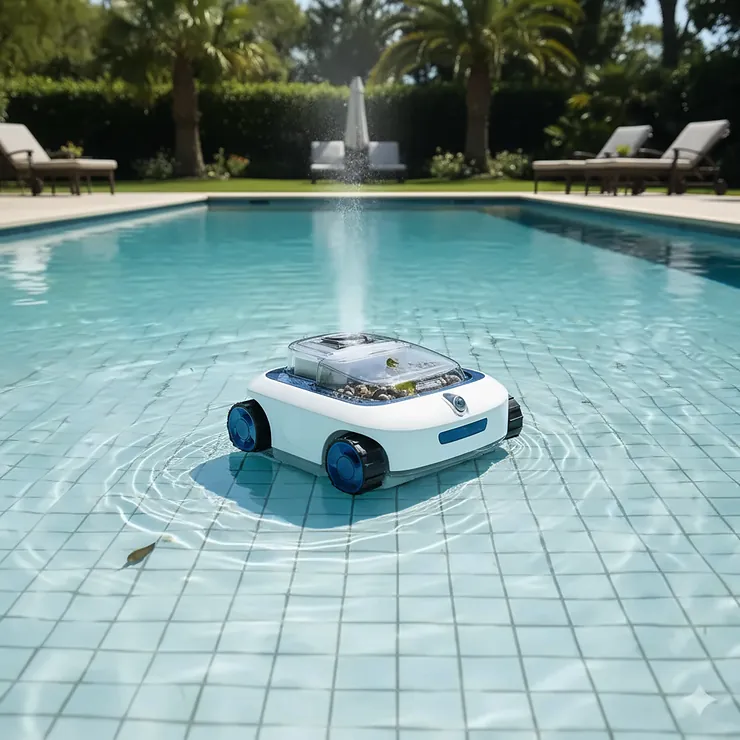
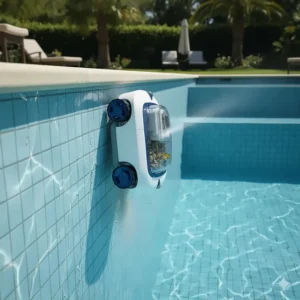
A cordless pool cleaner is a battery-powered robot that drives itself across your pool floor, walls, and sometimes the waterline, scrubbing dirt and sucking debris into an onboard filter. There is no power cable, no hose, and no connection to your pump. Think of it as a robot vacuum that happens to swim. 🏊
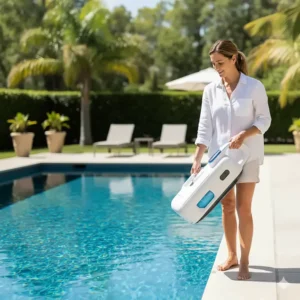
The idea isn’t new. The Wikipedia overview of automated pool cleaners traces the lineage from suction-side and pressure-side machines to today’s electric robots. What is new is that the battery finally keeps up. A few years ago, a cordless pool cleaner meant short runtimes, weak suction, and a robot that quit halfway across the deep end. In 2026 the better models run for hours, map your pool with cameras and sensors, and park themselves at the surface when they’re done.
Cordless still isn’t magic, though. Batteries need charging, and a few reviewers who prefer corded robots argue that the daily charge-and-lift routine is the hidden cost. So this guide skips the sales-page glow. I pulled real specs, expert roundups, and the review sentiment I could verify across multiple sources, then ranked seven models from budget to premium. Where something couldn’t be confirmed, I say so instead of guessing. Prices are ranges because they move constantly. Check the current price before you buy.
Let’s start with the cheat sheet.
Cordless Pool Cleaner Comparison: 7 Picks at a Glance
| Model | Best For | Cleans | Standout Spec | Price Range* |
|---|---|---|---|---|
| Beatbot AquaSense 2 Ultra | Large, complex pools | Floor, walls, waterline, surface | 13,400mAh battery, AI camera | $2,300–$2,800 |
| Polaris Freedom Plus | Brand-loyal, low-fuss buyers | Floor, walls (verify waterline) | Critic-favorite all-rounder | $1,300–$1,500 |
| Aiper Scuba S1 Pro | Fine debris and waterlines | Floor, walls, waterline | 180- and 3-micron dual filtration | $1,000–$1,300 list |
| Wybot C2 Vision | Mid-budget smart cleaning | Floor, walls, waterline | AI camera that hunts dirt | Upper-$500s and up |
| Dolphin Liberty 400 | Inground pools up to ~33 ft | Floor, walls (verify waterline) | Magnetic inductive charging | Premium tier |
| Beatbot Sora 10 | Shoppers under $500 | Floor, walls, waterline | Wall climbing on a budget | Under $500 on sale |
| Aiper Surfer S2 | Leafy, tree-lined pools | Surface only | Solar charging, 150-micron filter | $350–$400 |
*Ranges reflect what I found at the time of research. Prices may vary, so check current price.
Looking at the table, the Beatbot AquaSense 2 Ultra is the feature leader, but it asks a lot of your wallet. The Beatbot Sora 10 is the reasonable way into wall-climbing cordless cleaning. Note that the Aiper Surfer S2 isn’t a floor cleaner at all. It’s a skimmer that pairs well with one, which is why it sits last on the list.
💬 Just one click — help others make better buying decisions too!😊
Top 7 Cordless Pool Cleaner Picks: Expert Analysis
Each pick below gets the same treatment: what the specs mean in practice, who it suits, and what verified review sentiment says. None of this comes from hands-on testing. It’s analysis built on specs and published reviews.
1. Beatbot AquaSense 2 Ultra — best for large, complex pools
The standout here is brains. The Beatbot AquaSense 2 Ultra combines an AI camera with infrared and ultrasonic sensors (27 sensors in total, per Beatbot), so it maps your pool instead of wandering through it.
The 13,400mAh battery takes roughly 4.5 hours to charge, and Beatbot rates one cycle for pools up to about 3,400 square feet. In plain English, that covers nearly every residential pool with battery to spare. It also skims the surface and surfaces beside the wall when finished, so you aren’t fishing it out with a pole. The robot is rated IP68, while its dock is only IPX4, so the dock stays on the deck.
Based on the spec comparison, this is the cordless pool cleaner for kidney-shaped pools, shelves, and tree-heavy yards, where mapping and surface skimming earn their keep. The tradeoff is weight. At about 26.5 pounds it’s a serious lift if it ever needs rescuing.
Reviewer sentiment is split in a useful way. Several outlets praise the mapping, the near-silent bottom crawl, and the double filter basket. The Pool Nerd, a corded-robot loyalist, found it underwhelming for the money and criticized the small basket and the daily routine cordless life demands. Brand-hosted reviews on Beatbot’s site skew heavily five-star, but brand sites naturally curate.
Pros:
- ✅ Camera and sensor mapping handles awkward pool shapes
- ✅ Skims the surface and self-parks at the edge
- ✅ Three-year warranty reported by reviewers
Cons:
- ❌ Heavy for a cordless unit
- ❌ Premium price with a small filter basket
Price: roughly $2,300–$2,800. Verdict: worth it only if your pool is large, shaded, or oddly shaped. Otherwise you’re paying for features you’ll rarely use.
2. Polaris Freedom Plus — best all-rounder from a legacy name
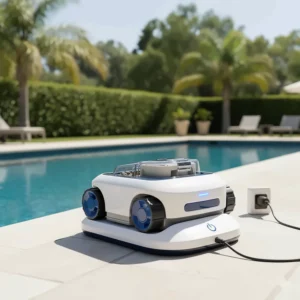
The pitch is familiarity. Polaris is a name that has shown up on pool cleaners for decades, and the Polaris Freedom Plus earned PCWorld’s pick as the best cordless robotic pool cleaner overall. Another buying guide calls it a strong premium option for people who want cable-free operation, orderly coverage, and easier retrieval.
I’ll be upfront: I couldn’t pull a consistent spec sheet from multiple sources, so confirm the runtime and pool-size rating on Polaris’s own page. That caveat is worth taking seriously. It means this model’s appeal is more about brand and critic consensus than headline numbers.
That’s a fine reason to buy, for the right person. If you’d rather deal with a well-known manufacturer and a straightforward device than a camera-and-app ecosystem, the Polaris Freedom Plus fits. It’s less flashy than the Beatbot AquaSense 2 Ultra, and for plenty of owners that’s a feature.
Review sentiment here is critic-driven. PCWorld ranks it first, and The Pool Nerd lists the standard Polaris Freedom as its runner-up cordless pick. I couldn’t verify a large pool of owner reviews, so treat this one as expert-endorsed rather than crowd-tested.
Pros:
- ✅ Named best overall cordless by PCWorld
- ✅ Established brand with wide dealer support
- ✅ Simple operation without app dependence
Cons:
- ❌ Fewer headline AI features
- ❌ Specs vary by source, so verify before buying
Price: around $1,300–$1,500. Verdict: solid value if brand confidence matters more than camera tricks.
3. Aiper Scuba S1 Pro — best for fine debris and waterlines
The hook is filtration. The Aiper Scuba S1 Pro uses a dual system with 180-micron and 3-micron filters, and the 3-micron stage is the one that grabs the fine, cloudy stuff most robots leave floating. Aiper also claims a dustbin 30% larger than the standard Aiper Scuba S1.
Retailer listings quote up to 180 minutes of runtime and a 240-minute charge, with four infrared sensors, five cleaning modes, and Aiper’s WavePath 2.0 navigation. That means a full-length cycle on most home pools, then an evening on the charger. It’s also billed as the first cordless robot with horizontal waterline cleaning, which matters if your pool has that gray scum ring.
My honest take: this is the pick for owners fighting pollen, dust, and waterline grime. One caution. A competing retailer’s site carries a warning alleging lithium-ion fire incidents with certain cordless robots. I couldn’t verify those claims independently, but they’re a good reason to follow the charging rules covered later in this guide.
Review sentiment is thin on hard data. A European retailer shows Aiper as middling on defect rates and returns, and Forbes picked the standard Aiper Scuba S1, not this model, as its best cordless. Optional solar panels and a communication buoy are sold separately.
Pros:
- ✅ Dual 180- and 3-micron filtration
- ✅ Horizontal waterline cleaning
- ✅ App control with five cleaning modes
Cons:
- ❌ Accessories like the buoy cost extra
- ❌ Limited verifiable owner-review data
Price: listed around $1,000–$1,300 at full price in several markets, with frequent discounting. Verdict: good for fine-debris pools, but compare against the discounted Aiper Scuba S1 first.
4. Wybot C2 Vision — best mid-budget pick with an AI camera
The trick is the camera. The Wybot C2 Vision uses an onboard camera to spot dirt on the pool floor and steer toward it, a floor-only mode layered on top of the usual patterns. At roughly 17.6 pounds (8 kg), it’s lighter than most premium rivals.
The base Wybot C2 carries a 2,641 GPH brushless pump, dual brushes, and a dual filter (180-micron plus 10-micron), plus up to 180 minutes in Eco mode and a roughly three-hour charge. Quoted runtimes for Vision-branded listings run closer to 120 minutes, so confirm the variant. For a typical 15-by-30-foot pool, even the lower figure is a workable cycle.
An Australian reviewer found the walls worked straight out of the box on pebblecrete, but slippery tile needs the supplied floating blocks for buoyancy. That’s a spec-sheet detail you’d miss, and a reason to check your pool surface.
Review sentiment is mixed. A major retailer’s listing for the base Wybot C2 shows a mid-3-star average across roughly 60 ratings, though its seller reviews run near 4 stars. The Pool Nerd criticized the base model’s limited cycles and frequent recharging.
Pros:
- ✅ Camera targets visible dirt directly
- ✅ Lighter than most cordless rivals
- ✅ App scheduling and multiple modes
Cons:
- ❌ Runtime figures vary by variant and mode
- ❌ Tile walls may need floating blocks
Price: upper-$500s and up for the Vision variant. Verdict: a reasonable step up from budget, provided you verify the runtime of the exact listing.
5. Dolphin Liberty 400 — best for inground pools up to about 33 feet
The draw is charging. The Dolphin Liberty 400 from Maytronics uses a Magnetic-Connect inductive charger, so you snap it on instead of fiddling with a port. It also has ClickUp, a sound-activated retrieval feature that makes the robot climb the nearest wall when you shake the clicker.
Official specs list a maximum pool length of 10 meters (about 33 feet), a default cycle around 2.5 hours on the U.S. page, an app, fine and ultra-fine filter options, and a three-year warranty. It weighs about 17.9 pounds. There’s no NanoFilter option, and there’s no weekly timer.
One conflict deserves flagging. Maytronics’ U.S. listing says waterline scrubbing is included, while one retailer says it isn’t. Confirm that before buying if the waterline matters to you.
The analysis: this is a sensible cordless pool cleaner for medium inground pools where you value a mainstream brand and easy handling over flashy mapping. It doesn’t try to out-feature the Beatbot AquaSense 2 Ultra.
Review sentiment: retailer pages I found carried no reviews yet, and I couldn’t verify a meaningful owner-review pool. Treat it as spec-and-brand-driven.
Pros:
- ✅ Magnetic inductive charging is genuinely easy
- ✅ ClickUp retrieval avoids hook work
- ✅ Three-year warranty
Cons:
- ❌ No weekly timer on listed specs
- ❌ Waterline claims conflict across sources
Price: premium tier. I couldn’t confirm a reliable current U.S. figure, so treat anything above $1,500 as a ballpark and check current price. Verdict: good for the brand-trusting buyer, but compare it to the Polaris Freedom Plus.
6. Beatbot Sora 10 — best cordless entry point under $500
The headline is price. The Beatbot Sora 10 is The Pool Nerd’s top cordless pick under $500, and it handles floor, walls, and waterline, which used to be a premium-only combination. It’s frequently on sale below that mark.
I didn’t find a deep, multi-source spec sheet, so I’ll keep the analysis honest. At this price tier, you’re accepting a smaller battery, simpler navigation, and a likelier need to recharge between cycles than on the Beatbot AquaSense 2 Ultra. The tradeoff is that you aren’t paying a thousand dollars extra for AI mapping you may not need.
Who is it for? Owners of small to mid-sized pools who want wall climbing without a premium bill. If your pool is huge or tree-choked, the economics flip fast. A cheap robot that needs twice the cycles hasn’t saved you anything.
Review sentiment comes mainly from The Pool Nerd’s testing roundup, which singles it out as the best-value cheap cordless robot across Beatbot’s budget lines. I couldn’t verify a broad owner-review pool, so look at current verified reviews before buying.
Pros:
- ✅ Floor, walls, and waterline under $500
- ✅ Named best cordless under $500 by a specialist reviewer
- ✅ Same brand ecosystem as pricier models
Cons:
- ❌ Fewer details verified than premium rivals
- ❌ Likely smaller battery and simpler navigation
Price: under $500 on sale. Verdict: the smartest first cordless pool cleaner for most small-pool owners.
7. Aiper Surfer S2 — best surface skimmer for leafy pools
The idea is division of labor. The Aiper Surfer S2 doesn’t vacuum the floor. It skims the surface, which is where leaves, pollen, and insects live before they sink and become your floor robot’s problem.
It carries a solar panel with USB-C backup charging, a 150-micron filter, a 5,200mAh battery, and app control. It also has a built-in chlorine tab holder. It weighs about 5.7 kilograms (roughly 12.5 pounds), light enough to lift out when needed. The practical meaning: leave it floating and the sun does the charging. Reviewers note long charge times when solar input is weak.
My analysis: pair this with a floor-focused cordless pool cleaner such as the Beatbot Sora 10 if trees hang over your pool. Keeping leaves from sinking reduces how often your main robot’s basket fills.
Review sentiment is encouraging across independent outlets. CyberShack, The Pool Nerd, and Android Authority all describe effective debris capture, though one reviewer watched it swim right past some leaves. The Pool Nerd noted past reliability complaints about certain Aiper cordless cleaners, but explicitly not this product.
Pros:
- ✅ Solar charging keeps it running
- ✅ Catches leaves before they sink
- ✅ Chlorine tab holder doubles as a feeder
Cons:
- ❌ Surface only, no floor or wall cleaning
- ❌ Slow charging when sunlight is weak
Price: roughly $350–$400. Verdict: excellent value for leafy pools, pointless for clean, covered ones.
How to Choose a Cordless Pool Cleaner
Buying a cordless pool cleaner is mostly about matching battery and brains to your pool. Work through these six steps in order.
- Measure your pool honestly. Compare your pool’s length and floor area against the manufacturer’s rating, then leave a buffer. A robot rated for exactly your size will end cycles with a flat battery and unfinished corners.
- Decide what it needs to clean. Floor-only robots cost less. Wall and waterline cleaning adds cost but matters if you fight scum lines.
- Check runtime against your cycle needs. A 120-minute battery can finish a small pool. A big, complex one needs more. Remember that wall climbing drains batteries faster than floor work.
- Plan for retrieval. Surface parking, clickers, and hooks all solve the same problem: getting a wet robot out. If you’ll hate lifting 25 pounds, prioritize surface parking.
- Respect charging safety. Cordless means lithium-ion batteries. The CPSC’s guidance on lithium-ion battery chargers is direct: use only the supplied charger, follow the manufacturer’s instructions, and unplug at full charge.
- Read the warranty. Three years from Beatbot AquaSense 2 Ultra and Dolphin Liberty 400 versus two on the Wybot C2 says something about how confident each maker is in its battery.
Features That Actually Matter (And Those That Don’t)
Marketing sheets are a buffet. Here’s how to fill your plate sensibly.
Features that matter: battery runtime in the mode you’ll actually use, filtration fineness, and retrieval. A 3-micron filter matters if you fight fine dust. Wall-and-waterline cleaning matters if your pool has tile or a scum ring. Warranty length matters because the battery is the part most likely to age.
Features that don’t, for most buyers: extreme suction numbers. Quoted GPH figures such as 2,641 GPH on the Wybot C2 or 6,000 GPH on the Aiper Scuba S1 Pro aren’t measured the same way across brands, so treat them as marketing, not a scoreboard. Voice assistants and “AI” buzzwords are similar noise unless they change how the robot covers your pool.
Here’s the sanity check I’d use: if a feature doesn’t change cycle length, coverage, or retrieval, it probably doesn’t change your weekend.
Cordless Pool Cleaner vs Corded Robots and Suction Cleaners
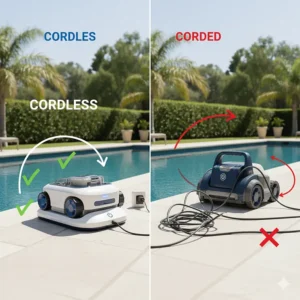
Cordless robots trade endless power for freedom. Corded models plug into a poolside transformer and run as long as you like. Suction and pressure cleaners are cheaper and simpler, but they lean on your pump.
| Factor | Cordless | Corded Robot | Suction/Pressure |
|---|---|---|---|
| Setup | Drop in, no cable | Cable and power supply | Hose and pump connection |
| Runtime | Battery-limited | Effectively unlimited | Runs with pump |
| Retrieval | Hook, clicker, or surface parking | Pull by cable | Pull by hose |
| Pump dependence | None | None | Yes |
| Typical Price | $350–$2,800 | $600–$1,500+ | Often under $300 |
| Best For | Small to mid pools, tangle-haters | Large, debris-heavy pools | Tight budgets |
For best-fit examples: Beatbot Sora 10 for budget cordless, Dolphin Premier (The Pool Nerd’s corded overall pick) for demanding pools, and a simple suction unit if you only need the basics.
The practical interpretation is that cordless wins on convenience and loses on stamina. A pool that drops leaves daily and runs long cycles may be better served by a corded robot. A weekend-warrior pool with light debris is where a cordless pool cleaner shines. Don’t pay for freedom you won’t use.
What to Expect: Real-World Performance
Specs turn into routines, so here’s what a typical week looks like with a cordless pool cleaner.
You’ll drop or place the robot in, start a cycle from the app or button, and walk away. Most are quiet underwater and louder near the surface. When the battery runs low or the cycle ends, many models park near the edge. Others expect you to hook them out. Then it goes on the charger.
The honest friction: cordless pool robots typically deliver shorter total cleaning time than corded ones, and wall climbing uses battery faster than floor work. One critical reviewer described removing a cleaner for yet another recharge as the defining annoyance. Your experience depends on pool size. Small pools barely notice. Large ones notice daily.
Run frequency also matters. Retailer guidance generally suggests two to three runs per week in swim season, which fits the battery rhythm well. Plan on a routine, not on never touching the thing.
Cordless Pool Cleaner for Specific Audiences
Different owners need different machines. Here are three profiles with matched picks and reasoning.
The first-time owner with a 14-by-28-foot inground pool and a $500 ceiling. The Beatbot Sora 10 fits the budget and covers floor, walls, and waterline. Expect to recharge between cycles and accept simpler navigation.
The family with a shaded backyard and an oak overhead. Leaves are the enemy here. Pair the Aiper Surfer S2 to catch debris on the surface with a floor robot like the Wybot C2 Vision. The skimmer cuts how fast the floor basket fills, which matters more than raw suction.
The owner of a 20-by-40 freeform pool with steps and a sun shelf. Complex shapes favor mapping. The Beatbot AquaSense 2 Ultra is the logical splurge, and the Dolphin Liberty 400 is the more traditional alternative if its 10-meter maximum length covers your pool.
Whatever profile you fit, the question to ask is the same: what does my pool throw at the robot most often?
Setup Guide: Your First 30 Days With a Cordless Pool Cleaner
A little discipline in month one sets up years of easy cleaning.
Day one: charge before you swim. Charge fully before the first run, using only the supplied charger. Download the app, pair via Bluetooth, and run a short test cycle while you’re standing there.
Week one: test your surfaces. If your walls are slick tile, check whether the manufacturer supplies floating blocks, as Wybot does. Watch the first cycle from the deck.
Mind your chemistry. Healthy water protects both swimmers and equipment. The CDC recommends a pH of 7.0–7.8 and at least 1 ppm free chlorine in home pools. You can read the details in their home pool water treatment and testing guidance. Manufacturers commonly advise waiting a day or two after shocking before running your robot, so check your manual.
Mistakes to avoid in the first 30 days:
- Leaving the robot in the pool during thunderstorms
- Skipping filter rinses, which silently shortens cycles
- Charging it unattended overnight in a cluttered garage
By day 30, you should know your pool’s cycle time and your charging rhythm. That’s all the “optimization” most owners ever need.
Problem and Solution Guide for Cordless Pool Cleaners
Most cordless problems fall into the same few buckets. Here’s the fix for each.
Problem: the robot stops before finishing. It’s usually battery, not malfunction. Switch to an Eco mode, split the cycle by zone, or step up to a bigger-battery model like the Beatbot AquaSense 2 Ultra.
Problem: it can’t climb tile walls. Slippery surfaces defeat some robots. Try floating blocks if supplied (as with the Wybot C2 Vision) and make sure filters are clean, since clogged baskets reduce traction-giving suction.
Problem: cloudy water despite regular runs. Coarse filters miss fine dust. A model with ultra-fine filtration, such as the Aiper Scuba S1 Pro, helps, along with balanced chemistry.
Problem: leaves overwhelm the basket. Skim first. The Aiper Surfer S2 keeps leaves from reaching the floor at all.
Problem: it’s hard to retrieve. Choose surface parking or a sound-activated clicker like the one on the Dolphin Liberty 400.
Long-Term Cost and Maintenance
The sticker price is only the first line of the ledger.
| Tier | Example Models | Price Range | Value Notes |
|---|---|---|---|
| Budget | Beatbot Sora 10, Aiper Seagull SE | $140–$500 | Great for small pools, shorter lifespans likely |
| Mid-range | Wybot C2 Vision, Aiper Scuba S1 Pro | $500–$1,300 | Balanced smarts and filtration |
| Premium | Beatbot AquaSense 2 Ultra, Polaris Freedom Plus, Dolphin Liberty 400 | $1,300–$2,800 | Longer warranties, bigger pools |
The cheapest model isn’t automatically cheapest. A premium robot that survives five swim seasons costs roughly a fifth of its price per year, while a bargain unit that dies in two seasons costs half its price per year. That’s why warranty length is a cost signal, not a footnote.
Electricity is negligible, since these run on a small rechargeable battery. Your real recurring costs are replacement filters and, eventually, a battery. I couldn’t verify replacement battery pricing across brands, so ask each manufacturer before you buy. Rinse filters after every few cycles, wipe brushes of hair and algae, and store the robot indoors out of direct sun.
Pool Safety: Batteries, Drains, and Supervision
A cordless pool cleaner removes cables and pump connections, but it doesn’t remove pool safety rules.
Battery safety first. Charge on a hard, non-flammable surface, only with the supplied charger, and never unattended overnight. The CPSC has repeatedly warned about fire hazards from aftermarket lithium-ion chargers.
Drains still matter. A cordless robot doesn’t hook into your main drain or pump, which is one reason owners like them. But entrapment hazards come from the pool’s own plumbing, not from cleaners. The CPSC’s pool and spa safety warning explains how blocked drains increase suction and advises checking your drain covers yourself throughout the year. Do that regardless of what robot you own.
Keep swimmers and robots separate. Most manuals advise running the robot when nobody’s swimming. That’s good manners and good safety.
✨ Ready to Pick Your Pool Robot?
🔍 Take your pool care to the next level with these carefully selected options. Click on any highlighted product to check current pricing and availability. A little battery planning now means a cleaner pool and more lazy afternoons for you!
Common Mistakes When Buying a Cordless Pool Cleaner
Expert commentary on pitfalls, ranked roughly by how often they cost owners money.
Buying for the spec sheet, not the pool. A robot rated for 3,400 square feet is wasted on a plunge pool, and a bargain unit is a headache on a big one.
Ignoring the waterline. If you want scum-line cleaning, verify it in writing. Retailers disagreed on the Dolphin Liberty 400 during my research.
Trusting brand-site reviews alone. Manufacturer-hosted ratings run positive. Cross-check independent reviewers, retailer ratings, and critical roundups.
Skipping the warranty details. A short warranty on a battery-powered product is a flag.
Forgetting surface debris. A floor robot can’t solve leaves on the surface. If trees are the issue, add a skimmer like the Aiper Surfer S2.
Overbuying features. A Beatbot AquaSense 2 Ultra is wonderful. It’s also more cordless pool cleaner than a small, clean pool needs.
Cordless Pool Cleaner FAQs
❓ Can a cordless pool cleaner climb pool walls?
❓ Do cordless pool cleaners work in saltwater pools?
❓ Can you leave a cordless pool cleaner in the pool all the time?
❓ How often should I run a cordless pool cleaner?
❓ Is a cordless pool cleaner worth it for an above-ground pool?
Conclusion
Here’s the short version. If your pool is large or awkwardly shaped and money is no object, the Beatbot AquaSense 2 Ultra is the most capable cordless pool cleaner I found. If you’d rather lean on a respected brand and critic consensus, the Polaris Freedom Plus is the safe choice. For fine debris and waterlines, look at the Aiper Scuba S1 Pro. For smart cleaning in the middle of the price range, the Wybot C2 Vision deserves a look, and the Dolphin Liberty 400 suits medium inground pools if you verify its waterline claims. Budget shoppers should start with the Beatbot Sora 10, and leafy-pool owners should pair a floor robot with the Aiper Surfer S2.
The pattern across every pick is the same. Cordless freedom is real, but it comes with batteries, charging routines, and retrieval habits. Match the robot to your pool size, debris load, and patience for lifting wet machinery, and you’ll spend your weekends swimming instead of scrubbing. 🏊♂️
✨ Ready to retire the pool brush? 🔍 Compare current prices on your favorite pick, check the warranty, and let the robot do the lap work. Your future self, floating on a clean pool, says thanks!
Recommended for You
- Robotic Pool Vacuum for Above Ground Pools: 7 Best Picks (2026)
- Best Pool Cleaner for Above Ground Pool: 7 Top-Rated Picks (2026)
- Best Automatic Pool Cleaner Above Ground: 7 Proven Picks (2026)
Disclaimer: This article contains affiliate links. As an Amazon Associate, I earn from qualifying purchases. If you purchase products through these links, we may earn a small commission at no additional cost to you.
✨ Found this helpful? Share it with your friends! 💬🤗
