
In This Article
Anyone who has spent a Saturday untangling a 60-foot power cord from a pool ladder knows the exact flavor of rage that cord produces. It’s small. It’s petty. And it’s the reason the battery pool cleaner went from curiosity to mainstream in about three summers.
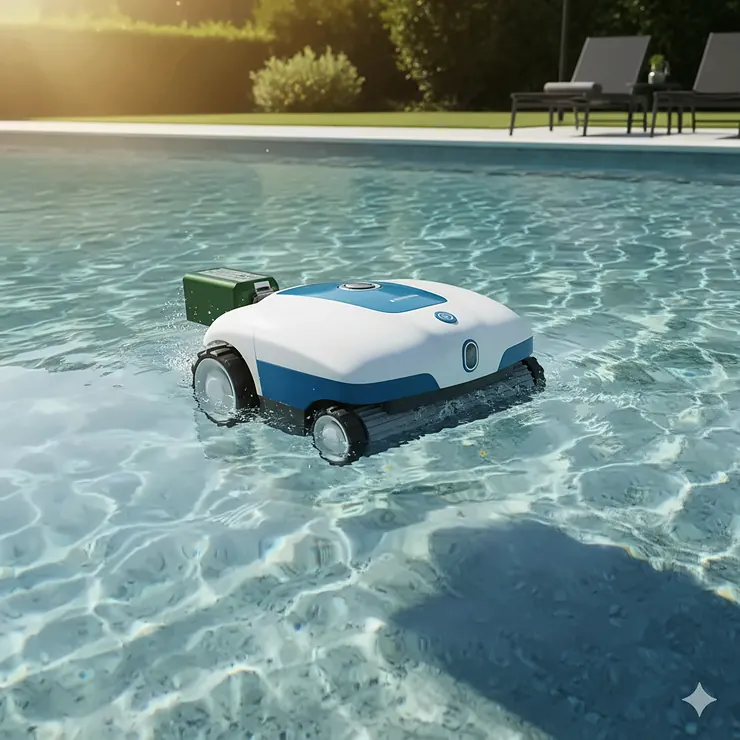
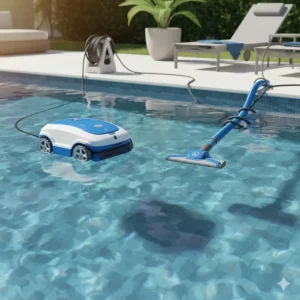
Here’s the short version of 2026. A battery pool cleaner now means a sealed, rechargeable robot that drops into the water, scrubs the floor (and often the walls), then parks itself for pickup. No hose. No transformer box on the deck. No cord drifting like seaweed.
But the category is messier than the marketing suggests. Runtimes range from roughly 90 minutes to 5 hours. Some models climb walls and some can’t. Some scrub the waterline and others skip it entirely. And yes, the big legacy names have joined the party, which is why a Dolphin cordless pool cleaner now sits next to budget upstarts on the same shelf.
So this guide does the sorting for you. Based on spec sheets, published reviews, and aggregated owner feedback, I’ve ranked seven real models across budget, mid-range, and premium tiers, then added the practical stuff Amazon listings skip: setup habits, battery care, and honest trade-offs. Prices below are ranges only and shift often, so check current price before you buy.
Quick Comparison: 7 Battery Pool Cleaner Picks at a Glance
| Product | Price Tier (check current price) | Rated Runtime | Best For |
|---|---|---|---|
| Beatbot Sora 10 | Mid-range (street price commonly under $500) | Up to ~300 min | Best overall value |
| Aiper Seagull SE | Budget | Up to ~90-100 min | Small, flat-floor pools |
| Wybot C2 | Budget to mid-range | Up to ~180 min (listed) | App scheduling on a budget |
| Dolphin Liberty 200 | Premium-leaning | ~90 min (U.S. 2025 listing) | Brand-loyal, mid-size in-ground pools |
| Dolphin Liberty 400 | Premium | ~90 min | Dolphin app control and inductive charging |
| Polaris Freedom Plus | Premium | Up to ~2.5 hrs | Remote control and big in-ground pools |
| Aiper Scuba S1 Pro | Premium ($900s to ~$1,200 range) | ~90-180 min (sources vary) | Leaves and grit on larger pools |
Looking at the table, the Beatbot Sora 10 pairs the longest rated runtime with a sub-$500 street price, which is why it’s my value pick. The Aiper Seagull SE is the cheapest way in, but it’s a floor-only specialist, so check your pool’s shape first. Meanwhile, the Dolphin and Polaris models cost more because you’re paying for brand support and refinement, not raw runtime.
💬 Just one click — help others make better buying decisions too!😊
What Is a Battery Pool Cleaner?
A battery pool cleaner is a cordless robotic vacuum that runs on an onboard rechargeable lithium-ion battery instead of a power cable. It navigates the pool on its own, collects debris in an internal filter basket, and surfaces or parks at the wall when finished. You charge it between cycles.
That definition matters because the category borders two older technologies. Wikipedia’s overview of automated pool cleaners separates them into suction-side, pressure-side, and electric robotic types. Suction and pressure cleaners lean on your pump and plumbing. A robot, by contrast, brings its own motor and filter.
So a battery pool cleaner is really a robotic cleaner with the tether cut. The trade-off is simple: you give up unlimited runtime and gain total freedom of placement. For most backyard pools, that’s a swap worth making, and the rest of this article is about doing it intelligently.
Top 7 Battery Pool Cleaners: Expert Analysis
Quick note on method. Everything below comes from published specs, professional reviews, and aggregated owner sentiment, not from me wrestling robots in my own backyard. Where sources disagree, I say so.
1. Beatbot Sora 10 — best overall value under $500
The Beatbot Sora 10 is the entry rung of Beatbot’s Sora lineup, and it behaves like it didn’t get the memo about being “entry-level.” The headline numbers are a 7,800mAh battery, a rated runtime of up to 300 minutes, and 6,800 GPH suction.
In practice, that runtime means a full floor-and-wall cycle without babysitting, even in a pool well over a thousand square feet. The 5L basket with 150-micron filtration holds a lot of leaves, which suits tree-lined yards. Based on the spec comparison, it’s aimed at people who want core cleaning (floor, walls, waterline, shallow areas down to about 12 inches) without paying for surface skimming.
Reviewers consistently praise the pool coverage, waterline scrubbing, and leaf pickup. The recurring complaints are steps, which it handles poorly, and a filter mesh that won’t trap fine silt or algae. Review volume is still thin for a 2026 release, so treat early sentiment cautiously.
Pros:
- ✅ Rated runtime up to roughly 5 hours
- ✅ Large 5L basket for leafy pools
- ✅ Waterline scrubbing and smart parking
Cons:
- ❌ Struggles to clean pool steps
- ❌ 150-micron filter misses fine silt
Street prices have commonly landed around $450-$500 against a higher list price. At that range, the value verdict is easy: it’s the model to beat.
2. Aiper Seagull SE — cheapest way into cordless
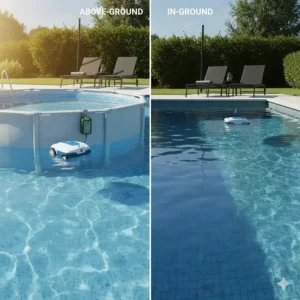
The Aiper Seagull SE exists for one job: vacuuming flat floors without drama. It’s rated for roughly 90 to 100 minutes, charges in about 2.5 hours, and handles round above-ground pools plus flat-floored in-ground pools up to about 40 x 20 feet.
Here’s the catch the spec sheet whispers. It has no wall climbing, so sloped floors, deep ends, and coves are out of reach. On a pancake-flat vinyl pool, that’s fine. On a pool with a dramatic deep end, it’s a recipe for disappointment.
Owner feedback splits sharply. On one Australian review site, happy small-pool owners sit beside frustrated ones reporting erratic paths and weak suction on bigger jobs, and several complaints involve customer service rather than the robot. Professional reviewers call it a smart, affordable tool for flat pools.
Pros:
- ✅ Lowest cost of entry in this lineup
- ✅ Quiet and lightweight to handle
- ✅ Self-parking makes retrieval simple
Cons:
- ❌ No wall climbing at all
- ❌ Only suits flat-bottomed pools
Think budget-tier pricing (check current price). Verdict: great value only if your pool matches its narrow brief.
3. Wybot C2 — app scheduling on a budget
The Wybot C2 targets shoppers who want smart features without premium pricing. Listings advertise up to 180 minutes of runtime, dual filters, a brushless motor, and app scheduling for up to four cleanings per week. It also returns to the pool edge after each cycle.
On paper, that scheduling feature is the real draw. You set it, forget it, and your pool gets a baseline cleaning even when you’re at work. Compared with the previous model, the C2 reportedly adds a larger battery and a fine filter.
The sentiment picture, though, is sobering. One retailer listing shows about 3.6 stars across roughly 61 ratings, a small Australian review page averages lower on five reviews, and a pool-testing site declined to approve the brand. Recurring themes include customer-service frustration and mixed durability. Cheerful reviews exist too, especially for easy setup and fast charging.
Pros:
- ✅ Weekly scheduling through the app
- ✅ Long listed runtime for the money
- ✅ Dual filters and easy setup
Cons:
- ❌ Mixed support and reliability reports
- ❌ Lower aggregate ratings than rivals
Budget-to-mid pricing applies (check current price). Verdict: tempting, but only if you accept the support risk.
4. Dolphin Liberty 200 — Dolphin’s first cordless robot
The Dolphin Liberty 200 was Maytronics’ opening move into cordless. The 2025 U.S. listing describes a 5,000mAh lithium-ion battery, roughly 90 minutes of cleaning, floor and wall coverage, and inductive “Magnetic-Connect” charging that keeps the battery away from pool-water corrosion. Pools up to about 33 feet are the target.
What that means in practice: it’s built for moderate in-ground pools where you want the Dolphin ecosystem without a cable. The fine-filter kit and active brush are solid, and the top-access basket is easy to rinse. Specs vary by region and model year, though. European listings cite longer cycles and waterline scrubbing, while U.S. listings and retailer reviews describe no waterline cleaning.
Reviewers acknowledge the convenience but note it lacks the efficiency of Dolphin’s corded flagships, and that the roughly six-hour charge feels long for 90 minutes of work.
Pros:
- ✅ Inductive charging avoids contact corrosion
- ✅ Lightweight design handles easily
- ✅ Two-year limited warranty on the product
Cons:
- ❌ Roughly six-hour full charge time
- ❌ U.S. version skips waterline cleaning
It sits in the premium-leaning tier, so check current price. Verdict: pay for the name only if support matters more than runtime.
5. Dolphin Liberty 400 — smart Dolphin with an app
The Dolphin Liberty 400 layers extras onto the cordless formula: the MyDolphin Plus app for scheduling, a Click-Up feature that sends it to the nearest wall when you shake the remote clicker, and inductive charging. A retailer FAQ lists a 1.5-hour cleaning cycle and a weight of about 17.9 pounds.
Interpreting that: you get a heavier-feeling, more controllable robot than the entry models, and an app that actually earns its keep for scheduled runs. But the same FAQ is blunt about gaps. It cleans floors and partial walls, skips the waterline, and doesn’t include NanoFilters, so fine algae and silt stay in the water.
I couldn’t verify a meaningful pool of independent owner reviews for this model, so I won’t pretend there’s a consensus. What is verifiable is the spec trade-off: premium money for convenience features, not for extra runtime.
Pros:
- ✅ App control with cleaning schedules
- ✅ Click-Up wall retrieval feature
- ✅ Inductive charging, no exposed contacts
Cons:
- ❌ No waterline cleaning
- ❌ No NanoFilter support for fine debris
Expect a premium price (check current price). Verdict: nice if you want Dolphin ergonomics, but the Beatbot Sora 10 out-specs it on runtime for less.
6. Polaris Freedom Plus — remote control and underwater LiFi
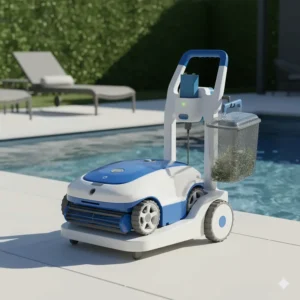
The Polaris Freedom Plus is Polaris’ premier battery-powered robot, built for in-ground pools up to roughly 50 feet. Rated cycles run up to 2.5 hours, and it recharges in under five hours on an outdoor-rated caddy. Its party trick is a handheld remote using LiFi, which lets you steer it or call it to the waterline mid-cycle.
That remote is more useful than it sounds. When a guest drops a sunglasses lens in the shallow end, you can summon the robot instead of fishing. It also sends end-of-cycle notifications through the iAquaLink app, though some owners call that app unreliable.
Professional testing at PCWorld described solid coverage and a deliberate pace, with a small patch missed around a 90-degree dogleg and a few leaves left on shallow steps. Owners on retail pages mostly like the no-tangle experience and easy filter access.
Pros:
- ✅ LiFi remote steers it underwater
- ✅ Long runtime and big pool rating
- ✅ Outdoor-rated charging caddy included
Cons:
- ❌ Premium price for modest cleaning gains
- ❌ App connectivity frustrates some owners
It’s a premium-tier buy (check current price). Verdict: worth it if the remote and brand support appeal; otherwise, cheaper robots clean about as well.
7. Aiper Scuba S1 Pro — long runtime for leaves and grit
The Aiper Scuba S1 Pro is the heavy hitter of Aiper’s cordless range. Sources disagree on runtime (anywhere from 90 to 180 minutes), so verify the figure on the current listing. One review aggregator lists 3,600 GPH flow, WavePath 2.0 navigation, and coverage for pools up to roughly 1,600 square feet.
In practice, the robot moves in methodical straight lines, like a lawnmower, on long tank-style treads. PCWorld found it removed leaves and grit well, with a long run time, but flagged that it’s not a small device.
Sentiment is mixed. One review aggregator reports around 4.1 stars from roughly 564 reviews, yet a pool-specialist review complains about mid-cycle stops and trouble on sloped or textured surfaces. Daily charging and lithium-battery aging are the recurring cons.
Pros:
- ✅ Strong leaf and grit removal
- ✅ Systematic, lawnmower-style navigation
- ✅ Dual filtration system
Cons:
- ❌ Bulky and harder to retrieve
- ❌ Reports of mid-cycle stalls on slopes
Listed from the $900s to roughly $1,200. Verdict: strong on big, flat pools, but the Beatbot Sora 10 is easier to justify on value.
Spec Snapshot: What Each Battery Pool Cleaner Actually Cleans
| Product | Cleans | Charging & Filtration Note | Best For |
|---|---|---|---|
| Beatbot Sora 10 | Floor, walls, waterline, shallow areas | ~3.5-4.5 hr charge; 150-micron basket | Leaf-heavy pools |
| Aiper Seagull SE | Floor only | ~2.5 hr charge | Flat above-ground pools |
| Wybot C2 | Floor and walls | Dual filters; app timer | Scheduled upkeep |
| Dolphin Liberty 200 | Floor and walls (U.S. listing) | ~6 hr inductive charge; fine filter | Mid-size in-ground pools |
| Dolphin Liberty 400 | Floor and partial walls | Inductive; no NanoFilters | App-driven Dolphin fans |
| Polaris Freedom Plus | Floor, walls, waterline | <5 hr via caddy | Large in-ground pools |
| Aiper Scuba S1 Pro | Floor and walls | ~4 hr charge (listing); dual filters | Big, flat pools |
Read the “Cleans” column first, because it’s where marketing hides. The Seagull SE and both Dolphin Libertys leave the waterline to you, which matters if your pool grows a scum ring. If waterline grime bugs you most, the Beatbot Sora 10 and Polaris Freedom Plus are the cleaner fits here.
Dolphin Cordless Pool Cleaner: What the Liberty Line Gets Right (and Wrong)
Dolphin cordless pool cleaner shoppers are usually brand-loyal for a reason: Maytronics’ support network is large, and the robots are polished. The Liberty line is its answer to the cord-free craze. Retailer hubs also list a Dolphin Liberty 300 and a removable-battery Dolphin Liberty 600 above the models covered here, so the lineup is broader than two names.
What does a Dolphin cordless pool cleaner do best? Handling and ergonomics. Inductive charging means no corroded contacts, the baskets are top-loading, and the robots park at the wall when the battery runs low. Dolphin also positions the cordless line as same-reliability, now with no cable.
Where does it lag? Runtime and filtration. The Dolphin Liberty 200 and Dolphin Liberty 400 both land near 90 minutes, while the Beatbot Sora 10 is rated at up to 300. Neither Liberty U.S. listing cleans the waterline either. A Dolphin cordless pool cleaner makes the most sense when your pool is under about 33 feet and you value a known brand’s service.
Meanwhile, if you’re torn between a Dolphin cordless pool cleaner and a corded Dolphin such as the Dolphin Nautilus CC Plus, hold that thought. The corded-versus-cordless section below tackles it head on.
✨ Don’t Miss These Exclusive Deals!
🔍 Take your pool care to the next level with these carefully selected cleaners. Click on any highlighted product name to check current pricing and availability. A little planning now means a sparkling, swim-ready pool all season!
How to Choose a Battery Pool Cleaner
Skip the spec-sheet scavenger hunt. These six steps cover what actually decides whether you’ll love your purchase.
- Measure your pool and match the rating. Check length and shape against the manufacturer’s maximum. Pools near the limit tend to leave patches, so pick a model rated above your size.
- Confirm what it cleans. Floor-only, floor-and-wall, and waterline-capable robots solve different problems. If you have a scum line, waterline scrubbing is non-negotiable.
- Compare runtime honestly. Rated minutes are best-case. Divide your pool’s square footage by the robot’s coverage to see whether one charge is truly enough.
- Check filtration. A 150-micron basket handles leaves but not silt. Finer filters catch more, but they clog faster.
- Think about retrieval. Self-parking at the waterline saves your back. Heavy robots with no retrieval aids are a chore.
- Read the warranty and support record. Battery packs age, so a two-year warranty beats a vague promise.
Run those six checks, and the shortlist usually shrinks to two models.
Battery Pool Cleaner vs Corded Robot: Which Wins?
Honestly, it depends on how you value convenience versus raw performance. Pool-testing sites that favor corded units argue cords still win on suction, filtration, and runtime. Cordless fans counter that tangle-free, plug-free operation is worth the compromise for most backyards.
| Factor | Battery Pool Cleaner | Corded Robot |
|---|---|---|
| Runtime | Limited by battery (≈1.5 to 5 hrs) | Effectively unlimited per cycle |
| Setup | Drop in and go | Cord, power supply, untangling |
| Filtration | Usually coarser | Often finer (e.g., NanoFilters) |
| Retrieval | Self-parking on many models | Pull by cable |
| Best For | Casual owners wanting simplicity | Heavy-debris or large pools |
Looking at the table, the cordless advantage is convenience, not power. A corded model like the Dolphin Nautilus CC Plus suits heavy debris and big pools, while a Beatbot Sora 10-class battery pool cleaner suits the typical suburban pool. If you’re unsure, ask how often you’ll actually clean. Daily or weekly? Cordless wins on friction.
Features That Actually Matter (And Those That Don’t)
Some features earn their keep. Waterline scrubbing, self-parking, and a large top-loading basket will pay you back every week. Meanwhile, others are mostly shiny.
Worth paying for: wall climbing if your pool has a deep end; a basket big enough that you aren’t emptying it mid-cycle; and a charger that’s easy to use, since you’ll plug it in constantly. Inductive charging, as on the Dolphin Liberty 200, is a genuine corrosion-proofing perk.
Mostly marketing: headline GPH numbers, because flow rate doesn’t tell you how well the brushes grip a wall. App-based pool “mapping” is another: if a robot cleans in neat parallel lines anyway, you don’t need a map to tell you so. Remote controls like the Polaris Freedom Plus LiFi clicker are fun, but they won’t change your pool’s cleanliness.
The rule of thumb: pay for what touches the debris, not what touches your phone.
What to Expect: Real-World Performance
Spec sheets promise perfection; pools deliver gravity and geometry. Here’s the honest picture.
Most battery pool cleaners cover wide, open floors well. Where they struggle is predictable: steps, coves, and tight corners. Both the Beatbot Sora 10 and the Polaris Freedom Plus draw reviewer mentions for leaving patches on steps or near awkward bends, so plan on a quick handheld pass there.
Runtime is another reality check. Rated minutes assume a full battery and easy conditions. A leaf-choked pool or a cloudy one drains the pack faster, and heavy filters make the robot work harder. So if your pool is large, aim for the longest-rated model, not the cheapest.
Finally, retrieval. Self-parking is great until the robot parks at the wrong wall. Expect to keep a pool pole or retrieval hook handy, especially for models like the Aiper Scuba S1 Pro, whose size makes it harder to wrangle.
Long-Term Cost, Battery Life, and Safety
Here’s the part listings never mention: the battery is a consumable. Lithium-ion packs lose capacity over time, so a robot that runs 90 minutes today may run noticeably less in a couple of seasons. That’s why a longer rated runtime and a solid warranty are cheap insurance.
Run the math on total cost. A cheaper robot that needs replacing in two seasons may cost more than a pricier one that lasts four. Electricity is minor either way; the real costs are the purchase, replacement filters, and eventual battery service.
Safety deserves a straight word too. Lithium batteries can overheat if damaged or charged improperly. Washington State Patrol’s fire-marshal guidance, citing U.S. Consumer Product Safety Commission data on lithium-ion incidents, advises using the manufacturer’s charger, unplugging once the battery is full, and avoiding charging in extreme temperatures (below 32°F or above 105°F).
In practice, that means charging in a shaded, ventilated spot, not a baking garage. Charge only with the supplied adapter, and stay nearby until you’ve learned how the unit behaves.
Practical Usage Guide: Your First 30 Days With a Battery Pool Cleaner
The first month sets your habits. Get these right and the robot practically disappears into your routine.
Day 1: Charge fully. Many robots ship partially charged. Let it fill completely before the first drop-in, per the manual. Meanwhile, skim visible leaves and large debris so the basket doesn’t clog in minute one.
Week 1: Learn its pattern. Watch a full cycle. Does it miss the steps? Stall at a corner? Note where, because those spots become your manual-touch list.
Weeks 2 to 4: Build a rhythm. Run it every couple of days if debris is steady. Rinse the basket after each run, since clogged filters cut suction. Wipe the charging contacts or inductive pad dry, as manuals typically advise.
Common first-month mistakes: skipping the basket rinse, running it in a murky pool before shocking it, and leaving it in the water 24/7. Many robots warn against that last one, so follow your manual.
One more tip: schedule runs for after the filter pump’s cycle. Cleaner water means less strain on both machines.
Real-World Scenarios: Matching a Battery Pool Cleaner to Your Pool
Specs only matter in context, so here are three realistic profiles.
The leafy backyard (in-ground, 16 x 32 ft, oak trees). Tree-shed means heavy leaves. A big basket and long runtime matter more than app features. The Beatbot Sora 10, with its 5L basket and rated runtime up to 300 minutes, is the logical pick. Budget: under $500.
The flat above-ground pool (round, 18-ft, light debris). Here, wall climbing is unnecessary. The Aiper Seagull SE fits the brief and saves serious money. Run it every few days, and you’ll hardly notice dirt.
The brand-loyal owner with a mid-size in-ground pool. If you already trust Dolphin service and your pool is under about 33 feet, the Dolphin Liberty 200 fits. Accept the shorter runtime and plan to handle the waterline yourself with a brush.
Each scenario boils down to the same question: what is the single worst problem in your pool? Solve that first.
Problem → Solution Guide: Fixing Common Battery Pool Cleaner Headaches
Even good robots hit snags. Here are the four I’d expect most, with fixes.
Problem: It stops mid-pool. A drained battery or a clogged basket is the usual culprit. Charge fully, rinse the basket, and check the filter for fine silt.
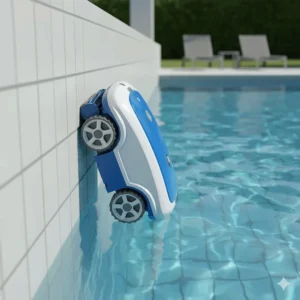
Problem: It won’t climb walls. Slimy walls reduce traction. Brush the walls, balance the water, and confirm the model actually supports wall climbing (the Aiper Seagull SE doesn’t).
Problem: Cloudy water after a cycle. Fine debris can pass coarse baskets. Run your pump longer and consider a finer filter if available. For chemistry, the CDC’s guidance on keeping pools safe and healthy stresses reading labels, never mixing chemicals, and wearing protective gear.
Problem: Short runtime after a year. That’s battery aging. Check your warranty, store the robot out of heat, and avoid draining it to zero repeatedly.
Fixing problems early saves you from blaming the wrong thing, because most “robot failures” are actually basket, water, or charging issues.
FAQ: Battery Pool Cleaner Questions Answered
❓ How long does a battery pool cleaner take to charge?
❓ Does a Dolphin cordless pool cleaner clean the waterline?
❓ Can I leave a battery pool cleaner in the pool all season?
❓ What pool size can a battery pool cleaner handle?
❓ Is it safe to charge a battery pool cleaner in my garage?
Conclusion: Which Battery Pool Cleaner Should You Buy?
Cordless pool robots aren’t magic, but they’ve matured into a smart, genuinely convenient choice for most backyards. The real decision isn’t “cordless or not.” It’s matching a battery pool cleaner to your pool’s shape, debris load, and tolerance for charging chores.
For most people, the Beatbot Sora 10 is the sweet spot: long rated runtime, waterline scrubbing, and a sub-$500 street price (check current price). If your pool is flat and small, the Aiper Seagull SE does the job for less. Brand-loyal buyers will find the Dolphin Liberty 200 and Dolphin Liberty 400 polished, though they trade runtime for refinement. And if you want remote control and big-pool capacity, the Polaris Freedom Plus and Aiper Scuba S1 Pro deserve a look.
Whatever you pick, remember the boring stuff: rinse the basket, respect the battery, and keep realistic expectations about steps and corners. Do that, and your battery pool cleaner will quietly earn its keep every week.
✨ Ready to ditch the cord for good? 🔍 Click any highlighted product name above to check current pricing and availability, then pick the robot that fits your pool, not just your budget. Your future self (and your weekends) will thank you! 🏊♂️
Recommended for You
- Cordless Pool Cleaner: 7 Best Picks for 2026 (Honest Ranking)
- Robotic Pool Vacuum for Above Ground Pools: 7 Best Picks (2026)
- Best Pool Cleaner for Above Ground Pool: 7 Top-Rated Picks (2026)
Disclaimer: This article contains affiliate links. As an Amazon Associate, I earn from qualifying purchases. If you purchase products through these links, we may earn a small commission at no additional cost to you.
✨ Found this helpful? Share it with your friends! 💬🤗
