
In This Article
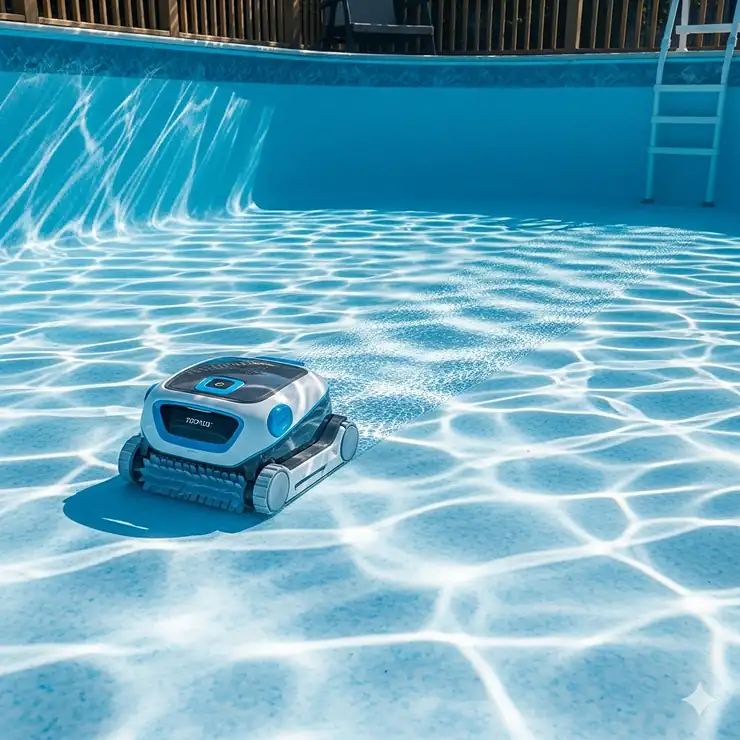
The best automatic pool cleaner above ground is a robotic cleaner that vacuums and scrubs your pool floor on its own motor, independent of your pump. For most owners, a lightweight, top-loading robot with a weekly timer delivers the clearest water for the least effort. Cordless and wall-climbing models suit more specific pools and budgets.
Here’s what nobody mentions when you buy an above ground pool: the pool is the easy part. The skimming, the net-swishing and the dragging of a manual vacuum hose across a vinyl floor in July heat are the real job. A good automatic pool cleaner above ground quietly takes that job over. Leaves, bugs, pollen, grit and algae film vanish while you’re inside doing literally anything else.
Choosing one is messier than it looks, though. Cleaners differ wildly: cords versus batteries, floor-only versus wall-climbing, mesh baskets versus ultra-fine filters, $150 versus $1,500. This guide pulls together independent test reports, manufacturer spec sheets and retailer listings to rank seven real options for 2026. To be upfront, it is analysis, not hands-on testing. Where verified owner reviews were thin, I say so.
One caution before we dive in. A robot removes debris; it does not sanitize. The CDC recommends a pH of 7.0–7.8 and at least 1 ppm free chlorine (2 ppm if you use cyanuric acid), so keep your test strips handy. The robot makes your chemistry’s job easier. It doesn’t replace it.
Quick Comparison: Best Automatic Pool Cleaners for Above Ground Pools at a Glance
| Product | Power | Cleans | Price Range | Best For |
|---|---|---|---|---|
| Dolphin Escape | Corded, 40 ft | Floor | $600–$750 range | Best all-round value for most above ground pools |
| Dolphin Cayman | Corded | Floor + walls | $900–$1,100 range | Owners who want automation plus wall scrubbing |
| Polaris P70 | Corded, 40 ft | Floor + cove | $550–$750 range | Small, simple pools and easy canister cleanup |
| Dolphin E10 | Corded, 40 ft | Floor | $500–$600 range | Tight budgets, pools up to 30 ft |
| Aiper Seagull SE | Cordless, about 90 min | Floor | $130–$200 range | Small pools and quick touch-ups |
| Beatbot AquaSense 2 | Cordless, about 4 hrs | Floor, walls, waterline | $800–$1,000 range | Tech lovers and pools far from an outlet |
| Dolphin Quantum | Corded, 60 ft | Floor, walls, waterline | $1,400–$1,600 range | Large or debris-heavy pools |
Looking at the table, the Dolphin Escape and Dolphin E10 cover the floor-only, corded middle ground. The Dolphin Cayman adds wall scrubbing for a few hundred dollars more. Budget buyers should note that the Aiper Seagull SE gets its low price by giving up corded power and a big basket. The Beatbot AquaSense 2 and Dolphin Quantum are for pools or patience that justify the premium.
💬 Just one click — help others make better buying decisions too!😊
Top 7 Best Automatic Pool Cleaners for Above Ground Pools: Expert Analysis
Prices below are ranges at the time of research (October 2026) and move constantly, so check current price before you buy. A note on sources: The Pool Nerd leans strongly toward corded Dolphin robots and discloses that it may earn commissions. Bob Vila’s editors rate a Polaris as their above-ground pick. I’ve weighed both camps instead of picking a side.
1. Dolphin Escape — value pick for floor-focused cleaning
The Dolphin Escape‘s trick is balance: premium-feeling parts in an entry-level body. It runs on a 40-foot cable with a default cycle of about 1.5 hours. Its top-loading MaxBin basket is billed by the manufacturer as roughly 50% larger than standard cartridges, which means fewer trips to dump leaves. The Pool Nerd measures flow above 4,000 gallons per hour from a 180-watt draw. On paper, that explains why a corded unit keeps pulling hard from first minute to last, which battery-powered rivals often can’t match.
The catch is that it scrubs floors only, with no wall or waterline work, and the weekly timer is a modest add-on. Based on the spec comparison, that timer is what turns it from “a robot you start” into “a robot that lives in your pool.” Editorial sentiment is strong: Pool Nerd scores it 4.8 stars, and Forbes’ editors name it their above-ground pick. I couldn’t verify a large pool of independent owner reviews, so treat that praise as editorial rather than owner feedback.
Pros:
- ✅ Steady corded suction through the whole cycle
- ✅ Top-load MaxBin is easy to empty
- ✅ Suits pools up to roughly 33 feet
Cons:
- ❌ No wall or waterline cleaning
- ❌ Weekly timer costs extra
Expect a mid-$600s to low-$700s range, with certified open-box offers reportedly dipping into the $400s–$500s. It’s strong value for a robot that does one job very well.
2. Dolphin Cayman — wall scrubbing without the flagship price
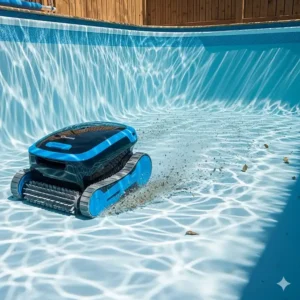
The standout feature of the Dolphin Cayman is that it climbs. Where the Dolphin Escape stays on the floor, the Dolphin Cayman scrubs walls up to the waterline and ships with the weekly timer already in the box. Pool Nerd describes the same 4,000-gallons-per-hour corded flow, a HyperBrush that spins faster than standard brushes, and a second-generation MaxBin holding about 50% more debris than older baskets. It lists the Dolphin Cayman for above ground pools and small inground pools up to about 33 feet.
So what does that mean in practice? If your pool wears a greasy sunscreen ring or gets algae film on the walls, a floor-only robot leaves that work to you. The Dolphin Cayman takes it on, and the included timer means you mostly just empty the basket weekly. Reviewers consistently frame it as the “sweet spot” of the Dolphin lineup. Again, that is editorial sentiment, as verified owner data was limited. Optional NanoFilters, which trap fine silt and pollen, are the upgrade worth considering.
Pros:
- ✅ Weekly timer included for true automation
- ✅ Scrubs walls up to the waterline
- ✅ Bigger Gen-2 basket holds more debris
Cons:
- ❌ Costs noticeably more than floor-only options
- ❌ Overkill for tiny, low-debris pools
A rough $900–$1,100 range is fair for the automation and wall coverage you get.
3. Polaris P70 — easiest canister to check and empty
Look at the lid first. The Polaris P70 has a transparent top, so you can see at a glance when the canister needs emptying, and a mesh filter around it that helps during pollen and cottonwood season. It uses a 40-foot cable, a 3-liter canister and cyclonic vacuum design to keep suction steady as debris collects. It cleans floor and cove only, with a single front brush. There’s no timer, app or swivel, and the caddy is optional.
In practice, that makes it a “drop it in, start it, walk away” machine. Bob Vila’s testers scored it 4.2 out of 5 and called out its light weight and top-loading simplicity, but also flagged the quick-filling basket and the lack of wall climbing. They cleaned a 28-foot test pool in about 90 minutes. Owner reviews on Polaris’s own site skew positive, though one 9×18 pool owner wished for stronger cleaning, a reminder that retailer-hosted reviews run optimistic.
Pros:
- ✅ Lightweight and simple to operate
- ✅ Transparent lid shows when it’s full
- ✅ Mesh filter helps during pollen season
Cons:
- ❌ Basket can fill quickly in leafy pools
- ❌ No timer or anti-tangle swivel
At roughly $550–$750, it’s fair value for simplicity, though automation shoppers should look higher up this list.
4. Dolphin E10 — no-frills floor cleaner for tight budgets
If the Dolphin E10 were a car, it would be a reliable hatchback: no sunroof, no surprises. The specs show a lightweight robot of about 14.6 pounds, a 40-foot cable, a 1.5-hour default cycle, an active scrubbing brush and a top-load filter. It is rated for above ground pools up to 30 feet. It has no weekly timer, no app and no waterline scrubbing, so you’ll press the power button each time.
That lack of automation is the real trade-off. Pool Nerd’s review hub scores it 3.9 stars with a “buy with caution” label, calling it dependable but pointing to the Dolphin Escape as the better step up. Forbes, by contrast, calls it their best-value robot and cites reviewers who like the rubber tracks and the brush that spins at twice the robot’s speed. One owner testimonial on a retailer page praised it in an 18-foot round pool, but that testimonial is retailer-hosted, so weigh it accordingly. If you’re sure you’ll never upgrade, it works. Otherwise, spend a little more.
Pros:
- ✅ Light enough to lift out easily
- ✅ Active scrubbing brush on a budget
- ✅ Top-load filter keeps hands clean
Cons:
- ❌ Manual start every cycle, no timer
- ❌ Floor-only with standard mesh filtration
Around $500–$600 is the typical range, so the value verdict is “good, unless the Dolphin Escape fits your budget.”
5. Aiper Seagull SE — cheapest way to stop skimming by hand
Cordless and cheap is a bold combination. The Aiper Seagull SE has no hoses, no power supply, no app: charge it, press a button, drop it in. Bob Vila’s testers saw about 90 minutes of runtime, dual-drive motors, bottom brushes and solid everyday debris pickup, and scored it 4.4 out of 5 with 4.7 for value. The tradeoffs are a small debris basket and no wall climbing.
Here’s where analysis matters: a 90-minute battery means recharging between runs, and Pool Nerd argues that lithium-powered robots in general fade in suction and become a daily chore. There’s also a safety footnote. The CPSC recall notices I found name the Aiper Seagull Pro and Elite Pro, not the SE, but check CPSC’s database before buying and never charge any lithium robot unattended. For a small pool needing occasional touch-ups, the simplicity is genuinely appealing.
Pros:
- ✅ Charge, drop and go simplicity
- ✅ Light and easy to lift out
- ✅ Very low cost of entry
Cons:
- ❌ Small basket fills fast in leafy pools
- ❌ Battery needs recharging between runs
At roughly $130–$200, the Aiper Seagull SE is a low-risk way to try robotic cleaning.
6. Beatbot AquaSense 2 — cordless with walls and self-parking
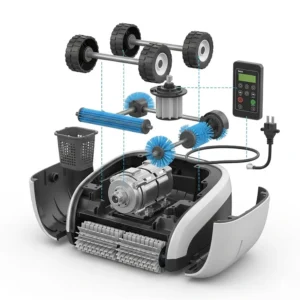
The party trick of the Beatbot AquaSense 2 is parking itself at the water’s surface when it finishes or runs low, so you aren’t fishing it out with a pole. It’s a cordless 3-in-1 that cleans floor, walls and waterline, runs about four hours per charge, weighs roughly 23 pounds and is rated for above ground and inground pools up to about 3,230 square feet. App control comes via Bluetooth and Wi-Fi.
Bob Vila’s testers gave it 4.6 out of 5, praising build quality and a detailed app log, though they noted it’s heavy to lift and misses debris more than about five inches above the waterline. The suction numbers deserve skepticism. One independent reviewer claims cordless robots top out near 1,200–1,500 gallons per hour, while one spec listing for the Beatbot AquaSense 2 claims far higher. Treat GPH as marketing until compared on the same basis. Verified owner reviews were limited, so lean on those independent tests.
Pros:
- ✅ About four hours of cordless runtime
- ✅ Floor, wall and waterline cleaning
- ✅ Self-parking makes retrieval easy
Cons:
- ❌ Heavy to lift despite surface parking
- ❌ Premium price for a cordless unit
Expect roughly $800–$1,000, often discounted from higher list prices. It’s worth it if you value tech and no cords.
7. Dolphin Quantum — bigger bin and waterline scrubbing for larger pools
When trees surround your pool, capacity matters, and the Dolphin Quantum is built for it. Pool Nerd highlights its extra-large top-load basket, and Maytronics lists a 60-foot cable, a two-hour cycle, a weekly timer, an anti-tangle swivel and an ultra-fine filter kit in the box. It scrubs floor, walls and waterline and weighs about 18 pounds.
One compatibility note: Maytronics’ US page classifies it as inground, while its global page lists inground and above ground. Pool Nerd recommends it as the splurge pick for larger above ground pools. Confirm your liner and pool type with the retailer before buying. On balance, it’s more robot than a small, light-debris pool needs, but for a big pool under maples, the capacity and waterline reach justify the price.
Pros:
- ✅ Scrubs waterline as well as walls
- ✅ Large basket suits tree-heavy yards
- ✅ Timer, swivel and fine filters included
Cons:
- ❌ Overkill for small, light-debris pools
- ❌ Highest price on this list
At roughly $1,400–$1,600, it’s a premium purchase best matched to large, leafy pools.
Top 7 Compared: Specs, Price Ranges and Editorial Take
| Product | Cable / Power | Cycle | Walls | Timer | Price Range | Editorial Take |
|---|---|---|---|---|---|---|
| Dolphin Escape | 40 ft corded | ~1.5 hrs | No | Optional add-on | $600–$750 | Pool Nerd 4.8/5 |
| Dolphin Cayman | Corded | Check listing | Yes | Included | $900–$1,100 | Pool Nerd “Approved” |
| Polaris P70 | 40 ft corded | ~2 hrs | No | No | $550–$750 | Bob Vila 4.2/5 |
| Dolphin E10 | 40 ft corded | ~1.5 hrs | No | No | $500–$600 | Pool Nerd 3.9/5 |
| Aiper Seagull SE | Cordless | ~90 min | No | No | $130–$200 | Bob Vila 4.4/5 |
| Beatbot AquaSense 2 | Cordless | ~4 hrs | Yes | App scheduling | $800–$1,000 | Bob Vila 4.6/5 |
| Dolphin Quantum | 60 ft corded | ~2 hrs | Yes | Yes | $1,400–$1,600 | Pool Nerd “Approved” |
Editorial ratings come from different outlets with different methods, so don’t compare them as one scale. The pattern is still clear: timers and wall coverage drive the price jumps. For a small pool, the Dolphin Escape with its timer add-on gets you most of the automation of the Dolphin Cayman at a lower price. If your main pain is a grimy waterline, skip the floor-only models and aim for the Dolphin Cayman or Dolphin Quantum.
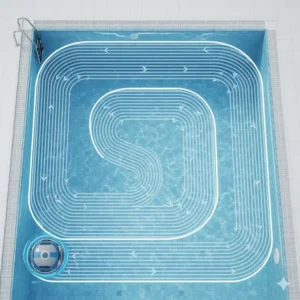
Practical Usage Guide: Setting Up Your Robot and Surviving the First 30 Days
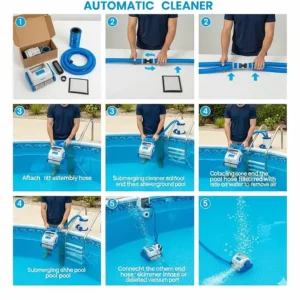
Setup is simple, but small habits decide how well a robot performs. Before the first run, test and balance your water. Then skim out big debris like sticks and soggy leaves, which can clog a basket in minutes. Take the ladder out or secure it per the manufacturer’s guidance, and smooth any wrinkles in the liner so the tracks don’t snag.
Place the power supply on dry, elevated ground and plug it into a GFCI outlet, never through an extension cord. Lay the floating cable out straight, since a twisted cable is the number-one cause of a robot that wanders in circles. Drop the robot in, let it fill and sink, then start it. After the first cycle, rinse the filter and check it for wear.
For the first month, build a rhythm. Run it every other day, or on a weekly timer if yours has one, and empty the basket after every run during leaf season. Rinse brushes and tracks weekly. Common first-30-day mistakes include running it with a half-full basket, leaving the power supply in the rain and ignoring a cable twist until the robot stalls. Fix those three, and most “my robot doesn’t work” complaints disappear.
Real-World Scenarios: Matching the Right Robot to Your Pool
Scenario 1: The leafy-yard family. A 15-foot round pool under maple trees, a budget near $700 and weekend-only attention. The Dolphin Escape with its timer add-on fits: strong corded suction, a big top-load basket and automatic runs. The missing wall coverage matters less in a small round pool.
Scenario 2: The sunscreen-ring problem. A 24-foot oval pool used daily by teenagers, with a greasy waterline and algae film on the walls. A floor-only robot leaves that mess behind, so the Dolphin Cayman earns its higher price with wall scrubbing and an included timer. Add NanoFilters if the water stays slightly hazy.
Scenario 3: The weekend cabin. A small rectangular pool used occasionally, minimal budget and low debris. The Aiper Seagull SE makes sense: one charge handles a quick clean, and the cost of being wrong is low. If runs get frequent or leaves pile up, step up to the Dolphin E10 or Polaris P70.
If your pool is large, tree-shaded and used daily, the Dolphin Quantum is the one to weigh, subject to confirming above ground compatibility. If outlets are scarce and you love gadgets, the Beatbot AquaSense 2 is the pick.
Problem → Solution Guide: Fixing Common Above Ground Cleaning Headaches
Problem 1: The cable keeps twisting. Lay the cable straight and untwist it every few runs. Models like the Dolphin E10 and Polaris P70 list no anti-tangle swivel, so they need more attention here than the Dolphin Quantum, which includes one.
Problem 2: The basket fills mid-cycle. Skim big debris first, empty more often, or step up to bigger-bin models like the Dolphin Cayman and Dolphin Quantum. In leaf season, shorter, more frequent cycles beat one long one.
Problem 3: Water still looks cloudy. Check chemistry first, since a robot can’t fix unbalanced water. Then consider fine filtration: NanoFilters are optional on the Dolphin Escape, and an ultra-fine kit ships with the Dolphin Quantum.
Problem 4: The robot stalls or stops short. Remove the ladder, smooth liner wrinkles and check that the cable isn’t snagged on a skimmer or return fitting.
Problem 5: A ring stays at the waterline. Floor-only robots such as the Dolphin Escape and Polaris P70 won’t touch it. Choose a wall-capable model or keep a waterline brush handy.
How to Choose the Best Automatic Pool Cleaner for Above Ground Pools
- Measure your pool. Check the longest dimension against each robot’s maximum length. The Dolphin E10 tops out at 30 feet, the Dolphin Escape at about 33, and the Dolphin Quantum at 50.
- Pick corded or cordless. Corded means steady power and no recharging. Cordless means no cable and no outlet near the pool, but a battery to manage.
- Choose your coverage. Floor-only is enough for small, low-grime pools. Wall and waterline scrubbing matters if you get algae film or a sunscreen ring.
- Insist on automation. A weekly timer is the difference between a robot you manage and a robot that manages itself.
- Check filtration. Mesh handles leaves. Ultra-fine filters handle silt, pollen and algae spores.
- Prefer top-load baskets and light weight. You’ll lift this thing out regularly, so a robot that’s a pain to handle gets used less.
- Review warranty and safety. Look for a clear warranty (Dolphin and Polaris list two years) and check CPSC’s database for battery recalls on any cordless model.
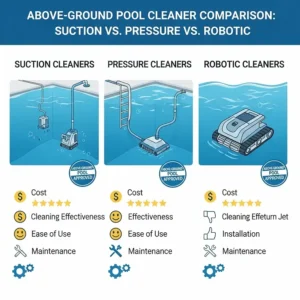
Robotic Cleaners vs Suction-Side, Pressure-Side and Manual Vacuuming
| Method | How It Works | Needs Pump? | Pros | Cons | Best For |
|---|---|---|---|---|---|
| Robotic | Own motor, onboard filter | No | Independent, thorough, low power draw | Higher upfront cost | Most above ground owners |
| Suction-side | Connects to skimmer line | Yes | Low cost | Loads your pump and filter | Light debris, tight budgets |
| Pressure-side | Uses booster pump | Yes | Handles larger debris | Extra pump, higher power draw | Larger pools with a booster |
| Manual vacuum | You push a head by hand | Yes | Cheapest | Time-consuming | Occasional spot cleaning |
Robotic cleaners have a structural advantage: they don’t depend on your pool pump, and they trap debris in their own filter instead of sending it through yours. A leading retailer executive told Bob Vila that robots can improve circulation and filtration beyond what the pump and filter manage alone. Bob Vila also reports that a booster pump can use up to ten times more electricity than a robot. So even though robots cost more upfront, they tend to cost less to run and put less strain on your equipment.
Corded vs Cordless Above Ground Pool Cleaners: The Honest Trade-Offs
Cordless sounds like the obvious winner until you do the daily math. The Pool Nerd argues that cordless units typically run 60–90 minutes and need a 4–5 hour recharge, meaning daily use means handling the robot twice a day. By contrast, a corded robot with a weekly timer needs you once a week, to empty the basket.
Safety is the other flag. The CPSC announced a recall of the Aiper Seagull Pro after reports of units melting, smoking or catching fire while charging. That model is separate from the Aiper Seagull SE, but the lesson holds for any lithium robot: charge on a hard, non-flammable surface and never unattended.
To be fair, longer-running cordless designs like the Beatbot AquaSense 2 (about four hours per charge, according to Bob Vila) narrow the gap. Suction claims also vary between sources, so treat them with caution. For most above ground owners, corded is the safer default. Cordless is best when outlets are scarce or you value simplicity over automation.
Features That Actually Matter (And Those That Don’t)
What matters: A weekly timer, because it’s the only feature that truly delivers set-and-forget. Fine filtration, if your pool collects silt, pollen or algae. A top-load basket, because lifting a soaked robot onto the deck to flip it over gets old fast. An anti-tangle swivel on corded models, because cable twists end cycles early. Pool Nerd also prefers tank-style tracks over wheels for grip, though that’s one tester’s view.
What doesn’t (always): AI mapping and laser navigation are impressive but add little in a simple round pool. Surface skimming matters if floating debris is your main problem, not if grit and algae are. Peak GPH numbers are marketing, since sources disagree on how they’re measured and cordless claims in particular are hard to compare.
Wall climbing sits in the middle. It’s a must for waterline rings and algae film, and a nice-to-have otherwise. Match the feature to your actual mess, not to the longest spec sheet. A Dolphin Escape that runs every other day on a timer will outclean an app-heavy robot you forget to start.
Common Mistakes When Buying an Above Ground Automatic Pool Cleaner
Mistake 1: Buying for the pool you wish you had. A $1,500 robot in a tiny, clean pool is wasted money. Match the machine to the mess.
Mistake 2: Skipping the timer. Manual-start models like the Dolphin E10 and Polaris P70 work fine, but you’ll become the automation. Budget for a timer or choose a model that includes one.
Mistake 3: Ignoring cable length and swivel. A cable shorter than your pool’s longest dimension strands the robot. A cable without a swivel twists.
Mistake 4: Assuming a robot replaces chemistry. A robot removes debris. It does not sanitize. Keep testing pH and chlorine.
Mistake 5: Trusting star ratings alone. Retailer-hosted ratings skew positive and brand-hosted reviews more so. Cross-check independent testers and read the complaints.
Mistake 6: Forgetting liner compatibility. Some robots aren’t designed for every surface. Bob Vila notes that vinyl needs extra attention, so verify your liner type with the manufacturer.
✨ Ready to Stop Skimming by Hand?
🔍 Compare the seven robots above and click any highlighted product name to check current pricing and availability. The right cleaner can turn pool maintenance from a weekend chore into a once-a-week basket rinse. Your future self will thank you!
Long-Term Cost & Maintenance: What an Above Ground Robot Really Costs
Think in cost per year, not sticker price. Bob Vila reports that a robotic cleaner typically lasts about five years with proper care. A robot in the $600–$700 range works out to roughly $120–$140 per year, a figure that drops further if it saves you a pool-service visit or a ruined weekend.
Running costs are small. The Dolphin Escape draws about 180 watts according to Pool Nerd, which at typical U.S. electricity rates means pennies per 1.5-hour cycle. That compares well with pressure-side cleaners that pull 700 watts or more from a booster pump.
Maintenance is what protects that lifespan. Rinse the filter after every run in leaf season, and wipe brushes and tracks weekly. Store the robot out of direct sun and keep the power supply dry. Replacement parts like filters, brushes and cables add modest ongoing costs. Cordless models add one more variable, the battery, whose lifespan varies by brand and use, so check warranty terms. Spend a little on care now, and a Polaris P70 or Dolphin Cayman can easily reach that five-year mark.
Safety, Electrical and Water-Chemistry Guide
Electricity and water demand respect. Plug corded robots into a GFCI outlet and avoid extension cords, which Bob Vila’s testing guide also advises against. Power supplies are typically water-resistant, not waterproof. One Bob Vila tester didn’t trust a power unit through a thunderstorm, so keep it dry and covered when not in use.
Store excess cable on a caddy rather than leaving it coiled on the deck, where it becomes a trip hazard. Remove the robot from the pool before swimmers get in, unless your manual specifically says otherwise. For cordless models, charge on a hard surface and don’t leave the unit charging unattended.
On chemistry, follow the CDC targets mentioned earlier: pH 7.0–7.8 and at least 1 ppm free chlorine, or 2 ppm with cyanuric acid. Robots help by removing the organic debris that eats up chlorine, but they don’t change your sanitizer demand. Test regularly, adjust as needed and let the robot handle the dirt.
FAQ
❓ Is a robotic cleaner worth it for a small above ground pool?
❓ Can I leave my automatic pool cleaner in the pool all season?
❓ Do I need to run my pump while the robot cleans?
❓ How long does an above ground pool robot typically last?
❓ Will a robot damage my vinyl liner?
Conclusion
So, what’s the best automatic pool cleaner above ground in 2026? For most owners, the Dolphin Escape hits the sweet spot: strong corded suction, a big top-load basket and a timer add-on for real automation. If you want wall and waterline scrubbing, step up to the Dolphin Cayman or, for a larger, leafier pool, the Dolphin Quantum. Tight budget? The Dolphin E10 and Polaris P70 do simple floor cleaning well. And if you hate cords or have no outlet nearby, the Aiper Seagull SE and Beatbot AquaSense 2 are the cordless routes.
The honest takeaway is to buy for your mess, not for the spec sheet. Measure your pool, decide corded or cordless, pick the coverage you actually need and insist on a timer. Keep your chemistry balanced, and the best automatic pool cleaner above ground will make a clean pool feel effortless.
✨ Your Cleanest Summer Starts Here!
🏊 Pick the robot that matches your pool, click any highlighted product name to check current pricing and availability, and reclaim your weekends. Your pool, and your free time, will thank you!
Recommended for You
- 7 Best Tikom Robot Vacuum Models That Will Transform Your Home Cleaning in 2025
- 7 Best Lefant Robot Vacuum Models That Will Transform Your Cleaning Routine in 2025
- 7 Best Cordless Pool Cleaner Options Revolutionizing Pool Maintenance in 2025
Disclaimer: This article contains affiliate links. As an Amazon Associate, I earn from qualifying purchases. If you purchase products through these links, we may earn a small commission at no additional cost to you.
✨ Found this helpful? Share it with your friends! 💬🤗
