
In This Article
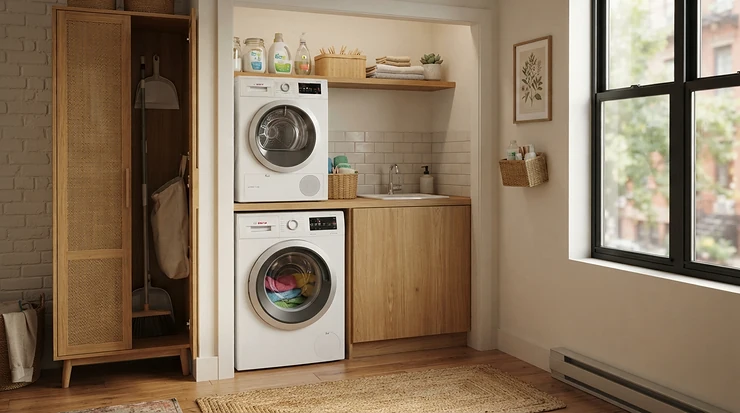
A compact top load washer for apartment closet living is a washing machine, usually 2 to 3 cubic feet and roughly 22 to 25 inches wide, that loads from the top and tucks into a utility closet, alcove, or kitchen corner. Some are permanent installs; others are portable units that roll to a sink.
Here’s the thing about apartment laundry: the machine is rarely the hard part. The closet is. Your compact top load washer for apartment closet project lives or dies on three numbers that product pages love to bury: how wide the cabinet really is, how much air the lid needs to swing open, and how much room the hoses need behind the drum. Miss one, and you’re stuck with a very expensive, very heavy coat rack.
Top-loaders also carry a quiet superpower in tight quarters. As Wikipedia’s overview of washing machines explains, the top-loading format is still the dominant design in the United States and Canada, and impeller models (the low, finned-disc style, no tall center post) are mechanically simpler than agitator designs. Translation: familiar parts, no kneeling to load, and you can rescue the sock you forgot after the cycle starts.
This guide compares seven real models, from a true 24 inch wide top load washer to narrower 21 inch units, using manufacturer spec sheets, retailer listings, and aggregated owner reviews. Nobody here is claiming to have tested these machines in a closet; every number traces back to published sources, and where reviews were thin, we say so. By the end, you’ll know which small footprint washer for condo living fits your space and which one would need a sledgehammer and a prayer.
Quick Comparison: 7 Compact Top Load Washers at a Glance
Start here if you’re holding a tape measure in one hand and scrolling with the other. Widths are published exterior figures; always confirm against the current spec sheet before you buy.
| Product | Capacity | Width | Price range | Best For |
|---|---|---|---|---|
| GE GNW128SSMWW | 2.8 cu. ft. | 24 in. | Around $900-$1,100 | Permanent installs needing a true 24 inch fit |
| GE GNW128PSMWW | 2.8 cu. ft. | 24 in. | Around $1,000-$1,100 | Rentals with no washer box; sink hookup |
| Avanti STW30D0W | 3.0 cu. ft. | 23.75 in. | $700-$800 range | Accessibility needs and soft-close lid fans |
| Hamilton Beach 3.0 | 3.0 cu. ft. | 24.8 in. | Mid-$400s | Budget buyers with a little width to spare |
| BLACK+DECKER BPW30MW | 3.0 cu. ft. | 23.7 in. | $450-$560 range | Out-of-the-box sink hookups, bigger loads |
| BLACK+DECKER BPWM20W | 2.0 cu. ft. | 21.6 in. | $375-$430 range | Narrow closets, singles and couples |
| Magic Chef MCSTCW20W6 | 2.0 cu. ft. | 21.7 in. | Mid-$400s | Planners who want a published lid-open height |
Looking at the comparison above, the GE GNW128SSMWW is the only model that genuinely lands at 24 inches wide, and its price reflects that. The BLACK+DECKER BPWM20W and Magic Chef MCSTCW20W6 give up roughly two inches of width and about a cubic foot of drum in exchange for a much friendlier closet fit and a lower cost. Notice also that the three 3.0 cu. ft. portables cluster near 24 inches, but one of them, the Hamilton Beach 3.0, runs close to 25.
💬 Just one click — help others make better buying decisions too!😊
Top 7 Compact Top Load Washer for Apartment Closet Picks: Expert Analysis
Every pick below is a real, documented model. Review commentary reflects aggregated reviewer themes from retailer pages, not hands-on testing. Prices are ranges at the time of research, so check current price before you commit.
1. GE GNW128SSMWW — true 24 inch width with the biggest drum here
This is the rare top-loader that measures exactly 24 inches across, which makes it the benchmark for any 24 inch wide top load washer search. It stands 37.4 inches tall and 24.5 inches deep, with a 2.8 cu. ft. stainless steel basket, impeller action, and a 750 RPM top spin. In practice, that spin speed means clothes come out damper than they would from a faster front-loader, so budget a little extra dryer time. GE’s spec sheet also lists eight cycles, four temperatures, delay start, and fill hoses in the box.
Based on the spec comparison, this is the pick for renters who want a permanent, plumbed-in machine rather than a roll-away. The tradeoff is vertical: GE lists 45.5 inches of height needed for the lid to open fully, so a low shelf above it will block the party.
One major retailer shows 4.1 out of 5 across 94 reviews, and an apartment-community reviewer on that page describes it as efficient even at a smaller capacity. Complaint themes weren’t consistent enough to summarize, so skim recent reviews before ordering.
Pros:
- ✅ Genuine 24 inch width fits standard closets
- ✅ More drum room than 2.0 cu. ft. rivals
- ✅ Stainless basket with eight cycles and delay start
Cons:
- ❌ Highest price on this list
- ❌ Needs 45.5 inches of overhead lid space
Expect roughly $900-$1,100 at the time of research; steep, but the value case rests on capacity and a true-to-size fit.
2. GE GNW128PSMWW — same cabinet on casters for sink hookups
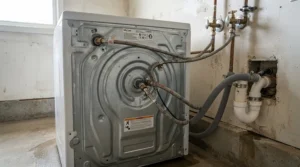
Think of this as the stationary model’s roaming twin. It shares the 24 by 24.5 by 37.4 inch cabinet, the 2.8 cu. ft. stainless basket, eight cycles, 750 RPM spin, child lock, and end-of-cycle signal, but adds caster wheels and a unicoupler that connects the hoses to a standard kitchen or bathroom sink. At roughly 99 pounds net, “portable” means “movable by a determined adult,” not “grab-and-go.”
Here’s what most buyers overlook: portability is a lifestyle commitment. If your closet has no washer box, you’ll be rolling this out, coupling hoses, washing, then un-coupling and wheeling it back every laundry day. That’s fine for weekly loads and miserable for daily ones.
A reviewer on a Canadian retailer’s listing describes wheeling it to the kitchen sink and attaching it to the faucet, and pushes back on complaints about low water by noting that high-efficiency machines use less water by design and sound different. That sample is small, so treat it as one data point, not a verdict.
Pros:
- ✅ Casters and unicoupler suit no-hookup rentals
- ✅ Same large 2.8 cu. ft. drum as the stationary model
- ✅ Child lock and delay start included
Cons:
- ❌ Roughly 99 pounds to push around
- ❌ Hoses must be connected every wash day
Plan on around $1,000-$1,100; worth it only if the roll-away flexibility is something you’ll genuinely use.
3. Avanti STW30D0W — soft-close glass lid and ADA-compliant build
The standout is the build philosophy: a soft-close glass lid, auto power-off, and control lockout, in a cabinet listed as ADA compliant. Dimensions are 23.75 wide by 24.75 deep by 39.5 tall, with 3.0 cu. ft. of capacity, six cycles, three load sizes, three temperatures, and a bottom pulsator. Avanti lists a 26 pound volume capacity and a weight near 100 pounds.
The catch is overhead. Avanti’s own spec sheet lists 64.25 inches of height with the lid open at 90 degrees, far more than the GE GNW128SSMWW needs. On paper, that makes this a poor fit for closets with a shelf at standard height, and a good fit for open alcoves.
I couldn’t verify a sizeable review sample for this exact model in the sources available. Its smaller sibling, the STW20D2P, shows 4.4 out of 5 across 128 reviews at one retailer, but that is a different machine, so consider it directional at best.
Pros:
- ✅ ADA-compliant with a soft-close glass lid
- ✅ 3.0 cu. ft. capacity inside a 23.75 inch width
- ✅ Auto power-off and control lockout
Cons:
- ❌ 64.25 inches needed with the lid open
- ❌ Some dealers listed it as backordered
Expect a $700-$800 range at the time of research; pricey for the capacity, so buy it for the accessibility features, not the drum size.
4. Hamilton Beach 3.0 Cu. Ft. Top Load Portable Washer — big drum at a mid-$400s price
This one’s hook is value: 3.0 cu. ft. with a stainless steel tub and LED display, generally at a price well under the premium options. Sam’s Club lists it at roughly 24.8 inches wide, 23.75 deep, and 39.4 tall. Listings disagree on cycle count (six on some, eight on others), so verify the version in front of you.
That near-25 inch width is the detail to respect. Some retailer headings round the width differently, which is a polite way of saying the spec sheet outranks the product title. If your door opening is a strict 24 inches, measure twice, then measure the door frame again.
Several hundred reviews exist across retailer listings, but I couldn’t extract dependable themes from the sources available. Skim the most recent reviews for hose, noise, and leveling comments before purchase.
Pros:
- ✅ 3.0 cu. ft. capacity at a budget-friendly price
- ✅ Simple one-touch controls with LED display
- ✅ Portable design works with sink hookups
Cons:
- ❌ Just under 25 inches wide
- ❌ Cycle count varies between listings
Plan on the mid-$400s range; strong value if your closet has an inch to spare.
5. BLACK+DECKER BPW30MW — 26.5 lb capacity with sink-ready hoses
The standout is how complete the box is: a quick-connect sink adapter and drain hose are included, so you can run a wash on day one. It measures 23.7 by 24.8 by 39.4 inches, weighs about 99 pounds, and offers six cycles, three water levels, and a transparent quiet-close lid. The listed 26.5 pound capacity is the largest load rating among the portables here.
Compared with the Hamilton Beach 3.0, the footprint is nearly identical, so the choice comes down to included hoses, lid design, and price. The weight deserves respect: stairs plus 99 pounds is a negotiation.
Reviewers repeatedly flag drain hose placement. One reviewer citing the manual says the hose should sit around 34 inches high or water leaves too early, and another mentions buying longer hoses for a better setup. A third was startled by how big it looked on arrival but found it fit.
Pros:
- ✅ Sink adapter and drain hose included
- ✅ 26.5 lb rated capacity handles bigger loads
- ✅ Transparent quiet-close lid
Cons:
- ❌ About 99 pounds to move
- ❌ Drain hose height must be dialed in
Expect roughly $450-$560 at the time of research; solid value for the capacity.
6. BLACK+DECKER BPWM20W — slimmest option at 21.6 inches wide
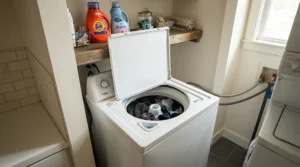
Its hook is the width: just 21.6 inches, with a 22.2 inch depth and 37.4 inch height. That’s about two and a half inches narrower than a true 24 inch unit, which can be the difference between “fits” and “scraped knuckles.” It holds 2.0 cu. ft. (up to 15.4 pounds), runs six cycles with hot, warm, and cold options, and includes two rollers, side handles, a quick-connect sink adapter, and hoses.
Based on the specs, this is a singles-and-couples machine. A 15.4 pound limit won’t love king-size comforters, and it calls for high-efficiency detergent only.
One retailer listing shows over a thousand ratings, and reviewers and editorial guides keep returning to the same theme: route the drain hose into a tub, shower, or sink at or below the machine, and check the manual’s maximum drain height first.
Pros:
- ✅ Narrowest model on this list
- ✅ Hoses and sink adapter included
- ✅ Rollers and handles aid repositioning
Cons:
- ❌ 15.4 lb limit rules out bulky bedding
- ❌ Drain hose routing takes planning
Count on about $375-$430; the best entry price for a genuinely narrow machine.
7. Magic Chef MCSTCW20W6 — a published lid-open height for easy planning
What sets it apart is transparency: Magic Chef’s listing spells out 53.9 inches of height with the lid open, a number most rivals skip. The machine measures 21.7 by 22.2 by 37.4 inches, weighs around 83.5 pounds, and packs a 2.0 cu. ft. stainless drum, impeller wash, six cycles, three water levels, delay start, and a filter for lint and debris.
On paper it mirrors the BLACK+DECKER BPWM20W, so the decision comes down to price, availability, and which lid-open figure fits your closet. That published number is worth real money if your shelf sits at 50 inches.
The verifiable review pool is smaller than for its rivals. One Walmart reviewer praised it for running a full cycle unattended, and incentivized reviews appear on the page, so weigh the praise accordingly.
Pros:
- ✅ Published 53.9 inch lid-open height
- ✅ Delay start and lint filter included
- ✅ Narrow 21.7 inch cabinet
Cons:
- ❌ Thinner review base than rivals
- ❌ Lid needs more overhead than the GE GNW128SSMWW
Expect the mid-$400s; fair value if the lid number clears your shelf.
Hookup Clearance: How to Measure Your Closet Before You Buy
Hookup clearance is the room your hoses, plug, and drain need behind and beside the machine. It’s also the number that quietly ruins delivery day. Follow this checklist before you click anything.
- Measure the door opening, not the closet interior. Door frames and trim usually steal the first inch.
- Add working depth. A common planning assumption is four to six inches behind the washer for hose bends; confirm the exact figure in the manual. One retailer’s spec note also advises leaving breathing room on each side and at the back.
- Find your supply and drain. Plumbed-in machines need hot and cold supply valves and a drain standpipe. Sink-hookup models use a quick-connect adapter at the faucet instead.
- Check power. These machines run on standard 120-volt power, and GE’s spec sheet calls for an individual circuit.
- Decide permanent or portable. Whirlpool’s guide to compact laundry for tight spaces notes that a portable top load washer can be hooked to a sink only when needed, or installed with standard plumbing in a permanent spot.
Finally, verify drain height. Portable units can siphon or drain early if the hose sits too low, which is why that 34 inch figure keeps surfacing in reviews.
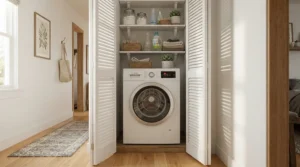
Real-World Scenarios: Three Closets, Three Washers
Specs are abstract until you drop them into a floor plan. Here are three honest profiles and the matches that make sense on paper.
Scenario 1: The studio renter. A hall closet with a washer box, a narrow door, one adult, roughly three small loads per week, and a tight budget. The BLACK+DECKER BPWM20W or Magic Chef MCSTCW20W6 fits best: 21.6 to 21.7 inches of width leaves breathing room, and 2.0 cu. ft. matches small, frequent loads. If a shelf sits above, the Magic Chef MCSTCW20W6‘s published 53.9 inch lid number makes planning easy.
Scenario 2: The condo couple. A laundry closet exactly 24 inches wide, an existing washer box, four or five loads a week, and no shelf above. The GE GNW128SSMWW is the logical choice: its 2.8 cu. ft. drum cuts loads per week, and its 45.5 inch lid requirement is easy to meet.
Scenario 3: The no-hookup renter. No washer box, a kitchen sink within wheeling distance, and a roommate who tolerates a rolling appliance. The GE GNW128PSMWW or BLACK+DECKER BPW30MW fits, but hose coupling every wash day is the lifestyle cost. If heavy lifting is a concern, the 99-pound weight on both is worth a second look.
Common Closet Laundry Problems and How to Fix Them
Even a perfect fit hits snags. These are the problems that surface most in reviews and manuals, with practical fixes.
The lid smacks a shelf. Measure from floor to shelf, then compare against the lid-open height: 45.5 inches for the GE GNW128SSMWW, 53.9 for the Magic Chef MCSTCW20W6, 64.25 for the Avanti STW30D0W. If the shelf is in the way, relocate it or pick a lower-swing model.
The drain hose empties too early. Reviewers of the BLACK+DECKER BPW30MW point to hose elevation (about 34 inches, per one reviewer citing the manual) as the fix. Secure the hose so it can’t slide down mid-cycle.
The machine rocks during spin. Adjust the leveling legs until it sits flat; the BLACK+DECKER BPWM20W and the GE models both list adjustable legs or leveling feet. A level, stable floor matters more than any feature.
The closet gets musty. Leave the lid propped open after each cycle and crack the closet door. Top-loaders don’t have a gasket to trap moisture, but a closed, damp closet still invites odors.
Suds or residue. The BLACK+DECKER BPWM20W calls for high-efficiency detergent only, and the same is a smart habit for every machine here.
How to Choose a Compact Top Load Washer for Apartment Closet Use
Seven steps, in order of importance. Skip none.
- Measure the narrowest point on the delivery path. Door frames and hallway corners beat the closet’s interior width every time.
- Check lid-open height. A washer that fits the floor but not the shelf is a wasted purchase.
- Plan the hookup. Plumbed-in or sink-fed? That decision narrows the field fast.
- Match capacity to your week. Roughly 2.0 cu. ft. (about 15 pounds listed) suits one or two people; 2.8 to 3.0 cu. ft. suits bigger households or bulky items.
- Respect the weight. Between 79 and 100 pounds, stairs change the math.
- Use high-efficiency detergent. Several of these units specify it; ignoring it invites suds and residue.
- Verify availability and return terms. Some listings showed backorders at times, so confirm stock and delivery before relying on a date.
Reviewed notes that compact washers generally run under 27 inches wide with about 2 to 3.5 cu. ft. of capacity, which means more loads, not bigger ones. Plan your week accordingly.
24 Inch Wide Top Load Washer: What the Number Really Means
Shopping for a 24 inch wide top load washer sounds simple until you read the spec sheets. Product titles round generously. Here’s what the published numbers show: the GE GNW128SSMWW lists 24 inches flat, the Avanti STW30D0W sits at 23.75, the BLACK+DECKER BPW30MW at 23.7, the Hamilton Beach 3.0 near 24.8, and the two 2.0 cu. ft. models at 21.6 to 21.7.
Why does this matter? Closets are rarely generous. A door frame, baseboard, or bi-fold track can steal an inch before the machine arrives. That’s why space saving dimensions deserve a three-way read: width, depth including hoses, and height with the lid raised. A machine that wins on width but needs 64 inches overhead hasn’t saved space; it has simply moved the problem upward.
Here’s the rule of thumb: treat “24 inch” as a nominal label, not a promise. Then compare the exact width, depth, and lid-open height from the manufacturer’s sheet to your tape-measure notes. A true 24 inch wide top load washer in a 24 inch closet leaves zero slack, so confirm whether the manual wants side clearance for vibration.
Lid Clearance: The Vertical Measurement Most Buyers Forget
Everyone measures width. Almost nobody measures lid clearance, and it’s the reason top-loaders get returned. When the lid lifts to 90 degrees, the machine effectively grows taller than its listed height.
The published numbers vary a lot. GE lists 45.5 inches of height needed for the lid on both of its models; Magic Chef lists 53.9 inches for the Magic Chef MCSTCW20W6; and Avanti lists 64.25 inches for the Avanti STW30D0W. For the Hamilton Beach 3.0 and both BLACK+DECKER models, the sources reviewed didn’t list a lid-open height, so ask the manufacturer or inspect the manual before buying.
A quick example: if your closet shelf sits at 48 inches, only the GE models clear it on published numbers. A shelf at 55 inches adds the Magic Chef MCSTCW20W6. Beyond that, you’ll want open space overhead.
If lid clearance simply isn’t available, front-loading compacts are the alternative, which brings us to the next comparison.

Small Footprint Washer for Condo Living: Top Load vs Front Load
A small footprint washer for condo living doesn’t have to be a top-loader, and the alternative deserves an honest look. Compact front-loaders such as the GE GFW148SSMWW (about 23.4 wide by 25.6 deep by 33.2 tall) and the Whirlpool WFW3090JW (24 by 24 by 33.25) are shorter, so they can slide under a counter or sit in a stack. According to ENERGY STAR’s clothes washer overview, certified front-load washers use about 50% less energy and water than a top-load agitator washer, and only models above 1.6 cubic feet qualify for the label.
The tradeoff is ergonomics and rescue loading. Front-loaders need floor depth for the door to swing and are harder to pause mid-cycle for a forgotten sock. Top-loaders need headroom instead.
| Feature | Compact top load | Compact front load | Best For |
|---|---|---|---|
| Typical width | 21.6-24.8 in. | About 23.4-24 in. | Narrow closets (top load) |
| Height | 37.4-39.5 in. (no under-counter fit) | 33.2-33.5 in. (counter-friendly) | Under-counter spots (front load) |
| Overhead need | 45.5-64.25 in. with lid open | Minimal | Low-shelf closets (front load) |
| Mid-cycle additions | Easy | More awkward | Forgetful loaders (top load) |
| Efficiency | Few models qualify for ENERGY STAR | More models qualify | Water-conscious buyers (front load) |
Summing up the table, front-loaders win on height and efficiency, while top-loaders win on ease of loading and on spaces where door swing depth is tight. If your closet has a low shelf, a front-loader like the GE GFW148SSMWW may be the smarter choice; if it has headroom but little depth, stay with a top-loader such as the GE GNW128SSMWW.
Space Saving Dimensions Compared: All 7 Models at a Glance
Here’s the full dimensional rundown with space saving dimensions front and center. Review signals reflect what was verifiable in the sources reviewed, not a lab score.
| Product | W x D x H (in.) | Lid-open height | Price range | Review signal | Best For |
|---|---|---|---|---|---|
| GE GNW128SSMWW | 24 x 24.5 x 37.4 | 45.5 in. | Around $900-$1,100 | 4.1/5 across 94 reviews (one retailer) | Low-clearance closets, permanent install |
| GE GNW128PSMWW | 24 x 24.5 x 37.4 | 45.5 in. | Around $1,000-$1,100 | Small sample; faucet hookup praised | No-washer-box rentals |
| Avanti STW30D0W | 23.75 x 24.75 x 39.5 | 64.25 in. | $700-$800 range | Not verified | Accessible, open alcoves |
| Hamilton Beach 3.0 | 24.8 x 23.75 x 39.4 | Not listed | Mid-$400s | Several hundred reviews; themes unverified | Budget, roomy closets |
| BLACK+DECKER BPW30MW | 23.7 x 24.8 x 39.4 | Not listed | $450-$560 range | 123 reviews on one retailer page | Big loads, sink hookup |
| BLACK+DECKER BPWM20W | 21.6 x 22.2 x 37.4 | Not listed | $375-$430 range | 1,000+ ratings on one retailer page | Tightest closets |
| Magic Chef MCSTCW20W6 | 21.7 x 22.2 x 37.4 | 53.9 in. | Mid-$400s | Limited sample verified | Mid-height shelves, small loads |
The table makes one thing obvious: the GE GNW128SSMWW and GE GNW128PSMWW trade price for the lowest published overhead need among 2.8 to 3.0 cu. ft. models. The BLACK+DECKER BPWM20W wins on footprint and price, while the Avanti STW30D0W demands the most vertical space. If review volume matters to you, the BLACK+DECKER BPWM20W has the largest visible pool, though volume isn’t the same as quality.
Features That Actually Matter (And Those That Don’t)
Marketing copy loves a long feature list. Most of it is noise. Here’s the filter.
Matters: published lid-open height, true exterior width, included hoses, and a stainless steel tub, which resists rust and chipping. Delay start is a genuinely useful small-space feature, since you can schedule noisy spin cycles around your neighbors.
Matters a little: capacity rating. A 2.8 to 3.0 cu. ft. drum reduces loads per week, but only if your closet and wallet can carry the cost.
Doesn’t matter much: cycle count. Six cycles versus eight rarely changes your laundry; most people live in Normal, Heavy, and Quick. Likewise, LED displays and transparent lids are pleasant but won’t change how clean clothes get.
Worth a skeptical look: ENERGY STAR claims. Listings conflict on the status of some of these models, so confirm on the ENERGY STAR Product Finder instead of trusting a retailer badge.
✨ Ready to Find the Washer That Fits Your Closet?
🔍 Take your laundry setup to the next level with these carefully selected washers. Click on any highlighted item to check current pricing and availability. The right measurements will help you create a laundry routine your whole household will love!
Long-Term Cost & Maintenance
Sticker price is only the opening bid. Total cost includes water, energy, upkeep, and the laundry-trip costs you stop paying. The U.S. EPA’s WaterSense clothes washer tech sheet recommends ENERGY STAR certified washers and notes that certified front-loaders are about 25 percent more energy and water efficient than top-load impeller models, so a top-loader trades some efficiency for headroom-friendly design.
Now the ROI math. Divide price by the number of shared-machine cycles you’ll replace and your local cost per cycle. Suppose your building charges $4 per wash-and-dry (a hypothetical figure; plug in your own). At two loads a week, that’s roughly $400 a year, which means a machine in the $400 range could pay for itself in about a year, while a $1,000 machine could take a couple of years. One reviewer of a BLACK+DECKER model made a similar payback comment based on their building’s laundry fees.
Maintenance is light but real. Clean the lint filter regularly (one reviewer calls the small net easy to clean), leave the lid open to dry the tub, use high-efficiency detergent, and inspect hoses for wear. Warranty terms on these models run about one year, so keep receipts.

Frequently Asked Questions
❓ Which compact top load washer fits a 24 inch closet?
❓ How much lid clearance does a compact top load washer need?
❓ Can a compact top load washer for apartment closet use run off a kitchen sink?
❓ Is a small footprint washer for condo living worth it versus shared laundry?
❓ Do compact top load washers need special detergent?
Conclusion
Choosing a compact top load washer for apartment closet living comes down to three tape-measure moments: width, lid clearance, and hookup clearance. Everything else is garnish.
If your closet is a true 24 inches with a washer box, the GE GNW128SSMWW is the best fit on paper, with the biggest drum and a modest 45.5 inch lid requirement. If you have no hookups, the GE GNW128PSMWW and BLACK+DECKER BPW30MW bring sink-friendly flexibility, as long as you accept the weight and the hose routine. For the narrowest closets and smallest budgets, the BLACK+DECKER BPWM20W and Magic Chef MCSTCW20W6 deliver 21.6 to 21.7 inch cabinets at a modest cost. The Avanti STW30D0W earns its price only if accessibility features matter and you have headroom, and the Hamilton Beach 3.0 is a value play for closets with a little extra width.
A final reminder: this analysis rests on published specs and aggregated reviews, with gaps flagged where evidence was thin. Verify dimensions on the current spec sheet, confirm stock, and measure your path from curb to closet. Your future self, mid-delivery, will thank you.
Recommended for You
- Top Load Washer With Sanitize Cycle For Allergies: 7 Best Picks 2026
- Top Load Washer For Seniors With Bad Backs: 7 Best Picks 2026
- GE Dishwasher For First-Time Homeowners: 7 Best Picks 2026
Disclaimer: This article contains affiliate links. As an Amazon Associate, I earn from qualifying purchases. If you purchase products through these links, we may earn a small commission at no additional cost to you.
✨ Found this helpful? Share it with your friends! 💬🤗
