
In This Article
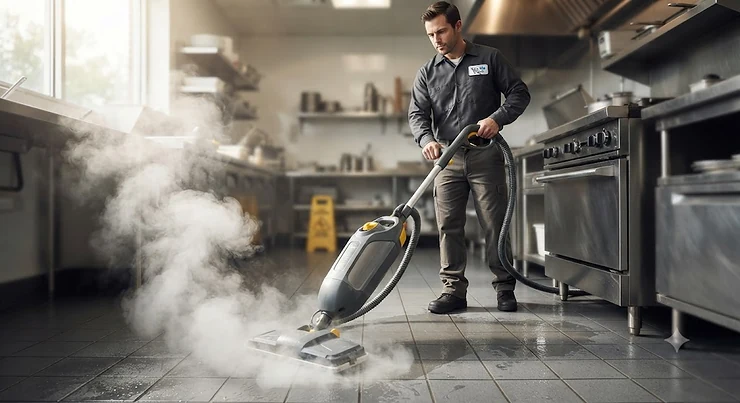
Walk into any restaurant kitchen at 6 a.m. or a boutique gym floor after a Saturday rush, and you’ll see the same story written in scuff marks and grime: a regular household mop just can’t keep up. That’s the entire reason the commercial-grade steam mop for small businesses category exists. It’s built around one blunt idea — floors that get walked on hundreds of times a day need a tool that heats water hot enough, holds enough of it, and survives daily abuse without falling apart by month three.
A commercial-grade steam mop for small businesses is a corded floor-cleaning appliance that uses heated water vapor (typically 200°F or higher) to loosen grime and reduce surface bacteria without chemical cleaners, built with sturdier components and longer duty cycles than home-market models…
Slippery floors aren’t just a nuisance, either. The Occupational Safety and Health Administration’s walking-working surfaces rule exists specifically because same-level slips are a leading cause of lost-workday injuries in general industry — and a wet, greasy commercial kitchen floor is exhibit A. For an owner juggling payroll, inventory, and a dozen other fires, buying the wrong mop isn’t just a wasted $150. It’s a machine that dies in six months, or worse, a floor that stays slick enough to cost someone a bad fall. This guide walks through seven real, currently sold machines — from a $79 entry-level unit to a nearly $1,800 stainless-steel workhorse — so you can match the tool to your actual traffic, not just the marketing copy on the box.
Quick Comparison Table
| Product | Best For | Tank Type | Price Range |
|---|---|---|---|
| PurSteam 10-in-1 | Micro-retail & boutiques | Removable, 12.7 oz | Under $100 |
| Reliable Pronto Plus 300CS | Cafés needing fast heat-up | Fill-on-the-go | $140-$180 range |
| Bissell Commercial BGST1566 | Purpose-built commercial value | Removable, 15 oz | $150-$170 range |
| McCulloch MC1385 Deluxe | Deep grout & tile jobs | Pressurized canister | $130-$170 range |
| Dupray Neat Plus | Continuous mid-shift cleaning | Heat-exchanger refill | $250-$300 range |
| Kärcher SC5 EasyFix Premium | Highest steam pressure | Dual-tank continuous | $400-$500 range |
| Vapamore MR-1000 Forza | Multi-location heavy use | 1-gallon stainless boiler | $1,700-$1,900 range |
Looking at the spread above, there’s really a three-tier decision hiding in this table: entry units like the PurSteam 10-in-1 and Reliable Pronto Plus 300CS are fine for light, occasional touch-ups, but they weren’t engineered for eight-hour shifts. The middle tier — Bissell Commercial BGST1566, McCulloch MC1385 Deluxe, and Dupray Neat Plus — is where most small businesses with genuine daily traffic should be shopping. The top tier, Kärcher SC5 EasyFix Premium and Vapamore MR-1000 Forza, only pays for itself if you’re running multiple shifts or multiple locations off one machine.
💬 Found a pick you like already? Jump to the full breakdown below and compare specs side by side before you check current pricing.😊
Top 7 Commercial-Grade Steam Mops: Expert Analysis
1. PurSteam 10-in-1 — lightest option for tight retail spaces
The standout here is simply how little space and setup it demands. Specs-wise, the 12.7-ounce tank and 30-second heat-up mean it’s ready almost instantly, but that same small tank caps continuous coverage at roughly 450-550 square feet per fill — plenty for a boutique register area, not enough for a full café floor between fills. At 5.9 pounds with a detachable handheld unit, it also doubles as a quick fabric or counter steamer, which is genuinely useful in a small shop where storage space is tight.
Based on the spec comparison, this is the pick for a business owner who wants chemical-free spot cleaning between a professional service’s visits, not a replacement for one. Independent testing found it removed roughly 89% of test stains on hard flooring, a solid number for its price bracket, though the 15.7-foot cord means frequent outlet changes in a larger footprint. Reviewers consistently note the 11-piece accessory kit outperforms rival budget mops on versatility, even if raw steam output trails the commercial-tier machines further down this list.
Pros:
- ✅ Fastest heat-up time in this lineup at 30 seconds
- ✅ Detachable handheld steamer adds real multi-surface use
- ✅ Lightest, easiest machine to store behind a counter
Cons:
- ❌ Small tank limits continuous runtime on bigger floors
- ❌ Not rated for heavy daily commercial duty cycles
At under $100 at the time of research, the PurSteam 10-in-1 is the easiest entry point into steam cleaning for a business that just needs occasional touch-ups rather than an all-day workhorse.
2. Reliable Pronto Plus 300CS — fastest fill-on-the-go refills
What stands out on the spec sheet is the “fill-on-the-go” tank design paired with a 6-bar pump and roughly 50 minutes of steam time per session. That combination means a staff member can top off water mid-shift without waiting for the unit to cool down, which is exactly the kind of interruption that kills momentum during a lunch rush.
Here’s what to weigh, though: the manufacturer itself classifies the 300CS as a residential-grade machine and recommends no more than about 15 hours of use per week — a detail easy to miss under the “commercial cleaning” marketing language but important for any owner planning genuinely heavy daily rotation. Reviewers report strong scrubbing performance on grout thanks to the included brush kit, and the convertible handheld mode gets consistent praise for tackling counters and equipment beyond the floor. Aggregated feedback flags the 1200W heater as adequate rather than exceptional against thick grease buildup, which tracks with its price bracket.
Pros:
- ✅ Continuous refill technology avoids mid-shift interruptions
- ✅ Converts to a handheld unit for counters and equipment
- ✅ 14-piece accessory kit covers grout, corners, and fabric
Cons:
- ❌ Manufacturer caps recommended weekly use at 15 hours
- ❌ 1200W heater struggles against heavy grease buildup
Priced around the $140-$180 range at the time of research, the Reliable Pronto Plus 300CS earns its keep in cafés and small retail spaces with moderate — not nonstop — traffic.
3. Bissell Commercial BGST1566 — purpose-built commercial value
This is one of the few machines on this list actually sold under a dedicated commercial product line rather than a home model with tougher marketing copy slapped on. The 12.5-inch cleaning path and SmartSet three-level digital steam control mean a staff member can dial down power on sealed hardwood in a lobby and dial it back up for tile in a stockroom, all on the same unit.
What most buyers overlook about this model is the 50-foot cord — nearly double what most competitors offer — which matters enormously in a restaurant or retail floor where outlets are sparse and repositioning a cord constantly wastes labor minutes. Reviewers consistently point to the flip-down Easy Scrubber as the standout feature for dried-on spots, cutting scrub time compared to pad-only competitors. Lab testing from Consumer Reports rates it well on both cleaning performance and convenience features like the ready-indicator light, though the modest 15-ounce tank means more frequent refills than the continuous-fill options further down this list.
Pros:
- ✅ Purpose-built commercial line, not a relabeled home model
- ✅ 50-foot cord dramatically cuts repositioning downtime
- ✅ Built-in Easy Scrubber speeds up dried, sticky messes
Cons:
- ❌ 15-ounce tank requires more frequent water refills
- ❌ No continuous-fill option for nonstop multi-hour shifts
At roughly $150-$170 at the time of research, the Bissell Commercial BGST1566 is arguably the strongest all-around value for a small business that wants genuine commercial branding without jumping to premium pricing.
4. McCulloch MC1385 Deluxe — best for deep grout and tile jobs
The defining spec here is pressurized steam up to 58 psi paired with a roughly two-hour runtime and 23 accessories — more raw pressure than any mop-style unit on this list, delivered through a canister-and-hose design rather than a push mop. That pressure difference matters in practice: on set-in grout lines and caked equipment grease, higher psi cuts through buildup that lower-pressure steam mops just push around.
On paper this means longer, tougher jobs without refilling, but the trade-off is real — testers report roughly 12 minutes to fully heat a full tank, and the canister-and-hose format is bulkier to maneuver than a standard mop head. Based on the spec comparison, this points to a specific use case: back-of-house deep cleans, not quick front-of-house touch-ups during open hours. Aggregated review sentiment consistently praises the accessory range for reaching equipment crevices a flat mop head simply can’t, while flagging the unit’s overall bulk as a genuine downside for cramped storage areas.
Pros:
- ✅ 58 psi steam pressure tackles heavy grout and grease
- ✅ Roughly two hours of runtime per fill
- ✅ 23 accessories cover equipment, corners, and vertical surfaces
Cons:
- ❌ About 12 minutes to fully heat a complete tank
- ❌ Canister-and-hose design is bulkier than a push mop
Typically found in the $130-$170 range at the time of research, the McCulloch MC1385 Deluxe suits a small business running scheduled deep-clean sessions rather than continuous floor work during business hours.
5. Dupray Neat Plus — best for continuous mid-shift cleaning
The headline spec is Dupray’s heat-exchanger technology, which the manufacturer says allows safe water refills while the unit is actively steaming — no cooldown period required. Paired with a 10-inch cleaning path and roughly 1-2 minute startup, that design directly targets the exact pain point busy restaurants and retail floors run into: staff who can’t afford to wait on a machine mid-shift.
What the spec sheet won’t tell you, but the ETL safety certification for US and Canada implies, is that Dupray built this specifically with commercial reliability expectations in mind rather than occasional home use. Reviewers describe the pop-up handle and rolling wheels as genuinely useful for moving between rooms or sections of a retail floor without lifting the unit. It’s worth noting Dupray’s separate “Neat” (non-Plus) model was subject to a manufacturer recall, so if you’re shopping this brand, confirm you’re specifically looking at current Neat Plus inventory rather than older recalled stock.
Pros:
- ✅ Heat-exchanger design allows refills without cooling down
- ✅ ETL certified for US and Canada commercial reliability
- ✅ Rolling wheels and pop-up handle ease multi-room use
Cons:
- ❌ Noticeably pricier than the mid-tier mops on this list
- ❌ Confirm you’re buying current Neat Plus stock, not recalled units
At around $250-$300 at the time of research, the Dupray Neat Plus is a strong fit for any small business where the floor genuinely can’t sit unattended mid-shift.
6. Kärcher SC5 EasyFix Premium — highest steam pressure in this lineup
Kärcher’s flagship domestic-commercial crossover leads with 4.2 bar of pressure and a 2kW-plus heater, plus a dual-tank system that lets you top off the small onboard reservoir from a larger secondary tank without interrupting steam flow. Independent testing found this translates into a full three-minute-or-under heat-up and consistently strong performance pulling dirt out of grout lines on both tile and laminate.
Here’s what to weigh: the VapoHydro function blends a hot-water blast with steam for genuinely stubborn buildup, which reviewers single out as the differentiator versus lower-pressure mops earlier on this list — but that same power and the German engineering behind it comes at a meaningfully higher price point. Testers also flagged the lack of a window squeegee attachment as an odd omission at this price tier. For a small business with mixed hard-flooring types and a real budget for equipment, this is the mop that professional cleaners tend to gravitate toward when performance matters more than sticker price.
Pros:
- ✅ 4.2 bar pressure, the strongest steam output on this list
- ✅ Dual-tank system enables true continuous refilling
- ✅ VapoHydro mode adds hot water for stubborn buildup
Cons:
- ❌ Among the priciest options outside the heavy-duty tier
- ❌ No window squeegee attachment included at this price
Historically priced in the $400-$500 range at the time of research, the Kärcher SC5 EasyFix Premium rewards businesses that will actually use its full power regularly.
7. Vapamore MR-1000 Forza — built for multi-location heavy use
This is the machine that earns “commercial grade” without any asterisk. A stainless-steel boiler with a 1-gallon capacity, a 1,900-watt heating element, and steam output up to roughly 90-95 psi at 280°F put it in a different performance class than every mop-style unit above it — this is closer to equipment restaurants, hotels, and auto detailers actually deploy across multiple properties.
What most buyers overlook about a machine like this is that the extra capacity isn’t about raw cleaning power alone — it’s about eliminating downtime across a long shift, since the boiler holds enough water to run continuously far longer than a mop-style tank ever could. Reviewers and case studies point specifically to restaurant kitchens, auto shops, and residential care facilities as common commercial deployments, with the 50-plus included tools letting one machine cover floors, equipment, and upholstery. The trade-off is obvious: this is a serious capital purchase, not an impulse buy, and the canister format needs real storage space.
Pros:
- ✅ Stainless steel 1-gallon boiler built for all-day use
- ✅ Up to roughly 90-95 psi output at high temperature
- ✅ 50-plus tools cover floors, equipment, and upholstery
Cons:
- ❌ Significant upfront investment compared to every other pick
- ❌ Bulky canister format demands dedicated storage space
At roughly $1,700-$1,900 at the time of research, the Vapamore MR-1000 Forza makes the most sense for a multi-location operator who wants one serious machine rather than several disposable ones.
How to Set Up and Maintain Your Commercial-Grade Steam Mop
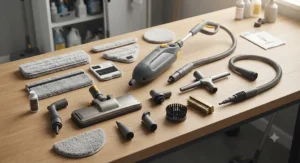
Getting a new machine right on day one saves real headaches later. Start by using filtered or distilled water where your tap water is hard — mineral buildup inside a boiler or tank is the single most common cause of steam mops losing pressure within their first year, and it’s almost entirely preventable. Run a quick test pass on an inconspicuous section of each flooring type in your space before committing to daily use, since unsealed wood and some vinyl composites don’t tolerate steam well regardless of what the mop’s marketing claims.
In the first 30 days, the most common mistake is treating every setting like “high.” Reviewers across nearly every model above note that dialing steam down for delicate laminate and up only for tile or grout extends both floor finish life and pad life. Build a simple weekly rhythm: descale according to the manufacturer’s schedule (monthly for most tank-style units, roughly every 20-30 uses for pressurized canisters), rotate through at least two microfiber pads so one is always washing while the other’s in use, and store the unit upright with the tank drained to avoid stagnant water odor. None of this is complicated — it’s just the kind of routine maintenance an Amazon listing never mentions, and it’s the difference between a mop that lasts two years and one that lasts six.
Which Steam Mop Fits Your Business? Real-World Scenarios
If you’re running a 900-square-foot coffee shop with two employees and moderate but not constant floor traffic, a fast-heating, easy-to-store unit like the PurSteam 10-in-1 or Reliable Pronto Plus 300CS genuinely covers your needs without the added cost of continuous-fill technology you won’t fully use.
If you’re managing a full-service restaurant kitchen with grease, grout lines, and a floor that needs cleaning multiple times per shift, the calculus changes. A unit like the Bissell Commercial BGST1566 or McCulloch MC1385 Deluxe brings the pressure and duty-cycle durability that light-duty mops simply weren’t built for, and the higher steam temperature does more work against baked-on grease near fryers and grills.
If you’re overseeing a retail boutique or small gym with continuous foot traffic all day and staff who can’t babysit a cooling-down machine, continuous-refill designs like the Dupray Neat Plus or Kärcher SC5 EasyFix Premium solve the actual operational problem — keeping the floor presentable without pulling a staff member off the register for ten minutes every hour. And if you’re running two or three locations off a shared equipment budget, the Vapamore MR-1000 Forza‘s capacity and durability spread that cost more efficiently than buying several smaller units.
Common Floor Problems in High-Traffic Spaces — And How to Solve Them
Problem: grimy grout lines that never look fully clean. Standard mop pads glide over grout without agitating it. Solution: reach for a unit with a built-in scrub brush or nylon attachment, like the McCulloch MC1385 Deluxe or Bissell Commercial BGST1566‘s Easy Scrubber, and hold steam on the line for a couple of extra seconds before moving on.
Problem: the floor looks clean but still feels sticky underfoot. This is usually residual detergent film from chemical mopping, not new dirt. Solution: two or three chemical-free steam passes typically strip the buildup completely, which is one of the strongest arguments for switching away from bucket-and-chemical mopping in the first place.
Problem: staff avoid steam mopping because it takes too long. Solution: continuous-fill machines remove the single biggest time sink — waiting on refills — and cut real cleaning time significantly compared to stop-and-start units.
Problem: floors near entrances stay slick on rainy days regardless of mopping frequency. Solution: pair steam cleaning with slip-resistant floor mats at entry points; steam alone can’t compensate for tracked-in water on a busy door.
Problem: the mop itself seems to lose steam power within months. Solution: this is almost always mineral scale from hard tap water — descale on schedule and switch to filtered water going forward.
✨ Ready to Upgrade Your Floors?
🔍 Compare the full lineup above and click through to check current pricing and availability on the model that fits your space. The right commercial-grade steam mop pays for itself the first month you stop reordering chemical mop solution.
How to Choose a Commercial-Grade Steam Mop for Small Businesses
Picking the right machine comes down to a handful of decision points, in roughly this order of importance:
- Match tank type to your traffic pattern. Light, intermittent use suits a removable-tank mop; continuous daily traffic justifies a fill-on-the-go or dual-tank design.
- Check the duty-cycle rating, not just the word “commercial.” Some machines marketed toward small businesses still carry residential weekly-use caps buried in the manual.
- Prioritize cleaning-path width for large open floors. A wider path, like the 12.5-inch head on the Bissell Commercial BGST1566, covers more square footage per pass.
- Weigh steam pressure against your flooring type. Grout and heavy grease need higher psi; sealed hardwood and laminate need adjustable, lower settings to avoid finish damage.
- Factor in cord length and storage footprint. A 50-foot cord like the Bissell’s saves real labor time in a space with limited outlets.
- Confirm accessory compatibility with your actual surfaces. Restaurants benefit from grout brushes and equipment nozzles; retail floors often don’t need them at all.
- Set a realistic budget band before shopping, using the price ranges above rather than chasing the cheapest listing you find.
Commercial Steam Mop for High Foot-Traffic Floors vs Traditional Mopping
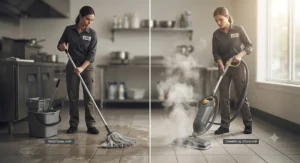
The case for a commercial steam mop for high foot-traffic floors over a bucket-and-string-mop setup isn’t just about convenience — it’s about what actually happens to dirty water during a cleaning pass. A traditional mop redistributes the same contaminated water across the whole floor with every stroke, effectively re-soiling clean sections as you go. Steam mops apply fresh heated vapor with every pass and lift debris into a removable pad instead.
| Factor | Traditional Mop & Bucket | Steam Mop |
|---|---|---|
| Water reused across floor | Yes, same bucket | No, fresh steam each pass |
| Chemical odor/residue | Common | None |
| Germ reduction | Chemical-dependent | Heat-dependent (200°F+) |
| Labor time per 1,000 sq ft | Higher (bucket changes) | Lower (fewer stops) |
| Best For | Very light, occasional use | Commercial-grade steam mop for small businesses operations |
Reading the table above, the labor-time gap is really the deciding factor for most owners: bucket changes and chemical mixing eat staff minutes that steam mopping simply removes from the workflow. That said, a traditional mop still has a place for spot-cleaning tiny spills between full steam passes, so most well-run operations end up using both rather than replacing one entirely.
Steam Mop for Restaurant and Retail Floors: Industry-Specific Considerations
A steam mop for restaurant and retail floors has to answer to different priorities depending on which side of the counter it’s cleaning. In a restaurant kitchen, grease is the enemy — chemical degreasers work, but they also leave a residue that can make tile dangerously slick if not fully rinsed, and the FDA Food Code sets baseline expectations for how physical facilities, floors included, need to be maintained in a retail food establishment. Steam sidesteps the rinse-residue problem entirely, since it’s just heated water that evaporates.
On the retail side, the priorities shift toward presentation and speed. A boutique or showroom floor rarely deals with grease, but it does need to look immaculate during business hours without displacing customers or blocking aisles with wet-floor signs for twenty minutes. This is where lighter, faster-heating units like the PurSteam 10-in-1 genuinely outperform heavier equipment — a five-minute steam pass during a slow window beats a full mop-and-bucket production every time. Reviewers who’ve used steam mops across both settings consistently note that restaurants lean toward higher-pressure, grout-focused machines, while retail spaces prioritize speed and quiet operation over raw steam output.
Continuous-Use Steam Tanks Explained: Why Tank Design Matters
Continuous-use steam tanks are water reservoirs engineered to be refilled without powering down or waiting for the unit to cool, using either a secondary “cold” tank that feeds the heated boiler or heat-exchanger technology that keeps the refill water separate from the pressurized chamber…
That distinction matters more than most buyers realize. On a standard removable-tank mop, running out of water mid-shift means switching the unit off, waiting for pressure to bleed down, refilling, and waiting again for reheat — five to ten minutes of dead time that adds up fast across a long shift. Machines built around continuous-use steam tanks, like the Dupray Neat Plus‘s heat-exchanger system and the Kärcher SC5 EasyFix Premium‘s dual-tank design, eliminate that gap entirely. The EPA’s guidance on cleaning and disinfecting commercial spaces notes that consistent, uninterrupted routine cleaning is a meaningful part of maintaining sanitary public-facing environments, and a machine that can’t be refilled without stopping works directly against that consistency.
High-Traffic Flooring: Features That Actually Matter (And Those That Don’t)
Marketing copy on steam mop listings tends to bury the genuinely useful specs under flashier ones. For high-traffic flooring specifically, cleaning-path width and cord length matter enormously — they directly determine how many minutes a staff member spends covering a given square footage — while flashy digital displays and app connectivity, seen on a few premium models, add essentially nothing to actual cleaning outcomes.
Steam temperature and adjustability matter more than raw wattage alone. A machine that hits 212°F but only offers one fixed setting is riskier on delicate laminate than a slightly less powerful unit with three adjustable levels, since the ability to dial back prevents warping or finish damage over hundreds of passes. Tank or boiler material is another quiet differentiator: stainless steel, like the boiler inside the Vapamore MR-1000 Forza, resists mineral scale buildup far longer than plastic reservoirs, which matters enormously in high-traffic settings where the mop runs almost daily. Accessory count, on the other hand, is often more marketing than substance — a business that only ever cleans flat floors doesn’t need fifty attachments gathering dust in a closet.
Commercial Floor Maintenance: Long-Term Cost, ROI & Common Buying Mistakes
Commercial floor maintenance costs add up in places owners don’t always track closely: chemical mop solution, replacement mop heads, staff labor minutes, and eventually flooring replacement or refinishing when grit and residue wear down a finish faster than it should. Steam cleaning doesn’t eliminate all of these costs, but it meaningfully reduces the chemical line item and, based on the spec comparison across this list, tends to reduce labor time per cleaning pass once a business moves past the lightest-duty units.
| Cost Factor | Chemical Mop & Bucket | Steam Mop |
|---|---|---|
| Ongoing chemical spend | Recurring monthly cost | Near zero |
| Replacement pads/mops | Frequent | Less frequent (washable) |
| Upfront equipment cost | Low | Moderate to high |
| Break-even timeline | N/A | Typically well under a year for daily-use operations |
The math above tends to favor steam for any business mopping daily, since eliminated chemical spend alone often covers a mid-tier machine’s cost within several months, before even counting the labor-time savings from continuous-fill designs.
The buying mistakes that undercut this ROI are consistent across reviews: owners who buy the cheapest available unit for genuinely heavy daily use burn through it within a year and end up buying twice; owners who buy the most expensive commercial-grade steam mop for small businesses on the market without matching it to their actual square footage overspend on capacity they’ll never use; and owners who skip checking duty-cycle limits, like the Reliable Pronto Plus 300CS’s residential-use recommendation, end up voiding warranties through no fault beyond a marketing-copy assumption.
Safety, Regulations & Compliance for Commercial Floor Cleaning
Beyond cleaning results, floor safety is a genuine liability concern for any small business open to the public. OSHA’s walking-working surfaces standard requires floors to be kept clean and free of hazards that could cause a slip, trip, or fall — a requirement that applies to nearly every commercial floor a customer or employee walks across, not just industrial settings. A wet floor left standing after chemical mopping, particularly near entrances or in kitchens, is a textbook version of exactly the hazard that standard targets.
Steam cleaning has a practical safety edge here: because it uses far less standing water than a saturated chemical mop, floors typically dry faster, shrinking the window where a freshly cleaned surface is at its most hazardous. For food-service operations specifically, keeping physical facilities — floors included — clean and in good repair is also a baseline expectation under retail food safety guidance, which makes documented, consistent floor cleaning a compliance matter as much as a cosmetic one. None of the seven machines above are a substitute for wet-floor signage during and immediately after cleaning, but choosing equipment that dries faster is a genuinely useful piece of a broader safety routine.
Frequently Asked Questions
❓ What is a commercial-grade steam mop for small businesses?
❓ How often should a small business steam mop its floors?
❓ Can a steam mop replace chemical disinfectants entirely?
❓ Do continuous-use steam tanks really save meaningful time?
❓ Is a commercial steam mop safe on all flooring types?
Conclusion
There’s no single best commercial-grade steam mop for small businesses — there’s only the right match for your specific floor, traffic, and staffing reality. A quiet boutique with light foot traffic doesn’t need the same machine as a full-service kitchen running grease-heavy lunch and dinner shifts, and buying past your actual needs just ties up capital that could go toward inventory or payroll instead.
What matters most is being honest about duty cycle before you buy: check whether a listing’s “commercial” label comes with real hourly-use ratings or just aggressive marketing copy. Match tank design to how long your floor needs continuous attention, match steam pressure to whatever your toughest surface actually is — grout, grease, or sealed hardwood — and factor cord length and storage footprint into a space that’s probably tighter than you’d like. Get those fundamentals right, and any of the seven machines above will earn its keep well past the first year.
✨ Ready to stop fighting your floors? Compare the picks above one more time and check current pricing before your next shift.💬🤗
Recommended for You
- 7 Best 2-in-1 Steam Mop and Vacuum Combo Picks for 2026
- 7 Best Handheld Steam Cleaners for Quick Cleanups (2026)
- Electric Steam Mop for Hardwood Floors: 7 Safe Picks (2026)
Disclaimer: This article contains affiliate links. As an Amazon Associate, I earn from qualifying purchases. If you purchase products through these links, we may earn a small commission at no additional cost to you.
✨ Found this helpful? Share it with your friends! 💬🤗
