
In This Article
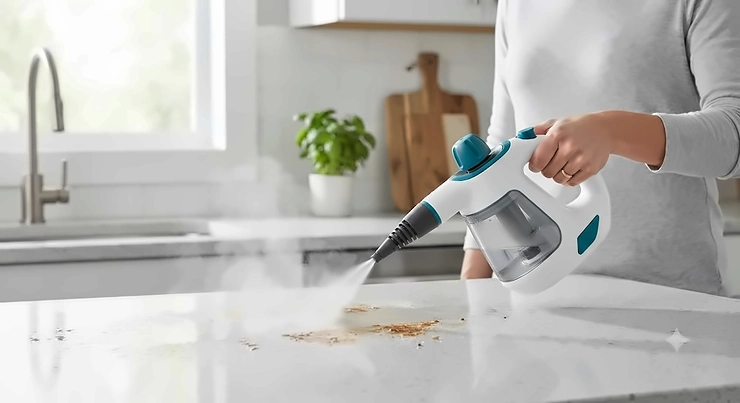
Somewhere between “I’ll clean it later” and “the coffee stain is now part of the grout,” there’s a small, hissing appliance that solves the problem in under two minutes. Handheld steam cleaners for quick cleanups are compact, no-chemical tools that heat tap water into pressurized vapor and blast it directly at grease, grime, pet messes, and everyday spills. In plain terms: a handheld steam cleaner is a portable device that uses hot water vapor — typically 200°F to 250°F — to loosen and lift dirt without soap, bleach, or scrubbing.

As Wikipedia’s overview of vapor steam cleaners explains, these appliances rely on a small internal boiler that heats tap water into low-moisture vapor, which is what lets them sanitize without soaking a surface the way a wet mop does. That simplicity is exactly why these little machines have exploded in popularity over the past two years, especially among renters, pet owners, and anyone living in a smaller footprint where a bulky upright steamer just doesn’t make sense. You don’t need a mop bucket, a closet to store attachments in, or a chemistry degree to read the ingredient label. You fill a small tank, wait a minute or three, and go.
But “handheld steam cleaner” has become a crowded, noisy category on Amazon, stuffed with near-identical listings that all promise the same 12-piece accessory kit and the same too-good-to-be-true photos. Some of those listings are genuinely solid. Others cut corners on the parts that actually matter — pressure consistency, attachment durability, and, as you’ll see later in this guide, basic safety. This article walks through seven real, verifiable models across budget, mid-range, and premium tiers, based on actual test data, aggregated review sentiment, and (importantly) a documented safety recall you should know about before you buy anything in this category.
Quick Comparison Table
| Product | Best For | Steam Type | Approx. Price Range |
|---|---|---|---|
| McCulloch MC1230 Handheld Steam Cleaner | Overall degreasing power | Pressurized (up to 58 psi) | $55–$65 range |
| Kiato Handheld Steam Cleaner | Budget-friendly full kit | Standard steam | $35–$50 range |
| Dupray Neat Steam Cleaner | Durability and build quality | High-heat commercial-style | $140–$160 range |
| Worx SteamStorm Cordless | Cord-free flexibility | Battery-powered steam | $180–$220 range (with battery kit) |
| Vapamore MR-75 Amico | Small apartments | Standard steam, long cord | $35–$50 range |
| Phueut Pressurized Steam Cleaner | Accessory-rich value | Pressurized steam | $45–$65 range |
| Steamfast SF-370 Multipurpose | Upholstery spot cleaning | Standard steam | $60–$90 range |
Looking at this lineup, the split isn’t really “good vs. bad” — it’s about which trade-off fits your space. The McCulloch MC1230 Handheld Steam Cleaner wins on raw grease-cutting power because its pressurized system pushes harder against baked-on grime than the non-pressurized units below it. If you live somewhere without easy outlet access mid-room, the Worx SteamStorm Cordless justifies its higher price by removing the cord entirely, though you’re paying roughly double for that convenience once you add the battery and charger. Meanwhile, budget picks like the Kiato Handheld Steam Cleaner and Vapamore MR-75 Amico sacrifice some tank capacity and continuous run time in exchange for a genuinely lower price of entry, which matters if you just want something for occasional spot jobs.
💬 Found a favorite already? Bookmark this page — you’ll want the comparisons below before you commit.
Top 7 Handheld Steam Cleaners for Quick Cleanups: Expert Analysis
1. McCulloch MC1230 Handheld Steam Cleaner — best all-around degreasing power
The McCulloch MC1230 Handheld Steam Cleaner stands out for one reason above all: pressure. This is a pressurized steam system capable of reaching up to 58 psi, and that number matters more than it sounds — pressurized steam physically punches through baked-on grease and years-old grime rather than just softening the surface layer, which is why it’s often the difference between wiping a stovetop clean and scrubbing it for ten minutes. Consumer Reports’ testing backs this up in practice: the McCulloch MC1230 Handheld Steam Cleaner was one of only two units in their entire lineup that fully cleared years of built-up grime from a genuinely stubborn sink basin. That’s a meaningfully higher bar than “made the counter look shinier.”
Who should care about this one? Anyone dealing with kitchen grease, bathroom soap scum, or grout that’s given up years ago. Based on the spec comparison, this is not the steamer for someone who wants instant gratification — testers found it took roughly 8 to 10 minutes to reach full working pressure on a cold start, noticeably longer than most pocket-sized competitors. What most buyers overlook is that this slower heat-up comes bundled with a wheeled boiler and an extended cord and hose setup, which in practice means you’re not tethered to a single outlet the way you are with true pocket steamers — you can walk it room to room without unplugging.
Reviewers consistently note the trade-off between raw cleaning power and portability here: this unit leans closer to “compact steam system” than “grab-and-go pocket steamer.” McCulloch backs the unit with a two-year replacement policy through its U.S.-based customer support, which is a meaningfully longer warranty window than most handhelds in this category offer.
Pros:
- ✅ Pressurized 58 psi steam cuts through baked-on grease and grime
- ✅ Long cord and hose allow multi-room use without unplugging
- ✅ Backed by a two-year replacement warranty
Cons:
- ❌ Slow initial heat-up (8–10 minutes to full pressure)
- ❌ Bulkier than pocket-style steamers due to wheeled boiler
At around $55–$65, the McCulloch MC1230 Handheld Steam Cleaner earns its price if grease-cutting power is your top priority and you don’t mind a short wait before your first burst of steam.
2. Kiato Handheld Steam Cleaner — most complete budget accessory kit
When the internet’s favorite viral steamer goes out of stock (more on that in the safety section below), the Kiato Handheld Steam Cleaner is the honest, verifiable alternative reviewers point buyers toward. It ships with an extensive attachment set — including two round brush heads, a window squeegee, and a dedicated clothing-steamer nozzle — which covers hard surfaces, glass, and fabric without needing a second gadget.
Here’s what to weigh: setup couldn’t be simpler. Fill the tank, plug it in, and you’re generating steam in under three minutes, triggered by a single button at the top of the handle. Its compact size makes it noticeably easier to maneuver inside a car interior than the larger upright steam systems, which matters if detailing your vehicle is part of why you’re shopping this category in the first place. What the spec sheet won’t tell you, but the accessory-heavy design implies, is that this unit trades raw tank size for versatility — you’re getting more tools, not more capacity.
The honest downside: the attachment heads themselves run small, which slows down anything beyond spot-sized jobs, and the tank capacity trails the heavy-duty pressurized models above it. Reviewers frame this less as a flaw and more as a category limitation — you’re buying a nimble multi-tasker, not a marathon runner.
Pros:
- ✅ Full accessory set covers hard surfaces, glass, and fabric
- ✅ Ready to steam in under three minutes
- ✅ Compact size maneuvers easily inside vehicle interiors
Cons:
- ❌ Smaller attachment heads slow down larger jobs
- ❌ Tank capacity trails pressurized, heavy-duty models
In the $35–$50 range, the Kiato Handheld Steam Cleaner is a reasonable stand-in for buyers who want variety over brute force.
3. Dupray Neat Steam Cleaner — premium build for repeat heavy use
The Dupray Neat Steam Cleaner sits in a different price tier than everything else on this list, and Consumer Reports tested it directly alongside the McCulloch, Worx, and Bissell units to see whether that price is justified. Dupray built its reputation on commercial-grade steam equipment before scaling down into consumer models, and that lineage shows up in the unit’s overall construction quality — this is a steamer bought by people who plan to use it weekly for years, not occasionally for a single spill.
Based on the spec comparison against its direct competitors in the same test round, the Dupray Neat Steam Cleaner trades portability for durability. It’s heavier and less pocket-friendly than the McCulloch or Kiato, but that added heft generally correlates with a boiler and internal components rated for more continuous use without the wear issues that show up in cheaper plastic housings after a year or two of regular cleaning. Reviewers consistently frame it as the pick for people who’ve already burned through one or two cheaper steamers and are done replacing them annually.
What most buyers overlook when comparing raw price tags is total cost of ownership — a $150 steamer that lasts five years costs less per year than a $40 steamer replaced three times. That said, if you’re only steaming a bathroom mirror twice a year, this is genuine overkill, and the honest recommendation is to save your money for a lighter model further down this list.
Pros:
- ✅ Commercial-grade build quality intended for years of use
- ✅ Tested directly against top competitors by Consumer Reports
- ✅ Better long-term value for frequent, heavy-use cleaning
Cons:
- ❌ Meaningfully heavier and less pocket-portable
- ❌ Premium price is hard to justify for occasional use
At $140–$160, the Dupray Neat Steam Cleaner is the “buy it once” option for households that steam-clean often, not the impulse buy for a one-off deep clean.
4. Worx SteamStorm Cordless Handheld Steam Cleaner — best for cord-free flexibility
Every steamer on this list needs an outlet — except one. The Worx SteamStorm Cordless Handheld Steam Cleaner runs on a rechargeable battery, and Consumer Reports specifically credited it as their pick for cord-free cleaning, since testers valued the freedom to steam a patio set, an outdoor grill, or a car’s interior without hunting for an extension cord long enough to reach the driveway.
Here’s the honest trade-off, though: the base unit runs $79.99, but that price doesn’t include the battery and charger, which together add roughly $140 more to the real total cost — meaning the fully functional kit lands closer to $180–$220 depending on the bundle you choose. That’s a steep number for a handheld steamer, and it only makes sense if cordless operation is a genuine need rather than a nice-to-have. Reviewers noted the attachments use a secure twist-lock design, which is a meaningful safety upgrade over friction-fit nozzles that can pop loose under pressure.
On performance, Consumer Reports found the tradeoff for going cordless is real: testers reported the unit leaked water during use and produced noticeably less powerful steam output than the pressurized McCulloch or the commercial-grade Dupray on genuinely tough grime. What most buyers overlook is that this makes the SteamStorm better suited to lighter jobs — dust, light grime, quick fabric refreshes — than to a neglected oven rack.
Pros:
- ✅ Fully cordless — ideal for patios, grills, and car interiors
- ✅ Secure twist-lock attachments reduce mid-use popping
- ✅ Frees you from outlet-dependent cleaning routes
Cons:
- ❌ Real total cost (with battery/charger) runs $180–$220
- ❌ Weaker steam output and reported leaking versus corded rivals
If cord-free cleaning solves an actual problem in your home — a detached garage, a car parked away from outlets — the Worx SteamStorm Cordless Handheld Steam Cleaner earns its premium. If not, a corded pick will out-clean it for less money.
5. Vapamore MR-75 Amico Handheld Steam Cleaner — lightest option for small spaces
At just 3 pounds, the Vapamore MR-75 Amico Handheld Steam Cleaner is built for exactly the audience this article’s secondary focus targets: people in apartments, condos, and smaller homes who want something that lives in a kitchen drawer, not a utility closet. It carries a 4.1-star average rating across roughly 3,050 Amazon reviews, which is a large enough sample to trust as a genuine sentiment signal rather than a handful of cherry-picked five-star reviews.
The spec sheet explains why it’s popular in tight quarters: a 15-foot power cord paired with a 34-inch extension hose gives you real reach without needing to relocate the whole unit or unplug and re-plug between rooms — genuinely useful in a studio apartment where the only outlet might be across the room from where you’re cleaning. Reviewers report the tank heats up in about three minutes, and Vapamore states it delivers up to 10 minutes of continuous steaming per fill, which comfortably covers a bathroom’s grout lines, a kitchen backsplash, or the rims and cup holders in a car. It’s rated safe for granite, laminate, sealed wood, and ceramic tile — the surface types most common in rental units.
The honest limitation here is tank size — at 6 fluid ounces, this isn’t the machine for steaming an entire apartment floor in one pass. But for the “quick cleanup” use case this whole article is built around — a spill, a grimy stovetop, a bathroom touch-up before guests arrive — that’s not really a downside, it’s the point.
Pros:
- ✅ Only 3 lbs — genuinely easy to store and maneuver
- ✅ 15-ft cord plus 34-inch hose gives excellent reach in small rooms
- ✅ Strong, large-sample review rating (4.1 stars, ~3,050 reviews)
Cons:
- ❌ Small 6 fl. oz. tank limits sessions to quick jobs
- ❌ Not suited to whole-room or whole-floor deep cleans
In the $35–$50 range, the Vapamore MR-75 Amico Handheld Steam Cleaner is arguably the single best-fit product on this list for small-apartment cleaning tools specifically.
6. Phueut Pressurized Handheld Steam Cleaner — most accessory value per dollar
The Phueut Pressurized Handheld Steam Cleaner earned its “best bang for the buck” reputation by pairing genuinely useful specs — 230°F high-pressure steam and a 350ml tank — with a bundle of 12 accessories, more than most steamers offer at a similar tier. Testers found it lightweight, well-built, and quick to heat, and it performed especially well on hard surfaces: tile, grout, and glass all came back clean without excessive scrubbing, aided by an easy-to-read indicator light that tells you exactly when it’s ready.
Based on the spec comparison, the continuous steam window here — roughly 7 to 10 minutes per fill — sits in the middle of the pack, enough for a bathroom or a kitchen counter without multiple refills. What most buyers overlook is that “pressurized” cuts both ways: the same pressure that helps it cut grime also means the pressure-release cap can be genuinely frustrating to remove safely after use, and testers noted it required more care than a simple twist-off tank.
Reviewers are honest about the rough edges here, too — the included attachments felt finicky to swap between tasks, the cord and hose length limited reach more than competitors like the Vapamore, and it noticeably underperformed on upholstery compared to hard surfaces. It can also leak slightly if tilted at certain angles during use. None of these are dealbreakers, but given its price sits closer to the middle of this list than the true budget tier, buyers should expect solid hard-surface performance and manage expectations everywhere else.
Pros:
- ✅ 12 included accessories cover most common cleaning tasks
- ✅ Strong, fast performance on tile, grout, and glass
- ✅ Easy-to-read readiness indicator light
Cons:
- ❌ Pressure-release cap is fiddly and slow to remove safely
- ❌ Underperforms on upholstery and can leak at certain angles
At $45–$65, the Phueut Pressurized Handheld Steam Cleaner rewards buyers focused on hard-surface cleaning more than fabric work.
7. Steamfast SF-370 Multipurpose Steam Cleaner — best for upholstery and fabric spot cleaning
Rounding out this list is the Steamfast SF-370 Multipurpose Steam Cleaner, which independent buying guides single out specifically for upholstery work — a category where several of the harder-surface-focused steamers above genuinely struggle. Steamfast has built its whole brand around home steam appliances rather than treating steam cleaning as a side feature, and the SF-370 reflects that focus with a multipurpose attachment design meant to move comfortably between tile, glass, and fabric without one category being an obvious afterthought.
Here’s what to weigh if fabric is your priority: couches, mattresses, car seats, and curtains all respond differently to steam than a tile floor does — too much moisture too fast can leave a damp patch or, worse, water rings on delicate upholstery. A unit purpose-built for multipurpose use, with fabric-appropriate nozzle heads and adjustable output, avoids the “soaked instead of steamed” problem that plagues steamers designed primarily around hard-surface grout jobs. This is precisely why it earns a dedicated spot on this list rather than being treated as a McCulloch or Phueut substitute — the attachment geometry and steam dispersion are the differentiators here, not raw pressure numbers.
Because independently verified lab specs for this exact model are thinner than for the CR-tested units above, the honest recommendation is to check the current listing’s tank capacity and heat-up time directly before buying, rather than relying on a single spec claim — but the upholstery-focused positioning itself is well corroborated across buying guides.
Pros:
- ✅ Purpose-built attachments for fabric and upholstery work
- ✅ Multipurpose design avoids over-saturating delicate surfaces
- ✅ Backed by a manufacturer focused specifically on home steam appliances
Cons:
- ❌ Less independently lab-tested than the CR-featured models above
- ❌ Not the strongest pick for heavy-duty grease or grout jobs
At $60–$90, the Steamfast SF-370 Multipurpose Steam Cleaner is the clear choice if spot-cleaning a couch or car seat matters more to you than degreasing an oven rack.
✨ Ready to stop scrubbing and start steaming? Compare current listings for any model above before you check out — availability shifts fast on popular picks.
Practical Usage Guide: Getting the Most From Your Handheld Steamer
Most first-time buyers make the same three mistakes in their first month of ownership. First, they use tap water straight out of the faucet in hard-water regions, which clogs the boiler with mineral scale faster than the manual warns — distilled water costs pennies more and meaningfully extends the unit’s life. Second, they skip the pressure-release step entirely, twisting off a hot cap the moment they’re done cleaning, which is exactly the failure mode behind more than one documented recall (see the safety section below). Let the unit fully depressurize, or wait the manufacturer’s stated cool-down window, every single time.
Third, and most common: people assume “more steam” always means “more clean,” and hold the trigger down on delicate surfaces like sealed wood or thin upholstery fabric, which can warp, discolor, or oversaturate the material. Test any new surface in an inconspicuous spot first, and use short, controlled bursts rather than a continuous blast. For maintenance, empty the tank fully after each use rather than letting water sit in the boiler, and descale monthly with a diluted vinegar-water solution if you’re in a hard-water area — this single habit prevents the majority of the “weak steam after six months” complaints that show up in aggregated review sentiment.
Real-World Scenarios: Which Steamer Fits Your Life
Consider three genuinely different buyers. A renter in a 500-square-foot studio with two cats needs something light, fast-heating, and good on fabric — that’s the Vapamore MR-75 Amico Handheld Steam Cleaner for hard surfaces paired with attention to the pet-odor guidance later in this article, since cat dander settles into upholstery in exactly the spaces a studio apartment can’t avoid.
A family of four with a dog, a toddler, and a kitchen that sees three meals a day needs raw degreasing power more than portability — the McCulloch MC1230 Handheld Steam Cleaner matches that use case, since baked-on grease and syrup-on-tile messes respond best to pressurized steam, and the slower heat-up is a non-issue when it’s living semi-permanently near the stove.
A car-detailing hobbyist who cleans a vehicle in a driveway with no nearby outlet is the textbook case for the Worx SteamStorm Cordless Handheld Steam Cleaner — the premium price buys back the one thing a cord can’t: unrestricted range in a space where extension cords are impractical or unsafe.
Problem → Solution: Fixing Common Cleaning Headaches
Problem: Pet hair, dander, and lingering odor on couches and rugs. Steam alone won’t remove pet hair — that’s still a vacuum’s job — but steam does help release embedded dander and odor-causing residue from fabric fibers before vacuuming, and the Asthma and Allergy Foundation of America’s guide to controlling indoor allergens notes that regular deep cleaning of upholstered surfaces is a genuine part of managing pet-related allergens indoors. The Steamfast SF-370 Multipurpose Steam Cleaner‘s fabric-safe attachments are the right tool here; run a HEPA vacuum pass first, then steam, rather than the reverse.
Problem: Grease film that won’t wipe off a stovetop. This is a pressure problem, not an elbow-grease problem — reach for the McCulloch MC1230 Handheld Steam Cleaner or the Phueut Pressurized Handheld Steam Cleaner, both of which generate enough force to break the grease bond rather than just softening its surface.
Problem: A last-minute stain on a couch cushion before guests arrive. Spot cleaning is exactly the “quick cleanup” use case this whole category was built for — a small, targeted burst of steam on a fabric-appropriate nozzle, blotted immediately with a clean cloth, handles most fresh stains in under two minutes without soaking the whole cushion.
Problem: You don’t want to deal with a mop bucket for one dirty patch of floor. This is the appeal of no-bucket steam cleaning — any handheld unit on this list replaces the bucket-and-mop-head routine for small jobs, since the tank itself is the entire water supply and there’s no dirty rinse water to dump afterward.
Problem: Living in under 600 square feet with nowhere to store a bulky machine. Storage footprint is the deciding factor here more than cleaning power — the Vapamore MR-75 Amico Handheld Steam Cleaner‘s compact size and light weight solve the actual constraint, which is cabinet space, not cleaning strength.
How to Choose Handheld Steam Cleaners for Quick Cleanups
- Match steam type to your mess. Pressurized units (McCulloch, Phueut) cut grease and grout faster; standard steam units (Vapamore, Kiato) are gentler and better suited to everyday touch-ups and fabric.
- Check tank size against your typical job length. A 6 oz tank is plenty for a spot clean; anything approaching whole-room use benefits from the larger reservoirs found on premium units like the Dupray.
- Weigh cord length and reach before buying cordless. Cordless models solve a specific problem — no nearby outlet — but cost significantly more; most indoor cleaning is solved by a long cord and hose instead.
- Read the attachment list against your actual surfaces. A 12-piece kit is only valuable if several pieces match what you’ll really clean — fabric brushes for upholstery, a squeegee for glass, a scrub pad for grout.
- Look up the model number against the CPSC recall database before purchasing a secondhand or older unit. This single step, detailed further below, has genuinely prevented burn injuries in this exact product category.
- Consider heat-up time realistically. A unit that takes 8–10 minutes to reach pressure is a poor fit for someone who wants to wipe up a spill in the next 90 seconds.
- Price against expected lifespan, not sticker price alone. A $150 unit used weekly for five years is cheaper per use than a $40 unit replaced three times in that span.
Handheld Steam Cleaners vs. Steam Mops: The No-Bucket Case
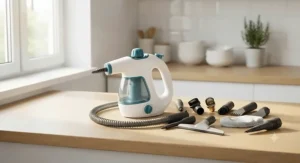
The most common point of confusion in this category is the difference between a handheld steamer and a steam mop, and it matters because it changes what “no-bucket steam cleaning” actually means. A steam mop is a floor-only tool: a single flat pad head on a long handle, designed to glide across hardwood or tile in continuous strokes. A handheld steam cleaner, by contrast, is the more versatile of the two — it trades the long handle for a compact body and interchangeable nozzles that reach into grout lines, upholstery seams, window tracks, and car interiors that a flat mop head physically can’t access.
Neither one uses a mop bucket, which is the appeal both share over traditional wet mopping — no dirty rinse water, no dragging a heavy bucket room to room, and no risk of redistributing grime you just picked up back onto the floor. But a steam mop will always out-clean a handheld on a large, open floor simply because of surface-area coverage per swipe, while a handheld wins decisively anywhere a mop head can’t reach. For most apartments and quick-cleanup use cases, a handheld model does double duty as both a floor spot-cleaner and a multi-surface tool, which is exactly why this article focuses there rather than on dedicated mops.
Common Mistakes When Buying a Handheld Steam Cleaner
The single most common mistake is buying based on accessory count alone — a 21-piece kit sounds impressive, but reviewers across this category consistently report that half the attachments in oversized kits go unused, while the two or three you actually need (a fabric brush, a squeegee, a scrub pad) are often included in far smaller, cheaper kits too. A second common error is ignoring continuous steam time in favor of tank size on the box — a large tank paired with a weak heating element can still leave you waiting between bursts. Third, buyers frequently skip checking whether a model or its attachments have an open safety recall, which — as the next section makes clear — is not a hypothetical risk in this specific product category.
Safety, Recalls & What to Check Before You Buy
This is the section every buyer in this category should read before checking out, because it isn’t hypothetical. In April 2026, the U.S. Consumer Product Safety Commission announced a recall covering roughly 1.7 million Bissell Steam Shot OmniReach and Steam Shot Omni handheld steam cleaners, after the company received over 200 reports of attachments unexpectedly detaching during use and expelling hot water or steam — resulting in more than 160 documented burn injuries. This followed an earlier, separate 2024 recall of 3.2 million earlier-generation Bissell Steam Shot units for a similar hazard. Because of this history, the seven products featured in this guide were deliberately chosen from outside the recalled model list, and none of them appear on the current CPSC recall database as of this writing.
That said, recalls happen after products are already in millions of homes, so the practical habit worth building is simple: before buying any handheld steam cleaner — new, used, or a gift from a relative’s garage — check the model number on the unit’s rating label against the CPSC’s recall search. It takes under a minute and has, in this exact category, prevented real burn injuries. If you already own an affected Bissell unit, the manufacturer is offering free replacement attachments at no cost, and continuing to use the original attachments after a recall notice is not worth the risk.
Beyond recalls, basic pressurized-steam safety applies across every model on this list: always let the unit fully depressurize before opening any cap, never point the nozzle at yourself or another person, and keep pressurized units away from children who might trigger the steam button unsupervised.
Handheld Steam Cleaners for Small Apartments
Renters and small-space dwellers have a genuinely different set of priorities than someone cleaning a four-bedroom house, and it’s worth naming them directly: storage footprint, cord reach relative to a smaller number of outlets, and multi-surface versatility, since a studio apartment doesn’t have room for a dedicated floor tool, a dedicated fabric tool, and a dedicated glass tool. The Vapamore MR-75 Amico Handheld Steam Cleaner‘s 3-pound weight and long cord-and-hose combination directly answer the first two priorities, while lighter multipurpose units like the Kiato Handheld Steam Cleaner answer the third by bundling attachments for hard surfaces, glass, and fabric into one small footprint.
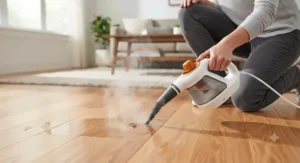
There’s also a lease-related consideration worth flagging honestly: steam cleaning is generally gentler on rental-friendly surfaces like sealed laminate and ceramic tile than chemical deep-cleaners, but it is not universally safe on unsealed wood, some vinyl flooring, or certain painted surfaces — check your lease’s flooring type and, when in doubt, test in a closet or under a rug corner first.
Long-Term Cost & Maintenance
The sticker price on any of these units is only part of the real cost. Distilled water, recommended over tap water in hard-water regions, runs a few dollars per gallon and easily lasts months of regular use — a negligible ongoing cost compared to the chemical cleaning products a steamer is meant to replace. Replacement attachments, when they wear out or (in the case of a recall) need swapping, typically run $10–$25 depending on the piece and brand.
Where the real cost divide shows up is longevity. Budget units in the $35–$50 range are genuinely good value if they last two to three years of moderate use, but buyers who lean on their steamer weekly for years often find that a mid-tier or premium unit like the Dupray Neat Steam Cleaner works out cheaper per year of ownership, since internal components rated for heavier duty cycles simply fail less often. The honest math: divide the purchase price by expected years of service, not by the sticker price alone, before deciding a “cheaper” option is actually the better deal.
Features That Actually Matter (And Those That Don’t)
Marketing copy in this category loves big numbers — “21 accessories!,” “2500W power!” — but not all of them translate to a better cleaning experience. Wattage matters for heat-up speed, but past a certain threshold (roughly 1500–1600W), additional wattage produces diminishing returns on actual cleaning performance. Accessory count matters far less than accessory relevance — three well-designed nozzles you’ll actually use beat twelve generic ones sitting in a drawer.
What genuinely matters: continuous steam time (how long you can work before refilling), heat-up time (how long you wait before you can start), and attachment lock security (whether nozzles can detach mid-use, which ties directly back to the safety section above). Indicator lights that clearly show “ready” versus “still heating” are a small feature that meaningfully reduces user error, since impatient triggering before full pressure is a common cause of weak, sputtering steam output. It’s also worth noting, per Wikipedia’s entry on steam cleaning, that steam-only cleaning without added detergents is generally considered a more eco-friendly method than chemical-based approaches — a genuine side benefit beyond the marketing-spec arms race.
FAQ
❓ Can handheld steam cleaners kill germs and bacteria?
❓ Are handheld steam cleaners safe for hardwood floors?
❓ Do handheld steamers work on pet urine odor?
❓ How long does a handheld steam cleaner tank last per fill?
❓ Is a handheld steam cleaner better than a spray-and-wipe cleaner for quick cleanups?
Conclusion
Handheld steam cleaners for quick cleanups earn their popularity honestly: no bucket, no chemical smell, and a genuine ability to cut through the kind of grime that a sponge alone just pushes around. But this category rewards a little homework before you buy. The McCulloch MC1230 Handheld Steam Cleaner and Phueut Pressurized Handheld Steam Cleaner lead on raw degreasing power, the Vapamore MR-75 Amico Handheld Steam Cleaner and Kiato Handheld Steam Cleaner fit small apartments and lighter budgets, the Dupray Neat Steam Cleaner rewards buyers who’ll use it for years, the Worx SteamStorm Cordless Handheld Steam Cleaner solves a real cord-access problem for a real price premium, and the Steamfast SF-370 Multipurpose Steam Cleaner is the honest pick when upholstery and fabric spot-cleaning matter more than grout.
Whichever model fits your space and budget, the one non-negotiable step is checking the model number against the current CPSC recall list — a habit that costs a minute and, in this specific product category, has already prevented real injuries. Steam is a genuinely useful, chemical-free cleaning tool. Buy the right one, use it correctly, and it earns its spot in your cleaning routine for years.
✨ Don’t Miss These Exclusive Deals!
🔍 Take your quick-cleanup routine to the next level with the models compared above. Click through to check current pricing and availability before it changes — a genuinely useful, chemical-free clean is closer than you think!
Recommended for You
- Electric Steam Mop for Hardwood Floors: 7 Safe Picks (2026)
- Steam Mop for Tile and Grout: 7 Ridiculously Effective 2026 Picks
- How To Maintain Vacuum Cleaner: 7 Proven Picks for 20
Disclaimer: This article contains affiliate links. As an Amazon Associate, I earn from qualifying purchases. If you purchase products through these links, we may earn a small commission at no additional cost to you.
✨ Found this helpful? Share it with your friends! 💬🤗
