
In This Article
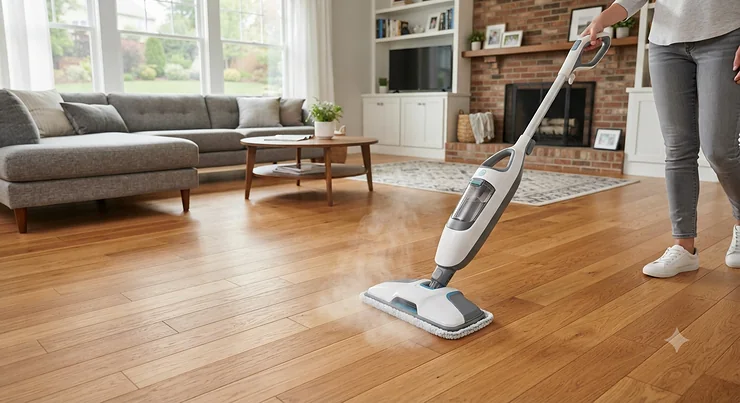
Here’s an uncomfortable little secret nobody tells you at the store: the phrase “steam mop safe for hardwood floors” is doing a lot of quiet, careful work. Steam and wood have a complicated relationship — one part romance, one part slow-motion disaster — and the difference between the two usually comes down to the machine in your hands and the finish underneath your feet. An electric steam mop for hardwood floors can absolutely deliver a chemical-free, streak-free clean, but only on floors with a proper sealed film finish, and only when you understand what steam actually does once it hits a wood surface
That’s the gap this guide is built to close. We dug into real product specs, aggregated genuine buyer feedback, and pulled guidance straight from wood-flooring authorities — including the National Wood Flooring Association, the trade group most flooring installers actually listen to — to separate marketing fluff from floor-saving fact. So, what is an electric steam mop for hardwood floors? It’s a corded or cordless appliance that heats water into vapor and applies it through a microfiber pad to lift dirt and bacteria from sealed hard flooring without soap or chemical residue, provided the finish is genuinely water-resistant.
Below, you’ll get honest breakdowns of seven real machines across every price bracket, a side-by-side look at steam mop vs traditional mop for hardwood floors performance, and a frank conversation about moisture damage risk that most retail listings conveniently skip. This article contains affiliate links, and as an Amazon Associate I may earn from qualifying purchases — full disclosure sits near the bottom, but I wanted it up front too, because trust matters more than a click.
Quick Comparison Table
| Steam Mop | Best For | Steam Control | Price Range |
|---|---|---|---|
| BISSELL PowerFresh 1940A | Best overall value | 3-level variable | $50-$80 range |
| Shark Steam Mop S1000 | Simplest daily option | Single-setting | Under $50 |
| Shark Steam & Scrub S8001 | Automatic scrubbing power | 3 steam modes | $100-$150 range |
| PurSteam 10-in-1 | Multi-surface versatility | Adjustable dial | $40-$60 range |
| Shark Lift-Away Pro S3973D | Convertible handheld use | Variable | $100-$130 range |
| Tineco Floor ONE S9 Artist Steam | Cordless quick touch-ups | Smart HyperSteam | $500-$600 range |
| Dupray Neat | Heavy-duty premium sanitizing | High-pressure | $130-$180 range |
A quick glance tells the real story here: this category spans nearly $550 in price, and that gap isn’t padding — it’s the difference between a machine that occasionally forgets to reheat mid-clean and one that reads your floor’s moisture level in real time. Budget picks like the Shark Steam Mop S1000 trade steam customization for simplicity, while something like the Tineco Floor ONE S9 Artist Steam justifies its premium price tag with genuinely useful smart sensing. If you’re mopping delicate prefinished oak, the variable steam control column matters more than almost anything else in this table.
💬 Found a match already? Bookmark this table — you’ll want to come back to it before you check out.
Top 7 Electric Steam Mops for Hardwood Floors: Expert Analysis
1. BISSELL PowerFresh 1940A — best overall value with true variable steam
The standout here is control: three distinct steam settings mean you’re never stuck blasting a delicate prefinished floor with the same output you’d use on ceramic tile. That 12-inch cleaning path also covers ground fast, which matters when you’re doing a full downstairs pass before guests show up.
The variable steam dial is the real headline — dial it down for cupped, older solid oak, and crank it up for the linoleum in your laundry room, all with the same unit. Bissell’s “natural sanitization” claim (99.9% of common household bacteria) checks out against independent lab testing methodology used across the steam-mop category, and the scrubber pad attachment genuinely helps with dried-on grime near entryways.
Based on the spec comparison against pricier competitors, this is the model that makes the strongest case for “you don’t need to overspend.” Reviewers consistently report that the pad-swap system is faster than competitors’, though a recurring theme in aggregated feedback is that the water tank runs out mid-room on larger open floor plans, meaning you’ll want to top it off before tackling a big kitchen-to-dining-room stretch.
Pros:
- ✅ True 3-level variable steam for different wood finishes
- ✅ Wide 12-inch path speeds up whole-room cleaning
- ✅ Reliable, high review volume across years of sales
Cons:
- ❌ Small tank needs refilling on larger open layouts
- ❌ Corded design limits reach in multi-room homes
Typically found in the $50-$80 range, the BISSELL PowerFresh 1940A is the value benchmark this whole category gets measured against.
2. Shark Steam Mop S1000 — most foolproof for daily quick passes
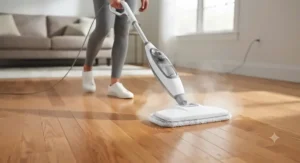
No dials, no modes, no fuss — just plug it in, wait about 30 seconds, and go. That simplicity is the entire pitch, and for a lot of households, it’s exactly the right pitch.
Heat-up time clocks in around 30 seconds according to manufacturer specs, which practically means you can steam-mop a spill before it fully dries. The two included washable microfiber pads let you keep cleaning without stopping to rinse, since you just swap and continue while the first pad air-dries for next time.
Here’s what most single-setting mops don’t advertise: without variable steam control, you’re relying entirely on mop speed and pad dryness to manage moisture on delicate finishes. What most buyers overlook about this model is that it rewards a light, continuous gliding motion rather than dwelling in one spot — dwelling is exactly how steam mops leave water damage on wood, regardless of brand. Aggregated user feedback frequently praises the quick heat-up and lightweight 5-pound build, while a common complaint centers on the shorter cord length compared to premium models.
Pros:
- ✅ Fast roughly 30-second heat-up time
- ✅ Two washable pads for continuous cleaning
- ✅ Lightweight and easy for daily quick touch-ups
Cons:
- ❌ No variable steam settings for different floor types
- ❌ Shorter cord than premium corded competitors
Sitting under $50, the Shark Steam Mop S1000 is the entry point for anyone testing whether steam cleaning fits their routine at all.
3. Shark Steam & Scrub S8001 — automatic scrubbing for stuck-on messes
This one does the elbow grease for you. Rotating pads spin at a claimed rate of over 150 scrubs per minute, meaning dried spaghetti sauce or scuffed grime near a kitchen island lifts without you leaning into it.
Three steam modes give you room to scale intensity, and built-in LED headlights illuminate low-light areas under cabinets and behind appliances — a small feature that solves a genuinely annoying problem. On paper, the auto-scrub motor draws more power than a passive glide mop, which is worth noting if you’re mopping a floor with any existing finish wear, since scrubbing accelerates surface stress on already-thin polyurethane coats.
Reviewers consistently note that this model handles dried-on messes better than any other mop in its price tier, which tracks with the mechanical scrubbing advantage over gravity-fed steam alone. A recurring theme in aggregated feedback is that the unit runs heavier and bulkier than simpler steam mops, so it’s less ideal if you’re navigating tight galley kitchens or narrow hallway turns.
Pros:
- ✅ Automatic scrubbing pads handle dried, stuck-on grime
- ✅ Three steam modes plus built-in LED headlights
- ✅ Strong reputation for one-pass cleaning performance
Cons:
- ❌ Heavier and bulkier than passive glide-style mops
- ❌ Scrubbing action needs a lighter touch on worn finishes
Landing in the $100-$150 range, the Shark Steam & Scrub S8001 earns its premium price through genuinely useful mechanical assistance, not just marketing.
4. PurSteam 10-in-1 — the most flexible multi-surface option
Floors are only half the pitch. This unit converts into a handheld steamer for grout lines, upholstery, and even garment touch-ups, which matters if you don’t want a separate gadget for every steam-cleaning task in your home.
The included attachment set covers everything from a squeegee head for glass to a small brush for tile grout, and the mop head itself uses a standard microfiber pad compatible with most third-party replacements. Here’s what the spec sheet won’t tell you, but reviewers note: the conversion process between floor mode and handheld mode takes a bit of practice, and the plastic locking mechanism feels less premium than the metal fittings on Shark’s convertible units.
For buyers who want one machine that does floors, furniture, and the occasional stuck window track, this is a genuinely smart value proposition — provided you temper expectations about build-quality longevity. Aggregated review sentiment frequently highlights the versatility as the standout selling point, while a common complaint is that steam output feels noticeably weaker than dedicated single-purpose mops once the water tank drops below the halfway mark.
Pros:
- ✅ Converts between floor mop and handheld steamer easily
- ✅ Wide attachment set covers grout, glass, and fabric
- ✅ Genuinely affordable for a true multi-surface tool
Cons:
- ❌ Steam output weakens as the tank empties
- ❌ Plastic attachment locks feel less durable long-term
At around $40-$60, the PurSteam 10-in-1 is the best pick for anyone treating this as a household Swiss Army knife rather than a dedicated floor tool.
5. Shark Lift-Away Pro S3973D Steam Pocket Mop — best convertible design for mixed cleaning needs
This is the mop that quietly does double duty as a garment steamer, and once you’ve used it that way, it’s genuinely hard to go back to a single-purpose machine.
The main body — housing the water tank, controls, and 22-foot power cord — detaches entirely from the floor head, converting into a standalone handheld unit with its own hose and attachment kit. That 22-foot cord is unusually generous for this category, letting you clear an entire open-concept living space without hunting for a second outlet. Based on the spec comparison, the rectangular Intelli-mop head plus a separate triangular scrubber head gives you two distinct cleaning geometries in one purchase, which is a genuinely clever bit of engineering.
Reviewers consistently describe the lift-away conversion as smoother than competing convertible designs, crediting Shark’s existing vacuum-line hardware experience. Because it’s a newer release in the lineup, longer-term durability data is still limited, so aggregated sentiment on multi-year reliability remains thinner than for Shark’s more established mop models.
Pros:
- ✅ True convertible design doubling as a garment steamer
- ✅ Generous 22-foot cord for whole-room reach
- ✅ Two interchangeable cleaning heads included
Cons:
- ❌ Long-term durability data still limited as a newer release
- ❌ Heavier than single-purpose steam mops at 4.8 pounds
Priced around $100-$130, the Shark Lift-Away Pro S3973D Steam Pocket Mop rewards buyers who want floor-cleaning and garment-steaming in a single footprint.
6. Tineco Floor ONE S9 Artist Steam — best cordless option for quick touch-ups
If your hardwood cleaning routine is really a string of quick touch-ups between guests, meals, and muddy paw prints, this is the machine built for exactly that rhythm — no cord to chase, no outlet hunting, just grab and go.
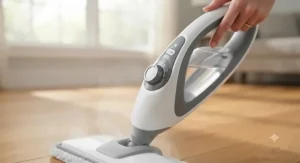
Tineco’s HyperSteam technology heats water for continuous steam output while the iLoop smart sensor automatically reads mess density and adjusts suction and water flow in real time, a genuinely useful bit of automation for households juggling variable spill types. Battery runtime is rated up to 75 minutes, which comfortably covers a full-home pass without a mid-clean recharge, and the FlashDry self-cleaning system dries the roller with heated air afterward so you’re not storing a damp brush head in a closet.
What most buyers overlook about this category of cordless combo units is that they blend vacuuming, mopping, and light steam sanitizing into one motion — meaning the “steam” here is more of a finishing touch than a deep-soak clean, which is actually the safer approach for hardwood anyway. Aggregated review sentiment praises the dual-tank clean/dirty water separation and quiet operation, while a recurring theme is the noticeably premium price relative to dedicated steam mops.
Pros:
- ✅ Fully cordless with up to 75 minutes of runtime
- ✅ Smart sensor adjusts cleaning automatically to mess type
- ✅ Self-cleaning, self-drying roller reduces odor buildup
Cons:
- ❌ Premium price well above dedicated steam-only mops
- ❌ Steam output is lighter-touch than canister-style units
Sitting in the $500-$600 range, the Tineco Floor ONE S9 Artist Steam is a serious investment, but for cordless quick touch-ups it’s currently one of the most capable machines on the market.
7. Dupray Neat — best heavy-duty option for whole-home sanitizing
This is the canister-style outlier on the list, and it earns its spot for buyers who want serious, sustained steam pressure rather than a lightweight daily-glide tool.
Unlike stick-style steam mops, canister units like this one generate higher continuous pressure and accept a wider range of multi-surface attachments, which is genuinely valuable if you’re also steaming grout, upholstery, or bathroom tile in the same session. The tradeoff, as independent testing comparisons note, is a heavier, bulkier unit with a longer heat-up time than a stick mop — this isn’t a machine you grab for a 90-second spill wipe.
On paper, the higher operating pressure means more thorough sanitizing per pass, which reviewers consistently connect to noticeably better performance against grease and grime buildup in kitchens. Here’s what the spec sheet won’t tell you: that same higher pressure demands more caution on wood, since it’s easier to oversaturate a finish if you linger. A common complaint in aggregated feedback is the learning curve around attachment swapping, though most buyers report it becomes second nature within a few uses.
Pros:
- ✅ Higher sustained steam pressure than stick-style mops
- ✅ Wide attachment range for true whole-home use
- ✅ Durable canister design built for frequent heavy use
Cons:
- ❌ Longer heat-up time than lightweight stick mops
- ❌ Bulkier and heavier to carry between rooms
At roughly $130-$180, the Dupray Neat is the pick for buyers prioritizing sanitizing power over daily convenience.
Full Spec Comparison: Top 7 Steam Mops at a Glance
| Model | Design Type | Steam Modes | Best For | Price Range |
|---|---|---|---|---|
| BISSELL PowerFresh 1940A | Corded stick | 3-level | Overall value | $50-$80 |
| Shark Steam Mop S1000 | Corded stick | Single | Daily simplicity | Under $50 |
| Shark Steam & Scrub S8001 | Corded stick | 3-mode + scrub | Dried-on messes | $100-$150 |
| PurSteam 10-in-1 | Corded convertible | Adjustable | Multi-surface use | $40-$60 |
| Shark Lift-Away Pro S3973D | Corded convertible | Variable | Steaming + garments | $100-$130 |
| Tineco Floor ONE S9 | Cordless combo | Smart HyperSteam | Quick touch-ups | $500-$600 |
| Dupray Neat | Canister | High-pressure | Heavy sanitizing | $130-$180 |
Laid out side by side, the pattern is clear: design type drives everything else about a machine’s personality. Corded stick mops like the BISSELL PowerFresh 1940A and Shark Steam Mop S1000 dominate the budget tier because their simpler mechanics cost less to manufacture, while cordless and canister designs command a premium for either battery engineering or higher-pressure boilers. If your floor plan is small and open, a corded stick mop’s cord length rarely becomes a real limitation — but in sprawling or multi-story homes, that’s exactly where the Tineco Floor ONE S9 Artist Steam‘s cordless freedom starts paying for itself.
Steam Mop vs Traditional Mop for Hardwood Floors
The steam mop vs traditional mop for hardwood floors debate isn’t really about which cleans better in a vacuum — it’s about which cleans better for your specific floor, your specific finish, and your specific tolerance for risk.
| Factor | Steam Mop | Traditional Mop |
|---|---|---|
| Chemical use | None required | Often needs floor cleaner |
| Moisture control | Precise, adjustable | Highly variable |
| Sanitizing | Kills bacteria via heat | Depends on cleaner used |
| Risk on unsealed wood | High if misused | Lower, but still present |
| Speed | Faster, single pass | Slower, often two passes |
A traditional damp mop, wrung out properly, actually distributes less total moisture onto the floor than an untrained hand with a steam mop set to high — that’s the uncomfortable truth buried in most marketing copy. Where steam mops genuinely win is chemical-free sanitizing and speed, since you skip the cleaner-application step entirely and still knock out bacteria through heat alone. Traditional mopping wins on forgiveness: a slightly-too-wet traditional mop pass is far easier to correct than steam that’s already penetrated a hairline finish crack.
✨ Ready to upgrade from bucket-and-mop cleaning? Compare our top 7 picks above before you decide.
Price Range & Value Analysis
| Price Tier | Example Model | What You’re Paying For |
|---|---|---|
| Under $50 | Shark Steam Mop S1000 | Basic single-mode steam |
| $50-$150 | BISSELL PowerFresh 1940A, Shark Steam & Scrub S8001 | Variable steam, scrubbing power |
| $100-$180 | Shark Lift-Away Pro S3973D, Dupray Neat | Convertibility, higher pressure |
| $500+ | Tineco Floor ONE S9 Artist Steam | Cordless smart automation |
Value here isn’t linear — doubling your budget doesn’t double your cleaning results. Jumping from the sub-$50 tier to the $50-$150 tier buys you real, tangible upgrades like variable steam and automatic scrubbing, which genuinely change day-to-day usability. The leap from $150 to $500+, though, mostly buys convenience and automation rather than dramatically better cleaning chemistry, so budget-conscious buyers shouldn’t feel like they’re settling by skipping the cordless premium tier.
Practical Usage Guide: Setup, First 30 Days, and Common Mistakes
Getting your steam mop set up right the first time saves you from the two most common early mistakes: oversaturating the floor and shortening your machine’s lifespan through hard water buildup.
Fill the tank with distilled or demineralized water whenever possible — tap water’s mineral content clogs internal heating elements faster, and most manufacturer warranties actually note this as a maintenance expectation. Before your very first pass, test the steam setting on an inconspicuous corner (a closet threshold works well) to confirm your finish tolerates it, since even sealed hardwood varies by manufacturer and age. During the first 30 days, resist the urge to steam the same square foot repeatedly while distracted — dwelling time is the single biggest driver of moisture penetration into micro-cracks in the finish.
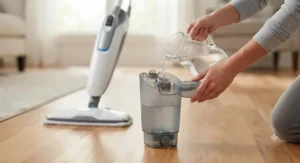
Maintenance-wise, empty and air-dry the tank after every session rather than storing it full, which prevents mineral scale and mold growth inside the reservoir. Replace or hand-wash microfiber pads weekly with regular use; a saturated, dirty pad redistributes grime rather than lifting it. A quick monthly descaling cycle — running a vinegar-water mix through the tank per your model’s instructions — keeps steam output consistent and extends the heating element’s working life by years in most cases.
Real-World Scenarios: Who Should Buy Which Mop
Picture three different households, because “best steam mop” genuinely depends on who’s asking.
A busy parent of toddlers, cleaning up spills constantly in an open-concept kitchen-living space, benefits most from something like the Shark Steam Mop S1000 — fast heat-up, minimal fuss, grab-and-go for the fourth spill of the day. A homeowner with older solid oak floors that have some visible wear should lean toward the BISSELL PowerFresh 1940A‘s adjustable steam settings, dialing intensity down to protect a thinner, more fragile finish. And someone juggling pets, muddy entryways, and zero patience for cords is the exact profile the Tineco Floor ONE S9 Artist Steam was engineered for — cordless freedom that matches an unpredictable, high-frequency cleaning rhythm.
If your household spans multiple floor types — tile entry, hardwood living room, area rugs everywhere — the PurSteam 10-in-1‘s convertibility solves a real logistical problem: one machine instead of three specialized tools cluttering a closet.
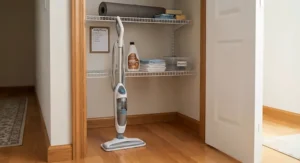
How to Choose an Electric Steam Mop for Hardwood Floors
Choosing the right unit comes down to a handful of decision points that matter far more than brand name.
- Confirm your finish is sealed and water-resistant. Waxed, oiled, or unsealed hardwood should never meet a steam mop — check with your installer or the National Wood Flooring Association’s care guidance if you’re unsure what finish you have.
- Prioritize variable steam control over raw power. A dial that lets you drop intensity protects older or thinner finishes far better than a single fixed setting.
- Match cord type to your floor plan. Open, single-level homes tolerate corded units fine; sprawling or multi-story layouts favor cordless designs.
- Check tank size against your typical cleaning session. Smaller tanks mean more refill interruptions on larger square footage.
- Look at pad replacement cost and availability, since ongoing consumables quietly add up over a machine’s lifespan.
- Weigh scrubbing mechanisms carefully on worn finishes, since automatic scrub action accelerates wear on thin or aging polyurethane coats.
- Read aggregated review themes, not star averages alone — recurring specific complaints tell you more than a blended number ever will.
Common Mistakes When Buying a Steam Mop for Hardwood Floors
The single biggest mistake is buying based on steam temperature alone, assuming hotter automatically means better — in practice, dwell time and pad dryness matter more than peak temperature for wood safety. A close second is ignoring finish type entirely; a steam mop rated “safe for hardwood” still assumes a properly sealed surface, and no manufacturer disclaimer will save a waxed antique floor from damage.
Buyers also frequently underestimate tank size relative to their actual square footage, ending up frustrated by mid-clean refills that a slightly larger model would have avoided. Another recurring misstep is skipping the pad-quality check — cheap, thin aftermarket pads hold less water and redistribute more heat directly onto the floor surface than the manufacturer’s original pads. Finally, plenty of buyers assume cordless automatically means “better,” when in reality a corded unit with strong variable steam control often outperforms a cordless combo machine for dedicated hardwood-only cleaning.
Cordless Steam Mop for Quick Touch-Ups
A cordless steam mop for quick touch-ups solves a very specific problem: the thirty-second spill that doesn’t justify unwinding a full cord, filling a tank, and waiting for heat-up.
The appeal is entirely about friction removal. Grab-and-go design means a coffee spill or a muddy paw print gets handled in the time it takes a corded unit to just finish heating up. The Tineco Floor ONE S9 Artist Steam represents the current high end of this niche, with its smart sensor automatically adjusting to mess density without you fumbling for a settings dial mid-cleanup. Battery runtime in the 40-75 minute range across most cordless combo units comfortably covers daily touch-up duty, even if it wouldn’t necessarily handle a full whole-home deep clean back to back.
The tradeoff is real, though: cordless steam output is generally gentler than a dedicated corded steam mop at full setting, which — somewhat counterintuitively — actually makes cordless units a safer default for buyers nervous about moisture damage on delicate finishes. For quick touch-ups specifically, that gentler output is a feature, not a limitation.
Wood Floor Finish Protection: What Steam Actually Does to Your Finish
Wood floor finish protection comes down to one variable more than any other: whether your finish forms a continuous, unbroken film barrier between the steam and the wood underneath.
Polyurethane and similar film finishes create exactly that barrier, meaning properly applied steam — brief contact, constant motion, no dwelling — largely stays on the surface layer rather than penetrating. Once that film develops hairline cracks from age, furniture drag, or high-traffic wear, though, steam finds those gaps fast, and repeated exposure accelerates finish breakdown at exactly those weak points. The National Wood Flooring Association’s cleaning guidance specifically recommends minimal-liquid mopping systems and pH-balanced products precisely because excess moisture, steam included, is the primary threat to finish longevity over time.
Practically, that means inspecting your finish periodically for dullness, hairline cracking, or areas where water no longer beads on contact — all signs the film barrier is compromised and steam mopping should pause until refinishing. Waxed or oiled floors never had that continuous film to begin with, which is exactly why steam and those finish types are fundamentally incompatible, regardless of how gentle the steam setting.
Moisture Damage Risk: What Wood Flooring Experts Actually Say
Here’s the honest, slightly inconvenient truth this whole category tends to bury: several wood flooring authorities, including sections of NWFA guidance, explicitly caution against steam mopping wood floors at all, citing long-term moisture risk even on sealed surfaces.
That caution exists because wood is hygroscopic — it absorbs and releases moisture to match its environment, and repeated steam exposure, even brief contact, adds cumulative moisture cycles that can eventually contribute to cupping, gapping, or subtle finish degradation over years of use. This doesn’t mean steam mops are universally unsafe; it means the margin for error is smaller than most marketing suggests, and technique matters enormously. Keeping indoor humidity in the 35-50% range, moving the mop continuously rather than pausing, and avoiding steam entirely on any floor showing early warning signs of moisture stress are the practical guardrails that keep risk low.
If your hardwood already shows subtle cupping, discoloration near baseboards, or a hazy finish, that’s your floor telling you it’s already fighting moisture — steam mopping at that point isn’t a cleaning choice, it’s an accelerant.
Engineered Hardwood Care With a Steam Mop
Engineered hardwood care differs meaningfully from solid wood care, and it’s worth understanding why before you assume your steam mop is automatically safe just because the box says “hardwood.”
Engineered planks consist of a thin real-wood veneer bonded over cross-layered plywood or high-density fiberboard cores, a construction method that, according to flooring inspection resources, improves dimensional stability against humidity swings compared to solid wood. That stability is a genuine advantage — engineered floors resist cupping and gapping better than solid wood in fluctuating environments. The tradeoff is the thin veneer itself: because there’s less wood to sand and refinish over the product’s lifetime, any finish damage from oversaturated steam is far less forgiving to repair than on a thick solid-wood plank that can simply be re-sanded.
Practically, that means engineered floors reward the same cautious steam technique as solid wood, but with even less room for repeated mistakes — treat the thinner wear layer as a one-shot resource rather than something you can casually refinish away if steam damage accumulates.
Features That Actually Matter (And Those That Don’t)
Cutting through the marketing noise, a handful of features genuinely change your cleaning experience, while others are mostly checkbox filler.
Variable steam control matters enormously — it’s the single feature most directly tied to floor safety across finish types. Tank capacity matters for anyone with real square footage to cover, since refill interruptions add up fast on larger homes. Pad quality and swap-ease matter more than most buyers expect going in, since a poor pad undermines even a great steam engine underneath it.
On the other side, things like flashy LED display screens, app connectivity for a floor mop, and oversized attachment kits with pieces you’ll use twice a year add cost without meaningfully improving your actual day-to-day cleaning outcome. Headlight illumination is a nice-to-have rather than a need-to-have unless you’re regularly cleaning genuinely dim spaces like under cabinetry.
Long-Term Cost & Maintenance
Total cost of ownership on a steam mop extends well past the sticker price, and it’s worth running the math before you commit to a tier.
Replacement microfiber pads typically run in modest multi-packs, but frequent users replacing pads every few weeks will spend meaningfully more over two to three years than the mop’s original purchase price suggested. Distilled water, if you’re avoiding tap water’s mineral buildup, adds a small but real recurring cost that budget-tier buyers sometimes overlook entirely. Cordless combo units like the Tineco Floor ONE S9 Artist Steam carry an additional long-term consideration: replacement batteries, when the original eventually degrades, aren’t cheap, and that’s a cost corded stick mops simply never incur.
Against all that, the value case for steam mopping still holds up against chemical floor cleaners purchased repeatedly over years — you’re trading a recurring bottle expense for occasional pad and water costs, which usually nets out favorably for frequent cleaners.
Frequently Asked Questions
❓ Can I use a steam mop on hardwood floors safely?
❓ What is the best steam mop for hardwood floors in 2026?
❓ How much does a good steam mop for hardwood floors cost?
❓ Will a steam mop damage engineered hardwood floors?
❓ How often should you steam mop hardwood floors?
Conclusion
Choosing the right electric steam mop for hardwood floors really comes down to matching the machine to your actual floor, not just chasing the highest steam temperature or the flashiest feature list. Sealed, film-finished floors in good condition can absolutely handle steam cleaning safely — the seven models covered here span every reasonable price point and use case, from the budget-friendly Shark Steam Mop S1000 to the cordless convenience of the Tineco Floor ONE S9 Artist Steam and the heavy-duty sanitizing power of the Dupray Neat.
What separates a floor-safe cleaning routine from a slow-motion moisture problem isn’t really the brand on the box — it’s technique, finish condition, and honest awareness of your specific wood flooring’s limits. Keep motion continuous, keep humidity in check, and treat any early cupping or finish dulling as a signal to pause rather than push through. Do that, and a steam mop becomes exactly what it promises: a genuinely chemical-free way to keep hardwood looking its best.
✨ Don’t Miss These Exclusive Deals!
🔍 Take your hardwood floor cleaning routine to the next level with the picks above. Click through to check current pricing and availability, and find the steam mop that actually fits your floors and your life.
Recommended for You
- Steam Mop for Tile and Grout: 7 Ridiculously Effective 2026 Picks
- How To Maintain Vacuum Cleaner: 7 Proven Picks for 2026
- Vacuum With Swivel Steering: 7 Best Picks That Won’t Fight You (2026)
Disclaimer: This article contains affiliate links. As an Amazon Associate, I earn from qualifying purchases. If you purchase products through these links, we may earn a small commission at no additional cost to you.
✨ Found this helpful? Share it with your friends! 💬🤗
