
In This Article
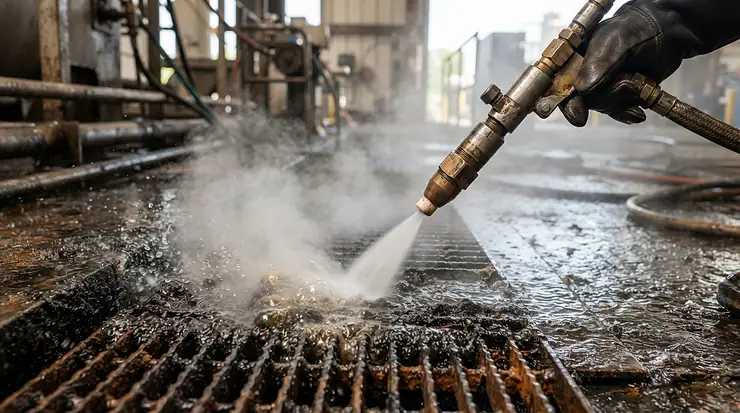
Grease doesn’t care how hard you scrub. Cold water just skates across it, beading up like rain on a freshly waxed hood while the actual grime underneath laughs and stays put. That’s the whole reason a hot water pressure washer for grease removal exists in the first place — heat does the chemistry that pressure alone can’t. Warm the oil enough and it stops behaving like a solid stuck to metal and starts behaving like a liquid that wants to leave.
So, what is a hot water pressure washer for grease removal? It’s a pressure washer equipped with a heating element, burner, or heat exchanger that raises outlet water temperature — often to 140°F–225°F — so pressure and heat work together to break down oil, grease, and baked-on grime that cold-water units can’t touch.
Auto detailing shops, quick-lube bays, fleet maintenance yards, and even serious home garages all run into the same wall eventually: a cold-water unit that’s rated for 3,000 PSI still can’t cut through a transmission that’s been leaking fluid onto a shop floor for three years. This guide walks through seven real, currently-available machines spanning entry-level electric units up to full commercial gas rigs, plus the buying logic, maintenance realities, and workshop-specific advice that actually determines whether you’ll be happy with what you buy.
One quick regulatory note before we get into the gear: commercial washwater — especially anything containing oil, grease, or detergent — generally can’t legally go down a storm drain. The EPA’s NPDES stormwater program regulates exactly this kind of discharge, and it’s worth understanding before you’re hosing a bay floor into the street.
Quick Comparison Table: Best Hot Water Pressure Washers at a Glance
| Model | Power Type | Best For |
|---|---|---|
| AR Blue Clean Pro AR630HW | Electric (accepts external hot water) | Budget entry point for small shops |
| Simpson MB1518 Mini Brute | Electric motor + diesel burner | Indoor-safe bay cleaning |
| Delux 320EC | Electric + diesel burner | Auto detailing shops (purpose-built) |
| Mi-T-M HSP-3504-3MGH | Gas (Honda GX390) + diesel burner | Best all-around commercial pick |
| Mi-T-M HSE-4004-0M10 | Electric + diesel/kerosene burner | Premium indoor industrial use |
This snapshot isn’t the full lineup — there are two more machines below covering the budget-gas and heavy-industrial ends of the spectrum — but it’s a fast way to see where each unit lands. Notice the split between machines that generate their own hot water and the AR Blue Clean Pro AR630HW, which is a hot-water-capable electric washer that needs an external heat source feeding it. That distinction matters more than most buying guides admit, and we’ll unpack it properly in the comparison section below.
📋 Bookmark this table — you’ll want to reference it while reading the full breakdowns below.
Top 7 Hot Water Pressure Washers for Grease Removal: Expert Analysis
1. AR Blue Clean Pro AR630HW — accepts inlet water up to 180°F
The standout feature here is flexibility: this machine doesn’t generate its own heat, but it’s built to accept pre-heated water up to 180°F, which turns it into a genuine hot-water degreasing tool if you already have a hot spigot or a separate heater.
Under the hood, it’s a 1,600 PSI, 2.3 GPM electric unit running on a 20-amp induction motor with a nickel-plated brass triplex pump built around an Annovi Reverberi pump platform. What that combination actually means in practice: this is a quiet, indoor-friendly machine with pump internals that resist corrosion far better than the painted-steel pumps you’ll find on big-box store units, so you’re not trading durability for the lower price tag.
Based on the spec comparison, the AR Blue Clean Pro AR630HW makes the most sense for a solo detailer or small shop that already has hot water plumbed in — a garage water heater, a tankless unit, or a shared hot line — rather than someone who needs a self-contained heating burner. Verified aggregated review data specific to this exact SKU is limited at time of research, but the AR630 platform it’s built on has a long track record among detailers for pump reliability, which the hot-water variant inherits.
Pros:
- ✅ Accepts hot water up to 180°F for real grease-cutting power
- ✅ Corrosion-resistant nickel-plated triplex pump
- ✅ Quiet enough for indoor detail bay use
Cons:
- ❌ Doesn’t generate its own heat — needs an external hot source
- ❌ Lower 1,600 PSI ceiling limits heavy industrial jobs
Typically priced in the $300-$450 range at the time of research — check current price before buying, as it fluctuates. For a shop that already has hot water access, this is genuinely strong value; without it, you’re really shopping for a different category of machine.
2. Simpson MB1518 Mini Brute — safe for indoor electrical outlets
What immediately stands out about the Mini Brute is that it’s designed to plug into a standard 15-amp household circuit, which is rarer than it should be in this category.
Specs-wise, it delivers 1,500 PSI at 1.8 GPM through a 120-volt heavy-duty induction motor paired with a diesel-fired burner that raises incoming water temperature by roughly 100°F. What that temperature rise means in real terms: if your tap water comes in around 60°F, you’re spraying somewhere near 160°F — comfortably in grease-melting territory — without needing a 240-volt commercial circuit or an outdoor gas engine spewing exhaust into an enclosed bay.
Here’s what most buyers overlook about this model: the “indoor-safe” branding isn’t marketing fluff, it’s a genuine engineering decision. A gas-powered unit inside a closed service bay creates a carbon monoxide hazard, which the CDC’s pressure washer safety guidance flags directly for anyone running fuel-powered equipment in partially enclosed spaces. The Mini Brute sidesteps that entirely — the motor’s electric, only the burner uses diesel, and the burner exhaust is designed for that use case.
Pros:
- ✅ Runs on a standard 15-amp outlet, safe indoors
- ✅ Diesel burner adds roughly 100°F without a gas engine
- ✅ Heat-resistant spray gun rated to 320°F
Cons:
- ❌ 1,500 PSI ceiling is modest for heavy commercial grease
- ❌ 4-gallon diesel tank means more frequent refills on long jobs
Pricing runs roughly in the $2,800-$3,300 range depending on retailer at the time of research. For a one-bay shop that can’t run a gas engine indoors, this is close to the only sensible option in its class.
3. Delux 320EC — purpose-built for detail shops and auto repair stations
The standout advantage on the 320EC is right there in the manufacturer’s own framing: it’s specifically marketed as custom-built for detail shops and automotive repair stations, not adapted from a general-industrial platform.
It runs 2,000 PSI at 3.0 GPM, powered by a 4 HP, 230-volt single-phase electric motor paired with a stainless-steel-housed diesel burner capable of hitting 200°F outlet temperatures. On the pump side, it uses a direct-drive General triplex pump with ceramic plungers — the same pump architecture found in far more expensive industrial units, just sized down to a shop-appropriate footprint. What that means practically: you get commercial-grade pump longevity in a machine actually proportioned for a service bay rather than a construction yard.
Here’s what the spec sheet won’t tell you, but the target market makes obvious: at 2,000 PSI, this unit is deliberately tuned below the 3,000+ PSI range of construction-grade machines. That’s not a weakness for detailing work — it’s a feature. Auto body panels, engine bays, and wheel wells don’t need 4,000 PSI; they need sustained heat and moderate, controllable pressure that won’t strip clear coat or blast trim loose.
Pros:
- ✅ Engineered specifically for detail shops, not repurposed industrial gear
- ✅ 200°F outlet temperature with a stainless burner housing
- ✅ 35-foot GFCI power cord for bay flexibility
Cons:
- ❌ 350 lbs shipping weight means it’s a stationary, not mobile, setup
- ❌ Premium price for its PSI class compared to general-purpose units
Expect a price point in the $5,200-$5,500 range at time of research. If your business card literally says “detailing” or “auto repair,” this is the machine built with your floor plan in mind.
4. Mi-T-M HSP-2503-0MMH — Honda-powered EMF ignition, no battery needed
The standout hook on this model is its Electro Magnetic Firing system, which ignites the burner without requiring a separate 12-volt battery — one less maintenance item and one less thing to die on you in a cold shop.
Specs: 2,500 PSI at 2.6 GPM, driven by a 196cc Honda OHV engine producing 210,000 BTUs per hour, with a temperature rise of 150°F above ambient and a maximum outlet temperature around 200°F. On paper this means a fairly modest mid-tier gas unit, but the BTU output punches above its PSI rating — that heat number is genuinely comparable to units with much higher price tags, because Mi-T-M didn’t cut corners on the burner to hit a lower price point.
Reviewers and trade forum discussions around the HSP platform consistently point to the EMF system’s reliability advantage over battery-ignition burners, which tend to fail exactly when you need heat most — in cold weather, first thing in the morning. That’s a common complaint about competing systems that this model was specifically designed to avoid.
Pros:
- ✅ Battery-free EMF ignition simplifies cold-weather startup
- ✅ 210,000 BTU/hr output rivals higher-PSI competitors
- ✅ 7-year pump warranty signals serious build confidence
Cons:
- ❌ 2.6 GPM flow rate is on the lower side for large surface jobs
- ❌ Not CARB-compliant in some configurations — check state restrictions
Pricing sits roughly in the $4,200-$4,900 range based on research at time of writing. It’s the sensible middle ground between the detail-shop electrics above and the full-commercial gas units below.
5. Mi-T-M HSP-3504-3MGH — Honda GX390 with 140°F temperature rise
This is the model that shows up most often in commercial shop recommendations, and the standout reason is balance: enough PSI and GPM for genuinely tough jobs without tipping into overkill territory or trailer-mount pricing.
It delivers 3,500 PSI at 3.3 GPM through a Honda GX390 389cc engine and a direct-drive oil-bath triplex pump with a forged brass manifold, ceramic plungers, and stainless-steel valves. The EMF firing system produces up to a 140°F temperature rise with a max outlet temperature around 210°F. What that combination means in the field: enough flow and pressure to cover a full shop floor in a reasonable time window, and enough heat to actually dissolve axle grease and undercarriage tar, not just soften it.
Based on the spec comparison against the HSP-2503 above, the jump to 3,500 PSI and the larger Honda engine costs real money, but the extra 0.7 GPM of flow adds up fast on larger jobs — that’s roughly 25% more water moving per minute, which translates directly into less time standing in one spot re-blasting the same grease stain.
Pros:
- ✅ Honda GX390 engine is a known-reliable commercial workhorse
- ✅ 140°F temperature rise handles stubborn undercarriage grease
- ✅ Forged brass manifold and ceramic plungers built for daily use
Cons:
- ❌ 550 lb shipping weight requires freight delivery, not a quick pickup
- ❌ Not sold in California per manufacturer listing — verify local availability
At the time of research, pricing ranged from roughly $5,600 to $7,800 depending on retailer and included accessories — always confirm current pricing before ordering. For a shop that wants one machine to handle nearly everything, this is the one most trade sources point to first.
6. Mi-T-M HSE-4004-0M10 — 4,000 PSI electric with 225°F output
The standout advantage here is unusual: full commercial-grade pressure and heat output, delivered through an electric motor instead of a gas engine — a rare combination at this power level.
It runs 4,000 PSI at 3.5 GPM via a 10 HP, 230-volt electric motor paired with a diesel- or kerosene-fired heat exchanger capable of reaching 225°F, the highest outlet temperature in this lineup. The pump is a Mi-T-M direct-drive triplex unit with a forged brass manifold and pressure-relief start system. What most buyers overlook about this configuration: running 4,000 PSI without a gas engine means no exhaust fumes and dramatically lower noise, which matters enormously if this machine is going to live inside an enclosed bay rather than an outdoor wash pad.
The spec sheet won’t tell you this, but the 10-gallon fuel tank on the burner side (separate from the electric motor) is sized for extended commercial runtime — this isn’t a machine designed to be topped off every hour, it’s built for a full working shift.
Pros:
- ✅ 4,000 PSI commercial power without gas-engine exhaust
- ✅ 225°F max output — the hottest unit in this comparison
- ✅ 10-gallon burner fuel tank for extended shift runtime
Cons:
- ❌ Highest price point in this lineup by a significant margin
- ❌ 230V electric requirement means dedicated wiring in most shops
Expect pricing in the $10,000-$10,500 range at time of research. This is a premium purchase aimed squarely at high-volume operations that need commercial heat and pressure indoors.
7. Easy-Kleen 4000 PSI (15HP Gas) — trailer-portable industrial-grade output
The standout feature is mobility at industrial scale: 4,000 PSI and 3.5 GPM built onto a heavy-duty steel frame with oversized pneumatic tires, designed to roll across gravel and mud, not just smooth concrete.
It’s powered by a 15 HP gasoline engine with electric start, paired with a diesel-fired hot water burner. What that pairing means in the field: no pull-cord hassle in cold weather, and enough raw heat and pressure to strip sludge off farm equipment or construction gear, not just clean a car. Reviewers and dealers commonly position this class of machine for fleet washdown, heavy equipment maintenance, and construction-site cleanup as much as auto detailing — it’s the most industrial-leaning unit in this list.
Here’s the honest tradeoff: this specific listing ships as-is with no manufacturer warranty, which is a meaningful consideration compared to the Mi-T-M units above that carry multi-year pump and engine warranties. That’s reflected in the price, but it’s worth weighing against your risk tolerance for a machine you can’t easily return.
Pros:
- ✅ 15HP electric-start gas engine — no pull-cord in cold weather
- ✅ Oversized pneumatic tires for job-site mobility
- ✅ 4,000 PSI / 3.5 GPM matches full commercial output
Cons:
- ❌ Sold as-is with no manufacturer warranty on this specific listing
- ❌ Heaviest, least indoor-friendly unit in this roundup
Pricing for machines in this class typically runs $6,000-$8,000 based on comparable listings at time of research — confirm current availability and warranty terms directly with the seller. If mobility across rough terrain matters more than warranty security, this earns its spot.
💬 Already narrowing down your pick? Comparing PSI and GPM side-by-side below will make the decision a lot easier.
Top 7 Products Comparison Table
| Model | PSI / GPM | Power Type | Price Range | Best For |
|---|---|---|---|---|
| AR Blue Clean Pro AR630HW | 1,600 / 2.3 | Electric (needs external hot water) | $300-$450 | Budget entry, existing hot water access |
| Simpson MB1518 Mini Brute | 1,500 / 1.8 | Electric motor + diesel burner | $2,800-$3,300 | Indoor bays, standard outlets |
| Delux 320EC | 2,000 / 3.0 | Electric + diesel burner | $5,200-$5,500 | Purpose-built detail shops |
| Mi-T-M HSP-2503-0MMH | 2,500 / 2.6 | Gas (Honda) + diesel burner | $4,200-$4,900 | Mid-tier commercial use |
| Mi-T-M HSP-3504-3MGH | 3,500 / 3.3 | Gas (Honda GX390) + diesel burner | $5,600-$7,800 | All-around commercial pick |
| Mi-T-M HSE-4004-0M10 | 4,000 / 3.5 | Electric + diesel/kerosene burner | $10,000-$10,500 | Premium indoor industrial |
| Easy-Kleen 4000 PSI | 4,000 / 3.5 | Gas (15HP) + diesel burner | $6,000-$8,000 | Heavy-duty, job-site mobility |
Looking at the table, there’s a clear split between electric units built for enclosed, indoor bays and gas units built for open-air commercial or industrial sites. The Mi-T-M HSP-3504-3MGH sits in the sweet spot of PSI, GPM, and price for most auto-focused shops, while the Mi-T-M HSE-4004-0M10 justifies its premium price only if indoor operation without exhaust fumes is a hard requirement. Budget-conscious buyers should note that the AR Blue Clean Pro AR630HW only competes on price if you already have a hot water source to feed it — otherwise you’re comparing apples to a completely different machine category.
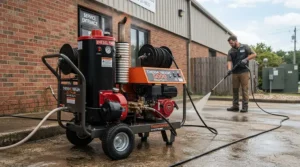
Practical Usage Guide: Setting Up Your Hot Water Pressure Washer for Grease Jobs
Getting a new unit running correctly in the first 30 days prevents most of the early failures shops run into. Start by flushing the system with clean water before the first hot-water run — manufacturing residue and pump-preservation oils need to clear out before you introduce heat, or you risk scorching residue onto internal components.
Next, prime the burner fuel system according to the manual before your first heated pass; running the burner dry, even briefly, is one of the fastest ways to damage a heat exchanger coil. Once running, work through a first-use degreasing pass at the lowest effective pressure and widest nozzle angle, then step down in angle only as needed — this protects trim, gaskets, and painted surfaces while you’re still learning how the machine’s spray pattern behaves.
For maintenance, set a weekly rhythm: check pump oil levels, inspect the high-pressure hose for abrasion near fittings, and clean or replace inline water filters before sediment reaches the pump. Monthly, de-scale the heat exchanger coil if you’re running hard water — mineral buildup is the single biggest silent killer of heating efficiency in this equipment category, gradually reducing your outlet temperature without any obvious warning sign until output noticeably weakens.
The most common first-30-days mistake isn’t mechanical — it’s chemical. New owners frequently pair aggressive degreasers with maximum heat and pressure simultaneously, which strips wax, clear coat, and paint sealant right along with the grease. Dial in one variable at a time.
Real-World Scenarios: Matching the Right Machine to Your Situation
The solo mobile detailer. Running out of a van, working driveways and small commercial lots, budget under $500, no access to shop power beyond a standard outlet. The AR Blue Clean Pro AR630HW paired with a portable water heater fits this exactly — light enough to move, quiet enough for residential neighborhoods, and genuinely hot-water capable without a commercial-scale burner system.
The single-bay auto repair shop. Fixed location, standard electrical service, needs to run indoors during winter without ventilation concerns. The Simpson MB1518 Mini Brute or the Delux 320EC both solve this — electric motors avoid the carbon monoxide risk that gas engines create in enclosed spaces, a concern the CDC specifically flags for indoor equipment use.
The multi-bay commercial detailing operation or fleet maintenance yard. Higher volume, outdoor or well-ventilated space available, budget for commercial-grade equipment. The Mi-T-M HSP-3504-3MGH covers daily heavy use, while operations needing to work in gravel lots or construction sites should look at the Easy-Kleen 4000 PSI for its terrain-ready tires and higher raw output.
How to Choose a Hot Water Pressure Washer for Grease Removal
- Match PSI and GPM to your actual surface area. More square footage per day means prioritizing GPM over PSI — flow rate determines how fast you cover ground, not just how hard the water hits.
- Decide electric vs. gas based on your workspace. Enclosed bays favor electric motors; open lots and job sites favor gas engines for mobility and independence from outlets.
- Check maximum outlet temperature, not just “hot water” claims. A 140°F unit and a 225°F unit are not interchangeable for heavy grease — verify the actual number.
- Confirm burner fuel type and tank size. Diesel and kerosene burners need refueling logistics factored into daily operations, especially on longer shifts.
- Verify pump construction materials. Ceramic plungers and brass manifolds outlast painted-steel or plastic components significantly under daily commercial use.
- Factor in warranty coverage separately from price. As-is listings without manufacturer warranty carry real risk that a slightly higher sticker price often eliminates.
- Plan for wastewater capture before you buy, not after. Commercial washwater discharge rules apply regardless of which machine you choose.
Hot Water vs Cold Water Pressure Washer for Grease Cleaning
The core difference isn’t subjective — it’s thermodynamic. Grease and oil are semi-solid at room temperature because their molecular chains are tightly bound; heat loosens those bonds, turning stubborn residue into something pressure can actually flush away rather than just smear around. A cold-water unit at 4,000 PSI can physically dislodge loose dirt just fine, but on baked-on grease, that same pressure often just polishes the grime into the surface rather than removing it.
This is why commercial kitchens, auto shops, and industrial facilities standardize on hot water equipment specifically for grease-heavy environments, while landscapers and general exterior cleaners frequently stick with cold-water units for dirt, mildew, and loose debris where heat adds cost without meaningfully improving results. Reviewers across trade forums consistently describe combining hot water with a targeted degreaser as the actual winning formula — heat alone or pressure alone each fall short of what the combination achieves.
The tradeoff is real, though: hot water units cost more upfront, need burner fuel or an external heat source, and require more maintenance attention to the heating components. For general driveway and siding cleaning, that extra complexity isn’t worth it. For grease-specific work, it’s close to non-negotiable.
Hot Water Pressure Washers for Auto Detailing Shops
Auto detailing introduces constraints that industrial cleaning doesn’t have to worry about: painted surfaces, trim, rubber seals, and customer vehicles that need to leave looking better, not stripped. This changes the buying calculus significantly compared to a construction-equipment washdown pad.
Detail-shop-appropriate units, like the Delux 320EC, tend to sit in the 1,600-2,500 PSI range rather than pushing toward 4,000 PSI — enough heat and flow to melt engine bay grease and undercarriage tar, without pressure high enough to peel clear coat or force water past door seals. Nozzle selection matters as much as the machine itself here; wide-angle tips paired with sustained heat consistently outperform narrow, high-pressure tips on painted surfaces.
Electric units also solve a practical shop-floor problem: most detail bays are indoor or semi-enclosed, and running a gas engine in that environment creates ventilation headaches that electric motors simply avoid. If your shop’s floor plan includes customer-facing waiting areas near the bay, noise level becomes a real factor too — induction motors run noticeably quieter than small gas engines under load.
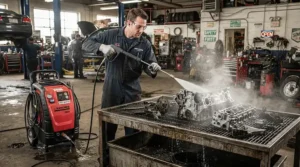
Grease-Cutting Temperature: What the Science Really Means for Your Cleaning Results
Not all “hot water” claims are created equal, and the actual outlet temperature number matters more than most marketing copy suggests. Light automotive grease and fresh oil residue start loosening noticeably around 120-140°F. Heavier, aged grease and baked-on undercarriage tar typically needs sustained exposure closer to 180-210°F to break down efficiently, which is exactly why the machines in this guide cluster around that range rather than pushing toward true steam temperatures above 212°F.
What most buyers overlook here: temperature rise isn’t just about the burner’s rated output — incoming water temperature, ambient air temperature, and flow rate all affect the actual temperature reaching the nozzle. A machine rated for a 150°F rise starting from 40°F winter tap water still only reaches roughly 190°F, not the burner’s theoretical maximum. Higher GPM units also lose some heat efficiency simply because more water is moving through the heat exchanger per second, spending less time absorbing heat.
Practically, this means matching the stated maximum outlet temperature to your worst-case grease scenario, not your average job, since temperature degrades under real-world conditions rather than improving.
Workshop Floor Cleaning: Getting Concrete Truly Clean
Shop floors present a different challenge than vehicles — porous concrete absorbs oil and grease over months or years, rather than sitting on a sealed painted surface. Surface-level hot water spraying alone often isn’t enough; the grease has migrated below the top layer of concrete.
The most effective approach combines a degreaser pre-treatment with a dwell time of several minutes, followed by hot water at higher PSI than you’d ever use on a vehicle — 3,000-4,000 PSI units like the Mi-T-M HSP-3504-3MGH or Easy-Kleen 4000 PSI are genuinely suited to this job in a way that gentler detailing-focused machines aren’t. Working in sections and keeping the nozzle moving in overlapping passes prevents etching the concrete surface while still driving heat and pressure deep enough to lift embedded oil.
One frequently overlooked detail: unsealed concrete will keep releasing trace oil for a period after cleaning as it dries, which is why shops with chronic grease problems increasingly invest in floor sealants after a deep hot-water cleaning, rather than treating the cleaning alone as a permanent fix.
Heated Water Tank Options: On-Demand Burners vs Storage Tanks
Most commercial hot water pressure washers, including every gas and diesel-burner unit in this guide, use on-demand heat exchangers rather than storage tanks — water passes through a coil and burner assembly and comes out hot almost instantly, with no standing reservoir to maintain. This is efficient and compact, but it means heat output is directly tied to flow rate at any given moment.
The alternative — a separate heated storage tank feeding a cold-water-only pressure washer, which is essentially what the AR Blue Clean Pro AR630HW setup requires — trades that instant-on convenience for flexibility. You’re not limited to a single manufacturer’s burner system, and a larger storage tank can sometimes deliver more consistent sustained temperature for extended jobs, since it’s not trying to heat water in real time under load.
For most shops, on-demand burner systems win on footprint and simplicity. Storage tank setups make more sense when you’re retrofitting an existing cold-water unit rather than buying new, or when consistent temperature matters more than compact size.
Common Mistakes When Buying a Hot Water Pressure Washer
Buyers regularly over-index on PSI while ignoring GPM, when flow rate is often the more important number for actual job speed. Another frequent mistake: choosing a gas unit for an indoor bay without accounting for ventilation, then discovering carbon monoxide buildup is a real operational problem, not a theoretical one. Skipping wastewater capture planning is a third common error — buying the machine and only later realizing local ordinances prohibit discharging grease-contaminated washwater into a storm drain, which can mean expensive retrofits or fines after the fact.
Underestimating burner fuel logistics trips up plenty of new commercial buyers too — a 4-gallon diesel tank sounds fine until you’re three hours into a shift and out of fuel with no backup on hand.
Long-Term Cost & Maintenance
Total cost of ownership extends well past the sticker price. Diesel or kerosene burner fuel is an ongoing operating cost that scales with usage — a shop running daily hot-water cleanup should budget for it as a recurring line item, not an afterthought. Pump maintenance, including annual oil changes and periodic seal replacement, typically runs a modest but real cost across the equipment’s life, and skipping it tends to shorten pump lifespan dramatically.
Heat exchanger de-scaling, particularly in hard-water regions, is the maintenance item most likely to get neglected and most likely to quietly degrade performance over time. Comparing the Mi-T-M HSP-3504-3MGH‘s multi-year pump warranty against the as-is Easy-Kleen 4000 PSI listing illustrates the tradeoff directly: a higher upfront price with warranty coverage often costs less over a 3-5 year window than a cheaper unit with no coverage that needs an early pump rebuild.
FAQ
❓ What temperature is best for cutting grease with a pressure washer?
❓ Can I use a cold water pressure washer for grease removal instead?
❓ Is a hot water pressure washer worth it for a small auto detailing business?
❓ Do hot water pressure washers need special maintenance?
❓ Can I pour pressure washer grease wastewater down a storm drain?
Conclusion
Choosing the right hot water pressure washer for grease removal really comes down to three questions: how much heat and pressure your worst-case grease job actually demands, whether your workspace can handle a gas engine or needs to stay electric, and how your budget lines up against warranty coverage rather than sticker price alone. The Mi-T-M HSP-3504-3MGH earns its reputation as the versatile middle-ground pick for most commercial shops, the Delux 320EC and Simpson MB1518 Mini Brute solve the indoor detailing-bay problem specifically, and the Mi-T-M HSE-4004-0M10 or Easy-Kleen 4000 PSI cover the high-output end depending on whether indoor operation or job-site mobility matters more to your operation.
Whatever you land on, remember that the machine is only half the equation — proper wastewater handling, realistic fuel logistics, and a maintenance rhythm you’ll actually stick to determine whether this purchase pays for itself in saved labor hours or just becomes an expensive space-taker in the corner of the shop.
Recommended for You
- Foam Cannon For Car Detailing Pressure Washers: 7 Best Picks (2026)
- Surface Cleaner Attachment For Driveway Pressure Washing: 7 Picks (2026)
- Extension Wand For Pressure Washer For Second-Story Cleaning
Disclaimer: This article contains affiliate links. As an Amazon Associate, I earn from qualifying purchases. If you purchase products through these links, we may earn a small commission at no additional cost to you.
✨ Found this helpful? Share it with your friends! 💬🤗
