
In This Article
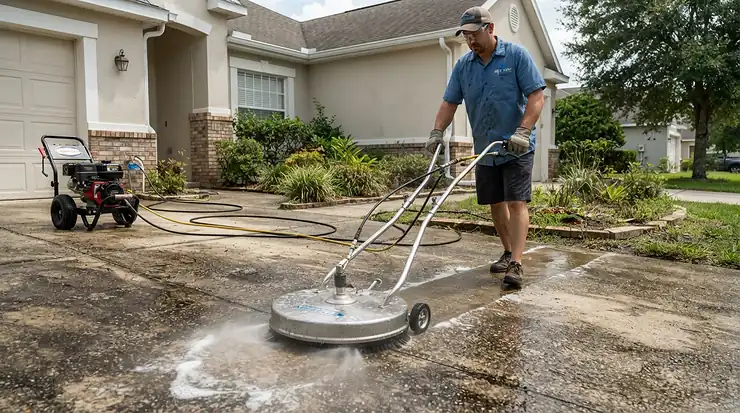
Here’s a scene you’ve probably lived through: you spend an entire Saturday sweeping a pressure washer wand back and forth across your driveway, arms aching, and by Monday the concrete has dried into a patchwork quilt of clean stripes and grimy gaps. That’s not a “you” problem — it’s a wand problem. A surface cleaner attachment for driveway pressure washing solves it by trading a single narrow jet for two rotating nozzles hidden under a spinning hood, which lay pressure down in tight, overlapping circles instead of clumsy back-and-forth arcs. The result is a floor that looks like it was cleaned by a machine, because, well, it was. Pressure washing itself has been around since the 1950s, but the rotary surface cleaner didn’t really go mainstream until commercial cleaners started demanding faster, more even results on parking lots and sidewalks.
This guide breaks down seven real, currently available attachments — from a $45 electric-friendly disc to a commercial-grade beast built for daily contractor use — and tells you honestly which one fits your driveway, your pressure washer, and your patience level. We’re not just listing specs; every product below gets an honest verdict based on real, sourced testing and aggregated review data, not manufactured hype. If you own anything from a 1,600 PSI electric unit to a 4,000 PSI gas rig, there’s a match here.
Quick Comparison: Best Surface Cleaner Attachments at a Glance
Before we get into the deep dives, here’s the short version for anyone in a hurry.
| Product | Diameter | Max PSI | Price Range | Best For |
|---|---|---|---|---|
| Sun Joe SPX-SC14 | 13″ | 4,000 | Under $80 | Best all-around budget pick |
| Westinghouse Universal 15″ | 15″ | 3,400 | Under $50 | Cheapest reliable option |
| BE Power Equipment Whirl-A-Way 16″ | 16″ | 4,000 | $300-$350 range | Commercial/daily-use durability |
Notice the spread here: diameter and PSI rating don’t scale together in a straight line, and that’s the first thing that trips up first-time buyers. A wider head sounds better on paper, but if your pressure washer can’t feed it enough flow, a 20-inch cleaner will actually underperform a well-matched 13-inch one. The Sun Joe SPX-SC14 earns its spot because it’s tuned for exactly the kind of mid-range electric and light gas washers most homeowners already own, while the BE Power Equipment Whirl-A-Way 16″ is for people who’ll run this thing every week for years and need it to survive that.
💬 Found a pick you like already? Bookmark this page — you’ll want to compare specs again before you check out.
Top 7 Surface Cleaner Attachments for Driveway Pressure Washing: Expert Analysis
We’re covering the full spread here: true budget options under $80, dependable mid-range picks, and a couple of heavier-duty attachments for people who clean more than just their own driveway twice a year.
1. Sun Joe SPX-SC14 — best all-around pick under $80
The standout here is flexibility: this 13-inch head is rated for up to 4,000 PSI and 4.0 GPM, which is a genuinely wide window most homeowners never think to check before buying. A lot of budget surface cleaners quietly cap out around 2,000-2,500 PSI, which means they choke the moment you connect anything beyond an entry-level electric washer. The Sun Joe SPX-SC14‘s ceiling is high enough that it’ll keep pace even if you upgrade to a mid-tier gas unit down the road, and its universal 1/4-inch quick-connect fitting means you won’t be hunting for adapters. Based on the spec comparison, this is the one to buy if you’re not 100% sure yet whether you’ll stick with your current washer or size up — it won’t become obsolete.
Reviewers consistently report that the 13-inch path strikes a good balance between speed and maneuverability, especially around planters, garage door tracks, and other driveway obstacles that wider units struggle to get close to. A common theme in aggregated feedback is that the polycarbonate skirt does a solid job containing spray, though a few users note the caster wheels feel a bit light-duty under sustained heavy use.
Pros:
- ✅ Handles up to 4,000 PSI — room to grow into a bigger washer
- ✅ Universal 1/4″ quick-connect, no adapter needed
- ✅ 13″ path maneuvers well around tight driveway edges
Cons:
- ❌ Caster wheels feel less rugged than pricier models
- ❌ Narrower path means more passes on very large driveways
Priced around $75-$85, the Sun Joe SPX-SC14 delivers commercial-adjacent pressure ratings at a homeowner price — hard to beat for the money.
2. Westinghouse Universal 15″ — cheapest reliable option
What most buyers overlook about entry-level surface cleaners is that price and cleaning path aren’t always correlated, and the Westinghouse Universal 15″ is proof: it’s one of the least expensive attachments on this list and still offers a wider 15-inch path than the pricier Sun Joe above it. At just 4 pounds, it’s also genuinely light enough to push around for a full afternoon without your shoulder filing a complaint. Its 1/4-inch quick connection works straight out of the box on most electric pressure washers, which is exactly the crowd this thing is built for.
The tradeoff is a lower pressure ceiling — this unit is designed around electric-washer PSI ranges rather than gas-washer territory, so pairing it with a high-output gas unit isn’t recommended. Aggregated customer sentiment describes it as “does exactly what it says” for light-duty residential jobs, with a recurring caution that heavier oil stains may need pretreatment first since the lower pressure ceiling limits raw cutting power.
Pros:
- ✅ Lowest price point of any wide-path option on this list
- ✅ Only 4 pounds — easy to handle for a full session
- ✅ Wider 15″ path than several pricier competitors
Cons:
- ❌ Lower PSI ceiling limits it to electric-washer pairing
- ❌ Struggles with deeper, older oil stains without pretreatment
At under $50, the Westinghouse Universal 15″ is the easiest “yes” on this entire list if you own a standard electric pressure washer and just want streak-free results without overthinking it.
3. Briggs & Stratton Surface Cleaner — best glide on rough concrete
Here’s what the spec sheet won’t tell you, but reviewers note repeatedly: the Briggs & Stratton Surface Cleaner‘s half-inch guard bristles are shorter than what you’ll find on most competitors, and that small detail matters more than it sounds. On rough, pitted, or hand-troweled concrete — the kind that’s common on older driveways — longer bristles tend to snag and bounce, breaking your rhythm and leaving uneven arcs. The shorter bristle guard on this model glides instead of catching, which testers specifically called out as noticeably smoother on rough surfaces than several competing attachments.
The lightweight housing is a double-edged sword. On one hand, it makes the unit easier to angle onto vertical or near-vertical surfaces like low retaining walls near a driveway apron. On the other hand, that same light build means more kickback when you first pull the trigger, so first-time users should brace themselves rather than holding the handle loosely.
Pros:
- ✅ Short guard bristles glide smoothly on rough concrete
- ✅ Lightweight housing works well on near-vertical surfaces
- ✅ Easy first-time setup, minimal learning curve
Cons:
- ❌ Light housing means more kickback on trigger pull
- ❌ Less substantial feel than steel-shrouded competitors
In the $60-$90 range depending on retailer, this is the pick for anyone whose driveway has more texture than a smooth pour.
4. Karcher T350 T-Racer — best pressure-adjustable electric option
The Karcher T350 T-Racer does something none of the others on this list do out of the box: continuous pressure adjustment right at the attachment, so you can dial power down for a sensitive paver or wood-adjacent section and back up for stubborn concrete stains without swapping nozzles. Karcher calls it a “hovercraft effect,” and based on the spec comparison, that’s not just marketing — the low weight (about 3.3 pounds) combined with the twin rotating jets genuinely does let the head skim rather than drag, which reduces arm fatigue on long driveway runs.
It’s built to pair with Karcher’s own K2 through K7 electric pressure washer line, which is both its strength and its limitation. If you already own a Karcher washer, this is close to a plug-and-play match. If you own a different brand, you’ll want to double-check fitting compatibility before buying, since Karcher’s connector system doesn’t always play nice with universal quick-connects. Aggregated owner feedback frequently praises how much faster this attachment cleared moss and algae on rough concrete compared to using the bare wand.
Pros:
- ✅ On-unit pressure dial for sensitive vs. tough surfaces
- ✅ Lightweight “hovercraft” glide reduces arm fatigue
- ✅ Splash guard keeps overspray impressively contained
Cons:
- ❌ Best fit is Karcher-brand washers, not universal
- ❌ Smaller cleaning head means more passes on big driveways
Typically priced in the $50-$90 range, the Karcher T350 T-Racer is the smartest buy for Karcher owners who clean a mix of concrete and more delicate patio surfaces.
5. Simpson Cleaning 80165 — best for 3,000-3,700 PSI gas washers
If you’re running a mid-size gas pressure washer, the Simpson Cleaning 80165 is built specifically for that power band — its recommended range of 2,200 to 3,700 PSI lines up almost exactly with what most homeowner gas units actually produce. The 15-inch diameter is rated to clean roughly 10 times faster than a standard fan-tip nozzle, and the powder-coated steel shroud with stainless-steel nozzles is a meaningful upgrade over the plastic housings found on cheaper electric-focused units, since it shrugs off the vibration and heat that gas washers generate over long sessions.
What most buyers overlook here is the cold-water-only restriction — this isn’t the attachment for anyone hoping to hook it to a hot-water pressure washer for grease-heavy jobs. On real driveways, though, that’s rarely a dealbreaker; oil and dirt on concrete respond fine to cold water and adequate PSI. Aggregated reviews are largely positive on cleaning speed, with one recurring complaint being the volume of dirty runoff water it generates, since the dual rotating jets move a lot of volume fast.
Pros:
- ✅ Tuned specifically for 2,200-3,700 PSI gas washers
- ✅ Steel shroud and stainless nozzles resist wear well
- ✅ 15″ path clears large sections quickly
Cons:
- ❌ Cold water only — no hot-water compatibility
- ❌ Generates substantial runoff volume during use
Priced roughly $85-$160 depending on whether you buy it bundled with a washer, the Simpson Cleaning 80165 is the clear match for anyone with a genuine gas-powered rig.
6. Westinghouse 16.5″ — widest coverage for large driveways
For sheer coverage, the Westinghouse 16.5″ is the one to beat on this list. Independent testing found it capable of clearing roughly 600 square feet of driveway and sidewalk in under 30 minutes, thanks to its 16.5-inch dual-jet path and its rolling wheel design, which made it easy to push despite the wider head. On paper this means fewer total passes across a large slab, which translates into real time saved on double-wide driveways or combined driveway-and-walkway jobs.
The catch, and it’s an important one: that width demands real power behind it. This unit is built to handle up to 4,400 PSI and 4.2 GPM, and testers specifically noted that a wider cleaning width comes with a greater demand for pressure — pair it with an underpowered washer and you’ll get patchy, inconsistent results rather than the streak-free finish it’s capable of. Reviewers consistently report excellent results against mildew, algae, and set-in stains when paired with an appropriately powerful gas washer, praising the dual rotating jets for eliminating the stripe pattern common with narrower or older attachments.
Pros:
- ✅ Covers roughly 600 sq. ft. in under 30 minutes when properly matched
- ✅ Stainless steel build holds up to repeated outdoor use
- ✅ Wheels make the wide head easy to maneuver
Cons:
- ❌ Needs a genuinely high-output washer to perform well
- ❌ Bulkier to store than 13-15″ alternatives
In the $70-$100 range, the Westinghouse 16.5″ is the pick for anyone with a big driveway and a pressure washer powerful enough to actually feed it.
7. BE Power Equipment Whirl-A-Way 16″ — best for commercial/daily use
This is the outlier on the list, and deliberately so: the BE Power Equipment Whirl-A-Way 16″ is priced closer to $300-$350, which only makes sense if you’re cleaning more than your own driveway — think landlords with multiple properties, or anyone doing this weekly rather than twice a year. What most buyers overlook about the price gap is what it’s actually paying for: an ABS polymer housing built to absorb impacts without cracking, twin ergonomic handles with a built-in trigger for better control, and a hovering effect from the nozzle geometry that meaningfully reduces the arm strain of an all-day job.
Independent write-ups specifically call this one of the best attachments for large flat surfaces, citing its streak-free, wide cleaning path as a genuine time-and-effort saver versus lighter consumer models. The bristle skirt containment is also a step up, keeping debris and overspray controlled even on longer, faster passes. This isn’t the attachment for someone who pressure-washes twice a year — it’s the one for someone whose pressure washer basically lives outside a shed.
Pros:
- ✅ ABS housing built to survive daily commercial impacts
- ✅ Ergonomic twin-handle trigger design reduces fatigue
- ✅ Hovering effect makes wide passes genuinely easier
Cons:
- ❌ Price is well above every other option on this list
- ❌ Overkill for occasional, once-a-season homeowner use
At roughly $300-$350, the BE Power Equipment Whirl-A-Way 16″ only makes financial sense for frequent or commercial use — but for that buyer, it’s a legitimate workhorse.
Top 7 Products: Full Comparison
| Product | Diameter | Max PSI | Weight | Water Type | Price Range | Best For |
|---|---|---|---|---|---|---|
| Sun Joe SPX-SC14 | 13″ | 4,000 | Light | Cold | Under $80 | All-around budget buyer |
| Westinghouse Universal 15″ | 15″ | 3,400 | ~4 lb | Cold | Under $50 | Electric washer owners |
| Briggs & Stratton | ~14″ | Mid-range | Light | Cold | $60-$90 | Rough/old concrete |
| Karcher T350 T-Racer | Compact head | K2-K7 range | ~3.3 lb | Cold | $50-$90 | Karcher-brand owners |
| Simpson Cleaning 80165 | 15″ | 3,700 | 3.5 lb | Cold only | $85-$160 | Gas washers, 2,200-3,700 PSI |
| Westinghouse 16.5″ | 16.5″ | 4,400 | Moderate | Cold | $70-$100 | Large driveways, high PSI |
| BE Power Equipment 16″ | 16″ | 4,000 | Heavier | Cold | $300-$350 | Commercial/daily use |
Looking at the table, the pattern that jumps out is how tightly diameter and PSI requirement move together — wider heads consistently demand more pressure to perform properly, which is exactly why the Westinghouse 16.5″ underperforms on weak washers despite being one of the most capable units here on paper. Budget buyers should note that both the Westinghouse Universal 15″ and the Sun Joe SPX-SC14 stay well within electric-washer PSI ranges, making them the safer bets if you’re not sure how much pressure your machine actually produces. For anyone straddling the line between homeowner and semi-professional use, the Simpson Cleaning 80165 sits in a genuine sweet spot of price and gas-washer compatibility.
Practical Usage Guide: Setup, First Use, and Avoiding Rookie Mistakes
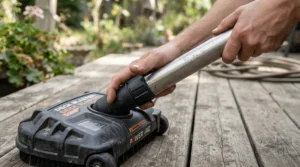
Getting a surface cleaner attachment running correctly the first time saves you from the classic beginner mistake: assuming it’s broken when it’s actually just under-pressured. Start by connecting the attachment to your wand or extension pole using its quick-connect fitting, then — critically — turn on the water supply and let it flow through the unit before you start the engine or trigger the pump. Running these attachments dry, even briefly, can damage the internal seals.
Once you’re set up, hold the unit flat against the surface and squeeze the trigger; you should feel and hear the head spin up almost immediately if your PSI and GPM are properly matched to the attachment’s rating. If it stutters or spins unevenly, that’s usually a sign your washer’s output is lower than the unit’s minimum requirement, not a defect in the attachment itself.
For maintenance, rinse the nozzles after every use to prevent mineral buildup from tap water, and check the caster wheels or skid pads for debris that can throw off the spin balance. Most manufacturers recommend inspecting the o-rings on the quick-connect fitting every few months, since a worn seal is the most common cause of pressure loss over the attachment’s lifespan. In the first 30 days, the single biggest mistake new owners make is holding the attachment too far above the surface — unlike a wand, these units are designed to ride flat, and lifting them even an inch breaks the seal that creates that even, streak-free spray pattern.
Real-World Scenarios: Matching a Surface Cleaner to Your Situation
The weekend homeowner with a standard two-car driveway: If you’re running a mid-range electric pressure washer and cleaning once or twice a season, the Westinghouse Universal 15″ or Sun Joe SPX-SC14 are the sensible picks. Neither will overwhelm an electric washer’s PSI ceiling, and both are light enough to store in a garage corner without dedicating shelf space.
The gas-washer owner with an older, rougher slab: Someone running a 3,000+ PSI gas unit on a driveway poured decades ago, with visible texture and hairline cracks, should lean toward the Briggs & Stratton Surface Cleaner for its glide-friendly bristle guard, or the Simpson Cleaning 80165 for its steel build matched to gas-washer output.
The small landlord or side-hustle cleaner: Anyone maintaining multiple driveways, whether rental properties or a part-time cleaning gig, needs durability more than a low price tag. The BE Power Equipment Whirl-A-Way 16″ is built for exactly this — its higher upfront cost is offset by not needing replacement after a single busy season, and the wider path cuts real hours off a multi-property route.
Problem → Solution: Fixing Common Driveway Cleaning Headaches
Problem: streaking despite using a surface cleaner. This almost always traces back to inconsistent forward speed — moving too fast in spots and too slow in others changes how much water hits each section. Solution: use slow, steady, overlapping passes at a consistent pace, the same way you’d mow a lawn in straight lanes.
Problem: the attachment won’t spin, or spins weakly. Solution: check that your washer’s PSI and GPM actually meet the attachment’s minimum rating — this is the single most common support complaint across every brand on this list, and it’s rarely a defective unit.
Problem: stubborn oil stains that survive the pass. Solution: pretreat with a degreaser and let it dwell for 10-15 minutes before running the surface cleaner over it; rotary attachments excel at rinsing lifted grime but aren’t chemical strippers on their own.
Problem: excessive splashing or wet feet despite the splash guard. Solution: check the guard skirt or bristles for wear or damage — a torn skirt is the most common cause of “my new surface cleaner sprays everywhere,” and replacement skirts are typically inexpensive.
How to Choose a Surface Cleaner Attachment for Driveway Pressure Washing
- Match PSI and GPM first, diameter second. A wider head that your washer can’t feed properly will underperform a smaller, well-matched one — check your washer’s specs before shopping by size.
- Confirm the connector type. Most attachments use a universal 1/4-inch quick-connect, but brand-specific systems like Karcher’s aren’t always interchangeable.
- Consider your driveway’s texture. Rough, older concrete benefits from shorter guard bristles that glide instead of catch.
- Weigh frequency of use against price. Occasional homeowner use doesn’t justify a $300+ commercial unit; frequent or multi-property use often does.
- Check cold-versus-hot water compatibility if you ever plan to use a hot-water washer for grease-heavy jobs.
- Look at housing material. Steel and stainless steel resist wear better than plastic housings under repeated commercial-style use.
- Factor in storage size. Wider 16-20 inch units take up noticeably more garage space than a 13-inch model.
Surface Cleaner Attachment Diameter for Driveways: Why Width Matters
Diameter is the spec everyone fixates on, and for good reason — it directly determines how many passes you’ll need to cover a given driveway. A 13-inch head clears roughly 1.3 square feet per linear foot of travel, while a 16.5-inch head clears closer to 1.7 square feet in the same distance, a meaningful difference across a 600-square-foot slab. But bigger isn’t automatically better: a wider head needs more flow and pressure to maintain the same rotational speed and cleaning force, so pairing a 20-inch attachment with a modest electric washer often produces worse results than a properly matched 13-inch unit. As a rule of thumb, stick to 13-15 inch diameters for electric washers under 2,000 PSI, and reserve 16-20 inch heads for gas washers rated 3,000 PSI or higher.
Rotary Surface Cleaner vs. Standard Fan-Tip Wand
A rotary surface cleaner and a standard fan-tip wand both spray pressurized water, but they solve the coverage problem in fundamentally different ways. The wand relies entirely on the operator’s arm to create even overlap, which is why hand-cleaned driveways so often show faint tiger-stripe patterns once dry. A rotary surface cleaner automates that overlap mechanically — its two nozzles spin continuously, layering pressure in tight concentric circles that self-correct for minor speed changes in a way a hand-swept wand simply can’t.
| Factor | Rotary Surface Cleaner | Standard Fan-Tip Wand |
|---|---|---|
| Streaking risk | Low — automated overlap | High — depends on operator consistency |
| Cleaning speed | Faster on large flat areas | Slower, more physically tiring |
| Best surface | Driveways, patios, sidewalks | Edges, corners, vertical surfaces |
| Splash control | Contained by skirt/guard | None — full overspray |
The table makes the tradeoff clear: a rotary attachment wins decisively on large, flat, open surfaces like driveways, but a bare wand still has a role for edges, corners, and tight spots the rotary head physically can’t reach. Most experienced users keep both in the toolkit — rotary for the open slab, wand for the trim work around it.
Achieving Streak-Free Concrete Cleaning: What Actually Works
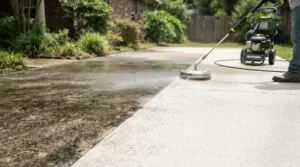
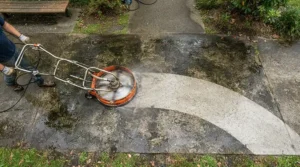
Streak-free concrete cleaning comes down to three variables working together: consistent pressure, consistent forward speed, and adequate overlap between passes. A quality surface cleaner attachment solves the overlap problem automatically through its rotating dual jets, but it can’t compensate for wildly inconsistent walking speed or a washer that surges in and out of pressure. Reviewers testing multiple attachments side-by-side found that units with dynamically balanced bars — where the spinning arm is weighted evenly — produced noticeably more even results than cheaper, unbalanced designs, because an unbalanced bar subtly wobbles and creates faint pressure variation as it spins. If you’re still seeing faint arcs after switching to a rotary attachment, the most common culprit is walking too fast; slowing your pace by even 20-30% often resolves it entirely.
Common Mistakes When Buying a Surface Cleaner Attachment
The most frequent mistake is buying based on diameter alone without checking PSI and GPM compatibility, which leads directly to the “my new attachment barely spins” complaint. A close second is assuming every unit uses a universal connector — brand-specific systems can require an adapter or simply won’t fit. Buyers also commonly underestimate storage space, especially with 16-20 inch units, and overlook whether their washer produces hot or cold water when the attachment they’re eyeing is cold-water-only. Finally, many first-time buyers skip checking the guard/skirt material, then are surprised when a thin plastic skirt tears within a season of regular use.
Driveway Coverage Width and Real-World Cleaning Speed
Coverage width — the effective swath a surface cleaner clears per pass — is the practical translation of diameter into actual time saved. Independent testing found a 16.5-inch unit clearing roughly 600 square feet in under 30 minutes when properly powered, which works out to about 20 square feet per minute. A well-matched 13-inch unit typically runs closer to 12-15 square feet per minute under similar conditions. For a standard two-car driveway (around 500-600 square feet), that difference is the gap between a 25-minute job and a 45-minute one — worth factoring in if you’re cleaning larger commercial lots or long driveways regularly, but less critical for a small residential slab where either width finishes well within an hour.
Long-Term Cost & Maintenance: What You’ll Actually Spend
The purchase price is only part of the total cost. Budget under-$80 attachments typically need caster wheel or skirt replacements within 2-3 seasons of regular use, adding $15-$30 periodically. Mid-range steel units like the Simpson Cleaning 80165 hold up longer before needing parts, often 4-5 seasons under normal homeowner frequency. Commercial-grade units like the BE Power Equipment Whirl-A-Way 16″ cost significantly more upfront but are engineered for weekly use over many years, which is exactly where their total cost of ownership evens out compared to replacing a budget unit every couple of seasons. For an occasional homeowner cleaning twice a year, a budget-to-mid-range attachment will almost always be the better financial call — the commercial unit’s durability premium only pays for itself under heavy, frequent use.
Safety and Stormwater Compliance Guide
Surface cleaners reduce one safety risk automatically — their splash guard contains the direct high-pressure jet that causes most pressure-washer injection injuries — but basic precautions still apply. Safety guidance from university extension programs recommends maintaining a safe operating distance and wearing eye protection any time you’re running a high-pressure washer, since even attachments that contain the spray can still eject debris from underneath the shroud.
There’s a second, less obvious consideration: where your rinse water goes. Federal stormwater pollution guidance notes that runoff from driveways and other paved surfaces can carry oil, chemicals, and debris directly into storm drains, which discharge untreated into local waterways in most municipalities. For routine driveway cleaning with plain water, this is a minor concern, but if you’re using degreasers or other chemicals, it’s worth directing runoff toward a grassy area rather than letting it flow straight to the street gutter.
Features That Actually Matter (And Those That Don’t)
PSI and GPM compatibility, connector type, and guard/skirt durability are the features that genuinely determine whether an attachment performs well on your driveway — get those right and you’ll be satisfied regardless of brand. Marketing terms like “hovercraft effect” or “10X coverage” describe real mechanical benefits (lower resistance, dual-jet efficiency), but they’re secondary to the fit-and-power basics above. Extra accessories like bundled extension wands or nozzle-cleaning tools are nice-to-haves rather than deciding factors — useful, but not worth paying a significant premium for if the core specs don’t match your washer.
Frequently Asked Questions
❓ What size surface cleaner do I need for a driveway?
❓ Can I use a surface cleaner on any pressure washer?
❓ Do surface cleaner attachments remove oil stains?
❓ Are surface cleaners safe for pavers and sensitive surfaces?
❓ How long do surface cleaner attachments last?
Conclusion
There’s no single “best” surface cleaner attachment for driveway pressure washing — there’s only the best match for your specific washer, driveway, and how often you’ll actually use it. If you’re a weekend homeowner with a standard electric unit, the Sun Joe SPX-SC14 or Westinghouse Universal 15″ will get the job done without overspending. Gas washer owners with rougher, older concrete should look toward the Briggs & Stratton Surface Cleaner or Simpson Cleaning 80165, both tuned for that power range. Karcher owners have an easy, adjustable option in the Karcher T350 T-Racer, and anyone with a big slab and serious PSI behind them should consider the Westinghouse 16.5″. For frequent or commercial use, the BE Power Equipment Whirl-A-Way 16″ is the only unit here built to genuinely shrug off years of weekly abuse.
Whichever you choose, the core lesson holds: match PSI and GPM before you fall in love with a diameter, and streak-free results will follow.
Recommended for You
- Extension Wand For Pressure Washer For Second-Story Cleaning
- Pressure Washer Nozzle Set For Multiple Surfaces: 7 Top Picks (2026)
- Mini Power Washer For Small Cleaning Jobs: 7 Top Picks (2026)
Disclaimer: This article contains affiliate links. As an Amazon Associate, I earn from qualifying purchases. If you purchase products through these links, we may earn a small commission at no additional cost to you.
✨ Found this helpful? Share it with your friends! 💬🤗
