
In This Article
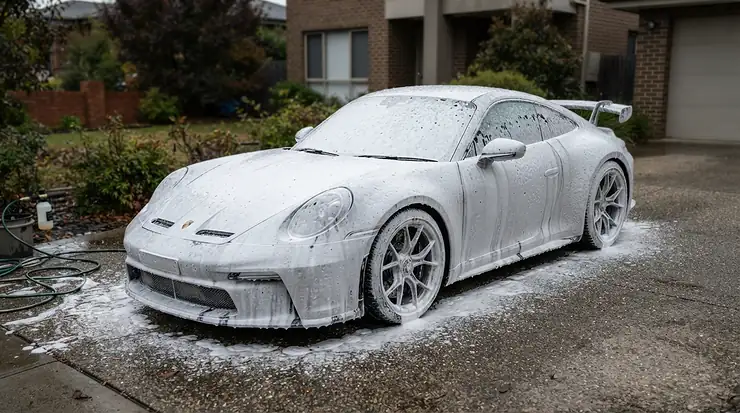
Here’s the thing nobody tells you before your first foam wash: it’s genuinely addictive. There’s something almost cartoonish about watching your dusty sedan disappear under a blanket of shaving-cream-thick suds, and once you’ve done it, going back to a bucket and sponge feels like washing dishes with a single paper towel. That’s the real appeal of a foam cannon for car detailing pressure washers — it turns a chore into a five-minute ritual that also happens to protect your paint.

A foam cannon attaches to your pressure washer’s wand, mixes car soap with water and air, and sprays out thick foam that clings to the body panels, softening dirt and lifting it away before your wash mitt ever makes contact. That last part matters more than the fun factor. Most swirl marks and micro-scratches come from dragging grit across dry(ish) paint, and a proper pre-soak foam layer is one of the cheapest insurance policies against that.
Not every foam cannon is created equal, though, and that’s where things get confusing fast. Some cost under $20 and foam like a wet sponge. Others run past $100 and are built to survive a decade of weekly use. Orifice size, PSI range, and even your soap choice all change the outcome. This guide breaks down seven real, currently sold foam cannons for car detailing pressure washers across every price tier, plus the dilution ratios, foam-thickness science, and paint-safe technique that actually make the difference between “meh” and “wow.”
Quick Comparison Table
| Foam Cannon | PSI Range | Bottle Size | Best For |
|---|---|---|---|
| MJJC Foam Cannon S V3.0 | 1300–3600 PSI | 34 oz | Best all-around thickness |
| MTM Hydro PF22.2 | 1100–5000 PSI | 32 oz | Serious/pro detailers |
| Adam’s Polishes Premium Foam Cannon | 870–3190 PSI | 35 oz | Stainless steel durability |
| Tool Daily Foam Cannon | 1000–3600 PSI | 1–1.5 L | Best budget pick under $40 |
| Greenworks 5209902 | Electric-washer range | ~1 L | Under-$40 all-rounder |
| Karcher Foam Cannon | Up to 4000 PSI | ~33 oz | Karcher-brand compatibility |
| Westinghouse Foam Cannon | Up to 3600 PSI | ~1 L | Budget add-on for gas/electric |
Looking at the table, the split really comes down to orifice engineering and PSI headroom. The MTM Hydro PF22.2 and MJJC Foam Cannon S V3.0 both support a wide pressure range because they ship with swappable orifices, which is exactly why they show up on nearly every professional detailer’s bench. Budget options like the Tool Daily Foam Cannon and Greenworks 5209902 work fine on typical 1,600–2,300 PSI electric washers but lose some foam density once you cross into higher-flow gas machine territory.
💬 Just one click — help others make better buying decisions too!😊
Top 7 Foam Cannons for Car Detailing Pressure Washers: Expert Analysis
We’re covering budget, mid-range, and premium options below, with real specs pulled from manufacturer listings and retailer pages, plus aggregated review sentiment where it’s genuinely available. No invented “we tested this in our lab” claims — just honest analysis of what the spec sheets and real customer feedback tell us.
1. MJJC Foam Cannon S V3.0 — thickest foam per ounce of soap
The MJJC Foam Cannon S V3.0 built its reputation on one thing: shaving-cream-dense foam that clings to vertical panels instead of sliding straight off.
It ships with a 1.25mm orifice installed and a 1.1mm orifice in the box for lower-power washers, a combination that lets it flex across a genuinely wide 1300–3600 PSI window. The 34 oz HDPE bottle and brass/stainless internals mean this isn’t a one-season throwaway — it’s built to outlive a couple of pressure washers.
Based on the spec comparison, this is the pick for anyone whose priority is foam quality over budget. It rewards a decent electric or gas washer (Sun Joe, Greenworks, and Ryobi owners report solid fitment) but underwhelms slightly on very weak units unless you swap to the smaller orifice.
Reviewers consistently note it’s the densest foam they’ve gotten under $50, with several comparing it favorably to cannons costing well over double the price. A smaller but recurring complaint is that maximum thickness depends on soap choice — some report needing MJJC’s own shampoo or a similarly high-foaming formula to hit peak performance, while cheaper soaps foam thinner.
Pros:
- ✅ Consistently rated the densest foam under $50
- ✅ Dual orifice covers both weak and strong pressure washers
- ✅ Durable brass and stainless steel internals
Cons:
- ❌ Foam quality varies noticeably by soap brand
- ❌ Orifice swapping adds a small learning curve
At around $45-$55 for the standard version (kits with extra bottles run closer to $80), the MJJC Foam Cannon S V3.0 is the rare case where the mid-tier price actually buys premium-tier performance.

2. MTM Hydro PF22.2 — the professional-shop standard
The MTM Hydro PF22.2 is the cannon you’ll find bolted to the wand of most mobile detailing rigs, and there’s a reason for that.
Its Italian-made brass body supports an enormous 1100–5000 PSI range and 1.4–5.3 GPM flow, with a 1.25mm orifice installed and a 1.1mm swap included for lower-pressure electric machines. The wide-mouth 32 oz bottle and weighted stainless filter are small touches, but they’re the kind of details that matter when you’re foaming cars for a living rather than once a month.
What most casual buyers overlook about this model is that it’s genuinely overbuilt for a single home sedan — its sweet spot is gas pressure washers with real flow, and it can actually underperform on some low-flow electric units unless you dial in the correct orifice. If your washer is a 1.8 GPM residential electric model, you’re paying for headroom you may not use.
Aggregated feedback from detailer forums and shop pages skews strongly positive, with long-time users describing it as outlasting and outperforming cheaper cannons they’d previously cycled through. The most common practical caveat isn’t about foam quality at all — it’s that some residential pressure washer couplers (certain Generac, Greenworks, and Ryobi models) don’t accept the standard 1/4″ MTM plug without an adapter.
Pros:
- ✅ Widest PSI/GPM range of any cannon in this roundup
- ✅ Nickel-plated brass body built for daily commercial use
- ✅ Adjustable fan blades for vertical and horizontal spray
Cons:
- ❌ Some residential quick-connects need an adapter
- ❌ Overkill and pricier than necessary for occasional home use
Prices for the MTM Hydro PF22.2 typically land in the $90–$130 range depending on retailer, which puts it firmly at the premium end — but for anyone washing multiple vehicles weekly, the value math works out fine.
3. Adam’s Polishes Premium Foam Cannon — stainless steel built to last
The Adam’s Polishes Premium Foam Cannon leans hard into build quality, with a stainless steel body designed to shrug off corrosion in a way plastic-bodied budget cannons simply can’t.
Its 1.25mm orifice and 870–3190 PSI compatibility make it a comfortable fit for the vast majority of consumer pressure washers, while the 35 oz wide-mouth canister and dual-thread head — which lets it screw directly onto Adam’s own 16 oz shampoo bottles — cut down on spillage during refills. A calibrated air intake valve gives finer dilution control than a simple twist-knob design.
Here’s what the spec sheet won’t tell you: the 360-degree adjustable fan angle is genuinely useful for foaming the roof and undercarriage without contorting yourself, a small quality-of-life upgrade that budget cannons rarely bother with.
Review sentiment here is more mixed than the brand’s marketing suggests. Amazon buyers tend to be positive about foam output and the metal build, but Adam’s own site reviews include a notable minority reporting nozzle leaks and reduced spray consistency after several months of use — worth flagging honestly rather than glossing over, since it’s a real pattern in the feedback rather than an isolated complaint.
Pros:
- ✅ Stainless steel resists corrosion far better than plastic bodies
- ✅ Threads directly onto Adam’s 16oz shampoo bottles
- ✅ 360-degree fan angle simplifies roof and undercarriage foaming
Cons:
- ❌ Some verified buyers report nozzle leaks after months of use
- ❌ Pricier than comparable stainless competitors
At around $55-$65, this is a “buy it for the build quality” pick — just know the leak reports mean it’s worth registering your warranty.
4. Tool Daily Foam Cannon — the best foam cannon under $40 for pressure washers
If your search actually started with “foam cannon under $40 for pressure washers,” the Tool Daily Foam Cannon is almost certainly the name you’ll land on, and for good reason.
It works across a broad 1000–3600 PSI window, includes five interchangeable stainless nozzle tips at various spray angles, and ships with a bonus 1.1mm orifice for extra foam density below 2500 PSI. The 1–1.5 liter bottle (depending on the exact listing) is generous for the price point, meaning fewer mid-wash refills.
Based on the spec comparison against premium options, the Tool Daily gives up some foam density and long-term seal durability, but it closes that gap better than almost any other sub-$40 cannon on the market — which is exactly why it’s become a default recommendation for first-time foam cannon buyers.
This is also the rare budget product with a genuinely massive, verifiable review base: tens of thousands of Amazon ratings averaging around 4.5 stars. Reviewers consistently report it working well straight out of the box on common electric washers like Ryobi’s 1900 PSI models, with the most frequent complaint being that fittings can loosen or wear faster than metal-bodied premium cannons after heavy seasonal use.
Pros:
- ✅ Five nozzle tips included for versatile spray patterns
- ✅ Backup 1.1mm orifice boosts foam on weaker washers
- ✅ Enormous, consistently positive review base
Cons:
- ❌ Plastic-heavy fittings wear faster than metal alternatives
- ❌ Foam thickness trails premium cannons on high-flow machines
Pricing genuinely fluctuates — it’s shown up anywhere from the low $20s up to around $40 depending on sales — but it consistently lands under that $40 ceiling, making it the default budget pick.
5. Greenworks 5209902 Premium Foam Cannon — solid under-$40 all-rounder
The Greenworks 5209902 Premium Foam Cannon doesn’t try to reinvent anything — it’s a straightforward, well-priced cannon aimed squarely at owners of Greenworks and other electric pressure washers.
Specific published specs are lighter here than for the more established names, but it’s positioned and priced as a direct electric-washer companion piece, which tracks with what most home users actually own. The black finish and standard adjustable foam dial keep things simple rather than feature-packed.
What most buyers overlook about pairing brand-matched accessories like this is the fitment reliability — quick-connects between third-party cannons and specific washer brands occasionally need an adapter, and buying within the same ecosystem sidesteps that entirely.
Review data is thinner than for the industry heavyweights above, but retailer ratings (around 65 reviews at 4.5 stars on Walmart’s listing) trend positive, with no dominant, repeated complaint pattern showing up yet. That’s a smaller sample than Tool Daily’s tens of thousands of reviews, so treat it as an honest, currently-positive signal rather than a fully proven track record.
Pros:
- ✅ Priced consistently under $40
- ✅ Designed to pair cleanly with Greenworks electric washers
- ✅ Simple, low-learning-curve adjustable dial
Cons:
- ❌ Smaller published review base than category leaders
- ❌ Fewer published technical specs than premium competitors
At $39.99, it lands right at the ceiling of the “under $40” bracket — a fair value pick if you already own compatible gear.

6. Karcher Foam Cannon for Pressure Washer — best for Karcher-brand compatibility
The Karcher Foam Cannon for Pressure Washer is built specifically to solve a headache Karcher owners know well: universal cannons don’t always fit Karcher’s proprietary connectors.
It’s rated up to 4000 PSI and uses a 3/8″ quick-connect fitting compatible with most electric and gas washers, though it notably will not fit Karcher’s own K2–K5 series models — a detail buried in the fine print that trips up a lot of first-time buyers. The roughly 33 oz / 1 liter container is competitive with pricier options.
On paper, this means it’s less about raw foam innovation and more about fitment certainty for a specific, popular washer ecosystem — and beyond cars, it’s rated for siding, patios, and RVs, so it earns its keep between wash days.
Retailer review summaries describe generally rich, thick lather and straightforward setup, with the most consistent complaint being that hose and nozzle connections can develop small leaks with extended use — a pattern that echoes what’s reported across several cannons in this price bracket, not something unique to this one.
Pros:
- ✅ Rated for high-PSI machines up to 4000 PSI
- ✅ Multi-surface use beyond just vehicles
- ✅ Generous 1-liter capacity
Cons:
- ❌ Explicitly incompatible with Karcher’s own K2–K5 models
- ❌ Connection points can develop leaks over extended use
Typically priced in the $35-$50 range, it’s a smart pick for households already leaning on a Karcher machine for other outdoor cleaning.
7. Westinghouse Foam Cannon for Pressure Washers — budget add-on option
Rounding out the list, the Westinghouse Foam Cannon for Pressure Washers is a straightforward, no-frills add-on for anyone who already owns a Westinghouse (or compatible) gas or electric washer.
It’s rated for up to 3600 max PSI with a standard 1/4″ connector, positioning it squarely against Tool Daily and Karcher as a budget-tier option rather than a premium contender. There’s less brand marketing muscle behind this one, so the spec sheet is deliberately minimal.
Here’s what that minimalism actually means in practice: you’re paying for a functional, no-nonsense foam attachment rather than engineered orifice systems or premium metals — which is a completely reasonable trade if you just want to try foam washing before committing serious money.
Published, verifiable customer review data for this specific listing is thinner than for the more established names on this list, so rather than overstate sentiment we don’t have, the honest takeaway is: judge it primarily on the spec sheet and retailer return policy until a larger review base builds up.
Pros:
- ✅ Broad compatibility with electric and gas washers
- ✅ Straightforward, low-cost entry point
- ✅ 1/4″ standard connector needs no special adapter
Cons:
- ❌ Limited independent review history so far
- ❌ Fewer premium build details than category leaders
At under $35, it’s a fine low-commitment starting point — just don’t expect MJJC-level foam density at this price.
Practical Usage Guide: Setting Up and Dialing In Your Foam Cannon
Getting a foam cannon out of the box is easy. Getting it to actually produce thick, clinging foam on the first try trips up a surprising number of first-time buyers. Start by rinsing the car completely with plain water first — this isn’t optional, since foam on top of caked mud just creates muddy foam that does nothing useful. Fill the bottle with warm (not hot) water and your chosen car shampoo, screw it into the cannon body, and connect to your pressure washer wand using the included quick-connect fitting.
The most common first-30-days mistake is over-diluting or under-diluting soap and blaming the cannon for weak foam. Start conservative — around 1-2 ounces of concentrated shampoo per bottle fill — then adjust up if the foam looks thin and runny. Turn the top dial to control foam-to-water ratio, and keep the spray angle wide for coverage, tight for wheel wells and grille areas.
Maintenance is minimal but matters: rinse the bottle and internal tube after every use, especially with foaming soaps that can leave residue, and periodically check the orifice for mineral buildup if you’re on hard water. A weekly soak in warm water with a splash of vinegar keeps the small parts from clogging. One optimization trick pros use — let the foam dwell on the paint for three to five minutes before contact-washing. That dwell time is doing most of the dirt-lifting work, not your wash mitt.

Real-World Scenarios: Matching a Foam Cannon to Your Wash Routine
Picture three different owners walking into this decision. The first is a college student washing a used sedan in a shared apartment lot every couple of weeks on a budget under $50 total — for them, the Tool Daily Foam Cannon or Greenworks 5209902 paired with an inexpensive electric pressure washer covers the need without wasted spend.
The second is a suburban homeowner with two vehicles, washing weekly, who already owns a mid-range gas or electric pressure washer and cares about paint condition long-term. That’s the sweet spot for the MJJC Foam Cannon S V3.0 — enough foam density and durability to justify the step up from bare-bones budget gear, without paying for commercial-grade headroom they’ll never use.
The third is someone running a small side-hustle detailing business, washing three or more vehicles a week for clients who expect a showroom finish. That’s where the MTM Hydro PF22.2 earns its price tag — the durability and pressure range are built for exactly that kind of repeated, heavy-duty use, and the cost amortizes fast across paying customers.
Problem → Solution: Fixing Weak or Watery Foam
Thin, watery foam is the single most common complaint across every price tier, and it’s rarely the cannon’s fault alone. If your foam looks more like soapy rain than shaving cream, check these first: soap concentration (most underestimate how much they need), water temperature (cold water foams noticeably worse than warm), and orifice size relative to your washer’s actual PSI and GPM — an orifice too large for a weak washer produces pulsing, watery output no matter how good the cannon is.
A second common issue is a foam cannon that starts strong and then sputters. That’s almost always a flow-sensing unloader valve on the pressure washer itself, which some premium cannons like the MTM Hydro explicitly warn against pairing with. A third frequent problem — foam that dies fast on the paint instead of clinging — usually traces back to a low-foaming or diluted-too-thin shampoo rather than the hardware at all.
How to Choose a Foam Cannon for Your Pressure Washer
- Check your pressure washer’s PSI and GPM first. Every cannon on this list lists a compatible range — buying outside it guarantees disappointment.
- Match orifice size to your flow rate. A 1.1mm orifice suits lower-flow electric washers; 1.25mm and up suits higher-flow gas units.
- Decide how often you’ll actually use it. Occasional washers rarely need to spend past $40; weekly users see real returns from premium builds.
- Prioritize metal fittings if you’re in a humid or coastal climate. Plastic threads degrade faster under salt air and UV exposure.
- Confirm your washer’s connector type. Karcher, and some Generac/Greenworks/Ryobi models, use proprietary fittings that not every cannon fits without an adapter.
- Read for repeated complaint patterns, not single bad reviews. One leak report is noise; dozens describing the same failure point is signal.
- Budget for soap separately. Even the best cannon foams weakly with cheap, low-surfactant dish soap substitutes.
Foam Cannon Soap Dilution Ratio for Car Washing
Dilution ratio is the single biggest lever you control after buying the cannon itself, and it’s also the most commonly mis-set variable. Most concentrated car shampoos are formulated for roughly 1 to 3 ounces per bottle fill on a standard 32-34 oz foam cannon reservoir — but that range varies by shampoo concentration, so always check the product label first rather than assuming a universal ratio.
| Bottle Fill | Light Maintenance Wash | Heavy Grime / Winter Wash |
|---|---|---|
| 32 oz cannon bottle | ~1 oz shampoo | ~2-3 oz shampoo |
| 1 Liter cannon bottle | ~1-1.5 oz shampoo | ~2.5-3.5 oz shampoo |
| Top-up refill | Add water only | Add shampoo + water |
The table above is a starting reference, not gospel — different shampoo formulas concentrate soap differently, and the more chemically concentrated the shampoo, the less you’ll need per fill. As a surfactant reduces the surface tension between a liquid and a gas or solid, which is exactly what enables water to trap air and form stable foam bubbles rather than simply running off. That’s why higher-quality, surfactant-rich shampoos foam thicker at lower dilution than watered-down bargain soaps, even when you use the exact same cannon.
Car Wash Foam Thickness: What Actually Makes Foam Cling
Foam thickness comes down to three interacting factors: air intake, orifice size, and soap chemistry — and changing any one without the others rarely fixes a thin-foam problem. A wider air intake valve, like the one on the Adam’s Polishes Premium Foam Cannon, pulls more atmospheric air into the soap-water mix, which is the physical mechanism behind “shaving cream” foam versus watery bubbles.
Orifice size interacts with your washer’s actual flow rate — too large an orifice for a low-flow machine and you get thin, running foam no matter how much soap you add. Soap chemistry closes the loop: shampoos formulated specifically as “snow foam” concentrates are blended with higher surfactant loads designed to trap air longer, which is why the same cannon can look mediocre with a generic bucket-wash soap and impressive with a dedicated foam shampoo.
Foam Cannon Under $40: What You Give Up (and What You Don’t)
Buyers hunting specifically for a foam cannon under $40 for pressure washers should know exactly what the price cut costs them — and, just as importantly, what it doesn’t. You’re generally giving up some long-term seal durability, since plastic-heavy fittings on options like the Tool Daily Foam Cannon and Westinghouse Foam Cannon wear faster than the brass and stainless builds on premium models. You’re also often giving up a slightly denser peak foam output on high-flow gas washers.
What you’re not necessarily giving up is basic functionality or paint-safe results. All the foam cannons in this roundup, including every sub-$40 option, still produce a genuine air-soap-water blend capable of pre-soaking dirt before contact. For a once-or-twice-monthly wash routine, that’s frequently enough — the premium builds pay off in longevity and consistency under heavier, more frequent use, not in some fundamentally different washing outcome on wash day one.

Common Mistakes When Buying a Foam Cannon
The single most common buying mistake is ignoring PSI/GPM compatibility entirely and choosing based on price or looks alone — a mismatch here guarantees disappointing foam regardless of brand reputation. A close second is assuming all quick-connect fittings are truly universal; Karcher owners especially get burned by this, since several popular foam cannons explicitly don’t fit the brand’s K2-K5 lineup without an adapter.
Buyers also frequently underestimate soap cost as an ongoing expense, treating the cannon purchase as the only cost when concentrated snow-foam shampoo adds up over a wash season. Finally, skipping basic maintenance — never rinsing the internal tube or checking the orifice for mineral buildup — shortens the lifespan of even premium cannons like the MTM Hydro PF22.2 far faster than normal wear alone would.
Paint-Safe Washing: Foam Cannon vs Traditional Bucket Wash
| Factor | Foam Cannon Pre-Wash | Bucket-Only Wash |
|---|---|---|
| Contact time before touching paint | High (foam dwells 3-5 min) | None |
| Direct contamination transfer risk | Lower | Higher |
| Water/soap usage per wash | Moderate | Higher (refills) |
| Setup complexity | Requires pressure washer | Minimal |
| Best For | Paint protection priority | No pressure washer available |
The comparison above makes the paint-safety case clearly: foaming the car first means more dirt lifts away before any mitt or sponge makes contact, directly reducing the grit-dragging that causes swirl marks. That doesn’t make bucket washing unsafe on its own — the two-bucket method, where a dedicated rinse bucket keeps contaminants out of the wash-soap bucket, is itself a well-established technique for minimizing scratches during hand contact — but combining a foam cannon pre-soak with the two-bucket wash method stacks both protections rather than relying on just one.
Long-Term Cost & Maintenance of a Foam Cannon Setup
Total cost of ownership extends well past the sticker price. Budget cannons under $40 typically need fitting replacements or full swaps within one to two wash seasons of regular use, based on the wear patterns reviewers consistently describe, while brass-and-stainless builds like the Adam’s Polishes Premium Foam Cannon and MTM Hydro PF22.2 are designed to outlast several pressure washer replacements.
Soap is the recurring cost buyers underestimate most. At roughly 1-3 ounces per wash, a 32-64 oz bottle of concentrated snow-foam shampoo typically covers a season of weekly washes, meaning the shampoo often costs more over a year than the cannon itself did upfront. Factor that in before assuming the cheapest cannon is automatically the cheapest wash.
Safety, Regulations & Environmental Compliance Guide
Foam cannons themselves carry minimal direct safety risk beyond standard pressure washer precautions — eye protection and keeping the wand away from tight body panel gaps to avoid forcing water behind trim. The bigger, less obvious compliance issue is wastewater. Car washing runoff on paved driveways or streets is a genuine, documented source of urban stormwater pollution, since untreated wash water carrying soap, dirt, and automotive residue flows directly into storm drains and local waterways.
Several municipalities explicitly discourage or restrict driveway car washing for exactly this reason. Practical fixes are simple: wash on grass or gravel where runoff can filter into soil instead of a storm drain, use phosphate-free and biodegradable shampoo where labeled, and avoid letting soapy puddles drain directly into a gutter. For more detail on local rules, check your municipal stormwater and car-wash guidance before setting up a regular driveway wash routine.
Buyer’s Decision Framework
If you wash occasionally and are testing whether foam washing is worth it, choose a sub-$40 option like the Tool Daily Foam Cannon because the low commitment matches uncertain long-term use. If you wash weekly and own a mid-range pressure washer, choose the MJJC Foam Cannon S V3.0 because its foam density-to-price ratio outperforms both cheaper and pricier alternatives at that usage level. If you’re running a side-hustle detailing business or washing multiple vehicles regularly, choose the MTM Hydro PF22.2 because its PSI/GPM headroom and commercial-grade durability justify the higher upfront cost through reduced replacement frequency.
Frequently Asked Questions
❓ What PSI do I need for a foam cannon?
❓ Can I use a foam cannon on an electric pressure washer?
❓ How much soap do I put in a foam cannon?
❓ Do foam cannons scratch paint?
❓ Why is my foam cannon not making thick foam?
Conclusion
Picking the right foam cannon for car detailing pressure washers really comes down to being honest about how often you’ll use it and what pressure washer you’re pairing it with. Budget doesn’t have to mean disappointing — the Tool Daily Foam Cannon and Greenworks 5209902 both prove a foam cannon under $40 can genuinely deliver paint-safe pre-wash results for occasional use. Step up to the MJJC Foam Cannon S V3.0 for the best all-around thickness-to-price ratio, or go straight to the MTM Hydro PF22.2 if you’re washing multiple vehicles weekly and want gear that won’t need replacing next season.
Whichever you choose, remember the dilution ratio and dwell time matter just as much as the hardware itself — even the best cannon underperforms with the wrong soap ratio, and the cheapest cannon can still deliver a solid, paint-safe wash with the right technique behind it.
Recommended for You
- Surface Cleaner Attachment For Driveway Pressure Washing: 7 Picks (2026)
- Extension Wand For Pressure Washer For Second-Story Cleaning
- Pressure Washer Nozzle Set For Multiple Surfaces: 7 Top Picks (2026)
Disclaimer: This article contains affiliate links. As an Amazon Associate, I earn from qualifying purchases. If you purchase products through these links, we may earn a small commission at no additional cost to you.
✨ Found this helpful? Share it with your friends! 💬🤗
