
In This Article
Think about the last time you got rid of a bucket of gray mop water. Maybe you hauled it to a utility tub that was too shallow. Maybe you used a kitchen sink you swore you’d sanitize afterward. Maybe it was a bathtub you’ll never mention to anyone. That small, slightly gross moment is why the floor mop sink exists. It’s also why choosing a good one matters more than its humble job suggests.
A floor mop sink sits at floor level. You tip the bucket and let it drain. You never lift thirty-odd pounds of dirty water over a rim at waist height. Your lower back will thank you.
The catch is that the market looks like a swamp of near-identical listings. Stainless basins from importers sit next to molded-stone classics from plumbing-supply houses. Footprints run from a tidy 19 inches to a sprawling 36. Prices swing from “fine, whatever” to “wait, for a sink?”
This guide cuts through that. It compares published specs, listed certifications, and real review signals across seven floor mop sink options. Along the way it translates each spec into what it means on a Tuesday morning with a full bucket. It also covers where plumbing and health codes come in.
One note on money: prices below are ranges only, because they change constantly. Always check the current price before you buy.
What Is a Floor Mop Sink?
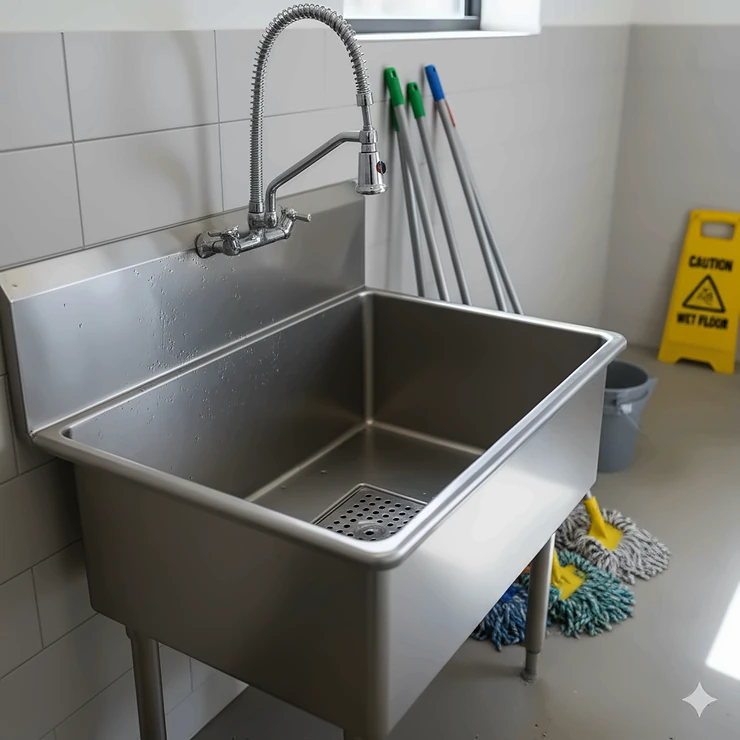
A floor mop sink (also called a mop basin, service basin, or janitorial sink) is a low, floor-mounted basin with a built-in drain. It’s designed for filling buckets, rinsing mops, and disposing of dirty wash water. Its curb sits only about 10 to 13 inches high, so you can empty heavy buckets without lifting them.
Why does a basin this simple show up in so many rulebooks? Health codes. Rules based on the FDA Food Code require at least one service sink, or a curbed cleaning facility with a floor drain. It has to be conveniently located for cleaning mops and disposing of mop water. Toilets and urinals are explicitly off the table, as Washington State’s adopted version of Food Code section 5-203.13 shows. Other states adopt their own editions, so confirm what your local health department expects.
You’ll also see this fixture called a slop sink, a mop receptor, or a janitor’s sink. They’re all cousins. Whatever the label, the job is the same: give dirty water a legal, sanitary, back-friendly place to go.
Quick Comparison: 7 Best Floor Mop Sink Options at a Glance
Here’s the lineup before the deep dive. Ranges are approximate and based on comparable listings at the time of research, so confirm current pricing.
| Product | Material | Footprint (L x W x H) | Typical Price Range* | Best For |
|---|---|---|---|---|
| DuraSteel 24x24x13 | 304 stainless, NSF-listed | 24″ x 24″ x 13″ | Roughly $250-$400 | Food-service closets |
| Zurn Z1996-24 | Molded composite | 24″ x 24″ x 10″ | Roughly $150-$300 | Light-commercial, easy install |
| Zurn Z1996-36 | Molded composite with shelf | 36″ x 24″ x 10″ | Mid-$300s | Large equipment, janitorial teams |
| Mustee 65M | Fiberglass (Durastone line) | 24″ x 36″ | Mid-$200s | Big buckets, home or shop |
| GRIDMANN 19x22x12 | 304 stainless, NSF-listed | 19″ x 22″ x 12″ | Mid-$300s | Heavy-use compact spaces |
| VEVOR 22x19x12 | 304 stainless | 22″ x 19″ x 12″ | $150-$200 range | Budget stainless |
| WILPREP 19x16x8 | 304 stainless | 19″ x 16″ x 8″ | Varies widely by seller | Tight closets |
*Ranges are estimates from comparable listings; prices may vary.
Looking at the table, the VEVOR 22x19x12 wins on entry price. The DuraSteel 24x24x13 and GRIDMANN 19x22x12 are the picks where an inspector might ask for NSF paperwork. The two Zurn basins and the Mustee 65M trade stainless’s polish for molded, lighter-weight construction, which can mean easier handling and a lower sticker price. Whichever way you lean, footprint matters more than most buyers expect, so measure your closet first.
💬 Just one click — help others make better buying decisions too!😊
Top 7 Floor Mop Sink Picks: Expert Analysis
1. DuraSteel 24x24x13 — NSF-rated stainless for food-service closets
If a health inspector is ever going to peek into your janitorial closet, this is the basin that answers the question before it’s asked.
The 24-by-24-inch footprint matches the slot most janitorial closets were framed around, so it drops into an existing layout without rework. The 13-inch overall height runs a few inches taller than the 10-inch molded-stone standard. In practice that means fewer splash-overs when you sluice out a loaded bucket. The listing describes 304 stainless, an alloy that holds up to cleaning chemicals better than cheaper grades. It also advertises a leak-proof flat drain and NSF certification. A third-party roundup describes the steel as 18-gauge.
Based on the spec comparison, this is the sensible default for cafés, daycare kitchens, and small restaurants. Stainless shows water spots and scratches, so it rewards a quick weekly wipe-down habit.
On reviews, one third-party roundup reports a 4.7-star average across 56 reviews for this size. Treat that as a snapshot and read the current Amazon reviews for drain-fit notes.
Pros:
- ✅ NSF certification listed for food-service use
- ✅ 304 stainless resists corrosion and cleaning chemicals
- ✅ Standard 24-inch footprint fits existing closets
Cons:
- ❌ Stainless shows spots and scratches over time
- ❌ Costs more than molded composite basins
Price range: roughly $250-$400, so check current price. Verdict: strong value if NSF matters, overkill for a basic garage.
2. Zurn Z1996-24 — lightweight composite with a stainless dome strainer
Not every closet needs stainless gleam. Sometimes you want a sturdy, no-drama basin that behaves like the standard-issue fixture it is.
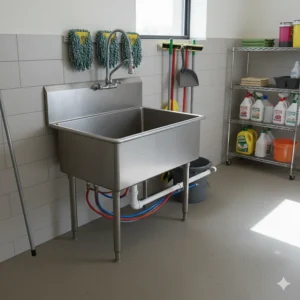
This model is a 24-by-24-inch basin, 10 inches deep, made of molded high-density composite. Zurn’s spec sheet for the Z1996 family lists a PVC drain body, a stainless steel strainer with lint basket, and a 3-inch gasketed outlet. It also lists ANSI Z124.6, CSA, and IAPMO listings. That gasket is the quiet hero. It’s designed to seal onto a drain stub without caulked-lead plumbing gymnastics. Faucets, hose brackets, and mop hangers are sold as separate options, so budget for them.
Here’s what to weigh. Composite is lighter than stainless and won’t dent, but it won’t carry the same professional sheen. For a school custodial room or a retail back hallway, that trade usually makes sense.
I couldn’t verify a large enough pool of independent reviews for this exact model to summarize sentiment responsibly. Let the specs lead, and check the current Amazon reviews for installation notes.
Pros:
- ✅ Lightweight molded one-piece composite body
- ✅ Stainless strainer and lint basket in the family spec
- ✅ ANSI, CSA, and IAPMO listings noted
Cons:
- ❌ Faucet and mop hanger cost extra
- ❌ 10-inch walls allow more splash than taller basins
Price range: roughly $150-$300, so check current price. Verdict: solid middle-of-the-road value.
3. Zurn Z1996-36 — 36-inch basin with a self-draining mop shelf
Some jobs call for a mop bucket on wheels, a wringer, and a floor machine’s dirty parts all at once. This is the basin built for that sprawl.
The spec sheet describes a 36-by-24-by-10-inch molded composite basin with an integrally molded, self-draining mop shelf. Weight is roughly 55 pounds. The PVC drain body, stainless strainer, and 3-inch gasketed outlet match the smaller sibling. It meets ANSI Z124.6, is IAPMO-listed, and carries a one-year warranty, according to a supplier listing.
The shelf is the point. It gives you a dry-ish perch for a wet pail or wringer, and water runs back into the bowl instead of onto your floor. That’s the kind of detail the spec sheet won’t brag about, but a janitorial crew will notice daily.
The extra length needs about three feet of wall. If your closet is narrow, the 24-inch version is the safer bet.
I couldn’t verify enough independent reviews for this exact listing to summarize sentiment. Read the current feedback for fit and shipping condition before committing.
Pros:
- ✅ Self-draining shelf keeps pails off the floor
- ✅ Roomy bowl suits wheeled buckets and wringers
- ✅ Same certifications as the smaller model
Cons:
- ❌ Needs roughly three feet of wall space
- ❌ Priciest composite pick in this lineup
Price range: mid-$300s at one supplier, so check current price. Verdict: worth it for volume, wasteful for a small closet.
4. Mustee 65M — big-bowl fiberglass from a plumbing-aisle name
This one has the longest “I’ve seen that in the plumbing aisle” energy of the bunch.
The listing identifies it as a 24-by-36-inch fiberglass mop service basin. Mustee’s documentation for the sibling 63M describes one-piece molded Durastone construction, an integral drain, a 3-inch drain seal for ABS, PVC, or iron pipe, and a removable stainless strainer. Retailer descriptions of that line also mention homeowners using these basins in garages, mud rooms, and pet-washing areas. Confirm the exact 65M inclusions on the listing, since I’m extrapolating from the family.
What this means for you: fiberglass is light, quiet, and won’t clang when a bucket bumps it. The 36-inch length is generous for large buckets and for rinsing the full length of a mop.
Retail listings I found show only a handful of reviews for this model. That’s thin, so lean on specs and read the current Amazon reviews.
Pros:
- ✅ Large 24-by-36-inch bowl for big buckets
- ✅ One-piece molded body, no seams to leak
- ✅ Quiet and light compared with stainless
Cons:
- ❌ Needs three feet of wall length
- ❌ Fiberglass can stain and scuff over time
Price range: mid-$200s at one retailer, so check current price. Verdict: great value for home garages and shops.
5. GRIDMANN 19x22x12 — heavier-gauge bowl in a compact stainless frame
Thicker steel is the cheapest insurance policy in a mop closet.
A retailer listing describes a 16-gauge #304 stainless bowl with an 18-gauge #304 apron, NSF certification, and a stainless wall clip. A backsplash version also exists for sinks sitting against drywall. The curved, angled corners are listed as helping drainage.
Why gauge matters: 16-gauge steel is noticeably thicker than the 18-gauge used on many stainless basins. It resists the dents that come from dropped bucket handles and wringer frames. Over years of daily use, that’s the difference between a basin that looks used and one that looks abused.
The 19-by-22-inch footprint is compact, which is a plus in tight janitorial closets. The bowl is smaller than a 24-inch model’s, so check it against your largest bucket.
I couldn’t verify enough independent reviews for this exact model to summarize sentiment responsibly. Check current Amazon reviews for drain and clip feedback.
Pros:
- ✅ 16-gauge bowl resists dents and wear
- ✅ NSF certification listed for commercial use
- ✅ Wall clip included, with a backsplash option
Cons:
- ❌ Smaller bowl than 24-inch basins
- ❌ Higher price than imported budget stainless
Price range: mid-$300s at one retailer, so check current price. Verdict: good value if you plan to use it heavily for years.
6. VEVOR 22x19x12 — budget stainless with a wall bracket
Not everyone is outfitting a restaurant. Sometimes you just want stainless that won’t flinch at a garage or laundry room.
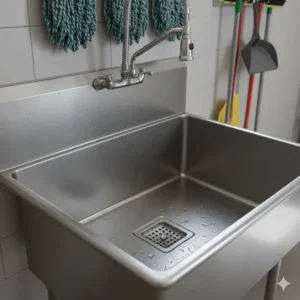
The published specs list SUS304 stainless at roughly 22 by 19 by 12 inches. The inner basin is about 19 by 16 by 8 inches, and the unit weighs around 23 pounds. Sink panel thickness is listed at 1.2 mm, roughly 18-gauge territory. The Amazon title advertises a 3-in-1 filter, a wall-mounted bracket, and an X-shaped groove for quick drainage. A backsplash version is also sold.
At 23 pounds, it’s easy to wrestle into place, which makes anchoring it to the wall (the bracket helps) more than a formality. An 8-inch interior depth handles a standard bucket fine, but you’ll want to pour slowly.
I didn’t see an NSF claim on the listings I reviewed, so food-service buyers should confirm requirements first. I also couldn’t verify a solid pool of independent reviews, so read the current Amazon feedback for drain-fit details.
Pros:
- ✅ Lowest entry price among the stainless picks
- ✅ Wall bracket included for stable mounting
- ✅ Light enough for easy handling
Cons:
- ❌ No NSF claim seen on reviewed listings
- ❌ Shallower 8-inch bowl invites splashing
Price range: around $150-$200, so check current price. Verdict: strong value for homes and light-duty shops.
7. WILPREP 19x16x8 — compact 304 stainless for tight spots
If your janitorial “closet” is really a wide hallway, this is the basin that fits.
The listing describes a 19-by-16-by-8-inch 304 stainless basin with a strainer and X-shaped floor guides. It also mentions seamless welds, polished edges, reinforced corners, and an NSF claim. Those smooth welds matter because grime loves rough seams. The listing cites a roughly 10-gallon capacity, which the dimensions support.
The compact footprint is the headline. It’s also the limit. An 8-inch bowl suits short buckets and mop heads, but a tall bucket can be awkward.
Pricing is where you need care. Third-party sellers list this basin at wildly different prices, so compare listings and check current price before buying. I couldn’t verify enough independent reviews for a sentiment summary.
Pros:
- ✅ Small 19-by-16-inch footprint suits tight closets
- ✅ Seamless welds and polished edges clean up fast
- ✅ X-shaped floor guides help water exit smoothly
Cons:
- ❌ Shallow 8-inch bowl limits tall buckets
- ❌ Seller pricing varies widely
Price range: varies widely, so compare sellers and check current price. Verdict: worth it only at a sensible price.
✨ Don’t Miss These Top Picks!
🔍 Take your cleaning closet to the next level with these carefully selected basins. Click on any highlighted item to check current pricing and availability. These picks will help you build a cleanup station your whole team will actually use!
How to Choose a Floor Mop Sink
Choosing well comes down to a handful of decisions. Work through them in order:
- Measure the bucket, not the closet. Your tallest mop bucket and widest wringer set the minimum bowl size. Then confirm the basin physically fits through the door.
- Match material to your environment. Stainless suits food service and heavy use. Molded composite and fiberglass suit lighter duty and tighter budgets.
- Check the drain connection. Confirm drain size (commonly 3 inches) and whether the basin uses a gasket or caulked joint, then match it to your existing rough-in.
- Confirm certifications. Look for NSF where food service applies, and ANSI Z124.6, CSA, or IAPMO listings on molded basins.
- Plan the faucet and backflow protection. A wall-mounted service faucet with a vacuum breaker is standard, and the Southern Nevada Health District notes that plumbing must be protected from backflow at each point of use, including mop sinks.
- Think about wall protection and storage. A backsplash and mop hangers keep walls dry and mops draining into the bowl.
- Budget for the whole kit. The basin is only the start; faucet, drain fittings, and labor add up.
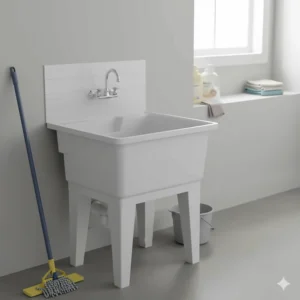
Floor Mop Sink Materials Compared: Stainless vs Molded Stone vs Fiberglass
Material is the biggest fork in the road, so here’s the short version:
| Material | Strengths | Trade-offs | Best For |
|---|---|---|---|
| 304 stainless (DuraSteel 24x24x13, GRIDMANN 19x22x12) | Durable, sanitary, NSF options | Shows spots; louder; pricier | Food service, heavy use |
| Molded composite (Zurn Z1996-24, Zurn Z1996-36) | Light, chemical-tolerant, listed to ANSI | Less polished look | Schools, retail, janitorial |
| Fiberglass (Mustee 65M) | Quiet, light, large bowls | Can stain or scuff | Garages, shops, home |
Stainless wins on cleanability and inspector-friendliness. Composite and fiberglass win on weight, noise, and price. Many institutions standardize on a 24 x 24 x 10 inch molded-stone basin with one-inch shoulders and a stainless strainer, as one university custodial-closet standard spells out. That’s a decent hint about what a “default” floor mop sink looks like in a commercial setting.
Features That Actually Matter (And Those That Don’t)
What matters: a properly sized drain with a removable strainer, because a clogged drain turns a fixture into a puddle machine. A bowl depth that fits your bucket matters too. So does a way to anchor the basin to the wall, and certifications that match your use.
What doesn’t (much): fancy accessory racks and add-ons you can buy separately later. Vague marketing labels like “industrial sewage tank” are also just words, not specs.
Gauge deserves a mention. A thicker stainless bowl, like the 16-gauge in the GRIDMANN 19x22x12, resists dents better. That feature earns its keep in busy spaces and is wasted in a lightly used laundry room.
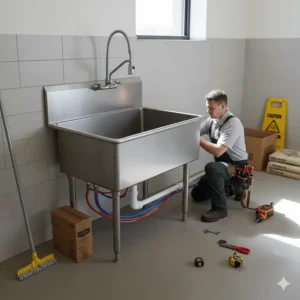
Floor Mop Sink Installation & Your First 30 Days
Good installation prevents most of the problems people blame on the basin.
Before you set it: confirm the drain rough-in, floor flatness, and wall access for the faucet and mop hangers. A Texas State University design standard calls for the spout to sit at least 36 inches above the sink so a wheeled bucket fits underneath. Custodial standards often place mop hangers five to six feet up.
At install: set the basin level, seal the drain connection per the manufacturer’s instructions, and anchor it with the wall clip or bracket. The VEVOR 22x19x12, GRIDMANN 19x22x12, and similar stainless models include them.
First 30 days:
- Run a full fill and watch for leaks at the drain.
- Clean the strainer daily; lint builds fast.
- Wipe stainless dry to prevent spotting.
- Avoid steel wool and prolonged bleach contact on stainless.
Real-World Scenarios: Which Floor Mop Sink Fits Your Space?
The 40-seat café. The closet is small, the inspector is real, and the budget is moderate. A 24-inch NSF stainless basin like the DuraSteel 24x24x13 fits the footprint and the paperwork. Daily use means you’ll want the cleaning habit to match.
The homeowner with a muddy garage. You wash boots, buckets, and occasionally a dog. The VEVOR 22x19x12 keeps cost down if you have a drain to connect to. The Mustee 65M offers a bigger bowl for a bit more money.
The facilities manager with a floor machine. Wheeled buckets, wringers, and big squeegees demand room. The Zurn Z1996-36 and its mop shelf give you that, provided you have the wall length. Daily use makes a durable basin worth the money.
Problem → Solution Guide
Slow drain. Lint and mop strings are the usual suspects. Pull the strainer and clean it daily, and consider a lint basket if the basin supports one.
Splashing on the wall. Choose a backsplash version or add a wall guard. Pour from a lower height, too.
Basin that rocks or slides. Re-level the floor or shim it, then anchor it with the included clip or bracket.
Water spots on stainless. Wipe dry after use and skip abrasive pads.
Musty smell from the drain. Run water regularly so the trap seal stays filled, and clean the strainer.
Safety, Plumbing & Code Guide
Three things deserve your attention.
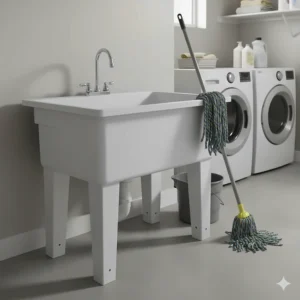
First, backflow. A hose connected to a faucet can pull dirty water backward if pressure drops, which is why service faucets include vacuum breakers. Health districts, like the Southern Nevada Health District, spell out protection requirements at mop sinks.
Second, floors. OSHA’s guidance on slips, trips, and falls notes that floors should stay clean and dry where possible. Where wet processes are used, maintain drainage and provide mats or dry standing places. A floor mop sink helps by keeping water off walkways in the first place.
Third, local rules. Plumbing codes and health regulations differ by jurisdiction, so confirm requirements with your local inspector before you buy or install.
Long-Term Cost & Maintenance
The sticker price is the tip of the iceberg. Total cost includes the basin, faucet, drain fittings, labor, and replacement strainers.
Here’s an illustrative example: a basin that lasts ten years at a mid-$300s price works out to a few dozen dollars a year. A cheaper basin that needs replacing in five years may not save money at all. That doesn’t mean expensive is always better. A lightly used home garage may never wear out a budget basin.
Maintenance is simple. Clean strainers daily, wipe stainless dry, and avoid harsh abrasives. For molded basins, avoid scratching the surface, and inspect the drain gasket periodically.
Common Mistakes When Buying a Floor Mop Sink
- Ignoring drain size. A basin that doesn’t match your rough-in becomes a plumbing project.
- Buying the smallest bowl. If your bucket doesn’t fit, the sink is a decoration.
- Skipping the faucet plan. Many basins ship without one.
- Forgetting wall protection. Splashes damage drywall quickly.
- Assuming all “NSF” claims are equal. Verify certification on the listing or with the seller if your use requires it.
Floor Mop Sink vs Utility Sink vs Mop Bucket Station
A floor mop sink sits low so you can pour out a bucket without lifting. A utility sink sits higher, which suits hand washing and small tasks but forces you to hoist heavy buckets. A mop bucket station with no drain just relocates the mess.
Traditional supply-house basins, like Fiat’s 24-by-24-inch molded-stone MSB2424 or Mustee’s 63M, are common in commercial specs. The seven picks above are what you’d find through a retailer like Amazon, and they give you more footprints and materials to choose from.
The practical difference: a floor mop sink protects your back and keeps wet work in one place. If you mop daily, that adds up.
Price Range & Value Analysis
| Tier | Typical Range | Picks | Value Take |
|---|---|---|---|
| Budget | $150-$200 range | VEVOR 22x19x12 | Best entry price for stainless |
| Mid-range | Roughly $200-$400 | Mustee 65M, Zurn Z1996-24, DuraSteel 24x24x13 | Balance of size, material, and cost |
| Premium | Mid-$300s and up | Zurn Z1996-36, GRIDMANN 19x22x12 | Heavier build or larger features |
| Wildcard | Varies | WILPREP 19x16x8 | Compare sellers carefully |
The VEVOR 22x19x12 is the cost leader, and the Mustee 65M gives you the most bowl per dollar. If you need NSF, DuraSteel 24x24x13 and GRIDMANN 19x22x12 are the more defensible choices. Whatever you choose, confirm current pricing before buying.
FAQ
❓ How much does a floor mop sink cost?
❓ Can a floor mop sink go in a garage or basement?
❓ Does a floor mop sink come with a faucet?
❓ Is NSF certification required for a floor mop sink?
❓ Can a floor mop sink double as a dog-washing station?
Conclusion
A floor mop sink is one of those fixtures you only notice when it’s wrong. The right one keeps buckets off your back, water off your floors, and inspectors off your case.
If you need NSF paperwork, the DuraSteel 24x24x13 and GRIDMANN 19x22x12 are the more natural fits. If you want the lowest stainless entry price, the VEVOR 22x19x12 is the budget route. For molded, lighter-weight basins, the Zurn Z1996-24 and Mustee 65M are practical, and the Zurn Z1996-36 is the pick when you need shelf space and room to spread out. The WILPREP 19x16x8 earns its place only when space is tight and the price is fair.
Measure first, match the drain, plan the faucet, and then buy.
✨ Don’t Miss These Top Picks!
🔍 Ready to upgrade your cleanup routine? Click on any highlighted item above to check current pricing and availability. These basins will help you keep your space cleaner, drier, and a lot less stressful!
Recommended for You
- Mop Sink Faucet: 7 Best Picks for 2026
- Mop Handle: 7 Best Picks to Buy in 2026
- Mop Wringer: 7 Best Picks for Dry, Streak-Free Floors (2026)
Disclaimer: This article contains affiliate links. As an Amazon Associate, I earn from qualifying purchases. If you purchase products through these links, we may earn a small commission at no additional cost to you.
✨ Found this helpful? Share it with your friends! 💬🤗
