
In This Article
✨Was this helpful? Spread the word! 🚀
Finding the perfect mop sink faucet can transform your cleaning routine from frustrating to efficient. Whether you’re managing a commercial facility or setting up a home utility space, choosing the right faucet makes all the difference in your daily operations.

However, selecting the ideal mop sink faucet isn’t as straightforward as it might seem. Moreover, with dozens of options available on the market, understanding which features matter most can save you both time and money. According to the NSF International standards, commercial faucets must meet stringent safety and performance requirements that differ significantly from residential models. In this comprehensive guide, I’ll walk you through everything you need to know about mop sink faucets, from essential features to top product recommendations.
Understanding Mop Sink Faucet Basics 🚰
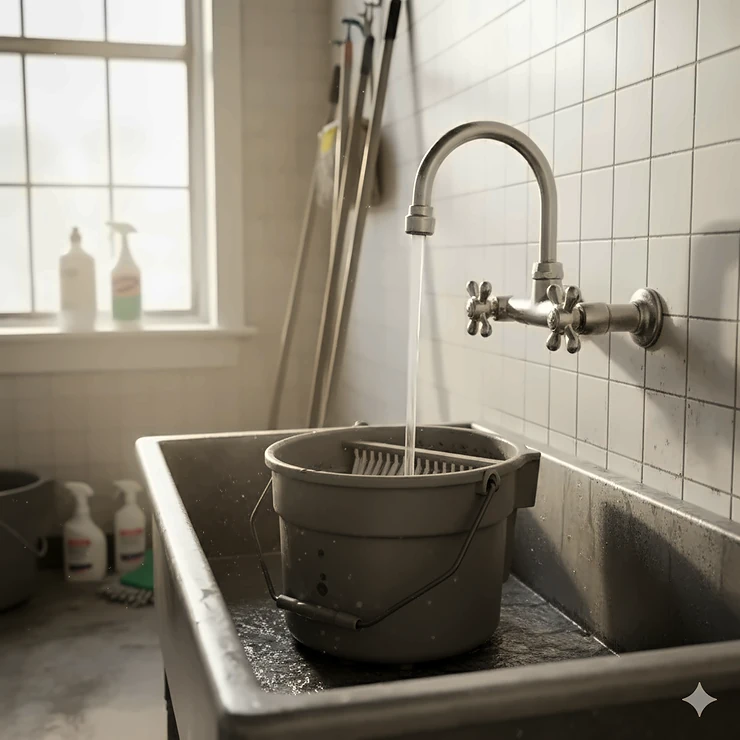
A mop sink faucet serves as the heart of any utility cleaning station. Unlike regular kitchen or bathroom faucets, these specialized fixtures must handle heavy-duty use while providing specific functionality for maintenance tasks. Furthermore, they need to withstand harsh chemicals, frequent temperature changes, and constant operation.
The primary difference between standard faucets and mop sink faucets lies in their construction and features. Most notably, mop sink faucets include vacuum breakers for backflow prevention, hose thread connections for bucket filling, and robust materials that can handle commercial-grade usage. Additionally, they often feature wall-mounted designs to maximize floor space and allow for easy bucket placement.
Essential Features to Look For ✅
When selecting a mop sink faucet, several critical features demand your attention. First and foremost, vacuum breaker protection prevents contaminated water from flowing back into your clean water supply. This safety feature is not only recommended but required by most plumbing codes in commercial applications.
Adjustable center spacing represents another crucial consideration. Most quality mop sink faucets offer 8-inch adjustable centers, typically ranging from 7.75 inches to 8.25 inches. This flexibility ensures compatibility with various sink configurations and simplifies installation procedures.
Material construction directly impacts longevity and performance. Solid brass construction with chrome plating provides the best durability, while ceramic disc cartridges ensure leak-free operation for years. Conversely, plastic components may save money initially but often require frequent replacement in demanding environments.
Top 7 Mop Sink Faucet Products for 2025 🏆
1. ZKDAUSDO Commercial Mop Sink Faucet – Premium Choice
The ZKDAUSDO Commercial Mop Sink Faucet stands out as a premium option offering exceptional value for commercial applications. This wall-mounted unit features a 6.5-inch vacuum breaker spout and 8-inch adjustable center spacing, making it suitable for most standard installations.
Key Specifications:
- Solid brass construction with chrome plating
- Ceramic cartridge valve (500,000+ cycles)
- 3/4″ hose thread connection
- Temperature range: -30°C to 60°C
- Price range: $85-$120
Professional reviews consistently praise this model for its durability and leak-free performance. Additionally, the included pail hook and wall bracket provide excellent stability during operation. The chrome-plated finish resists corrosion even in harsh industrial environments.
2. American Standard 8344212.004 – Industrial Grade
The American Standard 8344212.004 delivers commercial-grade reliability with top brace wall-mount design. This model features integral supply stops and a 6-inch vacuum breaker spout specifically engineered for high-volume applications.
Notable Features:
- Cast brass body construction
- 1/4 turn ceramic disc valve cartridges
- Metal lever handles with temperature indicators
- Price range: $150-$190
3. Moen 8124 Commercial M-Dura – Heavy-Duty Performance
The Moen 8124 Commercial M-Dura represents the gold standard in heavy-duty service sink faucets. Built for constant use and occasional misuse, this faucet incorporates vandal-resistant features and superior engineering throughout its design.
Professional Specifications:
- M-Dura series heavy-duty construction
- Vandal-resistant torx head screws
- 10.25-inch spout reach
- ADA compliant design
- Price range: $180-$250
Customer feedback consistently highlights the faucet’s exceptional build quality and smooth operation. Furthermore, the vacuum-breaker spout includes garden hose threading for versatile applications.
| Comparison Table: Top 3 Professional Models |
|---|
| Feature |
| Construction |
| Warranty |
| Price Range |
| Vandal Resistance |
| Flow Rate |
| Detailed Specifications Comparison |
|---|
| Model |
| ZKDAUSDO Commercial |
| American Standard 8344212 |
| Moen M-Dura 8124 |
| Sepaitek Commercial |
| Phivan Commercial |
| Installation Requirements Matrix |
|---|
| Mounting Type |
| Wall Mount |
| Wall Mount |
| Wall Mount |
4. Sepaitek Commercial Mop Sink Faucet – Value Leader
The Sepaitek Commercial Mop Sink Faucet offers excellent functionality at a budget-friendly price point. Despite its lower cost, this model includes essential features like vacuum breaker protection and adjustable center spacing.
Value Features:
- Brass construction with chrome finish
- Built-in vacuum breaker
- Dual lever handles
- Price range: $65-$85

5. Phivan Commercial Mop Sink Faucet – Versatile Option
The Phivan Commercial Mop Sink Faucet provides reliable performance for both commercial and residential applications. This model features an 8-inch adjustable center design with comprehensive mounting hardware included.
Practical Benefits:
- Chrome-plated brass construction
- Easy installation with included hardware
- Pail hook for convenient bucket hanging
- Price range: $75-$105
6. T&S Brass Commercial Service Sink Faucet – Professional Grade
T&S Brass has earned its reputation through decades of commercial kitchen and utility equipment manufacturing. Their service sink faucets incorporate professional-grade components designed for institutional use.
Professional Features:
- NSF certified construction
- Stainless steel components
- Price range: $200-$280
7. Zurn Service Sink Faucet – Institutional Quality
Zurn specializes in commercial plumbing fixtures, and their service sink faucets reflect this expertise. These units excel in schools, hospitals, and other institutional environments requiring reliable performance.
Institutional Benefits:
- Heavy-duty construction
- Easy maintenance design
- Price range: $160-$220
💬 Just one click – help others make better buying decisions too! 😊
Industry-Specific Applications and Use Cases 🏭
Commercial Kitchen Operations
In restaurant and food service environments, mop sink faucets play a crucial role in maintaining sanitation standards. Professional kitchens require faucets that can handle frequent sanitizer exposure while providing reliable performance during busy service periods. Therefore, stainless steel or heavy-duty chrome-plated models work best in these demanding environments.
Food service establishments typically benefit from faucets with higher flow rates and extended spout reach. This allows staff to fill large cleaning buckets quickly while accommodating various container sizes. Additionally, the vacuum breaker protection prevents cross-contamination between cleaning water and potable water supplies.
Healthcare Facility Requirements 🏥
Hospitals and medical facilities demand the highest standards of hygiene and reliability from their utility fixtures. Consequently, mop sink faucets in these environments must meet stringent health department regulations while providing consistent performance for intensive cleaning protocols. Furthermore, infection control requirements often dictate specific material choices and design features.
Healthcare applications often require hands-free operation or lever handles that can be operated with elbows or forearms. Moreover, antimicrobial coatings and easy-to-clean surfaces help maintain sterile conditions throughout busy medical facilities. Additionally, compliance with healthcare facility guidelines ensures proper infection control protocols.
Healthcare-Specific Requirements: 🔬
- ✅ Antimicrobial surface treatments for pathogen control
- ✅ Hands-free operation capabilities where possible
- ✅ Easy disinfection procedures with hospital-grade cleaners
- ✅ Compliance with Joint Commission standards
- ✅ Minimal crevices to prevent bacterial harboring
Educational Institution Needs 🎓
Schools and universities present unique challenges for utility fixtures due to high usage volumes and potential vandalism. As a result, educational facilities typically choose faucets with vandal-resistant features and robust construction that can withstand heavy daily use. Therefore, durability becomes the primary consideration over aesthetic features.
The Moen M-Dura series excels in educational environments due to its vandal-resistant torx screws and heavy-duty ceramic cartridges. Furthermore, these faucets maintain consistent performance despite frequent operation by maintenance staff throughout the school day. Consequently, long-term reliability reduces both maintenance costs and operational disruptions.
Educational Facility Benefits: 📚
- ✅ Vandal-resistant hardware prevents tampering
- ✅ Heavy-duty construction withstands high-volume use
- ✅ Standardized parts reduce inventory complexity
- ✅ Professional appearance maintains facility aesthetics
- ✅ Extended warranties protect capital investments
Industrial and Manufacturing Applications
Manufacturing facilities and industrial plants require mop sink faucets capable of handling harsh chemicals and extreme temperatures. These environments demand materials that resist corrosion from cleaning solvents while maintaining operational integrity under challenging conditions.
Brass construction with specialized coatings provides the best protection against chemical exposure. Additionally, ceramic disc cartridges outperform rubber components in industrial applications due to their resistance to chemical degradation and extended service life.
Advanced Technical Analysis and Engineering Principles ⚙️
Hydraulic Performance Characteristics
Understanding flow dynamics helps optimize mop sink faucet selection for specific applications. Flow rate calculations involve multiple variables including supply pressure, pipe diameter, and fixture design characteristics. Most commercial mop sink faucets operate efficiently between 20-125 PSI supply pressure.
The relationship between pressure and flow follows hydraulic principles governed by Bernoulli’s equation. Higher supply pressures generally produce increased flow rates, but excessive pressure can cause splashing and reduce user comfort. Therefore, pressure-reducing valves often improve overall system performance.
Material Science and Durability Factors
Modern mop sink faucets incorporate advanced metallurgy and surface treatments to maximize service life. Consequently, brass alloys typically contain copper and zinc in specific proportions that provide optimal strength and corrosion resistance. Lead-free brass compositions comply with NSF/ANSI 372 standards while maintaining excellent mechanical properties.
Chrome electroplating processes create protective surface layers that resist tarnishing and corrosion. Additionally, the plating thickness directly affects durability, with commercial-grade faucets typically featuring thicker chrome deposits than residential models. Furthermore, proper surface preparation before plating ensures long-term adhesion and appearance retention.
Valve Technology and Cartridge Design
Ceramic disc cartridges represent the current state-of-the-art in valve technology for commercial applications. According to ASME A112.18.1 standards, these components utilize precision-machined ceramic discs that create leak-proof seals while providing smooth operation throughout their service life. Unlike rubber washers or O-rings, ceramic discs resist wear from particulates in water supplies.
Quarter-turn operation reduces handle wear compared to multi-turn compression valves. Furthermore, this design feature particularly benefits high-usage commercial applications where rapid on/off cycling is common. Additionally, ceramic cartridges maintain consistent performance across temperature variations encountered in utility applications.
Backflow Prevention Systems
Vacuum breaker technology prevents contamination of potable water supplies through backflow conditions. These devices operate by admitting air into the system when downstream pressure exceeds upstream pressure, thereby effectively breaking the siphon effect that could draw contaminated water backwards.
According to the U.S. Access Board guidelines, ASSE 1001 standards govern vacuum breaker design and performance requirements. Compliant devices undergo rigorous testing to ensure reliable operation under various pressure conditions and temperature extremes. Additionally, regular inspection and maintenance of vacuum breakers ensures continued protection of water supply systems.
Comprehensive Setup and Installation Guide 🔧
Pre-Installation Planning and Preparation
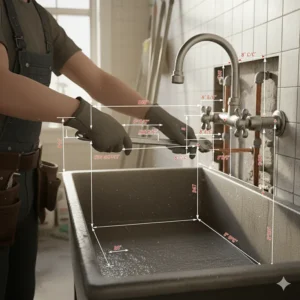
Successful mop sink faucet installation begins with thorough planning and site preparation. Start by verifying water supply line locations and ensuring compatibility with the chosen faucet model. Most commercial installations require 1/2-inch supply lines with adequate pressure for proper operation.
Measure existing hole spacing carefully to confirm compatibility with new faucet requirements. Standard 8-inch centers accommodate most commercial models, but some installations may require modification of existing holes. Additionally, consider accessibility for future maintenance when planning faucet placement.
Essential Tools and Materials:
- Adjustable wrenches (10-inch and 12-inch)
- Pipe thread sealant or Teflon tape
- Level for proper alignment
- Drill and appropriate bits for mounting holes
- Safety glasses and gloves
Step-by-Step Installation Procedures
Phase 1: Water Supply Preparation Begin by shutting off water supply to the installation area and draining existing lines. Remove any old fixtures and clean mounting surfaces thoroughly. Apply appropriate thread sealant to supply connections according to manufacturer specifications.
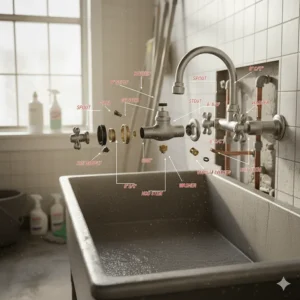
Phase 2: Faucet Assembly and Mounting Assemble the faucet body and mounting components according to provided instructions. Most commercial models include eccentric unions that allow for minor adjustments to center spacing. Position the faucet body and secure mounting hardware finger-tight initially.
Phase 3: Supply Line Connections Connect supply lines to faucet inlets using proper techniques for threaded connections. Apply thread sealant sparingly to male threads only, leaving the first two threads clean. Tighten connections with appropriate torque to prevent leaks while avoiding over-tightening that could damage components.
Phase 4: System Testing and Adjustment Gradually restore water supply pressure while checking for leaks at all connections. Test both hot and cold water operation, adjusting handle positions as needed. Verify proper vacuum breaker function by observing air admission during flow shutdown.
Safety Considerations and Code Compliance
Local plumbing codes specify requirements for commercial utility fixtures, including backflow prevention and accessibility standards. Ensure installations comply with applicable ADA guidelines where required. Additionally, verify that chosen faucets carry appropriate certifications such as NSF/ANSI 61 for potable water contact.
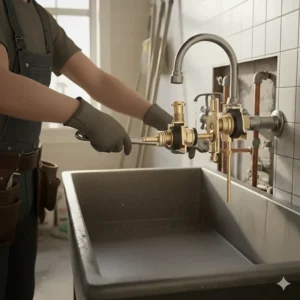
Professional installation by licensed plumbers ensures code compliance and warranty protection. However, experienced maintenance personnel can typically handle replacement installations using proper procedures and quality materials.
🛠️ Grab Your Perfect Faucet Today!
Ready to upgrade your cleaning station? Check out these professional-grade mop sink faucets that combine durability with functionality. These carefully selected models deliver the reliability you need for demanding applications. 🚀
Maintenance and Longevity Strategies 🔄
Daily and Weekly Maintenance Protocols
Consistent maintenance extends mop sink faucet life significantly while preventing costly repairs. Daily cleaning with appropriate sanitizers removes chemical residues that could damage internal components. Avoid abrasive cleaners that may scratch chrome surfaces or damage protective coatings.
Weekly inspection of handle operation and spout function identifies potential issues before they become serious problems. Check for unusual noises, stiff operation, or reduced flow rates that might indicate internal wear or mineral buildup. Additionally, verify that vacuum breaker devices function properly by observing air admission during flow cessation.
Weekly Maintenance Checklist:
- Clean external surfaces with appropriate sanitizer
- Check handle operation for smooth movement
- Inspect connections for signs of leaks
- Test vacuum breaker air admission
- Verify adequate flow rate at normal pressure
Monthly and Quarterly Servicing
Monthly deep cleaning involves disassembly of removable components for thorough sanitization. Remove aerators and flush supply lines to eliminate mineral deposits that could affect performance. Lubricate moving parts with food-grade lubricants where specified by manufacturer guidelines.
Quarterly maintenance should include inspection of internal cartridge condition and replacement if necessary. Document maintenance activities and component replacement dates to establish predictable service intervals. Furthermore, professional inspection by qualified technicians can identify potential issues requiring specialized attention.
Troubleshooting Common Issues
Low Flow Rate Problems Reduced flow typically results from mineral buildup in aerators or supply lines. Remove and clean aerator components with appropriate descaling solutions. If problems persist, check supply line filters and consider professional descaling of internal passages.
Handle Operation Difficulties Stiff or binding handles usually indicate cartridge wear or mineral accumulation around moving components. Disassemble handle mechanisms and clean thoroughly with appropriate solvents. Replace worn cartridges promptly to prevent damage to faucet body threads.
Leak Detection and Repair External leaks often occur at threaded connections due to aging sealants or thermal cycling. Retighten connections carefully, replacing thread sealant if necessary. Internal leaks typically require cartridge replacement or professional repair services.
Replacement Parts and Warranty Information
Maintain inventory of critical replacement components including cartridges, O-rings, and aerators. Quality manufacturers like Moen and American Standard provide comprehensive parts support for their commercial products. Additionally, authorized service centers can provide professional repair services when needed.
Most commercial faucets include warranties ranging from two to five years depending on manufacturer and application. Professional installation and proper maintenance typically ensure warranty coverage for the full term. Furthermore, documented maintenance records support warranty claims when component failures occur.
Comparative Analysis: Traditional vs. Modern Solutions 📊
Traditional Compression Valve Systems
Older mop sink faucets typically employed compression valve technology with rubber washers or packing materials. While these systems provided adequate performance, they required frequent maintenance and component replacement due to wear characteristics of rubber components.
Compression valves operate through linear motion that compresses sealing elements against valve seats. This design requires multiple handle turns and applies significant stress to sealing components during each operation. Consequently, these systems develop leaks more frequently than modern ceramic disc alternatives.
Traditional System Characteristics:
- Multi-turn handle operation
- Frequent seal replacement requirements
- Moderate initial cost with high maintenance expenses
- Limited temperature and chemical resistance
Modern Ceramic Disc Technology
Contemporary mop sink faucets utilize ceramic disc cartridges that provide superior performance and longevity. These components operate through rotational motion between precision-machined ceramic surfaces that create leak-proof seals without elastic deformation.
Quarter-turn operation reduces mechanical stress on internal components while providing precise flow control. Additionally, ceramic materials resist chemical attack from cleaning agents commonly used in utility applications. The result is extended service life with reduced maintenance requirements.
Modern System Advantages:
- Single quarter-turn operation
- Extended cartridge life (500,000+ cycles)
- Superior chemical resistance
- Consistent performance across temperature ranges
Cost-Benefit Analysis Over Product Lifetime
Initial investment in quality ceramic disc faucets typically exceeds traditional compression valve costs by 30-50%. However, reduced maintenance requirements and extended service life provide significant long-term savings. Professional studies indicate total cost of ownership favors modern systems by substantial margins.
10-Year Cost Comparison:
| System Type | Initial Cost | Maintenance | Total Cost |
|---|---|---|---|
| Traditional Compression | $75 | $180 | $255 |
| Modern Ceramic Disc | $120 | $45 | $165 |
| Premium Commercial | $200 | $30 | $230 |
Labor costs for maintenance represent the largest operational expense for utility fixtures. Modern systems require approximately 60% less maintenance time compared to traditional compression valves, resulting in significant labor savings over product life.
Case Studies and Real-World Success Stories 📈
Large Hospital Complex Renovation 🏥
Metro General Hospital faced frequent maintenance issues with aging mop sink faucets throughout their 800-bed facility. Specifically, maintenance staff spent approximately 15 hours weekly addressing leaks and component failures across 120 utility stations. Additionally, the inconsistent performance created compliance concerns with infection control protocols.
Challenge Analysis: 🔍 The hospital’s maintenance team identified several critical issues with existing fixtures. First, frequent cartridge failures resulted in emergency repairs during peak patient care periods. Second, inconsistent flow rates made cleaning protocols difficult to standardize. Finally, vandalism-related damage in public areas required expensive component replacement. Consequently, the total annual maintenance cost exceeded $35,000 across all locations.
Solution Implementation: ⚡ Hospital administrators chose to standardize on Moen M-Dura 8124 faucets throughout the facility. The vandal-resistant design and heavy-duty construction addressed their primary concerns while providing consistent performance across all departments. Furthermore, the phased replacement schedule minimized operational disruption during installation.
Detailed Implementation Process:
- ✅ Phase 1: Critical care areas (ICU, OR, Emergency) – 40 units
- ✅ Phase 2: Patient floors and nursing stations – 50 units
- ✅ Phase 3: Administrative and support areas – 30 units
- ✅ Total Timeline: 6 months with minimal service interruption
Measurable Results: 📊
- 75% reduction in maintenance calls within first year
- $18,000 annual savings in parts and labor costs
- Improved cleaning protocol compliance rates from 78% to 94%
- Zero vandalism-related replacements after installation
- Staff satisfaction scores increased by 23% for facility maintenance
Restaurant Chain Standardization Project 🍽️
Regional restaurant chain “Fresh Kitchen” operated 45 locations with inconsistent utility fixtures causing operational challenges. Specifically, franchisees reported varying maintenance costs and cleaning difficulties due to different faucet specifications across locations. Moreover, training challenges arose when staff transferred between locations with different equipment.
Pre-Implementation Assessment:
- ❌ 12 different faucet models across 45 locations
- ❌ Maintenance costs varied by 340% between locations
- ❌ Parts inventory challenges for service technicians
- ❌ Inconsistent cleaning protocol execution
- ❌ Staff confusion during location transfers
Standardization Benefits: 🎯 Implementing uniform ZKDAUSDO Commercial faucets across all locations provided several operational advantages. Consequently, maintenance staff could service any location with standard parts inventory. Additionally, consistent flow rates enabled standardized cleaning procedures chain-wide. Therefore, the investment in standardization paid dividends through improved operational efficiency.
Implementation Strategy:
- Pilot Program: 5 highest-volume locations tested new fixtures
- Performance Validation: 3-month evaluation period with detailed metrics
- Chain-wide Rollout: Remaining 40 locations over 8 months
- Training Program: Standardized maintenance procedures across all staff
Financial Impact: 💰
- 40% reduction in utility fixture maintenance costs ($28,000 annually)
- Simplified inventory management with single parts source
- Improved staff training efficiency across locations (25% time reduction)
- Enhanced brand consistency in facility appearance
- ROI achieved within 18 months of complete implementation
Educational Institution Upgrade
State University addressed aging infrastructure in student housing facilities including 200 utility closets requiring faucet replacement. Budget constraints demanded cost-effective solutions without compromising performance or durability.
Value Engineering Approach: The university maintenance department evaluated multiple options balancing initial cost with long-term operational requirements. They selected Sepaitek Commercial faucets for their combination of essential features and competitive pricing.
Implementation Results:
- Successful installation within budget constraints
- Reduced maintenance requirements compared to previous fixtures
- Improved student satisfaction with facility conditions
- Established predictable replacement schedule for future planning
Future Trends and Market Evolution 🚀
Smart Technology Integration
Emerging smart faucet technology incorporates sensors and connectivity features that enhance operational efficiency while providing valuable data for facility management. Flow monitoring capabilities help identify usage patterns and detect anomalies that might indicate maintenance needs.
IoT-enabled faucets can transmit operational data to building management systems, enabling predictive maintenance scheduling based on actual usage rather than arbitrary time intervals. Furthermore, remote monitoring capabilities allow facility managers to optimize cleaning schedules and resource allocation.
Anticipated Smart Features:
- Automatic flow rate adjustment based on usage patterns
- Maintenance alert systems with predictive capabilities
- Water usage tracking for sustainability reporting
- Integration with facility management software platforms
Sustainability and Environmental Considerations
Growing environmental awareness drives demand for water-efficient fixtures that reduce consumption without compromising functionality. Advanced aerator designs and pressure-compensating technology optimize flow characteristics while minimizing waste.
Manufacturers increasingly focus on sustainable materials and manufacturing processes. Recycled metal content, reduced packaging, and local sourcing initiatives help minimize environmental impact throughout product lifecycles. Additionally, extended product life through improved durability reduces replacement frequency.
Sustainability Initiatives:
- WaterSense certification for reduced flow rates
- Recycled material content in construction
- Local sourcing to reduce transportation impact
- Design for disassembly to facilitate recycling
Advanced Materials and Coatings
Research into advanced surface treatments promises enhanced performance and appearance retention for commercial fixtures. Antimicrobial coatings provide continuous protection against bacterial growth, particularly valuable in healthcare and food service applications.
Nanotechnology applications create self-cleaning surfaces that resist mineral buildup and maintain appearance with minimal maintenance. These treatments show particular promise for high-usage commercial applications where appearance and hygiene are critical factors.
Emerging Technologies:
- Antimicrobial surface treatments
- Self-cleaning nanotechnology coatings
- Enhanced corrosion resistance through advanced metallurgy
- Smart materials that respond to temperature and chemical exposure
Market Personalization and Customization
Increasing demand for customized solutions drives manufacturers to offer more configuration options and specialized features. Modular designs allow users to select specific combinations of spouts, handles, and mounting options to meet unique application requirements.
3D printing technology enables cost-effective production of specialized components for unique installations. This capability particularly benefits retrofit applications where standard components don’t fit existing configurations perfectly.
Investment and Purchase Decision Framework 💰
Total Cost of Ownership Analysis
Evaluating mop sink faucets requires comprehensive analysis beyond initial purchase price. Operating costs including maintenance, repair, and replacement significantly impact total ownership expenses over typical 10-15 year service life.
Cost Components to Consider:
- Initial purchase price and installation costs
- Annual maintenance requirements and parts costs
- Energy costs for water heating (if applicable)
- Replacement timeline and associated labor expenses
- Facility downtime costs during maintenance or repairs
Quality commercial fixtures typically provide 40-60% lower total ownership costs compared to budget alternatives despite higher initial investment. Professional-grade components reduce maintenance frequency while extending overall service life significantly.
Decision Matrix Development
Creating structured evaluation criteria helps compare options objectively while considering specific application requirements. Weight factors according to application priorities such as durability, ease of maintenance, or initial cost constraints.
Key Evaluation Factors:
| Criteria | Weight | ZKDAUSDO | Moen M-Dura | Am. Standard |
|---|---|---|---|---|
| Initial Cost | 20% | 9 | 6 | 7 |
| Durability | 25% | 8 | 10 | 9 |
| Maintenance | 20% | 8 | 9 | 8 |
| Features | 15% | 7 | 9 | 8 |
| Warranty | 10% | 7 | 9 | 9 |
| Availability | 10% | 9 | 8 | 8 |
| Total Score | 100% | 8.1 | 8.6 | 8.2 |
Budget Planning and Financing Options
Commercial facility managers often require capital budget approval for fixture replacement projects. Developing comprehensive cost projections including installation, training, and initial parts inventory helps secure necessary approvals.
Volume purchasing agreements with preferred suppliers can provide significant cost savings for multi-unit installations. Additionally, some manufacturers offer financing programs for qualified commercial customers, spreading costs over multiple budget periods.
Budget Planning Considerations:
- Phased replacement schedules to distribute costs
- Volume pricing benefits for large quantities
- Financing options for capital equipment purchases
- Integration with planned facility renovation projects
Performance Metrics and Success Measurement
Establishing measurable success criteria enables objective evaluation of fixture performance after installation. Track maintenance costs, failure rates, and user satisfaction to validate purchase decisions and inform future specifications.
Key Performance Indicators:
- Mean time between failures (MTBF)
- Annual maintenance cost per fixture
- User satisfaction ratings from facility staff
- Water consumption efficiency metrics
- Warranty claim frequency and resolution times
Document baseline performance with existing fixtures before replacement to demonstrate improvement quantitatively. This data supports future capital requests and validates equipment selection processes.
Frequently Asked Questions 📋
❓ How often should I replace the cartridge in my mop sink faucet?
❓ What's the difference between wall-mount and deck-mount mop sink faucets?
❓ Can I install a mop sink faucet myself or do I need a professional plumber?
❓ What water pressure range works best for commercial mop sink faucets?
❓ How do I prevent mineral buildup in my mop sink faucet?
Recommended for You
- 10 Best Mop Handle Options for Ultimate Floor Cleaning Efficiency in 2025
- 7 Best Mop Wringer Systems That Transform Your Floor Cleaning Experience in 2025
- 7 Best Battery Pool Cleaner Options That Will Transform Your Pool Maintenance in 2025
Disclaimer: This article contains affiliate links. If you purchase products through these links, we may earn a small commission at no additional cost to you.
🌟 Don’t Wait – Upgrade Your Cleaning Station Today!
Transform your facility’s cleaning efficiency with these professional-grade mop sink faucets. Each model offers proven reliability and performance that busy commercial environments demand. Click on any highlighted product to check current pricing and secure your investment in operational excellence! 🎯
✨ Found this helpful? Share it with your friends! 💬🤗
