
In This Article
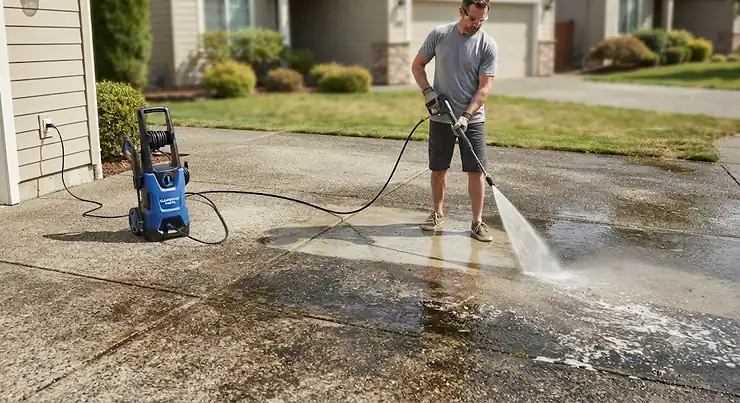
Your driveway has a memory. Every oil drip, every leaf pile that rotted into a dark blotch, every winter of road salt — it’s all still sitting there, waiting for you to notice. And once you notice, there’s no unseeing it. That’s usually the moment people start Googling for an electric pressure washer for driveways, half-hoping there’s a magic wand that turns thirty-year-old concrete back into a showroom floor.
There sort of is. It just runs on 120 volts instead of magic.
Here’s the honest version of that pitch: an electric pressure washer for driveways won’t out-muscle a gas unit on a five-year oil stain, but for the vast majority of homeowners — the ones dealing with algae, tire marks, pollen film, and the occasional charcoal-grill mishap — electric is quieter, lighter, cheaper to maintain, and starts with a button instead of a pull cord and a prayer. No gas cans in the garage. No carburetor gumming up over a mild winter. Just plug in, pull the trigger, and watch a decade of grime disappear in stripes.
This guide breaks down seven real, currently available models across budget, mid-range, and premium tiers, with honest analysis of who each one actually fits — plus the driveway-specific stuff nobody else covers, like what happens to stains before you resurface and what your homeowners association thinks about the noise you’re about to make.
What Is an Electric Pressure Washer for Driveways?
An electric pressure washer for driveways is a corded, motor-driven cleaning tool that uses an electric pump — rather than a gas engine — to force water through a narrow nozzle at high pressure, typically 1,600 to 2,300 PSI, in order to strip dirt, algae, oil film, and surface stains off concrete or asphalt without harsh chemical scrubbing.
That’s the textbook version. For more background on how pressure washing works as a cleaning method, the mechanics are simple, but in practice, it’s the difference between a driveway that looks merely “swept” and one that looks freshly poured.
Quick Comparison: Electric Pressure Washers for Driveways at a Glance
Before diving into the deep-dive reviews, here’s the shape of the market. Some of these figures come from independent testing groups that evaluate pressure output, water flow rate, and cleaning efficiency side by side, and all pricing is shown as a range rather than a fixed number, since retailer pricing shifts constantly.
| Model | Max PSI / GPM | Best For | Price Range |
|---|---|---|---|
| Greenworks Pro 2300 PSI Brushless | 2300 PSI / 2.3 GPM | Best overall, two-car driveways | $380–$420 |
| Kärcher K5 Premium + T5 | ~2000 PSI / 1.4 GPM | Premium bundle, streak-free finish | $420–$460 |
| Westinghouse ePX3500 | 1800 PSI / 1.06 GPM | Lightest, easiest to store | $130–$170 |
| Sun Joe SPX3000 | 2030 PSI / 1.76 GPM | All-around value | $130–$180 |
| Ryobi RY141900 | 2000 PSI / 1.2 GPM | Best warranty backing | $140–$180 range |
| BLACK+DECKER BEPW1600 | 1600 PSI / 1.2 GPM | Best under $150 | $85–$130 |
| Craftsman CMEPW1700 | 1700 PSI / 1.2 GPM | Compact budget alternative | $90–$140 |
Looking at the spread, the pattern is clear: PSI climbs fast once you cross into the premium tier, but GPM — the number that actually determines how quickly you rinse away loosened grime — barely budges below $400. That’s why the Greenworks Pro 2300 PSI Brushless stands out mathematically; its 2.3 GPM flow rate is roughly double what most sub-$200 electrics deliver, which is the real reason it clears a two-car driveway faster, not just its PSI number.
💬 Bookmark this table now — you’ll want to compare it against the deeper reviews below before you decide.
Top 7 Electric Pressure Washers for Driveways: Expert Analysis
Here’s where the specs turn into real-world decisions. Each of these seven models is a genuine, currently sold product — budget, mid-range, and premium — and every pick below is graded on what it actually does to concrete, not just what the box promises.
1. Greenworks Pro 2300 PSI Brushless — best overall for two-car driveways
The standout here is the TruBrushless motor, which one testing outlet rates for well over 500 hours of operation — several times longer than the universal motors found in most budget competitors. That durability claim matters more than it sounds — a brushless motor sheds heat better under sustained trigger time, which is exactly what a full driveway demands.
At 2300 max PSI and 2.3 GPM, the math works out to roughly 5,290 cleaning units, the highest of any corded electric currently on the market. In practice, that means fewer passes to lift the same grime a 1,600 PSI unit would need three tries to shift. The 25-foot hose and 35-foot GFCI cord combination is long enough to walk a full two-car driveway without unplugging and re-plugging halfway through, which is a small thing until you’re the one doing it in July heat.
Aggregated buyer sentiment across major retail listings consistently flags the fold-down handle and onboard nozzle storage as standout conveniences, though a recurring theme in reviews is that the plastic wheel casters can feel less rugged than the steel frame surrounding them.
Pros:
- ✅ Highest cleaning-unit output in the corded electric class
- ✅ Brushless motor rated for extended duty-cycle life
- ✅ Long hose and cord combo covers wide driveways solo
Cons:
- ❌ Plastic caster wheels feel less durable than the frame
- ❌ Premium pricing puts it above most budget-focused buyers’ ceiling
This one sits at the top of the market, around $380 to $420 depending on retailer promotions — worth it if you’re clearing a genuinely large slab and never want to think about motor burnout.
2. Kärcher K5 Premium + T5 — quietest premium bundle with surface cleaner
Kärcher’s name shows up again and again in noise-focused buying guides, and for good reason — the brand is repeatedly ranked among the top manufacturers known for quiet-running pressure washer designs. The K5’s water-cooled induction motor runs noticeably smoother than the axial-cam pumps found in most competitors, which is the mechanical reason it feels quieter in a driveway, not marketing spin.
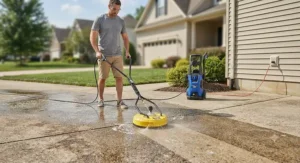
The included T-Racer surface cleaner attachment is the real differentiator. A standard wand nozzle leaves overlapping arcs — the “tiger stripes” you’ve probably seen on a neighbor’s concrete — while the rotating T5 head applies even pressure across a flat swath, eliminating that streaking entirely. For anyone repainting or sealing a driveway afterward, that even finish actually matters to the final result.
Reviewers consistently note the K5’s build quality and quieter startup compared to entry-level electrics, though the higher price and bulkier surface-cleaner attachment mean storage takes more garage real estate than the compact units below.
Pros:
- ✅ Induction motor runs measurably quieter than axial-pump rivals
- ✅ Bundled surface cleaner eliminates streaking on flat concrete
- ✅ Strong reputation for pump longevity among premium buyers
Cons:
- ❌ Highest price point of any model in this roundup
- ❌ Surface cleaner attachment adds bulk to storage needs
Expect a price range around $420 to $460 for the bundle — a fair ask if quiet, even results matter more to you than shaving dollars off the sticker.
3. Westinghouse ePX3500 — lightest build for easy hauling
The standout feature is weight distribution: this is one of the lighter corded units built specifically to be lightweight and easy to maneuver for everyday tasks rather than heavy-duty demolition work. If you’ve got stairs between the garage and the driveway, or a spouse who’ll actually be the one hauling it out on Saturdays, that lighter frame changes the whole experience.
At 1800 PSI and roughly 1.06 GPM, the cleaning-unit total lands lower than the Sun Joe or Ryobi below it, which honestly means longer dwell time on set-in stains. Where it earns its keep is everyday maintenance washing — pollen, light algae, seasonal dust — rather than one massive annual deep-clean.
Because this is a newer entrant in most review roundups, verified aggregated customer sentiment is thinner than for the longer-established Sun Joe or Ryobi lines; what’s currently available leans positive on portability and negative on how quickly the small onboard detergent tank empties during a full driveway job.
Pros:
- ✅ Noticeably lighter and easier to carry than most electrics
- ✅ Compact footprint for tight garage storage
- ✅ Simple, low-learning-curve controls for first-time buyers
Cons:
- ❌ Lower cleaning-unit total means more passes on tough stains
- ❌ Smaller detergent tank than premium competitors
At around $130 to $170, this is the pick for someone who wants “good enough, easy to carry” over maximum stripping power.
4. Sun Joe SPX3000 — best all-around value under $200
This is the model most homeowners have already heard of, and the reputation is earned. At 2030 certified PSI and 1.76 certified GPM, cleaning-unit output lands in solidly average territory for its price bracket — not flashy, just dependable. The dual 0.9-liter detergent tanks are the sleeper feature here: you can load a degreaser in one and a general soap in the other and switch mid-job without draining and refilling.
The Total Stop System automatically shuts the pump down the instant you release the trigger, which both saves energy and meaningfully extends pump life versus washers that idle under pressure between bursts. For a driveway job that involves a lot of stop-start spot treatment — around planters, mailbox posts, parked cars — that feature alone reduces wear you’d otherwise rack up on a lesser design.
Aggregated review sentiment for the SPX3000 across major retailers is remarkably consistent: buyers repeatedly praise the value-to-performance ratio, while a recurring complaint involves the quick-connect nozzle tips loosening after repeated use.
Pros:
- ✅ Dual detergent tanks let you switch cleaners without refilling
- ✅ Total Stop System reduces pump wear during stop-start use
- ✅ Long track record with consistently strong buyer sentiment
Cons:
- ❌ Quick-connect nozzles can loosen with heavy repeated use
- ❌ GPM is lower than newer premium competitors
Typically priced in the $130 to $180 range, this remains the default recommendation for buyers who want proven reliability without premium pricing.
5. Ryobi RY141900 — toughest warranty backing in the mid-range
Ryobi’s standout here isn’t a spec number, it’s the paperwork: a three-year limited warranty that outlasts most competitors’ one- or two-year coverage. For a tool that lives outdoors and gets dragged across concrete, that extra coverage window is a genuine, quantifiable value-add most spec sheets bury in the fine print.
At 2000 PSI and 1.2 GPM, performance sits in line with its Sun Joe and Westinghouse peers — nothing shocking, just steady mid-tier cleaning power. The roll-cage frame design is worth calling out specifically for driveway use, since it protects the pump housing if the unit ever tips while you’re maneuvering around a parked car or trailer.
The included turbo nozzle, rated for up to 50% more cleaning power over a standard fan tip, is the feature reviewers mention most often as exceeding expectations, while some buyers note the onboard hose reel storage feels tighter to wind than competing designs.
Pros:
- ✅ Three-year warranty beats most mid-range competitors
- ✅ Roll-cage frame protects the pump if the unit tips
- ✅ Bonus turbo nozzle adds real cleaning width
Cons:
- ❌ Onboard hose reel can be fiddly to wind back neatly
- ❌ GPM ties with entry-level models despite mid-range pricing
Priced typically in the $140 to $180 range, this is the pick for buyers who value long-term backing over chasing the highest PSI number.
6. BLACK+DECKER BEPW1600 — best pick under $150
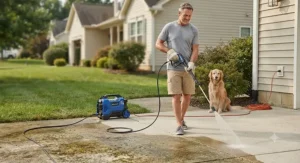
If your budget cap is genuinely firm, this is where to start looking. At 1,600 max PSI and 1.2 GPM, the BEPW1600 won’t win any cleaning-unit contest, but it’s not trying to — it’s built for routine maintenance washing on a driveway that isn’t decades-neglected. The turbo nozzle attachment claims up to 145% more cleaning width than the standard 40-degree tip, which noticeably speeds up coverage on wide, flat concrete.
The automatic shut-off, triggered the moment you release the spray gun, extends motor life exactly the way pricier models’ Total Stop Systems do — it’s a nice example of a genuinely useful feature trickling down to the budget tier instead of staying locked behind a premium price gate.
Real buyer sentiment on this model skews positive for ease of setup and cord/hose length relative to price, with one recurring theme being that pressurization can feel slow to build on first startup, something owners note tends to smooth out after a few uses.
Pros:
- ✅ Genuinely sits under most $150 budget caps
- ✅ Turbo nozzle adds real coverage width for its price tier
- ✅ Automatic shut-off protects motor between uses
Cons:
- ❌ Lower PSI means more time needed on set-in stains
- ❌ Some owners report slow initial pressurization
Typically found in the $85 to $130 range, this is the honest budget answer to anyone specifically hunting for an electric pressure washer under $150.
7. Craftsman CMEPW1700 — most compact budget alternative
Rounding out the list, the CMEPW1700 occupies the same budget tier as the BLACK+DECKER above but with a smaller physical footprint — a real advantage for anyone whose “garage storage” is actually a corner of a shed. At 1700 PSI and 1.2 GPM, cleaning power sits a notch above the BEPW1600 while staying well inside the sub-$150 target most budget shoppers are chasing.
Because Craftsman is a newer entrant to the electric pressure washer category compared to Sun Joe or Black+Decker, independently verified aggregated review data is thinner across major retailers; what’s currently visible trends positive on compactness and light weight, with less established long-term reliability data than the more established brands above.
Where this model earns its spot on the list is simple honesty about scope: it’s marketed and best suited for light-duty jobs — cars, small patios, and driveway touch-ups — not stripping a decade of oil stains in one pass.
Pros:
- ✅ Smallest storage footprint among the budget picks
- ✅ Slightly higher PSI than similarly priced rivals
- ✅ Lightweight design suits first-time buyers
Cons:
- ❌ Thinner verified long-term review history than older brands
- ❌ Not intended for heavy, deeply set stains
Expect a range of roughly $90 to $140, positioning it as a legitimate alternative to the BEPW1600 for shoppers who prioritize compact storage over brand tenure.
Electric Pressure Washer Under $150: What You Actually Get
Chasing an electric pressure washer under $150 isn’t a compromise so much as a different set of trade-offs. Here’s the honest breakdown of what that budget buys and what it doesn’t.
| Feature | Under $150 Reality | Premium ($350+) Reality |
|---|---|---|
| PSI range | 1,600–2,000 | 2,000–2,300+ |
| Motor type | Universal (shorter lifespan) | Brushless or induction |
| Included attachments | 3 nozzles, basic soap tank | Turbo nozzle, surface cleaner options |
| Best For | Light-to-moderate maintenance washing | Deep annual cleans, large slabs |
The gap isn’t as dramatic as the price difference suggests. Both the BLACK+DECKER BEPW1600 and Craftsman CMEPW1700 handle routine driveway maintenance — pollen film, light algae, seasonal grime — competently. What you sacrifice at this price point is motor longevity under heavy, sustained use and the raw flow rate that shortens a full deep-clean from an hour to twenty minutes.
✨ Don’t Miss These Exclusive Deals!
🔍 Take your driveway cleaning to the next level with these carefully selected picks. Click on any highlighted model to check current pricing and availability. These tools will help you restore genuinely spotless results your neighbors will notice!
Quiet Electric Pressure Washer for Residential Neighborhoods
If you live somewhere with shared fences and close-set homes, a quiet electric pressure washer for residential neighborhoods isn’t a luxury preference — it’s often the difference between an uneventful Saturday chore and an awkward conversation with a neighbor. Electric units already have a built-in advantage here: gas-powered pressure washers typically run 90 decibels or higher, while electric models generally fall between 60 and 80 decibels, roughly the range of a normal conversation to a running dishwasher. For context on why that gap matters, sustained exposure above 85 decibels is the threshold where hearing damage risk begins, according to federal occupational health guidance — a useful benchmark even for weekend yard work.
Within the electric category, motor type is the biggest noise differentiator. Induction motors, like the one inside the Kärcher K5 Premium + T5, run measurably quieter under load than the axial-cam pumps found in most budget and mid-range units, including the Sun Joe SPX3000 and Ryobi RY141900. If minimizing noise is your top priority rather than a secondary bonus, that mechanical difference is worth paying for.
Beyond the machine itself, timing matters just as much as decibel rating. Early morning and early evening are the two windows most likely to overlap with a neighbor’s nap, work-from-home call, or toddler’s bedtime — worth keeping in mind regardless of which model you choose.
HOA Noise Considerations Before You Fire Up Your Washer
Before you roll any electric pressure washer for driveways out of the garage, it’s worth a five-minute check of your community’s governing documents. As one property management guide to HOA noise rules explains, associations frequently fold noisy equipment — including lawn mowers, leaf blowers, and power washers — into the same quiet-hours restrictions that govern parties and construction work, and enforcement typically leans on what’s called a “reasonable person” standard rather than a strict decibel meter reading.
Some associations get specific. One community management resource notes that governing documents sometimes pair a numeric decibel ceiling with a defined time window — for instance, restricting noise above a set threshold after 11:00 p.m., in addition to whatever the surrounding city ordinance already permits, meaning an HOA rule can be stricter than local law even when it isn’t looser than it. Municipal ordinances layer on top of that: some cities have gone as far as capping outdoor equipment noise at 65 decibels before 7 a.m. or after 10 p.m., with tighter weekend windows for exactly this kind of yard work.
The practical takeaway: run your washer midday, on a weekday if possible, and lean toward one of the quieter induction-motor models above if your HOA’s documents mention specific decibel thresholds by name.
Concrete Stain Removal: Tackling Oil, Rust, and Tire Marks
Concrete stain removal is where most electric pressure washer for driveways buyers get their expectations recalibrated. Water pressure alone loosens surface dirt beautifully, but oil, rust, and old tire marks have chemically bonded into the porous top layer of the concrete — spraying harder doesn’t fix that, it just spreads it.
The sequence that actually works starts before the washer ever gets turned on. As a detailed concrete cleaning resource on removing embedded oil stains explains, fresh oil should be blotted or absorbed with cat litter rather than sprayed, since pressure alone tends to push oil deeper into porous concrete instead of lifting it out. For stains that have already set, a dedicated degreaser applied and left to dwell for the manufacturer’s recommended time gives the pressure washer something to actually rinse away instead of fighting the stain cold.
Set-in stains that have penetrated deep sometimes need a poultice — a paste of absorbent material and solvent left to sit for hours before being scraped and rinsed. Once that chemical breakdown has happened, even a modest 1,600 PSI unit like the BLACK+DECKER BEPW1600 will finish the job; a premium 2,300 PSI machine like the Greenworks Pro 2300 PSI Brushless simply does it faster and with fewer passes.
Driveway Resurfacing Prep: Why Pressure Washing Comes First
If a resurfacing overlay is in your future, driveway resurfacing prep is not optional — it’s the single biggest factor separating a coating that lasts a decade from one that bubbles and peels within a season. Adhesion is everything with concrete overlays, and adhesion fails when contaminants are trapped underneath.
Professional guidance on this is consistent: the slab needs to be thoroughly pressure washed to remove dirt, grease, and stains before any new layer is applied, since residue left behind causes the overlay to fail prematurely. That’s the pressure washer’s real job in a resurfacing project — not cosmetics, but literally creating a surface the new material can chemically bond to.
Sequence matters here too. Wash first, let the slab fully dry, then move to crack repair and etching or mechanical grinding to open the concrete’s pores — reversing that order traps moisture and debris under the new overlay. For a two-car driveway headed toward resurfacing, budget a full pass with a mid-to-premium unit like the Sun Joe SPX3000 or Ryobi RY141900 rather than rushing through with the lowest-PSI option on this list; contractors specifically flag inadequate cleaning as a top cause of resurfacing failure.
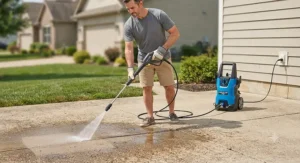
Real-World Scenarios: Matching the Right Washer to Your Driveway
Specs are easier to weigh against a real situation than against each other in the abstract. Here are three profiles that map cleanly onto the picks above.
The apartment-to-house upgrader with a small budget. You’ve got a single-car driveway, light seasonal grime, and a hard $150 ceiling. The BLACK+DECKER BEPW1600 or Craftsman CMEPW1700 covers this completely — you’re not fighting decades of oil, just keeping a newer slab looking cared-for.
The suburban HOA resident with close neighbors. Noise complaints are a real risk, and you’ll likely be washing during a narrow midday window on weekends. The Kärcher K5 Premium + T5 or Westinghouse ePX3500 minimizes the acoustic footprint while the T-Racer attachment (on the Kärcher) also gets the job done faster, shrinking your total noisy-minutes.
The long-time homeowner prepping for resurfacing. You’ve got real oil staining, a two-car slab, and a contractor deadline. The Greenworks Pro 2300 PSI Brushless delivers the flow rate to strip contamination across the full surface efficiently, giving your resurfacer the clean bond it needs.
How to Choose an Electric Pressure Washer for Driveways
Cutting through spec-sheet noise, here’s the actual decision order that matters:
- Set your PSI floor at 1,600. Anything lower struggles with genuine driveway grime rather than light patio dust.
- Weigh GPM as heavily as PSI. A higher flow rate rinses loosened dirt away faster — it’s the number budget shoppers most often overlook.
- Match motor type to usage frequency. Occasional users are fine with universal motors; anyone washing multiple properties or a large slab regularly should lean brushless or induction.
- Measure your actual driveway length against hose-plus-cord reach before buying, so you’re not fighting an extension cord mid-job.
- Check your HOA documents for decibel language before assuming any electric model is automatically “quiet enough.”
- Decide if a surface cleaner attachment earns its cost. It matters more for resurfacing prep than for routine maintenance washing.
- Confirm the warranty length, since pump seals are the most common failure point across every price tier.
Common Mistakes When Buying an Electric Pressure Washer for Driveways
The most common misstep is buying on PSI alone and ignoring GPM entirely — it’s an easy trap because PSI is the number printed largest on every box. A second frequent mistake is underestimating cord and hose reach, leading buyers to purchase extension cords that aren’t rated for the amperage draw, which can trip breakers mid-job. Third, plenty of shoppers skip checking their HOA’s governing documents until after a neighbor complains, when a five-minute read beforehand would have avoided the friction entirely. Finally, some buyers assume a zero-degree red nozzle is the “strongest” and therefore “best” option — in reality, that tip is narrow and aggressive enough to gouge softer or aging concrete, and most driveway work is better served by the 15- or 25-degree tips included with every unit on this list.
Electric vs Gas Pressure Washers: Which Wins on the Driveway?
The honest answer is: it depends on your driveway’s condition, not brand loyalty. Gas units still lead on raw cleaning units for heavily soiled, large commercial-style slabs, but for the vast majority of residential driveways, electric closes the gap enough that the trade-offs tip the other way.
| Factor | Electric | Gas |
|---|---|---|
| Noise level | 60–80 dB typical | 90+ dB typical |
| Maintenance | Minimal, no oil changes | Regular oil/spark plug service |
| Startup | Instant push-button | Choke, pull cord, priming |
| Raw cleaning power | Strong up to ~2,300 PSI | Higher ceiling, 3,000+ PSI |
| Portability | Corded, tethered to outlet | Untethered, needs fuel storage |
The table makes the trade-off explicit: gas wins on raw ceiling PSI, but it costs you in noise, maintenance, and startup friction every single time you use it. For anyone in a noise-sensitive HOA or simply tired of gas-engine upkeep, an electric pressure washer for driveways like the Greenworks Pro 2300 PSI Brushless closes most of the performance gap while eliminating nearly all of gas power’s downsides.
Long-Term Cost & Maintenance: What Nobody Tells You
Sticker price is a small slice of total cost of ownership. Electric units skip oil changes, spark plugs, and fuel stabilizer entirely — a maintenance routine that easily runs $40 to $60 a year on a comparable gas model once you account for oil, filters, and fuel additive. Pump seals are the real wear item across every electric on this list; letting a unit run dry, even briefly, is the single fastest way to void a pump’s working life regardless of brand or price tier.
Storage matters too. Units left outdoors through freezing temperatures with residual water in the pump risk cracked internals by spring — a five-minute winterizing routine (running pump antifreeze through the system, or simply draining thoroughly) costs nothing and prevents the most common warranty claim across this entire category. Between the Ryobi RY141900‘s three-year coverage and the shorter windows on some budget models, warranty length is often the more honest predictor of long-term cost than the PSI number on the box.
Frequently Asked Questions
❓ Is an electric pressure washer strong enough for a concrete driveway?
❓ What PSI do I need for driveway cleaning?
❓ Can I use a pressure washer before resurfacing my driveway?
❓ Will my HOA fine me for using a pressure washer?
❓ How do I remove old oil stains before pressure washing?
Conclusion
The right electric pressure washer for driveways isn’t the one with the biggest number on the box — it’s the one that matches your actual slab, your actual budget, and your actual neighbors’ tolerance for noise on a Saturday morning. Budget shoppers land well with the BLACK+DECKER BEPW1600 or Craftsman CMEPW1700. Anyone chasing quiet, HOA-friendly operation should look hardest at the Kärcher K5 Premium + T5 or Westinghouse ePX3500. And if you’re staring down a genuinely large, genuinely stained two-car slab, the Greenworks Pro 2300 PSI Brushless earns its premium price with flow rate alone.
Whichever you choose, treat the pre-wash prep — degreasing, dwell time, correct nozzle angle — as seriously as the machine itself. That’s the part that actually determines whether your driveway looks merely “cleaned” or genuinely restored.
Recommended for You
- Multi-Surface Cleaner for Pet Owners: 7 Best Picks (2026)
- Multi-Surface Cleaning Machine for Hardwood and Tile: 7 Winners (2026)
- 7 Best Grout Cleaning Machines for Hard Water Buildup in 2026
Disclaimer: This article contains affiliate links. As an Amazon Associate, I earn from qualifying purchases. If you purchase products through these links, we may earn a small commission at no additional cost to you.
✨ Found this helpful? Share it with your friends! 💬🤗
