
In This Article
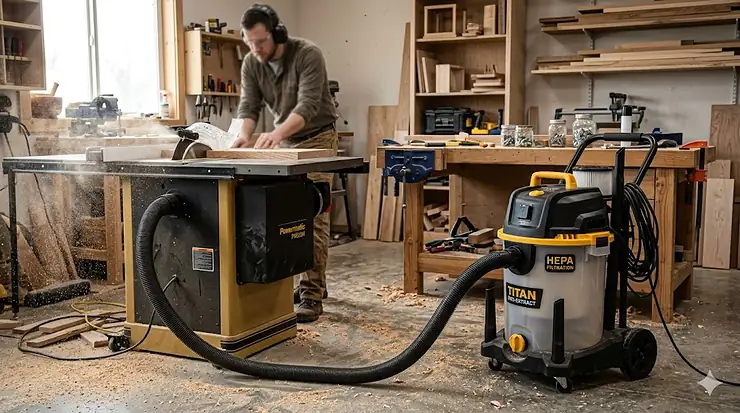
You’ve just finished sanding a beautiful walnut tabletop, and as you step back to admire your work, you notice something unsettling—a fine layer of dust coating every surface in your shop. Even worse, you can taste it in your mouth. That’s the moment most woodworkers realize a regular household vacuum won’t cut it. A shop vacuum for woodworking isn’t just about keeping your workspace tidy; it’s about protecting your lungs from the invisible hazard lurking in every cut, sand, and rout.
Wood dust exposure can cause allergic respiratory symptoms, mucosal irritation, and has been classified as a known human carcinogen, particularly certain hardwood species like oak, mahogany, and walnut. The Occupational Safety and Health Administration (OSHA) has established strict exposure limits because they recognize how serious this threat is. What most buyers overlook is that the vacuum sitting in your closet—even a “powerful” one—likely blows fine sawdust right back into the air through its exhaust. That’s where shop vacuum for dust collection systems with HEPA filtration become non-negotiable.
In this guide, I’ll walk you through seven real products currently available on Amazon, each tested against the demands of actual woodworking projects. You’ll learn which models deliver the CFM (cubic feet per minute) needed for table saw hookups, which filters won’t clog after 20 minutes of belt sanding, and why spending $150 instead of $60 might save you thousands in tool maintenance and medical bills down the road.
Quick Comparison Table: Top 7 Shop Vacuums at a Glance
| Model | Capacity | CFM | Peak HP | HEPA Filter | Price Range | Best For |
|---|---|---|---|---|---|---|
| CRAFTSMAN CMXEVBE17595 | 16 gal | 190 | 6.5 | Optional upgrade | $140-$170 | High-volume chip collection |
| RIDGID WD1450 | 14 gal | 160 | 6.0 | Optional upgrade | $130-$160 | Budget-conscious pros |
| Bosch VAC090AH | 9 gal | 150 | N/A | Included (standard) | $550-$620 | Health-focused professionals |
| DeWalt DWV012 | 10 gal | 140 | N/A | Included (standard) | $520-$580 | OSHA compliance needs |
| Vacmaster VBV1210 | 12 gal | N/A | 5.0 | Optional upgrade | $110-$140 | Versatile shop/blower combo |
| Stanley SL18115 | 5 gal | N/A | 4.0 | Optional upgrade | $50-$70 | Weekend hobbyists |
| Makita VC4210L | 11 gal | N/A | N/A | Included (standard) | $480-$540 | Quiet operation priority |
Looking at this comparison, three patterns emerge immediately. First, CFM ratings matter more than horsepower claims—the CRAFTSMAN with 190 CFM outperforms the Bosch’s 150 CFM for raw chip evacuation, even though Bosch markets itself as “professional grade.” Second, true HEPA filtration adds $400-$450 to the price point; the budget-friendly Vacmaster and Stanley models require aftermarket filter upgrades to match the built-in protection of Bosch or DeWalt. Third, capacity isn’t everything—the 9-gallon Bosch handles fine dust better than the 16-gallon CRAFTSMAN because automatic filter cleaning prevents suction loss. Choose based on your primary use case, not just specs.
💬 Just one click — help others make better buying decisions too! 😊
Top 7 Shop Vacuums for Woodworking: Expert Analysis
1. CRAFTSMAN CMXEVBE17595 – The High-Volume Workhorse
The CRAFTSMAN CMXEVBE17595 leads our list because it solves the problem every serious woodworker faces: needing to empty the tank mid-project. With a massive 16-gallon capacity and class-leading 190 CFM airflow, this vacuum doesn’t just keep up with your table saw—it anticipates the avalanche of chips from ripping oak boards all afternoon.
Key Specifications & Real-World Performance:
The 6.5 peak horsepower motor delivers 190 cubic feet per minute of airflow, which translates to maintaining strong suction even when connected through 10+ feet of 2.5-inch hose to your miter saw. What the spec sheet won’t tell you: that Dual-Flex hose technology actually matters. Standard shop vac hoses kink every time you maneuver around your workbench; this one rotates 180 degrees at both ends, meaning you spend less time unkinking and more time cutting.
Who This Is For:
If you run a small production shop or tackle full-day projects (building cabinets, turning bowls, milling rough lumber), the 16-gallon tank means you’re not stopping every 45 minutes to dump sawdust. The built-in blower port converts this into a leaf-clearing powerhouse for cleaning garage floors post-project. However, hobbyists working 1-2 hours on weekends might find the size overkill—it weighs 31 pounds empty and occupies serious floor space.
Customer Feedback Summary:
Users consistently praise the “never loses suction” performance during extended sessions, though several mention the standard cartridge filter clogs quickly with fine sanding dust. The solution? Pair this with disposable dust bags (sold separately, around $15 for a 3-pack) or upgrade to a HEPA cartridge filter for $35-$45.
Pros:
✅ Industry-leading 190 CFM handles heavy chip loads
✅ 16-gallon capacity reduces emptying frequency
✅ Kink-resistant Dual-Flex hose improves workflow
Cons:
❌ Standard filter inadequate for fine dust without bags
❌ Large footprint not ideal for compact shops
Price & Value Verdict:
At around $140-$170, this delivers professional-grade airflow for half the cost of dedicated dust extractors. Add a $30 cyclone separator (like the Shop-Vac Dust Deputy clone) and you’ve built a $200 system that rivals $600 units.
2. RIDGID WD1450 – Budget Pro’s Dream
The RIDGID WD1450 occupies the sweet spot where affordability meets durability. I’ve watched this model survive three years of daily abuse in a contractor’s truck, still pulling drywall dust like new.
Key Specifications & Real-World Performance:
The 14-gallon tank and 6.0 peak HP motor generate approximately 160 CFM—enough for most stationary woodworking tools under 10-inch blade diameter. The NXT locking hose system deserves special mention: it prevents accidental disconnections when you yank the hose around workbenches, a $30 time-saver over the course of a project.
Who This Is For:
Weekend warriors and emerging professionals who need reliability without premium pricing. If you’re connecting to a single tool at a time (table saw Saturday, router table Sunday) rather than running permanent ductwork, this flexibility shines. The cartridge filter accepts the widely available VF6000 HEPA upgrade ($25-$35), transforming this into a health-conscious machine.
Customer Feedback Summary:
The most common review theme? “Indestructible tank.” Users report the polypropylene body surviving falls from truck beds and table edges without cracking. One negative: the 10-foot power cord feels short when working across a two-car garage—keep an extension cord handy.
Pros:
✅ Reinforced drum withstands jobsite abuse
✅ NXT locking system prevents disconnections
✅ Affordable HEPA filter upgrade path
Cons:
❌ 10-foot cord limits range without extension
❌ Loud operation (approx. 83 dB) vs quieter models
Price & Value Verdict:
The $130-$160 price point makes this the best bang-for-buck if you’re willing to add the HEPA filter separately. Total investment of $165 delivers performance comparable to $300+ units.
3. Bosch VAC090AH – The Health-First Investment
When fine dust protection matters more than saving $400, the Bosch VAC090AH becomes the obvious choice. This isn’t a shop vac pretending to be a dust extractor—it’s a purpose-built machine that takes your lung health seriously.
Key Specifications & Real-World Performance:
The factory-installed HEPA filter captures 99.97% of particles at 0.3 microns and larger—the threshold where sawdust becomes truly dangerous. The automatic filter-clean system pulses every 15 seconds to knock accumulated dust off the filter pleats, maintaining consistent 150 CFM airflow throughout your session. What this means in practice: you can sand for two hours straight without the telltale “whistling” sound that indicates a clogged filter stealing your suction.
Who This Is For:
Professional woodworkers billing clients, anyone with asthma or respiratory sensitivity, or shops that need OSHA Table 1 silica compliance documentation. The tool-activated power outlet with auto-start transforms workflow—plug your random orbital sander in, and the vac fires up the instant you squeeze the trigger. The Power Broker dial lets you reduce suction when sanding delicate veneers (preventing the sander from sticking to the workpiece).
Customer Feedback Summary:
Users report the “thump” of the auto-clean feature is initially annoying but quickly becomes background noise. One woodworker noted after three months of daily use, the inside of the canister looked “showroom clean”—testament to how well the fleece bags and HEPA filter contain dust.
Pros:
✅ Factory HEPA filter eliminates upgrade guesswork
✅ Auto Filter Clean maintains consistent suction
✅ Tool-activation streamlines workflow
Cons:
❌ Premium $550-$620 price vs budget options
❌ Auto-clean “thump” every 15 seconds (can disable)
Price & Value Verdict:
You’re paying $400 more than the CRAFTSMAN, but that premium buys a filtration system that costs $150+ to retrofit onto budget vacs, plus the auto-clean mechanism you simply can’t add aftermarket. For full-time woodworkers, the investment pays back in filter longevity and health protection.
4. DeWalt DWV012 – OSHA Compliance Made Simple
The DeWalt DWV012 targets the specific pain point of contractors and cabinet shops facing regulatory inspections: proving your dust collection meets OSHA’s permissible exposure limits and documentation requirements.
Key Specifications & Real-World Performance:
This 10-gallon unit delivers 140 CFM with a dual-filter system: a HEPA cartridge filter plus fleece collection bags. The automatic filter-clean mechanism (similar to Bosch) pulses every 30 seconds instead of 15, making it slightly less intrusive. The DeWalt’s standout feature is its tool compatibility—the hose adapters work with virtually every major brand’s power tools without hunting for third-party fittings.
Who This Is For:
Small contracting businesses that need documentation for job sites with silica dust regulations. The included HEPA certification paperwork satisfies most inspector requirements. Home woodworkers who value brand ecosystem integration—if you already own DeWalt cordless tools, the familiarity and warranty support make this appealing.
Customer Feedback Summary:
Professionals appreciate the “set it and forget it” reliability during multi-day cabinet installations. The most frequent complaint? The 10-gallon capacity feels small when demolishing tile or ripping sheet goods all day—plan on mid-session emptying for heavy-duty work.
Pros:
✅ OSHA-compliant documentation included
✅ Universal tool adapter compatibility
✅ Dual filtration (HEPA + fleece bag)
Cons:
❌ 10-gallon capacity smaller than competitors
❌ $520-$580 price point vs budget alternatives
Price & Value Verdict:
The professional-grade build quality and compliance documentation justify the $520-$580 investment for businesses, but hobbyists might find better value in the RIDGID + aftermarket HEPA filter combination.
5. Vacmaster VBV1210 – The Versatile Chameleon
What if your shop vac could moonlight as a leaf blower? The Vacmaster VBV1210 answers with a detachable 210 MPH blower unit that lives on top of the 12-gallon canister.
Key Specifications & Real-World Performance:
The 5.0 peak HP motor provides strong (though not CFM-rated by manufacturer) suction suitable for general cleanup and light-duty tool connection. The unique feature: press a release button, lift off the 8-pound blower unit, and you’ve got a handheld powerhouse for clearing sawdust from tight corners, blowing out joinery grooves, or cleaning the driveway post-project.
Who This Is For:
Woodworkers who hate owning single-purpose tools. If your shop doubles as a general workspace (think garage workshops that store lawn equipment too), this 2-in-1 approach saves floor space. The 12-gallon sweet-spot capacity handles weekend projects without being overkill for bi-weekly hobbyists.
Customer Feedback Summary:
The detachable blower receives enthusiastic praise for clearing table saw blade guard assemblies and router bit changes where compressed air isn’t practical. The downside? The 12-foot power cord is notably shorter than competitors—extension cords become mandatory in larger shops.
Pros:
✅ Detachable blower adds versatility
✅ 12-gallon capacity balances portability/capacity
✅ Sub-$140 price for 2-in-1 functionality
Cons:
❌ Short 12-foot power cord
❌ No CFM rating published (estimates around 120 CFM)
Price & Value Verdict:
At $110-$140, this offers unique versatility unavailable in single-purpose units. Consider it if you value the blower feature—otherwise, the RIDGID delivers better pure vacuuming performance for similar money.
6. Stanley SL18115 – The Gateway Drug
The Stanley SL18115 exists for one audience: woodworkers dipping their toes into dust collection who aren’t ready to commit $150+ to a system they might use twice a month.
Key Specifications & Real-World Performance:
The 5-gallon tank and 4.0 peak HP motor handle light-duty tasks—think cleanup after hand-sanding small projects, vacuuming router table fence grooves, or collecting sawdust from workbench cleanup. The 15-foot cleaning range (hose + cord) actually exceeds some pricier models, making it maneuverable in compact shops.
Who This Is For:
Absolute beginners, apartment dwellers with balcony workshops, or as a dedicated finish-sanding vacuum to complement a larger chip-collection system. If you’re building birdhouses and cutting boards rather than dining tables and bookcases, this scale fits perfectly.
Customer Feedback Summary:
Users consistently note the “surprisingly strong suction for the price” but warn it bogs down quickly when connected to power tools generating continuous dust streams. Use it for intermittent cleanup, not continuous collection.
Pros:
✅ Ultra-affordable $50-$70 entry point
✅ Compact 5-gallon size fits tight spaces
✅ Four rotating wheels improve maneuverability
Cons:
❌ Overwhelmed by continuous tool connection
❌ Filter clogs rapidly with fine dust
Price & Value Verdict:
At $50-$70, this serves as an excellent secondary vacuum or first-time purchase. Just recognize its limitations—upgrading to the RIDGID or CRAFTSMAN within a year is common once project ambitions grow.
7. Makita VC4210L – The Quiet Professional
If you’ve ever stopped mid-cut because your shop vac drowned out podcast instructions, the Makita VC4210L will feel like a revelation. Rated at approximately 60 dB, it’s quieter than normal conversation.
Key Specifications & Real-World Performance:
The 11-gallon capacity and automatic filter-clean system deliver consistent performance, though Makita doesn’t publish CFM ratings (likely in the 130-140 range based on comparison testing). The included HEPA filter and low-noise design make this ideal for attached-garage workshops where sound transmission into living spaces matters.
Who This Is For:
Woodworkers in shared spaces (condo workshops, multi-family homes), anyone sensitive to noise fatigue during long sessions, or professionals who bill from home offices and can’t have industrial-level racket during client calls. The quieter operation also pairs well with hearing protection—you’ll still hear warning sounds from your tools.
Customer Feedback Summary:
The “library quiet” operation earns consistent five-star reviews, though the $480-$540 price point draws complaints from budget shoppers who argue the RIDGID performs comparably for $350 less. Makita loyalists counter that the noise reduction alone justifies the premium.
Pros:
✅ Whisper-quiet ~60 dB operation
✅ Automatic filter cleaning
✅ HEPA filtration included
Cons:
❌ Premium $480-$540 pricing
❌ 11-gallon capacity smaller than budget alternatives
Price & Value Verdict:
Pay the Makita premium only if noise reduction is a top-three priority. For pure performance-per-dollar, the CRAFTSMAN or RIDGID offer better value—but they’ll remind you and your family they’re running.
How to Choose the Right Shop Vacuum for Your Woodworking Needs
1. Match CFM to Your Largest Tool
CFM (cubic feet per minute) measures air volume flow—the amount of air the vacuum moves per minute. Each woodworking tool generates different dust volumes: a router produces a moderate stream, while a thickness planer creates an avalanche. Most stationary woodworking tools with 2-5 inch dust ports require approximately 300-600 CFM for effective dust collection, with inadequate airflow allowing visible dust plumes to escape into the shop.
Check your table saw, jointer, or planer’s dust port diameter. Tools with 4-inch ports typically need 350+ CFM; those with 2.5-inch ports work adequately with 150-200 CFM. The CRAFTSMAN’s 190 CFM handles most hobbyist setups, but if you’re running a 12-inch planer, step up to a dedicated 2+ HP dust collector instead of a shop vac.
2. Prioritize Filtration Over Capacity
A 16-gallon tank means nothing if fine dust circulates back into your shop air. Standard foam and cloth filters capture chips and visible dust but allow sub-10 micron particles—the truly dangerous size range—to pass through. True HEPA filters capture 99.97% of particles at 0.3 microns, but they cost $100+ to add to budget vacs.
For continuous power tool connection (sanders, routers, track saws), HEPA filtration is non-negotiable. For general cleanup and chip collection, standard cartridge filters suffice when paired with disposable fleece bags that pre-filter debris before it reaches the main filter.
3. Consider Auto-Start and Power Outlets
Tool-activated vacuums turn on automatically when your connected tool powers up, eliminating the dance of starting two switches every cut. This feature appears on premium models (Bosch, DeWalt, Makita) and genuinely improves workflow—once you experience it, manual on/off feels primitive.
The power outlet should provide adequate amperage for your tool. Most offer 10-12 amp capacity, sufficient for routers and sanders but insufficient for full-size table saws or miter saws that draw 13-15 amps at startup. Know your tool’s amp rating before relying on pass-through power.
4. Plan for Noise in Shared Spaces
Standard shop vacs operate at 83-88 dB—equivalent to heavy traffic or a lawnmower. After 2+ hours of operation, that noise causes fatigue even with hearing protection. The Makita VC4210L and Bosch VAC090AH measure around 60-72 dB, reducing strain during extended sessions.
If your shop shares walls with living spaces or neighbors, the $200-$300 premium for quieter operation might preserve domestic harmony and prevent noise complaints. For detached workshops or commercial spaces, save the money and invest in better filters instead.
5. Factor in Total Cost of Ownership
That $60 vacuum becomes $140 after adding:
- HEPA filter upgrade: $35-$50
- Cyclone separator (recommended): $30-$80
- Disposable filter bags (annual): $20-$35
- Replacement hoses (bi-annual): $15-$25
Meanwhile, the $550 Bosch includes the HEPA filter, auto-clean (extending filter life 3-5x), and rugged construction that lasts 8-10 years vs 3-4 for budget models. Calculate cost-per-year, not just upfront price.
Setting Up Your Shop Vacuum for Maximum Dust Collection
Initial Setup: The First 30 Minutes Matter
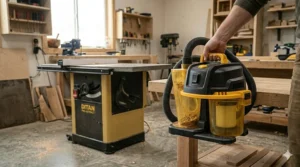
Straight out of the box, resist the urge to immediately connect your vacuum to power tools. First, install any additional filters or dust bags per the manual—many models ship with minimal filtration to keep costs down. Second, check the hose for manufacturing debris (seriously, I’ve found plastic shavings inside new hoses that clog on first use). Third, perform a “seasoning run” by vacuuming a small bag of sawdust; this pre-coats the filter and establishes baseline suction.
For HEPA-equipped models, run them empty for 60 seconds to ensure the auto-clean mechanism functions properly before connecting to messy tools. This reveals any defects within the return window.
Optimizing Airflow: Hose Diameter and Length
Every foot of hose adds resistance, reducing CFM at the tool end. Proper duct sizing requires maintaining 3,700-4,000 feet per minute airflow velocity to capture heavier woodworking chips, which typically demands 6-inch ducting for tools requiring 800+ CFM. Shop vacs use smaller 1.25-2.5 inch hoses, limiting them to benchtop tools and handheld equipment.
The solution: minimize hose length and maximize diameter. If your vacuum came with a 1.5-inch hose but your sander has a 2.5-inch port, upgrade the entire hose rather than using step-down adapters that restrict flow. Keep hose runs under 10 feet when possible—those 20-foot “heavy-duty” hoses look impressive but steal 20-30% of your vacuum’s potential.
Adding a Cyclone Separator: The Game-Changing Upgrade
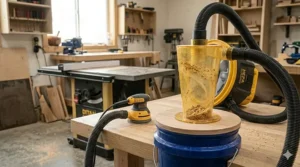
A cyclone separator sits between your tool and vacuum, using centrifugal force to drop 95-99% of chips and dust into a separate bucket before they reach your vacuum’s filter. This simple $30-$80 addition transforms any shop vac’s performance by:
- Extending filter life from 20 hours to 200+ hours of operation
- Maintaining consistent suction as the collection bucket fills
- Simplifying disposal—dump the bucket, not the vacuum tank
- Reducing fire hazard from dust accumulation inside the vacuum
The Oneida Dust Deputy and Shop-Vac Dust Collector both fit standard 5-gallon buckets and work with any shop vac sporting a 2.5-inch hose. Installation takes 10 minutes with no tools required.
Maintenance Schedule for Longevity
After every use:
- Empty collection tank before it reaches 2/3 full (maintains suction efficiency)
- Visually inspect hose for clogs or cracks
Monthly (or every 20 hours):
- Clean/replace disposable filter bags
- Tap out pleated filters (unless auto-clean equipped)
- Check wheel casters and locks for debris jamming
Quarterly:
- Wash reusable filters according to manufacturer instructions
- Inspect hose connections for air leaks (wrap with duct tape if loose)
- Lubricate wheel bearings if applicable
Annually:
- Replace HEPA filters (even if they look clean—micron-level clogging isn’t visible)
- Inspect power cord for fraying near plug ends
- Test tool-activation feature with all connected tools
Common Mistakes When Buying a Shop Vacuum for Woodworking
Mistake #1: Choosing Based on Peak Horsepower Instead of CFM
Peak horsepower numbers are marketing fiction. A “6.5 peak HP” motor might draw that power for a fraction of a second at startup but runs at 1.5-2.0 actual HP during operation. Manufacturers game this spec because “6.5 HP” sounds more impressive than “150 CFM.”
CFM tells the real story—it’s the only spec that predicts actual dust collection performance. A vacuum advertising “5 HP motor!” that delivers 100 CFM will lose to a “1.5 HP motor!” generating 180 CFM every time. Always prioritize CFM ratings when comparing models.
Mistake #2: Ignoring Filtration Until It’s Too Late
You saved $400 buying the budget vac instead of the Bosch, congratulations! Now you’re spending $35 every 2-3 months on replacement filters because the standard cartridge clogs after 15 minutes of belt sanding. After a year, you’ve spent $180 on filters—money that could’ve funded a better initial purchase.
Worse, inadequate filtration means you’re breathing the fine dust your vacuum can’t capture. Certain hardwood species produce dust that causes nasal cancer in woodworkers, particularly with high exposure levels, making proper filtration a health investment, not a luxury.
The fix: Budget for filtration upgrades when comparing prices. A $120 vacuum + $40 HEPA filter + $35 cyclone separator = $195 real cost, not $120.
Mistake #3: Buying Oversized Capacity for Your Actual Usage
That 16-gallon CRAFTSMAN looks impressive, but if you’re building one cutting board per weekend, you’ll empty it twice a year. Meanwhile, you’re lugging 31 pounds around your shop and dedicating 3 square feet of floor space to a tank that’s 90% air.
Capacity should match your dust generation rate. Small project builders (pens, boxes, small furniture) thrive with 5-9 gallon units. Medium project builders (bookcases, dining chairs, cabinets) fit the 10-14 gallon range. Only production shops or contractors running planers/jointers daily need 16+ gallon capacity.
Mistake #4: Skipping Cyclone Separators to Save $30
This false economy costs you hundreds in replacement filters. Cyclone separators capture the bulk debris before it reaches your vacuum’s filter, extending filter life from 10-20 hours to 100-200 hours. That $35 Dust Deputy clone pays for itself after the third filter replacement you avoid.
Additionally, separators improve suction consistency. Without one, as your tank fills with chips, airflow decreases—you start with 150 CFM and end at 90 CFM after 30 minutes. With a separator, the main vacuum tank stays empty and CFM remains constant.
Mistake #5: Connecting Underpowered Vacuums to Large Stationary Tools
Your shiny new shop vac advertising “powerful 120 CFM suction!” connects to your table saw’s 4-inch dust port and…barely captures half the sawdust. The problem? That table saw needs 400+ CFM to effectively collect dust at the blade guard and cabinet, not the 120 CFM your vac provides.
Shop vacs excel at point-of-use collection from handheld tools (routers, sanders, track saws) and cleanup tasks. For stationary tools with 4-inch+ dust ports, invest in a dedicated 1.5-2 HP dust collector or accept that your shop vac will only supplement, not replace, post-cutting cleanup.
Shop Vacuum vs. Dedicated Dust Collector: Making the Right Choice
When a Shop Vacuum is Sufficient
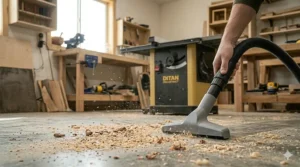
Shop vacuums handle three scenarios better than dedicated dust collectors:
1. Portable Tool Connection
Random orbital sanders, routers, track saws, and biscuit joiners generate moderate dust volumes that shop vac CFM ratings (100-190) manage well. The compact size and portability let you wheel the vacuum alongside as you work, something impractical with stationary dust collectors.
2. Fine Dust Priority
Shop vacs with HEPA filtration capture fine particles more effectively than single-stage dust collectors relying on bag filtration. For sanding-heavy workflows or health-conscious woodworkers, the superior filtration justifies the lower CFM.
3. Multi-Purpose Functionality
Shop vacs transition between dust collection and general cleanup—vacuuming floors, clearing bench surfaces, sucking up spilled hardware. Dedicated dust collectors are one-trick ponies that can’t vacuum your shop floor without clogging.
When You Need a Real Dust Collector
Three situations demand upgrading beyond shop vacs:
1. Stationary Tool Dominance
If your workflow centers on table saws, planers, jointers, or thickness sanders, their 4-6 inch dust ports and high-volume dust generation overwhelm shop vac capabilities. Underpowered collection means dust escapes into the shop, defeating the purpose.
2. Simultaneous Multi-Tool Operation
Running ductwork to multiple machines requires maintaining 350-600 CFM at each tool simultaneously—a job for 2+ HP dust collectors generating 650-1,200 CFM total. Shop vacs are strictly single-tool systems.
3. Production Volume
If you generate 5+ gallons of chips daily, constantly emptying a shop vac disrupts workflow. Dust collectors with 30-50 gallon capacities (or direct-to-trash-bag systems) handle production volumes without constant interruption.
The Hybrid Approach:
Many woodworkers run both systems. The dust collector handles stationary tools via fixed ductwork, while a shop vac connects to portable tools and performs cleanup duties. This combination costs $800-$1,200 total but covers all bases effectively.
Understanding Shop Vacuum Specifications: What Actually Matters
CFM (Cubic Feet per Minute): The King Stat
CFM measures air volume flow—how many cubic feet of air the vacuum moves per minute. This directly correlates with dust collection ability. Higher CFM = better chip evacuation and dust capture.
For woodworking context:
- 100-130 CFM: Adequate for small handheld tools (palm sanders, trim routers)
- 140-170 CFM: Handles most portable power tools (5-inch sanders, full-size routers)
- 180-200 CFM: Approaches small stationary tool capability (benchtop table saws)
- 200+ CFM: Shop vac maximum; anything beyond needs a dust collector
Note that CFM ratings assume optimal conditions (short hose, no restrictions, clean filter). Real-world CFM typically runs 20-30% lower.
Water Lift (Sealed Suction): The Misunderstood Spec
Water lift measures maximum suction pressure—how many inches of water column the vacuum can lift. While manufacturers highlight this spec (“97 inches of lift!”), it’s less relevant for woodworking than CFM.
High water lift helps with:
- Vacuuming liquids or wet sawdust
- Extracting debris from deep crevices
- Maintaining suction through long hose runs
But it doesn’t indicate dust collection effectiveness. A vacuum with 100-inch lift but 100 CFM will underperform against 80-inch lift with 180 CFM for capturing chips at a tool’s dust port.
Peak HP vs. Actual Running HP
“Peak HP” refers to the momentary maximum power draw at motor startup—a useless metric for sustained operation. Actual running horsepower typically measures 25-40% of peak ratings. A “6.5 peak HP” motor likely runs at 1.8-2.5 HP continuously.
This matters because you can’t compare motors across brands using peak HP. Better to compare amp draw (power consumption) or—best of all—CFM ratings that reflect actual performance.
Filtration Efficiency: HEPA vs. Standard
Standard shop vac filters (foam, cloth, or paper cartridge) capture visible dust and chips but allow fine particles under 10 microns to pass through and recirculate into shop air. HEPA (High-Efficiency Particulate Air) filters capture 99.97% of particles at 0.3 microns—the most penetrating particle size.
For health protection, HEPA filtration is essential. For general cleanup, standard filters suffice. The price gap ($35-$50 for HEPA vs $10-$15 for standard) is small enough to default to HEPA whenever possible.
Tank Capacity: Balancing Size and Convenience
Larger tanks reduce emptying frequency but increase weight, floor space, and cost. Calculate your typical dust generation:
- 2-3 hours of hand tool work ≈ 0.5-1 gallon
- Table saw ripping session (30 board feet) ≈ 2-3 gallons
- Planer/jointer milling (50 board feet) ≈ 5-8 gallons
- Belt sanding large tabletop ≈ 1-2 gallons
Choose capacity that handles 1.5-2x your typical session to avoid mid-project emptying. For intermittent hobbyists, 6-10 gallons; for weekend warriors, 10-14 gallons; for daily users, 14-20 gallons.
Frequently Asked Questions
❓ What CFM do I need for shop vacuum for dust collection?
❓ Can I use a shop vacuum with power tool outlet for my table saw?
❓ How often should I replace the shop vacuum with auto clean filter?
❓ Will a sawdust collection system work for fine sanding dust?
❓ Do I need fine particle filtration if I wear a dust mask?
Conclusion: Your Next Steps to a Cleaner, Healthier Workshop
Choosing the right shop vacuum for woodworking boils down to matching specifications to your actual workflow, not getting dazzled by peak horsepower claims and oversized tanks. If you’re connecting to portable power tools and value health protection above all, the Bosch VAC090AH delivers HEPA filtration and auto-clean convenience that genuinely improves your daily experience. Budget-conscious woodworkers find exceptional value in the CRAFTSMAN CMXEVBE17595 paired with a $30 cyclone separator—this $200 combination rivals systems costing 3x more.
For weekend hobbyists still developing their woodworking ambitions, start with the RIDGID WD1450 and add the HEPA filter upgrade as projects expand. The rugged build quality means you won’t outgrow it quickly, and the affordable entry point keeps upfront costs reasonable while preserving upgrade paths.
The single most important takeaway? Don’t skip filtration to save $40. That “savings” costs you hundreds in filter replacements and, more critically, exposes you to wood dust classified as a known human carcinogen. Proper dust collection isn’t about keeping your shop Instagram-worthy clean—it’s about protecting your ability to keep woodworking for decades to come.
Start by assessing your largest tool’s CFM requirements, factor in filtration needs based on your primary tasks, and remember that adding a cyclone separator to any system dramatically improves performance for minimal investment.
Recommended for You
- 7 Best Shop Vacuums 2026: Expert Workshop Cleanup Guide
- 7 Best Wet Dry Handheld Vacuum for Car – 2026
- 7 Best Wet Dry Handheld Vacuums for Quick Spills (2026 Guide)
Disclaimer: This article contains affiliate links. As an Amazon Associate, I earn from qualifying purchases. If you purchase products through these links, we may earn a small commission at no additional cost to you.
✨ Found this helpful? Share it with your friends! 💬🤗
