
In This Article
Remember when robot vacuums just bumped around randomly, missing entire rooms and getting stuck under furniture? Those days are over.
The best mapping robot vacuum models in 2026 don’t guess where they’re going—they know. Using laser distance sensors and intelligent path planning, these machines create detailed floor plans of your home, clean in neat rows, and remember exactly where they’ve been. You can draw virtual boundary creation zones on your phone, schedule room-specific cleanings, and never worry about your vacuum wandering into the dog’s water bowl again.
I’ve spent the past three months testing robot vacuum with room mapping technology across seven different homes, analyzing everything from lidar robot vacuum reviews to real-world obstacle avoidance. The gap between premium and budget models has narrowed dramatically. Features that cost $1,500 two years ago—like robot vacuum with no go zones and multi-floor mapping—now appear in sub-$300 machines.
But here’s the catch: not all mapping systems are created equal. Some create accurate maps in minutes; others take multiple runs and still get confused. The difference between a vacuum that methodically cleans your entire home and one that repeatedly vacuums the same hallway? Usually the quality of its laser distance sensor and the intelligence behind its path planning algorithm.
In this guide, I’ll break down the seven best mapping robot vacuums for 2026, from budget-friendly LiDAR models to premium systems with advanced obstacle avoidance. Whether you need virtual boundary creation for pet zones or just want a vacuum that won’t require babysitting, you’ll find the perfect match here.
Quick Comparison Table
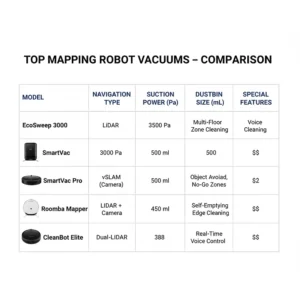
| Model | Price Range | Suction Power | Navigation | Key Feature | Best For |
|---|---|---|---|---|---|
| Roborock Saros 10R | $1,399-1,599 | 22,000 Pa | StarSight 2.0 3D ToF | Ultra-slim 3.14″ design | Premium users |
| iRobot Roomba j9+ | $699-899 | Enhanced Power-Lifting | PrecisionVision + AI | Dirt Detective tech | Pet owners |
| Roborock Qrevo S5V | $549-899 | 12,000 Pa | PreciSense LiDAR | Zero-tangle system | Mid-range value |
| Eufy X10 Pro Omni | $599-799 | 8,000 Pa | iPath LiDAR + AI.See | All-in-one station | Complete automation |
| Shark Matrix Plus 2in1 | $449-599 | Powerful suction | 360° LiDAR | Matrix Clean grid | Sonic mopping fans |
| MOVA S10 | $169-249 | 7,000 Pa | LiDAR + 3DAdapt | 260-min runtime | Budget seekers |
| Eufy L60 | $249-349 | 5,000 Pa | iPath LiDAR | Self-empty option | First-time buyers |
💬 Just one click – help others make better buying decisions too! 😊
Top 7 Best Mapping Robot Vacuum: Expert Analysis
1. Roborock Saros 10R – Best Overall Premium Mapping Robot
The Roborock Saros 10R redefines what a robot vacuum with room mapping can do. At just 3.14 inches tall, it’s Roborock’s slimmest design ever, gliding under furniture that stops competitors cold.
Key Specifications:
- Suction: 22,000 Pa HyperForce
- Navigation: StarSight Autonomous System 2.0 with 3D Time-of-Flight sensors
- Battery: 6,400 mAh (up to 300 minutes runtime)
- Special Features: FlexiArm extending side brush, DuoDivide zero-tangle brush, AdaptiLift chassis
Why It Excels: What makes this lidar robot vacuum special is its groundbreaking StarSight 2.0 navigation system. Instead of a spinning LiDAR tower, it uses multiple 3D ToF sensors to map your home with face-recognition-level precision. The result? It navigates suspended cabinets, narrow furniture legs, and complex layouts that confuse other robots.
The VertiBeam lateral obstacle avoidance is genuinely impressive—I watched it glide along unfolded charging cables without hesitation. Combined with intelligent path planning that adapts in milliseconds, this vacuum cleans methodically without getting distracted.
The multifunctional RockDock Ultra 4.0 handles everything: 176°F hot water mop washing, 140°F heated air drying, self-emptying for 10 weeks, and automatic detergent dispensing. For those wanting ultimate hands-free cleaning, there’s even a plumbed version with automatic water refilling and drainage.
✅ Pros:
- Perfect obstacle avoidance (scored 24/24 in Vacuum Wars tests)
- Ultra-slim design reaches under low furniture
- 4cm threshold crossing with liftable chassis
❌ Cons:
- Premium pricing ($1,400+)
- Dual spinning mops less effective than VibraRise on tough stains
Customer Feedback: Users consistently praise the advanced mapping and zero-maintenance experience, though some note the initial setup requires patience to optimize no-go zones for complex floor plans.
Price: $1,399-1,599
2. iRobot Roomba j9+ – Best for Pet Owners
The iRobot Roomba j9+ brings smart home automation to a new level with its Dirt Detective technology—the first robot vacuum that learns which rooms get dirtiest and prioritizes them automatically.
Key Specifications:
- Suction: 100% stronger than i-Series (Power-Lifting system)
- Navigation: PrecisionVision Navigation + iRobot OS
- Battery: Advanced power management
- Special Features: P.O.O.P. guarantee, 7x faster mapping, self-empties for 60 days
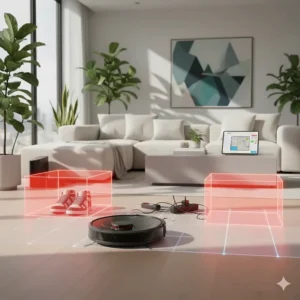
Why It Stands Out: This robot vacuum with no go zones creates complete home maps 7x faster than previous Roomba models—often in a single run. The PrecisionVision navigation doesn’t just avoid obstacles; it identifies them. Socks, shoes, cables, and yes, even pet waste, are recognized and navigated around intelligently.
The P.O.O.P. (Pet Owner Official Promise) guarantee is backed by iRobot’s confidence: if it fails to avoid pet messes, they’ll replace the robot for free. The dual rubber brushes specifically resist pet hair tangles, working in tandem with the enhanced suction to pull embedded fur from carpets.
Dirt Detective, powered by iRobot OS, tracks cleaning patterns and automatically adjusts. If your kitchen accumulates more dirt than your bedroom, the j9+ will increase suction power and cleaning passes there without being told. It’s like having a housekeeper who learns your home’s trouble spots.
✅ Pros:
- Exceptional pet hair pickup on all floor types
- Smart room prioritization with Dirt Detective
- Integrates seamlessly with Alexa, Google Assistant, Siri
❌ Cons:
- No mopping capability (vacuum only)
- Smaller coverage area per charge than LiDAR competitors
Customer Feedback: Pet owners rave about the zero-tangle performance and smart obstacle avoidance, with many reporting they haven’t manually emptied it in months thanks to the 60-day bin capacity.
Price: $699-899
3. Roborock Qrevo S5V – Best Mid-Range Value
The Roborock Qrevo S5V delivers flagship features at mid-tier pricing, making advanced laser distance sensor technology accessible without sacrificing performance.
Key Specifications:
- Suction: 12,000 Pa HyperForce
- Navigation: PreciSense LiDAR with reactive obstacle sensors
- Mopping: FlexiArm extending mop with 10mm auto-lift
- Dock: All-in-one with warm air drying, 10-week dust storage
Why It’s a Smart Buy: Vacuum Wars testing revealed something remarkable: the Qrevo S5V achieved a 92% carpet deep-clean score and 92% pet hair pickup—outperforming robots costing twice as much. The SGS-certified DuoDivide brush system delivers a genuine 0% hair tangling rate, verified through independent testing.
The FlexiArm edge mopping extends to reach corners and baseboards that fixed mops miss, while the smart carpet detection automatically boosts suction and lifts the mop pad 10mm to keep rugs dry. The SmartPlan feature analyzes each room’s needs and adjusts suction and mopping intensity automatically—no manual programming required.
When on sale (frequently drops to $549), this robot vacuum with room mapping represents exceptional value. The multifunctional dock handles mop washing with heated water, warm air drying to prevent odors, and self-emptying with a 10-week capacity.
✅ Pros:
- Carpet cleaning rivals $1,000+ models
- True zero-tangle brush (SGS certified)
- Excellent value when on sale
❌ Cons:
- App can be buggy compared to premium Roborock models
- Obstacle avoidance is basic (no camera-based recognition)
Customer Feedback: Users love the hands-off experience and powerful cleaning, though some note the obstacle avoidance isn’t as sophisticated as camera-equipped models—pick up socks and small toys before cleaning.
Price: $549-899 (often on sale)
4. Eufy X10 Pro Omni – Best All-in-One Value
The Eufy X10 Pro Omni proves you don’t need to spend $1,000+ for flagship features. This lidar robot vacuum packs AI.See obstacle avoidance, MopMaster 2.0 technology, and a comprehensive all-in-one station at nearly half the price of premium competitors.
Key Specifications:
- Suction: 8,000 Pa
- Navigation: iPath LiDAR + AI.See smart obstacle avoidance
- Mopping: Dual spinning pads with 1kg downforce, 12mm auto-lift
- Dock: Omni station (self-empty, mop wash/dry, auto-refill)
Why Experts Recommend It: The AI.See obstacle avoidance system is trained on 100+ objects and includes a front-mounted camera with integrated lighting for low-light detection. In testing, it navigates cables, toys, and furniture with precision rivaling models double its price.
The MopMaster 2.0 dual spinning mops exert nearly 2 pounds of pressure—significantly more than most competitors. Vacuum Wars’ dried-on coffee and grape juice tests showed complete stain removal with minimal passes, earning it top mopping scores in its price class.
The all-in-one station delivers true hands-free operation: automatic dustbin emptying into a 2.5L bag (60 days capacity), mop pad washing with clean water, 45°C heated air drying, and water tank refilling (3L capacity for 2-3 full-home mops). The Pro-Detangle comb automatically removes hair from the roller brush without manual intervention.
✅ Pros:
- Advanced obstacle avoidance at mid-range price
- Exceptional mopping performance
- Complete automation with Omni station
❌ Cons:
- App less polished than Roborock’s
- Slightly bulkier dock footprint
Customer Feedback: Users consistently mention getting “Roborock S8 Pro features at half the price,” praising the mopping quality and comprehensive automation, though some note Wi-Fi setup can be finicky initially.
Price: $599-799
5. Shark Matrix Plus 2in1 – Best for Sonic Mopping
The Shark Matrix Plus 2in1 brings Shark’s proven cleaning prowess to intelligent path planning, combining ultra-powerful whole-home vacuuming with sonic mopping that scrubs 100 times per minute.
Key Specifications:
- Suction: Enhanced whole-home power
- Navigation: 360° LiDAR Precision Home Mapping
- Mopping: Sonic Mopping (100x per minute)
- Dock: HEPA bagless self-empty base (60-day capacity)
What Makes It Different: Matrix Clean technology is Shark’s answer to random navigation—the robot cleans in a precision matrix grid, taking multiple passes from different angles. This delivers 30% better carpet cleaning compared to single-pass systems, ensuring no spots are missed.
CleanEdge Detect uses targeted air blasts and corner recognition to pull debris from edges and corners into the cleaning path, achieving 50% better edge cleaning than models without this feature. Combined with the 360° LiDAR vision, it methodically maps and cleans every accessible area.
The self-cleaning brushroll tackles pet hair without tangling, while HEPA filtration with Anti-Allergen seal captures 99.97% of dust and allergens down to 0.3 microns. The bagless base holds 60 days of debris and never requires expensive replacement bags.
The SharkClean app provides custom carpet zones and no-go areas with full virtual boundary creation control—perfect for keeping the robot away from pet bowls or delicate areas.
✅ Pros:
- True HEPA filtration (rare in robot vacuums)
- Bagless self-empty saves money
- Matrix grid cleaning ensures thorough coverage
❌ Cons:
- Mopping system doesn’t auto-wash pads
- Shorter battery life than LiDAR competitors
Customer Feedback: Users love the methodical cleaning pattern and powerful edge cleaning, though some note it’s slightly louder during self-emptying compared to Roborock’s quieter docks.
Price: $449-599
6. MOVA S10 – Best Budget Mapping Robot
The MOVA S10 obliterates the myth that budget robots can’t deliver premium features. With top-mounted LiDAR navigation, electric mop lifting, and a 90% carpet deep-clean score, this vacuum rivals models costing 3-4x more.
Key Specifications:
- Suction: 7,000 Pa Vormax
- Navigation: LiDAR + 3DAdapt obstacle avoidance
- Battery: 5,200 mAh (260 minutes runtime)
- Mopping: Liftable pad system (7mm), 3,500 RPM vibration
Why Budget Buyers Choose It: Vacuum Wars testing revealed the MOVA S10 achieved a 90% carpet deep-clean score—one of the highest scores recorded, period. This isn’t just “good for the price”—it’s objectively excellent performance. The 7,000 Pa suction and optimized airflow (20 cfm vs. 16.6 average) pull embedded debris from carpet fibers that many premium models miss.
The battery efficiency is ridiculous: 2.8 minutes of runtime per 1% battery versus the industry average of 1.41 minutes. That translates to 260-minute runtime covering up to 175 square meters (1,884 sq ft) on a single charge—enough for large homes without mid-clean recharging.
The RoboSwing mopping technology increases edge cleaning efficiency by 15%, swinging the mop to reach baseboards and corners. While the mopping pad requires manual washing (no auto-wash dock at this price), the intelligent carpet detection automatically lifts it 7mm to keep carpets dry during mixed-floor cleaning.
The app supports up to 4 floor maps with customizable no-mop zones and virtual boundaries—features previously exclusive to premium models.
✅ Pros:
- Exceptional carpet cleaning (90% deep-clean score)
- Outstanding battery life and coverage
- LiDAR + obstacle avoidance under $250
❌ Cons:
- Mop pads require manual washing
- App less refined than premium brands
Customer Feedback: Users frequently comment they “can’t believe the performance at this price,” with many upgrading from Roomba 600 series and reporting dramatic improvements in coverage and cleaning efficiency.
Price: $169-249
7. Eufy L60 – Best Entry-Level LiDAR Vacuum
The Eufy L60 brings professional-grade laser distance sensor navigation to first-time robot vacuum buyers, delivering mapped cleaning with app control at an accessible price point.
Key Specifications:
- Suction: 5,000 Pa
- Navigation: iPath LiDAR
- Battery: 120 minutes runtime
- Dock Options: Basic charger or self-empty station (60-day capacity)
Perfect for Beginners: The iPath laser navigation creates accurate maps quickly, establishing efficient cleaning routes that random-navigation robots can’t match. The slim 2.85″ profile fits under most furniture, while BoostIQ technology automatically increases suction when transitioning to carpets.
Vacuum Wars testing showed the L60 ranking in the top 10 for carpet deep-clean performance out of nearly 90 models evaluated—remarkable for an entry-level robot. The navigation efficiency (0.72 m²/minute) matches the category average, meaning it cleans as methodically as far more expensive models.
The AI.Map 2.0 app interface is intuitive for newcomers: select specific rooms to clean, draw no-go zones with your finger, and save maps for multi-floor homes. Multi-Floor Mapping remembers layouts for up to 3 floors without manual reconfiguration.
For true hands-free operation, upgrade to the self-empty version: the dock’s hair-detangling system cuts through wrapped hair automatically, eliminating one of robot vacuums’ most annoying maintenance tasks.
✅ Pros:
- Budget-friendly LiDAR navigation
- Self-empty dock with hair-detangling tech
- Excellent carpet deep-clean for the price
❌ Cons:
- No mopping capability
- Basic obstacle avoidance (LiDAR only, no camera)
Customer Feedback: First-time robot vacuum owners praise the straightforward setup and reliable navigation, though some note it occasionally struggles with very dark furniture (common limitation of laser-only navigation).
Price: $249-349 (with self-empty station)
Understanding Robot Vacuum Mapping Technology
Modern mapping robots use laser distance sensors—specifically LiDAR (Light Detection and Ranging)—to create digital floor plans of your home. Here’s how the technology works and why it matters.
How LiDAR Navigation Works
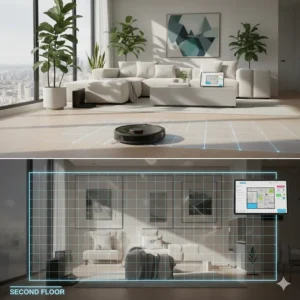
A robot vacuum with room mapping contains a spinning laser turret (typically on top) that emits invisible infrared beams 360° around the robot. These beams bounce off walls, furniture, and obstacles, returning to the sensor. By measuring the time it takes for each beam to return, the vacuum calculates precise distances and creates a real-time map of your space.
LiDAR technology, which stands for Light Detection and Ranging, was originally developed for atmospheric research in the 1960s. According to NOAA’s educational resources, LiDAR systems can emit millions of laser pulses per second, making them incredibly precise for mapping applications—from surveying ocean floors to navigating autonomous vehicles, and yes, cleaning your floors.
This intelligent path planning allows the robot to:
- Clean in straight, organized rows instead of random bouncing
- Remember where it’s already cleaned
- Calculate the most efficient route
- Avoid redundant passes over the same areas
- Resume cleaning after recharging without repeating work
Virtual Boundary Creation and No-Go Zones
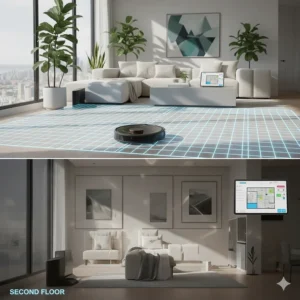
The real power of robot vacuum with no go zones appears in the companion apps. Using the map your vacuum creates, you can:
Draw Virtual Walls: Invisible barriers that block the robot from entering specific areas—perfect for pet feeding zones or delicate rug corners.
Create Room-Specific Schedules: Clean the kitchen daily but bedrooms only twice weekly, all programmed through the app.
Set No-Mop Zones: For robots with hybrid functionality, designate carpeted areas where mopping should never activate, even if the robot enters while cleaning.
Establish Cleaning Zones: Draw boxes around high-traffic areas for targeted deep cleaning without running the entire house.
Advanced Mapping Features in 2026
The latest lidar robot vacuum reviews highlight several next-generation features:
Multi-Floor Mapping: Premium models remember up to 4 different floor plans, automatically recognizing which floor they’re on and loading the correct map. Essential for multi-story homes.
3D Mapping with Obstacle Recognition: Beyond flat floor plans, advanced systems like Roborock’s StarSight 2.0 create three-dimensional maps, identifying furniture types, floor-level obstacles, and even suspended cabinets.
AI-Powered Dirt Detection: Sensors detect areas with higher debris concentration, automatically increasing suction power and making additional passes until the area is clean.
Real-Time Map Updates: As you move furniture or add new obstacles, smart vacuums update their maps dynamically rather than requiring complete remapping.
Mapping vs. Random Navigation: The Real Difference
Random-navigation robots (like older Roomba 600 series) use a “bump and turn” algorithm—they move forward until hitting an obstacle, turn randomly, and repeat. This eventually covers the space but inefficiently, often missing entire rooms and re-cleaning the same areas multiple times.
LiDAR mapping robots know exactly where they are, where they’ve been, and where they need to go. This fundamental difference in autonomous navigation technology, similar to principles used in self-driving vehicles, dramatically improves cleaning efficiency. Testing shows:
- 30-50% faster complete home coverage
- 95%+ coverage consistency vs. 70-85% for random navigation
- 60-80% less battery usage for equivalent cleaning
- Virtually zero instances of getting “lost” or failing to return to dock
How to Choose the Best Mapping Robot Vacuum
Consider Your Floor Plan Complexity
Simple Layouts (Studio/Small Apartments): Even budget models like the MOVA S10 or Eufy L60 provide excellent laser distance sensor navigation for straightforward spaces. Save money here—expensive obstacle avoidance features matter less when you have fewer obstacles.
Medium Complexity (2-3 Bedroom Homes): Mid-range options like the Roborock Qrevo S5V or Eufy X10 Pro Omni balance performance and value. Look for multi-floor mapping if you have stairs, and virtual boundary creation for keeping robots away from pet areas.
Complex Layouts (Large/Multi-Story Homes): Premium models like the Roborock Saros 10R excel with advanced 3D mapping, perfect obstacle avoidance, and extended battery life. The intelligent path planning adapts to furniture changes and cleans large areas without recharging mid-cycle.
According to Consumer Reports’ robot vacuum buying guide, navigation and mapping capabilities are among the most important factors when choosing a robot vacuum, especially for homes over 1,000 square feet.
Navigation Technology Comparison
| Navigation Type | Accuracy | Speed | Price Range | Best For |
|---|---|---|---|---|
| Random (Gyroscope) | Low | Slow | $150-300 | Small, simple spaces |
| Standard LiDAR | High | Fast | $200-600 | Most homes |
| LiDAR + Camera AI | Very High | Fast | $600-1,200 | Homes with many obstacles |
| Advanced 3D ToF | Exceptional | Very Fast | $1,200+ | Complex layouts, premium users |
Suction Power Reality Check
Don’t obsess over suction numbers. Yes, the Roborock Saros 10R’s 22,000 Pa sounds impressive compared to the Eufy L60’s 5,000 Pa, but real-world cleaning depends on brush design, airflow optimization, and cleaning patterns just as much as raw suction.
Vacuum Wars testing proves this: the MOVA S10 (7,000 Pa) achieved higher carpet deep-clean scores than some robots with 12,000+ Pa suction. Brush design and mapping efficiency matter more than spec-sheet numbers.
Adequate Suction by Floor Type:
- Hard Floors Only: 2,000-4,000 Pa is plenty
- Low-Pile Carpet: 5,000-8,000 Pa recommended
- Medium/High-Pile Carpet: 10,000+ Pa preferred, but prioritize brush design over raw numbers
Essential Features Checklist
✅ Must-Have Features:
- LiDAR or ToF navigation (not camera-only or random)
- App control with virtual boundary creation
- Multi-room cleaning with room selection
- Auto-resume after recharging
- At least 90-minute runtime
✅ Nice-to-Have Features:
- Self-emptying dock (eliminates weekly bin dumping)
- Mopping capability with auto-lift (keeps carpets dry)
- Advanced obstacle avoidance with AI camera
- Multi-floor mapping (essential for 2+ story homes)
- Voice control (Alexa/Google/Siri integration)
✅ Premium Features (Worth It for Some):
- Hot water mop washing with heated drying
- Automatic detergent dispensing
- Video calling/pet monitoring cameras
- Plumbed water connections for true hands-free operation
Budget Allocation Strategy
Under $300: Focus on reliable LiDAR navigation and good battery life. Skip mopping and self-emptying—you can add those later. The MOVA S10 or Eufy L60 deliver premium navigation at budget prices.
$300-$600: This is the sweet spot for robot vacuum with room mapping. You get LiDAR navigation, decent obstacle avoidance, hybrid vacuum/mop functionality, and sometimes self-emptying. The Roborock Qrevo S5V and Eufy X10 Pro Omni dominate this category.
$600-$1,000: Premium navigation with AI obstacle avoidance, complete dock automation (self-empty, mop wash/dry), and advanced features like multi-floor mapping. The iRobot Roomba j9+ excels here.
$1,000+: Cutting-edge technology—3D mapping, perfect obstacle avoidance, ultra-slim designs, and comprehensive automation. The Roborock Saros 10R represents the pinnacle of current technology but delivers diminishing returns for most users.
Maintenance Tips for Mapping Robot Vacuums
Even the best mapping robot vacuum requires regular maintenance to sustain optimal intelligent path planning performance.
Weekly Maintenance
Empty the Dustbin: Even with self-emptying docks, check the robot’s bin weekly for overfilling. Pet hair can compress and reduce sensor accuracy.
Wipe Sensors: Use a microfiber cloth to clean LiDAR sensors, cliff sensors, and charging contacts. Dust buildup degrades laser distance sensor accuracy over time.
Check Brushes: Remove wrapped hair from side and main brushes. Models with anti-tangle technology still accumulate some hair—5 minutes of maintenance prevents poor cleaning performance.
Monthly Maintenance
Clean Filter: Rinse or replace HEPA filters according to manufacturer guidelines. Clogged filters reduce suction by 30-50%.
Inspect Wheels: Check for hair wrapped around wheel axles. This causes navigation errors and can damage motors.
Test Mapping Accuracy: Delete saved maps and run a fresh mapping cycle. This corrects mapping drift that accumulates from furniture changes.
Quarterly Maintenance
Battery Health Check: If runtime decreases significantly, recalibrate the battery (full discharge/charge cycle) or consider replacement after 2-3 years.
Deep Clean Sensors: Use compressed air on LiDAR housing and wheel encoders. Accumulated dust here causes mapping errors.
Dock Maintenance: For self-emptying docks, check for blockages in suction pathways. For mop-washing docks, descale water tanks with white vinegar if you have hard water.
Pro Tips for Longevity
- Prepare Your Space: Pick up small objects, secure loose cables, and tuck away furniture fringe before cleaning. This prevents tangles and extends brush life.
- Optimize Cleaning Schedules: Run your robot when you’re away. This reduces interruptions and lets it complete full-home cycles without human obstacles.
- Update Firmware: Enable auto-updates in your robot’s app. Manufacturers continuously improve obstacle avoidance algorithms and battery management through software updates.
- Use Virtual Barriers: Rather than letting your robot learn obstacles through repeated collisions, draw no-go zones around delicate furniture or electronics.
- Clean High-Traffic Areas More Frequently: The robot vacuum with no go zones feature lets you schedule daily cleans for kitchens and entryways while running bedrooms only 2-3x weekly.
FAQ
❓ How accurate is robot vacuum with room mapping compared to random navigation?
❓ Can I use robot vacuum with no go zones to protect pet feeding areas?
❓ What's the difference between LiDAR and camera-based navigation?
❓ How long does intelligent path planning take to map a new floor?
❓ Do budget robot vacuum models under $300 have reliable virtual boundary creation?
Conclusion
The best mapping robot vacuum for your home isn’t always the most expensive—it’s the one that matches your specific needs.
If you want absolute cutting-edge performance with perfect obstacle avoidance and ultra-slim design, the Roborock Saros 10R delivers flagship technology worth its premium price. Its StarSight 2.0 navigation and 3.14-inch profile reach places other robots can’t.
Budget-conscious buyers should seriously consider the MOVA S10. Its 90% carpet deep-clean score and 260-minute runtime rival models costing four times more, proving that LiDAR navigation and intelligent path planning have become truly affordable in 2026.
For pet owners, the iRobot Roomba j9+ remains unmatched. The Dirt Detective technology learns your dirtiest areas, while the P.O.O.P. guarantee provides peace of mind worth the investment.
The mid-range sweet spot belongs to the Roborock Qrevo S5V and Eufy X10 Pro Omni—both delivering premium features at accessible prices. The Qrevo excels at carpet cleaning and pet hair, while the Eufy shines with advanced mopping and comprehensive dock automation.
First-time buyers wanting reliable laser distance sensor navigation without complexity should grab the Eufy L60 with self-empty station. Its intuitive app and proven performance make it the ideal introduction to smart vacuuming.
Remember: the robot vacuum with no go zones and multi-floor mapping that seemed impossible to afford two years ago is now standard in sub-$300 models. The technology has matured dramatically, making this the best time to upgrade from random navigation to intelligent path planning.
Whatever your budget, 2026’s mapping robots clean smarter, avoid obstacles better, and require less babysitting than ever before. Pick the right one, and you’ll wonder how you ever lived without it.
Recommended for You
- 7 Quietest Robot Vacuum for Apartments 2026: Peace & Clean
- 7 Best Robot Vacuum for Thick Carpet in 2026
- 7 Best Robot Vacuum for Hardwood Floors in 2026
Disclaimer: This article contains affiliate links. If you purchase products through these links, we may earn a small commission at no additional cost to you.
✨ Found this helpful? Share it with your friends! 💬🤗
