
In This Article
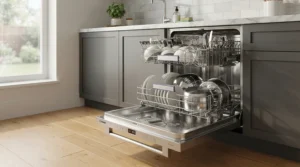
A 24-inch built-in dishwasher is a full-size, under-counter appliance designed to slide into a standard 24-inch-wide cabinet opening and connect permanently to your home’s plumbing and power. Most models in this class hold roughly 13 to 16 place settings, and the differences between them run far deeper than the matching stainless-steel fronts suggest.
Walk into any appliance showroom and every machine looks like a brushed-steel mini-fridge lying on its back. The real differences sit inside and behind the door: what the tub is made of, how loudly it runs at 2 a.m., how it dries a plastic lunchbox, and whether it can survive water that leaves a chalky film on every glass. Get those details wrong and you’ll live with them for a decade or more.
This guide is built around the questions buyers keep asking. Is a stainless steel tub worth it over a plastic one? Does the jump from 14 to 16 place settings matter? Which machine copes best with hard water? What does ENERGY STAR certification actually guarantee? And how should you approach built-in dishwasher Black Friday deals when the sales start in a few weeks?
One note on method. I haven’t tested these machines. Everything here comes from manufacturer and retailer spec sheets, plus the aggregated sentiment of real owner reviews on retail pages, and I say so where the evidence is thin. For a quick sense of what certified efficiency buys you, the ENERGY STAR dishwasher page says a standard-size certified model costs about $50 a year to run.
Quick Comparison: 7 Top 24-inch Built-In Dishwashers at a Glance
| Model | Best For | Tub | Place Settings (per listings) | Noise |
|---|---|---|---|---|
| Frigidaire FFCD2413US | Tight budgets, rentals, first homes | Plastic (polymer) | 14 (some listings say 12) | 55 dBA |
| GE GDT670SMVES | Big families on a mid-range budget | Stainless steel | 16 (some listings say 15) | 45 dBA |
| LG LDPH7972S | Fast cycles, smart-home fans | Stainless steel | 15 | 42 dBA |
| KitchenAid KDTM404KPS | Tall pots, odd-shaped cookware | Stainless steel | 16 | 44 dBA |
| Bosch SHE53C85N | Quiet kitchens without flagship pricing | Stainless steel (per most listings) | 16 | 46 dBA |
| Bosch SHP78CM5N | Premium drying and open-plan kitchens | Stainless steel | 16 | 42 dBA |
| Miele G5266SCVi | Hard water and heavy mineral buildup | Stainless steel interior | Confirm on spec sheet | 42 dBA |
Read the table by priority rather than by brand. The Frigidaire FFCD2413US is the only plastic-tub, louder machine here, and that is exactly why it costs the least. The GE GDT670SMVES, KitchenAid KDTM404KPS and Bosch SHP78CM5N cluster at 16 place settings, but they get there with different third-rack designs. The Miele G5266SCVi stands apart because it is the only one here with a built-in water softener.
💬 Just one click — help others make better buying decisions too!😊
Top 7 24-inch Built-In Dishwashers: Expert Analysis
1. Frigidaire FFCD2413US — the budget entry with a polymer tub
The headline here is simple: this is the machine that gets a 24-inch built-in dishwasher into your kitchen without a four-figure check.
It runs three wash cycles with a four-hour delay start and a heated drying system. Retailer listings put capacity at 14 place settings, though a few say 12, so verify before you plan around it. At 55 dBA (some listings say 60) it is audible in an open-plan space. With no third rack, flatware lives in the basket and tall items compete for room.
Based on the spec comparison, this suits rental flips, first homes, and secondary kitchens. It also suits anyone who runs loads overnight behind a closed door. The three-cycle layout means little to learn and little to customize.
Reviewer sentiment on retail pages is mixed but leans positive. Ratings sit around 4.2 out of 5 across thousands of reviews on one major retailer, with praise for price, simple controls, and decent cleaning. Recurring complaints are weaker drying, especially for plastics, and durability problems for some owners.
Pros:
- ✅ Lowest entry price in this lineup
- ✅ ENERGY STAR certified per listings
- ✅ Simple three-cycle controls
Cons:
- ❌ Plastic tub, with drying complaints from owners
- ❌ Louder than every other pick here
Price: around $550–$700, so check current price. Verdict: strong dollar-per-load value if you accept the trade-offs.
2. GE GDT670SMVES — 16 place settings at a mid-range price
The standout is capacity per dollar: a stainless tub and a third rack in a package that usually costs well below the premium European brands.
It lists 16 place settings (a few retailers say 15), 45 dBA operation, a stainless interior, and a third rack with a removable silverware caddy. Dry Boost adds heat for plastics, but stretches cycle time. The Piranha hard food disposer is meant to cut pre-rinsing, and Wi-Fi is available only through an optional adapter sold separately.
On paper this is the “family of five” machine. The third rack frees the bottom rack for pots and plates, which is where sixteen settings stop being a marketing number and start being usable space.
Aggregated retailer reviews show about 4.2 out of 5 across more than 3,000 reviews on one site. Owners praise the quiet operation and third rack. Common complaints are flimsy plastic rack components, inconsistent drying, and occasionally leaks or malfunctions. The listing shows only a one-year warranty.
Pros:
- ✅ 16 place settings with a third rack
- ✅ Stainless tub and 45 dBA operation
- ✅ ENERGY STAR qualified
Cons:
- ❌ Drying results vary, especially with plastics
- ❌ Wi-Fi needs a separate adapter
Price: from the mid-$600s to around $1,000 depending on retailer. Verdict: arguably the best capacity value here.
3. LG LDPH7972S — fast one-hour wash and dry
Speed is the hook: LG pairs QuadWash Pro with Dynamic Heat Dry for a one-hour wash-and-dry cycle.
It lists 15 place settings, 42 dBA operation, a NeveRust stainless tub, an adjustable-height third rack, TrueSteam, 10 cycles, and Wi-Fi through the ThinQ app. LG’s spec page shows about 238 kWh per year and a water factor of 2.9. That means this machine skews efficient.
The practical read: if you often need clean plates in under an hour, such as before guests arrive, this machine solves a real problem. Fifteen settings is a touch below the 16-place group, but the adjustable third rack narrows the gap.
I couldn’t verify a robust review sample for this specific model in the sources I used, so I won’t summarize owner sentiment. Check recent retailer reviews on drying and long-term reliability before buying.
Pros:
- ✅ One-hour wash-and-dry cycle
- ✅ 42 dBA with a stainless tub
- ✅ Efficient 238 kWh/year rating per LG
Cons:
- ❌ 15 settings, slightly under the 16-place group
- ❌ Smart features add cost you may not use
Price: roughly $1,000–$1,300; prices vary, so check current price. Verdict: worth it if speed and quiet matter most.
4. KitchenAid KDTM404KPS — third rack with rotating wash jets
What sets it apart is the FreeFlex third rack, which has its own rotating wash tubes rather than just sitting there.
It lists 16 place settings, 44 dBA, a stainless tub, five wash cycles, a ProWash cycle, a PrintShield fingerprint-resistant finish, and ENERGY STAR certification. The third rack is removable but not height-adjustable.
KitchenAid markets this as its largest usable tub, with deep, angled third-rack space for glasses, mugs, and cooking tools. That means a tall skillet or a blender jar finds a home instead of a hand-wash pile.
Controls are hidden top-mounted, which gives a clean look but means no peeking at cycle status mid-run. I couldn’t verify a reliable pool of owner reviews for this model in my sources, so check recent reviews for drying and rack durability.
Pros:
- ✅ Third rack with its own wash jets
- ✅ 16 place settings at 44 dBA
- ✅ Stainless tub, ENERGY STAR certified
Cons:
- ❌ Third rack is not height-adjustable
- ❌ Hidden controls hide cycle status
Price: roughly $1,000–$1,300. Verdict: best for cooks who run big, awkward loads.
5. Bosch SHE53C85N — quiet 300 Series without flagship pricing
Quiet is the draw here: it runs at 46 dBA, about as low as a mid-priced 24-inch built-in dishwasher gets.
It lists 16 place settings, a standard third rack, RackMatic adjustable middle rack (nine positions), PrecisionWash sensors, and AquaStop leak protection. PureDry uses a closed drying system with no exposed heating element, so plastics can go on the bottom rack without melting.
Listings conflict on ENERGY STAR status: Bosch’s own page shows it as certified, while several retailers say no. Confirm that before you buy if rebates matter to you.
Retailer copy says owners consistently praise the quietness and cleaning performance. That is retailer language rather than a verified review sample, so treat it as directional.
Pros:
- ✅ Very quiet at 46 dBA
- ✅ Plastic-safe PureDry drying
- ✅ Adjustable racks plus third rack
Cons:
- ❌ Drying is gentler than premium CrystalDry
- ❌ ENERGY STAR status unclear across listings
Price: roughly $850–$1,100. Verdict: a sweet spot for quiet-first buyers.

6. Bosch SHP78CM5N — CrystalDry and a flexible third rack
The standout is CrystalDry, a zeolite-based drying system aimed at the biggest complaint in this category: wet plastics.
It lists 16 place settings, 42 dBA, a stainless tub, a Flexible 3rd Rack with fold-down sides, PowerControl spray for the bottom rack, Wi-Fi via Home Connect, and ENERGY STAR certification. If you hardwire it, you’ll need a separate junction box, per Bosch’s spec sheet.
For open-plan kitchens, 42 dBA is the point where conversation continues uninterrupted. The flexible third rack lets stemware sit in the middle while utensils ride up top.
Retail pages show thousands of reviews, and an installer commenting on a deal thread called Bosch dishwashers great but harder to install than they need to be. That is one person’s opinion, so confirm installation requirements with your installer. Retail spec tables also show no built-in water softener.
Pros:
- ✅ CrystalDry targets wet plastics
- ✅ 42 dBA with 16 place settings
- ✅ Flexible third rack, ENERGY STAR certified
Cons:
- ❌ Premium price for a mainstream-looking box
- ❌ Installation can be more involved
Price: around $1,300–$1,600. Verdict: best all-rounder if drying and silence rule.
7. Miele G5266SCVi — built-in water softener for hard water
The headline is the integrated water softener, which most 24-inch built-in dishwashers lack.
It lists 42 dBA, a stainless interior, QuickIntenseWash (a 58-minute program), AutoOpen drying, a MultiFlex 3D cutlery tray, and ENERGY STAR status. Capacity varies by listing, so confirm it on the spec sheet.
The softener removes hard water spots caused by lime deposits, per retailer listings. It uses regeneration salt, so build a refill habit. The AutoOpen door cracks at the end of the cycle to release steam for better drying.
I couldn’t verify a robust owner-review sample for this exact model, so no sentiment summary here. Its reputation rests on long-term durability, which a review page can’t prove.
Pros:
- ✅ Built-in softener fights mineral spotting
- ✅ 42 dBA with AutoOpen drying
- ✅ Stainless interior, ENERGY STAR listed
Cons:
- ❌ Highest price in this lineup
- ❌ Needs regular salt refills
Price: roughly $1,400–$1,900. Verdict: the clear pick for hard water, if your budget allows.
Spec & Value Snapshot
| Model | ENERGY STAR | Third Rack | Approx. Price Range | Best For |
|---|---|---|---|---|
| Frigidaire FFCD2413US | Yes (listed) | No | $550–$700 | Budget buyers |
| GE GDT670SMVES | Yes | Yes (fixed) | Mid-$600s–~$1,000 | Large families |
| LG LDPH7972S | Yes | Yes (adjustable) | $1,000–$1,300 | Speed |
| KitchenAid KDTM404KPS | Yes | Yes (with jets) | $1,000–$1,300 | Big cookware |
| Bosch SHE53C85N | Verify | Yes | $850–$1,100 | Quiet on a budget |
| Bosch SHP78CM5N | Yes | Yes (flexible) | $1,300–$1,600 | Premium drying |
| Miele G5266SCVi | Yes (listed) | Cutlery tray | $1,400–$1,900 | Hard water |
Prices are approximate and change often. The gap between the Frigidaire FFCD2413US and the GE GDT670SMVES buys a stainless tub, a third rack, and 10 dBA less noise, which for most households is the best value jump on the table. Beyond that, the extra money for the Bosch SHP78CM5N buys drying and silence, while the Miele G5266SCVi premium buys water treatment rather than raw capacity.
Setup Guide: Getting Your New 24-inch Built-In Dishwasher Running Right
A good machine installed badly performs like a bad one. This is the checklist I’d follow in the first 30 days.
Before install: Confirm your opening. Bosch’s spec sheet lists a required cutout of about 33 7/8″ high by 24″ wide by 24″ deep, and other brands vary slightly. Check water pressure too (the Bosch SHP78CM5N sheet lists a 14 psi minimum), and confirm whether your model plugs in or needs hardwiring.
First run: Level the unit with its adjustable feet, then run an empty cycle with detergent to flush the lines. Fill the rinse aid dispenser right away, because it affects both drying and spotting.
Loading habits: ENERGY STAR notes that pre-rinsing can waste up to 20 gallons and that certified models and modern detergents are designed to handle soil. Scrape, don’t rinse. Keep tall items from blocking spray arms, and put plastics on the top rack unless your model, like the Bosch SHE53C85N with its closed drying system, says otherwise.
Maintenance rhythm: Clean the filter monthly, wipe the door gasket, and run a descaling or cleaning cycle on the schedule your manual recommends.
Common first-month mistakes: Over-dosing detergent, which creates suds that reduce cleaning, and using the heaviest cycle every time, which raises energy use without improving everyday results.

Hard Water Survival Guide: Best Built-In Dishwasher for Hard Water and Heavy Mineral Buildup
Hard water is calcium and magnesium dissolved in your supply, and it shows up as cloudy glassware, white scale, and detergent that underperforms. The USGS Water Science School classifies hardness as soft (0–60 mg/L), moderately hard (61–120), hard (121–180), and very hard (over 180 mg/L).
Here is the problem-to-solution path:
- Cloudy glasses and white film. Use rinse aid, and consider a model with a built-in softener. Among the seven picks, only the Miele G5266SCVi advertises one. In the sources I reviewed, none of the other six lists a built-in softener.
- Scale inside the tub. Run a dishwasher-safe descaler periodically, following your manual. Check the manual before using any acid-based home remedy.
- Detergent that never seems to work. Hard water consumes detergent. Test a slightly higher dose, within the manufacturer’s range.
- Whole-home impact. If your water tests very hard, a whole-house softener protects your water heater and fixtures, not just the dishwasher. Water-treatment sources commonly cite roughly 7 grains per gallon (about 120 mg/L) as the point where softening becomes worth considering.
For the best built-in dishwasher for hard water and heavy mineral buildup, my analysis points to the Miele G5266SCVi if water is very hard, with a stainless-tub model like the Bosch SHP78CM5N plus rinse aid as the lower-cost fallback. Test your water first, either with strips or your utility’s annual water-quality report.
Real-World Scenarios: Which 24-inch Built-In Dishwasher Fits Your Household?
Scenario 1: A couple in a starter home, about $600 to spend, running one load nightly. The Frigidaire FFCD2413US fits. Closed kitchen, low volume, simple cycles. Add rinse aid and run it overnight.
Scenario 2: A family of five in an open-plan kitchen, hosting often. Sixteen place settings and a third rack are worth paying for. The GE GDT670SMVES is the value play; the KitchenAid KDTM404KPS suits households with tall skillets and mixing bowls.
Scenario 3: A hard-water home where glasses cloud after every cycle. Test the water, then lean toward the Miele G5266SCVi. If budget limits you, the Bosch SHE53C85N with rinse aid and regular descaling is a sensible compromise.
Scenario 4: A professional who wants clean dishes in an hour with quiet operation. The LG LDPH7972S with its one-hour wash-and-dry cycle is the natural match. If drying plastics is the real pain point, the Bosch SHP78CM5N with CrystalDry deserves a look.
How to Choose a 24-inch Built-In Dishwasher
- Measure your opening first. Standard cutouts run about 24 inches wide, with height and depth varying slightly by model.
- Pick a tub material. Stainless costs more but resists stains and odors; plastic keeps the price down.
- Set a noise target. Under 46 dBA is near-silent in open kitchens; 55 dBA suits closed-off spaces.
- Match capacity to your household. Use the section below on 14 vs. 16 place settings.
- Test your water. Hardness is reported in mg/L or grains per gallon; as Wikipedia’s grain-per-gallon entry explains, one grain per gallon equals about 17.1 mg/L.
- Check ENERGY STAR status on the exact model number. Listings sometimes conflict.
- Compare warranties and installation requirements before you commit.
Stainless Steel Tub vs. Plastic Tub: What You’re Really Paying For
The stainless steel tub vs. plastic tub question is the biggest hidden fork in the 24-inch built-in dishwasher market. Manufacturer copy says stainless retains heat to improve drying and resists streaks, stains, and odors. Plastic tubs, like the polymer one in the Frigidaire FFCD2413US, keep costs down, and Frigidaire says its tub supports drying.
| Feature | Stainless Steel Tub | Plastic Tub |
|---|---|---|
| Stain and odor resistance | Strong | Weaker over time |
| Heat retention and drying | Generally better | Often weaker with plastics |
| Price | Higher | Lower |
| Best For | GE GDT670SMVES, LG LDPH7972S, KitchenAid KDTM404KPS, Bosch SHP78CM5N, Miele G5266SCVi | Frigidaire FFCD2413US |
Stainless is the better long-term bet in most kitchens, but plastic is not a disaster. If your household runs short cycles on a tight budget, a plastic tub is a defensible trade. If you hand-wash anything delicate and expect to keep the machine for a decade, stainless pays back in drying and appearance.
Place-Setting Capacity (14 vs. 16): Does the Extra Space Matter?
Place-setting capacity is a standardized way to describe how much a dishwasher holds, but it isn’t a guarantee of real-world fit. ENERGY STAR defines standard-capacity models as holding more than eight place settings and six serving pieces, which is a low bar.
The 14 vs. 16 gap amounts to about 14% more nominal capacity. Even within a single model, retailers disagree: the Frigidaire FFCD2413US shows up as 12 or 14, and the GE GDT670SMVES as 15 or 16. Treat the number as a rough guide.
What matters more is rack geometry. A third rack, fold-down tines, and an adjustable upper rack often add more usable space than two extra nominal settings. A family of four generating a day’s dishes can run one tightly packed 14-place cycle, but a 16-place machine with a third rack gives slack for pans and serving dishes.
ENERGY STAR also notes that dishwashers use about the same energy regardless of load size, so run full loads whenever possible. If you hover between 14 and 16, buy the larger one only if you genuinely run fewer, fuller cycles.
ENERGY STAR Certification: What It Guarantees (and What It Doesn’t)
ENERGY STAR certification means a dishwasher meets efficiency requirements for energy and water use. According to the program’s messaging, standard-size certified models are roughly 20% more energy efficient and 30% more water efficient than standard models, and they save about 5,800 gallons of water over their lifetime.
For perspective, ENERGY STAR says a certified dishwasher uses less than half the energy of washing dishes by hand. That makes certification meaningful but not dramatic between certified models. The difference between two certified machines is small compared with the gap between certified and hand-washing.
Certification doesn’t tell you how well a machine dries, how loud it is, or how long it lasts. It also isn’t uniform across listings: the Bosch SHE53C85N appears as both certified and not certified depending on the retailer. Confirm the exact model number, since rebates sometimes depend on it.
The Department of Energy’s Federal Energy Management Program guidance frames dishwasher savings over an assumed product life of 15.2 years. That’s a useful reminder that efficiency compounds over time.
Features That Actually Matter (And Those That Don’t)
Worth paying for: a third rack (the biggest capacity unlock), a drying system suited to your habits (CrystalDry on the Bosch SHP78CM5N, Dynamic Heat Dry on the LG LDPH7972S, Dry Boost on the GE GDT670SMVES), a low dBA rating if your kitchen is open, and leak protection such as AquaStop or Active Flood Protect.
Nice but optional: Wi-Fi. It’s handy for remote start, but the GE GDT670SMVES offers it only via an optional adapter, and plenty of owners never miss it. Sanitize cycles are useful for baby bottles but not essential for everyday loads.
Mostly marketing: counting cycles. Ten wash programs on the LG LDPH7972S versus three on the Frigidaire FFCD2413US sounds like a big gap, but most households use two or three cycles. Fingerprint-resistant finishes are real, though they vary in effectiveness, and they don’t change cleaning performance.
If you remember one rule from this section: pay for drying, noise, and rack flexibility, and ignore everything that exists mainly to fill a spec sheet.
Long-Term Cost & Maintenance of a 24-inch Built-In Dishwasher
Total cost of ownership is purchase price, installation, running costs, consumables, and eventual repairs. ENERGY STAR puts a certified standard-size unit at about $50 a year to run, though your rates will vary.
Here’s an illustration, not a forecast. Spread a purchase in the mid-$600s across eight years and it costs roughly $80 a year. Spread a purchase around $1,500 across fifteen years and it comes to roughly $100 a year. The premium machine isn’t automatically more expensive per year; it depends on whether it actually lasts.
Add consumables: detergent, rinse aid, and regeneration salt if you buy a softener model like the Miele G5266SCVi. Warranty terms also matter. One retailer listing for the GE GDT670SMVES shows a one-year warranty, while LG advertises a 10-year warranty on its direct drive motor.
Maintenance is cheap insurance: clean the filter monthly, wipe the gasket, run a cleaning cycle, and keep spray-arm holes clear. A clogged filter is the most common reason a good dishwasher starts performing like a bad one.
Built-In Dishwasher Black Friday Deals: How to Shop Smart in 2026
Black Friday 2026 falls on Friday, November 27. As of early October, I couldn’t verify any specific built-in dishwasher Black Friday deals, so treat any promise of guaranteed pricing with caution. Retailers have historically run appliance promotions around this period, but what’s on offer varies by year and retailer.
Here’s how to prepare:
- Shortlist model numbers now. Pick two or three candidates from this guide and note their current prices as a baseline.
- Watch for model-number variants. Sale versions sometimes differ slightly from standard models, so compare specs, not just names.
- Add up the full cost. Delivery, installation, haul-away, and hookup parts can erase a headline discount.
- Check warranty and return terms. Appliances are heavy, and returns are a hassle.
- Ignore “was/now” theater. Compare against a baseline you tracked yourself.
Prices change constantly, so always check current price and availability on the product page.
✨ Ready to Upgrade Your Kitchen?
🔍 Take your kitchen to the next level with these carefully selected dishwashers. Click on any highlighted product name to check current pricing and availability. The right 24-inch built-in dishwasher will keep your glasses clear and your evenings free!
FAQ
❓ What cutout size does a 24-inch built-in dishwasher need?
❓ Can I install a 24-inch built-in dishwasher myself?
❓ How long will a 24-inch built-in dishwasher last?
❓ Do I need a water softener for my built-in dishwasher?
❓ Is a quieter dishwasher worth the extra money?
Conclusion
Choosing a 24-inch built-in dishwasher comes down to four decisions: tub material, capacity, drying and noise, and water quality. If budget rules, the Frigidaire FFCD2413US gets the job done with a plastic tub and a louder motor. If you want the best capacity-per-dollar, the GE GDT670SMVES is hard to beat. The KitchenAid KDTM404KPS suits big cookware, the LG LDPH7972S suits fast cycles, and the Bosch SHE53C85N is the quiet value pick.
If drying and silence are your top priorities, the Bosch SHP78CM5N is the premium all-rounder. For hard water and heavy mineral buildup, the Miele G5266SCVi, with its built-in softener, is the one machine in this lineup built to fight scale rather than just survive it.
Test your water, confirm the ENERGY STAR status of the exact model number, and start tracking prices now so that any built-in dishwasher Black Friday deals you find are real savings rather than clever packaging.
Recommended for You
- PSI Pressure Washer For Wood Deck Cleaning Without Damage 7 Best 2026
- Pressure Washer For Beginners Choosing The Right PSI: 7 Best (2026)
- PSI And GPM Combination For Driveway Cleaning: 7 Proven Picks 2026
Disclaimer: This article contains affiliate links. As an Amazon Associate, I earn from qualifying purchases. If you purchase products through these links, we may earn a small commission at no additional cost to you.
✨ Found this helpful? Share it with your friends! 💬🤗
