
In This Article
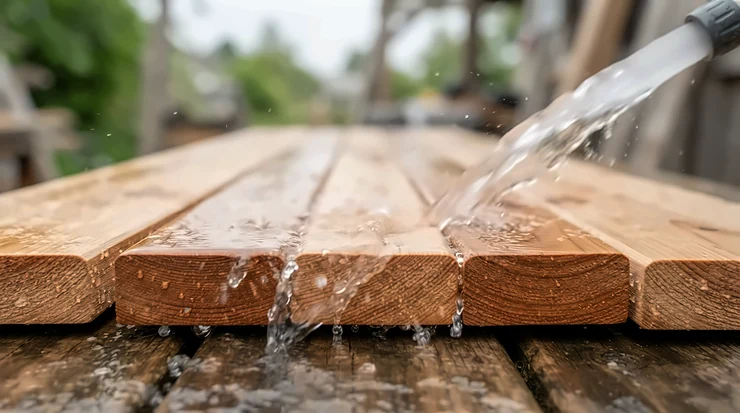
Wood is soft. Water at high pressure is not. Put a pencil-thin 3000 PSI jet four inches from a cedar board and you get pale, furry stripes that look like a zebra crossing. No amount of stain will hide them.
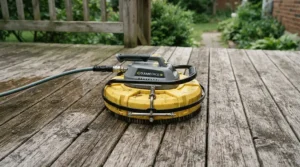
The best PSI pressure washer for wood deck cleaning without damage is rarely the one with the biggest number on the box. What matters is the pressure that actually reaches the board. That comes down to the nozzle angle, the distance from the wand, the water flow, and whether you can dial things down. Most pressure washing works by blasting grime off hard surfaces with a high-pressure spray. Wood fibers are not a hard surface.
This guide compares seven real machines, from compact electrics to gas workhorses. For each one it asks the question that matters: can you hold it gently enough? Along the way you’ll see where published PSI advice agrees and where it contradicts itself. You’ll also get a deck staining prep sequence, a nozzle-and-distance routine, and an honest look at electric versus gas.
One note on sourcing. Everything below is built from manufacturer specs, retailer listings, published reviews, and wood-finishing guidance. I haven’t touched these machines, and I won’t pretend otherwise. Where a spec or review couldn’t be verified, I say so.
Quick Comparison: 7 Deck-Friendly Pressure Washers at a Glance
| Product | Type | Max PSI / GPM | Price Range | Best For |
|---|---|---|---|---|
| Karcher K5 Premium | Electric (induction) | 2000 / 1.4 | $300-$400 | Cedar decks, first-time users |
| Sun Joe SPX3000 | Electric (universal) | 2030 / 1.76 | $150-$250 | Budget yearly cleanings |
| Westinghouse ePX3050 | Electric | 2050-2100 max (1800 rated) / 1.76 max (1.2 rated) | $130-$230 | Small decks, easy storage |
| Ryobi RY142300 | Electric (brushless) | 2300 / 1.2 | $250-$350 | Long-term electric ownership |
| Greenworks Pro GPW3000 | Electric (brushless) | 3000 / 1.1 | $330-$500 | Mixed jobs, tougher stains |
| Generac SpeedWash 3200 | Gas | 3200 / 2.7 | $450-$600 | Big decks, wood-setting dial |
| Simpson MegaShot MS60763 | Gas | 3100 / 2.4 | $450-$600 | Whole-property workhorse |
Prices are approximate ranges at the time of research. Check current price, since they vary by retailer and bundle.
Notice how little separates the first four rows on pressure. What separates them is control, motor quality, and what ships in the box. The two gas units clean far faster thanks to their water volume, but that speed is exactly what makes them easy to misuse on wood. If your deck is the only job, the electrics at the top of the table are where your money is best spent.
💬 Just one click — help others make better buying decisions too!😊
Top 7 PSI Pressure Washer for Wood Deck Cleaning Without Damage: Expert Analysis
Each machine below gets the same treatment: what the specs mean on actual boards, who it suits, and what reviewers and review sites say.
1. Karcher K5 Premium — adjustable Vario wand for gentle first passes
The headline feature is the Vario Power Spray wand. It lets you twist from a low-pressure detergent spray toward full pressure without swapping tips, so you can creep up on the right setting instead of guessing.
The 2000 PSI maximum at about 1.4 GPM works out to roughly 2,800 cleaning units (PSI multiplied by GPM). That is a modest figure that cleans without overpowering. The water-cooled induction motor is designed to outlast cheap universal motors and runs quieter. The hose reel also keeps the high-pressure hose from kinking. The included DirtBlaster turbo wand should stay in the box for wood.
Based on the spec comparison, this is the machine for someone nervous about wrecking cedar. The ceiling is low and the adjustability is built in. The trade-off is time, because 1.4 GPM rinses slower than gas. Karcher also sells a Smart Control version with pressure control at the gun.
Review sentiment is thin but telling. One owner post on a deal forum described finishing a wood deck slowly but cleanly, noting that less power meant less splintering. Broader reviewer commentary praises the quiet motor and hose reel, and criticizes Karcher’s proprietary accessory connections.
Pros:
- ✅ Adjustable wand softens pressure without swapping tips
- ✅ Quiet, long-life induction motor
- ✅ Integrated hose reel prevents kinks
Cons:
- ❌ Slower rinsing than gas machines
- ❌ Proprietary accessory connections limit upgrades
Expect the $300-$400 range. For wood-first buyers who value control over speed, the value verdict is strong.
2. Sun Joe SPX3000 — dual soap tanks at a budget price
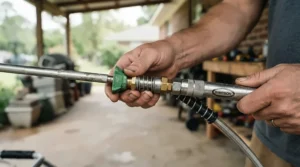
Two removable 0.9-liter detergent tanks and a dial let you switch between cleaners without refilling. That is a real convenience when you’re running an oxygen-based cleaner first and a plain rinse after.
The 2030 PSI figure is a maximum rating. Sun Joe’s own retail copy states that under typical load, working pressure is closer to 1450 PSI. That lands in a far more wood-friendly zone than the box suggests. The 1.76 GPM flow is generous for an electric. The five quick-connect tips include the 40-degree fan you want for decking, and the Total Stop System shuts the pump off when you release the trigger, which protects it from heat damage.
On paper this is the sensible choice for a once-or-twice-a-year cleaner. The catch is the universal motor, which is louder and shorter-lived than induction designs, plus a largely plastic build. Think of it as a few-seasons tool.
Reviewers consistently praise easy assembly and the soap tanks. The recurring complaint is durability over time.
Pros:
- ✅ Includes a 40-degree tip for gentle fans
- ✅ Two detergent tanks, easy switching
- ✅ Light enough to carry and shelf-store
Cons:
- ❌ Universal motor is louder and shorter-lived
- ❌ Plastic frame and wheels feel disposable
Expect roughly the $150-$250 range. It’s a good value for occasional deck care.
3. Westinghouse ePX3050 — the lightweight, tip-resistant compact
Four swivel wheels and a low center of gravity make this unit hard to tip, even when you drag it across uneven boards. The manual lists roughly 25 pounds, light enough to carry one-handed.
Here is the spec detail worth knowing. The headline numbers (about 2050-2100 PSI, 1.76 GPM) are maximums, while Westinghouse also publishes rated figures of 1800 PSI and 1.2 GPM. The rated pair is the realistic working output, and it sits comfortably near the upper edge of safe wood territory. It includes a Total Stop System and a 20-ounce onboard soap tank.
The catch is that listings show tip bundles of 0/15/25/soap or 15/25/turbo, and neither includes a 40-degree fan. Budget a few dollars for a 40-degree quick-connect tip before touching your deck. This is the kind of detail the box won’t tell you.
I couldn’t verify a representative sample of owner reviews for this exact bundle, so lean on the spec sheet and the manufacturer’s rated numbers.
Pros:
- ✅ Compact, stable, easy to store
- ✅ Rated output suits wood with the right tip
- ✅ Total Stop System protects the pump
Cons:
- ❌ No 40-degree tip in listed bundles
- ❌ Max versus rated numbers confuse shoppers
Expect roughly $130-$230. It’s the lowest-cost route to a deck-capable electric.
4. Ryobi RY142300 — brushless induction motor built to last
The 13-amp brushless induction motor is the whole story. It runs cooler and quieter than a universal motor, and Ryobi backs the unit with a three-year warranty.
At 2300 PSI and 1.2 GPM (about 2,760 cleaning units), it has more force than wood needs. That is fine, because you control it with tip choice and distance. The 1.2 GPM flow means rinsing takes longer on big decks. Consumer Reports lists it with a 25-foot hose, a 35-foot cord, and a thermal pump protector. Tips included are 15-degree, soap, and turbo, so you’ll want to add a 40-degree fan.
It also weighs around 49 pounds, heavy for an electric but sturdy.
Consumer Reports includes this model in its pressure washer test program, though the scores sit behind a membership. One older independent review framed the roughly $300 price as paying for reliability rather than extra pressure, which matches the spec logic.
Pros:
- ✅ Brushless induction motor for longer life
- ✅ Three-year warranty and onboard storage
- ✅ Solid metal wand and quick-connect tips
Cons:
- ❌ Ships without a 40-degree tip
- ❌ Heavy for an electric washer
Expect the $250-$350 range. It’s strong value if you want one electric washer for the next decade.
5. Greenworks Pro GPW3000 — the most pressure you can get from a plug
At 3000 PSI and 1.1 GPM, this is the most pressure available in a residential electric washer. Greenworks also advertises 2.0 GPM at only 100 PSI, but that is a rinse figure, not a working one.
The 14-amp TruBrushless motor carries a 10-year motor warranty and a three-year tool warranty. The bundle includes 15-, 25-, and 40-degree tips plus soap and turbo nozzles. That 40-degree tip matters, because this machine is more than a deck washer. It is a high-PSI pressure washer for tough stains on concrete and rough surfaces, and on wood it demands discipline.
Honestly, for a deck-only buyer this is overkill. The extra pressure is useful only if your other jobs include driveways or stubborn masonry. At roughly 47 pounds it’s also bulkier than the budget electrics.
Consumer Reports tests this model, and one independent review places it at the high end of the electric price scale, which fits the specs.
Pros:
- ✅ Highest PSI among home electrics
- ✅ Includes a 40-degree tip for decking
- ✅ Ten-year motor warranty
Cons:
- ❌ More pressure than wood needs
- ❌ Water flow is low at full pressure
Expect $330-$500. It’s worth it only if your deck is one job among several.
6. Generac SpeedWash 3200 — a PowerDial gun with a wood setting
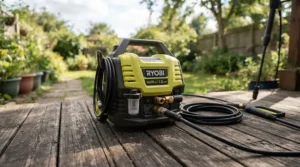
The PowerDial gun lets you rotate between Car, Wood, Concrete, and Soap at the handle. For a gas machine with this much muscle, a built-in wood position is a rare safety feature.
The engine is a 196cc OHV unit pushing 3200 PSI at 2.7 GPM, about 8,640 cleaning units, which makes rinsing very fast. The bundle includes a turbo nozzle, soap blaster, and power broom. The dial is the real draw, but Generac’s published materials I reviewed don’t state the exact PSI at each position. Run a test patch on a hidden board and, if possible, verify with a gauge. One more catch is that some retailer listings wrongly label it “adjustable pressure: no,” so verify against Generac’s own spec sheet.
This is a good fit for large decks or mixed-surface properties. The machine itself weighs about 62 pounds.
Review roundups praise the bundle value and the dial, while noting the included attachments are lighter duty and the engine is less universally serviceable than a Honda.
Pros:
- ✅ PowerDial includes a dedicated wood setting
- ✅ Large water flow rinses quickly
- ✅ Useful attachments included
Cons:
- ❌ Exact PSI per dial setting isn’t published
- ❌ Gas upkeep: oil, fuel, noise
Expect the $450-$600 range. It’s good value for big or mixed-use properties, with caution.
7. Simpson MegaShot MS60763 — a steel-framed gas workhorse
A welded steel frame and 10-inch pneumatic tires make this one roll across lawns and gravel without complaint. It also ships with a 40-degree tip.
The numbers are 3100 PSI at 2.4 GPM, about 7,440 cleaning units. The pump is a maintenance-free axial cam with thermal relief. Simpson lists a Kohler RH265 engine on this model, while Honda GC190 versions exist under different model numbers, so check which one you’re buying. The weight is about 64 pounds. Warranties run two years on the engine, one on the pump, and five on the frame.
There’s no pressure adjustment, so everything rides on the 40-degree tip, a generous distance, and a steady wrist. That makes it an experienced user’s tool for wood, ideal if your deck is one job among fences and driveways.
An aggregated review summary for the Honda-powered sibling points to easy starting and good value. Complaints include nozzles vibrating out of the holder and hoses that feel short.
Pros:
- ✅ Rugged steel frame with big pneumatic tires
- ✅ Includes a 40-degree wood-friendly tip
- ✅ Fast rinsing from 2.4 GPM
Cons:
- ❌ No on-gun pressure control
- ❌ Heavy, loud, and fuel-dependent
Expect the $450-$600 range. It’s a strong value for whole-property cleaning, not a gentle deck specialist.
Deck Staining Prep: The Sequence That Protects the Wood
Deck staining prep is where most deck projects are won or lost. Stain protects sound wood, but it cannot restore strength to a board that’s already failing. So start by probing the structure.
- Inspect first. Press a screwdriver into boards near ends and joists. Soft spots mean repair or replacement before anything else.
- Clear and pre-wet. Remove furniture, sweep, and wet nearby plants.
- Apply an oxygen-bleach deck cleaner. The common guidance is to keep it wet for about 12 to 15 minutes, scrubbing stubborn spots with a soft brush, then rinse. Chlorine bleach is widely cautioned against, because it can attack the lignin that holds fibers together and leave a fuzzy surface that soaks up stain unevenly.
- Rinse gently. This is where your pressure washer comes in. Stay in the low range, hold the wand back, and let the cleaner do the work.
- Consider a brightener. Deck brighteners restore color and prepare the surface, per USDA Forest Service finishing guidance.
- Dry completely. Follow the stain label’s moisture and dry-time guidance. Rain-soaked wood takes longer.
- Test a patch. Stain a hidden board and let it dry before committing to the whole deck.
Skip a step and you’re coating wood that is damp, fuzzy, or quietly coming apart.
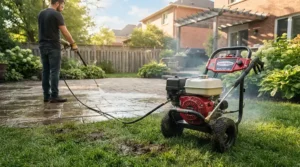
Step-by-Step: Pressure Washing Your Deck Without Damage
Here’s the routine, assuming you’ve already done the cleaner step above.
Before you start:
- Test the GFCI outlet or plug. The CDC’s pressure washer safety guidance also warns that the spray can cause wounds that look minor but need prompt medical attention, so never point the wand at anyone.
- Never run a gas unit in an enclosed space or within 20 feet of windows, doors, or vents.
- Wear closed-toe, rubber-soled shoes and eye protection.
The pass:
- Fit a 40-degree (white) tip. Never use the red 0-degree tip.
- Start 18 to 24 inches from the wood and work closer slowly.
- Sweep with the grain, overlapping each pass.
- Keep the wand moving. Pausing is how gouges happen.
- Rinse from the house outward so dirty water runs off the deck.
Common first-30-day mistakes:
- Leaving the machine running with the trigger released. Idling water heats the pump, a leading cause of pump failure.
- Starving the pump with a kinked or narrow hose.
- Skipping winterization. Frozen water can crack the pump housing.
Treat the wand like a paintbrush, not a power drill. If you see fuzz, back off.
Real-World Scenarios: Which Machine Fits Which Deck
Scenario 1: The townhouse deck. You own a 12-by-12 pressure-treated deck, wash it once a year, and store everything in a closet. Budget is under $250. The Westinghouse ePX3050 or Sun Joe SPX3000 fits, with a 40-degree tip added and a gentle cleaner doing the heavy lifting.
Scenario 2: The cedar deck you’re nervous about. About 400 square feet of cedar you want to keep looking new for years. You’ll wash annually and care more about control than speed. The Karcher K5 Premium, with its adjustable wand, is the logical choice. If you want a longer-lived electric, the Ryobi RY142300 works too, with a 40-degree tip added.
Scenario 3: The big property. A 600-square-foot deck, a cedar fence, and a driveway, all cleaned twice a year. Water volume matters here, so a gas machine saves hours. The Generac SpeedWash 3200 brings its wood-setting dial, and the Simpson MegaShot MS60763 brings rugged durability. Either needs a test patch first and a disciplined tip-and-distance routine. If you’d rather stay electric, the Greenworks Pro GPW3000 closes much of the gap.
✨ Ready to Pick Your Deck-Safe Washer?
🔍 Take your deck cleaning to the next level with these carefully selected machines. Click any highlighted product name to check current pricing and availability. The right match means a cleaner deck and a finish that lasts!
What Is the Right PSI Pressure Washer for Wood Deck Cleaning Without Damage?
A PSI pressure washer for wood deck cleaning without damage is a machine and setup whose pressure at the board can be held gently, typically from a few hundred to roughly 1,200 PSI. At that level, water and detergent lift dirt and mildew without tearing wood fibers. In practice, it’s a setup, not just a machine.
Three levers decide the real pressure. The first is the machine’s rated pressure, which is not the same as its headline maximum. The second is nozzle angle, with a 40-degree fan spreading force far wider than a 15-degree tip. The third is distance, because moving the wand closer rapidly increases the force on the surface.
Water flow (GPM) matters too, but differently. Pressure breaks dirt loose, while flow carries it away. For wood, flow is your friend, since you can clean effectively without leaning on pressure.
The takeaway is simple. A washer with a modest rated pressure and a 40-degree tip, held at a sensible distance, will clean most decks better and safer than a high-pressure monster used carelessly.
How to Choose a Pressure Washer for Your Wood Deck
- Identify your wood. Softwoods like cedar and pine need the gentlest approach, while dense hardwoods tolerate more. Your wood type sets your ceiling.
- Check rated, not max, pressure. Some brands publish both numbers. The rated figure is the realistic one, and the gap can be several hundred PSI.
- Confirm a 40-degree tip is included. Several popular models ship without one. A cheap aftermarket tip fixes it, but know before you buy.
- Weigh adjustability. An adjustable wand or dial lets you creep up on the right setting instead of guessing.
- Match flow to deck size. Under 300 square feet, 1.2 to 1.76 GPM is fine. Above that, gas flow saves time.
- Plan for storage and upkeep. Electric means a shelf and a cord. Gas means fuel, oil, and winterizing.
The Low-to-Mid PSI Range for Wood: Where the Sweet Spot Lives
The low-to-mid PSI range for wood is where deck cleaning gets both safe and effective. Published guidance is not unanimous, though. Some sources suggest 500 to 600 PSI for cedar and pine. Others allow up to 1,200 or beyond for pressure-treated lumber. One write-up even cites a manufacturer bulletin listing 1,200 to 2,500 PSI for wood while warning that misuse leaves damage. Treat all of it as starting points, not rules.
| Wood Type | Typical Starting Range | Tip / Distance | Best For |
|---|---|---|---|
| Cedar, redwood | 500-800 PSI | 40°, 12-24 in. | Soft, delicate boards |
| Pressure-treated pine | 800-1,200 PSI | 25° to 40°, 12-18 in. | Most home decks |
| Hardwoods (ipe, mahogany) | 1,000-1,500 PSI | 25° to 40°, 12 in. | Dense, tight-grain decks |
The range widens as wood density rises, but the pattern holds: start low, widen the fan, and test. Because most washers don’t show you real working pressure, the test patch is your gauge. Begin with the 40-degree tip at 18 to 24 inches, then creep closer only until dirt lifts and no fuzz appears.
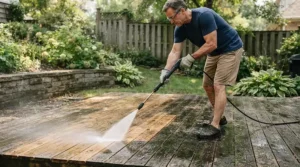
Wood Fiber Damage: What It Looks Like and How to Avoid It
Wood fiber damage shows up as fuzz, raised grain, stripes, and wand notches. The “furry” texture means fibers were lifted or torn, usually from too much pressure, too sharp an angle, or too little distance. Stain will not hide it, because the first coat soaks into the fuzz unevenly.
The USDA Forest Products Laboratory’s deck finishing guidance notes that power washing can remove wood from the surface. Its recommendation for routine cleaning leans on commercial deck cleaners and brighteners, which lift mildew and dirt chemically and let the natural color show through.
The habits that prevent it are simple:
- Never use a 0-degree tip or a turbo nozzle on wood.
- Keep the wand moving and avoid lingering at board ends.
- Spray with the grain, not across it.
- Let cleaner dwell so you need less pressure.
If damage has already happened, light sanding after drying can often smooth fuzzy boards before staining. Deep gouges may need board replacement.
High-PSI Pressure Washer for Tough Stains: When More Power Helps
A high-PSI pressure washer for tough stains has a place, just not directly on soft decking. Mildew streaks, rust, tannin stains, and old grime on concrete or masonry can need real force. The smart play is to let chemistry do the heavy lifting on wood and reserve power for hard surfaces.
For stubborn spots on decking, try an oxygen-bleach cleaner first with a soft brush. Wood brighteners, often oxalic-acid based, can address rust and tannin discoloration. Apply, wait, then rinse gently.
If you own a Greenworks Pro GPW3000, Generac SpeedWash 3200, or Simpson MegaShot MS60763, use the 40-degree tip, add distance, and consider the Generac’s wood setting. Old film finishes are another trap. Pressure is a poor way to strip a failing coating, and a chemical stripper is the safer tool.
Choosing Between Electric and Gas Pressure Washer for Home Use
Choosing between electric and gas pressure washer for home use boils down to flow, noise, and upkeep. Consumer Reports’ pressure washer ratings frame gas models as best suited to heavy-duty jobs, like a long-neglected deck or patio.
| Factor | Electric | Gas |
|---|---|---|
| Typical GPM | 1.2-2.0 | 2.4-3.5 |
| Noise | Conversation-level | Hearing protection advised |
| Upkeep | Pump care, winterizing | Oil, fuel, filters, plugs |
| Control for wood | Easier, lower ceilings | Harder, higher ceilings |
| Best For | Decks under about 400 sq. ft. | Large or mixed-use properties |
For most home deck owners, electric wins on control, noise, and storage. Gas wins on speed and reach. Choosing between electric and gas pressure washer for home use is really choosing which risk you’d rather manage: slower cleaning or a more powerful tool. If your deck is the main job, electric is the safer default.
Pressure Washer vs Traditional Alternatives for Wood Decks
| Method | Fiber Risk | Speed | Cost | Best For |
|---|---|---|---|---|
| Deck brush + cleaner | Very low | Slow | Low | Small decks, spot cleaning |
| Garden hose + oxygen cleaner | Very low | Moderate | Low | Light mildew, annual refresh |
| Pressure washer (low-to-mid) | Low to moderate | Fast | Moderate | Most routine cleanings |
| Pressure washer (high PSI) | High | Fastest | Higher | Hard surfaces, not decking |
If your deck is small and your patience is large, hand-scrubbing with an oxygen cleaner is the lowest-risk path. A pressure washer shines when time matters, and the rinse step benefits most. The worst outcome comes from using a pressure washer like a sander, so treat it as a rinse tool first.
Long-Term Cost & Maintenance: What a Deck Washer Really Costs
Think in cost per use, not sticker price. As a rough illustration, a machine in the $200 range used twice a year for five years comes to about $20 per use before accessories. A longer-lived induction-motor unit costs more up front but may spread that cost over many more seasons.
Maintenance is where cheap machines quietly cost more. Pump failures most often trace to three habits: running the machine in bypass, starving it of water, and letting it freeze. Fix them with these steps:
- Shut the machine off if you’ll pause longer than a minute or two.
- Use a short, wide hose from a fully open spigot.
- Run pump-saver antifreeze through the unit at season’s end.
- Rinse the inlet filter a few times a season.
- Coil the high-pressure hose in large loops.
Add the cost of a 40-degree tip, a surface cleaner if you need one, and cleaner or brightener each season. It all adds up, but it still beats resurfacing a scarred deck.

FAQ
❓ Can I use a 3000 PSI pressure washer on a wood deck?
❓ Is a pressure washer better than a deck brush for stain removal?
❓ Should I rent or buy a pressure washer for one deck?
❓ Do I need a surface cleaner attachment for decking?
❓ Can a pressure washer strip old stain from a wood deck?
Conclusion
Picking a PSI pressure washer for wood deck cleaning without damage comes down to control, not horsepower. For most people, an electric washer with a modest working pressure, a 40-degree tip, and a patient hand is the winning recipe.
If you want the gentlest start, the Karcher K5 Premium gives you an adjustable wand. If budget leads, the Sun Joe SPX3000 and Westinghouse ePX3050 get you there for less, just add a 40-degree tip where needed. The Ryobi RY142300 is the long-haul electric, and the Greenworks Pro GPW3000 brings the most pressure for mixed jobs. On the gas side, the Generac SpeedWash 3200 offers a wood-setting dial and the Simpson MegaShot MS60763 offers brute durability, both best for large properties.
Whatever you choose, test a hidden board first, let cleaner do the work, and let the wood dry before you stain. Your deck will thank you for years.
Recommended for You
- Pressure Washer For Beginners Choosing The Right PSI: 7 Best (2026)
- PSI And GPM Combination For Driveway Cleaning: 7 Proven Picks 2026
- Portable Hot Water Pressure Washer For Contractors: 7 Best Picks 2026
Disclaimer: This article contains affiliate links. As an Amazon Associate, I earn from qualifying purchases. If you purchase products through these links, we may earn a small commission at no additional cost to you.
✨ Found this helpful? Share it with your friends! 💬
