
In This Article
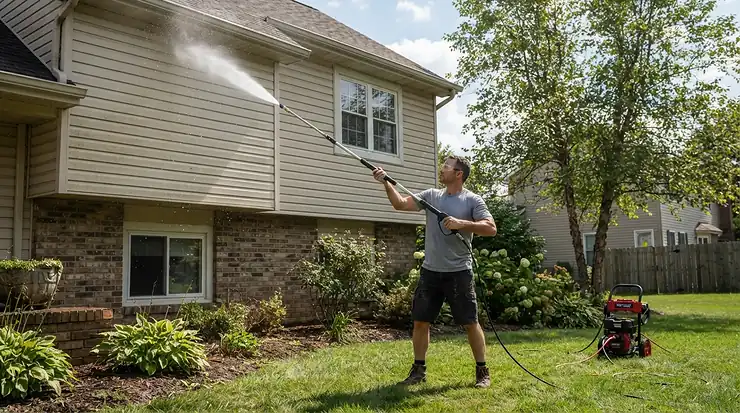
A pressure washer for beginners choosing the right PSI is an electric, cold-water machine paired with pressure settings gentle enough to learn on. For most first-timers, that means roughly 1,500–2,000 max PSI, at least 1.1 GPM of flow, a few interchangeable nozzles, and a wide fan tip that protects wood, paint, and car finishes.
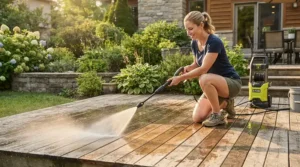
Here’s the trap. Pressure washer boxes shout “3,000 PSI!” the way cereal boxes shout “part of a balanced breakfast.” Bigger looks smarter, but on day one it isn’t. Pressure is only half the equation. Flow (GPM) is the other half, and the third variable is you: your distance, your nozzle, your patience. Too much PSI in novice hands is how cedar boards end up with fuzzy scars and siding loses its paint.
It helps to know how the machine actually works. Wikipedia’s overview of pressure washing notes that a machine’s pressure is built into its pump but can be varied through the unloader valve or by swapping nozzle tips. That is why nozzles matter as much as the number on the box.
This guide covers every angle a newcomer needs: a pressure washer for first-time buyers under $200, a low-PSI pressure washer for delicate surfaces, beginner-friendly settings, adjustable PSI dials, and starter pressure washer kits. We compare seven real models using published specs, aggregated review sentiment, and plain reasoning. There are no invented test drives here, just honest analysis of what the numbers mean for your driveway, deck, and car. Prices are given as ranges only, because they change constantly.
Quick Comparison: Which PSI Fits Which Job?
Before you meet the machines, match the pressure to the surface. The ranges below are commonly cited guidance, so always check your material’s manufacturer recommendations.
| Surface / Job | Commonly Cited Safe PSI | Nozzle | Best For |
|---|---|---|---|
| Cars, bikes, patio furniture | Roughly 300–1,500 | 40° fan | WORX Hydroshot WG620.1, Kärcher K1700 Cube |
| Softwood decks & fences (pine, cedar) | About 500–800 | 40°–60° fan | Sun Joe SPX3000 (Low mode) |
| Hardwood decks | Up to about 1,200–1,500 | 25°–40° | Greenworks 1800 PSI |
| Vinyl/PVC & capped composite | Around 1,500 or less; check maker | 40° | Craftsman CMEPW1700 |
| Concrete driveways & patios | Roughly 1,500–2,500+ | 15°–25° | Westinghouse ePX3500, Greenworks GPW3001 |
Look at the pattern in that table: the softer the surface, the lower the PSI and the wider the spray. Concrete forgives almost anything, while cedar forgives almost nothing. If your yard is mostly wood and vehicles, a 1,700–1,800 PSI machine with a 40° tip is plenty. The 3,000 PSI monsters only make sense when concrete dominates your chore list.
💬 Just one click — help others make better buying decisions too!😊
Top 7 Pressure Washers for Beginners: Expert Analysis
These seven span budget, mid-range, and premium tiers, from a cordless gentle-duty tool to a 3,000 PSI step-up. Each entry interprets the specs and summarizes genuine review sentiment. Nothing here is a first-hand test.
1. Sun Joe SPX3000 — two-mode pressure that forgives learning curves
The standout here is control. Sun Joe lists a Low setting near 870 PSI and a High setting near 1,450 PSI under typical load, so you get a gentler first rung than most single-pressure rivals offer. Notice the gap between that and the 2,030 PSI on the box. That figure is a peak rating, and everyday working pressure sits around 1,450 PSI, which shows why max-PSI shopping misleads beginners.
Beyond pressure, two removable 0.9-liter detergent tanks and a Total Stop System that halts the pump when you release the trigger cut refilling and motor wear. Based on the spec comparison, Low mode with a wide tip suits painted railings and softwood. Still, 870 PSI exceeds the 500–800 PSI many deck guides advise for cedar, so keep your distance and test a hidden spot. At roughly 31 pounds, it’s no featherweight.
Reviewers on a major retail listing average about 4.6 stars from a few hundred ratings, and summaries repeatedly mention quick setup, fair cost, and sturdy parts. Flow ratings differ between listings, so confirm the GPM on your exact model.
Pros:
- ✅ Low/High pressure selection for gentler starts
- ✅ Dual detergent tanks with an onboard selector
- ✅ Total Stop System protects the pump
Cons:
- ❌ Heavier than most compact rivals
- ❌ Flow ratings vary between listings
Expect roughly $150–$270 depending on retailer; check current price. The verdict is that it costs more than a bare-bones starter, but the pressure selector makes it the most forgiving learning tool here.
2. Kärcher K1700 Cube — foot switch keeps both hands on the wand
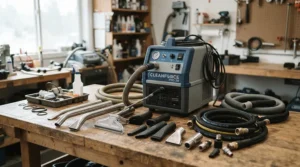
Beginners tend to wobble the lance while fumbling for a trigger. The K1700’s on/off foot switch sidesteps that, letting you steady the wand with both hands. Under the hood, 1,700 PSI and 1.2 GPM multiply to about 2,040 “cleaning units.” That is a rough shorthand, but it places the machine squarely in the budget-electric class. You also get a 35-foot power cord and a turbo nozzle, plus a detachable 0.3-gallon detergent tank and three nozzles.
Here’s what to weigh. There’s no low-pressure mode, so the 15° and turbo tips are too aggressive for delicate surfaces. Lean on the wide fan and keep your distance. The payoff is size: the cubic body takes up minimal storage space, and the unit is CETA certified, so its ratings are independently verified.
Retail sentiment is solid. Tractor Supply shows 4.6 stars across 69 reviews, while the Amazon listing sits near 4.3 stars with roughly 1,900 ratings. One buyer noted the included hose is too short to wash an SUV without repositioning, and one review site says it shows its limits with tougher grime.
Pros:
- ✅ Foot switch frees both hands
- ✅ Compact cube stores easily
- ✅ Three-year warranty and CETA certification
Cons:
- ❌ Short hose limits reach around vehicles
- ❌ No low-pressure mode for delicate work
Plan on about $170–$230 at the time of research. The verdict is that it’s the best-balanced under-$200 pick for households focused on cars and patio furniture.
3. Greenworks 1800 PSI — PWMA-certified with a GFCI cord
The value here is straightforward. A 35-foot cord with an in-line GFCI, a kink-resistant hose, push-button start, and a three-year warranty make the safety and usability basics easy. Specs are 1,800 PSI and 1.1 GPM. That’s about 1,980 cleaning units, slightly below the 1.2 GPM crowd on flow, so rinsing takes a touch longer. The GFCI plug is a quiet beginner win, since it cuts shock risk around wet grass and outdoor outlets.
Multiple Greenworks 1800 PSI variants exist. One is PWMA certified with an onboard soap tank, a hose reel, and 40° and turbo nozzles, while another adds never-flat wheels and a 2-liter soap tank. Weights across listings run from the mid-20s in pounds, so verify the exact SKU before buying.
The spec-sheet-versus-reality point: 1,800 PSI with a 40° tip is a sweet spot for hardwood decks, fences, and grills. Just skip the turbo tip on painted surfaces. Retail listings generally show strong scores, but review volume varies by SKU, so I couldn’t verify one aggregated figure. Check the retailer page for your exact model.
Pros:
- ✅ In-line GFCI plug on a 35-foot cord
- ✅ Three-year limited warranty
- ✅ Multiple SKUs including wheeled versions
Cons:
- ❌ 1.1 GPM rinses slower than 1.2+ rivals
- ❌ Confusing overlap between similar SKUs
Budget roughly $100–$170; prices vary. The verdict is that it’s a low-drama, safety-minded starter for decks and fences.
4. Craftsman CMEPW1700 — lowest entry cost with certified ratings
If the goal is simply getting started, this is the cheapest door in. Specs include 1,700 max PSI and 1.2 GPM, both quoted with the 40° nozzle. That fine print is good news for beginners, because the headline number already reflects the gentle wide fan. Other basics: a 20-foot kink-resistant hose, a 35-foot power cord, onboard storage, and CETA certification. The machine weighs about 22 pounds.
The trade-off is the soap system. It uses a soap applicator bottle rather than an onboard tank, which means more fiddling mid-job. You also get only two tips (40° and turbo), so there’s no in-between angle for stubborn spots. On paper, that’s fine for cars, grills, and furniture, and it’s a stretch for large concrete.
I found no reliable aggregated rating for this exact model. Buyer reviews of its sibling, the CMEPW1800, include reports of pump smoke and failures. Keep your receipt and use the three-year warranty if trouble appears.
Pros:
- ✅ Lowest entry price in this lineup
- ✅ 40° nozzle rating suits beginners
- ✅ Three-year warranty and CETA certification
Cons:
- ❌ Soap bottle instead of onboard tank
- ❌ Only two nozzle tips included
Expect roughly $80–$120; check current price. The verdict is that it’s a sensible first machine for light chores, with the warranty as your safety net.
5. WORX Hydroshot WG620.1 — cordless, gentle, and tap-free
This one is deliberately not a driveway blaster. The Hydroshot kit pairs a 20V battery with a 320 PSI, 0.53 GPM cleaner that can draw water from any freshwater source. In practice, 320 PSI is a low-PSI tool for delicate surfaces: bikes, windows, grills, outdoor cushions, and cars. A reviewer noted that its 5-in-1 nozzle runs from a 0° jet through 15°, 25°, and 40° fans to watering, which makes it easy to dial down.
Expert testers frame it as a complement, not a replacement. One says it isn’t powerful enough for oil stains, another calls it unsuitable for large patios and driveways, and a third reviewer approached the 320 PSI spec skeptically but accepted that the maker doesn’t pitch it as a pressure-washer replacement. The same review raised a concern about the exposed battery connection near water, so keep the battery dry.
Pros:
- ✅ Cordless with tap-free water drawing
- ✅ Gentle enough for delicate items
- ✅ Battery works with other WORX 20V tools
Cons:
- ❌ Too weak for oil or large surfaces
- ❌ Battery connection needs careful drying
Kits run around $150–$200; prices vary. The verdict is that it isn’t your only machine if you have a driveway. It’s an excellent second tool, or a first one for apartment dwellers.
6. Westinghouse ePX3500 — big power in a 19-pound frame
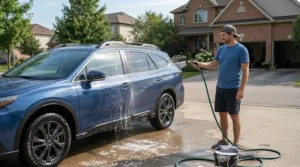
The headline is a compact body with serious numbers. Westinghouse rates it at 2,500 max PSI (measured at initial discharge) and up to 1.76 GPM, in a 19-pound unit that stands 16.5 inches tall. That’s roughly 4,400 cleaning units, about double the 1,700 PSI class. Because the PSI is an initial-discharge figure, real working pressure will be lower. Four 360° wheels and a low center of gravity resist tipping, which helps beginners tugging a hose across a lawn.
Here’s the catch. The tip set is 0°, 15°, 25°, turbo, and soap, so there’s no 40° fan in the box. At this power, that is a real gap. Buy a 40° tip before touching wood, or keep the wand well back on softer surfaces. On the plus side, you get a 25-foot hose, a 600 mL detergent tank, and a Total Stop System, backed by a three-year limited warranty.
Sentiment is strong: 4.7 stars from over 10,000 ratings on one major listing. A small minority of reviewers report early pump failures, though one said warranty replacement went quickly.
Pros:
- ✅ Highest power-to-size ratio in the lineup
- ✅ Anti-tip four-wheel design
- ✅ Very large positive review base
Cons:
- ❌ No 40° wide-fan tip listed in the box
- ❌ Some early pump-failure reports
Plan for roughly $170–$300 depending on retailer. The verdict is that it’s the one to buy if you’d rather grow into the machine than replace it.
7. Greenworks GPW3001 — 3,000 PSI room to grow
This is the premium step-up. Bob Vila’s team named it their favorite after testing 13 electric models, citing 3,000 PSI, up to 2 GPM, five nozzles, and an onboard detergent tank. A 14-amp brushless motor, push-button starts with no priming or choke, and a 35-foot cord make it easy to operate. That’s about 6,000 cleaning units, roughly triple a budget starter.
For a beginner, more power isn’t automatically better. At 3,000 PSI, a 0° tip can scar wood, so start with the widest fan and a generous distance. The real benefit is the 2 GPM flow, which rinses fast, plus the headroom that keeps the machine from straining on concrete. The catch is noise: a comparable 3,000 PSI Greenworks listing measures around 76.8 dB, similar to freeway traffic.
I found no reliable aggregated star rating for this exact SKU, so lean on the editor’s-choice signal and check current reviews.
Pros:
- ✅ Ample flow for fast rinsing
- ✅ Push-button start, no priming or choke
- ✅ Room to grow into big concrete jobs
Cons:
- ❌ Far more power than most beginners need
- ❌ Loud in operation
Expect roughly $350–$500; prices vary widely by retailer. The verdict is that it’s overkill for a first machine but sensible if you know concrete is your main chore.
Top 7 at a Glance
| Product | Max PSI / GPM | Price Range | Rating Signal | Best For |
|---|---|---|---|---|
| Sun Joe SPX3000 | 2,030 / varies by listing | $150–$270 | ~4.6★ (retail listing) | Learning with Low/High modes |
| Kärcher K1700 Cube | 1,700 / 1.2 | $170–$230 | 4.6★ (69) / ~4.3★ (Amazon) | Cars & patio furniture |
| Greenworks 1800 PSI | 1,800 / 1.1 | $100–$170 | Varies by SKU | Budget decks & fences |
| Craftsman CMEPW1700 | 1,700 / 1.2 | $80–$120 | Limited verified data | Lowest entry cost |
| WORX Hydroshot WG620.1 | ~320 / 0.53 | $150–$200 | Mixed for niche use | Windows, bikes, delicate items |
| Westinghouse ePX3500 | 2,500 / 1.76 | $170–$300 | 4.7★ (10,000+) | Growing into driveways |
| Greenworks GPW3001 | 3,000 / 2.0 | $350–$500 | Editor’s favorite | Long-term upgrade |
Looking at the table, the Kärcher K1700 Cube and Craftsman CMEPW1700 deliver near-identical cleaning power, so the choice comes down to the foot switch and warranty support versus raw price. The Westinghouse ePX3500 roughly doubles their cleaning units for a modest premium, which is the best value jump in the group. Meanwhile, the WORX Hydroshot WG620.1 isn’t really competing on power at all. It exists for jobs where less is the point.
Beginner-Friendly Settings: Your First-Day Setup Guide
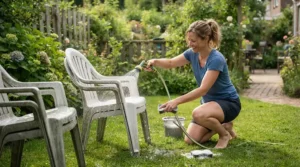
Great hardware still fails when the first session goes wrong. Here’s a sequence built on beginner-friendly settings that protects your surfaces and your pump.
- Connect water first, then purge air. Attach the garden hose, squeeze the trigger with the power off, and let water flow until the spray is steady. Air trapped in a pump is a classic cause of sputtering and pulsing.
- Start with the widest tip. Snap on the 40° fan, or the widest your model includes. Deck guides consistently advise starting around 500–600 PSI for softwoods and holding the wand a couple of feet away.
- Test a hidden patch. Ten seconds under a bench or behind a planter tells you if the setting is safe.
- Sweep, don’t stab. Move the wand in even, overlapping passes parallel to the grain, keeping a steady distance. Avoid going closer than about six inches to wood.
- Apply soap through the low-pressure tip. Let detergent dwell for a few minutes, then rinse from the top down. Cleaner does the heavy lifting, so pressure doesn’t have to.
- Drain and store properly. Squeeze the trigger to release residual pressure, drain the pump, and coil the hose loosely. In freezing climates, never leave water in the pump.
The mistakes that show up in the first 30 days are predictable: jumping to the turbo tip, working too close, and skipping the test patch. With the Sun Joe SPX3000, begin on Low. With the Westinghouse ePX3500, swap in a 40° tip before touching wood. And with the Greenworks GPW3001, treat the widest fan as your default, not your fallback.
Real-World Scenarios: Matching Your Yard to the Right PSI
Specs feel abstract until they meet a real household. These three profiles show how the same decision plays out differently.
The apartment renter (budget: under $150, monthly use). Picture a balcony with grill grates, a bike, and patio cushions, and no outdoor tap in sight. The WORX Hydroshot WG620.1 fits because it draws from a bucket and its 320 PSI won’t strip paint. If a tap is available and she wants more muscle, the Craftsman CMEPW1700 covers occasional bigger jobs at the lowest entry price.
The suburban deck owner (budget: $150–$250, twice a year). With a 300-square-foot softwood deck and a cedar fence, wood damage is the enemy. The Sun Joe SPX3000 on Low mode with a 40° tip is the most forgiving option here. The Greenworks 1800 PSI works too, provided the turbo tip stays in the drawer.
The two-car family (budget: $200–$400, monthly car washing plus seasonal concrete). Oil spots and a big driveway argue for extra flow. The Westinghouse ePX3500 handles both, and the Greenworks GPW3001 adds headroom if the driveway is huge. A Kärcher K1700 Cube stays the simpler pick if the driveway is small and cars come first.
Notice what changed in each case: surface, frequency, and budget, not just PSI. That’s the real framework. Identify the softest surface you’ll clean, then buy for that, not for the toughest fantasy job.
✨ Ready to Pick Your Starter Machine?
🔍 Take your pressure washer for beginners choosing the right PSI journey to the next level with these carefully selected products. Click on any highlighted item to check current pricing and availability. These tools will help you create authentic, spotless results your family will love!
Problem → Solution: Fixing Common First-Timer Headaches
Even the right machine throws curveballs. These are the four issues newcomers hit most, with fixes drawn from standard operating guidance.
Problem: streaky, zebra-striped concrete. Uneven distance and choppy passes cause it. Slow down, overlap each pass by about a third, and keep the wand height constant. A surface cleaner attachment solves it for large flat areas.
Problem: the pump surges or won’t build pressure. Trapped air is the usual suspect, followed by a clogged inlet screen or a kinked hose. Run water through the wand with the power off, clean the inlet filter, and straighten the hose. A kink-resistant hose, such as the one on the Craftsman CMEPW1700, helps prevent the last cause.
Problem: the GFCI keeps tripping. Moisture at the plug is the classic reason. Keep the connection off wet ground, and don’t daisy-chain extension cords. The Greenworks 1800 PSI includes an in-line GFCI, which makes diagnosis easier.
Problem: soap won’t foam or seems weak. Most beginner machines pull detergent through a downstream injector that only works with the low-pressure soap tip. Switch to that tip and dilute per the detergent label.
Problem: fuzzy or scarred wood. That’s etching from too much pressure or too little distance. Sand lightly and use a wider tip next time, and remember the test patch. Prevention beats repair every time.
How to Choose a Pressure Washer for Beginners: Choosing the Right PSI
Follow these six steps in order, and the shortlist builds itself:
- Identify your softest surface. It sets your PSI ceiling. If cedar or painted siding is on the list, prioritize adjustable PSI dials or a machine with a wide fan tip.
- Pick a max-PSI band. For most first-timers, 1,500–2,000 PSI covers cars, decks, fences, and light concrete. Going above 2,500 only pays off if you’re mostly cleaning masonry.
- Check the flow rate. Aim for at least 1.1 GPM, and preferably 1.2 or more. Flow moves dirt away, so a low-GPM machine cleans slower even at the same PSI.
- Confirm a wide-fan tip is in the box. A 40° nozzle is a beginner’s best friend. If it’s missing, budget a few dollars for one.
- Look for safety and durability basics. That means a GFCI plug, an auto-stop feature, a kink-resistant hose of 20+ feet, and a cord of 35 feet or more.
- Verify certification and warranty. CETA and PWMA programs exist to verify that PSI and flow ratings match reality, and a three-year warranty is a healthy sign in this class.
Brands often step up PSI in small increments while flow barely moves. ProToolReviews’ breakdown of Craftsman’s electric lineup shows the line climbing from 1,700 to 1,900 to 2,100 max PSI while flow stays at 1.2 GPM. In practice, those 200-PSI jumps matter less than nozzles, technique, and surface choice.
Low-PSI Pressure Washer for Delicate Surfaces: What Actually Works
Delicate surfaces include softwood decking, cedar fences, painted siding, vinyl, window screens, and vehicle finishes. The good news is you rarely need a special machine, just the right settings. Guidance varies, though. Some deck sources suggest 500–600 PSI with a 40–60° fan tip for soft wood or composite, while one cedar guide says keep pressure under about 800 PSI and no higher than 1,500 for PVC. Meanwhile, a deck-industry resource at Decks.com says around 1,200 PSI is enough for softwood decking and 1,200–1,500 for hardwood, and it advises checking composite makers’ guidelines.
The pattern is clear: the ceiling is lower than most machines’ max ratings. So how do you stay under it? There are three levers:
- Nozzle angle. A 40° tip spreads force across a wider area than a 15° tip.
- Distance. Doubling your distance dramatically drops the effective force.
- Machine choice. The WORX Hydroshot WG620.1 is naturally gentle at about 320 PSI, and the Sun Joe SPX3000 offers a Low mode near 870 PSI under load.
For most homeowners, a 1,700–1,800 PSI unit like the Kärcher K1700 Cube or Greenworks 1800 PSI, run at distance with a wide fan, is a perfectly safe low-pressure tool. Always test a hidden spot. When the tip choice is right, the machine’s max number stops mattering.
Adjustable PSI Dials: Features That Actually Matter (And Those That Don’t)
Marketing loves the phrase “adjustable PSI dials.” Yet the pump determines a consumer machine’s pressure, and as Wikipedia explains, flow is usually built into the pump and isn’t variable, while pressure can be varied by the unloader valve or nozzle tips. Translation: many “adjustable” claims just mean you can change nozzles. That is legitimate, though it’s a different thing from a true pressure selector.
The Sun Joe SPX3000 is a rare exception among the budget models here, since it lists both Low and High pressure modes. For a beginner working on wood, that switch is worth real money. The Westinghouse ePX3500, by contrast, relies on its tip set, and it’s missing a 40° wide fan.
Features that matter:
- A GFCI plug and a Total Stop System
- A kink-resistant hose of 20+ feet
- Quick-connect nozzles with a 40° option
- An onboard detergent tank or a solid applicator
Features that don’t:
- Bragging-rights max PSI numbers
- Eight-piece nozzle collections you’ll never touch
- Extra brushes that duplicate what a car-wash mitt does better
Rule of thumb: pay for control and safety, not for peak numbers.
Pressure Washer for First-Time Buyers Under $200: Where Your Money Goes
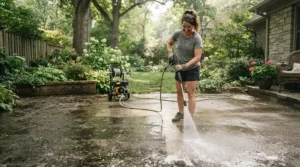
A pressure washer for first-time buyers under $200 is a category with plenty of credible options. One holiday deals roundup lists electric models from several brands under $200, including Kärcher, Greenworks, and WORX units at 1,700–2,400 max PSI. The prices in such lists shift often, so treat them as a snapshot.
Does buying beat renting? Rental costs run about $50 a day. A machine like the Craftsman CMEPW1700 or Greenworks 1800 PSI pays for itself in roughly two to three rentals. Add a three-year warranty, and the total cost of ownership over a few seasons looks favorable, provided you use it more than once or twice.
Where does the money go in this tier? Mostly into the motor, the pump, and a basic accessory set, so expect plastic housings and modest flow. Value is best when you treat 1,700–1,800 PSI as your practical ceiling. If your list includes big concrete or frequent use, stretching toward the Westinghouse ePX3500 buys meaningfully more flow, and it’s worth comparing before you commit. Finally, budget a few dollars for a 40° tip, a hose washer, and safety glasses.
Starter Pressure Washer Kits: What Belongs in the Box
Starter pressure washer kits bundle the machine with accessories, and the quality of the bundle matters more than the count. What separates a useful kit from a cardboard filler?
- A 40° fan tip. This is the single most important beginner accessory.
- A turbo or rotary tip for tough, flat surfaces only, used with caution.
- A soap applicator or foam cannon. The Sun Joe SPX3000 includes onboard tanks, while the Craftsman CMEPW1700 uses a bottle applicator.
- Adequate hose and cord length. Look for about 20+ feet of hose and 35 feet of cord, like the 35-foot cord on the K1700 Cube.
- A surface cleaner attachment. Some retailers list Greenworks packages that bundle an 11-inch surface cleaner, which speeds up big flat areas and evens out streaks.
Should you buy a kit or add accessories later? If a kit supplies your missing pieces at a fair spread, it wins on convenience. Otherwise, a bare unit plus a couple of chosen add-ons often costs less. Compatibility matters here. Check that fittings match, since quick-connect and threaded couplers vary by brand.
Electric vs Gas vs Garden Hose: Benefits vs Traditional Alternatives
Is an electric pressure washer really better than the alternatives for a beginner? Bob Vila’s testing team frames it simply: gas models are often used by pros, while electric versions are more affordable, quieter, and easier to store for at-home use.
| Factor | Garden Hose + Nozzle | Electric (Beginner Class) | Gas |
|---|---|---|---|
| Typical pressure | Low (household water pressure) | About 1,500–3,000 max PSI | Often higher, 2,500+ PSI |
| Upkeep | None | Minimal: drain and store | Fuel, oil, seasonal servicing |
| Noise | Silent | Moderate | Loud |
| Learning curve | None | Gentle | Steeper |
| Best For | Light rinsing | Kärcher K1700 Cube, Sun Joe SPX3000, Westinghouse ePX3500 | Large or commercial jobs |
The table makes the trade-off plain: a hose can’t lift embedded grime, and gas is more machine than most homeowners can justify. Electric sits in the sweet spot, with enough power for decks, cars, and patios and no fuel to maintain. For a beginner, that combination of low upkeep and moderate pressure is precisely what keeps mistakes cheap and small.
Safety, Rules & Wastewater: The Compliance Guide
Power tools deserve respect, and pressure washers are no exception. Safety trainers flag that the high-velocity stream can abrade skin and, depending on pressure, even penetrate it. So never point the wand at people, pets, or your own feet, and wear eye protection and closed-toe shoes. Use GFCI protection, like the in-line plug on the Greenworks 1800 PSI, and keep connections off wet ground.
Wastewater matters too. Storm drains often flow directly to creeks and rivers. Sacramento County’s stormwater guide for pressure washing explains that storm drains carry water to waterways, so pollutants must be kept out of them. It’s written for professional operators, but the principles apply at home:
- Sweep debris first, then wash.
- Use soap sparingly and choose biodegradable formulas where possible.
- Direct runoff onto lawn or landscaping instead of the street.
Local rules vary, so check your city or county’s ordinances before washing near a storm drain. It takes a few minutes and can save a fine.
FAQ: Pressure Washer for Beginners
❓ Is 1,500 PSI enough for a pressure washer for first-time buyers under $200?
❓ Can a pressure washer for beginners damage car paint?
❓ Do adjustable PSI dials really lower the pressure?
❓ Is a starter pressure washer kit worth it versus a bare unit?
❓ Can I use an extension cord with an electric pressure washer?
Conclusion
Choosing a pressure washer as a newcomer isn’t about chasing the biggest number. It’s about matching pressure, flow, and technique to the softest surface you’ll clean. The Sun Joe SPX3000 gives you the most forgiving control with its Low and High modes, while the Kärcher K1700 Cube balances cars, patios, and storage best under $200. The Greenworks 1800 PSI and Craftsman CMEPW1700 keep costs low and safety features solid.
If gentle care matters most, the WORX Hydroshot WG620.1 handles delicate items without drama. And for buyers who expect to grow, the Westinghouse ePX3500 offers the best power jump per dollar, with the Greenworks GPW3001 waiting beyond it for serious concrete. Whichever you pick, start with the widest tip, test a hidden patch, and let the detergent do the heavy lifting.
Ultimately, a pressure washer for beginners choosing the right PSI comes down to restraint, not raw power. Keep distance, keep the fan wide, and you’ll get pro-looking results without pro-level mistakes.
Recommended for You
- PSI And GPM Combination For Driveway Cleaning: 7 Proven Picks 2026
- Portable Hot Water Pressure Washer For Contractors: 7 Best Picks 2026
- Hot Water Pressure Washer For Commercial Kitchens: 7 Picks For 2026
Disclaimer: This article contains affiliate links. As an Amazon Associate, I earn from qualifying purchases. If you purchase products through these links, we may earn a small commission at no additional cost to you.
✨ Found this helpful? Share it with your friends! 💬🤗
