
In This Article
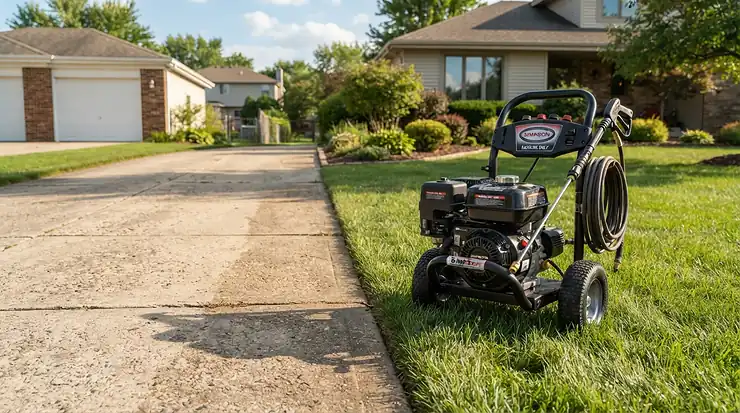
The PSI and GPM combination for driveway cleaning is the pairing of pressure (force per square inch) and water flow (gallons per minute) that lets a pressure washer loosen grime and carry it away efficiently. For most concrete driveways, that means roughly 2,500–3,300 PSI with at least 2.0 GPM.
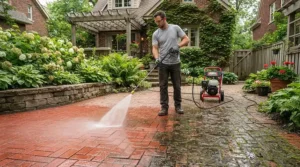
Here’s the dirty little secret of the pressure washer aisle: the giant number on the box is only half the story. PSI is the punch. GPM is the broom that sweeps up after the punch. Get the PSI and GPM combination for driveway cleaning wrong, and you’ll spend a Saturday chasing streaks across a slab that never quite looks finished.
According to the overview of pressure washing, a machine’s flow rate is usually designed into the pump and isn’t adjustable, while pressure can be varied through the unloader valve or specialized nozzle tips. Translation: flow is a fixed personality trait. You have to choose it wisely at checkout.
That’s why this guide leans on real specs, real review patterns, and honest reasoning instead of hype. Below you’ll find seven actual models, from a gas workhorse to a compact electric that hides on a garage shelf. You’ll also get the math behind cleaning units (PSI x GPM), a plain-English lesson in spec label interpretation, and realistic driveway cleaning time estimates. We’ll even sort out pressure washer PSI comparison for common household tasks, so you stop over-buying (or under-buying).
One honesty note before we roll: I haven’t handled these machines myself. Everything here comes from manufacturer specs, aggregated buyer feedback, and comparative analysis. Prices are ranges only and shift constantly, so check current price before you buy.
Quick Comparison Table: 7 Pressure Washers at a Glance
Skimmers, this one’s for you. The figures come from manufacturer listings. Where a label shows both a “max” and a “rated” number, the cleaning units use the more conservative rated pair. (We decode that trick later in the spec label interpretation section.)
| # | Product | Power | Label PSI / GPM | Approx. Cleaning Units | Price Range | Best For |
|---|---|---|---|---|---|---|
| 1 | Westinghouse WPX3400 | Gas | 3,400 / 2.6 | ~8,840 | $330–$380 | Big slabs on a budget |
| 2 | Simpson PowerShot PS3228 | Gas | 3,300 / 2.5 | ~8,250 | $475–$600 | Frequent, heavy-duty use |
| 3 | Simpson Clean Machine 3200 PSI | Gas | 3,200 / 2.4–2.5 | ~7,700–8,000 | $330–$420 | Tight storage, mid-size driveways |
| 4 | Greenworks Pro 3000 PSI | Electric | 3,000 / 1.1 | ~3,300 | $300–$450 | Quiet, low-maintenance upkeep |
| 5 | Westinghouse WPX3000e | Electric | 2,600 rated / 1.1 rated | ~2,860 | $200–$300 | Surface-cleaner pairing |
| 6 | Westinghouse ePX3500 | Electric | 2,000 rated / 1.2 rated | ~2,400 | $150–$200 | Small driveways, easy handling |
| 7 | Sun Joe SPX3000 | Electric | 2,030 max (1,450 working) / 1.76 max | ~2,400 (certified) | $120–$200 | Occasional, budget-first jobs |
Read the table in two passes. First, look at the cleaning units column: the three gas machines cluster around 8,000–8,800, while the four electrics sit between roughly 2,400 and 3,300. That gap isn’t marketing. It’s flow. A gas unit pushing about 2.5 GPM moves more than twice the water of a 1.1 GPM electric, which is why the Westinghouse WPX3400 and Simpson PowerShot PS3228 rinse a slab so much faster.
Second, notice that several electrics carry two sets of numbers. The Westinghouse WPX3000e advertises 3,000 max PSI but only 2,600 rated. Budget buyers should treat the Sun Joe SPX3000 and Westinghouse ePX3500 as honest light-duty tools: fine for a tidy one-car driveway, slower on stained concrete. If you want quiet operation without giving up too much bite, the Greenworks Pro 3000 PSI leans hardest toward gas-style pressure.
💬 Just one click — help others make better buying decisions too!😊
Top 7 Pressure Washers for the Right PSI and GPM Combination: Expert Analysis
Every pick below gets the same treatment: specs translated into real-world meaning, an honest take on who it suits, and a summary of aggregated buyer sentiment. Ratings and prices move, so verify current listings.
1. Westinghouse WPX3400 — most cleaning units per dollar
The headline is math. 3,400 PSI paired with 2.6 GPM works out to roughly 8,840 cleaning units, the highest figure on this list, in a price bracket where rivals usually trim one number or the other. A 212cc four-cycle OHV engine drives a maintenance-free axial cam pump. The kit adds five quick-connect tips (0°, 15°, 25°, 40°, soap), a 25-foot hose, and 12-inch never-flat wheels.
On a driveway, the 2.6 GPM flow is the real hero. It keeps rinse-off moving so loosened grime doesn’t settle back into the concrete pores, while big wheels roll over cracks and lawn edges without drama. Based on the spec comparison, this suits a homeowner with a wide slab, garage space, and zero fear of an oil dipstick. It’s a poorer match if you crave quiet or hate engine upkeep.
Editorial roundups consistently rank it as a value pick among gas units. I couldn’t verify a large independent review sample for this exact model, so read current retailer ratings before buying. Skip the 0° tip on concrete entirely; it’s a paint-stripping laser, not a cleaning tool.
Pros:
- ✅ Highest cleaning units in this lineup
- ✅ 2.6 GPM rinses large slabs quickly
- ✅ Onboard soap tank and five tips included
Cons:
- ❌ Loud, heavy, and needs seasonal engine care
- ❌ Axial cam pump suits homeowner, not daily pro, use
Expect roughly $330–$380; check current price. Verdict: the strongest power-per-dollar deal for large driveways.
2. Simpson PowerShot PS3228 — Honda engine and triplex pump durability
Where the Westinghouse WPX3400 wins on price, this one wins on longevity. A Honda GX200 engine (with low-oil shutdown) feeds an AAA triplex pump with an integrated unloader and thermal relief valve. The result is 3,300 PSI at 2.5 GPM, about 8,250 cleaning units. Add a welded steel frame, 10-inch pneumatic tires, and a 25-foot MorFlex hose.
Why does the pump matter? Triplex plunger pumps are the style contractors favor because they tolerate long sessions better than sealed, budget pump designs. Here’s the analysis: if you wash neighbors’ driveways, clean every season, or plan to keep a machine for a decade, the higher price spreads across many more uses. For a slab washed twice a year, it’s more machine than necessary.
Aggregated retailer feedback leans positive on power and build quality. Complaints cluster around shipping damage, missing accessories, and customer service rather than cleaning performance. Confirm whether you need the 49-state or 50-state version, since availability differs in California.
Pros:
- ✅ Honda GX200 engine with low-oil shutdown
- ✅ Triplex pump built for long sessions
- ✅ Sturdy welded frame and pneumatic tires
Cons:
- ❌ Highest purchase price among the gas picks
- ❌ Pneumatic tires can lose air over time
Roughly $475–$600, so check current price. Verdict: premium value if you’ll actually use that durability.
3. Simpson Clean Machine 3200 PSI — compact gas power that stores easily
The Clean Machine trades a little pressure for a lot of convenience. Depending on the variant, it’s listed at 3,200 PSI and roughly 2.4–2.5 GPM, landing near 7,700–8,000 cleaning units. That variation is a nice example of why spec label interpretation matters: sibling models carry different engines and flow numbers. One variant uses a 196cc Simpson OHV engine with a maintenance-free axial cam pump, thermal relief, 12-inch never-flat wheels, and a fold-down handle.
Interpretation: flow sits only slightly below the Westinghouse WPX3400, so driveway speed is comparable. You’re paying for compact storage rather than pump longevity. It’s the one for townhouse garages and shed corners.
Buyer feedback across the Clean Machine line is generally favorable on power and starting. Recurring complaints involve the stock hose, gun, and wand connections (some buyers reported leaks at joints), and one buyer felt the advertised pressure was optimistic. A little thread tape and a good nozzle set go a long way.
Pros:
- ✅ Fold-down handle makes storage easy
- ✅ Flow close to pricier gas models
- ✅ Never-flat wheels roll over rough concrete
Cons:
- ❌ Stock hose and gun fittings draw complaints
- ❌ Variants differ, so verify engine and GPM
Roughly $330–$420 depending on variant; check current price. Verdict: solid mid-tier gas value if space is your constraint.
4. Greenworks Pro 3000 PSI — brushless electric with gas-style punch
This is the electric that most aggressively borrows gas-washer thinking. A 14-amp TruBrushless motor runs continuously, adjusts to the nozzle in use, and comes with a 25-foot kink-resistant hose and a 35-foot GFCI cord. The warranty is 3 years on the tool and 10 years on the brushless motor.
Now the fine print. 3,000 PSI arrives at about 1.1 GPM. The 2.0 GPM “max” applies at roughly 100 PSI. The honest cleaning-unit figure is around 3,300, not 6,000. Practically, that means excellent bite on oil spots and tire marks but slower rinsing across a big slab. Pair it with a surface cleaner to even things out.
Buyers on a major retailer listing rate it around 4.7 stars across roughly 2,000 ratings, and the figures are PWMA certified. A Forbes roundup notes a few users reported hose longevity concerns, which the warranty helps offset.
Pros:
- ✅ Certified numbers make the label more trustworthy
- ✅ Quiet, with no fuel, oil, or pull cord
- ✅ 10-year brushless motor warranty
Cons:
- ❌ 1.1 GPM slows rinsing on large driveways
- ❌ Some buyers report hose longevity issues
Roughly $300–$450; check current price. Verdict: the best electric for stubborn spots on small-to-mid slabs.
5. Westinghouse WPX3000e — electric built for surface-cleaner pairing
On paper it shouts “3,000 PSI,” but read the small print: 3,000 max PSI with 1.76 max GPM at lowest pressure, and 2,600 rated PSI with 1.1 rated GPM. Rated numbers give roughly 2,860 cleaning units. You also get five nozzles, a 0.45-gallon soap tank, a 25-foot hose, a 35-foot GFCI cord, 10-inch never-flat wheels, M22 accessory fittings, and a 3-year limited warranty.
The Westinghouse WPX3000eM kit adds a 12-inch surface cleaner rated up to 2,500 PSI. That’s just under this washer’s 2,600 rated PSI, so confirm in the manual how the pair is meant to run. Analytically, a surface cleaner is the smartest way to turn a modest 1.1 GPM into an even, streak-free driveway.
An editorial roundup ranks it a top pick under $300, with a rating around 4.7. I couldn’t verify individual review volume, so check the listing.
Pros:
- ✅ Rated PSI stays high at 2,600
- ✅ M22 fittings accept surface cleaners
- ✅ 3-year limited warranty
Cons:
- ❌ 1.1 rated GPM limits rinse speed
- ❌ Corded reach restricts placement flexibility
Roughly $200–$300; check current price. Verdict: the most driveway-capable electric here per dollar.
6. Westinghouse ePX3500 — anti-tipping compact for small driveways
With 2,500 max and 2,000 rated PSI, plus 1.76 max and 1.2 rated GPM, cleaning units land near 2,400. The clever part is physical: a 16.5-inch-tall body, four quick-lock wheels with 360° steering, and 19 pounds of total weight. Add a 25-foot braided hose, a 35-foot GFCI cord, a 20-ounce soap tank, and five tips.
Why care? Electric units love to tip when you tug the hose. This low center of gravity tames that headache, which matters more than an extra 200 PSI when you’re cleaning around parked bikes. It suits a one-car driveway, patio, and cars. Expect several passes on old oil.
A review roundup reports a rating near 4.6 across many thousands of reviews at the time of research, though ratings change. Writers generally praise stability and value, with the recurring caveat that it’s a light-to-medium driveway tool.
Pros:
- ✅ Anti-tipping four-wheel design
- ✅ Light and easy to store
- ✅ Very budget-friendly
Cons:
- ❌ Around 2,400 cleaning units means slower results
- ❌ Modest 1.2 rated GPM demands more passes
Roughly $150–$200; check current price. Verdict: a friendly, low-cost pick for small slabs.
7. Sun Joe SPX3000 — cheapest way in, with fine print
The label reads 2,030 PSI and 1.76 GPM under CSA testing, yet one retailer listing notes that typical working pressure is closer to 1,450 PSI. The manufacturer’s own page lists certified figures of 2,030 PSI and 1.2 GPM. That’s exactly why cleaning units for this machine float anywhere from about 2,000 to 3,500 depending on which number you multiply, another lesson in spec label interpretation.
A 14.5-amp, 1,800-watt motor drives it. You also get dual 0.9-liter detergent tanks, a 34-inch wand, a 20-foot hose, a 35-foot GFCI cord, five tips, and a 2-year warranty. One review site suggests that cleaning a driveway at 1,450 PSI is doable but can eat much of an afternoon.
A major retailer listing shows a rating near 4.6 across roughly 1,800 reviews at the time of research.
Pros:
- ✅ Lowest cost of entry on this list
- ✅ Dual detergent tanks for multi-surface jobs
- ✅ Total Stop System reduces pump wear
Cons:
- ❌ Working pressure sits well below the headline
- ❌ Slow on anything larger than a one-car driveway
Roughly $120–$200; check current price. Verdict: great for cars, patio furniture, and occasional light driveway touch-ups.
Real-World Scenarios: Matching PSI and GPM to Your Driveway
Specs are abstract until you picture your own slab. Here are three profiles, with budget, environment, and frequency baked in.
Scenario 1: The first-time homeowner. A two-car concrete driveway (roughly 500–700 square feet), a $350 budget, and two cleanings a year. The Westinghouse WPX3400 is the logical match: about 8,840 cleaning units, plenty of GPM for fast job completion, and room in the garage. Add a 15-inch surface cleaner and you’ll finish quickly with fewer streaks. The Simpson Clean Machine 3200 PSI is the alternate if storage space is tight.
Scenario 2: The townhouse owner. A one-car driveway, a tight garage, an HOA that frowns on noise, and a once-a-year clean. Here the Westinghouse WPX3000e or Westinghouse ePX3500 makes sense. You give up cleaning units but gain quiet operation, no fuel, and easy storage. Plan for slower passes rather than fighting physics.
Scenario 3: The neighborhood favorite. Someone who cleans three driveways each spring for friends. Long sessions demand pump durability, so the Simpson PowerShot PS3228 with its triplex pump earns its higher price.
If oil stains are your main enemy and quiet matters, the Greenworks Pro 3000 PSI plus a degreaser and dwell time is a smart electric approach. The logic across all four cases is the same: match flow to slab size, then match pressure to stain severity.
Step-by-Step Driveway Cleaning Guide: Setup, Technique, and First-30-Day Mistakes
Amazon listings rarely tell you this part, so here’s a practical workflow.
- Prep the slab. Sweep, move vehicles, and check every hose connection. Confirm your garden hose supply can feed the pump’s GPM; an underfed pump runs poorly, so check the manual.
- Purge air first. Run water through the wand before starting the engine or motor. Never run the pump dry.
- Pretreat oil. Apply degreaser and let it dwell before blasting, since chemistry does the heavy lifting.
- Test first. Try a hidden corner with a 25° or 40° tip. Reserve narrow tips for spot work.
- Work in overlapping lanes. Keep a consistent wand height, or use a surface cleaner for even coverage.
- Direct the wash water. Detergents, oil, and sediment shouldn’t flow into storm drains. This local government guidance explains why and cites the relevant regulations.
- Maintain gas units. Follow the manual for oil changes, spark plug checks, and fuel stabilizer before storage.
Common first-30-day mistakes: using the 0° tip on concrete, standing too close and etching the surface, skipping pretreatment, and ignoring wash-water rules.
Cleaning Units (PSI x GPM): The Math Behind Driveway Power
Cleaning units (PSI x GPM) are the industry’s shorthand for combining force and flow into one comparable number. Multiply the two, and you get a rough measure of total output. It isn’t a lab result, just a useful yardstick.
Why does it matter? Because raw PSI can mislead. Industrial equipment maker Hotsy explains this trade-off: a 3,000 PSI, 4 GPM machine produces 12,000 cleaning units, while a 4,000 PSI, 2 GPM machine produces only 8,000. Higher pressure lost the contest.
Apply that to our list. The Westinghouse WPX3400 delivers about 8,840. The Simpson PowerShot PS3228 delivers about 8,250. By contrast, the Greenworks Pro 3000 PSI lands near 3,300 and the Westinghouse ePX3500 near 2,400. One buyer’s guide suggests 5,000–6,000 cleaning units as a comfortable target for residential concrete. Electrics fall below that, so they work, but slowly.
Two caveats. First, the same total can hide different balances. High pressure with low flow strips spots but rinses slowly, while high flow with moderate pressure finishes faster. Second, standards such as PWMA’s PW101 exist to keep the measurements honest, yet many labels still use inconsistent conditions. That brings us neatly to reading the label itself.
Spec Label Interpretation: Max, Rated, and Working Numbers
Spec label interpretation is a survival skill. Consider what the Westinghouse ePX3500 and Sun Joe SPX3000 listings reveal: “max” PSI is measured at initial discharge under CSA internal testing, and “max” GPM is measured without a nozzle at minimum pressure. Those two numbers never happen together in the real world.
Rated figures reflect steadier operation. That’s why the Westinghouse WPX3000e lists 2,600 rated PSI at 1.1 rated GPM instead of multiplying the flashy 3,000 by 1.76. Always multiply like with like: rated times rated, or certified times certified.
Here’s a quick checklist for decoding any label:
- PWMA certification: independent verification of pressure and flow claims.
- Pump type: axial cam pumps are typically sealed; triplex pumps suit long sessions.
- Hose and fittings: length, diameter, and M22 connections affect accessory compatibility.
- Nozzle set: a tip’s orifice determines the pressure you actually feel.
- Variant codes: 49-state versus 50-state models and different engines can share a name.
If a listing shows only one PSI and one GPM with no qualifiers, treat it as a maximum. Then subtract optimism accordingly.
Pressure Washer PSI Comparison for Common Household Tasks
A pressure washer PSI comparison for common household tasks prevents the classic mistake of using driveway-grade power on your car’s paint. The ranges below are commonly cited planning figures; always check manufacturer guidance for your specific surface.
| Task | Suggested PSI | Suggested GPM | Best For |
|---|---|---|---|
| Car and truck washing | 1,200–1,900 | 1.2–2.0 | Electric units like the Westinghouse ePX3500 |
| Patio furniture and grills | 1,200–1,800 | 1.2–2.0 | The Sun Joe SPX3000 |
| Vinyl siding and fences | 1,500–2,300 | 1.5–2.5 | The Greenworks Pro 3000 PSI |
| Wood decks | 1,000–1,800 | 1.5–2.5 | Electrics with a wide fan tip |
| Concrete driveways | 2,500–3,300 | 2.0–2.6+ | Gas units like the Westinghouse WPX3400 |
The pattern is clear: driveways demand the most of both numbers, while cars and furniture reward finesse. One buyer’s guide warns that pressures much above 4,000 PSI risk etching concrete or asphalt, so more isn’t automatically better. If you own a gas washer, swap to a 25° or 40° tip for gentler jobs. Nozzle choice is your pressure dial.
Pressure Washer GPM for Fast Job Completion
Pressure loosens dirt. Flow carries it away. That’s why pressure washer GPM for fast job completion matters more on wide, flat surfaces than any headline PSI.
The arithmetic is simple. A 2.5 GPM machine moves 150 gallons per hour, while a 1.1 GPM machine moves 66. On a driveway, that difference is measured in Saturday afternoons. Testers commonly report that gas washers run roughly 2.3–2.7 GPM while electrics top out around 1.8–2.0 at realistic performance, and many residential electrics list far less.
Does higher flow waste water? Per minute, yes. Per job, often no, because a faster machine finishes sooner. A 2.5 GPM unit running 30 minutes uses about 75 gallons, while a 1.2 GPM unit running 90 minutes uses roughly 108.
Practical takeaways:
- Choose 2.4+ GPM for slabs larger than a typical two-car driveway.
- Add a surface cleaner to spread flow evenly, which reduces streaking and repeat passes.
- If you’re stuck with an electric at 1.1–1.2 GPM, accept longer sessions and pretreat stains.
The Westinghouse WPX3400 and Simpson PowerShot PS3228 are the fast finishers here for exactly this reason.
Driveway Cleaning Time Estimates: What to Expect in the Real World
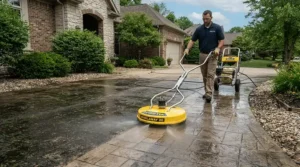
Driveway cleaning time estimates vary wildly with soil level, technique, and attachments. Reviewers report anything from about 25 minutes for a 1,200-square-foot slab using a 3,300 PSI, 2.4 GPM gas unit with a 16-inch surface cleaner, to roughly 45 minutes for a 4,000-square-foot driveway with a heavy-duty gas machine (including pretreatment). One tester says a 3,400 PSI gas unit handles a two-car concrete driveway in 20–30 minutes. Treat these as anecdotes, not lab data.
The table below offers planning estimates, built from those reports and flow-rate logic, per 1,000 square feet.
| Setup | Est. Minutes per 1,000 sq ft | Best For |
|---|---|---|
| Gas (2.5+ GPM) with 15–16″ surface cleaner | 12–25 | Large or heavily stained slabs |
| Gas with wand and 25° tip | 35–60 | Edges, slopes, mixed jobs |
| Electric (1.1–1.8 GPM) with 12″ surface cleaner | 35–70 | Small-to-mid driveways |
| Electric with wand only | 60–120+ | Spot cleaning and touch-ups |
The biggest lever isn’t horsepower. It’s the surface cleaner. Even a modest electric like the Westinghouse WPX3000e improves noticeably when paired with one, though a 1.1 GPM machine will never match a Westinghouse WPX3400 on raw speed. For a typical two-car driveway (often in the neighborhood of 500–700 square feet), expect roughly 10–20 minutes with a gas unit and surface cleaner, or up to an hour or more with an electric.
How to Choose the PSI and GPM Combination for Driveway Cleaning
Follow these steps to choose the PSI and GPM combination for driveway cleaning without overpaying.
- Measure your slab. Multiply length by width. Bigger areas justify higher GPM.
- Grade the grime. Light dust and algae need less pressure than oil, tire marks, and years of buildup.
- Target 2,500–3,300 PSI. That range handles most residential concrete without risking damage.
- Target 2.0+ GPM, or 2.4+ for large slabs. Flow is what makes the job finish quickly.
- Compare cleaning units like for like. Rated against rated, certified against certified.
- Pick your power source. Consider outlet access, noise tolerance, storage space, and willingness to handle fuel.
- Budget for extras. A surface cleaner, a degreaser, and warranty coverage matter as much as the motor.
A quick example: a 600-square-foot concrete driveway with oil spots points toward roughly 3,000+ PSI and 2.4+ GPM, meaning a gas unit like the Simpson Clean Machine 3200 PSI. A one-car driveway with light film? Electric works.
Gas vs Electric vs Traditional Alternatives for Driveways
Gas versus electric is the biggest fork in the road. Testers commonly note that gas machines run louder (often 85–95 dB), weigh 60–80 pounds, and need oil and fuel care, but they deliver higher flow and free you from cords. Electrics are quieter and lighter, with less maintenance.
| Option | Typical Output | Big Advantage | Trade-Off | Best For |
|---|---|---|---|---|
| Gas pressure washer | 2.3–2.7 GPM, 2,700–3,400 PSI | Fastest rinsing, no cord | Loud, heavy, maintenance | Large or stained driveways |
| Corded electric | ~1.1–1.8 GPM typical | Quiet, easy storage | Slower, cord limits | Small slabs, light upkeep |
| Garden hose and stiff brush | Roughly 60 PSI baseline | No machine to buy | Labor-intensive, weak on oil | Tiny areas, spot scrubbing |
| Professional service | Commercial equipment | No storage or upkeep | Recurring cost | Very large or oily slabs |
The gas advantage isn’t bragging rights; it’s the flow that turns hours into minutes. Yet a small electric like the Westinghouse ePX3500 beats a broom and a bucket by a mile for occasional cleaning. If you clean once a year and hate maintenance, electric plus patience is perfectly rational. If you clean seasonally and own a big slab, gas pays you back in weekends.
Safety, Regulations, and Wash Water Compliance
High-pressure water is not a toy. Manufacturer listings warn that the stream can penetrate skin, so never point the wand at people or pets. Wear eye and hearing protection, keep electrical connections dry, and test the GFCI before each use on electric models.
Then there’s the water itself. The EPA’s NPDES stormwater program explains that runoff carries oils, chemicals, and sediment into waterways, which is why many jurisdictions restrict discharges to storm drains. Wash water from a driveway can include degreasers, detergents, and oil.
Practical habits:
- Block or avoid storm drains where regulations apply.
- Direct rinse water toward lawns or gravel when local rules allow.
- Use biodegradable detergents sparingly.
- If nearby siding has old paint, check lead-paint guidance before blasting.
Rules vary by city and county, so a quick look at your local stormwater page is time well spent. Compliance is boring. Fines are worse.
Frequently Asked Questions
❓ Is 2,000 PSI enough for driveway cleaning?
❓ How much water does a driveway pressure washer use?
❓ Is a gas pressure washer worth it for a driveway?
❓ Does a surface cleaner really save time on a driveway?
❓ What is the best pressure washer for a driveway under $400?
Conclusion
The right PSI and GPM combination for driveway cleaning isn’t the biggest number on the box; it’s the balance. Aim for roughly 2,500–3,300 PSI with at least 2.0 GPM, then check the cleaning units (PSI x GPM) using like-for-like figures. Do that, and most of the marketing fog clears.
If you have a big slab and want speed, the Westinghouse WPX3400 is the strongest value, while the Simpson PowerShot PS3228 rewards heavy, frequent use. The Simpson Clean Machine 3200 PSI is the compact gas compromise. For quieter, low-maintenance cleaning, the Greenworks Pro 3000 PSI, Westinghouse WPX3000e, Westinghouse ePX3500, and Sun Joe SPX3000 cover a range of budgets, with realistic expectations about pressure washer GPM for fast job completion and driveway cleaning time estimates.
Remember the household-task lesson, too: a pressure washer PSI comparison for common household tasks keeps you from frying car paint or under-powering a concrete pad. Decode the label, match flow to slab size, add a surface cleaner, and respect wash-water rules. Your driveway, and your weekend, will thank you.
Recommended for You
- Portable Hot Water Pressure Washer For Contractors: 7 Best Picks 2026
- Hot Water Pressure Washer For Commercial Kitchens: 7 Picks For 2026
- Hot Water Pressure Washer For Grease Removal: 7 Best Picks (2026)
Disclaimer: This article contains affiliate links. As an Amazon Associate, I earn from qualifying purchases. If you purchase products through these links, we may earn a small commission at no additional cost to you.
✨ Found this helpful? Share it with your friends! 💬🤗
