
In This Article
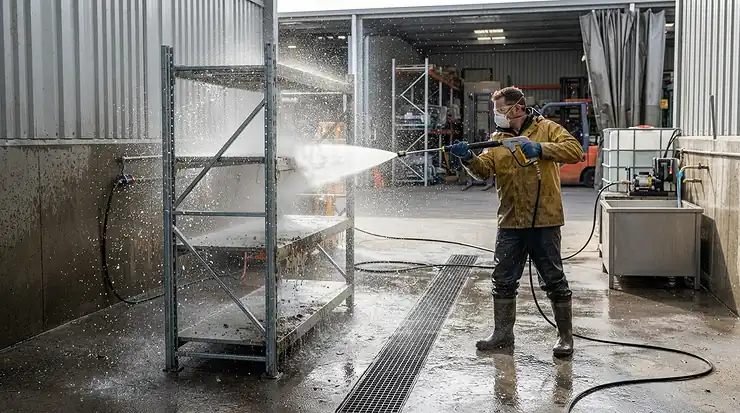
Grease doesn’t negotiate. It clings to hood filters, hardens on tile grout, and turns a once-a-week degreasing chore into a two-hour wrestling match if you let it sit. That’s the whole argument for a hot water pressure washer for commercial kitchens in one sentence: cold water pushes grease around, hot water actually dissolves it.
So what is a hot water pressure washer for commercial kitchens? It’s a heated, high-pressure cleaning machine — powered by electricity, diesel, or gas — that raises water temperature well above ambient before forcing it through a nozzle at 1,500 to 4,000+ PSI, breaking down animal fat, cooking oil, and protein residue faster and with less chemical than a standard cold-water unit.
This matters because kitchens live and die by inspection scores. Under the FDA Food Code, the model that most U.S. health departments adopt in some form, food-contact surfaces need real sanitizing, not just a rinse — and hot water is one of the two accepted paths to get there. A cold hose and a scrub brush might satisfy a homeowner, but they won’t cut through six months of hood grease or convince a health inspector that your floor drains are actually clean.
We dug into seven real machines on the market right now — electric heat-exchanger units built for indoor use, diesel-fired portables built for outdoor hood cleaning, and stationary skid units that live permanently in the back of house. Below you’ll find honest analysis of what each one does well, where it falls short, and which kitchen situation it actually fits — plus the sanitation standards, hood-degreasing tactics, and health code realities that determine whether your investment pays off or just sits in a closet.
Quick Comparison Table
| Model | Power/Fuel | PSI / GPM | Best For |
|---|---|---|---|
| Hotsy 1075SSE | Gas engine, diesel-fired burner | 3,500 PSI / 4.0 GPM | Heavy-duty outdoor degreasing |
| Mi-T-M HAE-3004 | Electric, heat exchanger | 3,000 PSI / 3.9 GPM | Indoor kitchen use, no fumes |
| NorthStar 2750 Electric | Electric motor, diesel burner | 2,750 PSI / 2.5 GPM | Mid-size multi-unit operations |
| Hotsy 965SS | Gas engine, diesel-fired burner | 3,000 PSI / 3.0 GPM | Portable outdoor hood/dumpster pads |
| Mi-T-M HAE-2503 | Electric, heat exchanger | 2,500 PSI / 2.8 GPM | Budget-friendly indoor sanitation |
| Cam Spray 1500SHDE | Electric motor, diesel-fired | 1,500 PSI / 3.0 GPM | Small kitchens, tight budgets |
| Cam Spray 1500STNEF | Electric motor, gas-fired stationary | 1,500 PSI / 3.0 GPM | Permanent wash-station installs |
Look at that spread for a second. The gap between the Cam Spray units at 1,500 PSI and the Hotsy 1075SSE at 3,500 PSI isn’t marketing fluff — it’s the difference between “rinses off yesterday’s spill” and “strips baked-on grease off a hood filter in one pass.” Kitchens doing daily heavy-grease work (fryers, charbroilers, wok stations) should lean toward the higher-PSI, higher-BTU end of this table, while a moderate-volume kitchen running mostly sauté and oven work can get by comfortably with a 1,500-2,500 PSI unit and save real money upfront.
💬 Which one matches your kitchen’s grease load? Keep scrolling — the full breakdown is below.
Top 7 Hot Water Pressure Washers for Commercial Kitchens: Expert Analysis
1. Hotsy 1075SSE — heaviest-duty diesel-fired burner in this lineup
The Hotsy 1075SSE is the machine you reach for when grease has been winning for a while. Powered by a commercial-grade 389cc Honda GX390 engine, it runs 4.0 GPM at 3,500 PSI, with a diesel-fired burner rated at roughly 309,900 BTU/hr — enough thermal output to keep water genuinely hot through a full shift of continuous use, not just a warm trickle for the first ten minutes.
What most buyers overlook about this model is the coil. It’s wrapped in a stainless-steel skin specifically to resist the corrosion that eats cheaper units alive after a year of exposure to grease-laden steam and cleaning chemicals. Pair that with a 7-year pump warranty and a 5-year coil warranty, and you’re looking at a machine built to survive the outdoor, semi-abusive environment where hood and dumpster-pad cleaning actually happens.
Reviewers consistently note that the roll-cage frame and 12-inch flat-free tires make this unit far easier to maneuver across a gravel or uneven loading-dock surface than lighter, cart-style washers — a small detail until you’re the one dragging a 500-pound machine across a parking lot at 6 a.m.
Pros:
- ✅ Diesel-fired burner delivers serious, sustained BTU output
- ✅ Stainless steel coil skin resists long-term corrosion
- ✅ 7-year pump warranty backs heavy daily use
Cons:
- ❌ Gas engine means it can’t be run indoors
- ❌ Heavier and bulkier than electric alternatives
Expect to pay in the $6,000-$8,000 range at the time of research, though prices fluctuate — always check current price before purchase. For a multi-unit restaurant group cleaning hoods, dumpster corrals, and loading docks regularly, this is a strong value against the labor hours it saves.
2. Mi-T-M HAE-3004 — cleanest option for true indoor kitchen use
Here’s the problem every kitchen manager eventually runs into: fuel-fired burners produce exhaust, and exhaust indoors is a non-starter in a food-prep environment. The Mi-T-M HAE-3004 solves that with a patented 72kW heat exchanger instead of a flame — it’s fully electric, delivering 3.9 GPM at 3,000 PSI with a 120-130°F temperature rise achieved in three to five minutes.
On paper this means you get hot-water cleaning power without a single drop of diesel or a whiff of combustion byproduct anywhere near your prep line. That’s a genuinely different value proposition from every diesel unit on this list, and it’s why Mi-T-M markets the HAE series specifically toward food and beverage facilities.
Based on the spec comparison, the trade-off is heat ceiling: a heat exchanger can’t chase the same extreme water temperatures a diesel burner can sustain continuously, so on the very worst baked-on grease jobs, it may take an extra pass. What the spec sheet won’t tell you, but the stainless-steel base and rubber vibration isolators suggest, is that this machine was engineered for a facility that runs it daily, not occasionally.
Pros:
- ✅ Zero combustion exhaust — safe for enclosed kitchen spaces
- ✅ Fast heat-up, 120-130°F rise in under five minutes
- ✅ Stainless base resists kitchen humidity and corrosion
Cons:
- ❌ Higher upfront cost than fuel-fired alternatives
- ❌ Requires a dedicated high-amperage electrical circuit
Pricing sits in the $5,500-$7,000 range at the time of research. For kitchens without outdoor access to a wash bay, this is arguably the most defensible purchase on the list.
3. NorthStar 2750 Electric Wet Steam & Hot Water Pressure Washer — the fuel-efficient middle ground
The NorthStar 2750 Electric splits the difference between the fully electric heat-exchanger units and the raw-power diesel machines. It runs an electric motor for pressure generation paired with a diesel-fired downdraft burner for heat, hitting 2,750 PSI at 2.5 GPM with water temperatures up to 250°F in wet-steam mode.
Here’s what most spec sheets bury: the downdraft burner design is claimed to deliver up to 35% better fuel efficiency than the older updraft burners still found on plenty of competing machines. If you’re running this daily across multiple kitchen locations, that efficiency compounds into real fuel-cost savings over a year — not a rounding error.
Reviewers consistently mention the CAT 4DNX pump’s durability and the “total start/stop” trigger technology, which shuts the pump down the instant you release the gun rather than idling. That’s a small mechanical detail with an outsized impact on component wear over thousands of duty cycles.
Pros:
- ✅ Downdraft burner claims up to 35% better fuel efficiency
- ✅ Total start/stop reduces pump wear between uses
- ✅ 250°F wet steam mode tackles stubborn grease deposits
Cons:
- ❌ Still requires diesel fuel for the burner
- ❌ Lower flow rate (2.5 GPM) than heavier-duty units
At around $3,500-$4,500 at the time of research, this lands as a genuinely good value for a mid-volume kitchen or a facility maintenance team covering more than one location.
4. Hotsy 965SS — the portable workhorse for hood and dumpster-pad duty
The Hotsy 965SS is the compact sibling of the 1075SSE, built around a 270cc Honda GX engine, delivering 3.0 GPM at 3,000 PSI with a fuel-oil-fired burner rated near 248,000 BTU/hr. A heavy-duty regulator rectifier eliminates the need for a separate battery — a detail that matters when your equipment sits outside and batteries have a way of dying at the worst possible moment.
Based on the spec comparison against its bigger sibling, you’re trading roughly 500 PSI and 1 GPM for a noticeably lighter, more compact footprint — a fair swap for kitchens that need a portable degreasing unit to wheel between the hood, the dumpster corral, and the delivery dock rather than a stationary heavy hitter.
What reviewers note most often is reliability over raw power: this is the machine that starts every time, even after sitting unused for a few weeks between deep-cleaning cycles, which matters more to a facilities team than an extra few hundred PSI they rarely need.
Pros:
- ✅ No battery required thanks to the regulator rectifier
- ✅ Compact footprint fits tight loading-dock storage
- ✅ Diesel/kerosene-fired burner handles heavy grease loads
Cons:
- ❌ Lower pressure than the 1075SSE for the toughest jobs
- ❌ Gas engine restricts use to outdoor areas only
Expect a price in the $4,500-$5,500 range at the time of research — solid mid-tier value for restaurant groups handling their own periodic exterior degreasing.
5. Mi-T-M HAE-2503 — the accessible entry into fume-free hot water
Not every kitchen needs 3,000+ PSI. The Mi-T-M HAE-2503 delivers 2.8 GPM at 2,500 PSI through the same patented heat-exchanger technology as its bigger sibling, powered by a 6 hp electric motor instead of the HAE-3004’s 8 hp.
What most buyers overlook here is that 2,500 PSI is still plenty for daily floor, mat, and wall degreasing in a moderate-volume kitchen — you don’t need to overbuy pressure you’ll never use just to get the fume-free benefit. The trade-off is a slightly longer heat-up window and a lower flow rate, meaning larger areas take marginally longer to rinse.
Reviewers consistently point to the same stainless-steel frame and thermal-relief-valve protection found across the HAE line, suggesting Mi-T-M didn’t cut corners on build quality just because this is the entry model.
Pros:
- ✅ Lower cost entry point into fume-free electric hot water
- ✅ Same corrosion-resistant stainless frame as the HAE-3004
- ✅ Adjustable thermostat for precise temperature control
Cons:
- ❌ Lower GPM means slower rinse-down on large floor areas
- ❌ 6 hp motor needs a dedicated circuit like its sibling
Pricing typically falls in the $4,200-$5,200 range at the time of research, making this a smart middle-tier pick for kitchens that want indoor-safe hot water without the top-tier price tag.
6. Cam Spray 1500SHDE — the budget-friendly diesel-fired portable
The Cam Spray 1500SHDE delivers 1,500 PSI at 3.0 GPM through a diesel-fired heating system paired with a 3 hp electric motor and an industrial triplex plunger pump with ceramic plungers. It’s built for exactly the situation its name suggests: a “back-of-house” cleaning task that needs real heat but not extreme pressure.
On paper this means a smaller kitchen — a food truck commissary, a single-location café, a small catering operation — gets access to genuine hot-water degreasing without the price tag of a 3,000+ PSI industrial unit. What the spec sheet won’t tell you is how much that lower pressure matters for delicate surfaces: stainless equipment and softer tile grout can actually benefit from a gentler PSI that still gets real heat-driven grease removal.
Reviewers note the two 13-inch wheels and built-in hose-and-wand holder make it genuinely easy for one person to move and store between uses, which matters a lot in a kitchen with limited back-of-house square footage.
Pros:
- ✅ Lowest price point of the diesel-fired units here
- ✅ Compact, easy for one person to store and move
- ✅ Ceramic-plunger pump built for daily commercial use
Cons:
- ❌ 1,500 PSI won’t cut through the heaviest baked-on grease
- ❌ Still requires diesel fuel and outdoor/vented operation
At roughly $2,000-$2,800 at the time of research, this is the most accessible diesel-heated pressure washer for industrial cleaning tasks in a small food-service footprint.
7. Cam Spray 1500STNEF — the permanent stationary wash station
The Cam Spray 1500STNEF takes a different approach entirely: it’s a stationary, natural-gas-fired unit meant to be permanently plumbed into a facility’s gas line rather than wheeled around. It produces 1,500 PSI at 3.0 GPM through a 3 hp motor, with forced-air burner technology for efficient, consistent heat.
Based on the spec comparison against the portable Cam Spray unit, you’re trading mobility for permanence and, often, lower long-term fuel cost, since natural gas typically runs cheaper per BTU than diesel in most U.S. markets. What most buyers overlook is the installation requirement — this unit needs a 1-inch gas line and proper venting from an HVAC professional if installed indoors, which adds setup cost the sticker price doesn’t reflect.
Reviewers consistently frame this as the “set it and forget it” option for kitchens that clean the same wash-down area daily and never need to relocate the machine — a permanent utility rather than a piece of equipment you store away.
Pros:
- ✅ Lower long-term fuel cost via natural gas connection
- ✅ Skid frame built for permanent, rugged installation
- ✅ Low-pressure chemical injection for concentrated detergents
Cons:
- ❌ Requires professional gas-line installation and venting
- ❌ Not portable — locked into one wash-down location
Expect a price around $2,200-$3,000 at the time of research, plus installation costs. This is the pick for a kitchen that has a dedicated wash-down bay and wants a fixture, not a tool to store.
Diesel-Heated Pressure Washer for Industrial Cleaning: When Fuel-Fired Beats Electric
Not every kitchen has 200 amps of spare electrical capacity sitting around for a heat exchanger. That’s the practical reason a diesel-heated pressure washer for industrial cleaning still dominates in outdoor and heavy-grease applications: diesel burners generate BTU output largely independent of your electrical panel’s limits, and they hold that heat output steady through hours of continuous operation in a way some electric units struggle to match.
The trade-off is exhaust. A diesel-fired burner produces combustion byproducts, which is exactly why every diesel unit on our list — the Hotsy 1075SSE, the Hotsy 965SS, the NorthStar 2750 Electric, and the Cam Spray 1500SHDE — is designed for outdoor or well-ventilated use, not the middle of a working kitchen line. Electric heat-exchanger units like the Mi-T-M HAE-3004 and HAE-2503 exist precisely to fill that indoor gap.
The honest answer to “which is better” is: it depends on where the grease actually lives. If your worst buildup is on the exterior hood, the dumpster pad, or the loading dock, diesel wins on raw thermal output and cost per BTU. If it’s your prep-room floor or interior equipment, fume-free electric is the only responsible choice.
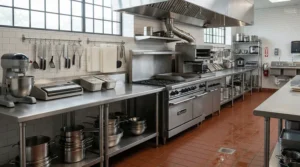
Commercial Kitchen Sanitation Standards for Cleaning Equipment
Commercial kitchen sanitation standards for cleaning equipment aren’t optional guidelines — they’re what your local health inspector checks against on every visit. The FDA Food Code, adopted in some form by the large majority of U.S. states, sets the baseline: food-contact surfaces must be sanitized, and hot water sanitizing typically requires reaching roughly 171°F at the surface, held long enough to actually reduce microbial load, not just rinse it away.
That standard matters directly to your equipment choice. A unit that tops out around 140-150°F might make surfaces look clean while falling short of the temperature threshold inspectors and food-safety trainers reference for true sanitizing. Every hot water pressure washer for commercial kitchens on our list can exceed that range, but heat-up time, sustained BTU output, and nozzle distance all affect whether that temperature actually reaches the surface being cleaned — not just the water leaving the wand.
Beyond temperature, sanitation standards also govern frequency: food-contact surfaces used with high-risk foods need cleaning as often as every four hours, while broader equipment and floor sanitation typically follows a daily or weekly schedule depending on cooking volume.
How to Choose a Hot Water Pressure Washer for Commercial Kitchens
- Match power source to location. If the machine will run indoors near food prep, electric heat-exchanger units are the only fume-free option.
- Size PSI and GPM to your grease load. Light sauté kitchens can run 1,500-2,500 PSI comfortably; charbroil and fryer-heavy operations need 3,000+ PSI.
- Check BTU output, not just PSI. A high-pressure machine with weak heat output won’t dissolve grease any faster than cold water.
- Confirm your electrical or gas infrastructure first. An 8 hp electric heat exchanger needs real amperage; a stationary gas unit needs a proper line and venting.
- Weigh portability against permanence. A wheeled unit serves multiple wash areas; a stationary skid unit serves one area extremely well.
- Factor in warranty length on the pump and coil. These are the two components that fail first under heavy commercial use.
- Price the true cost, not just the sticker. Installation, fuel, and detergent compatibility all shift total cost of ownership.
Food-Service Sanitation: What to Expect From Real-World Performance
Spec sheets promise a lot. Real kitchens are messier, hotter, and busier than any test bench, so it helps to know what food-service sanitation actually looks like day to day once one of these machines is in rotation.
Expect the first pass on baked-on hood grease to look dramatic — steam rolling off the surface as months of buildup starts to soften and lift. What reviewers consistently report is that a second, shorter pass is often needed on the worst spots; hot water dissolves grease efficiently, but it doesn’t teleport it away instantly the way marketing footage sometimes implies. Floor and drain areas typically clean faster than vertical hood surfaces, simply because gravity is doing some of the work for you.
On the maintenance side, expect burner components — nozzles, fuel filters, ignition parts — to need periodic attention on any diesel or gas-fired unit, roughly in line with how often you run it. Electric heat-exchanger units trade that maintenance profile for electrical-system reliability instead; there’s no burner to service, but there is a heating element and thermostat that eventually need checking.
Hood and Floor Degreasing: A Practical Usage Guide
Hood and floor degreasing is where most of these machines earn their keep, and doing it right takes more than pointing a wand and pulling the trigger.
Before you start: Clear loose debris and food scraps first — pressure-washing directly onto solid food waste just relocates the mess rather than removing it. Pre-treat especially heavy grease zones with a degreasing detergent through the machine’s chemical injector and let it dwell for two to three minutes before rinsing.
During the pass: Work top to bottom on hoods so runoff carries grease downward into a collection area rather than re-depositing it on surfaces you’ve already cleaned. On floors, work from the far corner toward the drain, keeping the nozzle 12-18 inches from the surface for most grease work — closer for stubborn spots, farther for delicate stainless.
Common first-30-days mistakes: New operators often run the pressure too high on grout lines, which erodes sealant faster than it should. Others skip the pre-treatment dwell time entirely, forcing multiple passes that waste fuel and time. According to fire-safety guidance under NFPA 96, the U.S. standard for ventilation control and fire protection in commercial cooking operations, hood and duct interiors need cleaning on a schedule tied directly to cooking volume — monthly for high-volume solid-fuel or wok operations, quarterly for standard restaurant volume — and a hot water pressure washer is the primary tool that makes hitting that schedule realistic in-house rather than outsourcing every cleaning to a specialty crew.
Maintenance schedule: Flush the detergent injector weekly to prevent clogging, check burner fuel filters monthly on diesel and gas units, and drain the pump before any extended storage period to prevent internal corrosion.
Health Code Compliance Scenarios: Matching the Machine to Your Kitchen
Health code compliance looks different depending on what kind of operation you’re running, so here are three realistic scenarios.
The single-location café, moderate volume, tight budget: A café running mostly sandwich prep and light sauté work doesn’t need 3,500 PSI. The Cam Spray 1500SHDE or Mi-T-M HAE-2503 covers daily floor and equipment sanitation without overspending on pressure that never gets used.
The multi-unit restaurant group with an outdoor wash bay: Groups managing several locations benefit from a fuel-efficient, higher-output machine like the NorthStar 2750 Electric or Hotsy 965SS — enough BTU to handle hood grease and dumpster-pad degreasing across sites without excessive fuel spend per location.
The high-volume kitchen with strict indoor sanitation needs: A hospital cafeteria or large catering commissary, where indoor air quality restrictions rule out combustion exhaust entirely, is the exact use case the Mi-T-M HAE-3004 was built for — full hot-water performance with zero fumes near food prep.
Health inspectors in every state reference some version of consistent cleaning and sanitizing procedures that apply regardless of kitchen size, so matching your equipment to your actual volume and layout — not just your budget — is what keeps every scenario above passing inspection consistently.
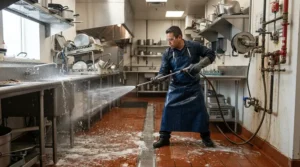
Common Mistakes When Buying a Commercial Hot Water Pressure Washer
The single most common mistake is buying on PSI alone and ignoring GPM — flow rate is what actually rinses debris away efficiently, and a high-PSI, low-GPM machine can leave you scrubbing longer than a balanced unit would. A close second is skipping the electrical or gas infrastructure check before purchase; more than one kitchen has bought an 8 hp electric unit only to discover their panel can’t support it without an upgrade.
Buyers also frequently underestimate burner maintenance on diesel and gas units, treating them like a set-it-and-forget-it appliance rather than equipment with fuel filters and ignition components that need periodic attention. And plenty skip verifying indoor-safe operation entirely, running a combustion-heated machine somewhere ventilation can’t keep up — a genuine safety and air-quality problem, not just an inspection risk.
Long-Term Cost & Maintenance: Total Cost of Ownership
| Cost Factor | Diesel/Gas Units | Electric Heat-Exchanger Units |
|---|---|---|
| Upfront price | Moderate to high | Moderate to high |
| Fuel/energy cost | Diesel or natural gas pricing | Electricity, dedicated circuit needed |
| Maintenance | Burner, nozzle, fuel filter service | Heating element, thermostat checks |
| Indoor use | Not recommended | Fully safe |
| Best For | Outdoor, high-BTU heavy grease | Indoor, fume-free sanitation |
Looking at the table, the honest takeaway is that neither fuel type is categorically cheaper over a machine’s lifespan — it depends on local fuel and electricity rates plus how often the unit runs. A kitchen running daily hood cleanups in a region with cheap diesel may find fuel-fired units win on ongoing cost, while a facility with expensive fuel but reasonable electricity rates often comes out ahead with an electric heat exchanger. Either way, factor pump and coil warranty length into total cost, since replacing either component early erases whatever you saved on the sticker price.
Features That Actually Matter (And Those That Don’t)
BTU output and pump warranty length actually matter — they determine whether the machine keeps performing at year three the way it did on day one. A stainless steel frame matters too, given how much moisture and chemical exposure this equipment sits in daily.
What matters less than marketing suggests: max PSI numbers north of what your kitchen will ever realistically need. An extra 500 PSI you never use isn’t adding value, it’s adding cost and, on delicate surfaces, risk of damage. Similarly, flashy digital displays and app connectivity look appealing in a showroom but rarely change day-to-day cleaning outcomes in a back-of-house environment where the machine gets used by rotating staff, not a dedicated technician.
Buyer’s Decision Framework
If your kitchen cooks primarily indoors with limited ventilation, choose an electric heat-exchanger unit because combustion exhaust isn’t an option near food prep.
If your heaviest grease lives outdoors — hoods, dumpster pads, loading docks — choose a diesel or gas-fired portable because sustained BTU output at a lower fuel cost per unit of heat matters more there than indoor safety concerns.
If you’re running one fixed wash-down station daily, choose a stationary natural-gas unit for lower long-term fuel cost and simpler plumbing.
If your budget is the primary constraint, start with a 1,500-2,000 PSI unit and scale up only if your actual grease load proves it’s insufficient — buying more pressure than you need rarely pays for itself.
FAQ
❓ What temperature does a hot water pressure washer need to reach for sanitizing?
❓ Can I use a diesel-heated pressure washer inside my kitchen?
❓ How often does NFPA 96 require hood cleaning?
❓ Do I need a chemical detergent with a hot water pressure washer?
❓ What PSI is enough for a small commercial kitchen?
Conclusion
There’s no single “best” hot water pressure washer for commercial kitchens — there’s only the best match for your specific grease load, your ventilation situation, and your budget. A single-location café doesn’t need the same machine as a hospital commissary running three shifts a day, and buying past your actual needs just burns cash on capacity you’ll never use.
What every kitchen shares, regardless of size, is the same underlying pressure: health inspectors expect real sanitizing, not a rinse that looks clean. Cold water alone increasingly can’t deliver that on grease-heavy surfaces, which is exactly why hot water equipment has moved from “nice to have” to standard back-of-house infrastructure across food service.
Whether you land on a fume-free electric heat exchanger for indoor peace of mind or a diesel-fired portable for raw outdoor cleaning power, the seven machines above represent real, currently available options across every price point we could find. Match the spec sheet to your actual kitchen, not the other way around, and the equipment will pay for itself in labor hours and inspection scores long before the warranty runs out.
Recommended for You
- Hot Water Pressure Washer For Grease Removal: 7 Best Picks (2026)
- Foam Cannon For Car Detailing Pressure Washers: 7 Best Picks (2026)
- Surface Cleaner Attachment For Driveway Pressure Washing: 7 Picks (2026)
Disclaimer: This article contains affiliate links. As an Amazon Associate, I earn from qualifying purchases. If you purchase products through these links, we may earn a small commission at no additional cost to you.
✨ Found this helpful? Share it with your friends! 💬🤗
