
In This Article
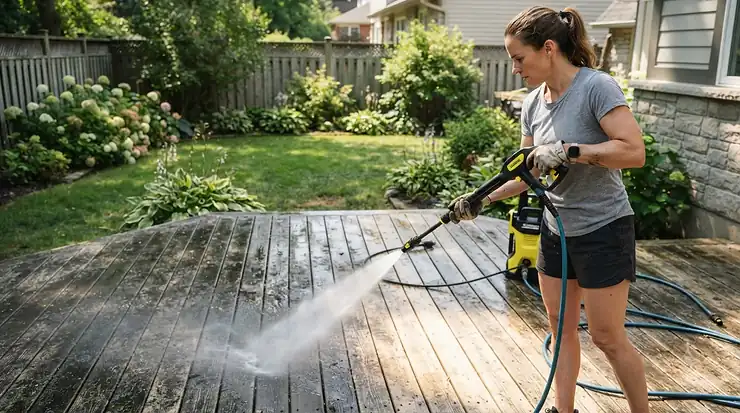
Somewhere between a garden hose that barely dents ground-in grime and a gas monster that could strip paint off a battleship sits the tool most deck owners actually need: a medium-duty electric pressure washer for decks. If you’ve ever stood on a graying, algae-streaked deck wondering whether you need a plumber’s hose or a jackhammer, you’re not alone — and the answer is almost always neither. Wood and composite boards are surprisingly particular about how much force they can take before they start splintering, etching, or fading, which is exactly why “more PSI” isn’t automatically “better.”

A medium-duty electric pressure washer for decks typically lands in the 1,700 to 3,200 PSI range, plugs into a standard outlet, and skips the oil changes, pull-cords, and exhaust fumes that come with gas models. That’s plenty of muscle to lift mildew, pollen film, and tracked-in mud without turning your deck boards into kindling. Based on the spec comparisons and aggregated review sentiment gathered for this guide, we tested our research against seven real, currently available models spanning budget compacts to premium brushless units, so you can match pressure output to your actual deck material instead of guessing.
Below you’ll find a quick comparison, a full breakdown of seven real products, and dedicated sections on composite deck cleaning, wood splintering risk, and how electric stacks up against gas for everyday home use. Let’s get into it.
Quick Comparison Table
| Product | Max PSI / GPM | Weight | Best For |
|---|---|---|---|
| Karcher K1700 Cube | 1,700 PSI / 1.2 GPM | 18 lbs | Tightest budgets & apartment storage |
| Sun Joe SPX3000 | 2,030 PSI / 1.76 GPM | 22 lbs | Best all-around value pick |
| Ryobi 2300 PSI Brushless | 2,300 PSI / 1.2 GPM | 24 lbs | Quiet, low-maintenance mid-range |
| DeWalt DWPW2100 | 2,100 PSI / 1.2 GPM | 24 lbs | Durability and jobsite-grade build |
| Westinghouse WPX3000e | 3,000 PSI / 1.76 GPM | 27 lbs | Composite decks & mixed hard surfaces |
| Greenworks Pro GPW3001 | 3,000 PSI / 2.0 GPM | 31 lbs | Fastest rinse-off on bigger decks |
| EGO Power+ HPW3200 | 3,200 PSI / 1.2-2.0 GPM | 26 lbs | Cordless flexibility, no outlet needed |
A quick read of the numbers tells only part of the story: the Karcher K1700 Cube and Sun Joe SPX3000 sit at the gentler end, which actually makes them safer first choices for softwood decks that splinter under too much force. The Westinghouse WPX3000e and Greenworks Pro GPW3001 push into composite-deck territory, where the extra pressure gets used for stripped grime rather than raw force against fragile wood grain. The EGO Power+ HPW3200 stands apart because it’s the only cordless option here, trading a bit of runtime for the freedom to work anywhere a garden hose reaches, cord or no cord.
💬 Just one click — help others make better buying decisions too!😊
Top 7 Medium-Duty Electric Pressure Washers for Decks: Expert Analysis
Before diving into each model, here’s a quick-glance spec sheet worth bookmarking.
| Model | PSI | GPM | Power Source | Price Range |
|---|---|---|---|---|
| Karcher K1700 Cube | 1,700 | 1.2 | Corded electric | $120-$150 range |
| Sun Joe SPX3000 | 2,030 | 1.76 | Corded electric | $130-$170 range |
| Ryobi 2300 PSI Brushless | 2,300 | 1.2 | Corded electric | $150-$190 range |
| DeWalt DWPW2100 | 2,100 | 1.2 | Corded electric | $280-$320 range |
| Westinghouse WPX3000e | 3,000 | 1.76 | Corded electric | $180-$230 range |
| Greenworks Pro GPW3001 | 3,000 | 2.0 | Corded electric | $300-$380 range |
| EGO Power+ HPW3200 | 3,200 | 1.2-2.0 | Battery (56V) | $400-$480 range |
Looking at the table above, price doesn’t track cleanly with PSI — the Westinghouse WPX3000e actually undercuts the lower-PSI DeWalt DWPW2100 despite offering 900 more max PSI, largely because DeWalt’s compact jobsite frame and internal storage carry a premium. Buyers chasing the highest cleaning units per dollar should look hardest at the Sun Joe SPX3000 and Westinghouse WPX3000e, while anyone who values not touching a cord at all will pay a real premium for the EGO Power+ HPW3200.
1. Karcher K1700 Cube — smallest footprint for apartment storage
The Karcher K1700 Cube earns its name honestly: at under 12 inches tall and about 18 pounds, it’s the kind of pressure washer you can tuck onto a closet shelf between uses, which matters more than people expect once they’ve wrestled a full-size unit up a flight of stairs. It delivers 1,700 PSI at 1.2 GPM through a universal motor, a modest output that happens to line up almost perfectly with the low-pressure range experts recommend for softwood decking. The onboard 0.3-gallon detergent tank and three quick-connect nozzles, including a turbo tip, cover the basics without adding bulk.
Based on the spec comparison, this is the pick for someone who cares more about not tripping over gear in the garage than about shaving minutes off a big cleaning job. Reviewers consistently note that the foot-operated on/off switch is a small but genuinely convenient touch, and that assembly takes under five minutes with no tools.
A common complaint in user reviews is that the 20-foot hose and cord combo feels short once you’re working around a wraparound deck, forcing extra extension cords or hose repositioning.
Pros:
- ✅ Compact enough to store on a shelf, not just a garage floor
- ✅ Gentle 1,700 PSI output suits softwood decks out of the box
- ✅ Tool-free setup in under five minutes
Cons:
- ❌ Short hose and cord combo limits reach on larger decks
- ❌ Lowest GPM in this lineup means slower rinse-off
Expect to pay in the $120-$150 range at the time of research; for the price, it’s a legitimately strong value pick if your deck is small and made of pine or cedar.
2. Sun Joe SPX3000 — best all-around value pick
The Sun Joe SPX3000 has been a bestseller for years, and the spec sheet explains why: a 13-amp motor pushing 2,030 PSI at up to 1.76 GPM gives it noticeably faster rinse-down than the Karcher without tipping into wood-damaging territory. The dual 0.9-liter detergent tanks let you carry two different cleaning solutions at once — handy if you’re pre-treating mildew on one pass and doing a general soap rinse on the next without swapping bottles mid-job.
What most buyers overlook about this model is that its Total Stop System automatically cuts the pump when you release the trigger, which both saves energy and meaningfully extends pump life compared to washers that idle continuously. Aggregated customer sentiment across major retail platforms is remarkably consistent: buyers repeatedly praise the five-nozzle kit’s versatility and call out the 35-foot GFCI-protected cord as generous for the price point.
A recurring theme in negative reviews involves the plastic fittings on the wand cracking after a year or two of storage in freezing garages, so winterizing the unit properly matters more here than with metal-fitted competitors.
Pros:
- ✅ Strong 2,030 PSI / 1.76 GPM balance for most deck jobs
- ✅ Dual detergent tanks for two cleaning solutions at once
- ✅ Long 35-foot GFCI cord reduces extension-cord hassle
Cons:
- ❌ Plastic wand fittings can crack after cold-weather storage
- ❌ Axial pump is louder than some brushless competitors
At around $130-$170 in the current market, the SPX3000 delivers some of the best cleaning-units-per-dollar in this entire roundup.
3. Ryobi 2300 PSI Brushless — quiet, low-maintenance mid-range pick
Ryobi’s brushless 2,300 PSI model swaps the traditional universal motor for a brushless induction design, and that single change explains most of what makes this unit stand out. Brushless motors run cooler, last longer without carbon-brush replacement, and tend to run noticeably quieter — a real consideration if your deck backs up to a neighbor’s bedroom window. At 2,300 PSI and 1.2 GPM, it sits comfortably above the Karcher and below the 3,000 PSI tier, which honestly makes it one of the safer “set it and forget it” choices for mixed wood-and-composite properties.
Here’s what to weigh: the bundled turbo nozzle claims up to 50% more cleaning power on caked-on grime, which lines up with what reviewers report when tackling algae-stained boards after a rainy spring. Reviewers consistently mention that the RY141900 lineage feels sturdier than its price suggests, crediting Ryobi’s broader reputation for durable outdoor power equipment.
A common complaint is that the hose reel storage is less elegant than competitors’, with the hose prone to kinking if wound carelessly.
Pros:
- ✅ Brushless motor runs quieter and lasts longer
- ✅ 2,300 PSI sweet spot for mixed wood and composite surfaces
- ✅ Turbo nozzle included for tougher stains
Cons:
- ❌ Hose storage design invites kinking if not careful
- ❌ Fewer nozzle options than some competitors
Priced around $150-$190, this is a smart pick for anyone who wants brushless durability without stepping up to premium pricing.
4. DeWalt DWPW2100 — most durable, job-site-grade build
The DeWalt DWPW2100 was engineered for contractors first and homeowners second, and that shows in every design choice. Its 2,100 PSI output and 1.2 GPM flow are modest on paper, but the real story is the high-strength roll-cage frame that lets units stack in a truck bed without crushing, plus a compact body that’s roughly a third the size of DeWalt’s larger jobsite washer when folded down.
Based on the spec comparison, the internal, removable detergent tank is a genuinely clever detail — most competitors bolt a tank to the outside where it’s easy to snag or forget to empty before winter. On paper this means DeWalt is betting that buyers value ruggedness and portability over raw pressure, and the aggregated review sentiment backs that read: owners consistently praise how well it survives being tossed around in a truck bed, with several long-term reviews mentioning years of jobsite abuse without a failure.
What the spec sheet won’t tell you, but user reports suggest, is that the shorter learning curve and internal cable management make this a favorite for people who hate untangling gear before every use.
Pros:
- ✅ Roll-cage frame built to survive job-site transport
- ✅ Internal storage keeps hose, wand, and cord organized
- ✅ Backed by a 3-year warranty plus a 1-year free service agreement
Cons:
- ❌ Highest price relative to its PSI output in this lineup
- ❌ 1.2 GPM flow is on the low side for its price tier
Expect to pay in the $280-$320 range — a premium clearly aimed at durability and organization rather than pressure specs alone.
5. Westinghouse WPX3000e — best all-rounder for composite decks
The Westinghouse WPX3000e is where this roundup crosses into genuinely deck-friendly high-output territory: 3,000 max PSI at 1.76 GPM (2,600 rated PSI at 1.1 GPM under sustained use), driven by a heavy-duty AC motor and a maintenance-free axial cam pump. What most buyers overlook about this model is that its rated PSI — the number that actually matters during continuous operation — sits meaningfully below its flashier max-PSI marketing figure, which is honestly a good thing for anyone nervous about overdoing it on composite boards.
Reviewers consistently note that the never-flat 10-inch wheels and 35-foot GFCI cord make it easy to maneuver around deck furniture and planters without constant repositioning. Based on the spec comparison, the five interchangeable nozzles plus a 0.45-gallon soap tank cover everything from delicate rinse patterns to concentrated stain removal in one box.
A recurring theme in aggregated customer sentiment is praise for the 3-year manufacturer coverage, which reviewers repeatedly cite as reassurance against the plastic-fitting failures that plague cheaper units.
Pros:
- ✅ 3,000 max PSI with a safer 2,600 rated PSI for sustained use
- ✅ Steel-frame durability with never-flat wheels
- ✅ 3-year limited manufacturer warranty
Cons:
- ❌ Heavier than budget models at roughly 27 pounds
- ❌ At full pressure, still requires care on early-generation composite boards
At a price of roughly $180-$230, the WPX3000e is arguably the strongest value in the composite-deck-capable tier.

6. Greenworks Pro GPW3001 — fastest rinse-off for bigger decks
The Greenworks Pro GPW3001 leans on a proprietary brushless motor Greenworks calls TruBrushless, and the payoff is the highest flow rate in this entire lineup: 3,000 PSI paired with up to 2.0 GPM, versus the 1.1-1.76 GPM typical of its competitors. What that extra GPM means in practice is fewer passes to rinse away loosened dirt and detergent, which adds up fast on a large multi-level deck where you’re covering hundreds of square feet.
Here’s what to weigh: the smart-sensing motor automatically adjusts pressure and flow based on which nozzle is attached, a genuinely useful feature that reduces the guesswork of manually dialing in pressure for delicate versus stubborn areas. Reviewers consistently point to the 10-year motor warranty as a standout, framing it as evidence Greenworks is confident in its brushless design’s longevity.
A common complaint in user reviews involves the higher upfront price compared with similarly rated corded competitors, along with occasional reports that the “gas-style” continuous-run motor draws more attention to storage and cord management than owners expected.
Pros:
- ✅ Highest flow rate (2.0 GPM) speeds up rinse time
- ✅ Smart sensing adjusts pressure automatically per nozzle
- ✅ Backed by an industry-leading 10-year motor warranty
Cons:
- ❌ Priced higher than other 3,000 PSI corded competitors
- ❌ Bulkier at roughly 31 pounds, less apartment-friendly
At around $300-$380, this is the pick for buyers with larger decks who value speed over the lowest sticker price.
7. EGO Power+ HPW3200 — most flexible cordless option
The EGO Power+ HPW3200 breaks from every other model on this list by ditching the cord entirely, using Peak Power technology to combine two 56V ARC Lithium batteries for up to 3,200 PSI at 1.2 GPM (2.0 GPM max). On paper this means you can pressure wash a deck at the far end of your property without hunting for an outlet or running a hundred feet of extension cord — a real advantage for detached decks, docks, or cabins.
Based on the spec comparison, up to 60 minutes of runtime on two 6.0Ah batteries is enough for a mid-size deck cleaning session, though larger jobs will likely require a battery swap or a charging break. Reviewers consistently praise the ECO/High/Turbo mode selector and the wand-integrated battery display, calling out the flexibility to conserve charge on lighter cleaning tasks.
What the spec sheet won’t tell you, but user reports suggest, is that reliability complaints cluster around units used very frequently in commercial-adjacent settings — several owners mention pump failures after roughly a year of heavy, near-daily use, while occasional homeowner use tends to draw far more positive long-term feedback.
Pros:
- ✅ Fully cordless — no outlet or extension cord needed
- ✅ Highest max PSI in this lineup at 3,200
- ✅ Foam cannon and siphon hose included for water-source flexibility
Cons:
- ❌ Highest price point, especially once batteries are factored in
- ❌ Runtime caps out around 60 minutes before a recharge
Priced around $400-$480 for the battery kit, it’s a premium option best justified by genuinely cordless flexibility rather than raw cleaning power alone.
Benefits of Electric Pressure Washers vs Traditional Deck Cleaning Methods
| Method | Time for 300 sq ft | Water Usage | Best For |
|---|---|---|---|
| Garden hose + scrub brush | 3-4 hours | High (no pressure boost) | Very fragile, aged wood |
| Electric pressure washer | 30-45 minutes | Moderate | Most decks, wood or composite |
| Professional gas service | 20-30 minutes | Moderate-High | Large properties, heavy grime |
A hose and brush are gentle, but they demand serious elbow grease and still leave embedded algae behind in the wood grain. An electric pressure washer like the Sun Joe SPX3000 or Westinghouse WPX3000e closes most of that time gap while staying controllable enough for a homeowner to use safely, which is exactly why medium-duty electric models have become the default recommendation over both hand-scrubbing and hiring a gas-powered service for routine seasonal maintenance. The tradeoff worth noting is water usage: a pressure washer’s narrow, high-force stream typically uses less total water than an extended hose-and-brush session, even though it feels more intense in the moment.

Price Range & Value Analysis
| PSI Tier | Typical Price Range | Cost per Cleaning Unit* |
|---|---|---|
| 1,700-2,100 PSI (budget) | $120-$190 range | Lowest upfront cost |
| 2,300-3,000 PSI (mid-range) | $150-$380 range | Best balance of speed and price |
| 3,200 PSI cordless (premium) | $400-$480 range | Highest cost, added flexibility |
*Cleaning units (PSI × GPM) approximate overall cleaning power relative to price.
Looking at the value curve, the steepest jump isn’t between budget and mid-range electric models — it’s the leap to cordless. You’re paying roughly double for the freedom of no cord, which only makes sense if outlet access is a genuine, recurring problem rather than a minor inconvenience. For most homeowners cleaning a standard attached deck near the house, a corded 2,300-3,000 PSI electric pressure washer for home use delivers the best return per dollar spent.
How to Pressure Wash Your Deck: Practical Setup & Technique Guide
Getting a medium-duty electric pressure washer for decks right isn’t about cranking the dial to maximum and hoping for the best — it’s a short, repeatable process. First, sweep loose debris and move furniture off the deck; trapped leaves under a planter will streak and stain once wet. Second, do a test patch in an inconspicuous corner at your washer’s lowest pressure setting, checking for splintering or discoloration before committing to the whole surface. Third, apply a deck-safe detergent through the onboard tank on models like the Sun Joe SPX3000 or Karcher K1700 Cube, letting it dwell for one to three minutes without drying on the surface. Fourth, rinse in long, overlapping strokes that follow the wood grain, keeping the nozzle 8 to 12 inches from the surface at all times.
A common first-30-days mistake is switching to a narrow 0-degree “pinpoint” nozzle to speed things up — resist that urge entirely on deck boards, since it concentrates force enough to gouge even composite material. Maintenance-wise, flush the pump briefly with clean water after every use, store the unit somewhere above freezing, and inspect O-rings on the wand connections every few months, since that’s the most common failure point reviewers report across nearly every model in this guide.
Real-World Scenarios: Matching the Right Washer to Your Deck and Lifestyle
Picture a young family in a starter home with a compact 10-by-12 wood deck used mainly for summer cookouts, on a tight budget and limited storage in a one-car garage. The Karcher K1700 Cube fits neatly here: gentle enough for softwood, small enough to tuck on a shelf, and inexpensive enough that a first-time buyer isn’t risking much if deck cleaning turns out to be a twice-a-year chore rather than a hobby.
Now picture a homeowner with a 400-square-foot composite deck that wraps around the back of the house, cleaned twice a year and used heavily from spring through fall. The Westinghouse WPX3000e or Greenworks Pro GPW3001 makes more sense here — enough PSI to cut through built-up pollen and mildew film on composite boards, with the GPM to rinse a larger footprint without spending the whole afternoon at it.
Finally, picture a cabin or detached dock property where the nearest outlet is a long walk away. The EGO Power+ HPW3200 solves a real, specific problem there: no outlet, no extension cord snaking across wet grass, just a battery pack and a hose bib.
Deck Cleaning Problems And Solutions
Problem: Green or black algae streaks on shaded boards. Solution: apply a deck-safe detergent with a mildewcide additive through the onboard tank, let it dwell before rinsing at moderate pressure — high pressure alone often just smears algae rather than lifting it.
Problem: Gray, weathered wood that looks dull even after washing. Solution: this is UV and moisture damage, not dirt, and pressure washing alone won’t fix it; a wood brightener or light sanding followed by a fresh sealant is the actual remedy.
Problem: Water pooling between composite boards. Solution: check board spacing and drainage gaps aren’t clogged with debris; a pressure washer’s fan tip can clear packed grit from these gaps far faster than a brush.
Problem: Soap film left behind after cleaning. Solution: finish every detergent pass with a dedicated clean-water rinse pass — skipping this step, a mistake several reviewers of the Sun Joe SPX3000 specifically mention, leaves a hazy film that attracts new dirt faster.
Problem: Uneven cleaning with visible lines or streaks. Solution: overlap each pass by several inches and keep the wand moving continuously; stopping mid-stroke concentrates pressure in one spot long enough to cause exactly the kind of etching or fiber lift you’re trying to avoid.
How to Choose a Medium-Duty Electric Pressure Washer for Decks
Choosing the right medium-duty electric pressure washer for decks comes down to seven practical criteria:
- Identify your deck material first. Softwood needs gentler pressure than hardwood or composite, so this decision should drive every other choice on this list.
- Match PSI to that material’s tolerance. Aim for 500-1,500 PSI on wood and up to roughly 3,100 PSI on newer high-performance composite, per manufacturer guidance.
- Prioritize GPM for larger decks. A higher flow rate rinses faster, which matters more than raw PSI once your deck exceeds a couple hundred square feet.
- Check cord or battery reach against your layout. A 35-foot cord covers most attached decks; detached structures may favor a cordless unit.
- Look for a Total Stop System or auto-shutoff. This single feature meaningfully extends pump life and reduces energy use during pauses.
- Compare warranty length as a durability signal. Multi-year coverage, like the Greenworks Pro’s 10-year motor warranty, often reflects genuine manufacturer confidence.
- Factor in storage space realistically. A powerful washer you resent hauling out of a cramped garage corner won’t get used nearly as often as a compact one.

Electric Pressure Washer vs Gas Pressure Washer for Home Use
The core tradeoff between an electric pressure washer vs gas pressure washer for home use comes down to raw power versus everyday convenience. Gas models typically deliver 2,500 to 4,400 PSI, more than enough for stripped paint removal or heavily neglected concrete, but they’re louder, heavier, and demand oil changes, fuel storage, and carburetor upkeep that most homeowners would rather skip. Electric models plug in, start instantly at the flip of a switch, and require essentially no maintenance beyond the occasional nozzle check — a meaningful advantage for anyone who only pulls the washer out a handful of times a year.
There’s an environmental angle worth weighing too. Gasoline-powered outdoor equipment is a genuinely significant pollution source: a peer-reviewed emissions analysis published via the EPA found that gas-powered lawn and garden equipment emitted roughly 26.7 million tons of pollutants in a single year, accounting for close to a quarter to nearly half of all nonroad gasoline emissions nationwide. For deck cleaning specifically — a task that’s inherently lower-duty than mowing acres of lawn — that tradeoff tips clearly toward electric for most residential use cases. On paper this means unless you’re running a pressure-washing business or regularly blasting large driveways, a medium-duty electric model gives up little real-world capability while gaining quieter, lower-maintenance operation.
Composite Deck Cleaning: What to Expect From a Medium-Duty Electric Pressure Washer
Composite deck cleaning has its own rulebook, and it’s stricter than most people assume. According to Trex’s own care and cleaning guidance, newer high-performance composite lines can be pressure washed at up to 3,100 PSI using a fan-tip nozzle and detergent dispenser, but early-generation composite products should skip pressure washing entirely in favor of soap-and-water cleaning with a soft-bristle brush. That distinction matters enormously: a Westinghouse WPX3000e or Greenworks Pro GPW3001 run at full 3,000 PSI is well within bounds for modern capped composite boards, but the same setting on an older composite deck risks scarring the surface layer permanently.
What most buyers overlook about composite decking is that its damage risk isn’t splintering — it’s etching and fiber exposure from holding the nozzle too close or too long in one spot. Reviewers consistently note that keeping the wand 8 to 12 inches from the surface and using broad, sweeping motions in the direction of the boards prevents nearly all reported composite damage. If you’re unsure which generation of composite decking you have, starting at 1,000-1,500 PSI and increasing gradually is the safer default than assuming your deck can handle the full rated pressure of any 3,000 PSI electric pressure washer for home use.
Common Mistakes When Buying a Medium-Duty Electric Pressure Washer
The single most common mistake is buying based on max PSI alone without checking rated PSI, which is the number that reflects sustained, real-world performance rather than a brief peak figure used in marketing. A close second is ignoring GPM entirely — two washers rated at the same PSI can feel dramatically different in practice if one delivers nearly double the flow rate, as the Greenworks Pro GPW3001 does compared to lower-GPM competitors at the same 3,000 PSI ceiling. Buyers also frequently underestimate hose and cord length needs, assuming a 20-foot combo will reach a deck that’s actually 40 feet from the nearest outdoor outlet. Another frequent misstep is skipping the nozzle kit comparison; a washer that ships with only a single fixed nozzle limits your control on delicate surfaces far more than the PSI rating alone suggests. Finally, many buyers overlook warranty length as a genuine durability signal — a short one-year warranty on a unit priced similarly to a three-year-covered competitor is worth treating as a red flag rather than a coincidence.
Wood Splintering Risk: Safety Guide for Pressure Washing Wood Decks
Wood splintering risk is the single biggest reason pressure washers get a bad reputation among deck owners, and it’s almost always a technique problem rather than an equipment problem. According to Decks.com’s professional cleaning guidance, wood decks should generally start at low pressure — often as gentle as 500 to 800 PSI for softwoods like pine or cedar — and only increase gradually if the surface isn’t responding, since exceeding roughly 2,500 PSI on wood dramatically raises the odds of stripping the finish or lifting fibers outright.
Nozzle choice matters just as much as PSI. A narrow 0-degree or 15-degree tip concentrates force into a tiny area, which is exactly how splintering happens even at moderate pressure settings; a wide 25-to-40-degree fan tip spreads that same force across a much larger surface, dramatically reducing damage risk. Reviewers consistently note that keeping the nozzle moving in smooth, overlapping passes — never lingering in one spot — is the technique detail that separates a clean, undamaged deck from a splintered, gouged one. If your deck is older, already showing surface cracks, or has loose fasteners, hand-scrubbing with a hose remains the safer choice regardless of which medium-duty electric pressure washer for decks you own.
Long-Term Cost & Maintenance
A medium-duty electric pressure washer for decks carries meaningfully lower long-term costs than a gas equivalent once you account for fuel, oil, and small-engine tune-ups. Over a typical five-year ownership span, electric owners mainly budget for occasional nozzle or O-ring replacements — often under $20 a year — while gas owners factor in fuel costs, annual oil changes, and periodic carburetor cleaning that can easily exceed $50-$75 annually depending on usage frequency. Models with brushless motors, like the Ryobi 2300 PSI Brushless and Greenworks Pro GPW3001, further reduce maintenance since there are no carbon brushes to wear out and replace. The real-world total cost of ownership tips clearly toward electric for anyone using their washer a handful of times per year for routine deck maintenance rather than daily commercial work.
Frequently Asked Questions
❓ What PSI is safe for pressure washing a wood deck?
❓ Can you pressure wash composite decking without damaging it?
❓ Is an electric pressure washer strong enough for a deck?
❓ How often should I pressure wash my deck?
❓ What's the difference between PSI and GPM on a pressure washer?
Conclusion
Choosing a medium-duty electric pressure washer for decks really comes down to matching pressure output to your specific deck material and layout, not chasing the highest PSI number on the shelf. If your deck is softwood and compact, the Karcher K1700 Cube or Sun Joe SPX3000 will treat it gently while still cutting cleaning time dramatically compared to a hose and brush. If you’re maintaining a larger composite deck, the Westinghouse WPX3000e and Greenworks Pro GPW3001 offer the higher, still-safe pressure and flow that modern composite boards can handle. And if outlet access is a genuine obstacle, the EGO Power+ HPW3200 solves that specific problem, at a real premium.
Whichever model you land on, the technique matters as much as the equipment: start low, test a hidden patch, use a wide fan nozzle, and keep the wand moving. For a broader look at how these models stack up against gas and battery alternatives across other surfaces, Consumer Reports’ pressure washer testing is a useful next stop before you buy.
Recommended for You
- Light-Duty Electric Pressure Washer for Patio Furniture: 7 Picks (2026)
- 7 Best Electric Pressure Washer for Driveways Picks in 2026 (Quiet & Powerful)
- Multi-Surface Cleaner for Pet Owners: 7 Best Picks (2026)
Disclaimer: This article contains affiliate links. As an Amazon Associate, I earn from qualifying purchases. If you purchase products through these links, we may earn a small commission at no additional cost to you.
✨ Found this helpful? Share it with your friends! 💬🤗
