
In This Article
Somewhere in your house, a vacuum cleaner is quietly losing suction, and you probably won’t notice until the day it flat-out refuses to pick up a cereal spill. That’s the sneaky thing about how to maintain vacuum cleaner performance — it’s rarely one big failure. It’s a slow leak of power, one clogged filter and one tangled brushroll at a time. The good news? Almost every performance complaint we researched traces back to three or four habits, and every single one is fixable in under ten minutes.
This guide walks through what actually keeps a vacuum running at full strength for years instead of months, and it does so alongside seven real machines — from a featherweight stick vacuum to a canister that costs as much as a weekend getaway — chosen specifically because they represent the spectrum of maintenance demands you’ll encounter on Amazon in 2026. Some practically maintain themselves. Others reward a little elbow grease with genuinely impressive longevity. According to the American Lung Association’s guidance on vacuums and indoor air quality, filtration quality and upkeep both play a direct role in whether a vacuum improves your indoor air or just stirs up what it can’t quite catch — which is exactly why maintenance matters as much as the spec sheet. We’ll cover the schedule, the shortcuts, the mistakes that quietly kill motors, and which models make the whole process painless.
What Is Vacuum Cleaner Maintenance?
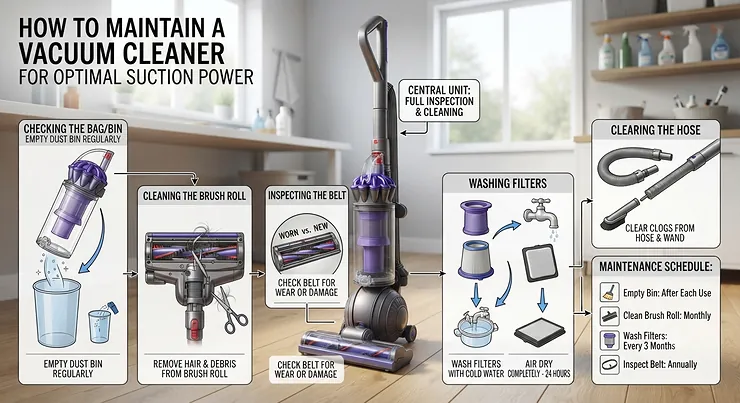
Vacuum cleaner maintenance is the routine care — emptying bins or bags, washing or replacing filters, clearing brushroll tangles, and checking hoses for blockages — that keeps suction, airflow, and motor health from degrading over time. Done consistently, it can double a machine’s usable lifespan and keep filtration performance close to factory-fresh for years.
Skip it, and the effects compound fast. A clogged filter forces the motor to work harder to pull the same amount of air, which raises internal temperatures and shortens motor life. A hair-wrapped brushroll strains the belt or gearbox. A half-full bag reduces airflow before you’d ever guess it’s the culprit. None of this is dramatic on any single day — it just adds up, quietly, until the vacuum that used to devour pet hair now leaves a visible trail behind it. The EPA’s guide to air cleaners in the home notes that effective allergen control depends heavily on frequent, consistent vacuuming — which only happens reliably when the machine doing the vacuuming is actually maintained well enough to keep working.
Quick Comparison Table: Best Vacuums for Easy Maintenance
| Vacuum | Type | Maintenance Level | Best For |
|---|---|---|---|
| Dreame R20 | Cordless stick | Low — washable cyclone & filter | Small apartments, quick daily upkeep |
| Eureka QuickShift OmniVerse | Upright, bagless | Low-Medium — HEPA rinse required | Budget buyers wanting simple filter care |
| Bissell Little Green | Portable spot cleaner | Very Low — self-rinsing hose | Spills, upholstery, cars |
| Kenmore Elite BU1018 | Upright, bagged | Very Low — swap-and-go bags | Allergy households, hands-off filtration |
| Shark PowerDetect Cordless | Cordless stick, auto-empty | Low — 45-day auto-empty base | Busy households wanting minimal touching |
| Dyson V15s Detect Submarine Absolute | Cordless wet/dry stick | Medium — dual filtration + wet roller care | Tech-forward users, mixed floors |
| Miele Complete C3 Calima | Canister, bagged | Very Low — lifetime HEPA + 9-layer bags | Long-term owners, deep-pile carpet & stairs |
Looking at the table, the pattern is clear: bagged systems like the Kenmore Elite BU1018 and Miele Complete C3 Calima consistently demand the least hands-on maintenance because the filtration lives mostly inside a disposable bag rather than a washable cyclone you have to babysit. Auto-empty cordless models like the Shark PowerDetect Cordless split the difference, automating the messiest step (emptying) while still asking you to rinse a filter every month or so. If your priority is truly minimal upkeep over sheer cleaning power, bagged and auto-empty options are worth weighing more heavily than raw suction numbers.
💬 Just one click — help others make better buying decisions too!😊
Top 7 Vacuum Cleaners for Easy Maintenance: Expert Analysis
1. Dreame R20 — lightest cordless design for effortless upkeep
At right around 6 pounds, the standout feature of the Dreame R20 isn’t suction — it’s how little it fights you during the parts of ownership nobody enjoys. Rated at up to 150–190AW of suction with a claimed 90-minute runtime from its swappable 8-cell battery pack, this stick vacuum leans on a washable multi-cone cyclone separator and a removable pre-filter, both of which pop out without tools. Based on the spec comparison against similar-weight rivals, that washable-everything design is what actually extends the vacuum’s useful life, since dust buildup inside a cyclone is one of the most common causes of gradual suction loss in stick vacuums.
Reviewers consistently note the Dreame R20 feels closer in power to machines twice its price, though a few flag an oversensitive trigger and a faint motor whine at full power. Aggregated owner feedback also frequently praises the low weight for reducing arm fatigue during longer cleaning sessions — a real factor in how often people actually bother doing upkeep versus letting a heavy, awkward vacuum sit in a closet.
Pros:
- ✅ Under 6 lbs, easiest stick vacuum here to maneuver and store
- ✅ Fully washable cyclone, filter, and brush — no proprietary tools needed
- ✅ Swappable battery pack means no downtime mid-clean
Cons:
- ❌ Trigger sensitivity takes some getting used to
- ❌ Real-world runtime often falls short of the 90-minute claim
Priced in the $150-$300 range depending on bundle, the Dreame R20 delivers strong value for anyone who wants low-maintenance cleaning without a premium price tag — check current price and configuration before buying, since Dreame sells several similarly named variants.
2. Eureka QuickShift OmniVerse — easiest bag-free filter cleaning on a budget
The Eureka QuickShift OmniVerse built its reputation on being a shockingly capable upright for around $200-$300, and part of that value comes from a sealed HEPA system rated to capture roughly 99.9% of dust and dander. Its QuickShift mechanism lets the canister slide up the wand for under-furniture reach, which — beyond the obvious cleaning benefit — also means less need to detach and reattach hose sections during routine cleaning, a small design choice that reduces wear on connectors over time.
What most buyers overlook about this model is that its anti-tangle roller genuinely reduces one of the most tedious maintenance chores on any vacuum: cutting hair out of the brushroll. Reviewers testing the OmniVerse against a dozen-plus rivals noted above-average pickup on both carpet and hardwood at a fraction of flagship pricing, though several also mentioned the QuickShift height adjustment can feel a little finicky until you get the hang of it.
Pros:
- ✅ Sealed HEPA filtration at a genuinely budget price point
- ✅ Anti-tangle roller cuts down on hair-related maintenance
- ✅ Lightweight for an upright at roughly 12.5-14 lbs
Cons:
- ❌ QuickShift height adjustment requires some practice
- ❌ Canister removal for filter cleaning isn’t as intuitive as rivals
At around $200-$300, the Eureka QuickShift OmniVerse is one of the strongest value plays in this lineup for anyone prioritizing simple, affordable filter care over premium features.
3. Bissell Little Green — simplest spot-cleaner maintenance routine
The Bissell Little Green isn’t a whole-home vacuum, and it doesn’t try to be — its standout feature is a maintenance routine so simple it borders on foolproof. Depending on the exact version (corded, cordless, or Mini), it uses a HydroRinse-style self-cleaning tool that flushes cleaning solution through the hose after use, which prevents the mildew smell that plagues neglected spot cleaners. On paper, this means most of the “maintenance” is really just rinsing two tanks under a tap, no filter replacement schedule required.
Aggregated review sentiment across multiple retailers describes the Little Green as a “cult classic” among portable carpet and upholstery cleaners, with reviewers repeatedly highlighting how quickly stains lift from car interiors, stairs, and couch cushions. The tradeoff, honestly discussed across several test reports, is that it leaves treated areas noticeably damp and works best as a supplement to — not a replacement for — a full-size vacuum.
Pros:
- ✅ Self-rinsing hose tool keeps odor and mildew from building up
- ✅ No filters to replace, ever
- ✅ Compact enough to store under a sink or in a car trunk
Cons:
- ❌ Leaves carpet or upholstery damp after use
- ❌ Not a substitute for regular whole-home vacuuming
Price ranges run from around $85 for the Mini up to the $150-$200 range for full-size versions, making the Bissell Little Green an easy add-on purchase alongside any primary vacuum on this list.
4. Kenmore Elite BU1018 — lowest-maintenance bagged design for allergy homes
Weighing about 21 pounds, the Kenmore Elite BU1018 trades portability for something a lot of allergy sufferers care about more: a triple HEPA filtration system rated to capture 99.97% of particles down to 0.3 microns, paired with a bagged design that seals dust away the moment you close the bin. Here’s what to weigh — bagged vacuums typically need less hands-on filter maintenance than bagless models because the bag itself acts as a disposable pre-filter, so you’re not scrubbing cyclone walls or rinsing foam inserts every few weeks.
The 3-motor direct-drive system and Power Flow technology are designed to maintain consistent suction as the bag fills, rather than tapering off sharply the way some cheaper bagged uprights do. Reviewers frequently mention the infrared dirt sensor and LED headlight as genuinely useful for spotting missed debris, while a smaller number note the fixed 30-foot cord and 21-pound body make it less nimble than cordless competitors on this list.
Pros:
- ✅ Triple HEPA filtration rated for 99.97% particle capture
- ✅ Bagged design means minimal hands-on filter cleaning
- ✅ Infrared dirt sensor helps confirm when a pass is actually clean
Cons:
- ❌ At 21 lbs, noticeably heavier than the cordless options here
- ❌ Corded design limits reach to 30 feet plus hose length
In the $300-$370 range, the Kenmore Elite BU1018 earns its spot as the pick for buyers who want allergy-grade filtration without a demanding maintenance routine.
5. Shark PowerDetect Cordless — self-emptying convenience that skips daily upkeep
The Shark PowerDetect Cordless, particularly the Clean & Empty configuration, is built around one idea: automate the single most annoying maintenance task in cordless vacuum ownership. Its auto-empty base empties and charges the unit after every session, storing up to 45 days of debris in a sealed bagless reservoir before you need to deal with it directly. Paired with a redesigned DuoClean Detect nozzle offering forward-and-reverse pickup and dirt-detecting sensors that boost power automatically, this model is engineered to need less manual intervention than a typical stick vacuum.
Reviewers who tested runtime in real conditions found the PowerDetect delivers roughly 30-40 minutes on auto mode and up to 70 minutes in eco mode at the handheld unit, which the spec sheet won’t tell you outright but matters if you’re planning to clean an entire multi-story house in one go. What most buyers overlook is that the detachable battery lets you keep a spare charged and ready, effectively sidestepping mid-clean downtime — a small maintenance-adjacent perk that saves real frustration.
Pros:
- ✅ Auto-empty base handles the messiest maintenance step automatically
- ✅ Anti-hair-wrap brushroll scored well in independent hair-tangle testing
- ✅ Detachable battery adds flexibility for longer sessions
Cons:
- ❌ Max-power runtime is noticeably shorter than the ECO-mode claim
- ❌ Auto-empty base adds bulk and requires its own dedicated space
Priced roughly $300-$450 depending on configuration, the Shark PowerDetect Cordless is the strongest pick here for households that want cordless convenience without becoming personally responsible for weekly bin emptying.
6. Dyson V15s Detect Submarine Absolute — smartest maintenance alerts on the market
Few vacuums on this list telegraph their maintenance needs as clearly as the Dyson V15s Detect Submarine Absolute. Its LCD screen displays real-time run time, power mode, and — critically — maintenance alerts, so you’re told exactly when a filter wash or blockage check is due instead of guessing based on declining suction. With 240AW of suction, a 60-minute rated runtime, and whole-machine HEPA filtration capturing 99.99% of particles down to 0.1 microns, this is a genuinely premium machine, and the added Submarine wet-roller head means mopping hard floors alongside dry vacuuming.
What the spec sheet won’t tell you, but user reports suggest, is that real-world auto-mode runtime tends to land closer to 30-45 minutes rather than the full 60, and the wet roller head requires its own rinse cycle after every mopping session to avoid mildew buildup — a maintenance step the dry-only vacuums on this list simply don’t have. Reviewers consistently rate its suction and filtration as best-in-class, while noting the higher price and the two-part cleaning routine (dry bin plus wet tank) as real tradeoffs.
Pros:
- ✅ Whole-machine HEPA filtration rated at 99.99% particle capture
- ✅ On-screen maintenance alerts remove the guesswork
- ✅ Converts between dry vacuuming and wet mopping in one machine
Cons:
- ❌ Wet roller head adds an extra rinse-and-dry maintenance step
- ❌ Premium price point, typically in the $700-$900 range
For buyers who want a machine that manages its own maintenance reminders, the Dyson V15s Detect Submarine Absolute justifies its cost through convenience as much as raw cleaning power.
7. Miele Complete C3 Calima — longest-lasting filtration system money can buy
The Miele Complete C3 Calima is a bagged canister vacuum built around a 12-stage AirClean Sealed System, a 4.76-quart bag capacity — the largest bag of any model on this list — and a HEPA AirClean filter meeting Europe’s strict HEPA13 standard, capturing over 99.95% of particles down to 0.1 microns. Based on the spec comparison, that larger bag alone means dramatically fewer bag changes per year than most bagged competitors, which is exactly the kind of unglamorous detail that adds up to real long-term maintenance savings.
A particularly clever touch reviewers highlight is the TimeStrip indicator built into the HEPA filter, which releases a visible red line over roughly a year to signal replacement — removing the guesswork that trips up owners of less transparent systems. Testing from independent labs found the Calima performs impressively on hardwood and stairs thanks to its 24-foot cord and 36-foot cleaning radius, though it’s a genuinely premium purchase and its turbo brush isn’t the strongest option here for homes with heavy-shedding pets.
Pros:
- ✅ Largest bag capacity in this lineup, fewer bag changes overall
- ✅ TimeStrip filter indicator removes guesswork on replacement timing
- ✅ German-engineered build with a 7-year motor and casing warranty
Cons:
- ❌ Premium price, typically in the $900-$1,000+ range
- ❌ Less effective on heavy pet-hair shedding than some rivals
For owners who plan to keep one vacuum for a decade or more, the Miele Complete C3 Calima is the pick that treats long-term maintenance simplicity as a core design goal, not an afterthought.
How to Choose a Vacuum Maintenance Routine
Building a maintenance routine that actually sticks doesn’t require a spreadsheet. It requires matching a handful of steps to how you actually use your vacuum.
- Check the filter type first. Bagged systems like the Kenmore Elite BU1018 and Miele Complete C3 Calima need bag swaps, not filter scrubbing — plan around replacement bags, not washing schedules.
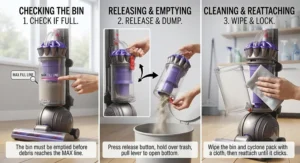
- Empty bins after every session, not when they look full. Suction drops noticeably before a bin visually appears packed.
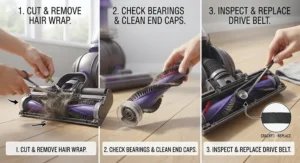
- Inspect the brushroll weekly if you have pets or long hair. A tangled roller strains the motor long before it visibly stops spinning.
- Wash filters on a fixed calendar, not “when performance drops.” By the time you notice weaker suction, the filter has likely been underperforming for weeks.
- Check hoses and wands for blockages monthly. A partial clog often mimics the symptoms of a dying motor.
- Let filters dry fully before reinserting them. Damp filters trap moisture against internal electronics, a common cause of premature motor failure.
- Match your schedule to your household, not a generic default. Pet owners and larger households need roughly double the maintenance frequency of a single-occupant apartment.
Preventive Maintenance Schedule: What to Do and When
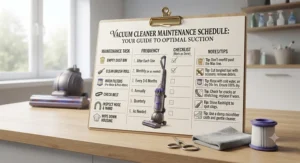
A little structure turns vacuum care from a guessing game into a five-minute habit. After every use, empty the bin or check the bag level, and give the brushroll a quick visual scan for wrapped hair — catching a tangle early takes seconds; catching it after it’s compacted around the axle takes ten minutes with scissors. Weekly, wipe down the exterior and check hose attachments for partial clogs, especially if you’ve been vacuuming plaster dust, cat litter, or anything finer than typical household dirt.
Monthly maintenance is where most of the real performance protection happens: wash or replace the pre-filter and post-motor filter according to the manufacturer’s guidance, and inspect the belt (on models that use one) for glazing or fraying. Quarterly, do a deeper strip-down — remove the brushroll entirely, clear the end caps of hair and string, and check the HEPA filter’s condition against a light source; if it looks gray and matted rather than white, it’s overdue. Annually, consider a full service or at minimum a complete filter replacement set, even on models with washable filters, since washable media does lose some efficiency after repeated cycles regardless of how clean it looks.
✨ Don’t Miss These Exclusive Deals!
🔍 Take your vacuum maintenance routine to the next level with these carefully selected picks. Click on any highlighted model to check current pricing and availability. These machines make it far easier to keep your home genuinely clean, not just clean-looking.
Best Practices for Vacuum Care
The American College of Allergy, Asthma & Immunology recommends regular HEPA vacuuming as a core step in reducing household allergens, alongside humidity control — a reminder that maintenance isn’t just about the machine’s lifespan, it’s about the air you’re breathing every time you run it. If there’s one habit that separates a vacuum that lasts eight years from one that dies in eighteen months, it’s this: treat filter maintenance as non-negotiable, not optional. Reviewers across nearly every model in this guide flag the same pattern — machines with sealed, easy-access filtration (the Miele Complete C3 Calima, the Kenmore Elite BU1018) tend to retain suction longer specifically because their owners find upkeep easy enough to actually do consistently.
Beyond filters, three habits matter more than most owners realize. First, never run a vacuum with a fully blocked hose — the motor doesn’t know it’s not moving air, and it will overheat trying. Second, store cordless models like the Dreame R20 or Shark PowerDetect Cordless with some charge remaining rather than fully depleted, since lithium batteries degrade faster when stored empty. Third, avoid vacuuming genuinely wet spills with a dry-only machine; it’s the single fastest way to destroy a motor, and it’s exactly why models like the Dyson V15s Detect Submarine Absolute build in a dedicated wet-roller system instead of relying on the dry motor to handle both jobs.
Real-World Scenarios: Matching Maintenance to Your Household
Consider a college student in a 500-square-foot studio with no pets. For that lifestyle, a lightweight stick vacuum like the Dreame R20 makes sense — light enough to use weekly without dread, with a washable cyclone simple enough to rinse in a dorm bathroom sink. Maintenance here is genuinely low-stakes: empty, rinse, dry, repeat every couple of weeks.
Now picture a family of four with two shedding dogs and a mix of carpet and hardwood. That household benefits far more from the Kenmore Elite BU1018‘s bagged HEPA system or the Shark PowerDetect Cordless‘s auto-empty base, since both remove the daily friction of dealing with pet hair volume that would otherwise mean emptying a bagless bin every single day. Finally, think about an empty-nester couple in a two-story home with area rugs and hardwood stairs, values built-to-last engineering, and doesn’t mind a slightly heavier machine in exchange for fewer replacement parts over a decade — that’s precisely the buyer the Miele Complete C3 Calima was designed around, with its oversized bag and simple, well-labeled filter replacement schedule.
Problem → Solution: Fixing the Most Common Vacuum Issues
Problem: Suction feels weaker than it used to. Nine times out of ten, this traces back to a full bin, a clogged filter, or a partially blocked hose — check all three before assuming the motor is failing.
Problem: The vacuum smells musty. This is almost always trapped moisture in a filter or bag that wasn’t fully dried before reinsertion, or a spot cleaner like the Bissell Little Green that wasn’t rinsed after use.
Problem: The brushroll has stopped spinning. Check for a snapped belt or a hair tangle jamming the axle; both are common, inexpensive fixes rather than motor failures.
Problem: The vacuum shuts off mid-clean. Many models include thermal overload protection that trips when airflow is restricted — this is a safety feature, not a defect, and usually resolves once a blockage is cleared.
Problem: Battery life on a cordless model has dropped noticeably. Lithium batteries naturally lose capacity over 300-500 charge cycles; if a model like the Shark PowerDetect Cordless or Dreame R20 offers a swappable pack, replacing just the battery is far cheaper than replacing the whole unit.
How to Extend Vacuum Lifespan: Longevity Best Practices for Every Model
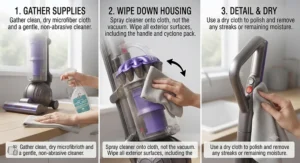
Extending vacuum lifespan comes down to reducing strain on the motor, and nearly every longevity best practice traces back to that single principle. Cleaning filters on schedule keeps the motor from working harder than necessary to move air through clogged media. Clearing brushroll tangles keeps mechanical resistance low, which protects belts and bearings. Avoiding wet debris in dry-only machines protects the motor from moisture damage, arguably the single most destructive and most preventable failure mode across every vacuum type.
There’s a genuine long-term cost angle here too. A $250 upright that lasts three years works out to roughly $83 per year before accessories; the same machine maintained properly and stretched to six years cuts that to about $42 per year — maintenance essentially pays for itself in extended service life. Premium models like the Miele Complete C3 Calima are built with this math in mind, backed by a 7-year motor and casing warranty that reflects genuine confidence in long-term durability when the machine is cared for as intended.
Vacuum Cleaning Tips for Every Floor Type
Hardwood and tile reward gentler brushroll settings — aggressive agitation on hard floors mostly just scatters fine dust rather than lifting it, and it can also accelerate brush wear against unforgiving surfaces. Low-pile carpet benefits from a moderate suction setting paired with slow, overlapping passes, since rushing tends to leave debris embedded rather than lifted. Thick or shag carpet is where models like the Eureka QuickShift OmniVerse, built with wider brush-head gaps to let larger debris pass through while maintaining suction, genuinely outperform narrower designs that clog on contact.
Stairs deserve their own approach entirely: a lightweight handheld conversion, available on every cordless model in this guide, beats dragging a full-size upright up and down steps, both for your back and for reducing wear on wheels and hose connectors not designed for that angle. And upholstery or car interiors are exactly the gap a dedicated spot cleaner like the Bissell Little Green is built to fill — using your primary vacuum’s crevice tool works in a pinch, but it won’t lift set-in stains the way a water-extraction tool can.
Cleaning Performance Optimization: Features That Actually Matter
Marketing copy loves to lead with wattage and RPM numbers, but reviewers consistently note that sealed filtration and consistent airflow design matter more to real-world performance than raw motor power alone. A vacuum with a high-wattage motor but a leaky seal around the bin will still lose suction faster than a lower-wattage machine with a properly sealed system — the air simply escapes around the dirt instead of through it.
Features genuinely worth prioritizing: sealed HEPA systems (found on the Kenmore Elite BU1018, Miele Complete C3 Calima, and Dyson V15s Detect Submarine Absolute), anti-tangle brushroll design, and — for cordless models — a swappable battery. Features that matter less than their marketing suggests: extremely high AW or RPM numbers in isolation, since suction at the floorhead depends as much on nozzle design and seal quality as on raw motor output, and “smart” app connectivity, which adds cost without meaningfully affecting cleaning performance or maintenance ease.
Common Mistakes When Maintaining a Vacuum Cleaner
The single most common mistake, based on aggregated review data across every product category in this guide, is waiting for visible performance loss before cleaning a filter — by that point, weeks of reduced efficiency have already passed. A close second is reinserting a filter while it’s still damp from washing, which traps moisture against sensitive components and can accelerate corrosion or mold growth inside the machine.
Other frequent missteps include ignoring the brushroll until it visibly stops turning rather than checking it proactively, using a dry vacuum on wet spills (a fast track to motor damage on any non-wet/dry model), and storing cordless vacuums fully depleted for long stretches, which shortens battery lifespan more than most owners realize. None of these mistakes are complicated to avoid — they’re just easy to forget until the machine forces the issue.
FAQ
❓ How often should I clean my vacuum filter?
❓ Can I use a dry vacuum to pick up water?
❓ How do I know if my vacuum's HEPA filter needs replacing?
❓ Why does my cordless vacuum's battery life keep dropping?
❓ Is a bagged or bagless vacuum easier to maintain?
Conclusion
Learning how to maintain vacuum cleaner performance isn’t about mastering some elaborate ritual — it’s about a handful of small habits, done consistently, matched to the machine you actually own. Bagged systems like the Kenmore Elite BU1018 and Miele Complete C3 Calima reward owners with lower-maintenance filtration, auto-empty models like the Shark PowerDetect Cordless automate the most tedious step entirely, and lightweight cordless picks like the Dreame R20 make washing a cyclone quick enough that you’ll actually do it.
Whichever machine ends up in your closet, the real lesson holds across every price point: a vacuum that’s properly maintained will out-clean and out-last one that’s simply more expensive but neglected. For deeper technical comparisons and lab-tested performance data across dozens of current models, Consumer Reports’ ongoing vacuum cleaner testing is worth a look before you commit to a purchase.
✨ Don’t Miss These Exclusive Deals!
Check current pricing on any of the seven vacuums above and start building a maintenance routine that actually sticks. 🧹💪
Recommended for You
- Vacuum With Swivel Steering: 7 Best Picks That Won’t Fight You (2026)
- 7 Best Vacuum With LED Headlights Picks for 2026
- Vacuum with self cleaning brush roll: 7 Picks That End Pet Hair Wrap (2026)
Disclaimer: This article contains affiliate links. As an Amazon Associate, I earn from qualifying purchases. If you purchase products through these links, we may earn a small commission at no additional cost to you.
✨ Found this helpful? Share it with your friends! 💬🤗
