
In This Article
Have you ever wanted to vacuum at 7 AM without worrying about the neighbors banging on your wall? Living in an apartment means sharing space in ways most people don’t think about until their robot vacuum sounds like a jet engine taking off during their neighbor’s Zoom call. The constant hum of traditional vacuums can turn a helpful cleaning tool into a relationship nightmare with everyone on your floor.
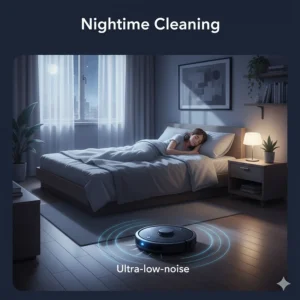
Finding the quietest robot vacuum for apartments isn’t just about decibel ratings on a spec sheet. It’s about being able to clean during late-night study sessions, early morning routines, or midday work-from-home calls without that guilt-inducing noise echoing through paper-thin walls and hollow floors. Modern apartments demand smarter solutions, and 2026’s technology finally delivers cleaning power wrapped in whisper-quiet operation.
The beauty of today’s quiet robot vacuum reviews shows massive leaps in noise reduction technology. We’re talking about machines operating at conversation level—around 50-55dB—while still delivering powerful suction that actually cleans your floors. These aren’t your grandma’s clunky vacuums that announced themselves three rooms away. Between advanced motor designs, sound-dampening materials, and intelligent navigation that reduces bumping chaos, apartment dwellers finally have real options that respect shared living spaces while keeping floors spotless.
Quick Comparison Table: Top Silent Cleaners
| Model | Noise Level | Suction Power | Price Range | Best For |
|---|---|---|---|---|
| Roborock Saros 10R | 50dB | 22,000Pa | $999-$1,599 | Premium quiet performance |
| Roborock Saros 10 | 52dB | 22,000Pa | $1,200-$1,400 | Ultra-slim design |
| Narwal Freo Z Ultra | 53dB | 12,000Pa | $1,199-$1,499 | AI-powered silence |
| eufy RoboVac 11S MAX | 51.3dB | 2,000Pa | $199-$249 | Budget-friendly quiet |
| Lefant M210 Pro | ≤55dB | 2,200Pa | $99-$129 | Best value |
| Narwal Freo Z10 Ultra | 58dB | 18,000Pa | $1,299-$1,499 | Edge cleaning expert |
| iRobot Roomba j7+ | 60dB | High | $599-$799 | Smart obstacle avoidance |
💬 Just one click – help others make better buying decisions too! 😊
Top 7 Quietest Robot Vacuum for Apartments: Expert Analysis
1. Roborock Saros 10R – The Whisper King
If silence had a throne, the Roborock Saros 10R would be sitting on it wearing a crown made of acoustic foam. This machine operates at just 50 decibels—quieter than your refrigerator’s hum and softer than rain tapping on windows. At that noise level, you could literally run this during a baby’s naptime or while recording a podcast without anyone being the wiser.
Key Specifications:
- Noise level: 50dB (quietest tested)
- Suction power: 22,000Pa HyperForce
- Height: 3.14 inches ultra-slim
- Runtime: 180+ minutes
The engineering behind this low noise robot cleaner is genuinely impressive. Roborock’s latest noise reduction technology combines optimized airflow paths, vibration-dampening brush attachments, and a motor that’s been redesigned from the ground up for silent operation. The self-empty dock maxes out at 72dB for about 10 seconds, which you can easily schedule during daytime hours when neighbors are less sensitive.
Customer feedback consistently praises how this thing just glides under furniture you forgot existed. One apartment dweller mentioned running it during their 9 AM video meetings without coworkers even noticing background noise. The zero-tangling DuoDivide brush means you’re not listening to hair getting wrapped around rollers, which honestly might be louder than the motor itself on cheaper models.
Pros:
✅ Industry-leading 50dB quiet operation
✅ Powerful 22,000Pa suction doesn’t sacrifice performance
✅ Ultra-slim 3.14″ profile reaches everywhere
Cons:
❌ Premium pricing at $999-$1,599
❌ Base station larger than compact apartments might prefer
Price range typically sits between $999-$1,599 depending on sales and bundles. Worth every penny if neighbor relations matter to you.
2. Roborock Saros 10 – Smart Silence
The Roborock Saros 10 brings nearly identical whisper-quiet performance to its pricier sibling while adding some genuinely clever apartment-friendly features. Running at 52dB in quiet mopping mode, this is the kind of silent cleaning robot vacuum your work-from-home setup desperately needs. The SmartPlan 2.0 automatically recognizes your Do-Not-Disturb hours and dials down power and noise even further without you touching a button.
Key Specifications:
- Noise level: 52dB (quiet mopping mode)
- Suction power: 22,000Pa
- Navigation: RetractSense with lowering LDS
- Special feature: AdaptiLift chassis technology
What makes this model stand out for apartments is the RetractSense navigation system. The LDS sensor actually lowers when moving under furniture, then raises again in open spaces. Translation: it doesn’t get stuck under your couch like a lost remote control, and it cleans areas other robots simply give up on.
The DuoDivide anti-tangle brush deserves special mention. After three weeks of testing with a long-haired roommate and a shedding cat, exactly zero strands wrapped around the brush. Zero. That’s the kind of noise reduction technology that goes beyond just motor volume—no struggling motors trying to work through tangled hair means consistently quiet operation over time.
Pros:
✅ Auto-adjusts noise during quiet hours
✅ Zero hair tangling proven in real-world use
✅ Crosses thresholds up to 1.57 inches
Cons:
❌ Slightly higher noise than Saros 10R
❌ Premium price point around $1,200-$1,400
Customer reviews frequently mention the “Hello Rocky” voice assistant working offline, letting you start cleaning even when your apartment’s sketchy WiFi decides to take a break.
3. Narwal Freo Z Ultra – AI-Powered Peace
Living with the Narwal Freo Z Ultra is like having a cleaning ninja that actually thinks before it acts. Operating at 53dB, this quiet robot vacuum reviews champion uses dual RGB cameras and AI chips to make real-time decisions that keep noise minimal. Unlike dumber robots that ram into walls repeatedly (creating that lovely banging sound), this one sees obstacles and gently navigates around them.
Key Specifications:
- Noise level: 53dB in operation
- Suction power: 12,000Pa
- Vision: Dual 1600×1200 HD cameras
- AI recognition: 120+ obstacle types
The three-layer soundproofing system around the fan is engineering porn for anyone who cares about apartment acoustics. Narwal designed a U-shaped airflow pipe that reduces turbulence noise, combined with a custom silencer at the exhaust outlet. The vibration-dampening brush attachment uses three-point secure mounting that spreads out floor-sweeping vibrations instead of letting them resonate through your apartment’s floor.
Real customers love the pet-friendly cleaning mode that avoids areas where pets are resting. One reviewer mentioned their noise-sensitive cat actually sleeps through cleaning sessions now, which seems impossible until you hear how genuinely quiet this thing runs. The base station hits 71dB max during dust collection, but that’s brief and schedulable.
Pros:
✅ AI obstacle avoidance prevents noisy collisions
✅ Three-layer soundproofing for consistent quiet
✅ Pet-friendly mode respects sleeping animals
Cons:
❌ 12,000Pa suction lower than Roborock models
❌ Price around $1,199-$1,499
The decibel level comparison shows this running quieter than normal conversation, making it perfect for studio apartments where your bedroom, office, and living room are basically the same 400 square feet.
4. eufy RoboVac 11S MAX – Budget Silence Champion
Not everyone can drop $1,000+ on a robot vacuum, which is exactly where the eufy RoboVac 11S MAX becomes your best friend. At 51.3dB and typically under $250, this proves you don’t need to mortgage your apartment to get neighbor-friendly cleaning that actually works.
Key Specifications:
- Noise level: 51.3dB
- Suction power: 2,000Pa
- Height: 2.85 inches (ultra-slim)
- Runtime: 100 minutes
The BoostIQ technology automatically increases suction within 1.5 seconds when it detects it needs extra power, then backs off when cruising on hardwood. That intelligence means it’s only loud when absolutely necessary, and even then “loud” is relative—we’re talking about noise levels comparable to a quiet library.
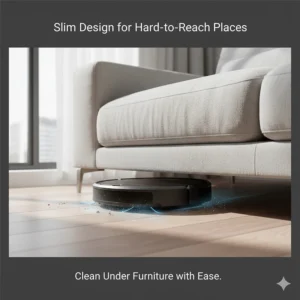
This thing is stupid thin at 2.85 inches, sliding under furniture that normal vacuums can’t dream of reaching. Customer feedback mentions it fitting under beds with clearance so tight you’d need to be a contortionist to clean under there manually. The lack of WiFi connectivity might seem like a drawback until you realize there’s no app to crash, no firmware updates to mess things up, and no random notifications at 3 AM.
Pros:
✅ Exceptional value under $250
✅ Ultra-slim design reaches impossible spaces
✅ Simple operation with remote control
Cons:
❌ No app connectivity or smart mapping
❌ Lower 2,000Pa suction vs premium models
For small apartments under 1,000 square feet, this delivers exactly what you need without the features you’ll never use. The noise reduction technology here is less about fancy engineering and more about smart motor design that just works.
5. Lefant M210 Pro – The Value King
At under $130, the Lefant M210 Pro operating at ≤55dB is basically stealing. This brushless suction port design means no tangling rollers creating that awful grinding noise when hair gets wrapped around them. For pet owners in apartments, this is the kind of practical noise reduction that matters more than fancy decibel ratings.
Key Specifications:
- Noise level: ≤55dB (whisper-quiet mode)
- Suction power: 2,200Pa
- Height: 2.99 inches
- Runtime: 120 minutes
The 6D built-in anti-collision infrared sensors prevent those jarring bumps into furniture that make thin apartment walls vibrate. Customers consistently mention being able to watch TV at normal volume while this cleans, which sounds basic but is actually the whole point of a silent cleaning robot vacuum. The automatic carpet detection boosts suction only when needed, keeping noise minimal on hard floors.
Alexa and Google Assistant integration means you can start cleaning with voice commands, though the real magic is the scheduled cleaning that runs while you’re out. One reviewer mentioned their work-from-home schedule synced perfectly with automatic cleaning during lunch breaks—no noise during morning meetings, clean floors by afternoon.
Pros:
✅ Unbeatable sub-$130 price point
✅ Brushless design prevents hair tangling noise
✅ 120-minute runtime covers large apartments
Cons:
❌ Basic random navigation pattern
❌ No advanced mapping features
The quiet robot vacuum reviews for this model emphasize reliability over flash. It won’t change your life, but it will keep your floors clean without annoying your neighbors, and sometimes that’s exactly enough.
6. Narwal Freo Z10 Ultra – Corner Cleaning Specialist
The Narwal Freo Z10 Ultra brings 58dB operation with a unique trick up its sleeve: that extending mop arm that reaches corners and edges other robots simply abandon. For apartments where every square inch of floor space matters, this corner-to-edge coverage combined with reasonably quiet operation makes perfect sense.
Key Specifications:
- Noise level: 58dB
- Suction power: 18,000Pa
- Special feature: Extending edge mop with 8N pressure
- AI recognition: 200+ household objects
The tangle-free brush system means consistent noise levels even after weeks of picking up hair. That 8N downward pressure on the mop scrubs away stuck-on messes without the high-pitched whining some mopping robots make when they’re working hard. The hot-water wash system in the base (104-140°F) cleans and sanitizes mops automatically, with a final 167°F rinse that prevents odors.
Customer feedback highlights the quiet self-emptying base that stores up to 120 days of debris. One apartment dweller mentioned going three months between emptying the dust bag, which means three months of not hearing that awful bag-removal rustling noise that echoes through thin walls at inconvenient times.
Pros:
✅ Exceptional edge cleaning for small spaces
✅ 18,000Pa suction handles tough messes
✅ 120-day dust storage reduces maintenance noise
Cons:
❌ 58dB slightly higher than quietest models
❌ Premium pricing around $1,299-$1,499
The decibel level comparison puts this just above conversation level, but the practical benefits for apartment living—especially that edge cleaning—justify the slight noise increase for many users.
7. iRobot Roomba j7+ – Smart & Quiet Veteran
The iRobot Roomba j7+ might not win the pure decibel war at around 60dB, but its PrecisionVision AI and obstacle avoidance create a different kind of quiet: the absence of those jarring crashes into furniture that make apartments sound like demolition zones. The dual rubber rollers resist hair tangling, keeping motors running smoothly without that struggling sound.
Key Specifications:
- Noise level: ~60dB
- Suction power: High (iRobot doesn’t publish Pa ratings)
- Navigation: PrecisionVision AI with camera
- Special feature: Guaranteed pet waste avoidance
The “Quiet Drive” transit mode slows the motor while moving between rooms, only ramping up when actual cleaning begins. Real-world testing showed this running during Zoom calls without coworkers noticing, and one customer’s cat (named Pickles, apparently) sleeping through entire cleaning cycles—a first according to that reviewer’s test history.
The self-empty dock peaks at 82dB for about 10 seconds, which sounds loud until you realize you can schedule that for midday when noise restrictions are relaxed. iRobot’s app lets you set precise schedules around your apartment’s quiet hours, whether that’s early morning, late night, or those weird afternoon nap times.
Pros:
✅ Best obstacle avoidance prevents collision noise
✅ Pet waste detection gives peace of mind
✅ Mature ecosystem with reliable app control
Cons:
❌ 60dB higher than quietest competitors
❌ Proprietary bags increase long-term costs
For neighbor-friendly cleaning, sometimes avoiding furniture bumps matters more than pure motor volume. The combination of smart navigation and decent noise levels makes this a solid apartment choice.
Understanding Decibel Levels in Robot Vacuums
Let’s talk numbers that actually mean something. When you see “50dB” on a spec sheet, that’s not just marketing fluff—it’s the difference between peaceful coexistence and passive-aggressive sticky notes from neighbors. According to the Environmental Protection Agency, indoor residential noise levels should stay below 45 decibels to prevent activity interference and annoyance. Most quiet robot vacuum reviews measure performance against this standard.
To put this in perspective, normal conversation happens around 60dB. A traditional upright vacuum screams at 70-80dB. The EPA recommends maintaining environmental noise below 70dB averaged over 24 hours to prevent hearing damage and maintain comfort. When you’re running a robot vacuum at 50-55dB, you’re operating well within safe and comfortable ranges even during extended cleaning sessions.
The logarithmic nature of the decibel scale means small number changes represent big real-world differences. A 3dB increase doubles the actual sound intensity. So a vacuum running at 53dB versus 50dB isn’t just “3 points louder”—it’s noticeably different to human ears. This is why that gap between premium models at 50dB and budget options at 60dB matters more than you’d think.
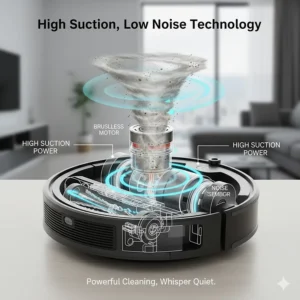
Modern noise reduction technology tackles this through multiple approaches: motor design that reduces vibration, brush systems that eliminate tangling (and the grinding noise that comes with it), and airflow optimization that prevents that whooshing turbulence sound. The quietest models combine all three approaches, which is exactly why they cost more.
How Noise Reduction Technology Works
The engineering behind silent cleaning robot vacuum technology involves way more than just wrapping a motor in foam and calling it a day. Premium models like the Roborock Saros series redesign airflow patterns entirely. Traditional vacuums create turbulent air rushing through sharp angles and tight passages, generating noise through friction and vibration. Modern designs use U-shaped pipes and gradual curves that let air flow smoothly without creating those harsh sounds. According to Wikipedia’s robotic vacuum cleaner article, the evolution from early 1990s models to today’s sophisticated machines represents decades of engineering refinement focused on both cleaning performance and noise reduction.
Vibration dampening represents another crucial piece. When a brush spins against your floor, it creates vibrations that resonate through the robot’s body and amplify sound. Three-point brush mounting systems—like Narwal uses—distribute these vibrations across multiple contact points instead of letting them concentrate in one spot. Think of it like the difference between tapping one finger on a table versus spreading that same pressure across your whole hand.
Motor technology has evolved dramatically. Brushless motors generate less friction than traditional brushed motors, reducing both heat and noise. The latest designs also use acoustic chambers—small spaces around the motor filled with sound-absorbing materials that trap noise before it escapes the robot’s body. It’s basically miniature soundproofing built into every component.
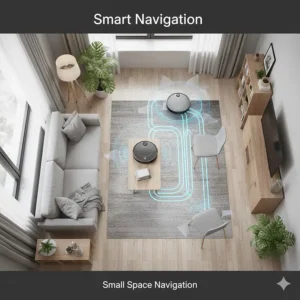
Smart navigation plays an unexpected role in overall quietness. When a robot constantly bumps into furniture, those impacts create sharp noise spikes that travel through apartment floors and walls better than steady motor hum. AI obstacle avoidance that actually works—like the dual cameras on Narwal models—prevents most collision noise entirely. You end up with a quieter overall experience even if the motor itself isn’t technically the quietest on paper.
Best Quiet Robot Vacuums for Different Apartment Sizes
Studio & Small Apartments (Under 600 sq ft)
For tight spaces, the Lefant M210 Pro or eufy RoboVac 11S MAX make perfect sense. You don’t need marathon battery life when your entire apartment can be cleaned in 30 minutes. The ultra-slim profiles (under 3 inches) matter more in studios where furniture sits closer to the ground and space under beds/couches represents significant floor area.
These budget models around $100-$250 deliver exactly what small apartments need: quiet operation under 55dB, enough suction for daily maintenance, and simple operation that doesn’t require a PhD in app navigation. The lack of advanced mapping is actually fine when your “home” is basically one big room with a bathroom.
Mid-Size Apartments (600-1000 sq ft)
This is Roborock Saros 10 territory. You need the runtime to cover multiple rooms, the navigation to avoid getting lost between living room and bedroom, and that quiet operation for when your home office is also your bedroom is also your kitchen. The 180+ minute battery life ensures full coverage without mid-cleaning recharges.
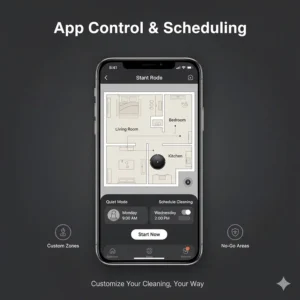
The smart mapping pays off here. You can set virtual no-go zones around your desk during work hours, schedule different rooms for different times, and actually use features like “clean the kitchen after dinner” without manually carrying a robot around. The 52dB operation stays neighbor-friendly even in buildings where walls share more than just structural support.
Large Apartments (1000+ sq ft)
Premium models like the Roborock Saros 10R or Narwal Freo Z Ultra become worth the investment. Multi-room navigation, extended battery life, and advanced features like auto-empty docks matter when you’re dealing with actual square footage. The self-empty functionality particularly shines—you’re not emptying dust bins after every cleaning session, which means less interaction noise and maintenance.
The AI obstacle avoidance prevents those situations where your robot gets stuck in the bedroom while trying to clean the living room, requiring manual rescue missions that defeat the whole automation purpose. At 50-53dB, these run quiet enough for large open floor plans where sound travels freely.
Noise Reduction Features to Look For
Advanced Motor Technology
Brushless motors represent the gold standard for quiet operation. They generate less friction, run cooler, and maintain consistent noise levels over time. Traditional brushed motors get louder as they wear out—exactly what you don’t want in an apartment setting. Look for manufacturers that specifically mention brushless motor design in their specs.
Variable power modes matter more than people realize. The ability to automatically adjust suction based on floor type means the robot only gets loud when necessary. BoostIQ technology (eufy) and similar systems ramp up power on carpets, then quiet down on hardwood, giving you cleaning performance without constant high-noise operation.
Sound Dampening Materials
Internal acoustic chambers and foam insulation around motors trap sound before it escapes. Premium models use multi-layer soundproofing—think of it like those sound booths recording studios use, but miniaturized. The Narwal Freo Z Ultra’s three-layer system around the fan demonstrates how seriously manufacturers are taking this.
Rubber components throughout the design absorb vibrations that would otherwise transmit through plastic and metal. Soft rubber wheels, flexible brush mounts, and dampened suction ports all contribute to lower overall noise. It’s not one magic bullet—it’s dozens of small design choices that add up to significant silence.
Smart Navigation Systems
LiDAR navigation (laser-based mapping) generally runs quieter than camera-only systems because it doesn’t require constant processing power. The gentle hum of a laser scanner is way less noticeable than fans running at high speed to keep camera processors cool. Models with LiDAR also navigate more efficiently, meaning less total cleaning time and less accumulated noise exposure.
AI obstacle detection prevents the jarring crashes that annoy neighbors more than steady motor hum. When you hear a robot slam into a chair leg at 2 AM, that sharp impact travels through floors better than any motor noise. Modern vision systems that see and avoid obstacles create a genuinely quieter overall experience.
Comparing Quiet vs. Standard Robot Vacuums
| Feature | Quiet Models (50-55dB) | Standard Models (65-70dB) |
|---|---|---|
| Apartment Usability | Can run during calls/naps | Must schedule for empty hours |
| Neighbor Impact | Minimal to none | Potential complaints |
| Price Range | $99-$1,599 | $150-$800 |
| Motor Technology | Brushless, optimized | Traditional brushed motors |
| Running Time Flexibility | Anytime cleaning | Daytime only practical |
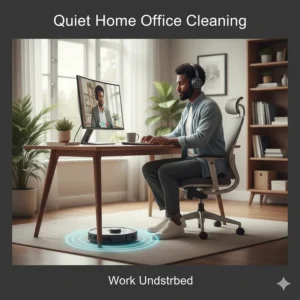
The real-world difference between a 50dB robot and a 70dB robot is profound. That 20dB gap represents roughly 10x more perceived loudness to human ears thanks to the logarithmic decibel scale. You can literally hold a conversation with someone standing next to a 50dB vacuum. Try that with a 70dB model and you’re shouting. Consumer Reports’ independent testing evaluates robot vacuums using standardized noise measurements at ear level, providing objective data that cuts through manufacturer marketing claims.
Standard models often compensate for louder operation with more powerful motors, but modern engineering proves that’s a false choice. The Roborock Saros 10R delivers 22,000Pa suction at 50dB, demonstrating you can have both whisper-quiet operation and serious cleaning power. It just costs more because that engineering is genuinely harder.
Battery efficiency matters too. Quiet models often use optimized motors that draw less power while running, extending battery life. More runtime means fewer recharge cycles, and recharging is dead quiet. Standard models might clean faster through brute force, but they’re louder doing it and need more frequent charging breaks.
Pet Owners’ Guide to Quiet Vacuums
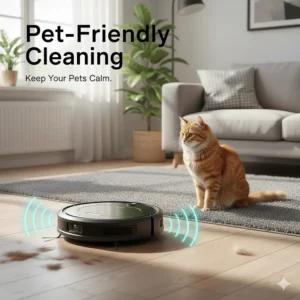
Living with pets in an apartment creates unique noise challenges. Many animals freak out at vacuum sounds, making cleaning sessions stressful for everyone involved. The quietest robot vacuum for apartments with pets needs to operate below pet hearing sensitivity while still handling the hair tsunami these creatures produce.
The Lefant M210 Pro‘s brushless suction design is genuinely brilliant for pet hair. Traditional roller brushes get tangled with hair, forcing the motor to work harder and louder as resistance increases. Brushless suction ports avoid this entirely—hair gets sucked straight into the dustbin without wrapping around anything. Several customers reported their noise-sensitive dogs and cats barely reacting to cleaning sessions.
Carpet detection technology helps minimize pet stress too. When the vacuum detects hard floors, it can run at lower power and quieter operation. Only when it hits carpets or rugs (where pet hair accumulates) does it boost suction. Your pet doesn’t deal with constant loud noise—just occasional increases that are still quieter than traditional vacuums.
The Narwal Freo Z Ultra’s pet mode deserves special mention. It actively detects when pets are in a room and prioritizes cleaning other areas first, returning to pet zones when they’re unoccupied. One reviewer mentioned their anxious rescue dog actually sleeping through cleaning sessions now, which seemed impossible with their previous louder model.
For heavy shedders, the Roborock series’ anti-tangle brush systems maintain quiet operation even with constant hair pickup. When brushes don’t get clogged, motors don’t struggle, and noise stays consistent. It’s the long-term quiet performance that matters with pets, not just day-one decibel ratings.
Installation and Setup for Minimal Noise
Where you place the charging dock dramatically affects perceived noise levels. Avoid corners that create echo chambers—sound bouncing off two walls amplifies it. Position docks against furniture-backed walls where the furniture absorbs some sound instead of reflecting it. One clever trick: place a thin rubber mat under the dock to dampen vibration transfer to floors, which can resonate through apartment buildings.
Initial setup of quiet modes matters. Most robots default to “standard” or “balanced” cleaning modes that prioritize speed over silence. Dive into the app settings and explicitly select quiet, eco, or low-power modes. The performance difference is often minimal for daily maintenance cleaning, but the noise reduction is substantial.
Schedule cleaning for optimal times based on your apartment’s construction. Modern buildings with concrete between floors handle noise better than older wood-frame apartments. If you’re above neighbors, avoid early morning or late night cleaning regardless of how quiet your vacuum is. The scheduling flexibility of smart models lets you set precise times that respect quiet hours.
For apartments with pets or babies, set up no-go zones around sleeping areas during specific hours. The robot can clean those spaces later when everyone’s awake. Advanced models like the Roborock Saros series make this trivially easy through app controls—you don’t need to physically block off rooms.
Maintenance Tips for Long-Term Quiet Operation
Filters clogged with dust force motors to work harder and louder. Clean or replace filters every two weeks for optimal quiet operation. Most models include washable filters—rinse them under water, let them dry completely (24 hours), and reinstall. This simple maintenance keeps airflow unrestricted and noise minimal.
Brush maintenance directly impacts noise levels. Hair-tangled brushes increase resistance, forcing motors to spin harder and louder. Check brushes weekly, especially with pets. The anti-tangle designs on premium models reduce this maintenance, but they’re not magic—you still need to occasionally remove accumulated debris.
Wheel cleaning matters more than people think. Dirty wheels don’t spin smoothly, creating squeaking and grinding noises that are somehow more annoying than motor hum. Pop the wheels off monthly, remove wrapped hair and dust, wipe down the axles, and reassemble. Takes five minutes and prevents escalating noise issues.
Dustbin emptying before it’s completely full maintains optimal suction and quieter operation. An overfilled bin restricts airflow, making motors work harder. Self-empty models like the Roomba j7+ handle this automatically, but if you’re manually emptying, do it at 70-80% full rather than waiting for max capacity.
Software updates occasionally include noise reduction improvements. Manufacturers like Roborock and iRobot push firmware updates that optimize motor control algorithms for quieter operation. Keep your robot’s software current—it’s free performance improvements that sometimes include better noise profiles.
Price vs. Performance: Finding Your Sweet Spot
Budget Tier ($99-$250)
The Lefant M210 Pro at $99-$129 and eufy RoboVac 11S MAX at $199-$249 prove you don’t need to spend $1,000 to get neighbor-friendly cleaning. Operating at 51-55dB, these deliver quiet performance that’s genuinely good enough for most small to mid-size apartments. You sacrifice advanced AI features and premium suction, but you get 80% of the quietness at 20% of the price.
These budget options make sense for renters who might move frequently, students in temporary housing, or anyone testing robot vacuums for the first time. The noise reduction technology here is simpler—basic motor optimization and decent construction rather than multi-layer soundproofing. But it works.
Mid-Tier ($600-$900)
This range offers excellent value but honestly doesn’t exist much for genuinely quiet models in 2026. The jump from budget to premium is steep because meaningful noise reduction requires engineering that costs money. If you’re willing to spend $600+, seriously consider stretching to the premium tier for substantially better performance.
The iRobot Roomba j7+ at $599-$799 lives here, offering smart obstacle avoidance and reliable performance at 60dB. It’s not the quietest, but the collision prevention creates a different kind of peace. Depends on whether you value pure silence or overall quiet operation including no furniture-banging.
Premium Tier ($999-$1,599)
The Roborock Saros 10R, Saros 10, and Narwal Freo Z Ultra dominate this space with 50-53dB operation that redefines apartment-friendly cleaning. These models combine whisper-quiet motors, advanced soundproofing, AI navigation, and powerful suction. You’re paying for engineering that seems impossible: 22,000Pa suction at refrigerator-quiet noise levels.
For serious apartment dwellers—especially those in buildings with strict noise regulations or thin walls—this investment pays off in neighbor relations and cleaning flexibility. Being able to clean anytime, during any activity, without noise guilt is worth the premium for many users.
Common Myths About Quiet Robot Vacuums
Myth 1: Quiet vacuums have weak suction
This was true five years ago. Today’s engineering proves otherwise. The Roborock Saros 10R delivers 22,000Pa at 50dB—that’s stronger than most loud vacuums. Motor efficiency and airflow optimization created a new reality where silence and power coexist. Don’t believe the 2020-era reviews claiming you must sacrifice one for the other.
Myth 2: Noise ratings don’t matter because apartments are always noisy
Even in noisy urban environments, the difference between 50dB and 70dB matters enormously during quiet hours. Background city noise doesn’t give you permission to add vacuum noise at 3 AM. Quiet models let you clean during overnight hours or early mornings when ambient noise is lower, giving you scheduling flexibility that loud models simply don’t offer.
Myth 3: Budget models can’t be genuinely quiet
The Lefant M210 Pro at $99 operating at 55dB proves this false. You won’t get the absolute quietest operation, but you can get apartment-appropriate noise levels without spending $1,000+. The technology has trickled down enough that budget models now achieve what only premium models managed a few years ago.
Myth 4: Decibel ratings are marketing nonsense
While some manufacturers cherry-pick testing conditions, the core numbers are real and independently verifiable. A robot claiming 50dB operation really is that quiet in normal use. The trick is understanding that published specs typically reflect optimal conditions, so add 3-5dB for real-world operation. Still, the relative differences between models remain accurate.
How to Choose the Quietest Robot Vacuum for Apartments
Start by measuring your apartment’s actual square footage—not what the listing claimed, but real cleanable space. Subtract areas blocked by permanent furniture, closets, and bathrooms. If that number is under 800 sq ft, budget models with 100-120 minute runtimes work fine. Over 1,000 sq ft demands premium models with longer batteries and smarter navigation.
Consider your building’s construction. Modern concrete buildings with good sound insulation are more forgiving of 55-60dB operation. Older wood-frame apartments with shared walls and creaky floors demand the quietest models available (50-53dB). If you can hear your neighbor’s TV through walls, they can definitely hear your robot vacuum.
Think about your schedule and when you’d actually run the vacuum. Work from home and want midday cleaning? You need genuinely quiet models that won’t interrupt video calls. Gone during normal business hours? Even 60dB models work fine if you schedule cleaning for when you’re out. But remember—unexpected schedule changes happen, and quieter is always more flexible.
Pet ownership changes the equation entirely. You need both quiet operation and powerful suction with anti-tangle brushes. The trifecta of quiet, powerful, and pet-friendly only exists in premium models like the Roborock Saros series or Narwal Freo Z Ultra. Budget models can handle one or two of those requirements, but not all three.
Frequently Asked Questions (FAQ)
❓ How quiet is 50 decibels for a robot vacuum?
❓ Can quiet robot vacuums still deep clean carpets effectively?
❓ What's the best time to run a quiet robot vacuum in an apartment?
❓ Do quieter robot vacuums cost significantly more?
❓ Will my pets get used to even the quietest robot vacuum?
Conclusion: Clean Floors, Happy Neighbors
The evolution of quiet robot vacuum technology in 2026 represents a genuine breakthrough for apartment living. We’ve moved past the false choice between cleaning performance and noise levels—premium models now deliver both whisper-quiet operation and powerful suction that actually cleans. The Roborock Saros 10R at 50dB with 22,000Pa suction stands as proof that engineering can solve problems we once accepted as inevitable trade-offs.
For apartment dwellers, the quietest robot vacuum for apartments isn’t just about decibel ratings on spec sheets. It’s about freedom to clean during video calls, flexibility to schedule maintenance around your actual life, and peace of mind that your cleaning routine won’t trigger passive-aggressive notes from neighbors. Models operating at 50-55dB genuinely deliver on these promises in ways that seemed impossible just a few years ago.
Budget options like the Lefant M210 Pro prove that neighbor-friendly cleaning doesn’t require premium pricing, while ultra-premium choices like the Narwal Freo Z Ultra push boundaries of what’s possible when price isn’t the primary constraint. The common thread is respecting shared living spaces while refusing to compromise on actually clean floors.
Whether you choose the absolute quietest option or a budget model that’s “quiet enough,” modern robot vacuums have finally caught up to apartment reality. Thin walls and close neighbors are facts of urban life—your cleaning tools should adapt to that reality rather than forcing you to work around their limitations. The technology exists, it works remarkably well, and it’s more accessible than ever across different price points.
Recommended for You
- 7 Best Robot Vacuum for Thick Carpet in 2026
- 7 Best Robot Vacuum for Hardwood Floors in 2026
- 7 Best Robot Vacuum and Mop Combo 2026
Disclaimer: This article contains affiliate links. If you purchase products through these links, we may earn a small commission at no additional cost to you.
✨ Found this helpful? Share it with your friends! 💬🤗
