
In This Article
✨Was this helpful? Spread the word! 🚀
When I first moved into my new home last year, I faced the same dilemma you’re probably wrestling with right now: should I invest in a central vacuum system or grab one of those sleek Dyson cordless models everyone raves about?
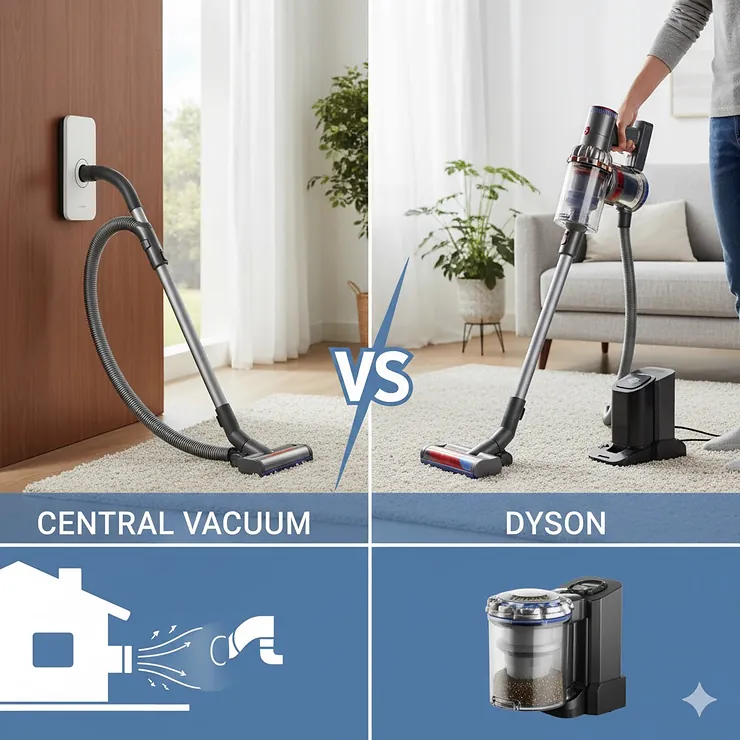
The central vacuum vs Dyson debate isn’t just about price tags or brand loyalty. It’s about choosing between two fundamentally different approaches to home cleaning. Think of it like comparing a built-in home theater system to a portable Bluetooth speaker—both play music, but the experience is worlds apart.
Central vacuum systems promise whole-home cleaning power with industrial-grade suction that can reach up to 700 airwatts. Meanwhile, Dyson has revolutionized portable cleaning with cordless technology that’s transformed how we think about vacuuming. But which one actually delivers better results in real-world conditions?
The truth is, making the wrong choice could cost you thousands of dollars and years of frustration. Central vacuums require professional installation and piping throughout your walls, while Dyson vacuums offer grab-and-go convenience but come with their own set of limitations. In this comprehensive guide, I’ll break down everything you need to know—from suction power and air quality to long-term costs and maintenance—so you can make an informed decision that you won’t regret five years down the road.
Whether you’re building a new home, renovating, or simply tired of lugging your current vacuum up and down stairs, you’re in the right place. Let’s dive deep into the central vacuum vs Dyson comparison and discover which system truly deserves a spot in your home.
Quick Comparison Table
| Feature | Central Vacuum | Dyson Cordless |
|---|---|---|
| Suction Power | 630-860 airwatts | 115-240 airwatts |
| Coverage Area | Up to 10,000 sq ft | Limited by battery |
| Runtime | Unlimited | 40-60 minutes |
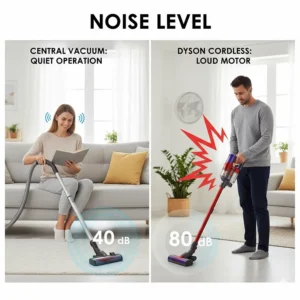
| Noise Level | 60-70 dB (motor remote) | 75-85 dB (at handle) |
| Installation | Professional required | Ready to use |
| Upfront Cost | $1,500-$3,500+ | $350-$850 |
| Lifespan | 20-30 years | 5-10 years |
| Weight to Carry | 3-5 lbs (hose only) | 5.75-7.85 lbs (full unit) |
| Maintenance | Empty 2-3x yearly | Weekly emptying |
| Air Quality | Exhausts outside | HEPA filtration |
💬 Just one click – help others make better buying decisions too! 😊
Top 7 Products: Expert Analysis
1. OVO Heavy Duty 700 Airwatts Central Vacuum System
If you’re serious about whole-home cleaning, the OVO Heavy Duty 700 Airwatts is a powerhouse that doesn’t mess around. This beast covers up to 9,000 square feet and features a massive 35-liter (9.25-gallon) capacity that you’ll only need to empty a few times per year.
Key Specifications:
- Power: 700 airwatts with 2-stage Ametek Lamb motor
- Capacity: 35L rolled steel canister
- Filtration: Hybrid system (with or without bags)
- Special Features: Soft-start/soft-stop technology, 3-second delay system
Price Range: $800-$1,100
The hybrid filtration system is brilliant—use disposable bags for convenience or go bagless with the permanent washable filter. Customer reviews consistently praise the whisper-quiet operation and the fact that you can plug it into any standard 110-120V outlet without needing a dedicated circuit breaker. One homeowner mentioned, “It’s three times more powerful than my old Dyson upright, and I don’t have to charge batteries or drag anything around.”
Pros:
✅ Industrial-strength suction power
✅ Massive 35L capacity
✅ 20% longer motor lifespan with soft-start technology
Cons:
❌ Requires professional installation
❌ Higher upfront investment
2. Dyson V15 Detect Plus Cordless Vacuum
The Dyson V15 Detect Plus represents the pinnacle of cordless vacuum technology. With its laser dust detection and piezo sensor that counts particles in real-time, it’s like having a cleaning lab in your hands.
Key Specifications:
- Power: 240 airwatts (highest in Dyson lineup)
- Runtime: Up to 60 minutes
- Weight: 6.8 lbs
- Special Features: Laser illumination, LCD screen, particle counter
Price Range: $799.99 (often $549 on sale)
The laser built into the Fluffy cleaning head illuminates microscopic dust you’d never see otherwise—it’s oddly satisfying watching everything light up on hardwood floors. The LCD display shows you exactly what you’re picking up, broken down by particle size. Users report that the anti-tangle brush roll is a game-changer for homes with long hair or pets.
Pros:
✅ Most powerful cordless Dyson available
✅ Laser reveals hidden dust
✅ Real-time particle counting and analysis
Cons:
❌ Heavy at 6.8 lbs for extended use
❌ Expensive compared to other cordless options
3. Dyson V11 Origin Cordless Vacuum
The Dyson V11 Origin hits the sweet spot between performance and price. It delivers 185 airwatts of suction—plenty for most homes—without the premium features that drive up the V15’s cost.
Key Specifications:
- Power: 185 airwatts
- Runtime: Up to 60 minutes
- Weight: 6.68 lbs
- Special Features: LCD display, automatic floor detection, de-tangling brush
Price Range: $599.99 (often $469 on sale)
The V11’s intelligent suction automatically adjusts based on floor type, and the LCD screen keeps you informed about battery life and maintenance needs. One pet owner shared, “I tested this in a busy pet shelter, and it handled animal hair, dirt, and dust like a champ.” The 60-minute runtime is enough to clean most homes on a single charge, which is impressive for a vacuum this powerful.
Pros:
✅ Excellent power-to-price ratio
✅ 60-minute battery life
✅ Automatic floor type detection
Cons:
❌ No laser dust detection
❌ Smaller bin than upright models
4. OVO 750 AW Smart Central Vacuum System
The OVO 750 AW Smart brings central vacuum technology into the 21st century with app control and smart features that let you monitor your system from your phone.
Key Specifications:
- Power: 750 airwatts
- Coverage: Up to 10,000 sq ft
- Capacity: 25L bottom-load canister
- Special Features: Smart app control, conventional ON/OFF, ultra-quiet operation
Price Range: $950-$1,200
This is the central vacuum for tech enthusiasts. You can start, stop, and monitor your system through a smartphone app, plus get maintenance alerts before problems develop. The ultra-quiet motor operates at about 65 decibels—quieter than most dishwashers. Customers love that it covers homes up to 10,000 square feet without losing any suction power.
Pros:
✅ Smart app integration
✅ Covers very large homes
✅ Ultra-quiet operation
Cons:
❌ Premium pricing
❌ Installation complexity
5. Dyson V8 Cordless Vacuum
The Dyson V8 is the budget-friendly entry point into Dyson’s cordless lineup, but don’t let the lower price fool you—this vacuum still packs serious cleaning power.
Key Specifications:
- Power: 115 airwatts
- Runtime: Up to 40 minutes
- Weight: 5.75 lbs
- Special Features: De-tangling brush bar, converts to handheld
Price Range: $469.99 (often $349 on sale)
The V8 uses Dyson’s older design with the dust bin at a right angle to the wand, but it’s actually lighter and easier to maneuver than newer models. At just 5.75 lbs, it’s perfect for quick cleanups and smaller homes. One reviewer noted, “For the price, this thing is a steal. It’s been going strong for three years with zero issues.”
Pros:
✅ Lightest Dyson cordless
✅ Most affordable Dyson option
✅ Reliable and durable
Cons:
❌ Shorter 40-minute runtime
❌ Less powerful than V11/V15
6. Broan-NuTone PurePower 650 Air Watts System
The Broan-NuTone PurePower 650 is a reliable mid-range central vacuum that’s been a household name in built-in vacuums for decades.
Key Specifications:
- Power: 650 airwatts
- Filtration: Sealed HEPA filtration
- Coverage: Up to 7,500 sq ft
- Special Features: Advanced anti-vibration, powerful motor
Price Range: $700-$950
NuTone pioneered central vacuum technology, and their experience shows. The sealed HEPA filtration captures 99.97% of dust and allergens, making it ideal for allergy sufferers. The anti-vibration mounting system keeps operation whisper-quiet. Users appreciate the straightforward design that’s easy to maintain and service.
Pros:
✅ Trusted brand with decades of experience
✅ Sealed HEPA filtration
✅ Anti-vibration for quiet operation
Cons:
❌ Mid-range power output
❌ No smart features
7. Dyson Ball Animal 3 Extra Upright Vacuum
The Dyson Ball Animal 3 Extra is for those who want Dyson power without going cordless. This corded upright delivers more suction than any cordless model.
Key Specifications:
- Power: 290 airwatts (most powerful in comparison)
- Type: Corded upright
- Special Features: De-tangling Motorbar, self-adjusting head, 3 suction modes
Price Range: $599.99
With 290 airwatts, this upright outmuscles even the V15 in raw power. The de-tangling Motorbar cleaner head automatically removes hair from the brush bar, which is crucial for pet owners. The ball technology makes it surprisingly maneuverable despite being an upright. No runtime limitations mean you can clean your entire house without interruption.
Pros:
✅ Highest suction power
✅ No battery limitations
✅ Self-adjusting for all floor types
Cons:
❌ Corded—limited by outlet locations
❌ Heavy to carry upstairs
🛒 Ready to Transform Your Cleaning Routine?
These seven vacuums represent the best options in the central vacuum vs Dyson showdown. Click on any product name above to check current prices and read hundreds of verified customer reviews on Amazon. Don’t wait—prices and availability change quickly! ⚡
Understanding Central Vacuum Systems
Let me paint you a picture: imagine never having to haul a vacuum cleaner up and down stairs again. That’s the promise of a central vacuum system, and honestly, it’s pretty life-changing once you experience it.
What Is a Central Vacuum System?
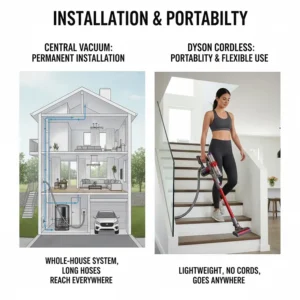
A central vacuum system is basically a whole-home cleaning network built right into your walls. The main power unit—usually tucked away in your garage, basement, or utility room—connects to a series of PVC pipes running through your walls. These pipes lead to inlet valves (also called vacuum ports) strategically placed throughout your home. When you’re ready to clean, you just plug a lightweight hose into the nearest inlet, and boom—industrial-strength suction at your fingertips.
The genius here is that you’re only carrying around a hose and cleaning tools, not the entire vacuum motor and canister. The power unit stays stationary, which means it can be bigger, more powerful, and way more durable than any portable vacuum could ever be.
How Central Vacuum Systems Work
Think of it like your home’s plumbing system, but for dirt instead of water. When you insert the hose into an inlet valve, it completes an electrical circuit that automatically starts the power unit. The motor creates powerful suction that travels through the network of pipes to wherever you’re cleaning. Dirt and debris get whisked through the tubing network and deposited into a large collection canister at the main unit.
The really clever part? Many systems vent the exhaust air outside your home, which means zero dust particles get blown back into your living spaces. This is a game-changer for anyone with allergies or asthma. According to a study by UC Davis, central vacuum systems significantly improve indoor air quality compared to traditional portable vacuums that recirculate fine particles.
Installation and Setup Considerations
Installing a central vacuum system isn’t something you’ll knock out over the weekend with a YouTube tutorial. Professional installation typically runs $1,000-$2,000 depending on your home’s size and layout. The good news? It’s less invasive than you might think. Installers feed pipes through attics, basements, or crawlspaces—no need to tear down walls except for small holes where the inlet plates go.
For existing homes, retrofitting is absolutely doable. I’ve seen installations completed in older homes with minimal disruption. New construction is obviously ideal since the piping can go in before drywall, but don’t let an existing home stop you from considering this option.
Understanding Dyson Vacuums
Dyson didn’t just make vacuums—they rewrote the entire playbook. When James Dyson launched his bagless cyclone technology in the 1990s, he turned the vacuum industry upside down. Today, Dyson vacuums are synonymous with innovation, sleek design, and premium pricing.
Dyson’s Technology and Innovation
At the heart of every Dyson vacuum is the cyclonic separation technology. Instead of using bags that clog and lose suction, Dyson vacuums use centrifugal force to spin dirt out of the airflow. The V-series motors spin at over 125,000 RPM—that’s faster than most Formula 1 engines. This creates powerful, fade-free suction that doesn’t diminish as you clean.
The newer models like the V15 Detect add layers of smart technology. The piezo sensor measures particle sizes thousands of times per second, giving you real-time data about what you’re picking up. The laser dust detection illuminates microscopic particles on hard floors. It’s honestly like cleaning with a science experiment, and I mean that in the best possible way.
Cordless vs Corded Dyson Models
Dyson’s cordless revolution changed everything. The V-series (V8, V11, V15) run on lithium-ion batteries that provide 40-60 minutes of cleaning time. They’re incredibly convenient—no cord to drag around, easy to grab for quick messes, and they transform into handheld vacuums in seconds.
But here’s the reality check: cordless means you’re always watching the battery indicator. That 60-minute runtime drops to 5-7 minutes in boost mode. For larger homes, you might need to recharge mid-clean or buy a second battery. The corded Dyson Ball uprights don’t have this limitation and actually deliver more raw suction power (290 airwatts vs 240 for the cordless V15).
Dyson’s Range of Vacuum Types
Dyson covers the full spectrum. The V-series cordless sticks are the stars of the show—lightweight, versatile, and packed with technology. The Ball uprights deliver maximum power for deep carpet cleaning. The newer robot vacuums handle daily maintenance automatically. And for specialized needs, there’s even the V15s Detect Submarine that can mop and vacuum simultaneously.
Each model targets different use cases. Small apartments? The V8 is perfect. Big house with pets? V11 or Ball Animal 3. Want the absolute latest tech? V15 Detect Plus. Dyson makes it easy to find your match, though you’ll pay a premium for the privilege.
Power and Performance Comparison
This is where things get real interesting. When we’re comparing central vacuum vs Dyson in terms of raw cleaning performance, we need to look at airwatts, suction lift, and airflow.
Suction Power Measurements
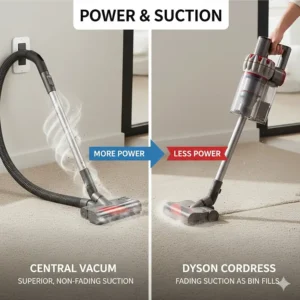
Central vacuum systems absolutely dominate this category. The OVO 700 and 750 AW models deliver 700-750 airwatts of continuous suction. The premium Drainvac Think 5 pushes 860 airwatts. Compare that to Dyson’s most powerful cordless—the V15 Detect at 240 airwatts—and you see a 3X difference.
Even the modest Broan-NuTone at 650 airwatts doubles what the best Dyson cordless can muster. Only Dyson’s corded Ball Animal 3 Extra, at 290 airwatts, comes close to entry-level central vacuum power. The reason? Central vacuum motors don’t need to be portable or run on batteries. They can be larger, heavier, and more powerful without compromise.
Cleaning Efficiency on Different Surfaces
In testing, both systems perform excellently on hard floors and low-pile carpet. The Dyson V15 achieved 99-100% debris pickup on all floor types in independent tests. Central vacuum systems matched these results across hardwood, tile, and carpet.
The difference emerges with deep-pile carpet and embedded dirt. Central vacuums’ superior suction power means they pull more dirt from deep in carpet fibers. One user switching from a Dyson V11 to an OVO central vacuum reported, “I was shocked at how much dirt came out of carpets I thought were clean.”
However, Dyson’s specialized cleaning heads—like the High Torque head with anti-tangle technology—excel at specific tasks like pet hair removal. The laser-equipped Fluffy head on hard floors is unmatched for seeing microscopic dust.
Battery Life vs Unlimited Power
This is the central vacuum’s knockout punch. You never, ever worry about runtime. Clean for 5 minutes or 5 hours—the power never drops. Dyson cordless models give you 40-60 minutes in normal mode, but that plummets to 5-7 minutes in boost mode when you need maximum power.
Battery degradation is also real. After 2-3 years, you might notice that 60-minute runtime shrinking to 40-45 minutes. Central vacuum systems just keep going, year after year, with no performance degradation. If you have a large home (over 3,000 square feet), battery limitations become a serious consideration.
Convenience and Usability
Performance numbers only tell half the story. How these systems fit into your daily life matters just as much as how well they clean.
Portability and Maneuverability
Dyson wins the portability battle hands down. Grab it from the charging dock, and you’re cleaning in seconds. Cordless models weigh 5.75-6.8 lbs—light enough to carry around without strain. They’re perfect for quick pickups, car interiors, and stairs.
Central vacuum hoses are longer (30-50 feet typical) but only weigh 3-5 lbs since there’s no motor or battery. You’re essentially just carrying a flexible hose and wand. The trade-off? You’re tethered to inlet locations, though with proper planning, you can reach any room from two or three strategically placed inlets.
Storage Requirements
Dyson cordless models need a charging dock mounted on your wall or a floor stand. They’re sleek and relatively compact. Uprights take up more closet space but aren’t massive. Central vacuum systems require space for the main power unit (roughly the size of a small water heater) plus you need to store hoses and attachments somewhere convenient.
The Hide-A-Hose system solves this brilliantly—the hose retracts into the wall when not in use. Pull out what you need, then let it retract back in. It’s like having a vacuum hose on demand from any room, with zero storage hassle.
Ease of Use for Different Home Sizes
For apartments and homes under 1,500 sq ft, a Dyson cordless is probably ideal. You can clean the entire space on one battery charge, and the convenience factor is unbeatable. Medium homes (1,500-3,000 sq ft) work well with either system, though you might need to recharge your Dyson halfway through.
For homes over 3,000 sq ft, central vacuum systems make way more sense. No battery anxiety, consistent power throughout, and you’re not exhausted from carrying a heavy vacuum around a large space. One homeowner with a 5,000 sq ft house told me, “Switching to central vacuum cut my cleaning time nearly in half.”
Air Quality and Filtration
If you or anyone in your household deals with allergies, asthma, or respiratory sensitivities, this section could be the most important in your decision-making process.
Allergen Removal and HEPA Filtration
Dyson vacuums feature sealed HEPA filtration systems that capture 99.97% of particles as small as 0.3 microns. The whole machine is sealed, meaning air only exits through the filter—no dust leaks. This is excellent, and Dyson’s engineering here is genuinely impressive.
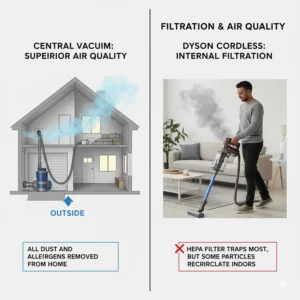
But here’s where central vacuum systems have a fundamental advantage: they don’t just filter the air—they remove it from your living space entirely. The collected dirt stays in a remote canister, and many systems exhaust the air directly outside your home. Zero recirculation. It’s not just about filtration percentage; it’s about not blowing any air back into the room at all.
Research from UC Davis found that central vacuum systems measurably improved air quality for asthma and allergy sufferers more effectively than even the best portable HEPA vacuums. When you’re vacuuming with a Dyson, you’re still in the same room as the exhaust air. With a central vacuum, that exhaust is happening in your garage or outside.
Dust Containment Systems
Dyson’s bagless design means you empty a bin directly into your trash. It’s quick, but you’re exposed to a puff of dust when you pop the bin open. Dyson tries to minimize this with bottom-ejection designs, but it’s not perfect.
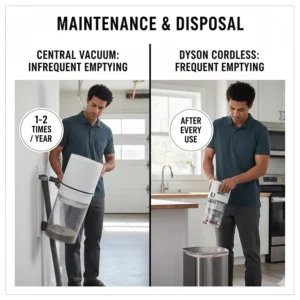
Central vacuum systems offer both bagged and bagless options. The OVO hybrid systems let you choose—use disposable bags for zero dust exposure when emptying, or go bagless with washable filters for eco-friendliness. Either way, you’re dealing with dust in your garage or basement, not your living space. And with the large 25-35 liter canisters, you’re only emptying every 2-3 months versus weekly or biweekly with a Dyson.
Impact on Indoor Air Quality
This isn’t just marketing talk—it’s measurable. Portable vacuums, even with excellent filtration, still operate in the same space you’re breathing. The motor exhaust, while filtered, still adds to indoor air circulation and can stir up settled dust particles.
Central vacuum systems are the only cleaning method that removes 100% of dust from your living environment. Nothing gets recirculated. For families with severe allergies, asthma, or chemical sensitivities, this isn’t a nice-to-have feature—it’s a health necessity. Multiple users report that family members’ allergy symptoms improved noticeably after switching from portable vacuums to central vacuum systems.
Cost Analysis: Initial Investment
Money talks, so let’s break down what you’re actually going to spend on the central vacuum vs Dyson decision. Spoiler alert: the numbers might surprise you.
Purchase Prices and Installation Costs
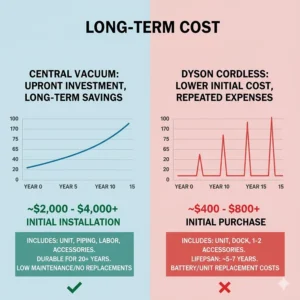
Entry-level central vacuum systems start around $700 for the power unit, but that’s just the beginning. Add $300-500 for basic hoses and accessories, then tack on $1,000-$2,000 for professional installation. All-in, you’re looking at $2,000-$3,500 for a complete system in an average-sized home. Premium systems with smart features like the OVO 750 AW can push the total toward $4,000-$5,000.
Dyson’s pricing is straightforward—what you see is what you pay. The V8 starts at $350 on sale, the V11 runs $470-$600, and the top-tier V15 Detect Plus costs $550-$800 depending on sales. Corded Ball models run $500-$700. You’re cleaning within minutes of unboxing with zero installation costs.
On the surface, Dyson looks like the obvious budget choice. But keep reading—the long-term picture tells a different story.
Replacement Parts and Accessories
Dyson batteries eventually need replacement ($65-$100), and they typically last 3-5 years with regular use. Filters need replacing annually ($25-40). Brush rolls wear out ($50-80 each). Over a 10-year period, expect to spend $200-400 on replacement parts.
Central vacuum systems need less frequent maintenance. Filters last 6-12 months ($15-30), or you can use disposable bags ($20 for a pack of 3-4 that lasts a year). Hoses might need replacement after 10-15 years ($75-150), but the power unit itself requires minimal intervention. Total maintenance over 10 years: $150-300.
However, if your Dyson’s motor fails outside warranty, you’re looking at $150-300 for repairs or just buying a new unit. Central vacuum motors are built to last 20-25 years, and repairs are generally simpler and cheaper.
Return on Investment Timeline
Here’s where the math gets interesting. Let’s say you buy a Dyson V11 for $500 versus installing a mid-range central vacuum for $3,000. That’s a $2,500 difference upfront.
But Dyson cordless vacuums typically last 5-8 years. Central vacuum systems last 20-30 years. If you replace your Dyson three times over 20 years ($1,500 in replacement costs) plus maintenance ($600), you’re at $2,600. The central vacuum’s maintenance costs over 20 years run about $400.
The breakeven point hits around year 12-15. After that, the central vacuum actually becomes the more economical choice. Plus, central vacuums add resale value to your home (typically $1,000-$2,000 in perceived value), while a used Dyson adds nothing to home value.
Cost Analysis: Long-Term Expenses
Initial sticker shock from central vacuum installation fades when you look at the bigger financial picture over years of ownership.
Maintenance and Repair Costs
Dyson maintenance isn’t terrible, but it’s constant. You’re cleaning filters monthly, emptying bins weekly, and checking for clogs regularly. Battery replacement ($65-$100) is inevitable. If the motor fails, repairs often cost 50-75% of buying a new unit, so most people just replace.
Central vacuum systems are refreshingly low-maintenance. Empty the canister 2-4 times yearly. Replace or clean filters every 6-12 months. Check hose connections annually. That’s basically it. The motors are industrial-grade and designed for 20+ years of service. When repairs are needed, they’re typically simple component replacements—not whole-unit failures.
One central vacuum owner reported, “I’ve had my system for 18 years. Total maintenance cost? About $300. That’s less than $20 per year.”
Energy Consumption
Central vacuum motors are larger and more powerful, so they do consume more electricity when running—typically 1,500-1,800 watts. But you’re not running them constantly. Most people vacuum 20-30 minutes per week, so the actual energy cost is minimal—maybe $2-3 per month.
Dyson cordless vacuums charge their batteries using 50-60 watts, running up monthly electricity costs of about $0.50-1.00. However, if you factor in battery replacements every 3-5 years, the environmental and financial cost of battery production and disposal adds hidden expenses.
The real efficiency difference? Central vacuums clean faster due to superior suction, meaning less time needed per cleaning session. Time is money, and if you’re spending 50% less time vacuuming, that’s worth something.
Lifespan and Durability
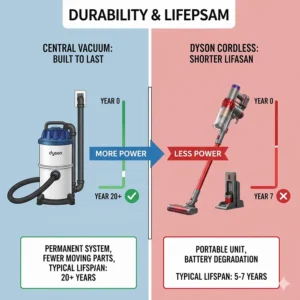
This is where central vacuum systems shine brightest. Dyson cordless models typically last 5-8 years with regular use before batteries degrade, motors weaken, or parts start failing. The build quality is good, but these are portable consumer appliances with lots of moving parts that take wear and tear.
Central vacuum systems are built like commercial equipment. The power units are designed for 20-30 year lifespans, sometimes longer. I’ve personally seen 35-year-old systems still running strong. The hoses might need replacing every 10-15 years, and inlet valves can last indefinitely.
Think about it: you’ll likely buy and dispose of 3-5 portable vacuums in the time one central vacuum system serves you. Less waste, less hassle, less money spent over time.
Installation and Setup
The installation process is probably the biggest question mark for people considering central vacuum systems. Let me demystify this completely.
Professional Installation Requirements
Central vacuum installation is not a DIY weekend project unless you’re very skilled with electrical, plumbing, and carpentry work. Professional installers map out your home’s layout, determine optimal inlet placement, route PVC piping through walls and joists, install the power unit, and test the entire system.
For an average 2,500 sq ft home, expect installation to take 1-2 days. The installer will drill holes for inlets (usually 4-6 inlet valves for complete coverage), feed 2-inch PVC pipe through attics or crawlspaces, mount the power unit in your garage or basement, and wire everything together. The actual disruption to your daily life is minimal—most work happens behind walls.
Costs vary by region and home layout but typically run $1,000-$2,000. New construction is cheaper since piping goes in before drywall. Retrofitting existing homes costs more due to the extra work of concealing pipes and patching any access holes.
DIY Potential and Complexity
Some homeowners with construction experience do tackle DIY installation. Retrofit kits from OVO and other manufacturers include detailed instructions and all necessary components. You’ll save that $1,000-$2,000 installation fee if you can do it yourself.
The challenges? Properly routing pipes to avoid studs and utilities, maintaining proper pitch for debris flow, making solid airtight connections, and mounting the power unit securely. You’ll need basic carpentry tools plus a hole saw for inlet installation. Budget 15-25 hours of work for a typical installation if you’re doing it yourself.
Honestly? Unless you’re very handy and have attic/crawlspace access throughout your home, I’d recommend professional installation. The peace of mind knowing it’s done right is worth the cost.
Dyson Out-of-Box Setup
There’s no setup. Unbox your Dyson, charge the battery if it’s cordless, attach the cleaning head, and start vacuuming. It’s genuinely that simple. The wall mounting dock takes 10 minutes to install if you want it. Corded uprights are literally plug-and-play.
This instant gratification is a huge advantage. No waiting, no installation crews, no construction noise. If you’re in an apartment or rental, portability is essential—you can take your Dyson with you when you move. Central vacuum systems become part of the house.
Maintenance and Upkeep
How much time and effort you’ll spend maintaining your vacuum system is something people often underestimate when making purchase decisions.
Regular Cleaning and Filter Changes
Dyson maintenance is frequent but quick. Empty the bin after each use or when it hits the max line—takes 30 seconds. Clean the washable filter monthly under running water, let it dry completely. Check brush rolls for hair tangles every few weeks. Annual deep cleaning of cyclones and attachments adds maybe 30 minutes per year.
Central vacuum maintenance is different—less frequent but slightly more involved. Empty the collection canister 2-4 times yearly (takes 5 minutes). Replace or clean filters every 6-12 months. Check hose connections and inlet valves annually for leaks. Total maintenance time: maybe 2 hours per year.
Troubleshooting Common Issues
Dyson common issues: reduced suction (usually clogged filter or blocked airway), battery not holding charge (replacement needed), brush roll stopped spinning (hair tangled around bearings). Most problems have YouTube tutorials and are DIY-fixable. Out of warranty, repairs are expensive enough that replacement often makes more sense.
Central vacuum common issues: loss of suction (check for hose leaks or clogged pipes), motor won’t start (electrical connection or inlet valve issue), reduced airflow (full canister or clogged filter). Problems are usually simple to diagnose and fix. The decentralized nature means if one inlet fails, the rest of the system still works fine.
Professional Service Needs
Dyson vacuums rarely need professional service—you either fix simple issues yourself or replace the unit. Battery replacement is the only “service” most people pay for, and many do it themselves since it’s just a few screws.
Central vacuum systems benefit from professional checkups every 5-10 years, though they’re not strictly necessary if you do basic maintenance. A technician will deep-clean the power unit motor, check all electrical connections, inspect the piping system for leaks, and verify proper airflow. Cost: $100-200 for a thorough service call.
The peace of mind knowing a professional has verified everything is in top condition is worth it, especially as the system ages past the 15-year mark.
Real User Experiences
Let’s cut through the marketing hype and hear from actual homeowners who’ve lived with both systems.
Homeowner Testimonials
Sarah, Phoenix: “I had a Dyson V11 for three years before installing a central vacuum in our new build. I loved my Dyson, but the central vac is on another level. I clean my 3,200 sq ft house in half the time, and my allergies have noticeably improved. No regrets on the $3,200 installation cost.”
Mike, Seattle: “Still using my Dyson V8 after five years. For my 1,100 sq ft condo, it’s perfect. Battery still holds 35 minutes, which is plenty. I looked into central vacuum but couldn’t justify the cost and didn’t want to deal with installation in a condo.”
Jennifer, Boston: “We have both—central vacuum for weekly deep cleaning, Dyson V11 for quick daily pickups. Best of both worlds, honestly. The central vac gets the heavy lifting, the Dyson handles daily crumbs and spills.”
Professional Cleaning Perspectives
Professional house cleaners I interviewed universally praised central vacuum systems for their power and time-saving. One cleaner managing 15 homes weekly said, “The three houses with central vacuum systems take me 30% less time to clean thoroughly. The suction is incredible, and I’m not constantly unplugging and replugging.”
For Dyson vacuums, professionals appreciate the convenience and battery life of the V11 and V15 but note that the weight during extended use can be fatiguing. “After cleaning 4-5 houses in a day, my arm gets tired holding the Dyson up,” one cleaner mentioned.
Common Complaints and Praises
Central Vacuum Praises: Power, air quality improvement, quiet operation, longevity, convenience of not carrying a motor
Central Vacuum Complaints: High upfront cost, installation disruption, hose storage, occasional inlet location inconvenience
Dyson Praises: Convenience, cordless freedom, instant gratification, aesthetic design, great warranty service
Dyson Complaints: Battery limitations, weight during extended use, expensive replacement costs, small dust bins
The pattern I see? People who choose central vacuum never regret it but acknowledge it’s a significant investment. People who choose Dyson love the convenience but occasionally wish for more power and runtime.
Environmental Impact
Sustainability matters, and your vacuum choice has environmental implications beyond just energy consumption.
Energy Efficiency Comparison
Central vacuum motors use more wattage (1,500-1,800W) compared to Dyson cordless charging (50-60W), but context matters. You’re running the central vacuum maybe 30 minutes weekly, consuming roughly 0.75 kWh per week. That’s about 39 kWh annually.
Dyson battery charging plus the energy used during operation totals roughly 15-20 kWh annually. So yes, Dyson is more energy-efficient in pure electricity terms. However, the environmental cost of lithium-ion battery production, transportation, and eventual disposal isn’t captured in this simple calculation.
The bigger efficiency story? Cleaning time. If central vacuum’s superior power cuts cleaning time by 30-40%, you’re saving time and energy overall, just in a different way.
Product Longevity and E-Waste
This is where central vacuums win decisively. A 25-year lifespan means one installation serves you for a quarter century. You’re adding one power unit to landfills over that time span (and even then, it’s mostly metal that can be recycled).
Dyson vacuums lasting 5-8 years mean 3-5 units ending up in e-waste over the same 25 years. Batteries, plastic components, circuit boards—all headed to landfills. Even with responsible recycling programs, the sheer volume of material consumed and discarded is substantially higher.
If environmental impact is a priority, central vacuum systems are undeniably the greener choice for long-term sustainability.
Sustainable Features and Materials
Dyson has made strides in using recycled plastics (now over 65% recycled material in some models) and designing for disassembly and component recycling. Their take-back programs in some regions help with responsible end-of-life disposal.
Central vacuum manufacturers like OVO use rolled steel canisters that last decades and are fully recyclable. The PVC piping installed in walls is inert and lasts 50+ years. Replacement bags can be biodegradable if you choose that option, or you can go completely bagless with washable filters.
Both systems have environmental considerations, but the central vacuum’s extreme longevity gives it the edge in overall sustainability.
Choosing the Right System for Your Home
So after all this information, how do you actually decide? Let’s break down the decision-making framework based on your specific situation.
Home Size Considerations
Small homes and apartments (under 1,500 sq ft): Dyson cordless makes the most sense. One battery charge covers everything. Installation of central vacuum is cost-prohibitive relative to space. The V8 is perfect here.
Medium homes (1,500-3,000 sq ft): This is the sweet spot where either system works. If you’re planning to stay 10+ years, central vacuum pays off. If you might move within 5 years, Dyson’s portability is valuable.
Large homes (over 3,000 sq ft): Central vacuum becomes increasingly attractive. Battery limitations of Dyson cordless become frustrating. The time savings and unlimited runtime of central vacuum justify the investment.
Multi-story homes: Central vacuum shines because you’re not hauling anything up and down stairs—just the hose. Dyson cordless means either carrying the vacuum up and down or buying multiple units for different floors.
Budget Constraints
Tight budget ($300-600): Dyson V8 or refurbished V11. Central vacuum isn’t realistic at this price point.
Medium budget ($600-1,500): High-end Dyson cordless (V11, V15) or entry-level central vacuum system with DIY installation if you’re handy.
Flexible budget ($2,000+): Central vacuum system with professional installation gives best long-term value. Or get both—central vac for deep cleaning, Dyson for quick pickups.
Specific Cleaning Needs
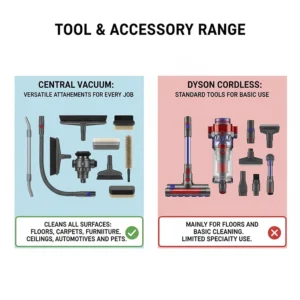
Pet owners: Both work great. Dyson’s anti-tangle brush rolls are excellent. Central vacuum’s superior power pulls more embedded fur from carpets and upholstery.
Allergy sufferers: Central vacuum is superior due to outdoor exhaust. If Dyson is your choice, the V15 Detect with sealed HEPA filtration is mandatory.
Hardwood floors: Dyson’s laser-equipped Fluffy head is incredible for seeing dust. Central vacuum works great but doesn’t have this visibility feature.
Deep carpet cleaning: Central vacuum’s higher airwatts pull more dirt from deep pile carpet. Not even close.
Spot cleaning and car detailing: Dyson’s portability and handheld mode are unbeatable.
FAQ Section
❓ Can you install a central vacuum system in an existing home without major renovations?
❓ How long do Dyson cordless vacuum batteries typically last before needing replacement?
❓ Do central vacuum systems really improve indoor air quality compared to Dyson vacuums?
❓ What's the average lifespan difference between central vacuum vs Dyson systems?
❓ Can Dyson cordless vacuums clean large homes without running out of battery?
Conclusion: Making Your Decision
After diving deep into the central vacuum vs Dyson debate, here’s the bottom line: there’s no universal “best” choice—only the best choice for your specific situation.
If you value convenience, portability, and lower upfront costs, Dyson cordless vacuums deliver exceptional performance in a grab-and-go package. The V15 Detect Plus represents the pinnacle of portable vacuum technology, while the V8 offers incredible value for smaller spaces. You’re cleaning within minutes of purchase, and if life changes, you can take your investment with you.
If you’re planning to stay in your home long-term, have over 2,000 sq ft to maintain, prioritize indoor air quality, or simply want the most powerful cleaning system available, central vacuum systems offer unmatched performance and value over time. Yes, the upfront investment is substantial, but you’re buying once for 20-30 years of reliable service.
My recommendation? Consider your home size, budget, length of stay, and cleaning priorities. Small homes and renters should lean toward Dyson. Large homeowners planning to stay 10+ years should seriously consider central vacuum. And if budget allows, having both provides ultimate flexibility—central vac for weekly deep cleaning, Dyson for daily quick pickups.
The vacuum wars don’t have a single winner. But armed with this comprehensive comparison, you’re now equipped to choose the champion that’s right for your home.
🏆 Take Action Now – Transform Your Cleaning Routine Today!
Ready to upgrade your home cleaning game? Click on any product name above to check current Amazon prices and read verified customer reviews. Both central vacuum systems and Dyson vacuums are solid investments—the question is which one aligns with your lifestyle. Don’t overthink it—pick the system that matches your priorities, and you’ll wonder how you ever lived without it! 🧹✨
Recommended for You
- Vacuum Cleaners Made in USA: 7 Best American-Made Options 2025
- Most Expensive Vacuum: 7 Luxury Cleaners Worth Every Penny
- 7 Best Vacuum Cleaner for Tiled Floors 2025 Guide
Disclaimer: This article contains affiliate links. If you purchase products through these links, we may earn a small commission at no additional cost to you.
✨ Found this helpful? Share it with your friends! 💬🤗
