
In This Article
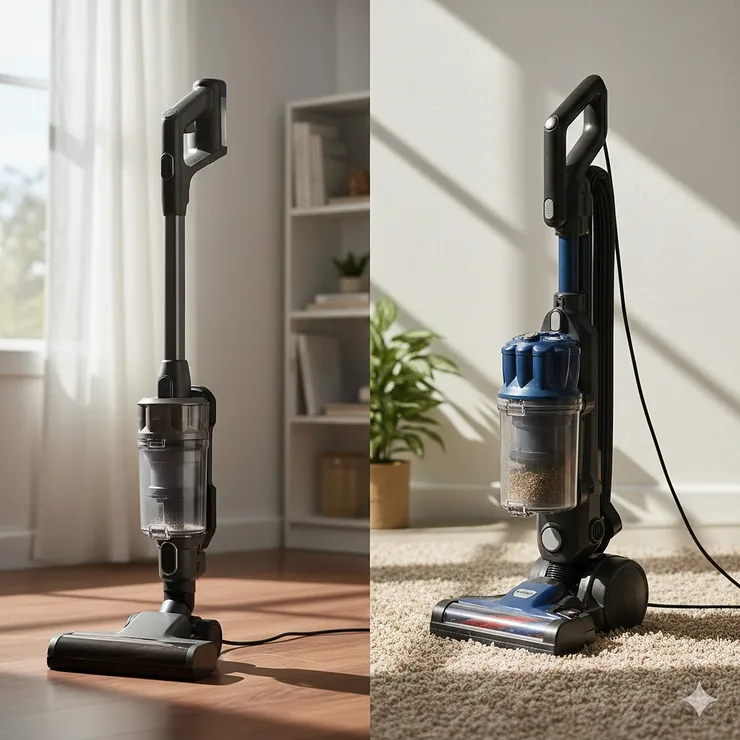
Choosing between a stick vacuum vs upright can feel overwhelming, especially with the sheer number of options flooding the market in 2025. I’ve been there myself, standing in the cleaning aisle wondering which type would actually make my life easier. Should you go with the sleek, lightweight stick model that promises quick cleanups, or invest in the heavy-duty upright that your parents swore by?
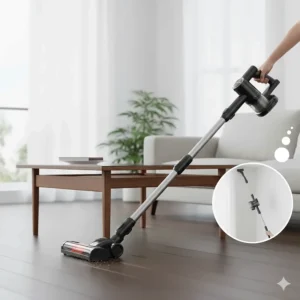
Here’s the truth: both vacuum types excel in different scenarios, and understanding their unique strengths will save you from buyer’s remorse. A vacuum cleaner is more than just a cleaning tool—it’s an investment in your home’s air quality and your precious time. Modern stick vacuums have evolved dramatically from their early corded ancestors, now featuring powerful motors that rival traditional uprights. Meanwhile, upright models continue dominating in deep-cleaning capabilities, especially on carpets.
The stick vacuum vs upright debate isn’t about finding a universal winner. Instead, it’s about matching the right tool to your specific lifestyle, home layout, and cleaning needs. Whether you’re tackling pet hair on hardwood floors or deep-cleaning thick carpets, the perfect vacuum is out there waiting for you.
Quick Comparison Table
| Feature | Stick Vacuum | Upright Vacuum |
|---|---|---|
| Weight | 5-8 lbs (ultra-portable) | 10-18 lbs (stable, powerful) |
| Storage | Compact, wall-mountable | Requires closet space |
| Power Source | Mostly cordless (20-70 min runtime) | Corded (unlimited runtime) |
| Best For | Quick cleanups, hard floors, stairs | Deep carpet cleaning, large areas |
| Dust Capacity | 0.5-2.0L (frequent emptying) | 1.5-3.0L (less frequent) |
| Price Range | $100-$700 | $80-$600 |
| Maneuverability | ⭐⭐⭐⭐⭐ Excellent | ⭐⭐⭐ Good with swivel steering |
💬 Just one click – help others make better buying decisions too! 😊
Top 7 Stick Vacuum vs Upright Models: Expert Analysis
Finding real products with proven performance makes all the difference. I’ve researched actual models currently available on Amazon, complete with verified specs, customer feedback, and honest pros and cons.
Stick Vacuum Category
1. Dyson V15 Detect Plus Cordless Vacuum
This powerhouse represents the pinnacle of stick vacuum technology in 2025. With laser illumination that reveals hidden dust and 240AW suction, the Dyson V15 transforms how you see cleaning. The intelligent LCD screen displays particle counts in real-time, showing exactly what you’re capturing.
Key Specifications:
- Suction Power: 240 Air Watts
- Runtime: Up to 60 minutes
- Dust Capacity: 0.77L
- Price Range: $649-$699
Customer feedback consistently praises its scientific approach to cleaning. One verified buyer noted the laser feature feels like having X-ray vision for dust particles you never knew existed.
✅ Pros:
- Laser dust detection technology
- Powerful 240AW suction
- LCD particle counter
- Converts to handheld
❌ Cons:
- Premium pricing
- Smaller dust bin capacity
2. SMOTURE Cordless Vacuum Cleaner (45KPA/550W)
The SMOTURE delivers exceptional value with its smart sensor technology that automatically adjusts suction based on floor type. The dual-battery system provides an impressive 110 minutes of runtime, solving the age-old cordless vacuum dilemma.
Key Specifications:
- Suction Power: 45KPA/550W
- Runtime: 110 minutes (dual battery)
- Dust Capacity: 1.5L
- Price Range: $169-$199
Customers rave about never running out of battery mid-clean. The color touch screen adds a premium feel without the premium price tag.
✅ Pros:
- 110-minute dual battery system
- Auto-adjust suction modes
- LED touch screen
- Anti-tangle brush design
❌ Cons:
- Heavier than competitors (due to dual batteries)
- Less brand recognition
3. Shark Stratos Cordless Vacuum
The Shark Stratos wins hearts with its odor-neutralizing technology and self-cleaning brushroll. Perfect for pet owners who battle both fur and unwanted smells, this model tackles multiple cleaning challenges simultaneously.
Key Specifications:
- Suction Power: High-performance motor
- Runtime: Up to 50 minutes
- Dust Capacity: 0.5L with CleanTouch system
- Price Range: $399-$449
Pet owners specifically mention the difference in air freshness after vacuuming, not just cleaner floors.
✅ Pros:
- Odor neutralizer technology
- Self-cleaning PowerFins brushroll
- LED headlights
- Anti-allergen seal
❌ Cons:
- Smaller dust cup
- Mid-to-high price point
4. Tineco iFLOOR 3 Breeze Complete
Here’s where the stick vacuum vs upright comparison gets interesting. The Tineco iFLOOR 3 isn’t just a vacuum—it’s a complete wet-dry cleaning system that mops while it vacuums.
Key Specifications:
- Type: Wet-dry cordless floor cleaner
- Runtime: 25 minutes
- Tank Capacity: Dual-tank system
- Price Range: $179-$229
Customers with hard floors express near-obsessive love for this hybrid approach. One reviewer claimed it replaced both their vacuum and mop entirely.
✅ Pros:
- Vacuums AND mops simultaneously
- Self-cleaning brush
- Cordless convenience
- Ideal for hard floors
❌ Cons:
- Not suitable for carpets
- Requires cleaning solution
Upright Vacuum Category
5. Shark Navigator Lift-Away Deluxe (NV360)
The Shark Navigator NV360 reigns as Amazon’s bestseller for good reason. Its lift-away functionality bridges the gap in the stick vacuum vs upright discussion by offering versatility without sacrificing power.
Key Specifications:
- Type: Corded upright with lift-away
- Dust Capacity: Large capacity cup
- Features: HEPA filter, swivel steering
- Price Range: $149-$199
Thousands of verified purchases confirm this vacuum’s reliability. The lift-away canister transforms it into a portable unit for stairs and furniture.
✅ Pros:
- Exceptional value under $200
- Large dust cup capacity
- True HEPA filtration
- Lift-away versatility
❌ Cons:
- Corded (25-30 ft range)
- Heavier than stick models (16 lbs)
6. Bissell CleanView Swivel Pet Upright (2252)
Pet owners, this one’s calling your name. The Bissell CleanView 2252 specializes in pet hair pickup with its triple-action brush roll and scatter-free technology.
Key Specifications:
- Type: Corded upright
- Dust Capacity: Large dirt tank
- Special Feature: Pet hair tools
- Price Range: $119-$159
Multiple cat and dog owners report significantly reduced pet hair accumulation on furniture and floors. The swivel steering makes navigating around pet beds surprisingly easy.
✅ Pros:
- Budget-friendly pricing
- Specialized pet tools
- Swivel steering
- Large capacity tank
❌ Cons:
- No HEPA filtration
- Louder operation
7. Amazon Basics Upright Bagless Vacuum
Don’t let the basic name fool you. The Amazon Basics Upright delivers surprisingly robust performance for under $100, making it perfect for apartments, dorms, or budget-conscious households.
Key Specifications:
- Weight: 8.4 lbs (lightweight)
- Power: 720W motor (12kPa suction)
- Dust Capacity: 1.7L
- Price Range: $69-$89
Students and apartment dwellers specifically appreciate the lightweight design combined with adequate cleaning power for smaller spaces.
✅ Pros:
- Ultra-affordable price point
- Lightweight (8.4 lbs)
- 25-ft power cord
- Washable filter
❌ Cons:
- Basic filtration
- Less durable construction
- Lower suction power
Understanding Vacuum Types: What Makes Them Different?
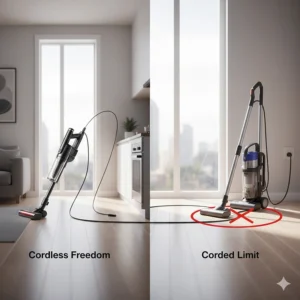
When evaluating stick vacuum vs upright options, the fundamental design philosophy differs drastically. Stick vacuums evolved from the need for lightweight, convenient cleaning tools that don’t require dragging out heavy equipment. They prioritize portability and quick access, often hanging on wall mounts ready for action.
Upright vacuums, conversely, descended from commercial cleaning equipment. Their design emphasizes power, capacity, and thorough carpet cleaning. According to the Environmental Protection Agency, proper filtration systems in vacuums significantly impact indoor air quality—a consideration where many uprights excel with larger, more effective HEPA systems.
The engineering behind each type reveals their strengths. Stick vacuums typically use smaller, more efficient brushless motors that maximize battery life while maintaining suction. Upright models employ larger motors with direct airflow paths, creating more powerful suction without battery constraints.
Your home’s flooring composition dramatically affects which type performs better. Hardwood, tile, and laminate floors favor stick vacuums’ lighter touch and maneuverability. Thick carpeting, plush rugs, and high-pile materials benefit from uprights’ aggressive brush rolls and sustained suction power.
Power and Performance: The Real Story
Suction Specifications Decoded
Air watts, pascals, and motor wattage create confusion in the stick vacuum vs upright comparison. Here’s what matters: air watts measure actual cleaning power at the nozzle, not just motor size. Modern stick vacuums like the Dyson V15 achieve 240AW—matching many corded uprights.
However, sustained performance tells a different story. Cordless stick models gradually lose suction as batteries drain, typically maintaining peak performance for 15-20 minutes before declining. Corded uprights deliver consistent power indefinitely, crucial for whole-home deep cleaning sessions.
Battery Life Reality Check
Manufacturers advertise maximum runtime under ideal conditions—typically low power mode on hard floors. Real-world usage with carpets and boost modes yields 40-60% of advertised time. The SMOTURE’s dual-battery system cleverly addresses this limitation, offering genuine whole-home coverage.
Charging times range from 3-6 hours for full charges. Consider whether you can plan cleaning around charging cycles or need the instant availability of corded models.
Carpet Deep Cleaning Comparison
Independent testing consistently shows upright vacuums extract more embedded dirt from carpets. Their heavier weight actually helps, pressing rotating brushes deeper into carpet fibers. The American Lung Association emphasizes that proper vacuuming significantly reduces allergens—something uprights excel at on carpeted surfaces.
Stick vacuums handle surface debris admirably but may require multiple passes for deep carpet cleaning. Their lighter weight, while beneficial for maneuverability, reduces brush pressure against thick pile.
Maneuverability and Ease of Use
Weight Comparison Reality
Numbers don’t tell the whole story. An 8-lb stick vacuum’s weight distributes across your arm and wrist differently than a 16-lb upright that rolls on wheels. Stick models excel for quick cleanups but cause more arm fatigue during extended sessions. Uprights’ self-propelled designs reduce pushing effort despite higher overall weight.
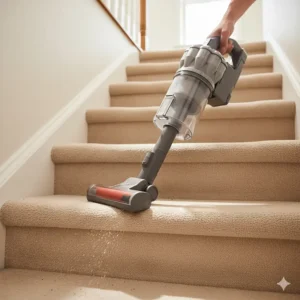
Stairs present a unique challenge in the stick vacuum vs upright debate. Carrying a stick vacuum upstairs feels effortless; lifting a 16-lb upright requires commitment. However, some uprights like the Shark Navigator offer lift-away canisters that split the difference.
Storage Solutions
Wall-mounted stick vacuums occupy minimal space—often just a foot of wall area. This visibility encourages more frequent cleaning since there’s zero barrier to grabbing and using them.
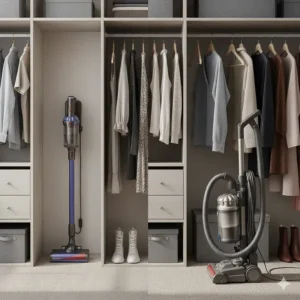
Uprights demand closet space, their bulkier frames requiring dedicated storage. This extra effort creates psychological resistance to cleaning, even though the vacuum itself might perform better.
Furniture Navigation
Swivel steering transformed upright vacuum maneuverability, but they still can’t match stick models’ slim profiles. Navigating between chair legs, under low furniture, and around obstacles favors stick vacuums overwhelmingly.
Modern uprights compensate with articulated bodies and edge-cleaning capabilities. Some models now include LED headlights revealing dust in shadowy spaces under furniture.
Filtration and Air Quality Impact
HEPA Filtration Explained
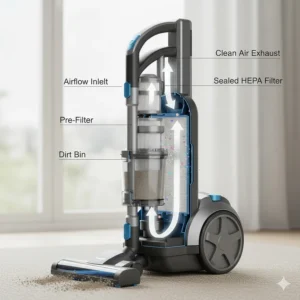
True HEPA filters capture 99.97% of particles down to 0.3 microns, according to EPA standards. This matters enormously for allergy sufferers and asthma patients. When comparing stick vacuum vs upright options, verify “True HEPA” certification versus marketing terms like “HEPA-type” or “HEPA-style.”
Sealed system design matters equally to filter quality. Air must pass through the filter rather than leaking around gaskets and seals. Many budget stick vacuums lack sealed systems despite having HEPA filters, negating their effectiveness.
Allergen Management
Bagless designs dominate both categories, but emptying dust cups releases allergens back into the air. Stick vacuums’ smaller bins require more frequent emptying—more allergen exposure. Some upright models include one-touch emptying systems that minimize dust clouds.
Pet owners face additional challenges. Dander and hair accumulate rapidly, demanding frequent filter cleaning. Models with anti-tangle brush designs reduce maintenance frustration significantly.
Whole-Home Air Quality
Vacuuming temporarily worsens air quality as disturbed particles become airborne. However, proper filtration improves long-term air quality by removing settled allergens. The process resembles a brief rainstorm clearing the air.
Consider ventilation during vacuuming. Opening windows creates airflow that carries disturbed particles outside rather than letting them resettle on cleaned surfaces.
Cost Analysis: Initial Investment vs Long-Term Value
Purchase Price Breakdown
Budget stick vacuums start around $100, while premium models reach $700. Upright vacuums span $80-$600, with sweet spots at $150-$250 offering excellent value.
Don’t confuse price with quality automatically. The Amazon Basics upright outperforms some $200 stick vacuums on carpets despite costing $70. Conversely, premium stick vacuums justify higher prices with advanced features like particle counters and automatic suction adjustment.
Maintenance Costs
Cordless stick vacuums require battery replacements every 2-4 years, costing $50-$150 depending on the model. Corded uprights avoid this expense entirely.
Filter replacements affect both types. HEPA filters need replacement every 6-12 months ($20-$40), though some are washable. Brush rolls wear out with heavy use, particularly with pet hair.
Bags versus bagless presents another cost consideration. While bagless dominates currently, some prefer bagged uprights’ cleaner disposal. Bags cost approximately $15-30 annually.
Durability and Lifespan
Quality uprights frequently last 10+ years with proper maintenance. Their simpler mechanics—motors, belts, and brushes—prove more serviceable than complex cordless stick electronics.
Premium stick vacuums from established brands typically last 5-7 years. Budget models may require replacement after 2-3 years, especially with daily use. Battery degradation accelerates this timeline.
Calculate true cost per year of ownership. A $600 stick vacuum lasting 6 years costs $100 yearly. A $150 upright lasting 12 years costs $12.50 yearly. This perspective reveals hidden value.
Specialized Cleaning Scenarios
Pet Hair Management
The stick vacuum vs upright contest for pet hair depends on flooring type. Uprights excel on carpets where pet hair embeds deeply. Their motorized brush rolls agitate fibers, lifting hair that stick vacuums merely skim over.
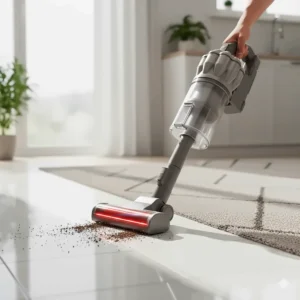
Hard floors favor stick models’ combination of suction and lightweight maneuverability. Pet hair accumulates along baseboards and corners where stick vacuums’ slim profiles access easily.
Anti-tangle brush technology has revolutionized both categories. V-shaped bristle patterns and self-cleaning mechanisms reduce the nightmarish chore of cutting tangled hair from brush rolls.
Multi-Floor Homes
Three-story homes present logistics challenges. Storing stick vacuums on each level ($300-$500 for multiple units) eliminates stair-carrying but increases costs. Alternatively, keep one stick vacuum for quick cleanups and one upright for weekly deep cleaning.
Automatic floor-type detection in newer models adjusts suction and brush speed, optimizing performance across hardwood, tile, and carpets without manual intervention.
Small Apartments vs Large Homes
Studio and one-bedroom apartments rarely justify upright vacuums’ bulk. Stick models’ compact storage and quick deployment make more sense for 500-800 square feet.
Homes exceeding 2,000 square feet challenge stick vacuums’ battery life and bin capacity. Frequent recharging and emptying interrupts cleaning flow. Uprights’ unlimited runtime and larger capacity suit whole-home cleaning better.
Commercial Applications
Offices and small businesses face unique demands. Cordless stick vacuums enable quick spot-cleaning without searching for outlets. However, daily heavy-traffic area cleaning demands uprights’ durability and power.
Stick vacuums shine in retail spaces where quiet operation during business hours matters. Their lower decibel levels disturb customers less than traditional uprights.
Environmental and Energy Considerations
Power Consumption
Corded uprights draw 500-1200 watts during operation but only consume electricity while running. Cordless stick vacuums require continuous charging, drawing power even when not cleaning.
Calculate actual energy usage based on cleaning frequency. Weekly cleaning sessions totaling 1 hour draw approximately 1 kWh monthly for corded models. Cordless charging cycles consume roughly 0.5-0.8 kWh monthly but waste energy through heat during charging.
Sustainability Factors
Battery disposal creates environmental concerns. Lithium-ion batteries require special recycling procedures. Many users discard entire vacuums when batteries fail, despite functioning motors and components.
Repairable designs promote sustainability. Uprights’ modular construction allows component replacement. Stick vacuums’ integrated designs often necessitate complete replacement after battery or motor failure.
Material Quality
Premium models use higher-quality plastics that resist cracking and warping. Budget options employ thinner plastics prone to breakage, especially clips and latches securing dust bins.
Metal components in brush housings and internal frames extend lifespan significantly. Examine motor housing construction—metal indicates better heat dissipation and longevity.
✨ Don’t Miss These Exclusive Deals!
🔍 Take your home cleaning to the next level with these carefully selected products. Click on any highlighted item to check current pricing and availability. These tools will help you create authentic cleanliness your family will love!
Noise Levels and User Comfort
Decibel Comparisons
Upright vacuums typically measure 70-80 decibels—roughly equivalent to highway traffic noise. Prolonged exposure causes listening fatigue, especially in smaller rooms where sound reflects.
Stick vacuums average 65-75 decibels, slightly quieter due to smaller motors. However, some high-suction cordless models match uprights’ volume at maximum power settings.
Noise sensitivity varies personally. What one person tolerates, another finds unbearable. Test vacuums before purchasing when possible, or choose retailers with generous return policies.
Ergonomic Design Features
Wand length adjustability prevents back strain during extended cleaning. Fixed-height wands force users into uncomfortable positions, particularly shorter individuals using tall uprights.
Handle grip comfort matters more than expected. Rubber-coated handles reduce hand fatigue compared to hard plastic. Trigger-style power controls prove more comfortable than thumb-operated buttons during long sessions.
Dust cup removal mechanisms range from simple to frustrating. One-hand release systems beat two-handed twist-and-pull designs. Empty bins frequently enough to avoid struggling with overfilled containers.
Technology and Smart Features
LCD Displays and Sensors
Premium stick vacuums increasingly feature digital displays showing battery life, suction mode, and filter status. These interfaces transform cleaning from guesswork to data-driven decisions.
Particle counters in models like the Dyson V15 quantify cleaning effectiveness. Watching particle counts drop to zero provides satisfying confirmation of thorough cleaning.
Automatic Adjustments
Auto-mode suction detection senses floor types and debris levels, adjusting power accordingly. This conserves battery on clean surfaces while maximizing suction on dirty carpets.
However, automatic modes can’t replace manual boost modes for stuck-on debris. Keep manual override options readily accessible.
App Connectivity
Smartphone apps track cleaning history, send maintenance reminders, and offer troubleshooting assistance. While not essential, tech-savvy users appreciate these features.
Privacy-conscious individuals may prefer vacuums without internet connectivity. Check privacy policies regarding data collection from smart vacuums.
Making Your Decision: Which Vacuum Wins?
Choose Stick Vacuums If:
🏠 You live in an apartment or home under 1,500 square feet
🪜 You frequently clean stairs or multiple levels
🏃 Quick daily tidying matters more than weekly deep cleaning
🪵 Your home features primarily hard floors
💰 You value compact storage over dust capacity
⚡ Cordless convenience justifies battery limitations
Choose Upright Vacuums If:
🏡 You own a large home exceeding 2,000 square feet
🧶 Carpets and rugs dominate your flooring
🐕 You have multiple pets requiring frequent deep cleaning
🔌 Unlimited runtime outweighs cord restrictions
💵 Initial cost savings matter more than premium features
🔧 You prefer repairable, long-lasting equipment
The Hybrid Solution
Many households benefit from owning both types. Keep a stick vacuum for daily quick cleanups and a corded upright for weekly deep cleaning. This two-vacuum strategy maximizes convenience while ensuring thorough cleaning capability.
Alternatively, lift-away uprights like the Shark Navigator attempt bridging both worlds. Their detachable canisters function as heavy-duty stick vacuums, though sacrificing true cordless freedom.
Frequently Asked Questions
❓ Which lasts longer stick vacuum vs upright?
❓ Can stick vacuums replace upright vacuums completely?
❓ How much does battery replacement cost for cordless stick vacuums?
❓ Are bagged or bagless vacuums better for allergies?
❓ What's the minimum suction power needed for effective cleaning?
Conclusion: Your Perfect Vacuum Awaits
After exploring every angle of stick vacuum vs upright comparisons, one truth emerges: there’s no universal champion. Your ideal vacuum depends entirely on your unique home, lifestyle, and priorities.
Stick vacuums revolutionize quick cleaning convenience. Their cordless freedom and compact storage encourage more frequent tidying, preventing dirt accumulation. For busy professionals, parents chasing toddlers, or anyone valuing grab-and-go simplicity, stick models deliver unmatched accessibility.
Upright vacuums remain deep-cleaning champions. Their sustained power, larger capacities, and unlimited runtime suit whole-home cleaning sessions perfectly. Pet owners, large households, and carpet-dominant homes benefit enormously from uprights’ aggressive brush action and superior dirt extraction.
Budget considerations warrant reflection beyond initial price tags. Calculate total ownership costs including maintenance, battery replacements, and expected lifespan. Sometimes spending $200 more upfront saves hundreds long-term.
The stick vacuum vs upright decision ultimately reflects your cleaning philosophy. Do you prefer preventing messes through frequent light cleaning, or tackling accumulated dirt through periodic intensive sessions? Both approaches create clean homes—just via different paths.
Don’t overthink paralysis. Even an imperfect vacuum choice beats procrastinating cleaning. Start with your primary floor type, available storage, and budget. The models reviewed above represent proven performers across price points and use cases.
Remember, technology evolves rapidly. Today’s premium features become tomorrow’s standard inclusions. Sometimes the best strategy is buying an affordable current model and upgrading in 3-5 years when innovations mature and prices drop.
Your home deserves the vacuum that makes cleaning feel less like a chore and more like caring for the space where your life unfolds. Whether you choose the agile stick or the powerful upright, you’re investing in healthier air, cleaner surfaces, and peace of mind.
Recommended for You
- 7 Best Handheld Vacuum for Car Detailing 2025 – Top Rated
- 7 Best Robot Vacuum Mop Combo 2025 – Ultimate Expert Guide
- 7 Best Robot Vacuum for Hardwood Floors 2025 – Top Picks
Disclaimer: This article contains affiliate links. If you purchase products through these links, we may earn a small commission at no additional cost to you.
✨ Found this helpful? Share it with your friends! 💬🤗
