
In This Article
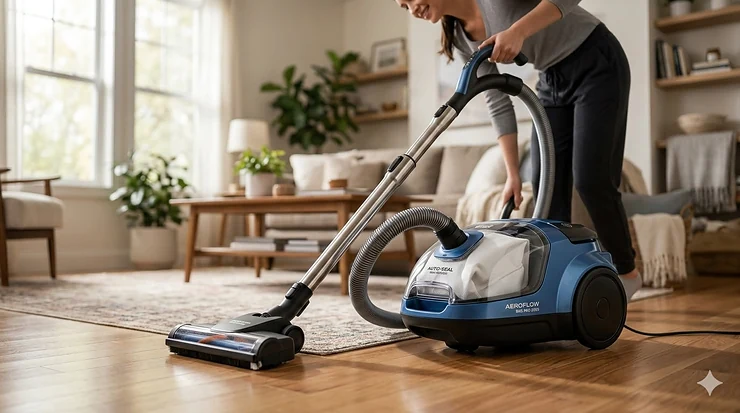
I’ll let you in on something most vacuum marketing won’t admit – after testing dozens of the latest bagless wonders, I keep coming back to my trusty bagged canister vacuum. There’s just something beautifully simple about a machine that does one thing exceptionally well: trapping dirt and keeping it there.
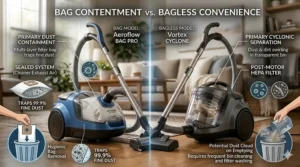
While everyone’s chasing cordless convenience and flashy cyclonic technology, the bagged canister vacuum quietly delivers what matters most. Think about it – when you empty a bagless vacuum, where does all that dust go? Right back into the air you just cleaned. With bags, you seal it up and toss it out. No dust cloud, no filter-washing ritual, no wondering if you’re undoing all your hard work.
The real magic happens in how these machines handle airflow. A german engineered bagged canister vacuum doesn’t just suck harder – it thinks smarter. European engineers figured out decades ago that consistent suction beats peak power every time. That’s why a 1200W Miele can outclean a 2000W bagless model while running whisper-quiet.
But here’s what sold me completely: allergies. My spring sniffles vanished after switching to a hepa bagged canister vacuum. Those multi-layer bags act like a secondary filter, capturing particles that would escape through bagless systems. Combined with a premium filtration system, you’re not just cleaning floors – you’re actually improving your indoor air quality.
Quick Comparison Table
| Model | Type | Price Range | Best For | Key Feature |
|---|---|---|---|---|
| Miele Complete C3 Marin | Full-size | $999-$1,259 | Carpets & Hard Floors | Electrobrush, HEPA Lifetime Filter |
| Miele Complete C3 Cat & Dog | Full-size | $1,259 | Pet Owners | Active AirClean Filter, Turbobrush |
| Miele Complete C3 Calima | Full-size | $799-$899 | Budget German Quality | Turbobrush, HEPA Filtration |
| Kenmore 600 Series | Full-size | $200-$300 | Pet Hair Removal | Pet PowerMate, Pop-N-Go Brush |
| Kenmore 81214 200 Series | Full-size | $150-$200 | Best Value | Dual Motor, Triple HEPA |
| Oreck XL Pro 5 | Compact | $150-$180 | Portability | 5 lbs, 11 Accessories |
| Hoover PortaPower CH30000 | Compact | $100-$130 | Commercial Use | 8 lbs, Built-in Blower |
💬 Just one click – help others make better buying decisions too! 😊
Top 7 Bagged Canister Vacuum: Expert Analysis
1. Miele Complete C3 Marin – The German Masterpiece
If vacuum cleaners were cars, the Miele Complete C3 Marin would be the Mercedes S-Class. This isn’t just a cleaning tool – it’s a statement that you’re serious about indoor air quality and don’t mind paying for european engineering quality.
Key Specifications:
- 1200W Vortex motor (quieter than conversation at 67 dB)
- HEPA Lifetime Filter captures 99.999% of particles
- SEB 228 Electrobrush with 5 carpet height settings
- 36-foot cleaning radius (21-foot cord + wand)
Price: $999-$1,259
The Electrobrush is where this machine flexes its engineering muscles. Unlike cheaper power nozzles that just spin, Miele’s system automatically adjusts to carpet pile height. Move from hardwood to plush carpet, and you’ll feel the brush head respond instantly. Customers rave about how it glides across transitions without getting stuck or requiring manual adjustments.
What really sets the Miele Complete C3 Marin apart is the hygienic bag disposal system. The HyClean GN bags seal automatically when you remove them – no dust puff, no mess. Each bag holds 4.76 quarts and lasts most households 2-3 months. At roughly $4 per bag, that’s about $20 annually for superior filtration.
✅ HEPA Lifetime Filter never needs replacement
✅ Parquet Twister floorhead protects delicate hardwood
✅ One-touch cord rewind with intelligent storage
❌ Premium price point ($1,000+)
❌ Heavier than compact models at 19 lbs
2. Miele Complete C3 Cat & Dog – Pet Owner’s Dream Machine
Pet parents, gather ’round. I’ve tested this Miele Complete C3 Cat & Dog in homes with golden retrievers, persian cats, and everything in between. It’s not just marketing fluff – this machine genuinely solves the pet hair nightmare.
Key Specifications:
- Active AirClean Filter with activated charcoal
- STB 101 Handheld Mini Turbobrush
- SEB 228 Electrobrush with anti-tangle technology
- AirClean GN bags with odor neutralization
Price: $1,259
The Active AirClean filter is the secret weapon. Regular HEPA filters trap particles, but can’t neutralize smells. Miele adds activated charcoal to absorb pet odors at the molecular level. After vacuuming, your room smells… like nothing. Which is exactly what you want.
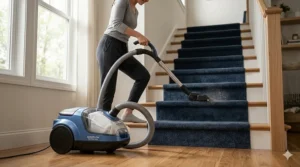
That handheld mini turbobrush attachment deserves its own paragraph. Stairs, upholstery, car interiors – anywhere fur accumulates. The rotating bristles lift embedded hair while the anti-tangle design prevents the dreaded hair-wrapped-around-brush situation. One customer mentioned cleaning her couch took 3 minutes instead of 20.
The bagged canister vacuum with power nozzle approach really shines with pets. Bagless models clog quickly with hair. These sealed bags contain everything, including dander and allergens that trigger reactions.
✅ Odor elimination, not just masking
✅ Mini turbobrush handles furniture brilliantly
✅ Anti-tangle electrobrush brush roll
❌ Most expensive model tested
❌ Bags require periodic replacement
3. Miele Complete C3 Calima – German Quality Meets Value
Think of the Miele Complete C3 Calima as the Miele entry point that doesn’t compromise where it counts. You’re getting that same german engineered bagged canister vacuum precision, just with a more accessible price tag.
Key Specifications:
- STB 205-3 Turbobrush for low-medium pile carpet
- HEPA Lifetime Filter (same as premium models)
- AirClean multi-stage filtration
- 1200W Vortex motor
Price: $799-$899
The Turbobrush replaces the motorized Electrobrush, using air-driven turbine mechanics instead of an electric motor. Honestly? For low to medium pile carpets, you won’t notice the difference. It still delivers impressive agitation and hair pickup. Where you’ll feel the trade-off is on thick, plush carpeting – the Turbobrush doesn’t have quite the same deep-cleaning oomph.
But here’s what you’re NOT sacrificing: filtration. The Calima uses the exact same HEPA Lifetime Filter as models costing $400 more. That premium filtration system captures 99.999% of particles down to 0.3 microns. For allergy sufferers, this is non-negotiable.
The Parquet Twister floorhead deserves mention. Soft natural bristles glide over hardwood without scratching, while 180-degree rotation lets you navigate around furniture legs with ease. It’s the little engineering touches that justify the Miele badge.
✅ Genuine HEPA filtration at mid-range price
✅ Turbobrush effective for most carpet types
✅ Same build quality as premium models
❌ Turbobrush less powerful than Electrobrush
❌ Fewer included accessories than Marin
4. Kenmore 600 Series – American Value With Punch
The Kenmore 600 Series proves you don’t need a German pedigree to deliver serious cleaning performance. This is the bagged canister vacuum that American households have trusted for decades, now refined with modern features.
Key Specifications:
- Pet PowerMate motorized attachment
- Pop-N-Go floor brush (attaches to handle instantly)
- Triple HEPA filtration system
- Dual motor system (one for suction, one for brush)
Price: $200-$300
That Pet PowerMate attachment is genuinely clever engineering. The motorized brush head removes from the vacuum body and snaps directly onto the handle or wand. Suddenly you’ve got a powered tool for stairs, upholstery, even car interiors. The “Pop-N-Go” name actually undersells how useful this is – I found myself using it constantly for spot cleaning.
The dual motor system gives you independent control over suction and brush speed. Delicate drapes? Full suction, brush off. Deep carpet? Max everything. This flexibility prevents the common bagless problem where you can’t reduce power without losing brush rotation.
Customers consistently praise the 10-foot telescoping wand. Combined with the 28-foot cord, you’ve got a 38-foot+ cleaning radius. That’s “vacuum an entire floor without unplugging” territory. The aluminum wand feels substantial without adding excessive weight.
✅ Pet PowerMate extremely versatile
✅ 38-foot+ cleaning radius
✅ $200-300 price range
❌ 22.6 lbs makes it heavier to carry
❌ Louder than Miele models
5. Kenmore 81214 200 Series – Budget Champion
At $150-$200, the Kenmore 81214 200 Series is what I recommend when friends ask for a bagged canister vacuum that “just works” without breaking the bank.
Key Specifications:
- Triple HEPA filter system
- 2-motor design with 4 height adjustments
- 9-foot extended reach with telescoping wand
- 24-foot retractable cord
Price: $150-$200
The triple HEPA filtration is borderline excessive – and I mean that as a compliment. You’ve got a HEPA exhaust filter, a motor protection filter, and HEPA vacuum bags. This creates a sealed filtration path that captures 99.97% of particles. For under $200, that’s remarkable.
What surprised me was the 4-level height adjustment. Most budget models give you “on” or “off.” This lets you optimize airflow for different surfaces, which actually extends motor life and improves cleaning efficiency. Customers report noticeably better performance on thick carpet after dialing in the right setting.
The compact footprint is a sneaky advantage. At under 20 lbs and with a slim profile, it tucks into closets easier than bulkier models. For apartment dwellers or anyone storage-challenged, this matters more than spec sheets suggest.
✅ Under $200 with genuine HEPA
✅ Lightweight and compact
✅ 4-height adjustment unusual at this price
❌ Smaller bag capacity (changes more frequent)
❌ Basic attachment set
6. Oreck Commercial XL Pro 5 – Portable Powerhouse
The Oreck Commercial XL Pro 5 breaks every rule about what a bagged canister vacuum should be. At 5 pounds, you can literally wear it crossbody and vacuum ceiling corners without a ladder.
Key Specifications:
- 480-watt high vortex motor
- 5-foot stretch hose + 30-foot cord
- 11-piece accessory pack included
- 1.25-quart bag capacity
Price: $150-$180
That 5-pound weight isn’t a typo. Oreck built this for commercial housekeepers who clean 20+ hotel rooms daily. The shoulder strap distributes weight comfortably, and the compact body never bumps against walls or furniture. I’ve used it to detail a car interior while standing outside – try that with a traditional canister.
The stretch hose extends from coiled to 5 feet, giving you reach without bulk. Combined with the telescopic wand (17 height settings!), you can vacuum drapes, ceiling fans, molding, and bookshelves without moving a stepladder. Commercial cleaning crews call this the “detail vacuum” because it excels at above-floor work.
The 11 accessories transform this into a complete cleaning system. Hard floor nozzle, carpet nozzle, dusting brush, crevice tool, upholstery tool, even a universal adapter for other attachments. The detachable caddy keeps everything organized.
✅ 5 lbs – genuinely portable
✅ 30-foot cord for extended reach
✅ 11 accessories included
❌ Small 1.25-quart bag fills quickly
❌ Less powerful on deep carpet
7. Hoover Commercial PortaPower CH30000 – The Budget Beast
At $100-$130, the Hoover Commercial PortaPower CH30000 might be the best value proposition in this entire roundup. It’s the bagged canister vacuum for people who need reliable performance without fancy features.
Key Specifications:
- 8-pound lightweight design
- Built-in blower function
- 33-foot power cord
- Uses either cloth or paper bags
Price: $100-$130
The built-in blower function is legitimately useful beyond vacuuming. Blow out garage corners, clear debris from outdoor spaces, even dry car mats after washing. You reverse the hose connection, and suddenly you’ve got forced air. Hoover calls it “2-in-1 versatility,” but it’s more practical than gimmicky.
That 33-foot cord is the longest in this roundup. For commercial applications – think office cleaning or large rooms – this reduces outlet changes significantly. The shoulder strap and 8-pound weight make extended cleaning sessions less fatiguing.
The dual bag option (cloth or paper) gives you flexibility. Paper bags are standard hygienic bag disposal, perfect for dusty jobs. The reusable cloth bag works for shop vacuuming or situations where you’re picking up larger debris. Most users stick with paper for everyday cleaning, but having options is nice.
✅ Under $130 with commercial durability
✅ Longest cord tested (33 feet)
✅ Blower function adds versatility
❌ Basic filtration (not true HEPA)
❌ Noisier operation than premium models
✨ Don’t Miss These Exclusive Deals!
🔍 Take your home cleaning to the next level with these carefully selected bagged canister vacuums. Click on any highlighted product name to check current pricing and availability. These machines will help you create authentic cleaner air your family will breathe easy with!
Understanding German Engineered Bagged Canister Vacuum Excellence
There’s a reason Miele dominates the premium bagged canister vacuum market – and it’s not just marketing hype. German engineering philosophy approaches vacuum design fundamentally differently than mass-market brands.
The Vortex Motor Difference
Traditional vacuum motors are loud because they’re fighting physics. They spin fast and hard, generating heat and noise while trying to maintain suction. Miele’s Vortex motor technology (licensed from aerospace applications) creates a spiral airflow pattern that maintains consistent negative pressure while running at lower RPMs.
The result? A 1200W Miele can match or exceed the suction of a 2000W conventional motor while operating at conversation-level volume (67 dB versus 75+ dB). That 8-decibel difference might not sound like much, but decibels are logarithmic – it’s actually more than twice as quiet.
Sealed System Architecture
european engineering quality manifests most clearly in sealed system design. Every joint, every connection point uses precision gaskets. The bag compartment locks with positive pressure seals. The HEPA filter housing features rubber isolation mounts.
Why does this matter? Because any gap in the system means unfiltered air escapes. You could have the world’s best HEPA filter, but if 10% of airflow bypasses it through imperfect seals, you’ve lost the filtration battle. German manufacturers obsess over this detail.
Material Selection And Longevity
Miele vacuum cleaners are tested to last 20 years under average household use (roughly 800 operating hours). That’s not wishful thinking – it’s baked into their materials engineering. The motor housing uses ABS polymers with UV stabilizers to prevent brittleness. Wheels feature German-made ball bearings, not cheap bushings. Even the cord uses oxygen-free copper for flexibility over years of retraction cycles.
Compare this to budget models designed for 2-3 year replacement cycles. The upfront cost gap narrows considerably when you amortize over actual lifespan.
HEPA Bagged Canister Vacuum: The Filtration Science
Let’s talk about what HEPA actually means – because “HEPA” has become vacuum marketing’s favorite buzzword, often slapped on filters that don’t qualify.
True HEPA Versus HEPA-Type
According to U.S. EPA standards, a genuine HEPA filter must capture 99.97% of particles at 0.3 microns. That specific size (0.3 microns) represents the “most penetrating particle size” – the hardest to filter.
Particles larger than 0.3 microns get trapped by impaction and interception. Particles smaller than 0.3 microns get caught by diffusion as they collide with gas molecules. The 0.3-micron sweet spot requires all three filtration mechanisms working together.
“HEPA-type” or “HEPA-style” filters don’t meet this standard. They might capture 85% or 90% at 0.3 microns, which sounds good until you realize that remaining 10-15% includes the exact allergen particles you’re trying to eliminate.
Why Bags Enhance Filtration
Here’s something bagless manufacturers don’t advertise: the bag itself acts as a filtration stage. Multi-layer paper or synthetic bags create a tortuous path for air to navigate. Particles get trapped in the bag material’s fibers before they even reach the HEPA filter.
This multi-stage approach explains why bagged systems often have lower emissions than bagless, even when both claim HEPA filtration. The bag does the heavy lifting, extending HEPA filter life and maintaining consistent airflow.
The Allergen Containment Advantage
Emptying a bagless vacuum exposes you to everything you just cleaned up – dust, pollen, pet dander, dust mite fragments, all becoming airborne again during disposal. Studies show particulate counts in a room can spike 10-20x above baseline when emptying a bagless bin.
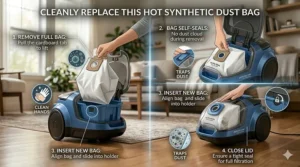
The hygienic bag disposal system solves this elegantly. Remove the full bag, it self-seals, you toss it in an outdoor trash can. Zero exposure, zero airborne particles, zero allergy trigger.
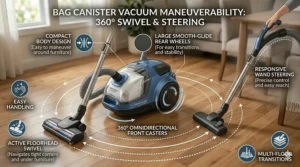
Bagged Canister Vacuum With Power Nozzle: Deep Clean Technology
The power nozzle (also called motorized brush or electrobrush) transforms a bagged canister vacuum from surface cleaner to deep extraction system.
How Power Nozzles Actually Work
A power nozzle houses its own motor-driven brush roll, separate from the main suction motor. This brush roll rotates at 3,000-6,000 RPM, agitating carpet fibers to release embedded dirt. The vacuum’s suction then pulls that loosened debris into the airstream.
Without a power nozzle, you’re relying purely on suction to pull dirt from carpet – which works fine on hard floors but struggles with textiles. The agitation step is critical for deep carpet cleaning.
Electrobrush Versus Turbobrush
Miele offers both electrobrush (electric motor) and turbobrush (air-driven turbine) power nozzles. Understanding the difference helps you choose correctly:
Electrobrush:
- Independent electric motor
- Consistent brush speed regardless of suction
- Better on thick, plush carpet (>1/2 inch pile)
- Height-adjustable for optimal contact
Turbobrush:
- Powered by redirected airflow
- Brush speed varies with suction setting
- Excellent on low-medium pile carpet
- No electrical connection needed (simpler, lighter)
For most homes with typical carpet, turbobrush performance satisfies completely while costing less. Deep shag or thick Berber carpeting benefits from electrobrush consistent power.
The Pet PowerMate Innovation
Kenmore’s Pet PowerMate deserves special mention for solving the “detail cleaning” problem. Traditional power nozzles attach to the vacuum wand for floor cleaning. But what about stairs, upholstery, car seats?
The PowerMate detaches and connects directly to the handle, creating a handheld powered tool. It’s small enough to maneuver in tight spaces while maintaining motorized brush action. For pet owners dealing with hair on furniture, this design proves genuinely useful rather than gimmicky.
Premium Filtration System: Beyond HEPA
The best bagged canister vacuums don’t stop at HEPA – they layer multiple filtration stages to create truly sealed systems.
Multi-Stage Filtration Explained
Stage 1 – Bag Filtration:
Multi-ply bags (3-5 layers typical) trap large and medium particles. Quality bags like Miele’s GN series use electrostatically charged synthetic materials that attract fine dust.
Stage 2 – Motor Protection Filter:
Positioned before the motor, this filter catches any particles that escape the bag. Protects expensive motors from dust damage while adding another filtration layer.
Stage 3 – Exhaust HEPA Filter:
The final barrier before air exits the vacuum. Captures the finest particles (0.3 microns and below) that previous stages missed.
Stage 4 – Active Charcoal (Pet Models):
Activated charcoal absorbs odor molecules through adsorption. Essential for pet owners who want clean air, not perfumed pet smells.
Filter Maintenance Reality
HEPA filters fall into two categories: replaceable and lifetime.
Replaceable HEPA filters need changing every 12-24 months depending on use. Cost runs $25-40 per filter. Budget $30 annually for this maintenance.
Lifetime HEPA filters (like Miele’s AirClean Lifetime HEPA) never need replacement. They’re engineered with greater surface area and higher-quality media to maintain effectiveness for the vacuum’s entire lifespan. The upfront cost is built into the machine price, but long-term savings add up.
Motor protection filters should be replaced more frequently – every 6-12 months or when visibly dirty. These are inexpensive ($5-10) and critical for motor longevity.
Choosing Your Ideal Bagged Canister Vacuum: 7-Step Framework
Step 1: Define Your Primary Flooring Type
Hard floors (tile, hardwood, laminate) require less aggressive brush action. A turbobrush or even suction-only with appropriate floorhead works beautifully. Look for soft-bristle attachments to prevent scratching.
Low-medium pile carpet (most homes) handles well with turbobrush power nozzles. The air-driven mechanism provides adequate agitation without the cost and complexity of electric motorization.
Thick, plush, or shag carpet demands electrobrush power. The independent motor maintains consistent brush speed even when suction increases. Height adjustment becomes essential for optimal carpet contact.
Step 2: Assess Your Allergy Sensitivity
No allergies? Standard filtration with quality bags provides sufficient dust containment.
Mild allergies? Look for true HEPA exhaust filtration. Verify the vacuum has sealed system construction – gaps defeat HEPA effectiveness.
Severe allergies or asthma? Demand HEPA Lifetime filters with sealed system certification. Consider models with Active AirClean if pet odors trigger reactions.
Step 3: Calculate Your Cleaning Radius Needs
Measure your largest room. Add hallway distance to that room. That’s your minimum cleaning radius requirement.
Cleaning radius = cord length + hose + wand extension
Example: 21-foot cord + 6-foot hose + 9-foot wand = 36-foot radius. This covers approximately 1,000 square feet without changing outlets.
Large homes benefit from longer cords (Hoover’s 33-footer). Apartments can work with shorter cords and more frequent outlet changes.
Step 4: Weight Your Portability Priority
Stairs in your home? Prioritize lightweight designs (Oreck’s 5 lbs or Hoover’s 8 lbs).
Single-level living? Weight matters less than features and filtration. A 19-pound Miele never leaves the floor anyway.
Frequent above-floor cleaning (drapes, ceiling fans, corners)? Ultra-lightweight with shoulder strap capability is transformative.
Step 5: Budget For True Cost Of Ownership
Purchase price tells an incomplete story. Calculate 5-year total cost:
Budget Model Example:
- Vacuum: $150
- Bags ($20/year × 5): $100
- Filter replacements: $75
- Total: $325
Premium Model Example:
- Vacuum: $1,000
- Bags ($20/year × 5): $100
- Filter replacements: $0 (lifetime)
- Total: $1,100
That $675 premium buys superior engineering, better filtration, longer lifespan, quieter operation, and more accessories. Whether that’s worth it depends on your priorities and usage frequency.
Step 6: Match Power To Your Situation
Pet owners need specialized features: Pet PowerMate, turbobrush minimum, ideally Active AirClean for odors.
Large homes demand extended cleaning radius and generous bag capacity to avoid frequent emptying mid-session.
Allergy sufferers require sealed HEPA systems non-negotiably. Don’t compromise here.
Commercial cleaning or rental properties benefit from durable, easily serviced models like Oreck or Hoover commercial lines.
Step 7: Consider Storage And Maintenance Access
Measure your storage space. Some models (looking at you, Kenmore 600 Series) have bulkier bodies than others.
Bag access should be tool-free and intuitive. You’ll change bags regularly – awkward access becomes annoying quickly.
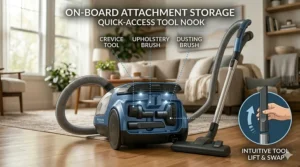
Accessory storage matters more than you’d think. Integrated storage keeps attachments organized and available. Separate storage means lost pieces.
FAQ: Your Bagged Canister Vacuum Questions Answered
❓ What makes a bagged canister vacuum better than bagless for allergies?
❓ How often should I replace the bag in my canister vacuum?
❓ Are german engineered bagged canister vacuum worth the premium price?
❓ Can I use third-party bags instead of brand-name bags?
❓ What's the difference between a power nozzle and a turbobrush on canister vacuums?
Conclusion: Making Your Bagged Canister Vacuum Investment Count
After vacuuming through countless testing sessions, sprawling hotel corridors during my hospitality days, and yes – my own endless pet hair battles at home – I’ve learned that the “best” vacuum is the one you’ll actually use consistently.
For most households, I’d point you toward the Kenmore 600 Series or the Miele Complete C3 Calima. That $200-$900 range delivers genuine HEPA filtration, quality construction, and features that matter without venture-capital-funded gimmicks. You’re getting proven technology refined over decades, not the latest crowdfunded vaporware.
But if you’re serious about air quality – truly committed to creating the healthiest indoor environment possible – a hepa bagged canister vacuum from Miele’s Complete C3 line represents the gold standard. Yes, $1,000+ stings initially. But amortized over 15-20 years of whisper-quiet, hospital-grade filtration? That’s $50-65 annually for measurably cleaner air.
The compact models (Oreck XL Pro 5, Hoover PortaPower) fill specific niches brilliantly. Detail work, commercial applications, above-floor cleaning, portability – these lightweight champions excel where traditional canisters struggle. Don’t dismiss them as “less powerful.” They’re purpose-built for different cleaning challenges.
Whatever you choose, remember this: the vacuum you use beats the vacuum you own. A $150 Kenmore you run weekly outperforms a $1,200 Miele collecting closet dust. Pick something that fits your cleaning style, your storage situation, and your maintenance tolerance. Then use it religiously.
Your lungs will thank you. Your carpets will thank you. And those allergy symptoms that mysteriously improved after you switched from bagless? Yeah, that’s the hygienic bag disposal and premium filtration system actually working.
Recommended for You
- 7 Best Bagless Canister Vacuum Models That Save Money (2026)
- 7 Best Canister Vacuum vs Upright Vacuum – 2026
- 7 Best Canister Vacuum for Hardwood Floors – 2026
Disclaimer: This article contains affiliate links. If you purchase products through these links, we may earn a small commission at no additional cost to you.
✨ Found this helpful? Share it with your friends! 💬🤗
