
In This Article
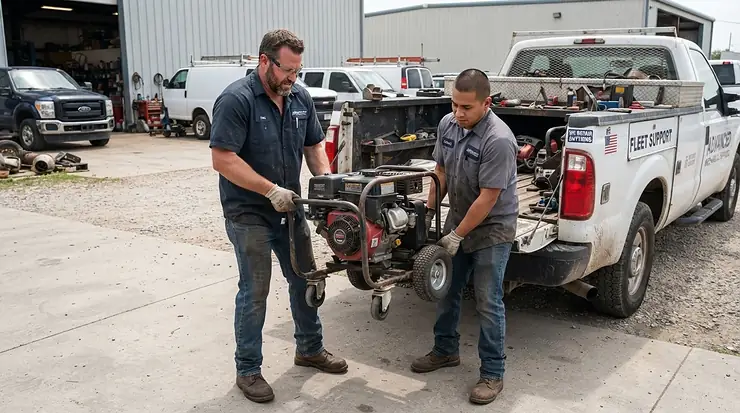
If you’ve ever shown up to a job with a pressure washer that quit halfway through a driveway, you already know why this decision matters more than most contractors give it credit for. A portable gas pressure washer for job sites isn’t just another item on the truck inventory — it’s the difference between finishing a paint-prep job before lunch or fighting a stalling engine until the light fades. A portable gas pressure washer for job sites is a self-contained, engine-driven cleaning unit — no cord, no generator, no outlet required — built to deliver high-pressure water spray anywhere a truck can park, from graffiti removal to fleet washing to concrete restoration.
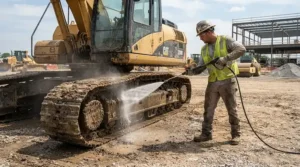
We’ve spent time digging through manufacturer spec sheets, aggregated customer feedback, and independent lab data to figure out which machines actually earn their keep on a jobsite, rather than just looking good in a big-box aisle. This isn’t a rewritten spec sheet. It’s an honest look at what separates a weekend-warrior unit from something that survives five days a week, fifty weeks a year.
Below, you’ll find seven real machines spanning budget, mid-range, and premium price points, plus deep dives into fuel efficiency, gas versus electric performance for commercial cleaning, off-grid reliability, and the maintenance habits that decide whether your investment lasts two years or ten. Whether you’re outfitting a solo deck-cleaning side hustle or standardizing equipment across a five-truck crew, there’s a practical answer here — grounded in real specs, not marketing copy.
Quick Comparison Table
Before we go deep on all seven, here’s the short version for anyone triaging a decision on their lunch break.
| Product | Best For | PSI / GPM | Price Range |
|---|---|---|---|
| Simpson PowerShot PS60843 | Heaviest daily commercial use | 4,400 PSI / 4.0 GPM | around $800-$900 |
| DeWalt DXPW3300 | Best all-around contractor balance | 3,300 PSI / 2.4 GPM | around $450-$500 |
| Generac 7122 SpeedWash | Fastest cleaning per hour | 3,200 PSI / 2.7 GPM | around $450-$550 |
| Simpson MegaShot MSH3125-S | Best Honda-powered value | 3,200 PSI / 2.5 GPM | around $400-$450 |
| Craftsman CMXGWAS020735 | Budget starter for small crews | 3,200 max PSI / 2.4 max GPM | around $300-$350 |
Looking at this lineup, the split is pretty clean: if you’re washing fleets, siding, and concrete every single day, the extra weight and cost of the Simpson PowerShot PS60843 pays for itself in fewer breakdowns. If you’re a smaller operation doing two or three jobs a week, the DeWalt DXPW3300 or Simpson MegaShot MSH3125-S hit a sweet spot most contractors never regret. Budget-conscious crews just starting out shouldn’t overlook the Craftsman CMXGWAS020735 — it won’t survive a decade of daily abuse, but it’s an honest entry point while cash flow catches up to ambition.
🛠️ Ready to gear up? Check current pricing and availability on these top-rated picks before your next job starts.
Top 7 Portable Gas Pressure Washers for Job Sites: Expert Analysis
We picked these seven because together they cover the real range of what shows up on actual job sites — not just what ranks well in search results. Budget options, Honda-powered mid-range units, and true commercial-grade machines are all represented, along with the trade-offs nobody puts on the box.
1. Simpson PowerShot PS60843 — heaviest-duty pump for daily commercial jobs
The AAA industrial triplex plunger pump at the heart of this machine is the reason contractors keep it in rotation. Delivering 4,400 PSI at 4.0 GPM through a CRX 420cc engine, this is one of the few machines on this list genuinely engineered — not just marketed — for daily professional cycles. The triplex design uses three pistons instead of the single-piston axial cam pumps found in residential units, which means less internal wear per gallon pushed through, and a pump that’s rated for far more duty-cycle hours before it needs attention.
Based on the spec comparison, this is the pick for contractors specializing in deck restoration, wood cleaning, paint prep, and graffiti removal — jobs where you’re running the machine for hours at a stretch. The 50-foot Monster hose and 13-inch pneumatic tires matter more than they sound: less repositioning per job, and better rolling over gravel, mulch, and construction debris. Reviewers consistently note the CRX engine starts reliably even after sitting idle for weeks, which matters for contractors who don’t run gas equipment every single day.
Pros:
- ✅ Triplex pump built for continuous daily commercial cycles
- ✅ 50-foot Monster hose reaches upper floors without repositioning
- ✅ 13-inch tires roll easily over rough jobsite terrain
Cons:
- ❌ At roughly 135 lbs, loading it solo is genuinely difficult
- ❌ Premium pricing puts it well above casual or occasional users’ budgets
Expect to pay in the $800-$900 range at the time of research, though prices may vary by retailer — for a crew running this five days a week, the value verdict is straightforward: it’s the machine that keeps working when cheaper units start leaking.
2. DeWalt DXPW61377 — best for two-story exteriors and paint prep
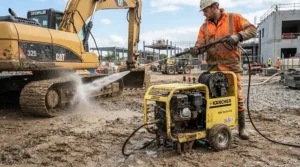
DeWalt built this one around a 420cc engine paired with a triplex pump, landing it at 4,400 PSI and 4.0 GPM — squarely in the same performance tier as the Simpson above, but with a 50-foot hose and DeWalt’s own frame geometry. What most buyers overlook about this model is that the extra flow rate (4.0 GPM versus the 2.5-3.0 GPM common on residential units) genuinely speeds up rinse time on large flat surfaces like driveways and parking pads, not just the peak pressure number most shoppers fixate on.
This is a genuinely commercial-oriented machine, and the specs back it up: five quick-connect nozzles, a 420cc engine with low-oil shutdown, and a triplex pump designed for repeated professional use rather than occasional weekend jobs. Aggregated customer feedback on Home Depot’s platform is mixed but instructive — several reviewers praise the raw cleaning power and Honda-class engine reliability, while others report frustrating experiences with warranty support when something does go wrong. That’s worth weighing honestly rather than glossing over.
Pros:
- ✅ 420cc engine and 4.0 GPM flow tackle two-story exteriors fast
- ✅ 50-foot hose cuts down repositioning on large properties
- ✅ Triplex pump construction built for repeated professional use
Cons:
- ❌ Bulky frame realistically needs a truck bed or trailer
- ❌ Some reviewers report inconsistent experiences with warranty service
Priced in the $700-$800 range at the time of research, this competes directly with the Simpson PowerShot for contractors who want commercial-grade output without stepping up to belt-driven, gas-fed systems.
3. DeWalt DXPW3300 — best balance of power and one-person portability
Here’s what the spec sheet won’t tell you, but hands-on reviewers note: the DXPW3300 hits a genuinely usable middle ground. At 3,300 PSI and 2.4 GPM, driven by a 208cc DeWalt engine, it has enough force for concrete cleaning and deck restoration without tipping into “needs two people to load” territory the way the premium units above do. One independent reviewer described wheeling it straight out of the box onto a driveway and being ready to clean before their coffee cooled — a reasonable proxy for how little assembly friction this model has.
The OEM Technologies axial cam pump is maintenance-free by design, meaning no scheduled oil changes for the pump itself (the engine still needs its own oil service). At roughly 64 pounds with a low center of gravity, it’s genuinely a one-person machine on uneven ground — something the 130-plus-pound units above can’t claim. For a solo contractor or a two-person crew that needs to move equipment fast between small commercial jobs, this is the honest sweet spot.
Pros:
- ✅ 208cc engine balances real power with one-person portability
- ✅ Low center of gravity rolls smoothly over cracked pavement
- ✅ Maintenance-free axial cam pump skips scheduled pump service
Cons:
- ❌ Oil drain plug sits against the frame, making oil changes messy
- ❌ A subset of owners report early pump or valve failures
At around $450-$500 in typical retail ranges, the value case is strong for contractors who need commercial-adjacent output without commercial-grade bulk.
4. Generac 7122 SpeedWash — fastest cleaning with PowerDial technology
Generac took a different approach here: instead of just chasing a higher PSI number, they built the PowerDial wand, which lets you adjust pressure on the fly without swapping nozzles mid-job. Paired with a Turbo nozzle attachment, aggregated reviews consistently report meaningfully faster cleaning times — Generac’s own testing claims up to 30% faster than standard fixed nozzles, and independent reviewers have echoed that the rotating pinpoint stream cuts through stubborn grime noticeably quicker than a standard 25-degree tip.
The 196cc OHV engine drives a brass-head axial cam pump rather than the more common aluminum-head design, which reviewers note tends to hold up better over years of use since brass resists the pitting and wear that aluminum heads are prone to. Based on the spec comparison, this is the pick for contractors who value throughput over raw peak pressure — think mobile detailing, fleet washing, and any workflow where time-per-vehicle or time-per-surface is the actual bottleneck, not maximum force.
Pros:
- ✅ PowerDial wand adjusts pressure without swapping nozzle tips
- ✅ Turbo nozzle attachment measurably speeds up cleaning time
- ✅ Brass-head pump resists wear better than aluminum equivalents
Cons:
- ❌ Included hose is prone to kinking on rough ground
- ❌ At roughly 62 lbs, it’s heavier than comparable direct-drive units
Expect a price in the $450-$550 range depending on retailer promotions — a reasonable investment for contractors whose billing model rewards speed over sheer power.
5. Simpson MegaShot MSH3125-S — best Honda-powered value pick
The Honda GC190 engine is the headline feature here, and for good reason — Honda’s small-engine reputation for cold-start reliability and longevity is well earned, and reviewers across multiple platforms consistently point to easy starts as a standout trait, even after the unit has sat in a truck bed through a cold snap. At 3,200 PSI and 2.5 GPM, it lands in the same performance tier as the Generac above, but the OEM Technologies axial cam pump with PowerBoost is tuned slightly differently, prioritizing consistent pressure delivery over speed-focused attachments.
Reviewers consistently note the 10-inch pneumatic tires and compact 24-by-21-inch footprint make this one of the easier machines to maneuver around parked vehicles, dumpsters, and other jobsite obstacles. One independent reviewer highlighted the tradeoff plainly: it’s one of the pricier machines in its performance class, but the payoff is a Honda engine that starts reliably and a pump built to skip oil-change maintenance entirely, since the crankcase is sealed from the factory.
Pros:
- ✅ Honda GC190 engine starts reliably even in cold conditions
- ✅ 10-inch tires roll smoothly over gravel and site debris
- ✅ Maintenance-free crankcase eliminates pump oil-change downtime
Cons:
- ❌ Some owners report pump housing pinhole leaks developing over time
- ❌ Availability has varied as Simpson updates and replaces model numbers
At the time of research, retailers have listed this model in the $400-$450 range, though as with any Simpson model, it’s worth confirming current availability since the MegaShot lineup sees frequent SKU refreshes.
6. Champion 100382 — lightest dolly-style for tight job sites
Not every job site needs 4,000-plus PSI. The Champion 100382 delivers a more modest 2,600 PSI at 2.2 GPM, and for a specific slice of contractor work — light siding cleanup, quick touch-ups between bigger jobs, vehicle and equipment washdowns — that’s genuinely enough, without the added weight, fuel consumption, and price tag of the heavier-duty machines above.
What most buyers overlook about lower-PSI units like this one is that GPM (flow rate) often matters more than peak pressure for everyday cleaning tasks; a lower-pressure, steady-flow machine can actually rinse detergent and loosened grime faster than a high-pressure, low-flow unit fighting against itself. Consumer Reports’ testing data confirms the tradeoff is real: this model scores well on portability and ease of transport, with the acknowledged downside that gas models like this one require you to store fuel and handle the maintenance realities that come with any small engine.
Pros:
- ✅ Compact dolly-style frame fits easily in a crowded truck bed
- ✅ Simple three-nozzle setup keeps the learning curve short
- ✅ Lower price point suits occasional jobsite touch-up work
Cons:
- ❌ 2.2 GPM flow rate is light for large concrete surfaces
- ❌ Lower PSI struggles with heavy paint-stripping or deep-set grime
Priced around $350-$400 in most listings, this is best treated as a secondary or backup unit rather than a primary daily driver for a full-time cleaning operation.
7. Craftsman CMXGWAS020735 — most affordable starter for side crews
At 3,200 max PSI and 2.4 max GPM (rated 2.3 GPM at the 3,200 PSI setting), the Craftsman CMXGWAS020735 is powered by a genuine Honda 187cc engine — a detail that matters, because Craftsman’s pressure washer lineup mixes Honda and Briggs & Stratton engines across different SKUs, and the Honda-equipped version tends to be the more dependable starter. The axial cam pump includes Craftsman’s Easy Start technology, which reduces the pull-cord resistance that makes cheaper engines frustrating to fire up on a cold morning.
Based on the spec comparison, this is squarely an entry-level jobsite machine: fine for a solo operator or a two-person side crew doing occasional residential and light-commercial work, but not built with the duty cycle of the triplex-pump machines earlier on this list. The half-gallon integrated detergent tank is a nice practical touch for anyone doing driveway or deck cleaning that requires a soap-and-rinse workflow, and the 30-foot hose gives more working radius than several pricier competitors.
Pros:
- ✅ Genuine Honda 187cc engine keeps startup dependable
- ✅ Half-gallon detergent tank simplifies soap-and-rinse workflows
- ✅ 30-foot hose extends working radius beyond pricier rivals
Cons:
- ❌ 2.3-2.4 GPM flow rate slows down large surface jobs
- ❌ Not built for true daily heavy-commercial duty cycles
At around $300-$350, it’s the most accessible entry point on this list — a reasonable starting machine while a smaller operation builds toward heavier equipment.
Top 7 Products: Full Spec Comparison
| Product | Engine | PSI / GPM | Approx. Weight | Best For |
|---|---|---|---|---|
| Simpson PowerShot PS60843 | CRX 420cc | 4,400 / 4.0 | ~135 lbs | Daily commercial fleet & facility cleaning |
| DeWalt DXPW61377 | DeWalt 420cc | 4,400 / 4.0 | ~130 lbs | Two-story exteriors, paint prep |
| DeWalt DXPW3300 | DeWalt 208cc | 3,300 / 2.4 | ~64 lbs | Solo contractors needing real power |
| Generac 7122 SpeedWash | 196cc OHV | 3,200 / 2.7 | ~62 lbs | Speed-focused fleet & vehicle washing |
| Simpson MegaShot MSH3125-S | Honda GC190 | 3,200 / 2.5 | ~60 lbs | Reliable Honda-powered value |
| Champion 100382 | ~196cc | 2,600 / 2.2 | ~64 lbs | Light-duty, occasional touch-ups |
| Craftsman CMXGWAS020735 | Honda 187cc | 3,200 max / 2.4 max | ~55 lbs | Budget-conscious side crews |
The pattern across this table is straightforward once you see it laid out: PSI and GPM climb together with engine displacement, and so does weight and price. The two 420cc, triplex-pump machines are built for contractors billing full-time hours on commercial contracts, while the 187cc-208cc tier serves solo operators and smaller crews well without demanding a two-person lift every time the machine needs to move.
How to Choose a Portable Gas Pressure Washer for Job Sites
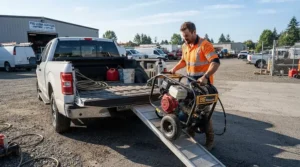
Picking the right portable gas pressure washer for job sites comes down to matching a handful of specs to your actual workload, not chasing the biggest PSI number on the shelf. Here’s the reasoning contractors should walk through before buying:
- Match PSI and GPM to your actual jobs. Light siding and vehicle work rarely needs more than 2,600-3,200 PSI; concrete, graffiti, and heavy paint prep justify 3,300 PSI or higher.
- Weigh pump type against duty cycle. Axial cam pumps handle occasional-to-regular use well; triplex pumps are built for daily, hours-long commercial cycles.
- Consider engine brand reputation. Honda-branded engines carry a well-earned reputation for cold-start reliability, which matters more than most spec sheets suggest.
- Check hose length against your typical site layout. A 50-foot hose on a two-story job saves real repositioning time compared to a 25-foot hose.
- Factor in one-person portability. A machine that needs two people to lift isn’t practical for a solo operator working alone most days.
- Confirm CARB or 49-state compliance for your region. Several models on this list ship in “49-state” configurations that exclude California sales.
- Price against your billing model, not just sticker shock. A pricier triplex-pump machine can pay for itself in fewer service calls if you’re running it daily.
Fuel Tank Capacity & Run Time: What It Actually Means for Your Workday
Fuel tank capacity rarely gets the attention it deserves in pressure washer marketing, but for a crew trying to finish a job before a scheduled inspection, run time between refuels is a genuinely practical concern. Manufacturers don’t always publish exact tank sizes, so the figures below combine confirmed specs where available with reasonable estimates based on typical consumption for each engine class — treat them as planning guides, not guarantees, and check your specific owner’s manual for the confirmed number.
| Product | Engine Size | Approx. Tank Capacity | Estimated Run Time* |
|---|---|---|---|
| Simpson PowerShot PS60843 | 420cc | ~1.7 gallons (mfr-listed) | ~1.5-2 hours continuous |
| DeWalt DXPW61377 | 420cc | ~1.5-2 gallons (typical for class) | ~1.5-2 hours continuous |
| DeWalt DXPW3300 | 208cc | ~1 gallon (typical for class) | ~1-1.5 hours continuous |
| Generac 7122 SpeedWash | 196cc | ~1 gallon (typical for class) | ~1-1.5 hours continuous |
| Simpson MegaShot MSH3125-S | Honda GC190 | ~0.95 gallon (Honda-published) | ~1-1.5 hours continuous |
| Champion 100382 | ~196cc | ~1 gallon (typical for class) | ~1-1.5 hours continuous |
| Craftsman CMXGWAS020735 | Honda 187cc | ~0.9-1 gallon (typical for class) | ~1-1.5 hours continuous |
*Estimates based on typical small-engine fuel consumption at moderate load; actual run time varies with throttle position, altitude, and ambient temperature.
The practical takeaway: none of these machines run a full 8-hour shift on one tank, so refueling breaks are part of the workday regardless of which model you choose. Larger fuel tank capacity on the 420cc units buys you longer stretches between stops, which matters more on sprawling commercial sites where walking back to a fuel can eats into billable time.
Gas Pressure Washer vs Electric Pressure Washer for Commercial Cleaning
The gas pressure washer vs electric pressure washer for commercial cleaning debate isn’t really about which is “better” in the abstract — it’s about which constraint matters more on your specific jobs: raw output and mobility, or noise and indoor usability.
| Factor | Gas Pressure Washer | Electric Pressure Washer |
|---|---|---|
| Typical PSI / GPM | 2,600-4,400 PSI / 2.2-4.0 GPM | 1,500-3,600 PSI / 1.2-2.0 GPM |
| Power source | Onboard gas engine — no outlet needed | Requires 120V/240V outlet or generator |
| Best environment | Outdoor, no-power sites | Indoor, noise-restricted, or urban jobs |
| Noise level | Loud — hearing protection recommended | Significantly quieter, often under 70 dB |
| Maintenance | Oil changes, fuel handling, engine tune-ups | Minimal — mostly pump and hose care |
The analysis here is fairly clean-cut once you separate the two use cases. For outdoor jobs on properties with no accessible power — new construction, rural sites, large parking lots — a gas pressure washer for job sites remains the practical default because it doesn’t depend on finding or running a generator. Electric units earn their keep in noise-restricted environments like storefronts, parking garages, and residential neighborhoods with ordinances, where a quieter induction motor lets a contractor work without frustrating nearby occupants or violating local noise codes. Many established cleaning contractors end up running both: gas for the bulk of exterior commercial work, electric as a specialized tool for the jobs where fumes or noise simply aren’t an option.
Off-Grid Power Tools: Why Gas Still Wins Where There’s No Outlet
For contractors working new-construction sites, rural properties, or anywhere without reliable power infrastructure, off-grid power tools aren’t a preference — they’re a necessity. A portable gas pressure washer for job sites is, functionally, an off-grid power tool: it carries its own energy source, so it works identically whether you’re parked next to a fully wired commercial building or in an open field with no utility poles in sight.
This matters more than it might seem at first glance. Renting or hauling a generator just to run an electric pressure washer adds cost, weight, and one more piece of equipment that can fail. Every model reviewed above sidesteps that problem entirely — the tradeoff is fuel logistics (keeping gas cans stocked and fresh) instead of power logistics (finding or generating electricity). For contractors who regularly bid jobs at sites without confirmed power access, that tradeoff consistently favors gas, and it’s part of why gas-powered units remain the default choice across commercial cleaning, construction cleanup, and facility maintenance work, according to the U.S. Environmental Protection Agency’s ongoing regulation of small nonroad spark-ignition engines used in this exact equipment category.
Fuel-Efficient Gas Pressure Washers for Daily Contractor Use
Fuel efficiency doesn’t show up on most spec sheets, but for a contractor running a machine five days a week, it adds up in ways that are easy to underestimate. Smaller-displacement engines — the 187cc-208cc range represented by the Craftsman CMXGWAS020735, Simpson MegaShot MSH3125-S, and DeWalt DXPW3300 — generally sip less fuel per hour than the 420cc engines powering the Simpson PowerShot PS60843 and DeWalt DXPW61377, simply because they’re moving less air and fuel per combustion cycle.
Here’s what most buyers overlook about fuel efficiency in this category: the most fuel-efficient gas pressure washer for daily contractor use isn’t necessarily the one with the smallest engine — it’s the one sized correctly for the job, run at the appropriate nozzle pressure rather than maxed out on every task. Running a 4,400 PSI machine on a light rinse-down job wastes fuel accomplishing what a 3,200 PSI unit could do just as effectively. For contractors doing genuinely daily commercial-grade cleaning, the smaller engines’ fuel savings can get eaten up by longer run times needed to hit the same cleaning result, so the real efficiency play is matching engine size to typical job scope rather than defaulting to the smallest tank.
Common Mistakes When Buying a Gas Pressure Washer for Contractor Work
Even experienced contractors make predictable errors when shopping for this equipment, and most of them trace back to optimizing for the wrong number.
Chasing peak PSI without checking GPM is probably the most common misstep — a high-pressure, low-flow machine can actually clean slower than a moderate-pressure, high-flow unit, because flow rate does the work of physically rinsing loosened debris away. Buying based on residential reviews for what’s genuinely a commercial-use machine is another trap; a unit rated highly by homeowners doing quarterly driveway cleanings tells you very little about how it holds up under five-day-a-week commercial cycles. Skipping the pump-type comparison is a third mistake worth flagging: assuming all pumps are interchangeable ignores the real durability gap between axial cam and triplex plunger designs. Finally, underestimating hose length needs — especially for two-story commercial buildings — leads to constant repositioning that eats into billable hours in ways contractors rarely account for when comparing sticker prices.
Practical Usage Guide: Your First 30 Days on the Job
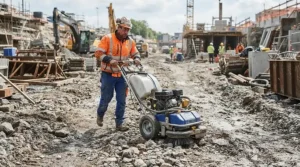
Getting a new machine dialed in during its first month matters more than most owners realize, since early habits often determine whether a pump lasts three years or ten.
Setup and first use: Before the first startup, check the oil level in the engine (most ship without oil pre-filled), connect a garden hose supplying at least 3/4-inch flow, and never run the unit dry — even a few seconds without water can damage the pump seals permanently. Break-in period: Run the engine at a lower throttle setting for the first hour of use to let internal components seat properly, a step several manufacturers explicitly call out in their manuals. Maintenance schedule: Change engine oil after the first 5 hours of use, then every 25-50 hours after that; inspect the high-pressure hose for kinks or abrasion weekly if it’s riding in a truck bed. Common first-month mistakes: Using the 0-degree pinpoint nozzle on soft surfaces like wood siding (it can gouge material at close range), forgetting to release trigger pressure before storage (which stresses the unloader valve), and storing the unit with fuel sitting in the tank for months without a stabilizer, which gums up carburetors on smaller engines especially.
Real-World Scenarios: Which Contractor Are You?
Matching a machine to your actual work pattern beats matching it to a spec sheet in isolation. Here are three profiles that map cleanly onto the products above.
The solo deck-and-fence contractor: Working two to three residential jobs a week, budget-conscious, needs to load and unload equipment alone. The DeWalt DXPW3300 or Craftsman CMXGWAS020735 fit this pattern well — enough power for wood restoration and staining prep, light enough to manage solo, priced to match a smaller revenue base.
The multi-crew facility maintenance company: Running two or three trucks daily on commercial contracts — parking structures, loading docks, fleet washing — with equipment expected to survive years of five-day-a-week use. The Simpson PowerShot PS60843 or DeWalt DXPW61377 justify their premium here; the triplex pump and higher flow rate translate directly into faster job completion and fewer mid-contract breakdowns.
The property management handyman crew: Handling a mix of light touch-ups — sidewalks, entryways, the occasional car wash for a resident complaint — spread across multiple properties without a heavy commercial cleaning contract driving daily use. The Champion 100382 or Simpson MegaShot MSH3125-S cover this range without overspending on capacity that rarely gets used.
Buyer’s Decision Framework: Matching Machine to Job Site
If you’re still weighing options, this framework simplifies the decision to a short checklist:
If you run a machine daily on commercial contracts, choose a triplex-pump model like the Simpson PowerShot PS60843 because the pump is engineered for that duty cycle and will cost less over time in avoided repairs. If you’re a solo or two-person crew doing regular but not daily work, choose a mid-range axial cam unit like the DeWalt DXPW3300 or Generac 7122 SpeedWash because they balance power and portability without commercial-grade pricing. If your jobs are occasional or light-duty, choose a budget model like the Champion 100382 or Craftsman CMXGWAS020735 because paying for capacity you won’t use is money better spent elsewhere. If your sites regularly lack accessible power, prioritize gas over electric regardless of budget tier, since off-grid reliability outweighs the noise and maintenance tradeoffs in that scenario.
✨ Don’t Wait for Bid Season to Upgrade!
🔧 Check current pricing and availability on the models above before your next contract starts — the right machine now can mean fewer callbacks and faster turnarounds all season long.
Long-Term Cost & Maintenance: The Real Cost of Ownership
The sticker price is only the opening bid in what a pressure washer actually costs a contractor over its working life. Engine oil changes, pump seal replacements, hose repairs, nozzle wear, and fuel consumption all stack up, and triplex-pump machines generally front-load more of that cost into the purchase price in exchange for lower repair frequency down the line.
Based on the spec comparison across all seven machines, the axial cam pumps found in the Simpson MegaShot MSH3125-S, DeWalt DXPW3300, Generac 7122 SpeedWash, Champion 100382, and Craftsman CMXGWAS020735 are described by their manufacturers as maintenance-free for the pump itself, meaning the sealed crankcase never needs oil changes — the tradeoff is a shorter expected service life under heavy commercial use compared to a triplex design. The triplex pumps in the Simpson PowerShot PS60843 and DeWalt DXPW61377 cost more upfront and still require periodic pump oil changes, but they’re rated for substantially more duty-cycle hours before wear becomes a problem, which is exactly why professional cleaning companies gravitate toward triplex designs despite the higher entry cost. For a contractor running a machine four or five days a week, the total cost of ownership math tends to favor the triplex option within two to three years, once you account for the axial cam units’ shorter realistic lifespan under that workload.
Safety, Regulations & Compliance on the Job Site
Gas pressure washers generate forces that genuinely warrant respect, and OSHA treats pressure-washing hazards seriously even without a single dedicated standard covering the equipment directly. Eye and face protection is a documented requirement under OSHA’s general PPE standards whenever workers face flying debris or chemical splash — a category that squarely includes pressure washing, especially above 2,000 PSI, where industry guidance recommends a full face shield rather than simple goggles. Beyond eye protection, contractors should factor in hearing protection near the 85-90 decibel range these engines typically produce, waterproof footwear to reduce slip hazards on wet surfaces, and never operating a gas-powered unit in enclosed or poorly ventilated spaces, since carbon monoxide buildup is a genuine and sometimes fatal risk indoors.
On the regulatory side, several models on this list ship in “49-state” configurations, meaning they don’t meet California Air Resources Board emissions standards and can’t be legally sold or, in some cases, registered there — worth confirming before ordering if you operate in or near California. More broadly, small gas engines like the ones in every product reviewed here fall under federal emissions rules for nonroad spark-ignition engines, which is why manufacturers publish CARB or 49-state compliance status prominently on their spec sheets.
Frequently Asked Questions
❓ What PSI is best for a portable gas pressure washer for job sites?
❓ How much does a good portable gas pressure washer for job sites cost?
❓ Is a triplex pump worth the extra cost for daily use?
❓ Can I use a gas pressure washer indoors on a job site?
❓ How often should I change the oil on a gas pressure washer engine?
Conclusion
Choosing the right portable gas pressure washer for job sites really does come down to matching engine class, pump type, and hose length to how you actually work, not to whichever machine has the flashiest PSI number on the box. The Simpson PowerShot PS60843 and DeWalt DXPW61377 earn their premium pricing through triplex pumps built for genuine daily commercial cycles. The DeWalt DXPW3300, Generac 7122 SpeedWash, and Simpson MegaShot MSH3125-S occupy a genuinely useful middle tier — enough power for most contractor work without commercial-grade bulk or price. And the Champion 100382 and Craftsman CMXGWAS020735 remain honest entry points for occasional use or smaller operations building toward heavier equipment.
None of these are perfect machines, and the honest reviews above reflect real trade-offs rather than glossing over weaknesses to sell a product. What matters is picking the one whose trade-offs actually fit your workload — whether that’s raw duty-cycle endurance, one-person portability, or simply staying within a startup budget while the client list grows. Whichever you choose, treat the maintenance schedule seriously from week one; it’s the single biggest factor separating a machine that lasts a decade from one that’s landfill-bound in eighteen months. For a deeper look at how pressure washing technology and terminology actually work, Wikipedia’s overview of pressure washing is a solid starting reference, and independent lab testing from outlets like Consumer Reports can help validate manufacturer claims before you commit.
✨ Ready to outfit your crew?
Compare current prices and availability on the models above before your next bid goes out. 🏗️💧
Recommended for You
- Heavy-Duty Electric Pressure Washer for Concrete: 7 Best Picks (2026)
- 7 Best Medium-Duty Electric Pressure Washers for Decks (2026)
- Light-Duty Electric Pressure Washer for Patio Furniture: 7 Picks (2026)
Disclaimer: This article contains affiliate links. As an Amazon Associate, I earn from qualifying purchases. If you purchase products through these links, we may earn a small commission at no additional cost to you.
✨ Found this helpful? Share it with your crew! 🛠️
