
In This Article
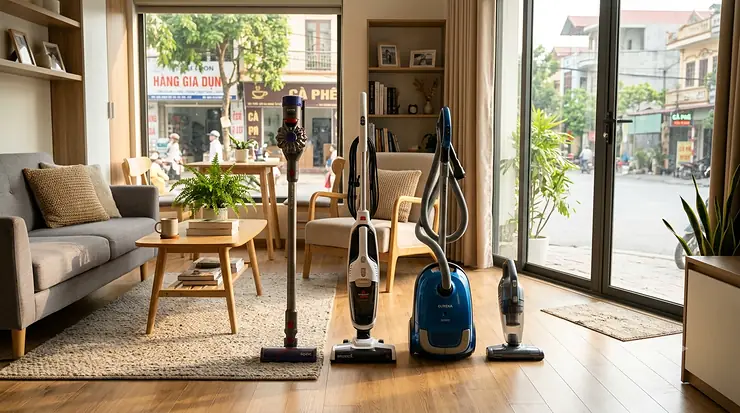
If you’ve ever tried to wedge a full-size upright into a hall closet that’s already full of a stroller, a vacuum, and three reusable grocery bags, you already know the core problem with apartment cleaning: it’s not really about suction power, it’s about space. The best vacuum for small apartments has to do double duty — clean well, and disappear when it’s not in use.
That’s a different set of priorities than what most “best vacuum” roundups optimize for. A 16-pound upright with a 2-liter bin might dominate a lab test, but if it can’t stand up in a coat closet or glide under a studio apartment’s low-profile bed frame, it’s the wrong tool for the job. Apartment dwellers need to weigh weight, footprint, noise (neighbors below you will notice a loud vacuum at 9pm), cord length versus battery runtime, and how well a unit handles the mixed flooring — hardwood plus one or two area rugs — that’s typical in rentals.
Below are seven vacuums currently sold on Amazon that are genuinely suited to compact living: a sub-2-pound handheld, two lightweight stick vacuums, one lightweight full-size upright, a sensor-equipped corded stick, and two robot vacuums at very different price points. Each one earns its spot for a specific apartment scenario rather than just “best overall.”
Quick Comparison Table
| Vacuum | Type | Weight | Best For | Price Range |
|---|---|---|---|---|
| Shark Ion W1 WV201 | Handheld | 1.4 lbs | Quick spot cleanups, counters, car | $50–$80 |
| Bissell Featherweight Stick | Corded stick/hand | Under 4 lbs | Tight budgets, dorm rooms | $40–$60 |
| Kenmore FeatherLite Lift-Up | Lightweight upright | Under 12 lbs | Carpet + allergy concerns | $130–$190 |
| Shark PowerDetect HZ4002 | Corded stick | ~9.5 lbs | Mixed flooring, pet hair | $200–$300 |
| Dyson V15 Detect Plus | Cordless stick | ~6.8 lbs | Daily driver, no cord hassle | $550–$750 |
| eufy RoboVac 11S MAX | Robot (no app) | 2.85″ tall | Set-and-forget on a budget | $100–$180 |
| eufy X10 Pro Omni | Robot + mop, self-empty | 4.47″ tall | Hands-off vacuum and mop | $500–$800 |
A pattern shows up immediately: price tracks almost directly with how much manual effort a vacuum removes from your routine, not just how strong its motor is. The Bissell and Shark handheld sit at the bottom because they need you to push, empty, and store them yourself. The eufy X10 Pro Omni sits at the top because its dock empties the dustbin, washes the mop, and dries it — features that matter more in a small space where you don’t want maintenance chores eating into your weekend. If you live in under 600 square feet with light foot traffic, the cheaper end of this table will likely cover your needs; if you’ve got pets, rugs, and allergy concerns, the extra money buys real time savings. For a more technical breakdown of how these vacuum categories perform specifically in apartment-sized spaces, RTINGS’ apartment vacuum testing is a useful independent reference point.
✨ Quick Note Before You Compare Specs
Take a minute to check your closet or under-bed clearance before choosing — it usually rules out two or three options on this list automatically.
Top 7 Vacuums for Small Apartments: Detailed Breakdown
1. Shark Ion W1 WV201 Handheld Vacuum
The Shark Ion W1 WV201 is built for the messes too small to justify dragging out a full vacuum — crumbs on the counter, spilled cereal, a quick once-over on the car seats.
At roughly 1.4 pounds with a built-in 10.8-volt lithium-ion battery, it’s genuinely one-handed, and it docks on a wall-mounted charging stand that takes up almost no floor space — useful in a studio where every closet inch is precious. It ships with a crevice tool and an upholstery/pet tool, which covers most of the above-floor messes a stick vacuum struggles with. The dustbin is small by design, so it’s not meant to replace your main floor vacuum; think of it as the backup tool that lives charged and ready by the door.
Who it’s for: Renters who already have (or are buying) a stick or robot vacuum for floors and want a lightweight, always-charged tool for spot cleanups, car interiors, and furniture.
✅ Pros: Extremely light; charges on a small wall dock; good with pet hair on upholstery
❌ Cons: Small dustbin needs frequent emptying; not a floor-cleaning replacement
Price & value: Typically in the $50–$80 range on Amazon, occasionally lower during sales — solid value as a second, supplementary vacuum rather than your only one.

2. Bissell Featherweight Stick Vacuum (2033 Series)
If your budget is the main constraint, the Bissell Featherweight corded stick vacuum is the cheapest legitimate option on this list that still converts between three modes — stick, hand vacuum, and stair vacuum — without feeling like a toy.
It weighs under 4 pounds, which matters more than the spec sheet suggests: in a small apartment you’re often vacuuming a hallway, then a closet, then carrying it up a step to a loft bed, all in one session, and a sub-4-pound machine doesn’t tire your arm out the way an 8-pound corded upright would. It’s bagless with a roughly 750ml dirt tank, includes a crevice tool, and the cord (rather than a battery) means you’re never caught mid-clean with a dead unit.
Who it’s for: College students, first apartment renters, or anyone furnishing on a tight budget who mostly deals with hard floors and low-pile rugs rather than thick carpet.
✅ Pros: Genuinely cheap; converts to hand vacuum and stair tool; no battery to degrade over time
❌ Cons: Single power setting; weaker on medium-to-thick carpet than the pricier picks here
Price & value: Usually $40–$60, making it one of the lowest-cost ways to cover floors, stairs, and furniture in one machine.
3. Kenmore FeatherLite Lift-Up Bagless Upright
A full-size upright sounds like the opposite of an apartment vacuum, but the Kenmore FeatherLite Lift-Up earns its place here because it solves a specific problem the stick vacuums on this list don’t: deep carpet cleaning with HEPA-level filtration, in a body that still weighs under 12 pounds.
The “Lift-Up” name refers to a pod that detaches from the floor head for stairs and above-floor cleaning, paired with roughly 7 to 9 feet of hose reach. The sealed HEPA filtration system is rated to capture 99.97% of dust down to 0.3 microns — a meaningfully different tier of filtration than most bagless stick vacuums offer, which matters if anyone in your apartment has allergies or asthma. Independent lab testing has consistently rated its carpet deep-cleaning and suction above the average for upright vacuums in its price class, even though it’s lighter than most competitors.
Who it’s for: Apartments with wall-to-wall carpet or area rugs, pet owners dealing with embedded hair and dander, or anyone who wants HEPA-grade filtration without paying Dyson prices.
✅ Pros: Genuinely strong carpet suction for its weight class; true HEPA-level sealed filtration; converts for stairs
❌ Cons: Longer hair can still wrap the brushroll over time; bulkier to store than a stick vacuum
Price & value: Generally $130–$190, which is competitive for sealed HEPA filtration at this performance level — the best pick here if carpet, not hardwood, is your main flooring.
4. Shark PowerDetect HZ4002 Corded Stick Vacuum
The Shark PowerDetect HZ4002 sits in the middle of this list on price and is built around a genuinely useful idea: sensors that adjust the vacuum’s behavior automatically instead of making you flip a switch.
Its Floor Detect sensor identifies hard floor versus carpet and adjusts brushroll speed accordingly, while Direction Detect boosts suction depending on whether you’re pushing forward or pulling back — a small thing, but it means you’re not manually toggling settings mid-room when your apartment has hardwood in the living room and a rug under the dining table. At roughly 9.5 pounds it’s heavier than the cordless sticks here, but the tradeoff is a 30-foot cord and zero battery anxiety, plus a self-cleaning brushroll that resists hair wrap — a real advantage for pet owners over bagless models without that feature. The Anti-Allergen Complete Seal HEPA system is rated for 99.99% particle capture.
Who it’s for: Renters with mixed hard floor and area-rug flooring who want sensor-assisted convenience and don’t mind being tethered to an outlet in exchange for never worrying about battery life.
✅ Pros: Automatic floor-type adjustment; strong pet-hair performance; self-standing for storage
❌ Cons: Cord limits range room-to-room; heavier than the cordless options on this list
Price & value: Commonly $200–$300 at full price, though it’s frequently discounted — keep an eye out, since this model has dropped meaningfully below its MSRP at various retailers.
5. Dyson V15 Detect Plus Cordless Vacuum
The Dyson V15 Detect Plus is the premium pick here, and the reason to spend significantly more than the other stick vacuums on this list comes down to two things: a laser that reveals dust invisible to the naked eye, and a piezo sensor plus LCD screen that tells you, in real time, how much debris you’re actually picking up.
That sounds gimmicky until you’ve vacuumed a “clean-looking” hardwood floor and watched the particle counter keep climbing. The de-tangling Digital Motorbar head automatically adjusts suction across floor types, and whole-machine HEPA filtration captures 99.99% of particles down to 0.3 microns — genuinely useful in an apartment with HVAC systems shared across units. Runtime is rated up to 60 minutes on the Plus configuration, which independent lab testing has found realistically lands closer to 60–70 minutes on low power and as little as 8 minutes on the highest boost setting — worth knowing before you assume “60 minutes” applies at full power.
Who it’s for: Anyone who wants a single cordless vacuum as their primary daily-use tool and is willing to pay for sensor tech, strong filtration, and no cord at all.
✅ Pros: No cord to manage in a small space; genuinely strong filtration; converts instantly to handheld
❌ Cons: Significant price jump over every other pick here; battery life shortens over years of use
Price & value: Typically $550–$750, though deal events have pushed comparable Dyson V15 configurations meaningfully lower — worth comparison-shopping before buying at full list price.
6. eufy RoboVac 11S MAX
The eufy RoboVac 11S MAX is the simplest, cheapest entry point into hands-off cleaning, and its defining feature for apartment living is its slim 2.85-inch body, which slides under furniture that stops bulkier robots in their tracks.
It deliberately skips Wi-Fi and app connectivity — everything runs off the included remote and onboard buttons — which keeps the price down and avoids another smart-home device to set up. BoostIQ technology automatically increases suction within about 1.5 seconds when it senses it’s moving from hard floor onto carpet, and it’s rated for up to 100 minutes of runtime at a noise level commonly compared to a quiet microwave (around 55 dB). It’s not going to replace deep cleaning, but as a daily maintenance tool for a one-bedroom or studio, it keeps dust and crumbs from accumulating between your bigger cleaning sessions.
Who it’s for: Renters on a budget who want a low-maintenance robot vacuum for daily upkeep and don’t need app scheduling, room mapping, or smart-home integration.
✅ Pros: Genuinely affordable; slim enough for low furniture clearance; quiet operation
❌ Cons: No app or Wi-Fi; no smart mapping, so it cleans somewhat randomly rather than methodically
Price & value: List price runs around $250, but it’s frequently discounted to roughly $100–$180 — one of the better value-per-dollar robot vacuums for small spaces.
7. eufy X10 Pro Omni Robot Vacuum and Mop
The eufy X10 Pro Omni is the most expensive item on this list, and the case for it comes down to one word: maintenance. Its dock doesn’t just recharge the robot — it empties the dustbin into a 2.5-liter bag (good for roughly two months in an average household), washes and dries the mop pads with heated air, and refills the onboard water tank automatically.
For an apartment, that combination means you can genuinely go weeks without touching the machine, which matters if your apartment doesn’t have a utility closet for vacuum maintenance supplies. The 8,000 Pa suction handles embedded dirt and pet hair well, dual spinning mop pads lift automatically by 12mm when they detect carpet (so they don’t soak your rugs), and AI-based obstacle avoidance recognizes over 100 object types — useful in a smaller floor plan where cords, shoes, and toys are more likely to be in the robot’s path. Day-to-day noise sits around 57–58 dB; the self-empty cycle briefly spikes louder for about 10 seconds.
Who it’s for: Renters who want both vacuuming and mopping handled with minimal hands-on involvement, and who have hard floors plus rugs (not deep, plush carpet, which mop-equipped robots generally avoid).
✅ Pros: True hands-off maintenance cycle; strong suction; smart obstacle avoidance with room mapping
❌ Cons: Large dock takes up real floor footprint; highest price on this list; replacement bags/pads are an ongoing cost
Price & value: List price runs close to $800, though it’s regularly discounted into the $500–$800 range, and certified-renewed units have appeared for less — worth checking current listings before buying at full price.
💬 Compare Before You Commit
Before you buy, weigh your actual floor type and storage space against this list — the “best” vacuum here depends entirely on which two or three factors matter most in your specific apartment.
Practical Setup & Maintenance Guide for Apartment Vacuums
Getting a vacuum is only half the equation — how you set it up in a small space affects both performance and how long it lasts.
Dock placement matters more than you’d think. For corded sticks like the Shark PowerDetect, map out which outlet you’ll actually use before buying — a 30-foot cord is plenty for most one-bedrooms, but dead-end hallways can still leave you short. For robot vacuums, the charging dock needs a flat wall section with enough clearance on both sides; the eufy X10 Pro Omni’s station in particular has a noticeably larger footprint than the robot itself, so measure before committing it to a spot.
Empty bagless bins after every session, not when they look full. In a smaller apartment, dust and debris accumulate faster relative to your vacuum’s bin size simply because you’re vacuuming more frequently in less square footage. Letting a bagless bin sit half-full reduces suction noticeably on most stick vacuums.
Filter cleaning on a schedule, not a guess. HEPA and sealed-filtration models (the Kenmore FeatherLite, Shark PowerDetect, and Dyson V15) all recommend monthly filter washing under normal use — set a recurring reminder, since a clogged filter is one of the most common reasons people think their “vacuum lost suction” when really it just needs a rinse and 24 hours to fully air-dry.
Common first-30-day mistake: running a robot vacuum at maximum suction on every cycle. It drains the battery faster and isn’t necessary for daily light-debris pickup — save max power for a deeper weekly pass.

Matching a Vacuum to Your Apartment Situation
Rather than picking the “best” vacuum in the abstract, it helps to think in terms of your specific living situation:
The studio renter with hardwood and a small dog: The eufy X10 Pro Omni or the Shark PowerDetect HZ4002 both make sense here — the X10 if you want vacuuming and mopping handled automatically, the PowerDetect if you’d rather manually clean but want sensor-assisted floor switching and strong pet-hair pickup at a lower price.
The budget-conscious dorm or first-apartment renter: The Bissell Featherweight covers floors, furniture, and stairs in one cheap unit, and the Shark Ion W1 handheld is worth adding for quick desk and counter cleanups — together they cost less than almost any single item further up this list.
The one-bedroom with mixed carpet and limited storage space: The Kenmore FeatherLite Lift-Up is the strongest carpet performer here that still stores easily, and pairing it with the budget eufy RoboVac 11S MAX for daily upkeep between deeper weekly cleans covers both ends of the maintenance spectrum without overspending.
How to Choose a Vacuum for a Small Apartment
- Measure your storage space first. A vacuum that performs beautifully in reviews is useless if it doesn’t fit your closet — check height and depth before anything else.
- Identify your actual flooring, not your ideal flooring. Hardwood-heavy apartments do fine with lighter stick vacuums; carpet or rugs benefit from stronger, sealed-filtration models like the Kenmore or Dyson.
- Factor in noise and your neighbors. Corded sticks and robot vacuums tend to run quieter than older bagless uprights, generally well below the noise-exposure levels CDC/NIOSH associates with hearing risk — still worth checking decibel ratings if you’re cleaning in the evening in a building with shared walls.
- Decide between cord and battery honestly. Cordless convenience comes with battery runtime limits and eventual battery degradation; corded models trade mobility for unlimited runtime.
- Weigh upfront cost against ongoing maintenance cost. Robot vacuums with self-empty docks cost more initially but reduce the bags, filters, and time you’ll spend on manual maintenance.
- Check real weight, not marketing language. “Lightweight” is relative — the Kenmore FeatherLite at “under 12 lbs” and the Bissell at “under 4 lbs” are both marketed as light, but that’s a meaningful difference if you’re carrying it up stairs daily.
Common Mistakes When Buying a Compact Vacuum
A few patterns show up again and again in apartment vacuum shopping:
- Buying based on suction-power marketing alone. Pascal (Pa) ratings and Air Watt numbers aren’t standardized across brands the same way, so a higher number doesn’t automatically mean better real-world performance — independent lab testing is a more reliable signal than spec-sheet numbers.
- Underestimating bin size needs. Smaller bins on lightweight vacuums mean more frequent emptying — fine for a studio, potentially annoying for a one-bedroom with two pets.
- Ignoring brushroll hair-wrap behavior. If you or a pet have long hair, a self-cleaning brushroll (like the Shark PowerDetect’s) saves real maintenance time over models without one.
- Assuming any robot vacuum will navigate a cluttered floor plan well. Budget robots without mapping (like the eufy 11S MAX) clean in a more randomized pattern — fine for open floor plans, less ideal if your apartment has a lot of furniture legs and cords on the floor.
Stick Vacuum vs. Robot Vacuum for Apartments
The two categories solve different problems, and a lot of apartment dwellers end up happiest with one of each rather than picking just one.
| Factor | Stick Vacuum | Robot Vacuum |
|---|---|---|
| Deep cleaning power | Generally stronger per-pass suction | Generally weaker, designed for maintenance |
| Hands-on time | Requires active vacuuming each session | Runs on its own schedule |
| Storage | Needs closet or wall-mount space | Dock often sits permanently on the floor |
| Best for | Weekly deep cleans, spills, stairs | Daily upkeep between deep cleans |
| Upfront cost | Lower on average in this list | Higher on average, especially self-empty models |
If you can only buy one, a stick vacuum like the Shark PowerDetect or Dyson V15 generally covers more ground — robot vacuums struggle with stairs, tight corners around furniture legs, and true deep-carpet cleaning. But if your weekly schedule barely leaves time to vacuum at all, a robot vacuum that runs automatically while you’re at work solves a different, very real problem.
Long-Term Cost & Maintenance
Sticker price is only part of the cost picture:
- Bagless stick and upright vacuums (Bissell, Kenmore, Shark PowerDetect, Dyson) mainly cost you replacement filters every few months — generally inexpensive, in the $10–$25 range per filter.
- The eufy RoboVac 11S MAX has minimal ongoing cost — occasional side-brush and filter replacements, typically under $20 a year.
- The eufy X10 Pro Omni carries the highest ongoing cost on this list: replacement dust bags and mop pads are an annual expense, generally estimated in the $50–$70/year range for an average household, according to independent testing.
- Cordless stick vacuums (Dyson V15) eventually need a replacement battery, usually after several years of regular use — a cost worth factoring into the higher upfront price.
Frequently Asked Questions
❓ What is the best vacuum for a small apartment?
❓ How much should I spend on a vacuum for a small apartment?
❓ Is a robot vacuum or a stick vacuum better for an apartment?
❓ Can I use a full-size upright vacuum in a small apartment?
❓ What vacuum is quietest for apartments with thin walls?
Conclusion
There’s no single “best vacuum for small apartments” — there’s a best vacuum for your apartment, and that depends on flooring, storage space, budget, and how much hands-on maintenance you’re willing to do. If you’re renting your first place and need something cheap and versatile, the Bissell Featherweight or Shark Ion W1 handheld will cover the basics without breaking the budget. If carpet and allergies are a bigger concern, the Kenmore FeatherLite’s HEPA filtration earns the extra few dollars. And if your weekly schedule barely has room for chores at all, the eufy robot vacuums — at either price tier — take the actual cleaning off your plate entirely.
Whichever you choose, double-check current pricing and availability on Amazon before buying, since all seven of these models see frequent price fluctuations and seasonal sales.
Recommended for You
- Best Vacuum for Senior Citizens: 7 Lightweight Picks (2026)
- 7 Best Vacuums for Stairs in 2026: Real Amazon Picks, Tested
- 7 Best Vacuums for Allergies and Asthma in 2026
Disclaimer: This article contains affiliate links. As an Amazon Associate, I earn from qualifying purchases. If you purchase products through these links, we may earn a small commission at no additional cost to you.
Found this helpful? Share it with a friend who’s apartment-shopping for a new vacuum! 🤗
