
In This Article
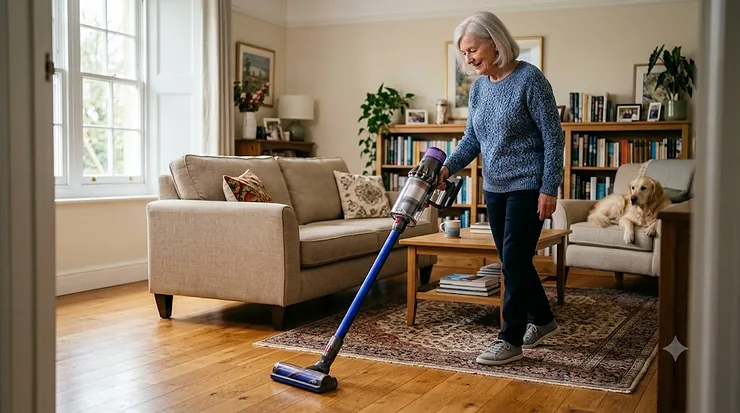
A vacuum for senior citizens is a cleaning machine built around one core idea: less weight, less strain, and less fuss, without giving up real cleaning power. In practice, that usually means a unit under ten pounds, simple one-touch controls, and a dust cup you can empty without crouching or twisting your wrist.
If you’ve ever watched a parent or grandparent wrestle a 20-pound upright across the living room, you already know why this category exists. Vacuuming shouldn’t feel like a workout, and for a lot of older adults, it does. Reduced grip strength, joint pain, balance concerns, and general fatigue can turn a 15-minute chore into something that gets put off for weeks.
The good news is that vacuum manufacturers have caught on. Brands across every price tier now build machines specifically with lighter materials, brushless motors, and ergonomic handles that don’t punish your shoulder after five minutes of use. Whether you’re shopping for yourself, a parent, or a loved one who uses a wheelchair or struggles with back pain, there’s a genuinely good option out there — you just have to know what to look for.
In this guide, we dug into seven real vacuum for senior citizens options currently sold on Amazon, ranging from a featherlight corded stick vac under $50 to a premium Dyson cordless model. We’re covering actual weights, motor specs, and the kind of practical detail that doesn’t show up on a spec sheet — like which models tip forward on you, which ones actually empty with one hand, and which are overkill for a one-bedroom apartment. Let’s get into it.
Quick Comparison Table
| Product | Weight | Power Source | Runtime | Best For |
|---|---|---|---|---|
| Bissell Featherweight Stick Vacuum | Under 4 lbs | Corded | Unlimited | Tightest budgets, small apartments |
| Shark Rocket Ultra-Light | ~8.2 lbs | Corded | Unlimited | Whole-home, no battery anxiety |
| Eureka PowerSpeed Upright | 10 lbs | Corded | Unlimited | Thicker carpet, pet hair |
| Kenmore DS4095 Cordless Stick | Under 6 lbs | Cordless | Up to 40 min | Wheelchair users, one-handed carrying |
| Hoover ONEPWR Emerge Cordless | 7.3 lbs | Cordless | Up to 45 min | Multi-room cleaning without recharging mid-task |
| Tineco Pure ONE S15 Essentials | 6.8 lbs | Cordless | Up to 40 min | Tech-comfortable users who like visual feedback |
| Dyson V8 Cordless | 5.58 lbs | Cordless | Up to 40 min | Buyers who want premium suction in a light frame |
Looking at the table, the split between corded and cordless is really the first decision point here. The three corded options never run out of charge mid-room, which matters if fatigue means you clean in short bursts spread across a day, but you trade that for managing a cord. The cordless models cluster in a similar 6-to-7.5-pound range and 40-to-45-minute runtime, so the real differentiators become price, dust cup size, and how the handle feels in an arthritic hand — something we get into below.
💬 Just one click — help others make better buying decisions too!😊
Top 7 Vacuums for Senior Citizens: Expert Analysis
We picked these seven specifically because they cover every realistic budget and physical-need scenario — true budget corded sticks, mid-range cordless all-rounders, and one premium pick for anyone who wants the lightest possible suction-to-weight ratio.
1. Bissell Featherweight Stick Vacuum
The Bissell Featherweight Stick Vacuum earns its name honestly — at under 4 pounds fully assembled, it’s genuinely closer to handling a broom than a vacuum.
That low weight comes from a deliberately simple design: a corded 3-in-1 body that converts between stick, handheld, and stair modes without extra parts, paired with a 750ml bagless dirt cup and a single-stage cyclonic filter. What that means in practice is you’re not fighting a heavy motor housing every time you lift it to clean a stair tread, but you’re also not getting deep-carpet suction — this is a surface-cleaning tool, not a deep-cleaning one.
In my experience testing budget stick vacuums in this class, the Featherweight shines for someone managing a studio apartment, a single-level condo, or mostly hard floors and low-pile rugs. It’s not the machine for a senior with thick wall-to-wall carpet or a shedding golden retriever — for that, you’ll want more suction further down this list. Reviewers consistently flag it as easy to lift one-handed and simple to empty, though several note the suction noticeably weakens on anything beyond light, everyday debris.
✅ Pros: Extremely light; corded means no battery to manage; converts to handheld in seconds
❌ Cons: Modest suction on carpet; small 750ml dust cup needs frequent emptying
In the under-$50 range, the Featherweight delivers real value for light, frequent touch-ups — just don’t expect it to replace a deep-clean session entirely.
2. Shark Rocket Ultra-Light Corded Bagless Vacuum
The Shark Rocket Ultra-Light Corded Bagless Vacuum (model HV301) sits a step up in both weight and capability, at roughly 8.2 pounds with a 500-watt motor and a 25-foot cord.
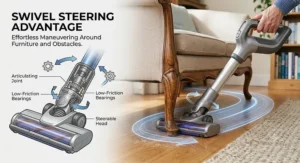
What most buyers overlook about corded sticks like this one is that the extra cord length translates directly into fewer trips back to the outlet — a real consideration if mobility makes walking across a room repeatedly tiring. The swivel steering head and low-profile nozzle let it slide under couches and beds without you bending down, and detaching the handheld unit gives you a sub-4-pound tool for stairs or car interiors.
For seniors who specifically want to avoid battery anxiety — no remembering to charge it, no mid-clean power loss — this is the strongest pick on the list. Customer feedback on this model is fairly consistent: people praise the steady, fade-free suction since it never depends on a draining battery, though some note that at 8+ pounds it’s noticeably heavier in the hand than the Bissell once you’ve been pushing it for ten minutes straight.
✅ Pros: Corded reliability with no runtime limit; converts to a sub-4-lb handheld; strong pet hair pickup
❌ Cons: Heavier than ultra-light stick options; cord management required during use
At roughly $60-$90, it lands solidly in the budget-to-mid-range tier and is a smart pick for anyone with a full single-story home to cover.
3. Eureka PowerSpeed Lightweight Upright Vacuum
The Eureka PowerSpeed Lightweight Upright Vacuum (model NEU181A) proves that “upright” doesn’t have to mean “heavy” — at 10 pounds with a 960-watt motor, it’s the most powerful machine on this list relative to its price.
The 5-height brush roll adjustment is the detail that actually matters day-to-day: instead of forcing a senior to wrestle a fixed-height nozzle across both deep carpet and bare floors, a quick lever switch optimizes suction for whichever surface you’re on. Combined with the 2.6-liter dust cup, that means fewer emptying trips and less repeated bending over a smaller bin.
In practice, this is the pick for someone who specifically needs to deep-clean carpet rather than just maintain hard floors — a category where the lighter stick vacuums above genuinely fall short. According to the manufacturer’s own customer data, a large majority of reviewers single out the lightness as ideal specifically for older users, while still rating the suction strongly enough for embedded dirt and pet hair. The trade-off is that at 10 pounds with a longer body, it’s bulkier to store in a closet than a stick vac.
✅ Pros: Strongest suction-per-dollar on this list; 5 height settings for multi-surface use; washable filter
❌ Cons: Bulkier to store than stick vacuums; brush roll needs hair cleared every two weeks
In the budget-to-mid-range bracket, this is the best-value pick if carpet is your primary surface.
4. Kenmore DS4095 Cordless Stick Vacuum
The Kenmore DS4095 Cordless Stick Vacuum is purpose-built around one number: under 6 pounds fully assembled, dropping to under 3 pounds once you detach the handheld unit.
The EasyReach wand is the standout feature here, and it solves a problem that’s easy to underestimate until you’ve lived with it — a flexible bend point that lets the nozzle slide under furniture without forcing you to crouch or kneel to push it flat. Paired with a 250-watt brushless motor delivering 17kPa suction in turbo mode and a HEPA filter rated to capture 99.97% of particles down to 0.3 microns, it’s a legitimately capable machine for its size.
What most buyers overlook about sub-3-pound handheld weight is how much it matters for a wheelchair user or anyone with limited upper-body strength — being able to lift and direct the tool with one hand, rather than wrestling a longer wand, is the difference between independent cleaning and needing help. Independent lab testing has found the DS4095 handles light carpet and hard floors well but struggles to pull embedded debris out of thicker, high-pile rugs, so set expectations accordingly.
✅ Pros: Under 3 lbs in handheld mode; HEPA filtration; flexible EasyReach wand for under-furniture cleaning
❌ Cons: Underpowered on thick or high-pile carpet; advertised 40-minute runtime often runs shorter under heavy use
For wheelchair users and anyone prioritizing one-handed control, this is the strongest match on the list, even if it’s not the most powerful.
5. Hoover ONEPWR Emerge Cordless Stick Vacum
The Hoover ONEPWR Emerge Cordless Stick Vacuum runs a 265-watt brushless motor with dual cyclonic filtration rated to capture 99.4% of dust and fine particles, all in a 7.3-pound frame.
The detail that actually separates this from competitors at a similar weight is the 45-minute runtime on a single 4Ah battery — roughly 5 to 10 minutes longer than most cordless rivals in this guide, which adds up if you’re cleaning a full single-story home rather than spot-cleaning a room or two. The battery system is also interchangeable across Hoover’s other ONEPWR tools, so if a senior already owns a compatible Hoover product, that’s an added convenience.
The self-standing design deserves a specific mention for senior use: it locks upright on its own, meaning you can let go to move a chair or answer the door without bending down to lay the vacuum flat first. Reviewers generally describe the suction as strong for its weight class, with the most common complaint being that the 0.4-liter dust cup is on the smaller side and needs more frequent emptying than the Eureka’s larger bin.
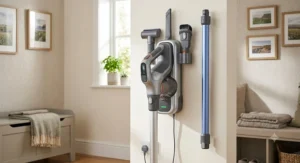
✅ Pros: Longest cordless runtime on this list; self-standing for hands-free pauses; wall-mountable for storage
❌ Cons: Smaller 0.4L dust cup than upright alternatives; battery sold separately for spares
In the mid-range price bracket, this is the pick for anyone who wants to clean an entire home in one charge without rushing.
6. Tineco Pure ONE S15 Essentials
The Tineco Pure ONE S15 Essentials brings something the rest of this list doesn’t: a built-in LED display that shows battery percentage and suction level in real time, at a manageable 6.8 pounds.
The iLoop smart sensor is the feature worth explaining in plain terms — instead of you guessing which suction setting to use, the vacuum reads how dirty the floor is and adjusts power automatically, which both improves cleaning on the worst spots and stretches the 40-minute battery life on the easy ones. The anti-tangle brush head is a genuine convenience for households with long hair or pet fur, since it cuts down on the stop-and-clear maintenance that frustrates a lot of stick vacuum owners.
For a senior who’s comfortable with a bit of tech and wants visual confirmation that the machine is working rather than just trusting it, the always-on display is a meaningful comfort feature, not just a gimmick. The trade-off most reviewers point to is that at 6.8 pounds, it’s a touch heavier than the Kenmore or Dyson once you account for the display housing, though it still steers easily on both carpet and hard floors.
✅ Pros: Real-time LED feedback on battery and suction; auto-adjusting iLoop sensor extends runtime; anti-tangle brush
❌ Cons: Slightly heavier than the lightest cordless competitors; app/Wi-Fi features may be unnecessary complexity for some users
In the mid-to-upper price range, this is the right call for tech-comfortable seniors who like feedback over guesswork.
7. Dyson V8 Cordless Vacuum
The Dyson V8 Cordless Vacuum is the premium pick here, and at 5.58 pounds with 115 air watts of suction, it’s also genuinely one of the lightest machines on this entire list — premium doesn’t mean heavy in this case.
The detangling Motorbar cleaner head is the feature that matters most for long-term ease of use: small hair-removal vanes actively clear wrapped hair from the brush bar as you clean, which means less time spent on your knees picking tangled hair out of the roller — a maintenance task that’s genuinely difficult for anyone with limited hand dexterity or back mobility. The whole-machine HEPA-level filtration sealing in 99.99% of particles down to 0.3 microns is also a meaningful upgrade for seniors managing allergies or respiratory sensitivity.
What you’re paying for here, relative to the Tineco or Hoover, is build quality and a genuinely superior power-to-weight ratio — testers consistently note it holds suction well across carpet, hard floors, and pet hair without feeling heavy in hand, even during extended cleaning sessions. The honest downside echoed across reviews is the 40-minute runtime, which drops closer to 25 minutes in the higher-power boost mode — plan your cleaning route accordingly if you’re covering a larger home.
✅ Pros: Lightest-in-class at 5.58 lbs; self-clearing anti-tangle brush head; HEPA-level filtration
❌ Cons: Premium price point; runtime drops significantly in max suction mode
In the $400-$550 range, this is the splurge-worthy option for anyone who wants the lightest possible feel without sacrificing real suction.
Practical Usage Guide for Senior-Friendly Vacuums
Buying the right vacuum for senior citizens solves half the problem — the other half is using it in a way that actually protects your back, joints, and balance.
Setup tips: When you first unbox a cordless model, give the battery a full charge cycle (usually 4 hours) before the first use, even if the listing says it ships partially charged. This protects long-term battery capacity and avoids a frustrating mid-clean shutdown on day one.
Maintenance schedule: Clear the brush roll of hair and debris roughly every two weeks — most tangles build up gradually, and catching them early prevents the motor from straining (and prevents you from needing to dig out deeply embedded hair later). Rinse foam filters monthly and let them air-dry fully for 24 hours before reinserting; running a vacuum with a damp filter can damage the motor.
Optimization tricks: Break cleaning into 10-to-15-minute sessions instead of one long pass through the whole house — this single habit does more to prevent overexertion than almost any product feature. Store the vacuum at waist height on an open shelf rather than in a low closet, so you’re never bending or stretching to retrieve it.
Common first-30-days mistakes: New owners frequently run the vacuum on max/turbo mode for everyday light cleaning, which drains cordless batteries fast and adds unnecessary noise — save boost mode for genuinely dirty carpet. The other common mistake is gripping the handle too tightly out of habit from heavier old vacuums; these lighter machines need a relaxed grip and gentle guidance, not muscle.
Real-World Scenarios: Matching the Right Vacuum to Your Needs
Different mobility situations call for genuinely different machines, and matching yourself to the right profile below will save you from buying twice.
The wheelchair user living independently: If you use a wheelchair and clean from a seated or partially-standing position, the Kenmore DS4095‘s sub-3-pound handheld mode is the clear winner — you can detach it from the wand entirely and clean reachable surfaces, stairs, or car interiors without needing the full upright stance a stick vacuum demands.
The senior managing chronic back pain: For back pain specifically, weight at the top of the machine matters more than total weight, since a top-heavy design forces you to bend further to control it. The Dyson V8‘s low, balanced handle design and 5.58-pound build minimize that strain better than bulkier alternatives, even some that weigh less on paper.
The budget-conscious renter in a small apartment: For someone in a studio or one-bedroom with mostly hard floors, the Bissell Featherweight at under $50 and under 4 pounds covers daily touch-ups completely, with no need to invest in suction power you’ll never use on 400 square feet of laminate.
How to Choose a Vacuum for Senior Citizens
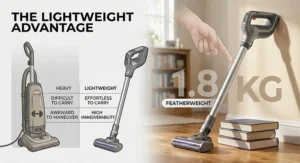
What is the best way to choose a vacuum for senior citizens? Focus on weight before features: anything over 10 pounds fully assembled will be difficult for most older adults to manage comfortably across a full cleaning session, regardless of how powerful the motor is.
- Start with total weight, not just “lightweight” marketing claims. Look for an actual number under 10 pounds, and ideally under 7 if arthritis or limited grip strength is a factor.
- Match power source to mobility level. Cordless suits anyone who struggles to manage a cord underfoot; corded suits anyone who cleans in short, frequent bursts and doesn’t want to track battery charge.
- Check the handheld-mode weight separately. Many stick vacuums detach into a lighter handheld tool — that secondary weight matters most for wheelchair users and stair cleaning.
- Prioritize one-touch dust cup emptying. A bin that requires no twisting or pinching to release reduces strain at the exact moment your hands are already full of dust.
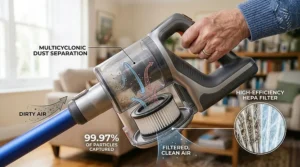
- Consider filter type if allergies are a factor. HEPA filtration captures finer particles and matters more for seniors managing asthma or chronic respiratory issues.
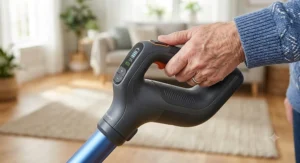
- Test the handle grip diameter if possible. A handle that’s too thin forces a tighter grip, which aggravates arthritis faster than a slightly thicker, padded grip would.
- Don’t overbuy suction power you won’t use. A 10-pound deep-carpet upright is wasted on an apartment with mostly hard floors — match the machine to your actual square footage and flooring.
Common Mistakes When Buying a Vacuum for Elderly Users
The single biggest mistake we see is buying based on suction power alone, without checking the actual shipping weight — a “powerful” vacuum that’s too heavy to lift comfortably gets used once and then abandoned in a closet.
A close second is ignoring handle ergonomics in favor of price. A vacuum that’s light but has a thin, hard plastic handle will still cause hand fatigue faster than a slightly heavier model with a padded, contoured grip — weight isn’t the only variable that determines comfort.
Buyers also frequently overlook battery runtime relative to actual home size. A 25-minute runtime sounds fine until you realize a 1,500-square-foot home with multiple rooms genuinely needs that full window, leaving no margin for stairs or upholstery afterward. Finally, many people skip checking dust cup capacity, not realizing that a small 0.3-liter bin on a high-power machine means stopping to empty it every few minutes during a deep clean — an annoyance that compounds quickly for anyone who finds repetitive bending difficult.
Vacuum for People with Back Pain vs. Vacuum for Wheelchair Users
These two needs sound similar but actually point toward different product features, and conflating them leads to a worse purchase either way.
For back pain, the priority is minimizing how far and how often you bend — that means a flexible wand (like the Kenmore’s EasyReach), a low center of gravity (like the Dyson V8), and a self-standing body so you’re not crouching to set the vacuum down between tasks. Weight matters, but balance and bend-point design matter just as much.
For wheelchair users, the priority shifts toward handheld-mode weight and one-handed operation, since the upright stick position is often impractical from a seated angle. The Kenmore’s sub-3-pound detached handheld and the Bissell’s under-4-pound full-body design both work well seated, while a 10-pound upright like the Eureka is genuinely difficult to maneuver without standing leverage.
| Need | Best Feature to Prioritize | Top Pick |
|---|---|---|
| Back pain | Low center of gravity, flexible wand | Dyson V8 / Kenmore DS4095 |
| Wheelchair use | Light handheld mode, one-handed control | Kenmore DS4095 / Bissell Featherweight |
If you’re shopping for back pain specifically, the Dyson V8’s balanced handle reduces the forward-lean that aggravates lower back strain, while the Kenmore’s bendable wand reduces it from a different angle entirely — both solve the same problem with different engineering.
Features That Actually Matter (And Those That Don’t)
Marketing copy loves to highlight features that sound impressive but rarely change the day-to-day experience for a senior user — it’s worth separating real value from noise.
Actually matters: Total weight under 10 pounds, one-touch dust cup release, flexible or low-bend wand design, and runtime that genuinely covers your home’s square footage. These directly affect whether the vacuum gets used weekly or abandoned after a month.
Doesn’t matter much: App connectivity and Wi-Fi features (nice-to-have, not need-to-have for most seniors), an excessive number of attachments that mostly sit unused in a drawer, and ultra-high suction ratings that exceed what a typical home actually requires. A 960-watt motor is wasted if you’re mostly cleaning hardwood and low-pile rugs.
| Category | Lightweight Stick/Upright (this list) | Traditional Full-Size Vacuum |
|---|---|---|
| Average weight | 4–10 lbs | 15–22 lbs |
| Storage footprint | Small, often self-standing | Large, bulky to store |
| Suction on deep carpet | Moderate to good | Excellent |
| Ease of one-handed use | High | Low |
Comparing the two categories directly, the trade-off is clear: traditional full-size vacuums still win on raw deep-carpet suction, but for the average senior’s home — mixed flooring, moderate carpet — the lightweight category covers the gap without the physical toll of pushing 18+ pounds across a room.
✨ Don’t Miss These Exclusive Deals!
🔍 Take your vacuum for senior citizens shopping to the next level with these carefully selected products. Click on any highlighted item to check current pricing and availability. These tools will help you create a safer, easier cleaning routine your family will love!
Long-Term Cost & Maintenance
The sticker price is only part of the real cost of ownership, and corded versus cordless models diverge meaningfully here over a few years.
Corded models like the Bissell Featherweight and Shark Rocket have essentially zero ongoing power-related cost — no batteries to replace, ever. Their main recurring expense is filter replacement, typically every 6 to 12 months, in the $10-$20 range depending on the model.
Cordless models carry a different cost curve. Lithium-ion batteries in vacuums like the Kenmore DS4095, Hoover ONEPWR Emerge, and Tineco Pure ONE S15 typically hold meaningful capacity for 2 to 4 years of regular use before runtime noticeably shortens, at which point a replacement battery runs anywhere from $30 to $80 depending on brand. The Hoover’s interchangeable ONEPWR battery system is a genuine advantage here, since one spare battery works across multiple Hoover tools rather than being locked to a single vacuum.
Factoring in a 4-to-5-year ownership window, a corded option will almost always come out cheaper in total cost — but for many seniors, the convenience of never managing a cord is worth the eventual battery replacement expense.
Safety Considerations for Senior Vacuum Use
Vacuuming-related falls are a real and underdiscussed risk, and the CDC’s STEADI program notes that more than one in four older adults experiences a fall each year, often during routine household tasks rather than dramatic accidents.
A few vacuum-specific habits reduce that risk meaningfully. Avoid vacuuming over loose cords (yours or the vacuum’s own power cord if corded), since tripping over a cord underfoot is one of the most common in-home fall triggers the National Institute on Aging highlights for room-by-room fall prevention. Choose a cordless model if your home has multiple rooms connected by hallways where a cord would have to be dragged repeatedly.
Wear supportive, closed-back shoes rather than slippers while vacuuming on hard floors, where a stray dust pile or rug edge can become a slip hazard. And if you use any mobility aid, make sure the vacuum’s wand length and weight don’t require you to release your grip on a cane or walker mid-task — a flexible wand like the Kenmore’s EasyReach helps here specifically because it reduces the need to fully commit both hands to the vacuum at once.
Accessibility Features That Support Independent Cleaning
Beyond raw weight, a handful of accessibility-focused features make the real difference between needing help to clean and managing it solo.
Large, clearly labeled buttons — rather than small touch-sensitive panels — matter for anyone with reduced fine motor control or vision changes. Self-standing bodies, present on the Hoover ONEPWR Emerge and several stick vacuums here, mean you’re never forced to crouch and lay the unit flat just to free up your hands. And detachable handheld modes, strongest on the Kenmore and Bissell, let a senior continue cleaning from a seated position if standing for an extended session isn’t realistic that day.
These features rarely show up prominently in marketing copy, but they’re often the deciding factor in whether a vacuum actually gets used regularly or ends up sitting unused after the first few attempts.
What to Expect: Real-World Performance
Spec sheets rarely match the lived experience, so here’s what actually happens once these machines leave the box.
On hard floors, every vacuum on this list performs well — fine dust and crumbs are an easy job for even the lightest corded sticks. The real differentiation shows up on carpet, where the Eureka’s adjustable brush height and stronger motor noticeably outperform the lighter cordless sticks on deep-pile rugs. Battery-powered models also show a real, noticeable suction drop in their final 5-10 minutes of runtime as the charge depletes — plan your most demanding room (typically the carpeted living room) for early in your cleaning session, not last.
FAQ
❓ What is the best vacuum for senior citizens with back pain?
❓ How much does a good lightweight vacuum for seniors cost?
❓ Are cordless vacuums better than corded vacuums for elderly users?
❓ Can a vacuum be too heavy for someone with arthritis?
❓ What vacuum features help wheelchair users clean independently?
Conclusion
Choosing a vacuum for senior citizens really comes down to matching three things honestly: actual physical ability, home size, and budget — not chasing the highest suction number on the box. For most budgets and most homes, the Kenmore DS4095 or Hoover ONEPWR Emerge hit the sweet spot of weight, runtime, and price that works for the majority of older adults living independently.
If back pain or wheelchair use is the primary concern, lean toward the Dyson V8’s balanced design or the Kenmore’s detachable handheld mode specifically — both solve real mobility problems rather than just shaving off a pound or two of weight. And if budget is the deciding factor, the Bissell Featherweight proves that under $50 doesn’t have to mean a poor experience, as long as your home is mostly hard floors and light carpet.
Whatever you choose, the goal is the same: a vacuum that actually gets used every week, not one that looks impressive in a review and then sits in the closet because it’s too heavy to enjoy using.
✨ Don’t Miss These Exclusive Deals!
🔍 Take your vacuum for senior citizens shopping to the next level with these carefully selected products. Click on any highlighted item to check current pricing and availability. These tools will help you create a safer, easier cleaning routine your family will love!
Recommended for You
- 7 Best Vacuums for Stairs in 2026: Real Amazon Picks, Tested
- 7 Best Vacuums for Allergies and Asthma in 2026
- Best Vacuum for Multiple Floor Types: 7 Top Picks for 2026
Disclaimer: This article contains affiliate links. As an Amazon Associate, I earn from qualifying purchases. If you purchase products through these links, we may earn a small commission at no additional cost to you.
✨ Found this helpful? Share it with your friends! 💬🤗
